LondonLife – Unveiling the Bomber Command Memorial…

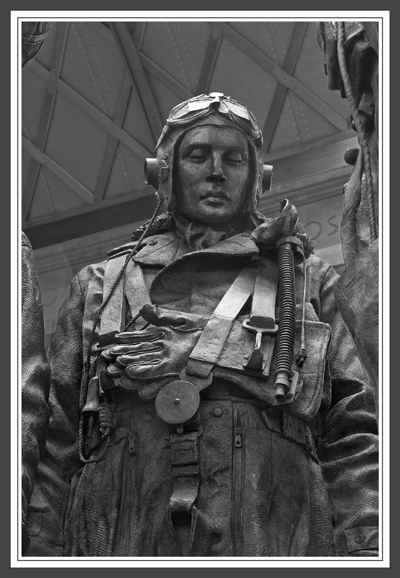
A new memorial honoring the 55,573 airmen who died while serving in Bomber Command during World War II was formally dedicated by Queen Elizabeth II in Green Park last week. At the centre of a new Portland stone pavilion, designed by architect Liam O’Connor (the architect behind the Commonwealth Memorial Gates near Buckingham Palace), is a nine foot high sculpture – the work of Philip Jackson – depicting seven aircrew from a Lancaster bomber having just returned from an operation (detail of which is pictured). The roof of the pavilion, the design of which was inspired by construction techniques used in the Vickers Wellington bomber, incorporates aluminium which was recovered from a Handley Page Halifax III bomber shot down over Belgium on the night of 12th May, 1944. The eight crew were killed during the incident and three of them were found still at their stations when the aircraft was excavated from a swamp in 1997 (they were subsequently buried with full military honors alongside the other five members of the crew). Hundreds of RAF veterans and Commonwealth airmen turned out to see the £6 million publicly funded memorial officially unveiled. The event was also marked with a flyover by five RAF Tornado bombers followed by the RAF’s last Lancaster Bomber which dropped thousands of poppies over Green Park in a message of remembrance. About 125,000 men served in Bomber Command from 1939-1945. The memorial, created following a five year campaign, commemorates people of all nations who lost their lives in the bombing campaigns of that period. For more on the memorial, see www.bombercommand.com.

PICTURE: Courtesy of Mike Legend at Flickr.

Around London – Olympic Rings unveiled on Tower Bridge; London from above; Blake on Primrose; V&A illustrations; and, Munch at the Tate Modern…

• The Olympic Rings were unveiled on Tower Bridge yesterday to mark one month until the Opening Ceremony of the 2012 Games. Each of the rings weighs three tonnes and are 25 metres wide and 11.5 metres tall. A light show featuring thousands of LED lights brings them to life at night. The rings retract when the bridge is raised. Among those at the unveiling were Lord Sebastian Coe, chairman of LOCOG, London Mayor Boris Johnson and the Culture Secretary Jeremy Hunt.

• Several hundred images of London have been included in Britain from Above, a new website launched by English Heritage and the Royal Commissions on the Ancient and Historical Monuments of Scotland and Wales. The website, which boasts more than 15,000 images taken between 1919 and 1953 includes some of the oldest and most valuable images from the Aerofilms Collection, an archive of more than a million photographs taken between 1919 and 2006. A search for London brings up 283 results, among them stunning images of Tower Bridge, The Tower of London and St Paul’s Cathedral. Users are encouraged to download images, customise their own themed photo galleries and share information to add to the knowledge behind each of the images. For more, see www.britainfromabove.org.uk.

• A quote from William Blake has been inscribed on stone on the summit of Primrose Hill, famous for its views of the London skyline. The quote – “I have conversed with the spiritual sun. I saw him on Primrose Hill” – was selected, according to Nick Biddle, The Regent’s Park manager, “because it sums up so well the experience of standing on Primrose Hill in the early morning light”. “It is always a wonderful experience,” he says. The unveiling of the inscription signalled the end to a series of improvement works on the hill. For more, see http://www.royalparks.org.uk.

• On Now: V&A Illustration Awards display. Features works by the 14 artists short-listed for the V&A’s annual illustration awards. Drawn from more than 1,000 entries the panel – fashion designer Orla Kiely, broadcaster and cultural commentator Emma Freud and Moira Gemmill, V&A director of design – selected their favorite entries in three categories – book illustration, book cover and jacket illustration – while winners of last year’s award judged a fourth category for students’ work. Runs until 31st December. Admission is free. For more, see www.vam.ac.uk/illustrationawards.

• On Now: Edvard Munch: The Modern Eye. This major exhibition at the Tate Modern reassesses the work of this Norwegian painter and aims to show how he engaged with the 20th century world, in particular his interest in the rise of modern media including photography, film and stage production. Organised in conjunction with the Centre Pompidou in Paris and the Munch Museum in Oslo, the exhibition features more than 60 paintings and 50 photographs as well as Munch’s lesser-known work in film. They include different versions of celebrated works like The Sick Child and The Girls on a Bridge as well as his last work, a self protrait. Runs until 14th October. Admission charge applies. For more, see www.tate.org.uk.

What’s in a name?…Lancaster Gate…

Now perhaps best known as a Tube station and a street and square in Bayswater, just west of the City, the name Lancaster Gate was actually first applied to a gateway located on the northern side of Kensington Gardens, close to where the ornamental water gardens known as the Italian Gardens now stand.

The gate is believed to have been named after Queen Victoria, in her capacity as the head of the Duchy of Lancaster (since the days of King Henry IV, the duchy has been the personal property of the monarch).

The nearby housing development of Lancaster Gate, centred on Christ Church followed in the mid 1800s (designed by Sancton Wood). The church closed in 1977 and was turned into housing in 1983; all that now remains architecturally are the church’s tower and spire.

Among people associated with the street is the Ethiopian Emperor Haile Selassie who resided in a hotel here at the start of World War II.

The Tube station where bears the name Lancaster Gate opened in 1900.

For more on Tube station names, try Cyril M Harris’ What’s in a Name?: Origins of Station Names on the London Underground.

Treasures of London – Duke of York’s Column…

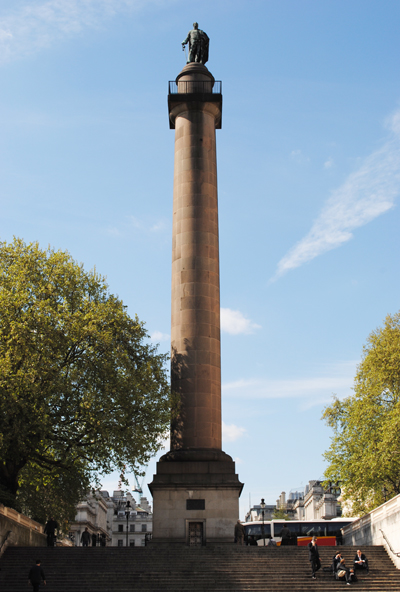
With Nelson’s Column in Trafalgar Square stealing much of the limelight, the Duke of York’s Column in Waterloo Place tends to get overlooked. So we thought it was time we took a more in-depth look at its history.

The monument is dedicated to Prince Frederick (1763-1827), the second son of King George III and commander-in-chief of the British Army during wars which were fought between France and European powers including Britain between 1792 and 1802.

The Duke was not a successful military commander on the field – his one outing in Flanders was a disaster and is said to have resulted in him being immortalised in the song, The Grand Old Duke of York – but he is celebrated for reforming the army after his return to England.

The almost 42-metre high monument  features a larger-than-life bronze statue of the Duke dressed in the robes of the Knights of the Garter – the work of Sir Richard Westmacott – standing on the top of a granite column and gazing down a series of steps and over The Mall towards St James’s Park.

The overall monument was designed by Benjamin Dean Wyatt. His design was selected by a committee from among other submissions and erected between 1830-33. While the Duke was an inveterate gambler and died deeply in debt, the British Army is said to have voted to forgo a day’s pay to fork out the £25,000 required to build the commemorative monument. It was said in jest that the height of the monument allowed the Duke to escape his creditors.

Interestingly, the hollow column contains a spiral staircase which originally gave access to a viewing platform at the top. Access was apparently prohibited after a spate of suicides.

Looking for more on statues and monuments around London – why not check out Peter Matthews’ London’s Statues and Monuments?

Around London – Trooping the Colour and Hampton Court celebrations; Park Lane sculptures; pathologist honored; Londoners at play; and, an exploration of gold…

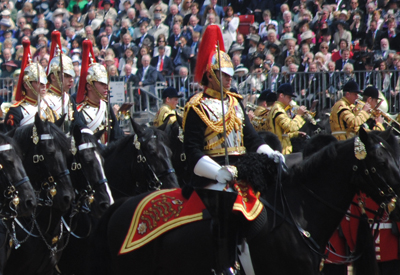
• It’s another weekend of celebration in London with events including Trooping the Colour and the Hampton Court Palace Festival taking place. With Diamond Jubilee fever in the air, expect crowds for this year’s Trooping the Color – the annual celebration of the Queen’s birthday – held at Horse Guards Parade on Saturday. The procession down The Mall kicks off at 10am  with the flypast back at Buckingham Palace at 1pm (organisers advice getting your place by 9am – for more, follow this link). The Hampton Court Palace Festival, meanwhile, kicks off today with a performance by Liza Minnelli and runs through next week until John Barrowman performs at the festival’s closing next Saturday (24th June). The festival, set against the backdrop of Hampton Court Palace, this year celebrates its 20th year – among other performers are Van Morrison, James Morrison, Frankie Valli & The Four Seasons and this Saturday (16th June) sees the holding of the 20th Anniversary Classical Gala and fireworks. For more, see http://hamptoncourtpalacefestival.com/. PICTURE: Trooping the Colour 2011.

• Park Lane’s central reservation is now hosting three new large scale sculptures by artist William Turnbull, considered a pioneer of modernism. The three works – 3×1 (1966), Large Horse (1990) and Large Blade Venus (1990) – have been installed as part of Westminster City Council’s ‘City of Sculpture’ festival. The works are on loan from the artist as well as the Yorkshire Sculpture Park and Chatsworth House, where they have been recently displayed.

• Professor Keith Simpson, a pathologist who has conducted post-mortems as part of the investigation into some of the country’s most infamous murders, has been honored with a green plaque at his former residence at 1 Weymouth Street by Wesminster City Council. The cases he worked on include the 1949 Acid Bath Murders (John George Haigh was hanged for the murder of six people in August that year) and the murder of gangster George Cornell, shot dead by Ronnie Kray in Whitechapel’s Blind Beggar Pub in 1966. Professor Simpson, who died in 1985, worked in the field of pathology for more than 30 years, taught at Guy’s Hospital in London and was renowned as having performed more autopsies than anyone else in the world.

• Now On: Londoners at Play. This exhibition at the Getty Images Gallery in Eastcastle Street explores through images how Londoners spent their leisure time – from the 19th century through to today. The display features 57 images including an image of ‘Last Night of the Proms’ from 1956 featuring conductor Sir Malcolm Sergeant, a print taken from a glass plate negative showing Londoners cycling in Royal Parks in 1895 and a crowd watching a Punch and Judy show in Covent Garden in 1900. Admission is free. Runs until 25th August. For more, see www.gettyimagesgallery.com/Exhibitions/Default.aspx.

• Now On: Gold: Power and Allure – 4,500 Years of Gold Treasures from across Britain. This exhibition at the Goldsmith’s Hall showcases more than 400 gold items, dating from 2,500 BC through to today. Admission is free. Runs until 28th July. For more information, see www.thegoldsmiths.co.uk.

Around London – Open gardens; new gates mark St Paul’s tercentenary; a new Olympics trail; and, truces at the IWM…

• If you’re not too exhausted after last weekend’s Diamond Jubilee festivities (or if you’re looking for something a little more sedate), this Saturday and Sunday London plays host to Open Garden Squares Weekend. Among the 208 gardens to be opened this weekend is the communal garden at Number 10 Downing Street, home of Prime Minister David Cameron. Laid out in 1736, the L-shaped garden at 10 Downing Street is shared by residents of both Number 10 and Number 11, including Larry, the Downing Street cat (tickets for this garden have already been allocated via a ballot process). Among the more than 200 gardens open to the public as part of the weekend are 24 new gardens and, for the first time, the event is being supported by the National Trust (along with the usual organisers, the London Parks and Gardens Trust). Downing Street aside, other gardens open to the public include the Regent’s Park Allotment Garden, the Royal College of Physicians’ Medicinal Garden, the Kensington Roof Gardens, and the gardens at HMP Wormwood Scrubs. Tickets for the gardens are cheaper if bought online in advance of the weekend and picked up on Saturday or Sunday – it’s not too late to do so, so for tickets and more information, head to www.opensquares.org.

A new pair gates designed to mark St Paul’s Cathedral’s tercentenary were opened in Richmond Park for the first time last week. The gates, which now form part of the historic vista seen from King Henry’s Mound in Richmond Park when looking toward’s St Paul’s Cathedral, were designed by 21-year-old blacksmith Joshua De Lisle and funded through a donation from the family of family of the late environmentalist and The Ecologist magazine founder Edward Goldsmith. Called ‘The Way’, the gates stand on the fence of Sidmouth Woods, and depict oak branches. Sir Christopher Wren, designer of St Paul’s, is acknowledged through the inclusion of a wren on one of the lower branches. For more on the Royal Parks, see www.royalparks.org.uk.

• Now On: Winning at the ancient Games. The British Museum is celebrating the London Olympics with a victory trail bringing together 12 “star objects” in its collection, united by the theme of winning. The ‘stops’ on the trail include a classical Greek statue of a winning charioteer on special loan from Sicily, a previously never exhibited mosaic showing Hercules, the legendary founder of the ancient Games, and the 2012 Olympic Medals. The trail is free. For more information, see www.britishmuseum.org.

Now On: Build the TruceDrawing on the idea of truce that was implemented during the ancient Olympic Games to allow athletes from Greece’s warring cities to compete, this new display at the Imperial War Museum features films, interviews and insights collected during a project investigating the concepts of truce, conflict and resolution and their relevance in the 21st  century. Highlights include excerpts of interviews with former IRA prisoner Seanna Walsh and former UDA prisoner Jackie McDonald -both now involved in peace initiatives in Northern Ireland, Courtny Edwards, who worked with a health service in displaced persons’ camps following civil war in Sierra Leone; and Professor Tony Redmond, who led aid teams in Kosovo following NATO attacks in 1999. Family activities are being run in conjunction with the exhibition on selected weekends. Entry is free. Runs until 23rd September. For more, see www.iwm.org.uk.

Around London – Leicester Square reopens; RA and MOL exhibitions mark Diamond Jubilee; ‘Jed’ retires; and, the history of horses at the British Museums…

• Leicester Square officially reopened last night following a £15.3 million transformation which has seen every paving stone replaced, new plants, and 40 new water jets placed around the Grade II listed fountain and statue of William Shakespeare. The 17 month makeover also included new lighting, new seating and a refurb of the underground toilets. The square – which owes its name to Robert Sidney, the 2nd Earl of Leicester, who purchased this land in 1630 and, after building himself a mansion, kept aside part of the land for public use – now welcomes as many as 250,000 tourists a day and is known as one of the world’s premiere sites for the release of new films.

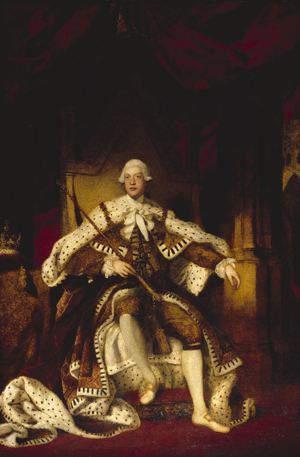
• The Royal Academy of Arts is marking the Queen’s Diamond Jubilee with a new exhibition opening tomorrow which features a selection of paintings by Royal Academicians elected during the early part of the Queen’s reign. The Queen’s Artists will include works by Jean Cooke, Frederick Gore and Ruskin Spear and will be displayed in the Reynolds and Council Rooms. Meanwhile The Saloon will house a collection of sculptures, paintings and drawings prepared by Royal Academicians for British coins and royal seals on loan from the Royal Mint Museum. The collection includes portraits of the Queen by Edward Bawden and Sir Charles Wheeler which have never before been shown in public, and Sir Anthony Caro’s new coin design of the London 2012 Olympic Games. Over in the Tennant Gallery, The King’s Artist’s George III’s Academy, will look at the king’s role in the foundation of the academy in 1768 and his influence in selecting the first artists. Highlights include portraits of King George III (pictured) and Queen Charlotte painted by the academy’s first president, Sir Joshua Reynolds. Admission charge applies. For more, see www.royalacademy.org.uk. PICTURE: Copyright Royal Academy of Arts, London/John Hammond.

• A new exhibition focusing on Londoners and their treasured souvenirs commemorating Queen Elizabeth II opens tomorrow at the Museum of London. At Home with the Queen features 12 photographic portraits of Londoners at home with their mementos as well as a selection of royal commemorative objects from the museum’s collection. The latter include trinkets produced for Queen Victoria’s Diamond Jubilee in 1897, official Coronation Day street decorations, Silver Jubilee paper tableware and souvenirs relating to the current Diamond Jubilee. Runs until 28th October. Admission is free. For more (including a series of events running on conjunction with the exhibition), see www.museumoflondon.org.uk.

The Royal Parks’ Shire horse, Jed, retired last week after a decade of service working in Richmond Park. The Queen presented a commemorative retirement rosette to Jed who was born in 1993 and joined the Royal Parks from Bass Brewery in Burton upon Trent almost 10 years ago. Horses have been used in Richmond Park since it was enclosed by King Charles I in 1637. The horses took a break in 1954 but the Shires were reintroduced in 1993 as a way to sustainably manage the parkland. For more on Richmond Park, see www.royalparks.org.uk/parks/richmond-park.

On Now: The horse: from Arabia to Royal Ascot. This major free exhibition at the British Museum is part of the august institution’s Diamond Jubilee celebrations and traces the history of the horse from domestication around 3,500 BC through to present day, with a particular focus on Britain’s equestrian tradition, from the introduction of the Arabian breed in the 18th century to events like Royal Ascot. Highlights include one of the earliest known depictions of horse and rider – a terracotta mould found in Mesopotamia dating from around 2000 to 1800 BC, a cylinder seal of Darius dating from 522 to 486 BC depicting the king hunting lions in a chariot, a 14th century Furusiyya manuscript, an Arabian manual of horsemanship, and the 19th century Abbas Pasha manuscript, the primary source of information about the lineage of purebred Arabian horses acquired by Abbas Pasha (mid-nineteenth century viceroy of Egypt). The exhibition is being held in Room 35. Runs until 30th September. For more, see www.britishmuseum.org.

Celebrating the Diamond Jubilee with 10 royal London locations – 6. The Mall…

For many Londoners, an opportunity to see the Queen means heading to Buckingham Palace to watch her wave from the balcony – or standing in the Mall to watch as her carriage goes by.

Given that, we thought we’d take the time to have a quick look at the history of The Mall, an important player in events like the annual Trooping the Colour.

This one kilometre long grand processional route which links Trafalgar Square to Buckingham Palace, was originally cut through St James’s Park in 1660 when King Charles II was looking for a new paille-maille pitch (see our earlier entry on Pall Mall for more on this). Two long avenues of trees were planted on either side, giving it a leafy feel that’s still in evidence today.

The Mall had become notorious by the 18th century and was spruced up in 1911 under the eye of Sir Aston Webb (who also designed other elements in the area including a new facade for Buckingham Palace, the Queen Victoria Memorial in front of the palace, and Admiralty Arch at the western end of the route) to become the grand avenue, complete with red-carpet like surface (this was done later), that it is today.

It is bordered by St James’s Park on the south side and on the north side is overlooked by various grand buildings – including Clarence House and the Institute of Contemporary Arts – as well as, toward the western end, Green Park.

These days the Queen publicly processes down The Mall for a number of events throughout the year – among them are the State Opening of Parliament (held earlier this month) as well as military ceremonies like Trooping the Colour and events like last year’s Royal Wedding when is it said that more than a million people were said to have filled the broad street.

The Mall is also the route along which Heads of State process in a horse drawn carriage during official visits (the road is then decorated with Union Jacks and flags of the visitor’s country). During the Olympics, it will be the start and end location of the marathons and cycling road races.

Apart from the Queen Victoria Memorial at the eastern end of The Mall, statues and monuments lining the road include the Queen Mother Memorial, a statue of explorer Captain James Cook, and a recently installed statue of cosmonaut, Yuri Gagarin.

There are apparently a series of tunnels underneath with link Buckingham Palace with Whitehall.

We should also briefly mention Horseguards, which is at The Mall’s eastern end and where Trooping the Colour and Beating Retreat takes place. This was formerly the site of a tiltyard of the Palace of Whitehall and jousting tournaments were held here during the time of King Henry VIII. It has been used for parades and ceremonies since the 17th century. While cars were parked here for much of the 20th century, this practice was stopped in the mid-1990s.

Treasures of London – Diana Memorial Fountain

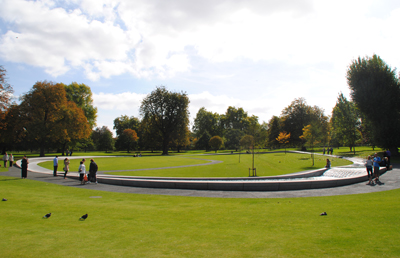
Located in Hyde Park (not far from the Lido), this memorial to Diana, Princess of Wales, is designed as a ring of water – rather like a stream bed – with two cascades tumbling down to meet in a pool at the bottom.

The fountain, which was opened by Queen Elizabeth II in July, 2004, also features three bridges which lead into the heart of the fountain – a symbol, apparently, of Diana’s openness to people.

Designed by US architect Kathryn Gustafson, the fountain – which cost £3.6 million – is made of 545 pieces of Cornish granite, each of which was shaped using laser cutting technology before being pieced together using traditional skills.

Gustafson’s design was selected after more than 10,000 plans were submitted to the Princess Diana Memorial Fountain Committee in 2002. The architect has been reported as saying she wanted the design to reflect Diana’s inclusive “personality”.

The fountain was briefly closed to the public shortly after opening in 2004 because of safety concerns but reopened with new guidelines soon after.

The fountain is located on the route for the the Diana, Princess of Wales, Memorial Walk, which takes on four of the royal parks – Kensington Gardens, Hyde Park, Green Park and St James’s Park.

Diana, whose divorce from Prince Charles had only been finalised the previous year, died in a car crash in Paris in August, 1997, along with Dodi Al Fayed.

WHERE: Hyde Park (nearest Tube stations are Knightsbridge and Hyde Park Corner); WHEN: 10am to 8pm until end of August (check website for times after that); COST: Free; WEBSITE: http://www.royalparks.org.uk/parks/hyde-park/diana-memorial-fountain

Around London – ‘Wild London’; National Trust photography contest; JK Rowling gets Freedom; and, Royal Devotion at Lambeth…

• Celebrate the Diamond Jubilee next Tuesday in Richmond Park as it hosts ‘Wild London’, the borough’s “first festival aimed at celebrating London’s woodlands, parks and gardens”. The event, which is being put on by Richmond Council and Royal Parks, will mark the Queen’s first visit to the borough in 23 years. It will showcase the conservational, recreational and inspirational role that parks and gardens play in London and will include hands-on exhibits, demonstrations, displays and performances. The event will be the first in a series celebrating the Diamond Jubilee held in Royal Parks. For more information, see www.richmond.gov.uk/home/leisure_and_culture/diamond_jubilee.htm

• The National Trust has launched a new photography competition aimed at celebrating green spaces and the life of the Trust founder Octavia Hill. The competition, called Your Space, is running in conjunction with National Trust Magazine and is open for entries until August. The competition was launched by internationally acclaimed photographers – Mary McCartney, Joe Cornish, Arnhel de Serra and Charlie Waite – with a new collection of pictures at National Trust places. One of the three Trust founder, Octavia Hill was a leading environmental campaigner in the Victorian Age and campaigned to save places in and around London like Parliament Hill. Entries in the competition, which aims to capture images of everyday green spaces, could include pictures from the local park or countryside. For details on how to enter, follow this link

• The author of the Harry Potter books, JK Rowling, received the Freedom of the City of London this week. The books have sold an estimated 450 million copies worldwide and have been made into films. The Freedom ceremony took place at Mansion House, the official residence of the Lord Mayor of London. Speaking before the ceremony on Tuesday, Rowling was quoted as saying that both her parents were Londoners. “They met on a train departing from King’s Cross Station in 1964, and while neither of them ever lived in London again, both their daughters headed straight for the capital the moment that they were independent.  To me, London is packed with personal memories, but it has never lost the aura of excitement and mystery that it had during trips to see family as a child. I am prouder than I can say to be given the Freedom of the City, which, on top of all the known benefits (and few people realize this), entitles me to a free pint in The Leaky Cauldron and a ten Galleon voucher to spend in Diagon Alley.” For more, see www.cityoflondon.gov.uk.

• On Now: Royal Devotion. This exhibition in the Great Hall of Lambeth Palace is being held to mark both the Diamond Jubilee of Queen Elizabeth II and the 350th anniversary of the revised Book of Common Prayer. The display charts the relationship between Crown and Church and its embodiment in the history of the Book of Common Prayer, one of the most important books in the English language. As well as the 1662 revision of the Book of Common Prayer, highlights include a 1549 printing of the Book of Common Prayer, medieval illuminated manuscripts, including the Book of Hours of King Richard III, Queen Elizabeth I’s personal prayer book and a copy of the book of private devotions compiled for Queen Elizabeth II in preparation for her coronation, the Book of Common Prayer used at the wedding of Queen Victoria, and King Charles I’s own handwritten revision of State Prayers. Admission fee applies. Runs until 14th July. For more, see www.lambethpalacelibrary.org/

Treasures of London – Marble Arch…

Originally installed as a grand entrance to Buckingham Palace, John Nash’s arch was moved to its current location, what is now effectively a traffic island not far from Speaker’s Corner in nearby Hyde Park, in 1851.

The story goes that this took place after it was discovered that the arch was too narrow for the widest of the new-fangled coaches but there are some doubts over this, particularly as the gold state coach passed under it during Queen Elizabeth II’s coronation in 1952. Another story says that it was moved after extensions to Buckingham Palace left insufficient space for it.

Work on the arch had started at Buckingham Palace in the mid 1820s and it was completed by 1833. It was originally moved to replace Cumberland Gate as the new entrance to Hyde Park and to complement Decimus Burton’s arch at Hyde Park Corner. Successive roadworks in the 20th century, however, left it in its current position.

Clad in Carrara marble, the design of the arch was inspired by Rome’s Arch of Constantine and the Arc do Carrousel in Paris. The sculptural ornamentation, which includes works by Sir Richard Westmacott and Edward Hodges Baily, however, was apparently never completed and an equestrian statue of King George IV, originally destined for the top of the arch, instead now stands in Trafalgar Square. The bronze gates – which bear the lion of England, cypher of King George IV and image of St George and the Dragon – were designed by Samuel Parker.

Only senior members of the Royal family and the King’s Troop Royal Horse Artillery are permitted to pass under the central arch of the monumental structure.

The arch stands close to where the Tyburn Tree once stood (for more on this, see our earlier post). It contains three small rooms which, up until the 1950s housed what has been described as “one of the smallest police stations in the world”.

There was some talk in 2005 that the arch would be moved to Speaker’s Corner but this obviously hasn’t eventuated.

Celebrating the Diamond Jubilee with 10 royal London locations – 2. The Queen’s childhood homes

Having spent the first few months of her life at 17 Bruton Street, the future Queen Elizabeth II moved into her parents’ new property at 145 Piccadilly.

The property, located close to Hyde Park Corner, was previously the townhouse of the Marquesses of Northampton (interestingly, it was while living here that her father the Duke of York first started visiting the Harley Street-based Australian speech therapist Lionel Logue, as depicted in The King’s Speech). The 25 bedroom house was later destroyed by a bomb during the war, long after the Yorks had moved out.

As well as the house at 145 Piccadilly, the young Princess Elizabeth (and from 1930 her younger sister and only sibling Princess Margaret) also lived at White Lodge in the centre of Richmond Park in the city’s south-west. The Lodge, a Georgian property built as a hunting lodge for King George II, now houses part of the Royal Ballet School.

She also considerable time outside the city, staying in places including Scotland with her grandparents at either Balmoral Castle (owned by the Royal Family) or at Glamis Castle (owned by the parents of her mother, the Earl and Countess of Strathmore) as well as, from the age of six, at Royal Lodge in Windsor Great Park, the country home of the Yorks. The princess apparently had her own small house, known as Y Bwthyn Bach (the Little Cottage), in the grounds  – a gift from the people of Wales in 1932.

Following the death of King George V and subsequent abdication of King Edward VIII in 1936, new King George VI and his family moved from 145 Piccadilly to Buckingham Palace. Following the outbreak of World War II in 1939, the princesses lived in Balmoral, Scotland, and Sandringham but spent most of the war at Windsor Castle.

Princess Elizabeth, meanwhile, had met Prince Philip of Greece during the 1930s and in 1947, he asked for permission to marry her.

Where is it? #23…

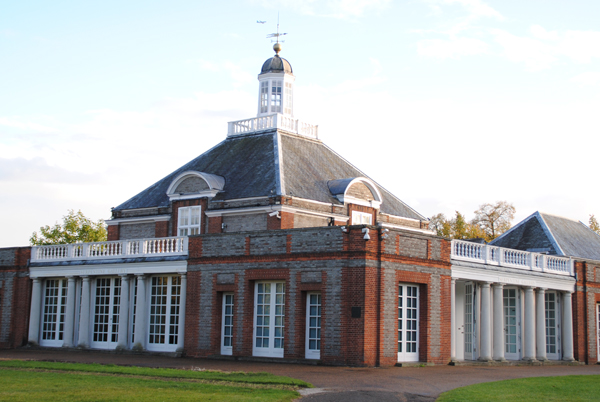
The latest in the series in which we ask you to identify where in London this picture was taken and what it’s of. If you think you can identify this picture, leave a comment below. We’ll reveal the answer early next week. Good luck!

Well done to Jameson Tucker and Sean Dennis, both of whom identified this correctly as the Serpentine Gallery in Kensington Gardens. The gallery, which features modern and contemporary art, was created in 1970 and is housed in a tea pavilion which dates from the 1930s. Every summer since the year 2000, the Serpentine – named for the body of water which, strictly speaking, just runs through Hyde Park (although the section in Kensington Gardens is also often referred to in the same way) – has had a different temporary pavilion, designed by a leading architect, set up outside.

The Serpentine Gallery is to be expanded this year with the creation of the Serpentine Sackler Gallery in The Magazine building in the gardens. Located only a short distance from the existing gallery, the new premises is being designed by Pritzker Prize-winning architect Zaha Hadid and is named after Dr Mortimer and Theresa Sackler, whose foundation made the project possible through the largest single donation ever received by the Serpentine Gallery.

WHERE: Kensington Gardens; WHEN: Daily 10am to 6pm; COST: Free; WEBSITE: www.serpentinegallery.org.

What’s in a name?…St John’s Wood

This well-to-do area in London’s north-west, just outside Regent’s Park, takes its name from the historic ownership of land here by the Order of St John of Jerusalem (also known as the Knights Hospitaller).

The land had previously been part of the Great Forest of Middlesex. The Order of St John of Jerusalem, which since 1140s had its English headquarters in a Clerkenwell priory where St John’s Gate stands (this now houses the Museum of the Order of St John – see our previous entry here), took over ownership of land in the early 1300s after the previous owners, the Knights Templar, fell into disgrace.

Following the Dissolution, it became Crown land and remained so until 1688 after which it passed into the hands of private families, notably the Eyre family who owned much of the area.

It remained relatively undeveloped until the early 19th century when, following the introduction of semi-detached villas on planned estates, it was marketed as a residential alternative for London’s middle classes, away from the smog and congestion of central London.

It became favored by the bohemian set and residents included creative types like artists and authors as well as scientists and traditional craftsmen (apparently in the late 19th century it was also known for its upmarket brothels).

Rebuilt with swanky apartment complexes in the early twentieth century, these days it remains a leafy enclave for the wealthy. Many of the houses which have survived are heritage listed.

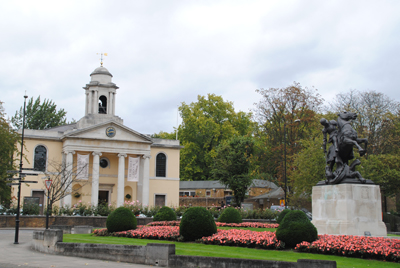
Landmarks include St John’s Church (pictured above, this was consecrated in 1814) and the St John’s Wood Barracks and a Riding School (this was completed in 1825 and is the oldest building still on the site) which is now home to the King’s Troop Royal Horse Artillery which carries out mounted ceremonial artillery duties such as firing royal salutes for the State Opening of Parliament, royal birthdays and state visits.

St John’s Wood is also home to Abbey Road Studios (home of the Beatles and that famous zebra crossing), Lord’s Cricket Ground (officially the home of the Marylebone Cricket Club which was moved here in 1814, the same year the church was consecrated) and the Central London Mosque located on the edge of Regent’s Park.

For more on St John’s Wood, take a look at the website of The St John’s Wood Society.

LondonLife – The Queen visits the newly transformed Kensington Palace…

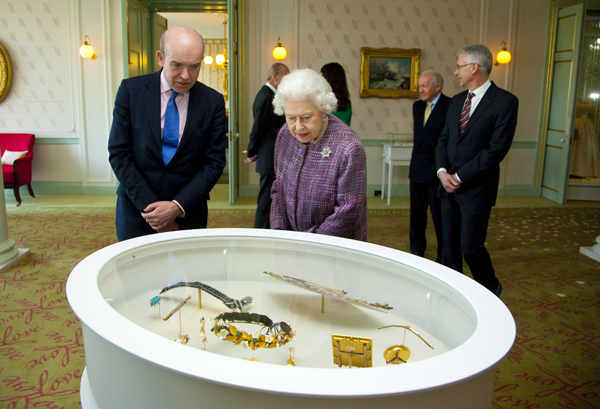
Queen Elizabeth II looks over gifts exchanged by Queen Victoria and Prince Albert in a display which forms part of the Victoria Revealed exhibition at Kensington Palace.

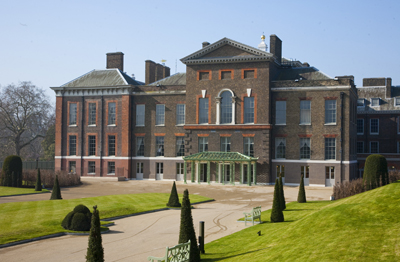
The Queen and Duke of Edinburgh visited palace last week to officially reopen the building following a £12 million, two year renovation project aimed at “transforming the visitor experience”.

The works have involved restoring the palace gardens – which will now be permanently open to the public free-of-charge – and reconnecting the palace with the surrounding parklands of Kensington Gardens partly through the provision of a new entrance. Landscape designer Todd Longstaffe-Gowan’s plan – which centres on a statue of Queen Victoria – features new lawns and avenues and a “maze-like path” inspired by 18th century “wilderness walks”.

There is also a new visitor reception area and “orientation hub” as well as a new courtyard terrace and cafe to complement The Orangery, shop and learning centre.

Victoria Revealed, a new permanent exhibition at the palace looks in intimate detail at the life of the Queen who once lived here and features everything from her black silk baby shoes to her wedding dress and the mourning clothing she wore following the death of Prince Albert as well as archive film footage showing the celebrations for the Diamond Jubilee of her reign in 1897.

The palace reopens on 26th March.

WHERE: The Broad Walk, Kensington Gardens, Kensington (nearest Tube stations are High Street Kensington or Queensway); WHEN: Daily 10am to 6pm (until 31st October); COST: £14.50 adult/£12 concession/children under 16 free (online booking discounts available, Historic Royal Palaces members free); WEBSITE: www.hrp.org.uk/KensingtonPalace.

PICTURES: Courtesy of Historic Royal Palaces/newsteam.co.uk

Around London – Family festival to celebrate Diamond Jubilee; British Library publishes world’s first detective novel; and, Closing Ceremony Celebration Concert tickets on sale Friday…

Sainsbury’s and Royal Parks have unveiled plans for a two day festival in Hyde Park – billed as the largest family festival London has ever seen – celebrating the Queen’s Diamond Jubilee over the June holiday weekend. The Jubilee Family Festival will feature live music and entertainment with one of the key highlights of each day being the finale – a 70 minute Disney concert specially created to celebrate the Jubilee. Other activities will include appearances by celebrity performers and dancer and children’s TV characters as well as equestrian events and motorcycle displays. There will also be a range of “Commonwealth-inspired” acts, food and drink supplied by Sainsbury’s and giant screens showing Jubilee-related events taking place elsewhere. There will be capacity for 50,000 ticket holders on each of the two days – Saturday, 2nd June, and Sunday, 3rd June. The event will run from 10.30am to 7pm on each day. Tickets – priced at £20 an adult/£12.50 for under 16s (children under three free) or £52 for a family of two adults and two children – go on sale at 9am tomorrow (Friday 24 February) from Ticketmaster – www.ticketmaster.co.uk or call 0844 847 1661 (+44 161 385 3211 from outside the UK) – or Seetickets –  www.seetickets.com  or call 0844 858 6760 (+44 1142 249 784 from outside the UK). In addition, from 28th March, Sainsbury’s customers who spend £60 in store will be able to enter a daily ballot for free family tickets. For more information on the festival, see www.sainsburys.co.uk/jubilee.

• The British Library has republished what many believe was the first detective novel ever published. The Notting Hill Mystery by Charles Felix was originally serialised between 1862 and 1863 in the magazine Once a Week (pictured right – image courtesy of the British Library). It was also published as a single volume in 1863, meaning it predates both Wilkie Collins’ The Moonstone (1868) and Emile Gaboriau’s first Monsieur Lecoq novel, L’Affaire Lerouge, but has not been available commercially since. The story is presented in the form of diary entries, family letters, chemical analysis reports, and interviews with witnesses as well as a crime scene map and follows an insurance investigator, Ralph Henderson, as he builds a case against the sinister Baron ‘R___’ whom he suspects of murdering his wife for life insurance. Available from the British Library bookshop – www.bl.uk/shop.

• Tickets for the BT London Live Closing Ceremony Celebration Concert go on sale tomorrow. The open air event will feature headline act Blur and will be held in Hyde Park on Sunday, 12th August, the day of the Olympic Games Closing Ceremony. Other artists performing at the concert will include The Specials and New Order, and giant screens in the park will show highlights of the Closing Ceremony. Another concert will be held in Hyde Park on Friday July 27, coinciding with the Games’ Opening Ceremony (headline acts and ticket prices will be announced shortly – BT customers will have 48 hour priority access for tickets for both concerts via www.bt.com/londonlive. Tickets for the August concert, priced at £55 (plus booking fee) go on sale at 9am on Friday via www.btlondonlive.com.

LondonLife – A blaze of autumnal colour in Green Park…

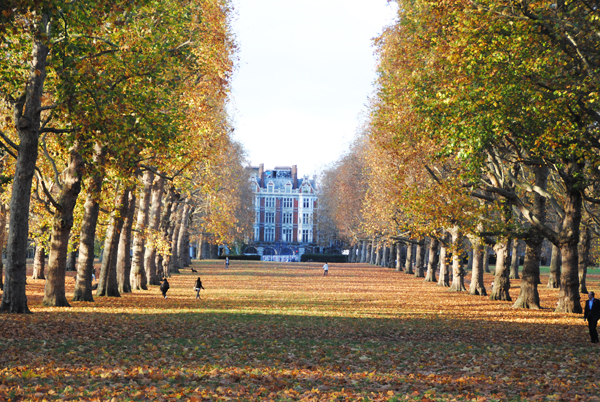
Taken from Canada Gate on the south side of The Green Park, the leaf-strewn Broad Walk runs down to Piccadilly and makes a pretty sight in the autumn sunlight. For more on The Green Park, see our previous entry here

The Royal Parks – 8. Bushy Park

And so we come to the final entry in our special series on Royal Parks – Bushy Park (Royal Parks also look after Brompton Cemetery, but given it’s not strictly a park, we’ll deal with that in an upcoming post).

Lying off the beaten track near Hampton Court in south-west London, Bushy Park’s location means it’s perhaps the least glamourous of the Royal Parks we have looked at. Yet, like the other parks, its connection with royalty goes back a long way – in this case to the time of King Henry VIII.

The park was included as part of the Hampton Court estate given to the king by Cardinal Wolsey. Henry immediately transformed what had been farmland (complete with artifical medieval rabbit warrens, the remains of which can still be seen) into a deer chase and enclosed the park with a brick wall (a section of the original wall lies on the north side of Hampton Court Road).

The character of the park was altered again in 1610 when King Charles I ordered the creation of the Longford River, a 12 mile ornamental canal designed to bring water from the River Colne in Hertfordshire to the park’s water features.

Christopher Wren had a hand in the park’s design in 1699 when he designed Chestnut Avenue – a mile long formal roadway which runs through the centre of the park. He also added the round pond at its end and placed a fountain topped with a statue in its midst.

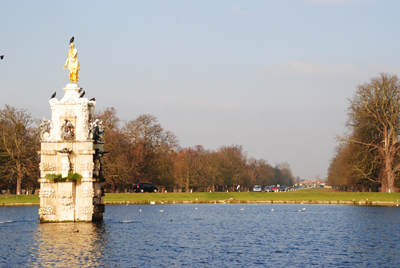
Known as the Diana Fountain after the Roman goddess of hunting, the statue (pictured above with Chestnut Avenue behind) actually represents one of Diana’s nymphs Arethusa. It was commissioned by King Charles I for his wife, Queen Henrietta Maria, and originally stood at Somerset House before Oliver Cromwell moved it to the Privy Garden at Hampton Court and Wren then moved it to its current location.

The 17th and 18th century also saw the appearance of houses at the park to be used as hunting lodges (and the ranger’s home), and gardens were added.

Worth noting here is the story of shoemaker Timothy Bennet. A resident of nearby Hampton Wick, in 1752, when an old man, he successfully fought to ensure a public right-of-way through the park after the then ranger, Lord Halifax, ordered it closed to the public. There’s a monument to him outside Hampton Wick Gate and a walking path which runs across the park at perpendicular to Chestnut Avenue is still known as Cobbler’s Walk.

More gardens were added in the 20th century including the Waterhouse and Pheasantry Plantations. Other areas include the tranquil Woodland Gardens and the Water Gardens which are comprised of a Baroque-style collection of pools, cascades, basins and the canal. There are also a series of ponds – including a pond for model boats – to the east of Chestnut Avenue.

The park saw service in both World Wars. During the first, Canadian troops were stationed there (there’s a totem pole in the Woodland Garden marking this) and other areas within the park were used for growing produce as part of the “Dig for Victory” campaign.

During the second, it was used again for food production and in 1942 became a US base and later Supreme Headquarters Allied Expeditionary Forces – the location where General Dwight Eisenhower planned Operation Overland, the reinvasion of Europe which kicked off with the D-Day landings. There are memorials concerning this connection in the park’s north-east corner.

Facilities today include the Pheasantry Welcome Centre, which opened in 2009, and includes a cafe, toilets and information. There are also sporting facilities, a small cafe near the carpark and a children’s playground.

WHERE: The park lies north of Hampton Court Palace, just west of Kingston and Hampton Wick and south of Teddington (nearest train station is Hampton Wick or Hampton Court). WHEN: 24 hours except in September and November when it’s open between 8am and 10.30pm; COST: Free; WEBSITE: www.royalparks.gov.uk/Bushy-Park.aspx

The Royal Parks – 7. Richmond Park

Covering almost 1,000 hectares, Richmond Park, located by the Thames in the city’s south-west, is the largest of the Royal Parks. We have talked about some of Richmond Park’s history in an earlier post, but here we’ll give a little more detail.

The park’s association with royalty goes back at least to the time of Edward I, who ruled in the late 13th and early 14th century, when it was part of the Manor of Sheen.

It was King Henry VIII who renamed the manor Richmond (after one he possessed in Yorkshire) but it was King Charles I to whom the park owes its existence as we know it.

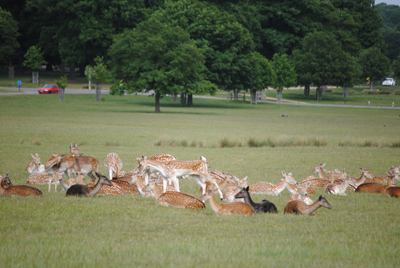
Charles, who had brought the court to Richmond in 1625 to escape the plague, enclosed the park – then farmland and pastures – in 1637 with eight miles of walls (these still remain, albeit having been repaired) and kept 2,000 red and fallow deer inside. The move didn’t met with universal approval from his subjects but he did pay compensation and eventually give people a right of way and allow them to collect firewood after complaints.

Features within the park – which still contains 650 Red and fallow deer (don’t get too close!) – include King Henry’s mound which features a protected, although tiny, view of St Paul’s Cathedral in the city 12 miles distant – it’s said by some that it was here where King Henry VIII watched for fireworks to be set off at the Tower of London indicating Anne Boleyn had been beheaded although the truth of that remains lost to history (others say it was here he watched hunting parties in the park – perhaps more likely).

The park is also home to White Lodge – it was a hunting lodge built for King George I and is now The Royal Ballet Lower School (complete with ballet museum) – and Pembroke Lodge – this house with stunning views overlooking the Thames Valley, now a restaurant, was once home to Prime Minister Lord John Russell and later the childhood home of his grandson, Nobel Prize-winning philosopher and mathematician Bertrand Russell.

More recently created is the Isabella Plantation – a woodland garden created largely in the 1950s by George Thomson , then park superintendent, his head gardener, Wally Milleron, an area once known as The Sleyt or Isabella Slade. The garden is well worth a visit at any time of year, having been specifically designed to be interesting all year round.

Richmond Park also features a lake divided in two by a causeway – as so known as Pen Ponds – which was dug in 1746 and remains a good place to see waterbirds.

WHERE: The park is located south of the Thames-side village of Richmond (nearest tube is Richmond). WHEN: 7am in summer (7.30am in winter) to dusk; COST: Free to enter; WEBSITE:www.royalparks.org.uk/parks/richmond_park/

The Royal Parks – 6. Greenwich Park

The oldest of the royal parks, the 74 hectare (183 acre) Greenwich Park has been associated with royalty since at least the 15th century.

The area covered by the park had been occupied by the Romans (there are some remains of a building, possibly a temple, near Maze Hill Gate) and later the Danes, who raised protective earthworks here in the 11th century. After the Norman Conquest, it became a manor.

Its enclosure only happened in 1433 after the land came into the possession of Humphrey of Lancaster, Duke of Gloucester and brother of King Henry V. At the time regent to the young King Henry VI, Duke Humphrey also built a tower on the heights above the park – where the Royal Observatory now stands.

Following the duke’s death in 1447, the land was seized by Margaret of Anjou – wife of King Henry VI – and subsequently became known as the Manor of Placentia. King Henry VII later rebuilt the manor house, creating what was known as Greenwich Palace or the Palace of Placentia.

Not surprisingly, it was King Henry VIII, who, having been born at Greenwich Palace, introduced deer to the park. Indeed the park was to have strong associations with others in his family – the king married Catherine of Aragorn and Anne of Cleeves at Greenwich Palace, and his daughters, later Queen Mary I and Queen Elizabeth I, were born there while his son, King Edward VI, died there in 1553 at the age of only 15. (There’s a tree in the park known as Queen Elizabeth’s Oak, which is said to be where she played as a child).

In 1613, King James I gave the palace and accompanying park – which he had enclosed with a high wall – to his wife, Queen Anne of Denmark, apparently as an apology after swearing at her in public when she accidentally shot one of his favorite dogs. Queen Anne subsequently commissioned Inigo Jones to design what is now known as the Queen’s House – for more on that, see our earlier post.

Following the Restoration, King Charles II ordered the palace rebuilt and while this work remained unfinished, the king did succeed in having the park remodelled – it is believed that Andre Le Notre, gardener to King Louis XIV of France, had a role in this.

The works included cutting a series of terraces into the slope – these were known as the Great Steps and lined with hawthorn hedges – as well as creating a formal avenue of chestnut trees (now known as Blackheath Avenue), and some woodlands. Work is currently taking place on restoring an orchard which dates from 1666 at the park.

King Charles II also commissioned Sir Christopher Wren to build the Royal Observatory that still stands on the hill overlooking the park – it stands on the site once occupied by the Duke Humphrey Tower (the Royal Observatory is home of the Prime Meridian – see our earlier post on the Royal Observatory for more).

King James II was the last monarch to use the palace and park – his daughter Queen Mary II donated the palace for use as a hospital for veteran sailors and the park was opened to the pensioners in the early 1700s. The hospital later become the Royal Naval College and the National Maritime Museum later moved onto the site (for more on this, see our earlier post).

As an aside, Royal Parks say the truncated shape of some of the trees in the park is apparently due to the fact that when anti-aircraft guns were positioned in the flower garden during World War II, the trees had to be trimmed to ensure a clear field of fire.

Facilities in the park today include a tea house, a children’s playground, sporting facilities such as tennis courts and, of course, the Wilderness Deer Park where you can see wildlife at large. Statues include that of Greenwich resident General James Wolfe, an instrumental figure in establishing British rule in Canada – it sits on the crest of the hill opposite the Royal Observatory looking down towards the Thames.

The park, which is part of the Greenwich World Heritage Site, is slated as a venue for next year’s Olympics – it will host equestrian events and the shooting and running events of the pentathlon.

WHERE: Greenwich Park (nearest DLR station is Cutty Sark – other nearby stations include Greenwich, Maze Hill and Blackheath); WHEN: 6am to at least 6pm (closing times vary depending on the month); COST: Free entry; WEBSITE: www.royalparks.gov.uk/Greenwich-Park.aspx