It’s that time of year again – our annual countdown of our 10 most read posts for the year!
First up are numbers nine and ten…
It’s that time of year again – our annual countdown of our 10 most read posts for the year!
First up are numbers nine and ten…
Before kicking off a new series, here’s a recap of our last…
3. St Edward’s Chapel, Westminster Abbey…
5. Henry VII’s Lady Chapel, Westminster Abbey…
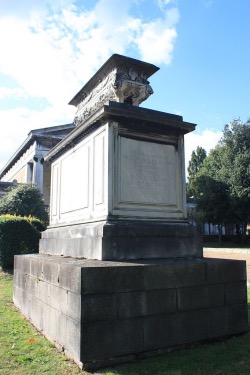
The oldest of London’s so-called ‘Magnificent Seven’ cemeteries established in the 19th century, Kensal Green is the burial place of a few members of the royal family dating from the Georgian and Victorian eras.
The ninth child and sixth son of King George III, Prince Augustus Frederick, the Duke of Sussex, died at Kensington Palace at the age of 70. In his will, he specifically requested he not have a state funeral and so was buried at Kensal Green on 4th May, 1843. His rather plain grey monument which is surrounded by concrete bollards, is located in front of the cemetery’s main chapel.
Opposite his grave is the tomb of his sister Princess Sophia, the 12th child of King George III. She, too, died at Kensington Palace – on 27th May, 1848 – and wished to be buried near her brother instead of at Windsor.
King George III’s grandson, Prince George, Duke of Cambridge, was also buried at Kensal Green. A military man (and ally of Queen Victoria), he served as commander-in-chief for 39 years before being forced to resign in 1895. He died in 1904 at Gloucester House, Piccadilly, in 1904 and was buried at Kensal Green with his wife the following day.
WHERE: Kensal Green Cemetery, Harrow Road, Queen’s Park (nearest Tube station is Kensal Green); WHEN: Monday to Saturday 9am to 5pm, Sundays 10am to 5pm; COST: Free: WEBSITE: www.kensalgreencemetery.com.
We return to Westminster Abbey for the location of yet another royal tomb – this time that of another of King Henry VIII’s wife, Anne of Cleves.

Anne, who lived in England for some 17 years after her marriage to King Henry VIII was annulled after just six months in July, 1540, died at Chelsea on 17th July, 1557, during the reign of Queen Mary I (she was the last of King Henry VIII’s wives to die).
Queen Mary ordered her funeral to be held at Westminster Abbey and she was laid to rest on the south side of the high altar. The unfinished stone monument, believed to have been the work of Theodore Haveus of Cleves, features carvings which depict her initials AC with a crown. There are also depictions of lions’ heads and skulls and crossed bones (believed to represent the idea of mortality).
An inscription on the back of the tomb was added in the 1970s. It can be viewed from the south transept and reads: “Anne of Cleves Queen of England. Born 1515. Died 1557” but this was not added until the 1970s.
HERE: Lady Chapel, Westminster Abbey (nearest Tube stations are Westminster and St James’s Park); WHEN: Times vary – see the website for details; COST: £27 adults/£24 concession/£12 children (discounts for buying online; family rates available); WEBSITE: www.westminster-abbey.org
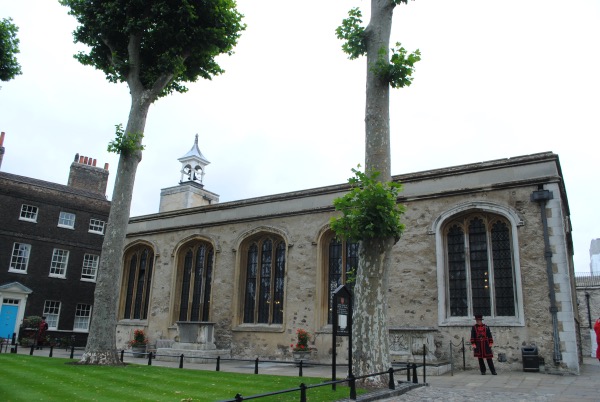
Officially the The Chapel Royal of St Peter ad Vincula, this small church is located in the Inner Ward of the Tower of London.
Under the direct jurisdiction of the monarch as a “royal peculiar”, the current building – and the name means “Peter in Chains”, a reference to St Peter’s imprisonment at the hands of King Herod – dates from 1520 and was constructed on the orders of King Henry VIII.
As well as being the burial place of officers who served at the Tower, the chapel – which is located only a few steps away from the execution site on Tower Green – is also the final resting place of many who were executed within the Tower’s precincts including the likes of Thomas Cromwell and Bishop John Fisher.
Those buried here include two of King Henry VIII’s wives who both suffered the ignominy of being beheaded. Queen Anne Boleyn and Queen Catherine Howard – respectively the second and fifth wives of the king – were both interred here after their executions.

Anne Boleyn, who was executed on 17th May, 1536, was buried under the floor in front of the high altar (along with her brother George who was executed two days before the Queen). Catherine Howard was executed several years later on 13th February, 1542, and was also buried beneath the floor.
The other royal figure buried in the Chapel was Lady Jane Grey, the “Nine Day Queen” who was executed on Tower Green on 12th February, 1554, at just the age of 17 on the orders of Queen Mary I. She was buried beneath the chapel’s altar (along with her husband, Lord Guilford Dudley, who was also executed on Tower Green).
The chapel fell into some neglect by the mid-19th century and in 1876 works were carried out under the direction of architect Anthony Salvin to restore the building. This included replacing the floor which had collapsed owing, it’s said, to the large number of burials that had taken place under it since the 16th century.
Many of the bodies were exhumed and identified, including that of Queen Anne Boleyn and Lady Jane Grey, and moved into a newly created crypt underneath.
The marble floor which was installed over the top features memorials commemorating those interred underneath. These include individual memorial stones for Henry VIII’s two Queens and a stone commemorating several of other prominent figures buried beneath including Lady Jane Grey.
WHERE: St Peter ad Vincula, Inner Ward, Tower of London (nearest Tube station Tower Hill); WHEN: 10am to 4.30pm (last admission 3.30pm), Tuesday to Saturday, 9am to 4.30pm (last admission 3.30pm) Sunday to Monday; COST: £29.90 adults; £14.90 children 5 to 15; £24 concessions (family tickets available; discounts for online purchases/memberships); WEBSITE: www.hrp.org.uk/toweroflondon/.
Located just to the east of St Edward the Confessor’s Chapel in Westminster Abbey is the lavishly ornate Lady Chapel built on the orders of King Henry VII.
Described as the “last masterpiece of English medieval architecture”, the chapel is the resting place of King Henry VII and his wife Queen Elizabeth of York.

The couple were the first to be buried in a vault under the floor rather than a tomb but still features an elaborate monument above the floor.
The monument was designed in the Renaissance style by Italian sculptor Pietro Torrigiano and features gilt bronze effigies of the King and Queen lying side-by-side above a black marble base decorated with six medallions representing the Virgin Mary and Henry’s patron saints (who included St Edward the Confessor). At either end of the base are coats of arms supported by cherubs.
A fine grille, designed by Thomas Ducheman, surrounds the monument – once gilded, it featured 30 statues in niches but only six – depicting saints – now remain. The lengthy Latin inscription written on the grille lauds King Henry as “a wise and watchful monarch, a courteous lover of virtue” among other superlatives. There are further inscriptions on the monument.
They’re not the only kings and queen’s buried in the chapel. King James I is buried in the vault under the King Henry VII’s tomb and his wife Queen Anne of Denmark is buried nearby.
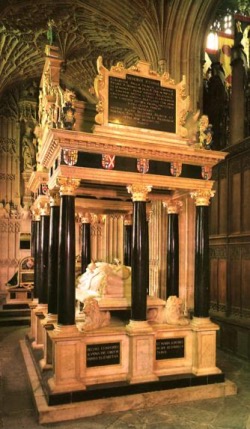
Queen Elizabeth I is buried in the chapel’s north aisle with a monument above depicting her effigy. Her coffin was placed on top of her half-sister Queen Mary I whose body had been placed there after her death in 1558. The monument was installed on the orders of King James I who, while commissioning a depiction of Queen Elizabeth, didn’t order an effigy of Mary to be made. Instead, she is commemorated with an inscription translated as “Partners both in throne and grave, here rest we two sisters, Elizabeth and Mary, in the hope of the Resurrection.”
The religious differences of the two Queens – Elizabeth being a Protestant and Mary a Catholic – are meanwhile commemorated in an inscription on the floor which reads: “Remember before God all those who divided at the Reformation by different convictions laid down their lives for Christ and conscience sake.”
Buried in a vault beneath the south aisle of the chapel – with just simple inscriptions on stones above (no monuments were erected due to the lack of space apparently – are the remains of the Stuart monarchs King Charles II, Queen Anne (and her husband Prince George), Queen Mary II and King William III.
The rather flamboyant tomb of Mary, Queen of Scots, is also in this aisle. King James I had her remains brought to the abbey from Peterborough Cathedral in 1612 and laid to rest in a marble tomb featuring an elaborate canopy and a white marble effigy at the feet of which stands a crowned Scottish lion. The eldest son of King James I, Henry Frederick, Prince of Wales, was also buried in the Queen’s vault (she was his grandmother), probably due to lack of space.
The young king Edward VI is buried beneath the floor in front of the altar and the last monarch to be buried in the abbey – King George II – lies in a vault under the central aisle along with his wife Queen Caroline and some of their children as well as other family members. On the King’s orders, the sides of the coffins of King George II and that of Queen Caroline were removed so their remains could mingle.
Several other royals – including Princess Mary of Orange, eldest daughter of Charles I and Henrietta Maria, and Prince Rupert of the Rhine – are also buried in the chapel.
HERE: Lady Chapel, Westminster Abbey (nearest Tube stations are Westminster and St James’s Park); WHEN: Times vary – see the website for details; COST: £27 adults/£24 concession/£12 children (discounts for buying online; family rates available); WEBSITE: www.westminster-abbey.org
We’ll return to Westminster Abbey shortly but first we’re heading into the City of London.
Christ Church Greyfriars, also known as Christ Church Newgate Street, was the burial site of several queens in the medieval era.
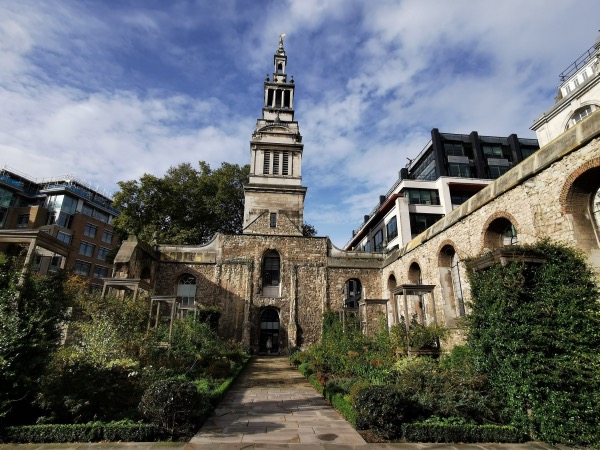
These include the second wife of King Edward I, Queen Marguerite, who partly financed construction of the church which commenced in the 1290s and finished well after her death in the 1360s.
Marguerite, who was the first uncrowned queen since the Norman Conquest (apparently due to the expense), was only 26 when she was widowed in 1307 (having married the king in 1299 when he was at least 40 years her senior).
She died on 14th February, 1318, while at her castle at Marlborough but her remains were brought to London where she was buried in Greyfriars wearing a Francisan habit. Her tomb, sadly, was destroyed during the Reformation.
Also buried in Greyfriars was Queen Isabella, the widow (and adversary) of the ill-fated King Edward II. Isabella, who was also known as the ‘She-wolf of France’, is said to have been buried in the clothes she wore at her wedding to the King 50 years earlier. Despite rumours to the contrary, her lover, Roger Mortimer, was not buried with her (although Isabella’s daughter – Joan of the Tower, who was the wife of King David II of Scotland – was).
While their predecessor as Queen, Eleanor of Provence, wife of King Henry III, was buried at Amesbury Priory in Wiltshire where she had died (the grave is unmarked), her heart was brought to London and buried in Greyfriars.
Others buried in the church include King Henry III and Eleanor’s daughter, Beatrice of England, and King Edward III’s daughter Isabella, Countess of Bedford.
There’s not much left of Greyfriars these days – the medieval church, one of the largest then in London, burned in the Great Fire of London of 1666 and following a rebuild under Sir Christopher Wren’s supervision, it was again all but destroyed during the Blitz in World War II.
It was decided not to rebuild and what remained of the church – some of the outer walls and tower – were designated a Grade I-listed building in 1950. Plantings inside are laid out to resemble the pews of the church in plan.
WHERE: Christ Church Greyfriars, King Edward Street (nearest Tube station is St Paul’s); WHEN: Anytime; COST: Free; WEBSITE: www.cityoflondon.gov.uk/things-to-do/city-gardens/find-a-garden/christchurch-greyfriars-church-garden
This chapel at the heart of Westminster Abbey is so named for the first king that was buried there – St Edward “the Confessor” – in early 1066.
The abbey, which had been constructed on the site of a Saxon Church at the behest of King Edward in fulfilment of a vow, was newly built when the King died. It had been consecrated on 28th December, 1065, but the king had been too ill to attend the service.
He died just a few days later some time on the night of 4th to 5th January. His burial took place on 6th January (the burial procession is actually depicted in the Bayeux Tapestry) with his body laid to rest beneath the floor of the new church (archaeologists using ground-penetrating radar believe they located the exact location of his original tomb in 2005).
He wasn’t to rest there for long. King Edward’s saintly reputation grew over the ensuing years and miracles began to be reported at the tomb – it’s also said said that when the tomb was opened in 1102, a “wonderful fragrance” is said to have filled the church suggesting that it he wasn’t embalmed the body was packed with aromatic herbs.
In 1163, two years after Edward had been made saint by Pope Alexander III, the king’s body was transferred from the tomb to a specially made shrine.
In the 13th century, King Henry III rebuilt St Edward’s church in the new Gothic-style of architecture, spending extravagant sums on the new building. His rebuilding programme culminated in 1269 when the bones of St Edward was translated into a new shrine featuring mosaics on a stone base created by Italian workmen in which the king’s coffin was placed with a wooden canopy over the top (such was his veneration of St Edward that King Henry III, his brother Richard, Duke of Cornwall, and the king’s two sons bore the coffin to the new shrine).
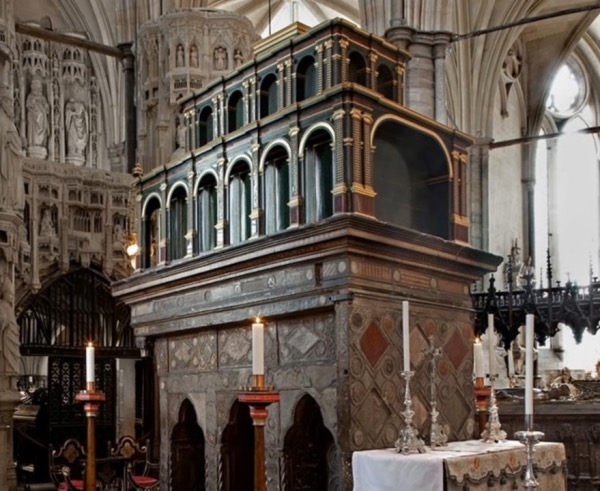
The shrine became a place of pilgrimage during King Henry III’s reign but his cult declined in the later years (and St Edward, who had for a time been considered patron saint of England was eventually replaced by St George).
The shrine was despoiled during King Henry VIII’s Dissolution of 1540 – the jewels were removed and presented to the King – and Edward’s body removed to another location in the abbey. But Queen Mary I had the Purbeck marble base reassembled (with new jewels added) and Edward’s body returned. The tiered wooden canopy which stands above the stone stone dates from the 16th century (and was heavily restored in the 1950s).
St Edward isn’t the only king buried in the chapel space. Others buried there – around the outer edges of the chapel – included King Henry III, King Edward I and his wife Eleanor of Castile, King Edward III and his wife Philippa of Hainault, King Richard II and his wife Queen Anne of Bohemia, King Henry V and Catherine of Valois (King Henry V had a chantry chapel built above his tomb at the eastern end of St Edward’s Chapel). Matilda, the wife of King Henry I, is also buried there.
WHERE: North Aisle, Westminster Abbey (nearest Tube stations are Westminster and St James’s Park); WHEN: Times vary – see the website for details; COST: £27 adults/£24 concession/£12 children (discounts for buying online; family rates available); WEBSITE: www.westminster-abbey.org
This “island church”, located in the middle of the Strand just outside the Royal Courts of Justice, is believed to have been the eventual burial site of King Harold I “Harefoot” who died in 1040.

The son of King Cnut, Harold’s rule was brief. Following the death of his father, he initially ruled as regent on behalf of his father’s heir and younger half-brother Harthacnut (Harthacnut was in Denmark and threats to the kingdom meant he couldn’t leave).
While Harold had apparently sought to be crowned king from the start of his rule (without success thanks to the opposition of Aethelnoth, the Archbishop of Canterbury), it was only in 1037 that, with the support of Leofric, the Earl of Mercia, and other nobles, he was crowned king.
But Harold (who was known by the name Harefoot apparently due to his speed and skill at hunting) died in 1040 and his brother subsequently returned from Denmark to claim the throne peacefully.
The story goes that King Harold had originally been buried in Westminster but that Harthacnut (clearly not a fan) had his body exhumed and flung into marshlands by the River Thames. The body was said to have been found by a fisherman who then had him buried at the church.
It had been established in the ninth century to serve the Danish community which was established after King Alfred the Great had granted them land.
Of course, the current church was not one King Harold would have recognised, having last been completely rebuilt in the 1680s to the designs of Sir Christopher Wren (and then having had its interior completely restored after it was gutted when bombed during World War II).
St Clement Danes, also known as one of the contenders for the church mentioned in the song Oranges and Lemons, is now the central church of the Royal Air Force. It’s one of two “island churches” in the Strand, the other being St Mary le Strand.
WHERE: St Clement Danes, Strand (nearest Tube stations are Temple, Covent Garden and Holborn); WHEN: 10am to 3:30pm weekdays; 10am to 3pm weekends; COST: Free (donations appreciated); WEBSITE: https://stclementdanesraf.org
Following the laying to rest of Queen Elizabeth II in St George’s Chapel, Windsor, we’re taking a look at where some royal burials have taken place within London.
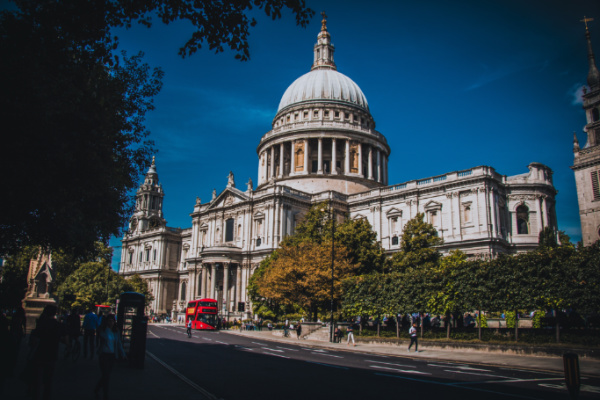
We start our new series with Old St Paul’s Cathedral which believed to have been the burial site of two Anglo-Saxon kings before it was destroyed in the Great Fire of 1666.
Aethelred (Ethelred) the Unready, who ruled from 978 until 1013 (and then again from 1014 until his death on 23rd April, 1016) was known to have been buried in the quire of the old cathedral (it’s marked on Wenceslaus Hollar’s 1658 plan of the cathedral as being on the northern side of the quire, just past the north transept) but his tomb was lost in the fire.
His memorial is among those which were lost in the Great Fire mentioned on a modern plaque in the crypt of the St Paul’s of today.
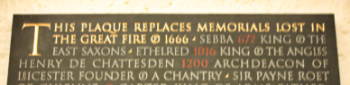
While his was the last royal burial to take place in St Paul’s, Aethelred wasn’t the only Anglo-Saxon king who was interred there.
Sæbbi, a king of the East Saxons who ruled from 664 to 694 (and is also known as Sebba or Sebbi), is also listed as being buried there (Aethelred was apparently buried close to him) and his grave also lost in the great fire.
There’s a story that when Sæbbi was about to be buried in a stone coffin, it was found it was too short for his body to lie at full length. Various solutions were proposed – including burying him with bent legs, but when they put the body back in the stone coffin this time, miraculously, it did fit.
Following an earlier fire in St Paul’s – in 1087 – Sæbbi body was transferred to a black marble sarcophagus in the mid-1100s and it’s that which was lost in the Great Fire.
Before we commence our next special series, here’s a recap of the series we’ve just run…
3. Crossbones Graveyard and Garden of Remembrance…
4. Queen Elizabeth Hall Roof Garden…
5. Tibetan Peace Garden, Imperial War Museum…
6. The Hill Garden and Pergola, Hampstead…
Located in the historic former Priory of St John of Jerusalem in Clerkenwell, this garden – despite its historic context – was planted out in the mid-1950s after the adjoining church was restored having suffered extensive damage from incendiary bombs in 1941.
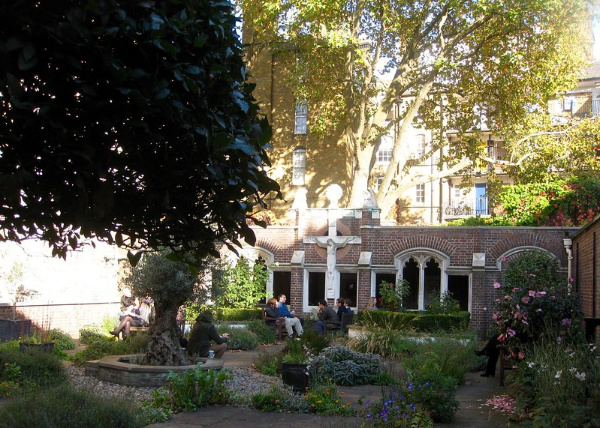
The garden, which was created on the site of two former church buildings and was designed by Alison Wear, is planted with flowers and fragrant and medicinal herbs and features a 200-year-old olive tree brought from Jerusalem.
A quiet place of reflection, it serves as a memorial to those who died in the two World Wars.
The garden, which is maintained by volunteers, was redeveloped in 2009-10 – thanks to a grant from the Heritage Lottery Fund and the Wellcome Trust – with the addition of paving and beds for planting.
Alongside being a peaceful haven for a casual visit, the garden is also these days used as an event space.
WHERE: The Cloister Garden, The Museum of the Order of St John, St John’s Gate, St John’s Lane, Clerkenwell (nearest Tube station is Farringdon); WHEN: Museum galleries and garden are open from 10am to 5pm Wednesday to Saturday; COST: Free; WEBSITE: https://museumstjohn.org.uk.
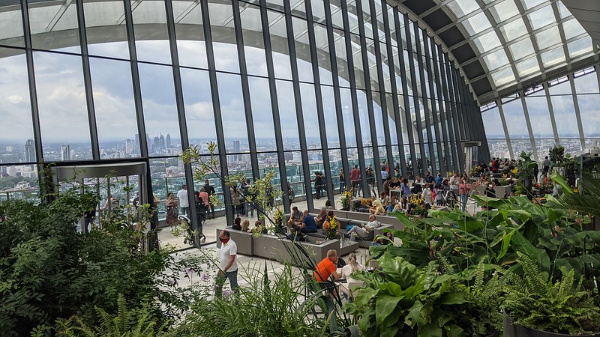
While recent years have seen the creation of a number of roof gardens across London, the Sky Garden – located atop the controversial ‘Walkie Talkie’ building (otherwise known as 20 Fenchurch Street) – has the honour of being the highest public garden in the city.
The three floor garden, which was designed by landscape architecture practice Gillespie’s, opened in January, 2015.
Located on the 36th to 38th floors, it was designed to provide 360 degree views across London and features landscaped gardens, observation decks, an open air terrace (named for the late architectural townscape advisor Francis Golding) and five bars and restaurants.
The gardens include flowering plants such as the African Lily (Agapanthus), Red Hot Poker (Kniphofia) and Bird of Paradise (Strelitzia reginae) as well as fragrant herbs such as French Lavender.
WHERE: Sky Garden (via 1 Sky Garden Walk) (nearest Tube station is Monument); WHEN: 10am to 6pm weekdays; 11am to 9pm weekends; COST: Free (but rebooking required); WEBSITE: https://skygarden.london.
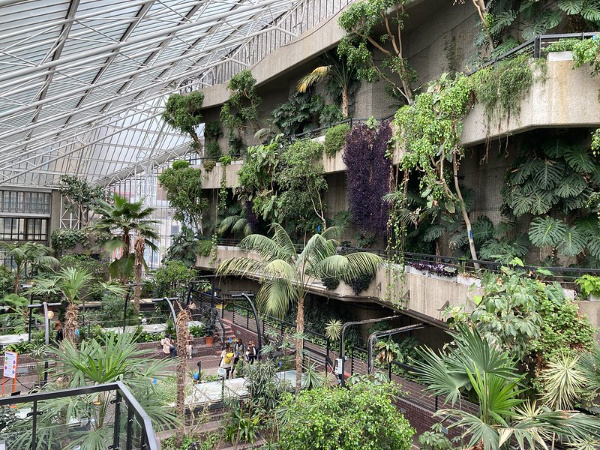
Located in the heart of the post-war Brutalist Barbican development is the second largest conservatory in London.
Designed by the complex’s architects Chamberlin, Powell and Bon, the 23,000 square foot steel and glass conservatory – only bested in size by the Princess of Wales Conservatory at Kew Gardens – was planted in the early 1980s and opened in 1984.
It now houses some 1,500 species of plants and trees from areas as diverse as the bushland of South Africa to the Brazilian coast.
Among the species on show are the tree fern and date palm as well as the Swiss cheese plant and coffee and ginger plants.
The conservatory also features pools containing koi, ghost, and grass carp from Japan and America, as well as other cold water fish such as roach, rudd, and tench and terrapins. An Arid House attached to the east of the conservatory features a collection of cacti, succulents and cymbidiums (cool house orchids).
The conservatory is just one of several distinct gardens at the Barbican complex. These include water gardens located in the midst of lake which feature a range of plants growing in the water itself as well as in a series of sunken pods which are reached by sunken walkways.
Since 1990 the estate has also been home to a wildlife garden which, boasting ponds, a meadow and orchard, is home to more than 300 species including the Lesser Stag Beetle and House Sparrow.
WHERE: The Barbican Conservatory, Barbican Centre, Silk Street (nearest Tube stations are Barbican, Farringdon and Liverpool Street; WHEN: Selected days, from 12pm (check website to book tickets); COST: Free; WEBSITE: www.barbican.org.uk/whats-on/2022/event/visit-the-conservatory.
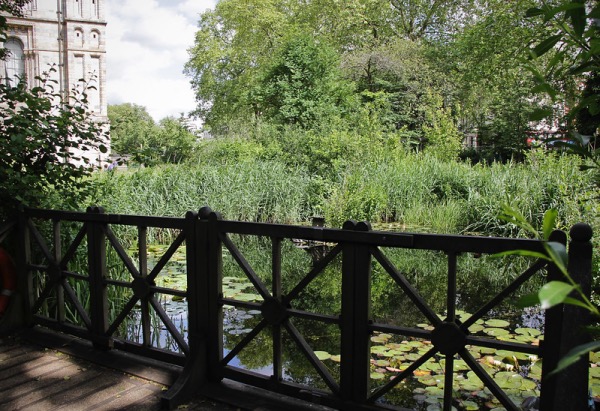
Opened in July, 1995, this garden in the grounds of the Natural History Museum in South Kensington has been found to be home to more than 3,300 species.
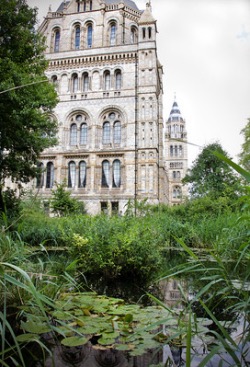
The garden, located on the corner of Cromwell Road and Queen’s Gate, and covering a single acre, was envisaged as a “place to put habitat creation and wildlife conservation into practice”, according to the museum’s website, where visitors can learn about wildlife in the UK and where naturalists, students and museum scientists carry out research.
It features a variety of habitats – everything from woodland, grassland, scrub, heath, fen, aquatic, reedbed, and hedgerow as well as urban environments – and among the species living there have been hedgehogs, common frogs, ladybirds (Rhyzobius forestieri) and Greyface Dartmoor sheep which are brought in to graze in the autumn.
‘Bioblitzes’ are held during the year by experts and amateurs which involve recording as many species of plants, animals and fungi as possible within a day.
Under the museum’s Urban Nature Project, all five acres of the grounds are being transformed into a fully accessible green space that promotes urban wildlife research, conservation and awareness and according to the museum, the Wildlife Garden will have an integral role to play in that with its overall size doubled (check before visiting to ensure it’s not closed for the renovation work). The new gardens will open next summer.
WHERE: Wildlife Garden, Natural History Museum, Cromwell Road, South Kensington (nearest Tube stations are South Kensington and Gloucester Road); WHEN: 11am to 5pm daily until 31st October (closed during wet weather); COST: Free; WEBSITE: www.nhm.ac.uk/visit/galleries-and-museum-map/wildlife-garden.html
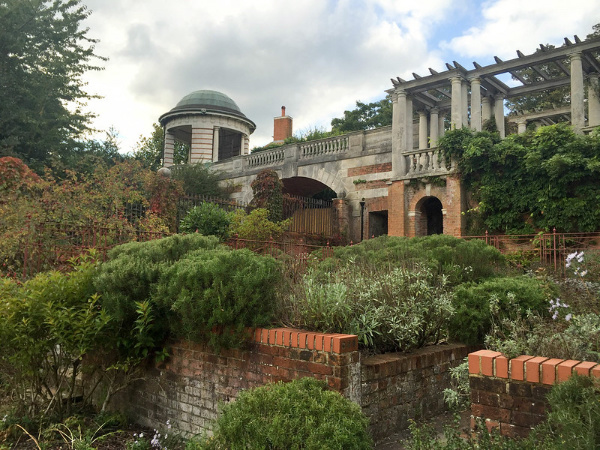
Tucked away in the north-west of Hampstead Heath is a Edwardian-era garden and extravagant pergola that were originally created for a mansion but are now open to the public.
The garden and pergola were created on the orders of the wealthy William H Lever, later Lord Leverhulme, who in 1904 purchased a sizeable Georgian townhouse on the Heath called “The Hill”. Remodelling the house extensively, Lever wanted to also create a garden where he could entertain and sought the help of renowned landscape architect Thomas Mawson to design one on what was steeply sloping land.
Mawson’s plan involved raising the level of the gardens by up to 30 feet and creating a series of terraces. This was made possible due in part to the close proximity of the Hampstead extension of the Northern Line of the Tube – Lever paid to have the spoil which had been dug out to make the Tube tunnels transported the short distance to his garden so it could be used to build it up.
An Italianate pergola was constructed on the boundary between 1905 and 1906, providing views over West Heath while at the same time preventing the general public from looking into the garden. The gardens and pergola were subsequently extended after he bought the neighbouring property in 1911 – the same year Lever was made a baronet – and again in with further works completed in 1925 just months before the now-Lord Leverhulme’s death.

The property was sold to Scots shipping magnate Lord Inverforth and, on his death in 1955, was bequeathed it to the private Manor House Hospital. Following a long period of neglect, London County Council bought the pergola and the gardens which had once been those of the neighbouring property, Heath Lodge, and opened them to the public in 1963 as the Hill Garden.
The City of London Corporation took over management with the abolition of the GLC in 1986 and restoration work was carried out. When the hospital closed in 1998 and the house was sold for luxury housing, further works were carried out and the public part of the gardens took on their current form.
WHERE: The Hill Garden and Pergola, Inverforth Close, North End Way, Hampstead (nearest Tube stations are Golders Green or Hampstead Heath); WHEN: 8:30am to 8pm daily; Daily; COST: Free; WEBSITE: www.cityoflondon.gov.uk/things-to-do/green-spaces/hampstead-heath/where-to-go-at-hampstead-heath/hill-garden-and-pergola.
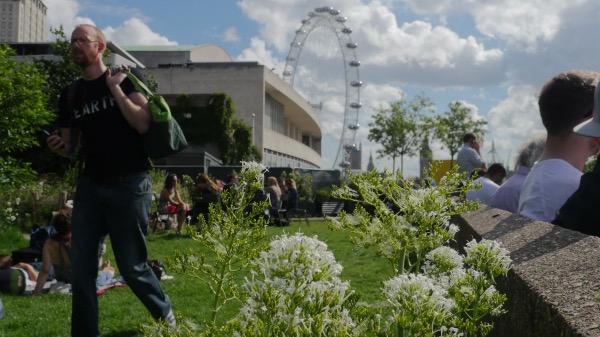
This garden can be found on the roof of the Queen Elizabeth Hall at the Southbank Centre.
The 1,200 square metre garden, which was created in 2011 as part of the 60th anniversary of the 1951 Festival of Britain celebrations, was developed in partnership with the Eden Project.
It is maintained by volunteers from Grounded Ecotherapy, a group which offers people dealing with issues like homelessness and addiction help through horticulture.
The Garden features more than 200 wild native plants as well as a lawn, paths and paving – and stunning views across the river. There’s also a cafe and bar.
WHERE: Queen Elizabeth hall Roof Garden (nearest Tube stations are Waterloo and Embankment); WHEN: Wednesday to Sunday from noon; COST: Free; WEBSITE: www.southbankcentre.co.uk/visit/outdoor/queen-elizabeth-hall-roof-garden-cafe-bar.
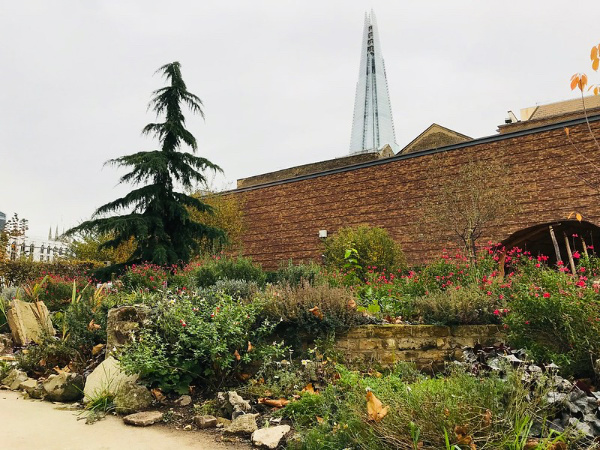
This small walled garden, located in Southwark, for centuries served as a burial site for the poor of the area nd by the time of its closing in 1853, was the location of some 15,000 burials.
The graveyard is said to have started life as an unconsecrated burial site for ‘Winchester Geese’, sex workers in the medieval period who were licensed to work in the brothels of the Liberty of the Clink by the Bishop of Winchester.
Excavations carried out in the 1990s confirmed a crowded graveyard was on the site.
While the site had been neglected for years following its closure, in 1996 local writer John Constable and a group he co-founded, the Friends of Crossbones, began a campaign to transform Crossbones into a garden of remembrance – something which has happened thanks to their efforts and those of the Bankside Open Spaces Trust and others.
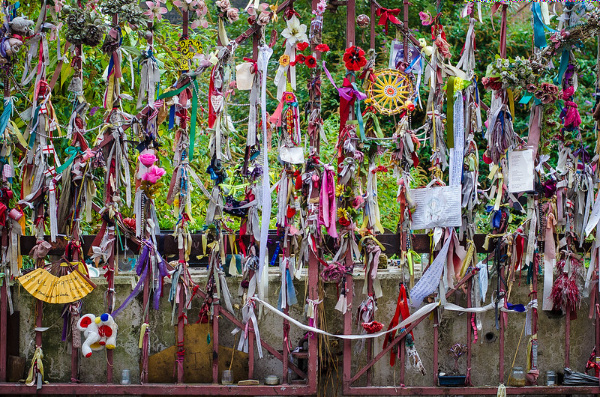
The garden provides a contemplative space for people to pay their respects to what have become known as the “outcast dead”.
A plaque, funded by Southwark Council, was installed on the gates in 2006 which records the history of the site and the efforts to create a memorial shrine.
WHERE: Crossbones Graveyard, Redcross Way, Southwark (nearest Tube stations are London Bridge and Borough); WHEN: Wednesdays, Thursdays and Fridays 12 to 2pm; COST: Free; WEBSITE: www.bost.org.uk/crossbones-graveyard.
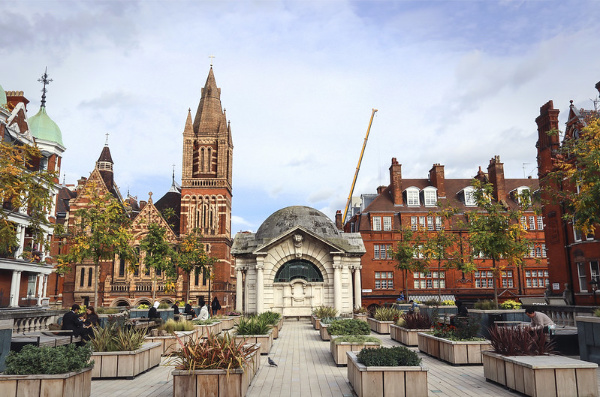
This elevated 10,000 square foot garden, located between Duke and Balderton Streets in Mayfair on the Grosvenor Estate, actually sits over the top of an electricity substation.
The now Grade II-listed substation was built in the early 20th century and the garden, which opened in 1906, was designed by Sir Charles Stanley Peach (also the designer of Wimbledon’s Centre Court) to provide some open space in what was then a working class residential area (not to mention its role disguising the substation below).
The garden replaced one which had formerly occupied the substation site and it was apparently at the insistence of the then-Duke of Westminster that the paved Italian-style garden be created following the demolition of the old garden.
It features a Portland stone domed gazebo and steps at either end.
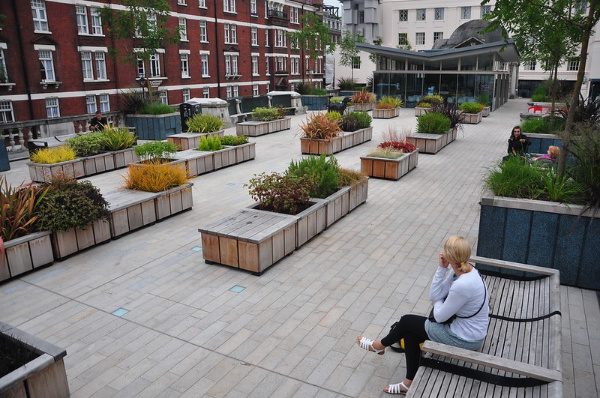
The garden deck remained open until 1980 when it was closed by the London Electricity Board. It reopened in October, 2007. A refurbishment project several years later saw the addition of a glass-walled cafe at the western end and other improvements including new planter boxes, seats and a new water feature.
The surrounding housing blocks were built in the late 19th century to replace the poor housing that had previously existed and since 1973 have been under the care of the Peabody Trust.
WHERE: Brown Hart Gardens, Duke Street, Mayfair (nearest Tube stations are Bond Street and Marble Arch); WHEN: Daily, 8am to 8pm; COST: Free; WEBSITE: www.grosvenor.com/property/property-uk/brown-hart-gardens.
The sun’s shining and it’s a good time to get outdoors so for our new special series we’re looking at 10 of London’s more unusual parks or gardens.
First up, we’re looking at a small slice of Japan in Holland Park – the Kyoto Garden.

The garden was created in the summer of 1991 as a co-operative project between the Royal Borough of Kensington and Chelsea and the Kyoto Chamber of Commerce in Japan to coincide with the 1991 Japan Festival that marked the centenary of the Anglo-Japanese Society.
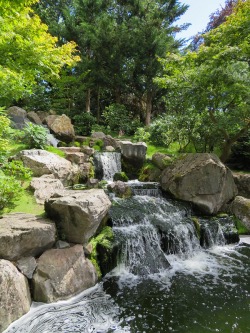
It was opened by the Prince Charles and, Naruhito, the Crown Prince of Japan, in September that year.
Designed by a renowned Japanese landscape architect Shoji Nakahara, it features a large pond complete with a tiered waterfall, a small bridge and stone lanterns. Among the plants are Japanese maple trees and Sakura trees while koi swim in the pond and peacocks roam the foliage.
The garden received a makeover in 2011.
Next to the garden is a second Japanese Garden, the Fukushima Memorial Garden, which was created in 2012 in recognition of the support the UK gave to the Prefecture of Fukushima following the 2011 tsunami.
WHERE: The Kyoto Garden, Holland Park (nearest Tube stations are Holland Park and Notting Hill Gate and nearest Overground is Kensington (Olympia)); WHEN: Daily, 7:30am until half an hour before dusk; COST: Free; WEBSITE: www.rbkc.gov.uk/leisure-and-culture/parks/holland-park.
 Exploring London