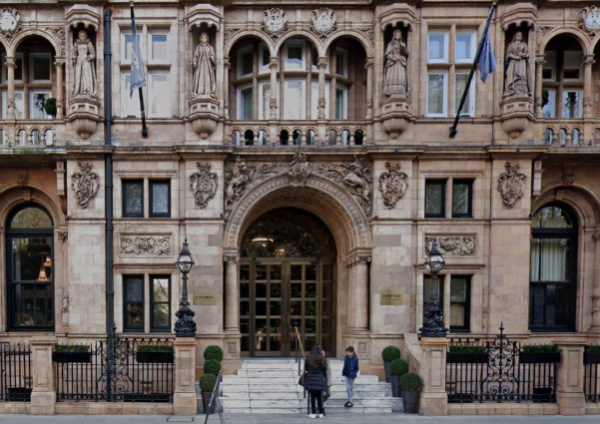
The facade of the former Hotel Russell featuring the statues of the four Queens. PICTURE: Courtesy of Google maps.
We finish our series of lesser known statues of English monarchs with a Bloomsbury building featuring four English queens.
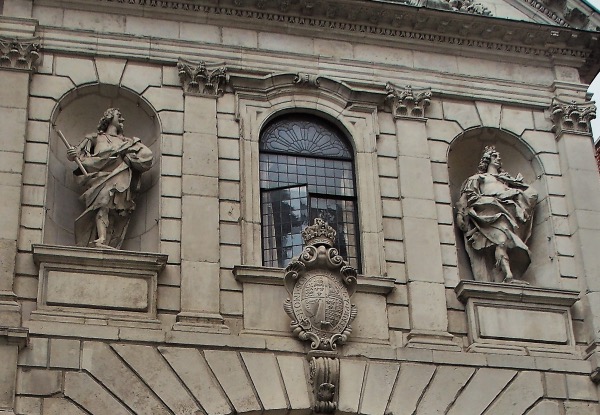
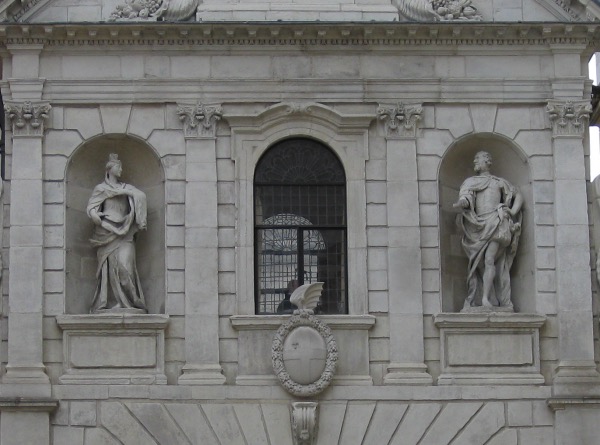
Tucked away in niches over the main entrance of the Hotel Russell – which opened in 1898, the four queens – Elizabeth I, Mary II, Anne, and Victoria – were the work of Henry Charles Fehr.
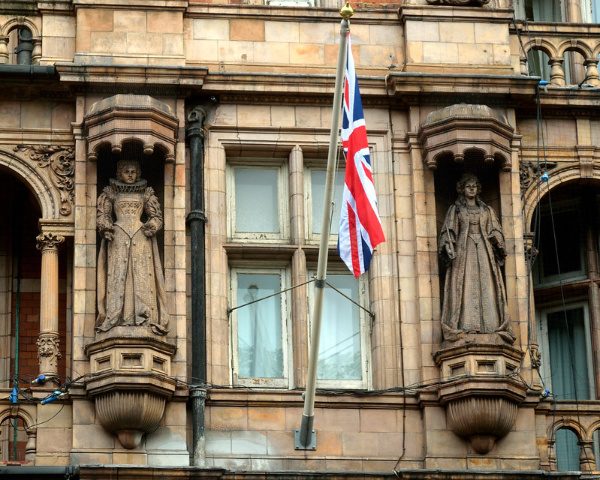
Queen Elizabeth and Queen Mary II. PICTURE: Tom Hilton (licensed under CC BY 2.0)
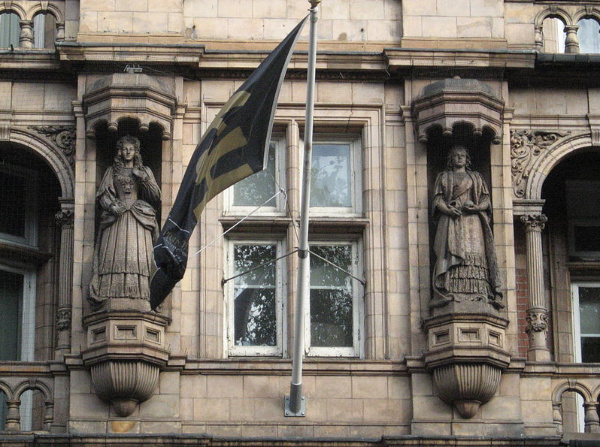
The larger than lifesize terracotta statues – which face out to Russell Square – don’t include Queen Mary I and are rather unusual and represent idealised versions of the queens. Elizabeth is readily identifiable due to the ruff she wears but there is some confusion over who’s who when it comes to Mary II and Anne. Victoria, meanwhile, is depicted as a very young woman.
Queen Anne and Queen Victoria. PICTURE: Jack1956 (Public domain)
Among other ornamentation, the building – which was designed by C Fitzroy Doll, also features the busts of four Prime Ministers – Lord Derby, Lord Salisbury, William Gladstone and Benjamin Disraeli – on the Guilford Street facade.
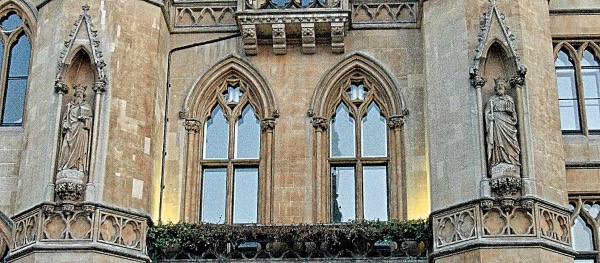
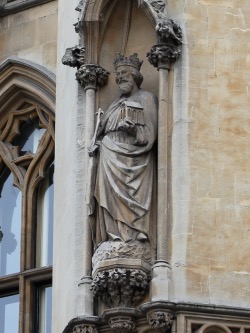
The neo-Gothic former Public Record Office (now the Maughan Library of King’s College) in Chancery Lane is adorned with statues of several kings and queens including two kings – King Edward III and King Henry III – as well as four queens.
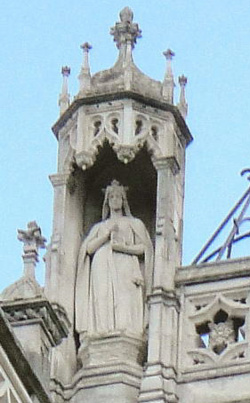
The queens, which can be found at the top of the tower over the main entrance, include three who are represented with more famous statues elsewhere – Queen Elizabeth I (on the facade of St Dunstan-in-the West), Queen Anne (outside of St Paul’s Cathedral) and Queen Victoria (outside Buckingham Palace among others).
But one of those statues – that of the Empress Matilda – is something of an outlier – unlike the others, the Empress Matilda, while she claimed the title of Queen of England, was never actually crowned (her attempt to be crowned at Westminster failed when opposed by the London mob which supported her opponent, King Stephen).
Instead, Matilda (sometimes known as Maud) claimed the title ‘Lady of the English’ and while she was eventually driven out of England to Normandy where she died, her eldest son did take the crown in 1154 as King Henry II.
The statue, which stands on top of the east side of the tower (and is quite difficult to spot), stands 2.4 metres high and was made of Portland stone to adorn the 1850s, now Grade II* listed building (the gatehouse leading to Chancery Lane – which features the two kings – was an extension in the 1890s). It is said to be the work of sculptor Joseph Durham.
What’s a little puzzling is why the Empress was included as one of the four, particularly given other English queens and monarchs – Queen Mary I and II – were not.
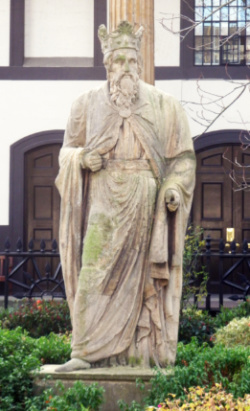
Long thought to have been London’s oldest public statue (and certainly the oldest of a monarch), this statue of Anglo-Saxon King Alfred the Great stands in a quiet location in Trinity Church Square in Southwark.
The statue prior to conservation work in 2009. PICTURE: Svitapeneela/Wikipedia
The statue – which depicts the bearded king robed and wearing a crown – was believed to have medieval origins with some suggesting it was among those which north face of Westminster Hall since the 14th century and were removed by Sir John Soane in 1825.
But recent conservation work has shown that half of the statue is actually much older. In fact, it’s believed that the lower half of the figure was recycled from a statue dedicated to the Roman goddess Minerva and is typical of the sort of work dating from the mid-second century.
Measurements of the leg of the lower half indicate the older statue stood some three metres in height, according to the Heritage of London Trust. It is made of Bath Stone and was likely carved by a stone worker located on the continent. It probably came from a temple.
The top half, meanwhile is made of Coade stone and, given that wasn’t invented by Eleanor Coade until around 1770, the creation of the statue as it appears today is obviously much later than was originally suspected which may give credence to theory that it was one of a pair – the other representing Edward the Black Prince – made for the garden of Carlton House in the late 18th century.
Putting the two parts of the statue together would have required some specialised skills.
The Grade II-listed statue has stood in the square since at least 1826. Much about who created it still remains a mystery. The fact it incorporates a much older statue means the question of whether it is in fact London’s oldest outdoor public statue remains a matter of some debate.
King Charles I (left) and his son King Charles II on what is now the south side of the gateway. PICTURE: haluk ermis (licensed under CC BY 2.0)
The equestrian statue of King Charles I at the top of Whitehall is one of London’s most well-known. But less well-known is the statue of the ill-fated King which can be found standing in a niche on the Temple Bar gateway, located at the entrance to Paternoster Square just outside of St Paul’s Cathedral.
Charles is not alone. Part of the gateway’s purpose was as a dynastic statement in support of the Stuarts so the grand portal also features statues of Charles’ father King James I, his mother Queen Anne of Denmark, and his son King Charles II. King James and Queen Anne can be found on the north side of the gateway (originally the east side) and the two Charles’ on the south side (originally the west side).
The design of the gateway, which originally stood at the intersection of Fleet Street and the Strand as a ceremonial entrance into the City of London, is believed to be the work of Sir Christopher Wren who was acting on the orders of King Charles II after the Great Fire of London.
Queen Anne of Denmark and King James I on the north side of the gateway. PICTURE: lizsmith (licensed under CC BY-NC-ND 2.0)
The statues, which cost a third of the total £1,500 spent on the gateway, are said to have been sculpted by one John Bushnell. They are depicted in Roman attire rather than the dress they would have worn during the period.
They were removed when the gateway was dismantled in 1878 and stored in a yard of Farringdon Road and when the gateway was re-erected at Lady Meux’s Hertfordshire estate at Theobold’s Park, they were placed back in their original locations. And they also accompanied the gateway back to the city when it was positioned its current location in 2004.
These two statues are listed together because they both appear on the exterior of the same building – The Sanctuary which stands next to Westminster Abbey.
This Grade II-listed building, which contains a gateway to the Dean’s Yard, was designed by Sir George Gilbert Scott and built in Bath stone with slate roofs in the mid-1850s.
The statues, which stand in niches on the exterior of the turrets on either side of the gateway, have been identified as the two kings on London Remembers.
Their position at this location is not random. The king on the left, identified as Edward the Confessor, had St Peter’s Abbey rebuilt here in the mid 11th century (and was buried in it only a week after its consecration).
The king on the right, King Henry III, rebuilt the abbey church in the mid-13th century to provide a shrine to venerate Edward the Confessor and as a site for his own tomb.
The kings are apparently not the only monarchs adorning the building – two roundels below them depict Queen Victoria and Prince Albert.
Close-up of the statue of Queen Elizabeth II. PICTURE: Close-up of the statue of Queen Elizabeth II. PICTURE: Matt Brown (licensed under CC BY 2.0)
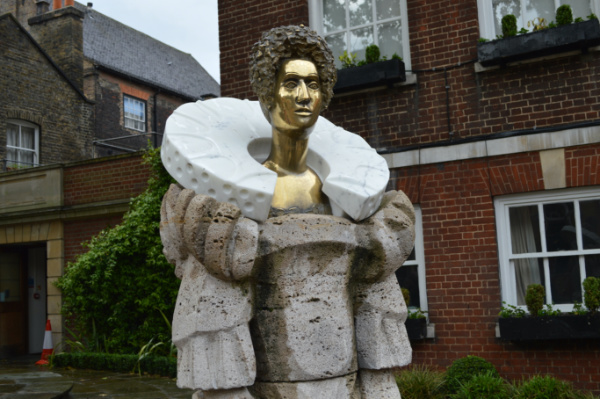
This rather unusual statue of Queen Elizabeth I is a relatively new addition – it was dedicated 12 years ago on what was the 450th anniversary of the refounding of Westminster School – more properly The Royal College of St Peter in Westminster – by the aforementioned Queen.
The larger-than-life statue, which can be found in Little Dean’s Yard, is the work of a former pupil, sculptor Matthew Spender.
It depicts the Queen in white Travertino Noce stone while her head, surrounded by a giant white ruff is gilded bronze with what was auburn hair. The unusual depiction has certainly attracted its share of detractors.
The statue, which was commissioned by the Westminster School Society, was unveiled by the Queen’s namesake, Queen Elizabeth II, on 21st May, 2010.
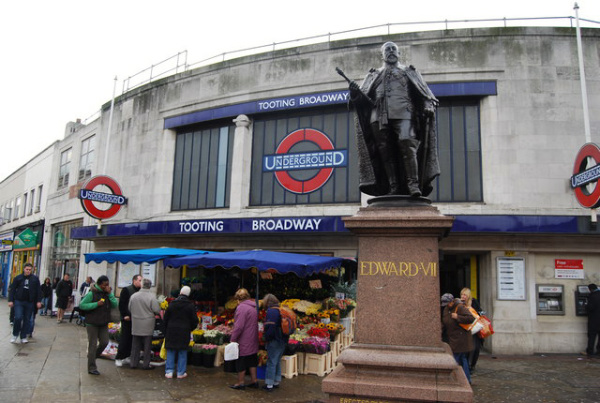
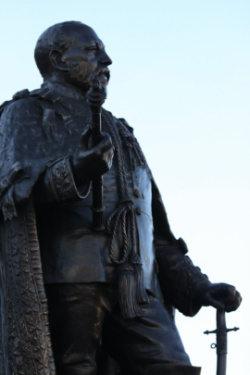
It’s a rather incongruous place for a king. Standing outside the entrance to Tooting Broadway Underground Station is a large-than-life statue of King Edward VII, who ruled from 1901-1910.
Erected in 1911 after the King’s death, the statue is the work of Louis Fritz Roselieb (later Roslyn) and was funded through a public subscription.
The statue depicts the King in royal regalia holding a sceptre in his right hand with his left hand resting on his sword hilt. The plinth features bronze reliefs on either side depicting representations of ‘peace’ and ‘charity’.
Given Tooting Broadway Underground Station didn’t open until 1926, the statue wasn’t initially located in relation to it.
In fact, it was originally located on a traffic island a short distance from its current siting but was moved after the area was remodelled in 1994.
It isn’t, of course the only statue of King Edward VII in London – the more well known one can be found in Waterloo Place. It was unveiled by his son, King George V, in 1921.
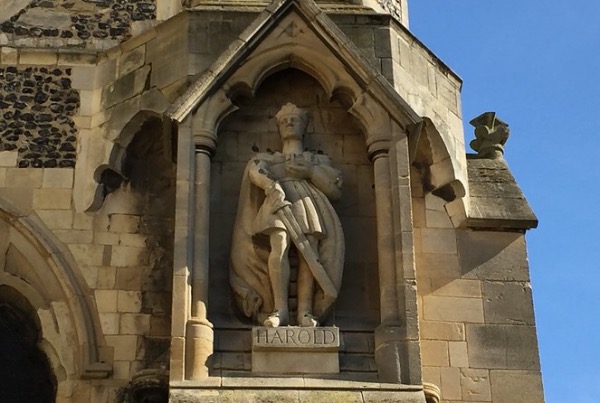
Depicting the last crowned Anglo-Saxon king who famously died at the Battle of Hastings, this statue is located in a niche on the exterior of Waltham Abbey Church on the north-eastern outskirts of Greater London.
The life-sized statue was the work of Canadian-born, Dorset-based, sculptor Elizabeth Muntz and was erected in the 1960s.
King Harold, also known as King Harold II, not only rebuilt the abbey church (apparently after he was healed of paralysis on a pilgrimage to Waltham), the abbey is also a possible site for his grave.
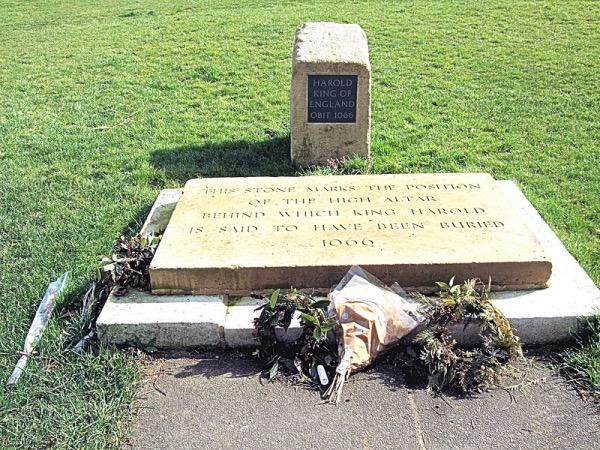
The grave is marked by a memorial stone now located in the churchyard which was erected in 1960. The inscription says the stone marks the position of the former church’s high altar. King Harold is said to have been buried behind this in 1066 after he was killed, according to tradition, by a well-aimed arrow to the eye at the Battle of Hastings (the church was rebuilt in the 12th century which explains why the altar is now located outside).
There are alternate theories for his burial place including in Bosham, West Sussex.
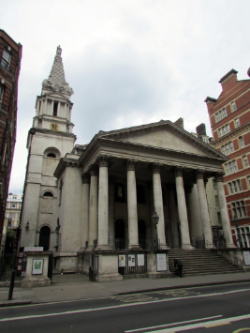
St George’s Bloomsbury with its stepped pyramid spire. PICTURE: Reading Tom (licensed under CC BY 2.0)
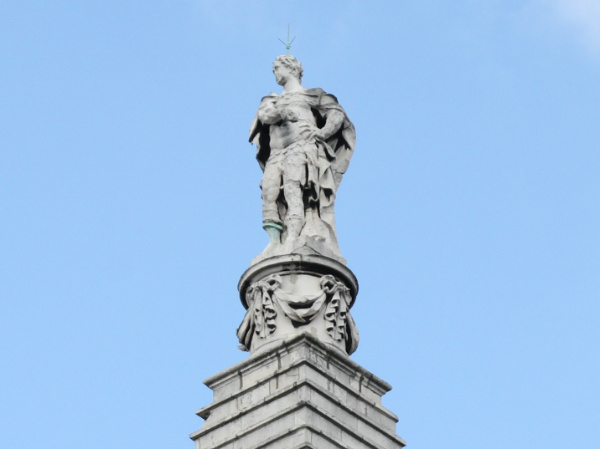
The larger-than-life-sized Portland stone statue is the work of Edward Strong who was master mason on the building of the church. It depicts the king in Roman costume standing atop a Roman altar.
The steeple, described as the “most eccentric” in London, also features statues of two unicorns and two lions at its base – both symbols of the Royal Coat of Arms of the UK – the lions representing England and the unicorns Scotland – and included apparently as a comment on Hanoverian succession. These were also originally the work of Strong but the originals disappeared in the 1870s and those now present are replicas which themselves recently underwent a restoration.
The stepped pyramid spire is said to have been influenced by Pliny the Elder’s description of Mausoleum at Halicarnassus.
Horace Walpole famously referred to the statue of King George in verse:
When Henry VIII left the Pope in the lurch, The Protestants made him the head of the church, But George’s good subjects, the Bloomsbury people Instead of the church, made him head of the steeple.
In honour of Queen Elizabeth II’s Platinum Jubilee, we have a new series looking at 10 lesser known statues of previous monarchs in London.
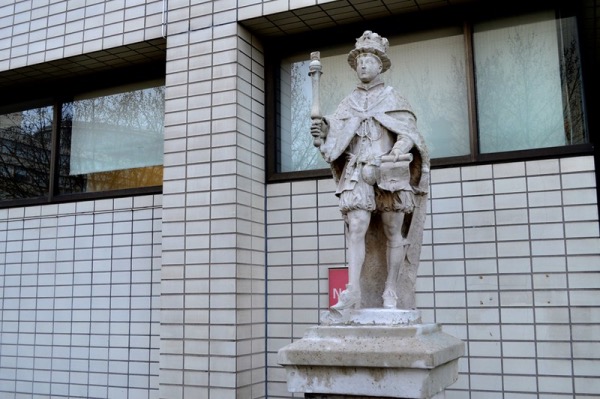
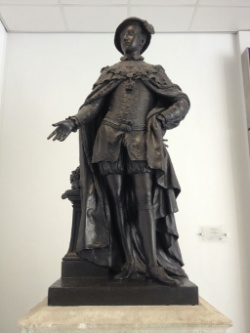
We kick off with not one, but actually two, statues of King Edward VI, the son of King Henry VIII and his third queen, Jane Seymour, can be found at St Thomas Hospital in Southwark.
Both of the statues were commissioned to commemorate the king’s re-founding of the hospital – which had been first founded in the 12th century and had been closed in 1540 as part of the Dissolution – in 1551 and which saw the complete rebuilding of the hospital under the stewardship of the hospital’s President, Sir Robert Clayton.
The oldest of the statues, now located outside the north entrance to the hospital’s North Wing on Lambeth Palace Road, was designed by Nathaniel Hanwell and carved from Purbeck limestone by Thomas Cartwright in 1682.
Peter Scheemakers’ bronze of King Edward VI. PICTURE: Secretlondon (licensed under CC BY-SA 3.0)
It originally was part of a group – the King standing at the centre holding his raised sceptre surrounded by four figures which were innovative in that they depicted patients of the time – which adorned the gateway to the hospital on Borough High Street.
It was moved when the gate was widened in around 1720 and subsequently occupied several different positions – including spending some time in storage – before eventually, without the surrounding figures, being moved to its current position in 1976. It was designated a Grade II* monument in 1979.
The second of the two statues is a bronze figure in period dress which was created by sculptor Peter Scheemakers in 1737.
It can now be found inside the hospital’s North Wing, having been moved there last century, and like its counterpart, was designated a Grade II* monument in 1979.
The inscription on the front of the plinth describes the King as “a most excellent prince of exemplary piety and wisdom above his years, the glory and ornament of his age and most munificent founder of this hospital” and adds that the statue was erected at the expense of Charles Joye, Treasurer of the hospital.
We close our series of historic London stairs with a stairway that has raised its share of controversy in recent years, largely due to the plaques associated with it.
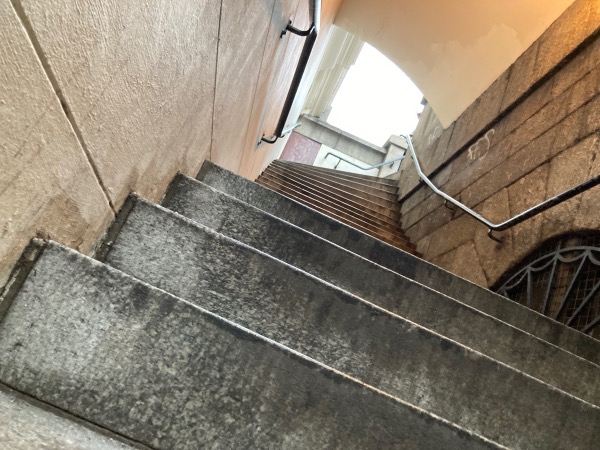
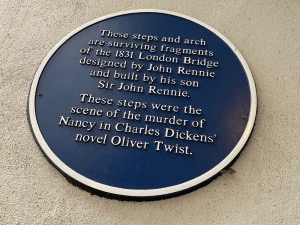
The steps, which are located in Southwark at the southern end of London Bridge and which lead down to Montague Close, are a remnant of the John Rennie-designed London Bridge which was completed in 1831 and which was replaced in the mid-20th century (and which was sold off and relocated to Lake Havasu in the US).
The controversy arises through the plaques associated with the steps which state that the steps where the scene of the murder of Nancy in Charles Dickens’ Oliver Twist. There’s a couple of problems with that claim.
The first is that Nancy wasn’t murdered here in the book – it is in their lodgings that Bill Sikes kills Nancy believing she has betrayed him. The confusion probably comes about because the musical Oliver! did set Nancy’s murder on the steps.
The bridge does, however, play a role in the book and have a connection to Nancy and its probably due to this connection that it has its name, Nancy’s Steps.
Because it was on steps located here – “on the Surrey bank, and on the same side of the bridge as Saint Saviour’s Church [now known as Southwark Cathedral]” that Nancy talks to Oliver’s benefactors while Noah Claypole eavesdropped on the conversation (which leads him reporting back to Sikes and eventually to her murder).
The second error made in the plaque is that Rennie’s bridge (and hence the steps) was completed in 1831 and with Oliver Twist published in serial form just a few years later can’t be the “ancient” bridge referred to in the text. The reference can only relate to the medieval bridge which occupied the site for hundreds of years until it was demolished following the completion of Rennie’s bridge.
The White Tower with external staircase – they’re not the stairs we’re talking about, a remnant of them is located in the niche you can see about half way up the external staircase. PICTURE: Amy-Leigh Barnard/Unsplash.
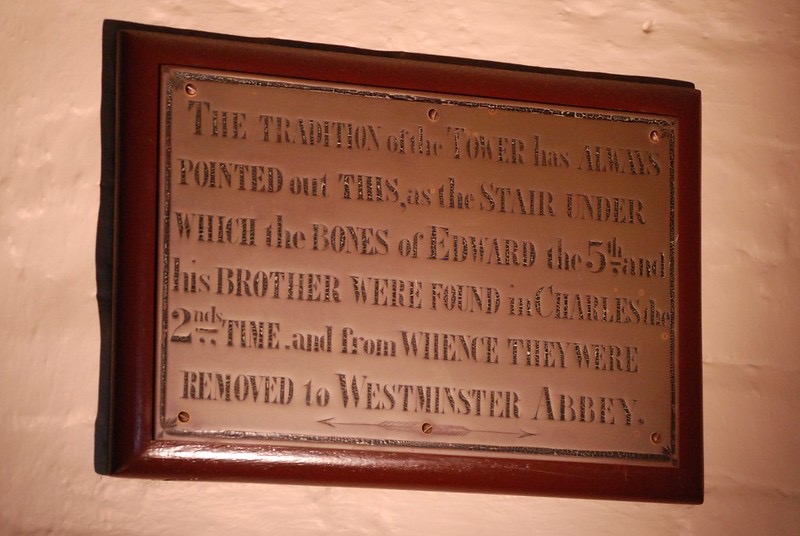
A truncated staircase – really just a few steps – located near the entrance to the White Tower is famous – or perhaps infamous is a better word – for its connection with the so-called ‘Princes in the Tower’ – the 12-year-old King Edward V and his nine-year-old brother, Richard, Duke of York, who disappeared after entering the Tower of London in the late 15th century.
While the princes are believed to have been held in the Bloody Tower, their connection with the staircase, which is located in a doorway niche halfway up the main outer stairway into the White Tower, dates to 1674.
King Charles II had ordered the demolition of what was left of the royal palace to the south of the White Tower and during those works a wooden chest containing two skeletons was discovered beneath the foundations of a staircase which had led up to St John’s Chapel.
Many have subsequently believed the skeletons to be those of the two princes.
A plaque located near the staircase remnant at the Tower of London. PICTURE: Ian McKellar (licensed under CC BY-SA 2.0)
The princes had been taken to the tower in April, 1483, following the death of their father, King Edward IV, on the 9th of that month. Their uncle, Richard, Duke of Gloucester (and the Lord Protector of his nephews), had done so, ostensibly for their protection, while Edward’s coronation was initially scheduled for June.
The last recorded reference to them being in the tower dates from 16th June when they were seen “shooting [arrows] and playing in the garden of the Tower sundry times”.
There has since been much debate over their fate with many believing Richard, who in July of that year was crowned King Richard III, had them murdered to ensure his own ascension to the throne.
The two skeletons found almost 200 years later were put on display for several years following their discovery before King Charles II ordered that they be placed in an urn and reburied in the Henry VII Chapel in Westminster Abbey. In 1933, they were disinterred and forensically examined by LE Tannery and W Wright who concluded they were the skeletons of two boys, aged 10 and 13. They were subsequently reinterred and have remained buried since. They have never been tested for DNA.
Historic Royal Palaces Chief Curator Lucy Worsley and special guests will look at the question of whether the urn should be opened and the bones tested using modern forensic methods in an online event on 16th March at 7pm. Follow this link to register for this event.
WHERE: Tower of London (nearest Tube station Tower Hill); WHEN: 9am to 4.30pm (last admission), Tuesday to Saturday, 10am to 4.30pm (last admission) Sunday to Monday; COST: £29.90 adults; £14.90 children 5 to 15; £24 concessions (family tickets available; discounts for online purchases/memberships); WEBSITE: www.hrp.org.uk/toweroflondon/.
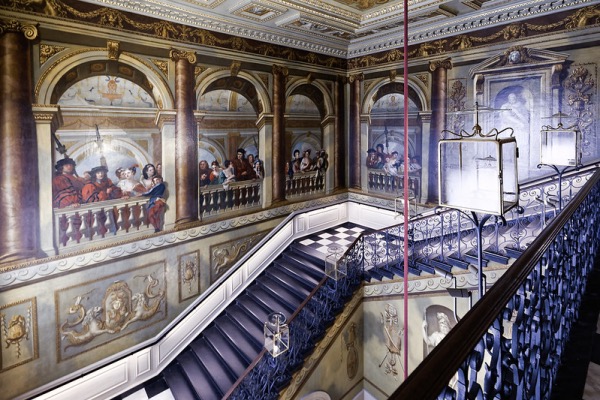
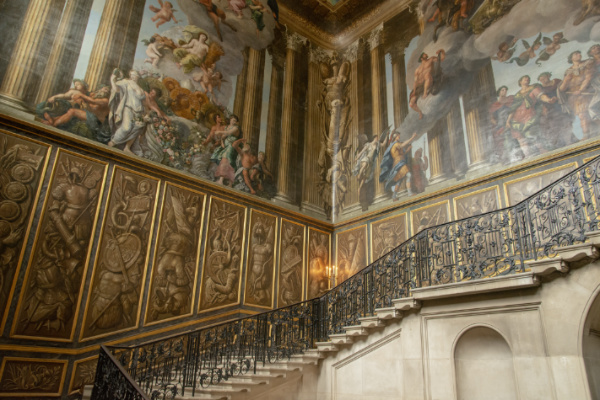
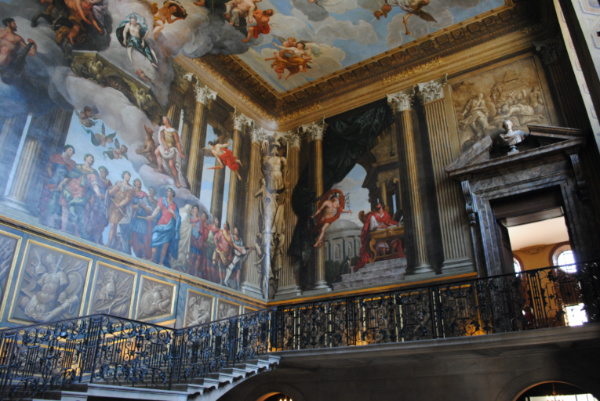
This staircase, a grand entrance to the King’s State Apartments at Kensington Palace, are famous for the paintings on the walls and ceiling which depict an 18th century court looking down on those who ascend.
The work of William Kent, the staircase paintings were complete in 1724 and replaced earlier wooden panelling.
The stairs were originally constructed as part of Sir Christopher Wren’s remodelling Nottingham House into Kensington Palace for King William III and Queen Mary II. Following a fire in 1691, they were rebuilt in marble.
There are 45 people in Kent’s painting and only about a dozen have been identified. As well as members of the Yeomen of the Guard, the images depict King George I’s Polish page Ulric, his Turkish servants Mahomet and Mustapha, Peter the ‘wild boy’, a child found in the woods in Germany, and Dr John Arbuthnot, a medical doctor and satirist who tried to teach Peter to speak.
Interestingly, Kent included a selfie on the ceiling – a depiction of himself, wearing a brown turban and carrying an artist’s palette, standing with his mistress by his side.
The trompe l’oeil (a technique which creates the optical illusion of 3D) work features architecture inspired by Rome where Kent had trained while there’s also a painted figure of Diana on the top landing which is based on an antique statue at Holkham Hall in Norfolk.
In 1734, Queen Caroline commissioned Kent to rework the stairs to the Queen’s State Apartments. His work there features a Roman-inspired scene again created as a trompe l’oeil. There is also a homage to Queen who is compared to Britannia. The staircase’s balustrade was another by Huguenot ironworker Jean Tijou.
WHERE: The Broad Walk, Kensington Gardens, Kensington (nearest tube stations are High Street Kensington or Queensway); WHEN: Daily 10am to 6pm (last admission 5pm); COST: £16 adult/£12.80 concession/£8 child (Historic Royal Palaces members free); WEBSITE: www.hrp.org.uk/KensingtonPalace.
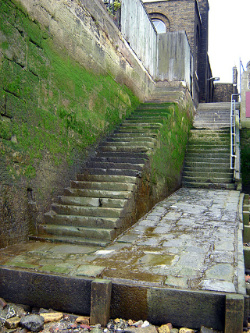
This Thames-side set of stairs gives access to the River Thames from Wapping High Street and is one of few survivors of what was once numerous “watermen’s stairs”.
The Grade II-listed stairs, which are accessed from the top via a narrow passage bearing their names which runs down the side of the Town of Ramsgate pub, were once used to reach boats to carry passengers across the Thames or offload cargo.
The worn stone stairs at Wapping Old Stairs, which the Historic England says may be of earlier origin than the 18th century, are unusual in that there’s two sets of stairs – one set back behind the other.
Many believe the stairs were the location of Execution Dock, where pirates, smugglers and mutineers were executed by hanging including the notorious Captain William Kidd (but there are alternate theories about where the stairs were located).
Other surviving watermen’s stairs go by the names of Alderman Stairs, Pelican Stairs and King Henry’s Stairs (also known as Execution Dock Stairs, thanks to its being another site posited as the location of Execution Dock.)
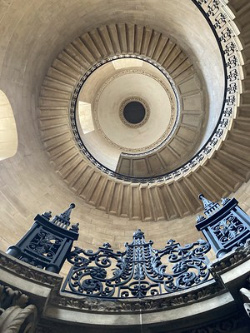
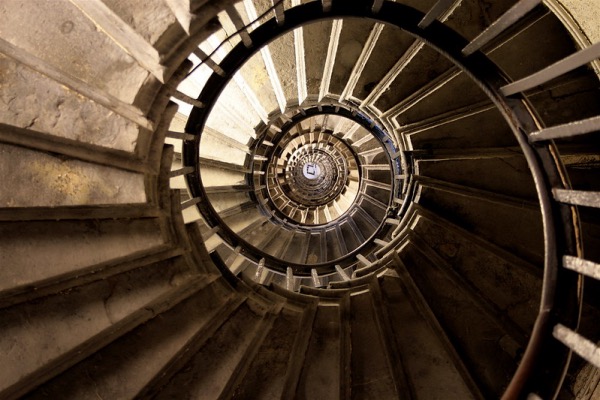
Known more formally as the Dean’s Staircase, this spiral staircase was designed by none other than Sir Christopher Wren and provides access to the triforium in St Paul’s Cathedral.
The staircase – each step of which is embedded into the wall – was built between 1675 and 1710 in the cathedral’s south-west tower by William Kempster. The ironwork is by famed French metal worker Jean Tijou.
Located in the south-west bell tower, the stair’s 88 Portland stone steps rise some 50 feet.
The staircase, which can be seen on the cathedral’s guided tours including triforium tours, has become famous in recent years thanks to its appearance in the 2004 Harry Potter film, The Prisoner of Azkaban, as well as Guy Ritchie’s 2009 film Sherlock Holmes.
The staircase has also been the site of art installations including Antony Gormley’s Flare II – which featured a falling figure within a cloud of wire.
WHERE: St Paul’s Cathedral (nearest Tube stations are St Paul’s, Mansion House and Blackfriars); WHEN: 8.30am to 4.30pm Monday to Saturday; COST: £21 adults/£18.50 concessions/£9 children/£36 family (these are walk-up rates – online advanced and group rates are discounted); WEBSITE: www.stpauls.co.uk (for tours, head to www.stpauls.co.uk/visits/visits/guided-tours)
This grand staircase was installed in Hampton Court Palace during the reign of King William III and Queen Mary II as a grand entrance to the King’s Apartments.
The staircase, which features shallow steps, was designed Sir Christopher Wren and features a wrought iron balustrade designed by French ironsmith Jean Tijou.
Another view of the staircase and accompanying art. PICTURE: David Adams
It was decorated in about 1700 by Italian painter Antonio Verrio to resemble a Roman courtyard which is open to the sky. The main image depicts ‘Victory of Alexander over the Caesars’ which features King William III as Alexander the Great and is painted as an allegory of William’s triumph over the Stuart King, James II, in the Glorious Revolution of 1688 (with the Stuarts represented by the 12 Caesars).
The stairs lead up to the Guard Chamber, an anteroom which had to be passed through to reach the Presence Chamber.
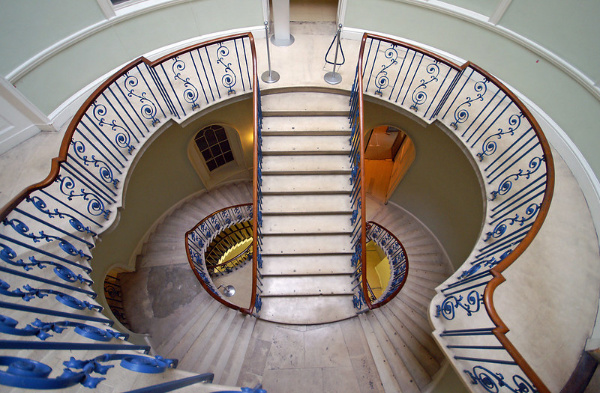
Located in Somerset House, this grand rotunda stairway rises up through the building to the Navy Board Rooms.
The present five storey stair is a replica of what was there up until the original suffered significant damage in The Blitz during World War II. It was rebuilt in the early 1950s under the supervision of Sir Alfred Richardson using original plans which had been kept safe in Sir John Soane’s House in Lincoln’s Inn Fields.
The architecturally interesting stair, which is located in the South Wing, was originally built in the late 18th century to the designs of Sir William Chambers with each flight a different configuration to the one underneath (the design was apparently made to reflect something of the stairs on ships).
It was initially known as the Navy Stair but renamed the Nelson Stair, ostensibly in honour of the heroic Vice-Admiral Horatio Nelson.
It’s not the only historic stair of note in Somerset House. The cube-like Stamp Stair, also located in the South Wing, is so-named for the stamping of newspapers that once took place here. Meanwhile, the Miles Stair, designed by Eva Jiricna Architects and named for Gwyn Miles, former director of the Somerset House Trust, is a stunning contemporary addition featuring a steel-mesh newel and a transparent balustrade.
Somerset House, Strand (nearest Tube stations are Temple and Charing Cross): WHEN: Daily (check website for times); COST: Free (but charges for exhibitions); WEBSITE: www.somersethouse.org.uk.
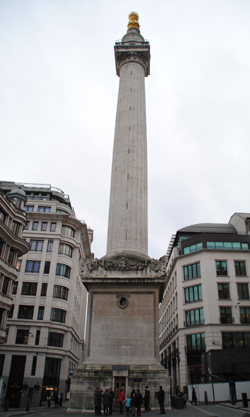
Running up the centre of the tallest free-standing stone column in the world, this 311 step stairway takes the visitor straight to the top of the Monument erected to commemorate the Great Fire of 1666.
The Monument
The Monument – actually a Doric column – was built close to Pudding Lane in the City – where the fire is believed to have started – between 1671 and 1677. It was designed by Sir Christopher Wren in collaboration with City Surveyor Sir Robert Hooke.
The cantilevered stairway – each step of which measures exactly six inches high – leads up to a viewing platform which provides panoramic views of the City. Above the platform stands is a large sculpture featuring a stone drum topped with a gilt copper urn from which flames emerge as a symbol of the fire (King Charles II apparently squashed the idea of an equestrian statue of himself lest people think he was responsible for the fire).
Interestingly, the circular space in the centre of the stairway was designed for use as a zenith telescope (a telescope which points straight up). There is a small hatch right at the top which can be opened up to reveal the sky beyond and a subterranean lab below (reached through a hatch in the floor of the ticket both) where it was envisaged the scientist could take measurements using a special eyepiece (two lenses would be set into the actual telescope). But it wasn’t successful (reasons for this could have been vibrations caused by passing traffic or the movement of the column in the wind).
Hooke also apparently attempted to use the staircase drop for some other experiences – including measuring differences in air pressure.
Among those who have climbed the stairs was writer James Boswell who visited the Monument and climbed the stairs in 1763. He suffered a panic attack halfway up but was able to complete the climb.
WHERE: The Monument, junction of Fish Street Hill and Monument Street (nearest Tube station is Monument); WHEN: Check website; COST: £5.40 adults/£2.70 children (aged five to 15)/£4.10 seniors (joint tickets with Tower Bridge available); WEBSITE: www.themonument.org.uk
This small stone stairway which now sits in the midst of a grassy expanse at the back of the Ministry of Defence was once part of the Palace of Whitehall.
Named for Queen Mary II, wife of King William III, for whom they were designed, the stairs were part of a terrace built in 1691 abutting the Thames in front of an old river wall constructed for King Henry VIII.
Designed by Sir Christopher Wren, the stairs were one of a pair located at either end of the terrace which gave direct access to the river – and state barges – from the Royal Apartments.
Excavations in 1939 during construction of the MoD revealed the Tudor river wall, the terrace and the northern-most of the two flights of steps. The upper part of the steps have been repaired and the terrace and wall reconstructed.
The steps and palace fragments are now a Grade I listed monument.


 Exploring London