What’s in a name?…Walthamstow

This north-eastern district of London’s name is apparently owed to a corruption the Anglo-Saxon place name Wilcumestowe.

That name – which means something like “a place where strangers are welcome” – is believed to have become confused with local landmark Waltham Forest, an early name used for the part of Epping Forest that centred on Waltham Abbey which lies to the north beyond the M25.
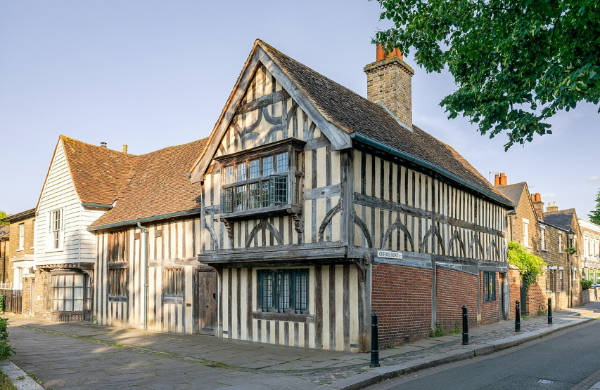
The 15th century ‘Ancient House’ in Walthamstowe. PICTURE: Tilman2007/Wikipedia (licensed under CC BY-SA 4.0)

Hence we ended up with Walthamstow (although the name Waltham Forest is remembered in the name of the London borough of which Walthamstow is part).

The Anglo-Saxon manor existed prior to the Norman invasion of 1066 and was recorded in the Domesday Book. Through marriage it passed into the hands of Norman Ralph de Toni, standard bearer to King William the Conqueror, and remained in his family until the 15th century. The family was responsible for the founding of St Mary’s Church, which still stands today, in the 12th century.

The village remained small – the area was populated by small scale farmers and yeomen – but during the 16th century wealthy people started constructing more substantial properties – these included navigator Sir Martin Frobisher, poet George Gasgoigne and Lord Mayor of London Sir George Monoux who built the Monoux Almshouses and School there (since rebuilt). Even diarist Samuel Pepys, had a connection, being entertained by Admiral Sir William Penn at a property in the village.

The trend for building large properties continued into the 18th century when included Water House was built. It later became a childhood home of Arts and Crafts designer William Morris and is now the home of the William Morris Gallery.
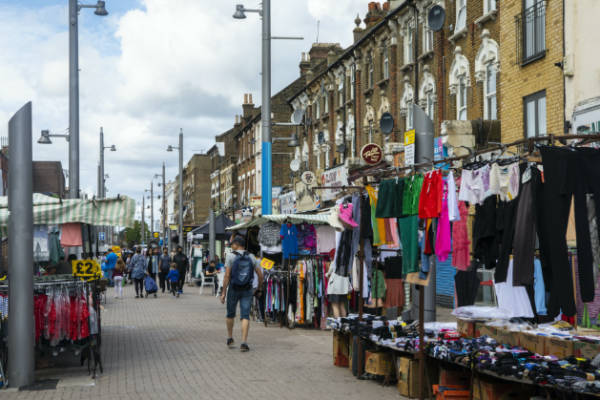
A view of Walthamstow Market on the High Street in Walthamstow, London, UK. PICTURE: Chris Dorney/iStockphoto

Urbanisation picked up pace in the 19th century and in the mid-1800s, more than 120 acres of the Walthamstowe Marshes to the west (the marshes followed the course of the River Lea and are now a site of Special Scientific Interest), were flooded to create reservoirs. Industry also moved in during this period and, in an unusual example of the sort of industry which took place in the area, the first British car with an internal combustion engine, the Brewer Car, was made in Walthamstow in the 1890s.

Development was further spurred by the arrival of the railways and, in 1930, the North Circular Road just to the north. In the late 1930s and early 1940s, the building of a rather grand new town hall and assembly hall moved the civic centre from where it had been on the High Street to Forest Road.

Redeveloped extensively after heavy bombing during World War II, Walthamstow became part of the London Borough of Waltham Forest in 1965.

As well as St Mary’s and Morris’ former home, landmarks include the 15th century “Ancient House”, the Forest School (1834) with a chapel featuring stained glass by William Morris, the Vestry House Museum (1930), the Lighthouse Methodist Church (1893) and the Copper Mill (the latest incarnation of a mill which has been associated with the village since the early Middle Ages). The daily Walthamstow Market, which stretches along the High Street, claims to be the longest daily street market in Europe.
What’s in a name?…Upminster…

Known to many as the eastern end of the District Line, Upminster is located some 16.5 miles to the north-east of Charing Cross and is part of the London Borough of Havering.

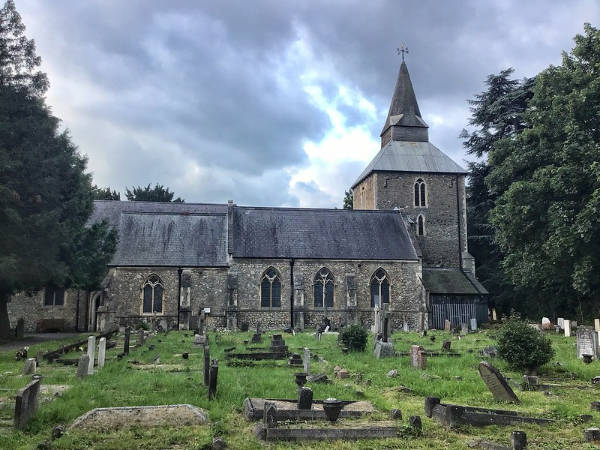
Historically a rural village in the county of Essex, its name comes from Old English and means a large church or “minster” located on high ground.

The Church of St Laurence in Upminster. PICTURE: Bob Comics (licensed under CC BY-NC-SA 2.0)

The church is said to have dated at least as far back as the 7th century and to have been one of a number founded by St Cedd, a missionary monk of Lindisfarne, in the area. It was located on the site occupied by the current church of St Laurence (parts of which date back to the 1200).

The nearby bridge over the River Ingrebourne shares the name Upminister and is known to have been in existence since the early 14th century.

Once wooded, the area was taken over for farming (cultivation dates as far back as Roman times) and by the 19th century it came to be known for market gardens as well as for some industry including windmills and a brickworks.

Development was initially centred around the minister and nearby villages of Hacton and Corbets Tey. It received a boost in the 17th century when wealthy London merchants purchased estates in the area.

Improved transportation links also helped in later centuries including the arrival of the London, Tilbury and Southend Railway in 1885 – it was extended from Barking – and the underground in 1902 via the Whitechapel and Bow Railway.

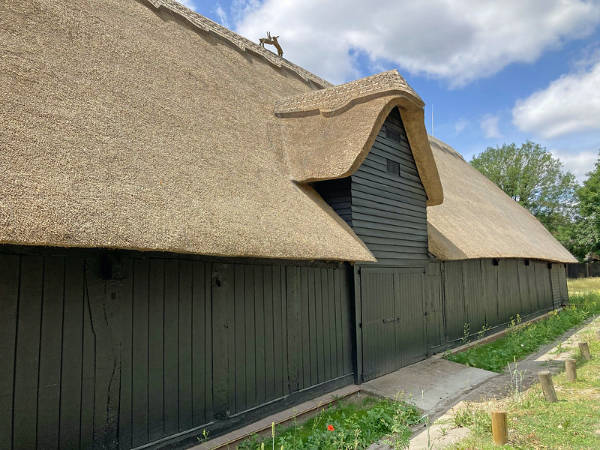
Landmarks include the Church of St Laurence, the redbrick Clock House (dating from about 1775), the 16th century house Great Tomkyns, the Grade II*-listed Upminster Windmill, built in 1803 and considered one of England’s best surviving smock mills, and the 15th century tithe barn (once owned by the monks of Waltham Abbey and now a museum).

The Upminster Tithe Barn. PICTURE: diamond geezer (licensed under CC BY-NC-ND 4.0)

Upminster Hall, which dates back to the 15th and 16th century (and, once the hunting seat of the abbots of Waltham Abbey, was gifted by King Henry VIII to Thomas Cromwell after the Dissolution), is now the clubhouse of the Upminister Golf Club.

Hornchurch Stadium, the home ground of AFC Hornchurch, is located in the west of the area.

It was in Upminster that local rector Rev William Derham first accurately calculated the speed of sound, employing a telescope from the tower of the Church of St Laurence to observe the flash of a distant shotgun as it was fired and then measuring the time before he heard the gunshot using a half second pendulum.

10 London mysteries – 3. Where is Boudicca buried?

The location of Queen Boudicca’s grave has remained a mystery for almost 2,000 years and, dare we say it (yes, thinking of you, King Richard III), is likely to remain so.

Subscribe for just £3 a month to gain access to all Exploring London’s content (and know that you’re helping to support our work!)

10 (lesser known) statues of English monarchs in London…3. King Harold Godwinson…

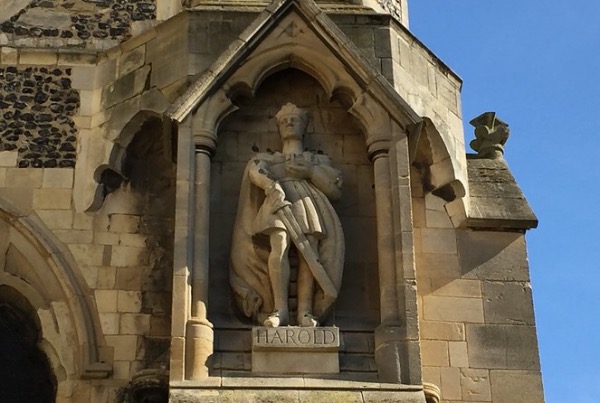
PICTURE: Matt Brown (licensed under CC BY 2.0)

Depicting the last crowned Anglo-Saxon king who famously died at the Battle of Hastings, this statue is located in a niche on the exterior of Waltham Abbey Church on the north-eastern outskirts of Greater London.

The life-sized statue was the work of Canadian-born, Dorset-based, sculptor Elizabeth Muntz and was erected in the 1960s.

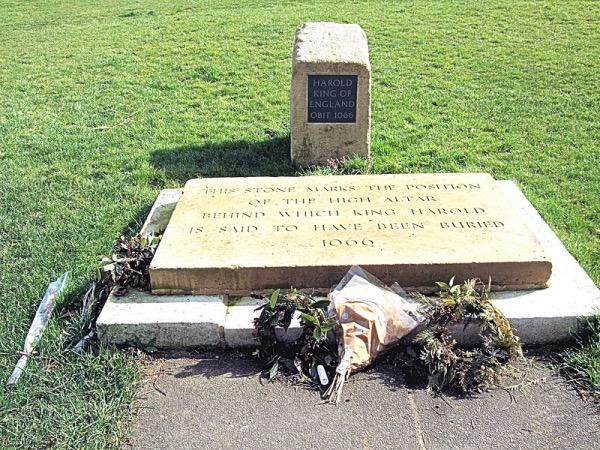
King Harold, also known as King Harold II, not only rebuilt the abbey church (apparently after he was healed of paralysis on a pilgrimage to Waltham), the abbey is also a possible site for his grave.

The grave is marked by a memorial stone now located in the churchyard which was erected in 1960. The inscription says the stone marks the position of the former church’s high altar. King Harold is said to have been buried behind this in 1066 after he was killed, according to tradition, by a well-aimed arrow to the eye at the Battle of Hastings (the church was rebuilt in the 12th century which explains why the altar is now located outside).

There are alternate theories for his burial place including in Bosham, West Sussex.

PICTURE: Jim Linwood (licensed under CC BY 2.0)