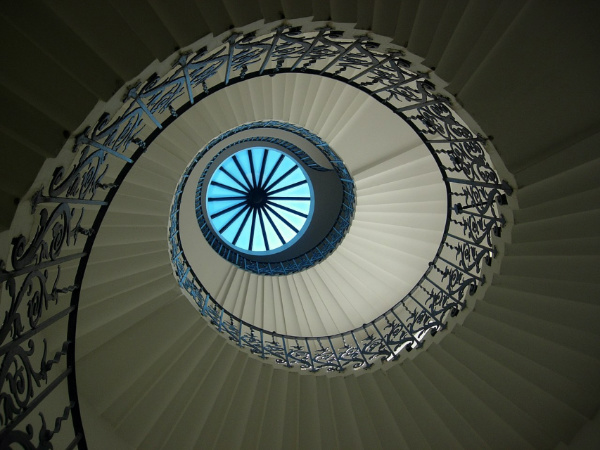
London has many beautiful stairways – and some of them have some incredible historic connections. In this series, we’re going to be looking at 10 of them and the history that goes with them. First up, it’s the spectacular Tulip Stairs found in The Queen’s House in Greenwich.
The wrought-iron stairs – which have the honour of being the first self-supporting spiral stair in the UK (meaning each tread is cantilevered from the wall and supported by the stair below rather than being supported by a central pillar) – were designed by Inigo Jones in 1635.
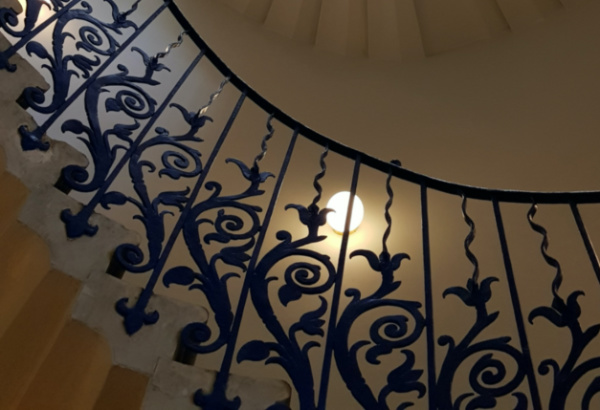
They are so named because the stairs, which are topped with a glass lantern, feature a flower pattern on the railings which resembles tulips although it is thought the flowers could be actually French lilies designed to compliment the Queen at the time of their completion.
For while Jones originally designed the house for Queen Anne of Denmark, wife of King James I, the building was unfinished and the stairs weren’t in place when she died in 1619. It was Queen Henrietta Maria, wife of King Charles I and daughter of French King Henry IV, who was Queen when he completed the property.
The stairs were at the centre of a ghost sighting in the mid 1960s when retired Canadian clergyman Rev RW Hardy took a photograph while visiting the house with his wife which appeared to show a couple of spectral figures on the staircase. The couple were both adamant that the stair was clear when the photo was taken and the mystery of the image, despite subsequent investigations, apparently remains unsolved.
WHERE: The Tulip Stairs, The Queen’s House, Greenwich (nearest stations are Cutty Sark DLR, Greenwich Station and Maze Hill Station or by water, Greenwich Pier); WHEN: Daily 10am to 5pm (but check the website for closures); COST: Free (but a prebooked ticket is required); WEBSITE: www.rmg.co.uk/queens-house.
Buckingham Palace is among the sites across London which will be hosting events to mark Queen Elizabeth II’s Platinum Jubilee this June. The Queen’s 70th year on the throne will be marked with four days of celebrations across the June bank holiday weekend which will include the Queen’s Birthday Parade (known as Trooping the Colour), the lighting of Platinum Jubilee Beacons – including the principal beacon at Buckingham Palace, a Service of Thanksgiving at St Paul’s Cathedral, the ‘Platinum Party at the Palace’ – a celebration concert in the gardens of Buckingham Palace, The Big Jubilee Lunch in communities across the city, and a special Platinum Jubilee Pageant, part of which will see a moving river of flags rippling down The Mall. For more information, head to www.royal.uk/platinum-jubilee-central-weekend.
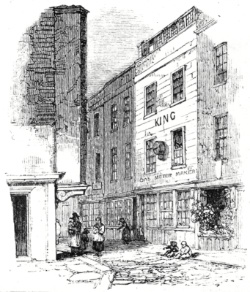
It’s 260 years ago this month that a supposed poltergeist known as the ‘Cock Lane Ghost’ was at the centre of an infamous scandal.
There had been several reports of strange sounds and spectral appearances at the property prior to January, 1762, but it was the events which took place that month which were to elevate the hauntings to the national stage.
Cock Lane, shown in Charles Mackay’s 1852 work ‘Haunted Houses’. PICTURE: Via Wikipedia
It was in that month that Elizabeth Parsons, the 11-year-old daughter of Richard Parsons, the officiating clerk at St Sepulchre Church, reported hearing knockings and scratchings while she was lying in bed. Her father, Richard Parsons, the officiating clerk at nearby St Sepulchre, enlisted the aid of John Moore, assistant preacher at St Sepulchre and a Methodist, to find their cause and the two concluded that the spirit haunting the house was that of Fanny Lynes, who had formerly lived in the property before apparently dying of smallpox in early February, 1760.
The two men devised a system for communicating with the spirit based on knocks and based on the answers they received, concluded that Lynes had not died of smallpox but actually been poisoned with arsenic by her lover (and brother-in-law) William Kent.
Kent had been married to Fanny’s sister Elizabeth and after her death, he had lived with Lynes as man and wife despite prohibitions on them being married due to their status as in-laws. Parsons, who was their landlord at the time, had taken a loan from Kent while they were living at the property but subsequently refused to pay it back leading Kent to successfully sue him for its recovery.
It was against that backdrop – and earlier reports that the ghost of Fanny’s sister Elizabeth had haunted the property after her death – that the story of ‘Scratching Fanny’ began to spread and led to crowds gathering in Cock Lane to witness the phenomena. Writer Horace Walpole was among them – he attended along with Prince Edward, the Duke of York and Albany, and, apart from not hearing the ghost (he was told it would appear the next morning at 7am), noted that the local alehouses were doing a great trade.
Such was the case’s fame that the Lord Mayor of London, Sir Samuel Fludyer, ordered an investigation – among those who was involved was famed lexicographer Samuel Johnson. They concluded that the girl had been making the noises herself (Dr Johnson went on to write an account of it which was published in The Gentlemen’s Magazine). Further investigations were held – Fanny’s body even exhumed – and Elizabeth was later seen concealing a small piece of wood (apparently to make the sounds), subsequently confessing that her father had put her up to it.
Kent, however, was determined to clear his name and Moore, along with Parsons, Parson’s wife Elizabeth, Mary Frazer, a relative of Parsons, and a tradesman Richard James, were all subsequently charged with conspiracy to take Kent’s life by alleging he had murdered Frances. The trial, which took place at Guildhall before Lord Chief Justice William Murray, on 10th July, 1762, saw guilty verdicts returned for all five defendants. Moore and Richards agreed to pay Kent a sum of more than £500 but the others refused and so in February the following year they were sentenced – Parsons to three turns in the pillory and two years imprisonment, his wife Elizabeth to a year in prison and Frazer to six months hard labour in Bridewell.
The case, which also caused controversy between the new Methodists and Anglicans over the issue of ghosts, was widely referred to in literature of the time including by satirical poet Charles Churchill in his work The Ghost. It was also referenced by William Hogarth in his prints and Victorian author Charles Dickens even alluded to the story in A Tale of Two Cities.
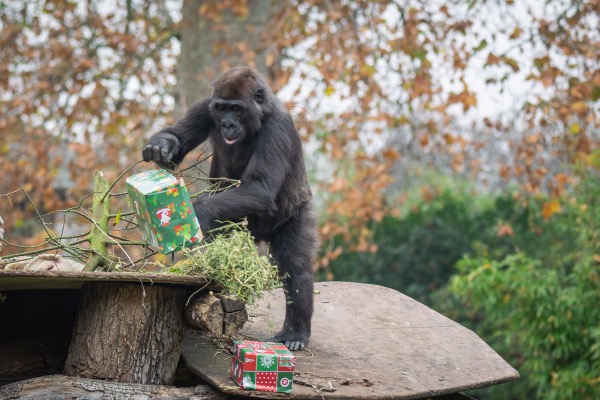
Christmas came early for some of the residents at ZSL London Zoo this week. Asiatic lions Bhanu and Arya discovered brightly wrapped boxes scented with seasonal spices in the Land of the Lions while in the Gorilla Kingdom, the zoo’s troop of Western lowland gorillas found gifts of their favourite festive vegetables. “Gorillas Alika, Gernot, Mjukuu and Effie are always keen to clean their plates of all the festive veg at Christmas – they loved digging into their presents to find juicy carrots and tasty Brussels sprouts,” said head zookeeper Dan Simmonds. “And while lioness Arya carefully picked up her gifts and carried them off to play with later, Bhanu opened his all at once, rolling around in the boxes to release his favourite seasonal scents – nutmeg and cinnamon.” The zoo is open every day apart from Christmas Day. For more, see www.zsl.org/london-zoo. PICTURES: ZSL London Zoo.
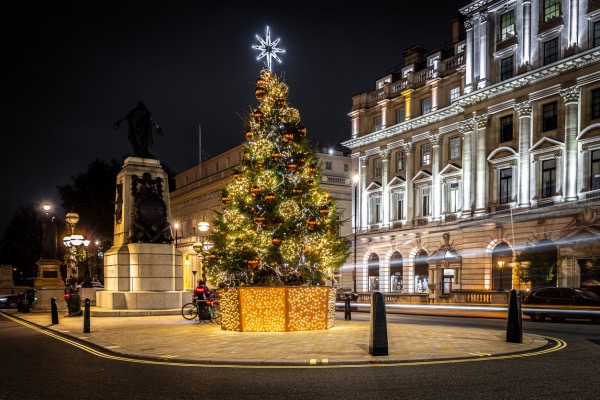
• Christmas is fast approaching and, to add to the festivities, Westminster City Council has created an augmented reality experience for families to enjoy at four landmark locations. Under the ‘Westminister Elves’ initiative, families are invited to scan a QR code at Piccadilly Circus, Marble Arch Mound, Soho Square and Hanover Square which will lead them to a microsite which, in turn, will transport them into the elves’ world. There, they can throw snowballs, share a moment with Santa’s reminder and glimpse inside Santa’s workshop as well as, of course, seeing the man himself. Those taking part are also invited to take a selfie or picture of a family member or friend alongside the elves at one of the four locations and post it on Twitter, Instagram or Facebook using the #WestminsterElves and tagging @CityWestminster. They’ll then be entered into a competition to win a £50 Love to Shop voucher. The competition closes at midnight next Wednesday with the winner announced on Christmas Eve. For more, see www.westminster-elves.co.uk.
• A recording of old sea song paying tribute to Horatio Nelson was released by the Museum of London this week. The song, which was thought to have been sung after the battle of Cape St Vincent in 1797 and subsequently transcribed by Nelson, was brought to life by musicians from the Guildhall School of Music & Drama. The recording marked the first performance of the piece in more than 200 years. While th song’s existence had previously been known about – it was referred to in a letter from Nelson to William Douglas, 4th Duke of Queensberry, which was was sold at auction in 2013 – it was one of four rediscovered last year among songbooks belonging to Nelson’s lover, actress and model Emma Hamilton. “The song was written by Nelson’s crew in one of his early victories,” said Lluis Tembleque Teres, the Museum of London librarian who found the songs. “It is fascinating how, some four years later and already a national hero, he recovers the lyrics and sends them to the Duke of Queensberry, almost as if showing off his early successes. The Duke then adds music and a chorus, and gifts the manuscript to Emma Hamilton, thus allowing us exactly 220 years later to relive Nelson’s fame while performing it.” The song’s release follows a special one-off live performance of all four songs at the Museum of London Docklands on 11th December, which will be available to watch in full as an online event – DIGITAL Emma’s Songbooks: rediscovered music for Nelson – next Tuesday, 21st December. Admission charge applies. For more, see museumoflondon.org.uk
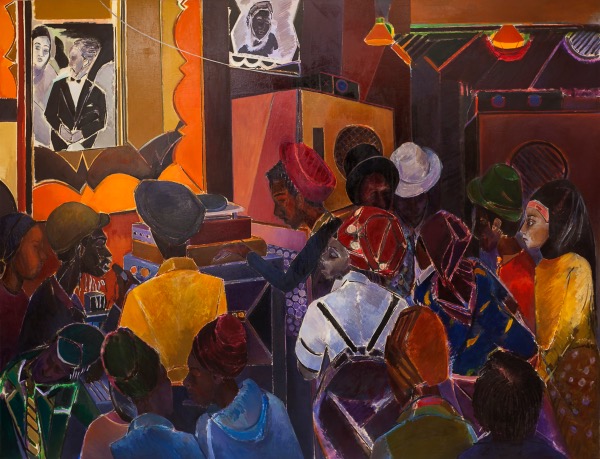
• A landmark exhibition exploring the extraordinary breadth of Caribbean-British art over four generations can be seen at Tate Britain. Life Between Islands spans 70 years of culture, experiences and ideas expressed through art and features more than 40 artists, including those of Caribbean heritage as well as those inspired by the Caribbean, such as Ronald Moody, Frank Bowling, Sonia Boyce, Claudette Johnson, Peter Doig, Hew Locke, Steve McQueen, Grace Wales Bonner and Alberta Whittle. Highlights include Neil Kenlock’s Black Panther school bags (1970), Denzil Forrester’s Death Walk (1983) – a tribute to Winston Rose who died in police custody, Lisa Brice’s After Ophelia (2018) – a work inspired by her time on Trinidad and new works including designs by Grace Wales Bonner evoking the brass bands and parades of the Commonwealth Caribbean. Runs until 3rd April. Admission charge applies. For more, see www.tate.org.uk.
Send all items for inclusion to exploringlondon@gmail.com.
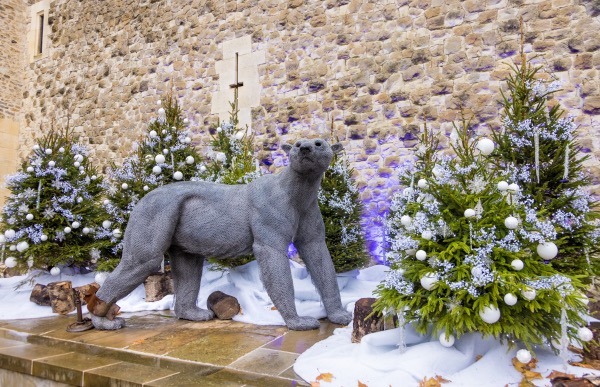
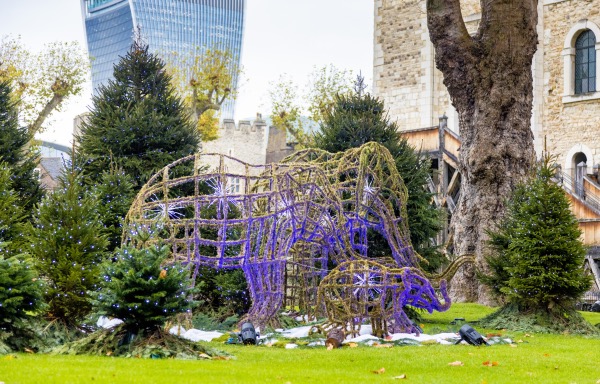
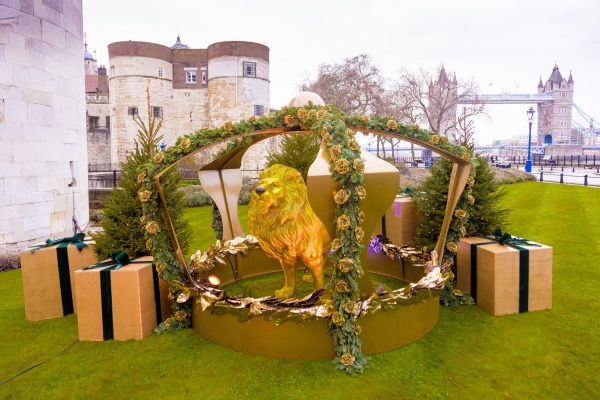
The Royal Menagerie at the Tower of London has been decked out for Christmas with an array of glittering decorations. Animals including a polar bear, elephants and lions were kept at various times in the Tower’s menagerie which started thanks to a royal penchant to giving exotic animals as gifts to fellow monarchs. King Edward I created the first permanent home for the menagerie which, after hundreds of years, closed for good in 1835. The Christmas display the Tower, which centres on the Tower Green Christmas tree, can be seen until 3rd January. Admission charges apply. For more, see www.hrp.org.uk.
Christmas is fast arriving so we went in search of some related monuments in London and found one depicting two famous characters from an iconic Yuletide text.
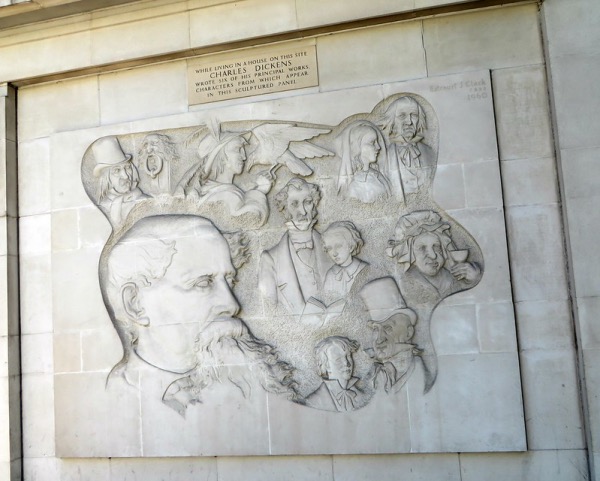
Located on the site of a house where 19th century writer Charles Dickens wrote six of his famous books, including A Christmas Carol, is a stone relief featuring several characters from them including Scrooge and Marley’s Ghost (represented as a door knocker in the top left).
The bas-relief is the work of Estcourt J “Jim” Clack and features a large portrait of Dickens as well as the characters who, alongside the characters from A Christmas Carol.
They apparently include Barnaby Rudge with his raven ‘Grip’ (from the book of the same name), Little Nell and Granddad (The Old Curiosity Shop), Dombey and his daughter Florence (Dombey and Son), Sairey Gamp (Martin Chuzzlewit), David Copperfield and Wikins Micawber (David Copperfield).
Correction: The name of Barnaby Rudge’s raven has been corrected.
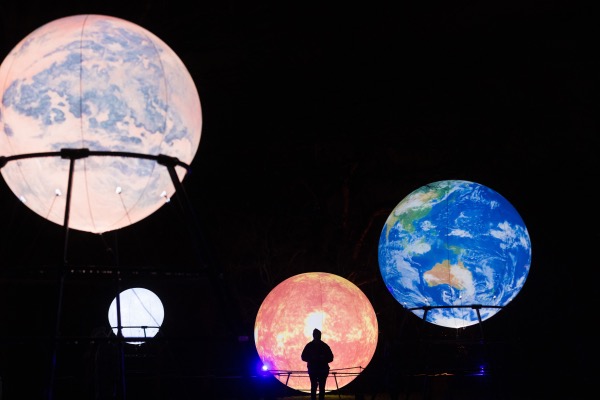
• An after-hours light trail featuring clocks, moons, planets and sundials has opened at Hampton Court Palace this week. Palace of Stardust takes people through the palace’s historic cobbled courtyards and gardens which have been filled with magical illuminations inspired by the palace’s famous astronomical clock installed at the command of King Henry VIII. Visitors to the display, designed and created by award-winning outdoor event producers Wild Rumpus, will uncover the mysterious meanings on the clock’s dial, attend a flickering moonlit ball in the East Front Gardens, hear the ancient royal trees as they whisper their secrets and peek into mysterious miniature shadow worlds before being transported to another planet in the deepest depths of the Wilderness, once home to King Charles II’s formal pleasure garden. Seasonal food and drink will also be available. Runs until 3rd January. Admission charge applies. For more, see www.hrp.org.uk/hampton-court-palace/whats- on/palace-of-stardust-at-hampton-court-palace.
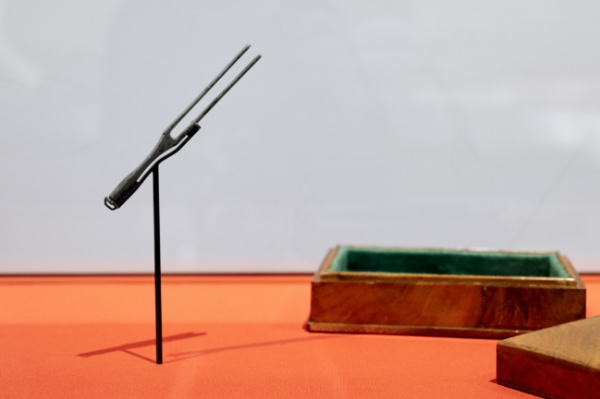
• One of the greatest composers of all time, Ludwig van Beethoven (1770-1827), is the subject of a new exhibition opening at the British Library. The display, which draws on the library’s world-famous collection, features manuscripts, archival documents, personal belongings and sound recordings with highlights including Beethoven’s own copy of his earliest published works which he composed at age 12 and 13, sketches for his Pastoral Symphony and late string quartets, a tuning fork which is thought to have belonged to him until 1803, and a pocket sketchbook the composer used to note down musical ideas when out walking, which dates from 1825. There is also a specially commissioned audio-visual incorporating bone conduction to present extracts from the composer’s music in an engaging and immersive way, in particular to those with hearing impairments. The exhibition runs until 24th April. Admission charge applies. For more, see www.bl.uk/events/beethoven. To coincide with the 250th anniversary of Beethoven’s birth, the library last year launched ‘Discovering Music: 19th century‘, a free online resource which explores key works of 19th-century classical music and the social, political and cultural contexts in which they were written.
• The World War II story of the elite tank regiment, the Sherwood Rangers Yeomanry, is being told in a new exhibition which opens today at the National Army Museum in Chelsea. Based on broadcaster and historian James Holland’s book, Brothers in Arms, the exhibition spans the period fromthe D-Day landings on 6th June, 1944, to VE Day almost a year later and focuses on the stories of eight soldiers who served in the regiment as it explores the dangers and pressures they faced and the camaraderie and bonds that bound them together. The exhibition is being accompanied by a programme of events. This Saturday, the Museum is putting a spotlight on tanks with free talks, tours and tank challenges for the family – plus the chance to see a Sherman tank parked up at the Museum. Online booking is recommended. For more, see www.nam.ac.uk/whats-on/brothers-arms.
Send all items for inclusion to exploringlondon@gmail.com.
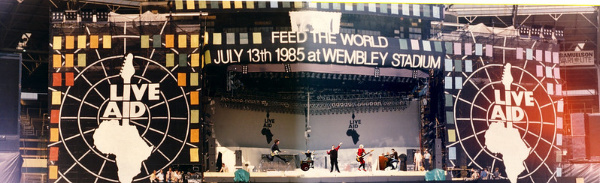
Wembley Stadium in London’s north-west has hosted numerous musical acts since the early 1970s but the most famous event was undoubtedly the British Live Aid concert in 1985.
Ultrasound perform at Live Aid at Wembley. PICTURE: cormac70 (licensed under CC BY-NC-ND 2.0)
Organised by Boomtown Rats frontman Bob Geldof and Ultravox vocialist Midge Ure (although it was apparently Boy George who first came up with the idea of a concert), the event featured an all-star line-up of the notable artists of the day.
Held to raise funds to support relief efforts aimed at those impacted by the devastating Ethiopian famine of 1983 to 1985, it followed the release of Band Aid’s single Do They Know It’s Christmas? the previous December (that song closed the British concert while We Are The World closed the US one).
About 72,000 people attended the event held on 13th July which featured artists including Paul McCartney, David Bowie, The Who (who reunited for the event), Queen and U2 (the latter two bands in show-stealing performances) and was held simultaneously with an event at at John F Kennedy Stadium in Philadelphia (attended by more than 89,000 people.
There were also concerts held in a range of other nations in Australia in support of the cause on the same day which were woven into the TV broadcast of the event. This was seen by an estimated 1.5 billion viewers worldwide.
The British event kicked off at noon and ran until 10pm that night while the US concert ended just after 4am, giving a total of 16 hours of concert time. Phil Collins famously performed at both events, taking a British Airways Concorde to the US after performing at Wembley and performing there.
Among the crowds watching were Prince Charles and Princess Diana.
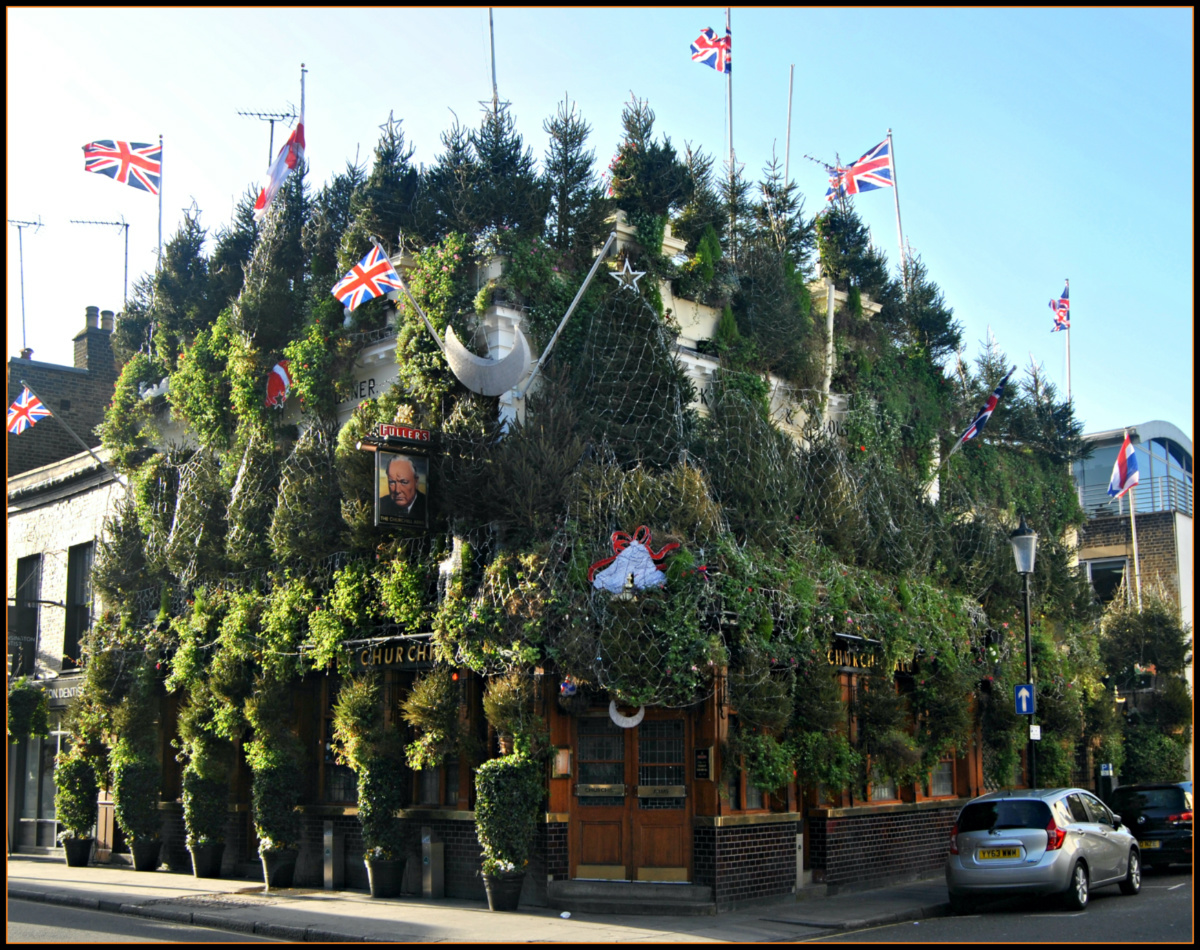
The Churchill Arms decorated for Christmas in 2015. PICTURE: Loco Steve (licensed under CC BY-SA 2.0)
It’s Christmas in London and for such a festive occasion, one pub immediately springs to mind – The Churchill Arms.
The name is certainly not a mystery and doesn’t really have anything to do with the Christmas theme. It stems from, of course, wartime Prime Minister Winston Churchill – or rather, his grandparents, the Duke and Duchess of Marlborough, John and Frances Anne Spencer-Churchill, who were patrons here and which, in honour of Churchill and them, saw the pub so-named after World War II.
Churchill remains a theme in the interior where a good deal of related memorabilia can be found – including wartime posters, pictures of the man himself and a (fake) plaque commemorating Churchill’s use of the pub for his wartime broadcasts (there’s even a celebratory night held each year around Churchill’s birthday).
The pub, which is located at 119 Kensington Church Street, dates from 1750.
But in recent times, it’s become famous for its stunning Christmas light displays which this year reportedly feature some 80 Christmas trees and 22,000 lights. The pub is also known for its extraordinarily profuse flower displays which cost thousands of pounds each year and which have even won at none other than the Chelsea Flower Show.
It also holds the claim to fame of being the first London pub to serve Thai food when it did so as far back as 1988.
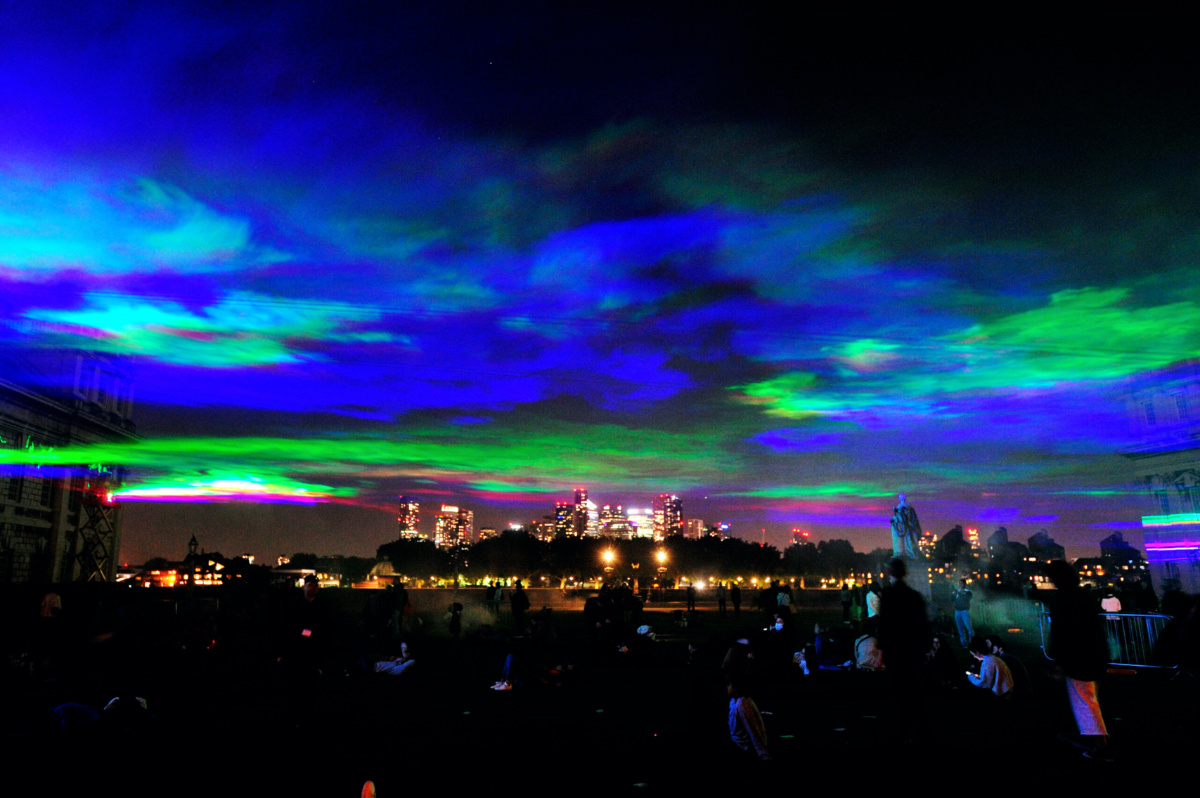
• A dazzling light show inspired by the Northern Lights – one of the seven natural wonders of the world – can be seen in the Guildhall Yard this December. Borealis – which can be seen between 11th and 22nd December – is the work of artist Dan Acher and is one of a number of light displays which is illuminating London this winter as part of Mayor Sadiq Khan’s ‘Winter Lights’ campaign. Others include an animal-themed display bringing to life the beasts that once lived at the Tower of London, an outdoor programme of installations and video art projections illuminating the Southbank Centre’s site, the ‘Illuminated River’ display lighting up nine of London’s bridges in what is be the longest public art project in the world, and a free Canary Wharf ‘Winter Lights Spectacular’ in January which will feature 20 new light commissions by some of the most innovative artists across the globe. In Grosvenor Square, Mayfair, thousands of illuminated white roses will form an ‘Ever After Garden’ designed by fashion designer Anya Hindmarch while traditional favourites like the Hyde Park Winter Wonderland as well as winter markets and ice rinks at locations like the Natural History Museum and Somerset House are also once again returning to the city. London’s red buses are an easy way to see the Christmas lights this year with routes 12, 94, 98, 139 and 390 all travelling through Oxford Circus. Free tickets to Borealis can be booked at www.visitlondon.com/Borealis while, for more on the best bus routes, see https://londonblog.tfl.gov.uk/festive-bus-routes/. For more information on all the light shows and events (some of which are already underway), see visitlondon.com .
• Costumes worn by then Princess Elizabeth and her sister Princess Margaret in wartime-era pantomimes are at the heart of a new display at Windsor Castle this Christmas. The princesses spent much of their time at Windsor during World War II – away from the Blitz in London – and, between 1941 and 1944, they performed in and helped to stage a series of pantomimes to raise money for the Royal Household Wool Fund which supplied knitting wool to make comforters for soldiers fighting at the front. Six of the costumes they wore have been brought together for the first time and are being displayed in the castle’s Waterloo Chamber where the pantos were originally performed. The costumes on show were worn in the last two pantos – Aladdin, which was performed in 1943, and Old Mother Red Riding Boots which was performed in 1944. Also on show are 16 large scale pictures of fairy-tale characters that were pasted around the walls to create the space for the performances. Visitors to Windsor this Christmas will also see State Apartments decorated for the festive season and a 20 foot high Christmas tree in St George’s Hall. The Semi-State Rooms, created for King George IV and now used for official entertaining, are also now open to visitors. The costumes can be seen until 31st January. Admission charges apply. For more on the Christmas activities at Windsor, including a ‘Mary, Queen of Scots at Christmas Family Activity Day’ on 18th December, see www.rct.uk/whatson/. Meanwhile, Buckingham Palace is offering guided tours of the State Rooms over winter with special family guided tours available for the first time. The tours run until 30th January. Admission charge applies. For more on the guided tours, head here and for more on the family tours, head here.
• The ancient Greeks’ pursuit of knowledge is the subject of a new exhibition which has opened at the Science Museum in South Kensington. Ancient Greeks: Science and Wisdom takes visitors on a journey in which they will sail the perilous seas with a statue of Hermes that was discovered on a shipwreck off the island of Antikythera, experience the lost music of the aulos instrument through interactive displays and an exclusive video that reimagines its ancient sounds, and gaze at the starry cosmos through ancient Greek eyes via a beautiful and rare silver globe depicting the known constellations and a Byzantine sundial-calendar – the second oldest known geared mechanism in the world. The free display can be seen until 5th June. Tickets are required – to book head to sciencemuseum.org.uk/ancient-greeks.
Send all items for inclusion to exploringlondon@gmail.com.



 Exploring London