10 historic London homes that are now museums…5. The Freud Museum…

The Freud Museum. PICTURE: A Peace of London (licensed under CC BY-NC 2.0)

The last residence of Sigmund Freud, the founder of psychoanalysis, is located in Hampstead and is now a museum dedicated to his work and that of his daughter, pioneering child psychoanalyst Anna Freud.

The Freuds moved into the property at 20 Maresfield Gardens (having initially briefly stayed at a flat at 39 Elsworthy Road, Primrose Hill) in September, 1938, having left their home in Vienna to escape the Nazi annexation of Austria earlier in the year.

The house dates from 1920 and was built in the Queen Anne Revival Style. A small sun room was added a year after to the rear of the property.

Freud finished his final works Moses and Monotheism and An Outline of Psychoanalysis while at the property and also saw patients there as well as some high profile visitors including Princess Marie Bonaparte, writer HG Wells and literary couple Leonard and Virginia Woolf. Already aged in his 80s when they moved in, he died in the home just a year after on 23rd September, 1939. But his daughter Anna remained in the property until her death in 1982.

As per her wishes, it was subsequently turned into a museum and opened to the public in July, 1986, as The Freud Museum.

Among the rooms which can be visited today are Freud’s study, the library, hall and dining room but some areas – such as Anna Freud’s consulting room – are used as offices and not open to the public.
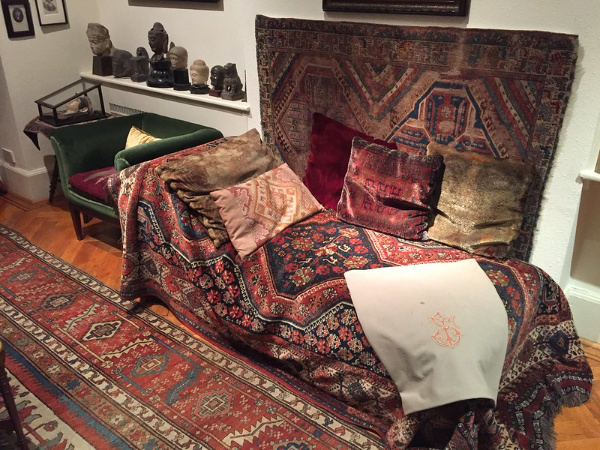
Freud’s couch. PICTURE: John Kannenberg (licensed under CC-BY-NC-ND-2.0)

The star sight inside is undoubtedly Freud’s famous couch. Located in the study, it was originally the gift of a patient, Madame Benvenisti, in 1890, and is covered with a Qashqa’i carpet which Freud added.

Other items which can be seen in the house include several paintings collected by Freud and a series of photographs by Edmund Engelman which depicted Freud’s apartment in Vienna just weeks before he fled. There’s also a portrait of Freud by Salvador Dali who visited him in London, his collection of antiquities and his painted Austrian furnishings as well as many mementoes related to Anna Freud.

The premises also hosts temporary exhibitions and a range of other events.

The garden outside – much loved by the Freuds – has been left largely as Sigmund Freud would have known it.

The house is one of the rare properties in London which features two English Heritage Blue Plaques – one commemorating Sigmund and the other Anna.

There’s a famous statue of Sigmund Freud by Oscar Nemon just a couple of minutes walk away at the corner of Fitzjohns Avenue and Belsize Lane.

WHERE: The Freud Museum, 20 Maresfield Gardens, Hampstead (nearest Tube stations are Finchley Road, Finchley Road & Frognal and Belsize Park); WHEN: 10:30am to 5pm, Wednesday to Sunday; COST: £14 adults/£12 concessions/£9 young persons (aged 12 to 16, under 12s free); WEBSITE: www.freud.org.uk.

10 notable blue plaques of London – 9. A family affair…

Freud-Museum

The fact the properties can have many residents with the passing of the years means that there’s a select number of properties in London (18 to be exact) which bear more than one English Heritage blue plaque – among them 4 Carlton Gardens in St James’s (home to 19th century PM Lord Palmerston and where General Charles De Gaulle set up the headquarter of the free French forces in 1940).

But among that group is an even more select group – properties which bear two blue plaques with both of those people commemorated coming from the same family.  The home at 20 Maresfield Gardens in Hampstead (pictured above) falls into this group.

Now a museum, the home’s celebrated occupants have included psycho-analyst Sigmund Freud, who lived here briefly in the final years of his life (between 1938 and his death on 23rd September, 1939), and his daughter Anna Freud, the youngest of his six children and herself a pioneering psycho-analyst, who lived here from 1938 until her death in 1982.

Both occupants have their own blue plaques on the property: Sigmund’s original London County Council blue plaque was unveiled on the site by his daughter Anna – then still occupant in the home – in 1956, the 100th anniversary of his birth. It had deteriorated and was replaced in 2002, at the same time a plaque to Anna herself was unveiled.

When Freud had moved to London from Vienna in June, 1938 – following the annexation of Austria by the Third Reich, he had initially lived in Primrose Hill before settling in the property in Maresfield Gardens along with his family and a significant collection of furniture from his Vienna consulting rooms.

In 1986, four years after Anna’s death, property was reopened as the Freud Museum and the public can still go inside and see Freud’s study, including his famed consulting couch, just as it was when he lived there.

The Freuds aren’t, of course, the only family members commemorated by English Heritage Blue Plaques – others include suffragette mother and daughters Emmeline and Christabel and Sylvia Pankhurst (the first two commemorated on a single plaque at 50 Clarendon Road in Notting Hill and the latter at 120 Cheyne Walk in Chelsea), and father and son Prime Ministers William Pitt the Elder and his son William Pitt the Younger (at 10 St James’s Square in St James’s and 120 Baker Street in Marylebone respectively).

WHERE: Freud Museum London, 20 Maresfield Gardens, Hampstead (nearest Tube stations are Finchley Road and Swiss Cottage);  WHEN: Noon to 5pm, Wednesday to Sunday; COST: £7 adults; £5 seniors; £4 concessions (including children 12-16); children under 12 free; WEBSITE: www.freud.org.uk.

PICTURE: Rup11/CC BY-SA 3.0/Wikimedia.

Treasures of London – Freud’s collection of antiquities…

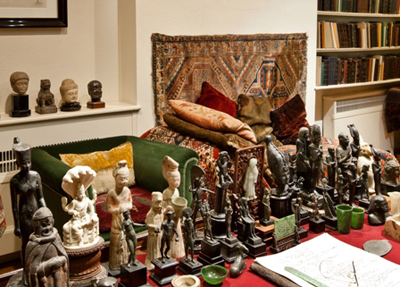
Freud's-DeskThis group of antiquities sits upon the desk of Sigmund Freud – the “founding father” of psychoanalysis –  at what was his home in Hampstead.

It’s part of an extensive collection of around 2,000 items which is on display at house – now the Freud Museum – located at 20 Maresfield Gardens.

The antiquities – which include Egyptian, Greek, Roman, and Oriental artefacts fill a series of cabinets and sit on almost every available surface in Freud’s study including the desk upon which Freud typically wrote until the early hours of the morning.

Collected by Freud from the 1890s onward, they include everything from a bronze statuette of the Greek goddess Athena (dating from the 1st or 2nd century AD – it’s mentioned in one of his manuscripts and, one of Freud’s favorite objects, was one of only three items he chose to have smuggled out of Vienna when his entire collection was threatened in 1938), a small bronze head of the Egyptian God Osiris believed to date from between 1075-716 BC, and a silver Roman ring featuring a blue glass intaglio depicting a pastoral scene which dates from between the 1st century BC and the 1st century AD (it was given as a gift from Freud to German psychoanalyst Ernst Simmel in 1928).

The museum has launched a conservation fund to repair and conserve the most fragile of the items and is aiming to raise £40,000 for the work. It follows a successful campaign earlier this year to raise funds for the conservation of Freud’s famous couch, brought from his former home in Vienna (seen in the background of this image).

Freud and his family lived at the home after escaping from Austria following the country’s annexation by Nazi Germany in 1938. It remained the family home until the death of Freud’s daughter, Anna, in 1982. The museum opened to the public in 1986.

PICTURE: Courtesy of the Freud Museum.

WHERE: Freud Museum, 20 Maresfield Gardens, Hampstead (nearest Tube stations are Finchley Road and Swiss Cottage);  WHEN: Noon to 5pm, Wednesday to Sunday; COST: £6 adults; £4.50 seniors; £3 concessions (including children 12-16); children under 12 free; WEBSITE: www.freud.org.uk.