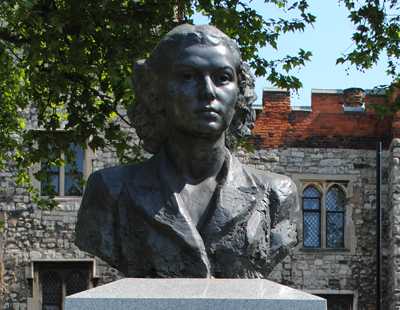
It’s International Women’s Day, so we’re celebrating by remembering two heroic women immortalised in statues in central London. Above is Edith Cavell, a British nurse who was trapped in Brussels by advancing German armies in 1914 and then subsequently arrested for aiding French and British soldiers to escape before being executed by firing squad on 12th October, 1915 – an event widely condemned around the world. The marble statue, located in St Martin’s Place at the intersection of Charing Cross Road and St Martin’s Lane, is by George Frampton and was erected in 1920. Below, meanwhile, is a bust of Violette Szabo which tops a memorial to the Special Operations Executive (SOE). Szabo, who was posthumously awarded the George Cross and the Croix de Guerre after she was captured and eventually executed by the German Army in early 1945, was among 117 SOE agents who did not return from their missions to France. Located on Albert Embankment, the statue – which is the work of Karen Newman – was unveiled in 2009.
Edith Cavell
Curious London Memorials – 8. Edith Cavell Memorial
Prominently located on Charing Cross Road near Trafalgar Square, this memorial is a war memorial with a difference. Rather than commemorating armies or great war leaders, its subject is Edith Cavell, a British nurse who was executed by a German firing squad during World War I.
Cavell, originally from Norfolk, was working at a medical institute in Brussels when the German army invaded in 1914. The institute become a Red Cross hospital and Cavell continued caring for injured soldiers regardless of their nationality until, on 5th August, 1915, she was arrested on charges of treason for helping as many as 200 British and French soldiers escape to neutral Holland.
Held for a time in solitary confinement, she was tried at a court martial after signing a confession. Cavell was sentenced to death, and on, 12th October, was shot dead at the age of 49 – an event that sparked worldwide headlines and prompted an international outcry. She subsequently featured prominently in propaganda designed to boost British recruitment.
The 1920 memorial, designed by Sir George Frampton, features comments Cavell made to an English Anglican chaplain with her on the night before her death: “Patriotism is not enough. I must have no hatred or bitterness for anyone”.
Cavell was buried next to the prison where she had been held before her body was later exhumed before being reburied in Norwich Cathedral.
