What’s in a name?….Giltspur Street

This City of London street runs north-south from the junction of Newgate Street, Holborn Viaduct and Old Bailey to West Smithfield. Its name comes from those who once travelled along it.
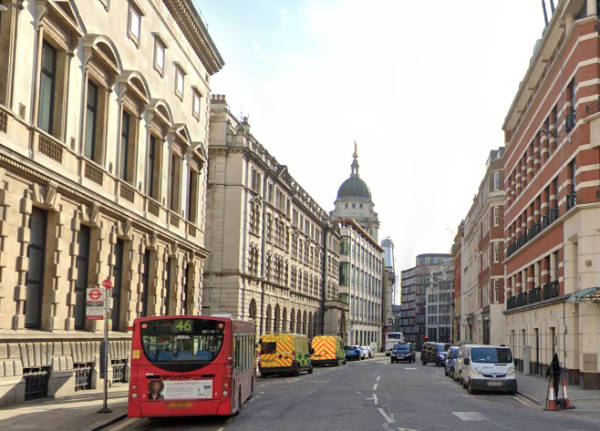
Looking south down Giltspur Street, with the dome of the Old Bailey visible, in 2018. PICTURE: Courtesy of Google Maps

An alternative name for the street during earlier ages was Knightrider Street which kind of gives the game away – yes, the name comes from the armoured knights who would ride along the street in their way to compete in tournaments held at Smithfield. It’s suggested that gilt spurs may have later been made here to capitalise on the passing trade.

The street is said to have been the location where King Richard II met with the leaders of the Peasant’s Revolt who had camped at Smithfield. And where, when the meeting deteriorated, the then-Lord Mayor of London William Walworth, ending up stabbing the peasant leader Wat Tyler who he later captured and had beheaded.

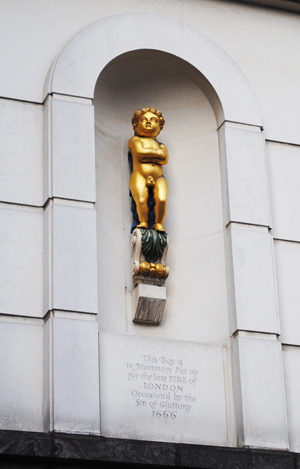
St Bartholomew’s Hospital can be found on the east side of the street. On the west side, at the junction with Cock Lane is located Pye Corner with its famous statue of a golden boy (said to be the place where the Great Fire of London was finally stopped).

There’s also a former watch house on the west side which features a monument to the essayist late 18th century and 19th century Charles Lamb – the monument says he attended a Bluecoat school here for seven years. The church of St Sepulchre-without-Newgate stands at the southern end with the Viaduct Tavern on the opposite side of the road.

The street did formerly give its name to the small prison known as the Giltspur Street Compter which stood here from 1791 to 1853. A prison for debtors, it stood at the street’s south end (the location is now marked with a City of London blue plaque).
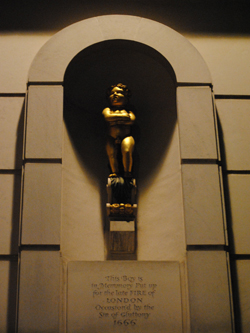
10 sites commemorating the Great Fire of London – 2. The Golden Boy of Pye Corner…

Golden-Boy-of-Pye-CornerWe’ve mentioned this memorial before but it’s worth a revisit. While last week’s entry looked at a plaque marking the site of the start of the Great Fire of London in September, 1666, this week we’re taking a (second) look at one of the sites where it was stopped.

Positioned high on a building on the corner of Giltspur Street and Cock Lane in Smithfield, this small wooden gilt 17th century statue, by an unknown maker, was once located on front of the pub, The Fortune of War, which stood on the site until it was demolished in 1910 (it was apparently used by body-snatchers as a place to display stolen corpses for surgeons from the nearby St Bartholomew’s Hospital to take their pick from).

The statue marks one of the locations on the city fringes where the fire was ‘stayed’ through the demolition of buildings. It bears an inscription which reads “This Boy is in Memmory put up for the late Fire of London Occasion’d by the Sin of Gluttony 1666”.

Well below it is an explanatory note below explains that the boy was made deliberately fat (the statue was apparently originally known as ‘The Fat Boy’ although to the modern eye it doesn’t look particularly so) in reference to the rather odd claim the fire was started in Pudding Lane as a result of the sin of gluttony and not by Papists as had been originally claimed on The Monument.

It has been said that the statue – which is believed to have once had wings and which is the reason why the building it is upon carries a Grade II heritage listing – was merely a shop sign and originally had nothing to do with the Great Fire, which may well be the case, but that said it is known that the fire stopped here (sparing St Bart’s further up Giltspur Street).

PICTURE: David Adams

Where’s London’s oldest…drinking fountain?

A rather humble looking fountain set into the railing outside the Church of St Sepulchre-without-Newgate at the corner of Giltspur Street and Holborn Viaduct, it’s easy to overlook this important part of London’s historic fabric.

FountainBut this free water fountain is London’s oldest and was installed here on 21st April, 1859, by the then Metropolitan Drinking Fountain Association. Established by Samuel Gurney – an MP and the nephew of social reformer Elizabeth Fry, the organisation aimed to provide people with free drinking water in a bid to encourage them to choose water over alcohol.

Within two years of the fountain’s creation, the organisation – which later changed its name to Metropolitan Drinking Fountain and Cattle Trough Association in reflection of its expanded role in also helping animals – had placed as many as 85 fountains across London.

Such was the need for a clean water supply that, according to the Drinking Fountain Association, as many as 7,000 people a day used the fountain when it was first installed.

The fountain on Holborn Hill was removed in 1867 when the nearby street Snow Hill was widened during the creation of the Holborn Viaduct and the rails replaced but it was returned there in 1913. Rather a poignant reminder of the days when water wasn’t the publicly available resource it is today, the marble fountain still features two small metal cups attached to chains for the ease of drinking and carries the warning, “Replace the Cup!”.

PICTURE: Wikipedia/JustinC

Curious London memorials – 9. The Golden Boy of Pye Corner

It’s widely known that Pudding Lane was the place where the Great Fire of London is believed to have started in 1666 – hard to miss given the site is commemorated nearby in the form of The Monument, the world’s tallest freestanding stone column – but what about where it was stopped? Standing in a niche on the corner of a building overlooking the junction of Giltspur Street and Cock Lane is a small gilt statue known as the ‘Golden Boy of Pye Corner’.

It’s not known how old the statue is but it is known that it was previously located on the front of a pub, The Fortune of War, which stood on the site until it was demolished in 1910 (and was apparently used by body-snatchers as a place to display stolen corpses for surgeons to peruse).

The statue – which apparently marks the place where the fire was ‘stayed’ (that is, buildings were destroyed to stop the fire spreading any further) –  is accompanied by an inscription which reads “This Boy is in Memmory put up for the late Fire of London Occasion’d by the Sin of Gluttony 1666”.

Below it an explanatory note below explains that the boy was made deliberately fat in reference to the fact the fire was started in Pudding Lane as a result of gluttony and not by Papists as was claimed on The Monument (this reference – “But Popish frenzy, which wrought such horrors, is not yet quenched” – was added to the inscriptions on the Monument in 1681 but was removed in 1831).