This Week in London – London homes in winter; artworks commemorating people of African, Caribbean, and Asian heritage; and, final NYE tickets…

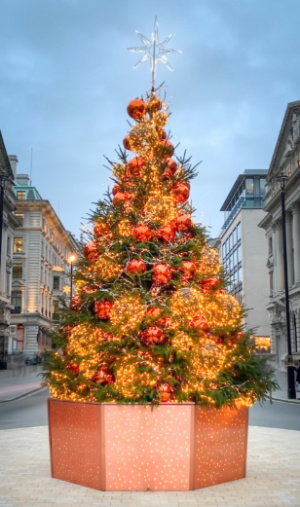
A Christmas tree in London. PICTURE: Hert Niks/Unsplash

See how Londoners lived during winters past at the Museum of the Home in Hoxton. Rooms Through Time: Winter Past centres on the museum’s ‘Rooms Through Time’ and reveals how winter has changed London homes through the last 400 years. The display – which includes rooms set out as they would have been on Millennium Eve, Christmas Eve in 1915, Twelfth Night in 1830, and during a Frost Fair in 1683 – takes a multi-sensory storytelling approach, offering new sounds, smells, sights and stories across the room sets. The display is accompanied by a series of ‘Winter Festival’ events. Runs until February next year. Entry is free. For more, see www.museumofthehome.org.uk.

• A series of artworks commemorating people of African, Caribbean, and Asian heritage from London’s past opens at the London Metropolitan Archives in Clerkenwell on Monday. Art at the Archive: Reimagining Unforgotten Lives sees three artists creating works after taking as their inspiration a range of people featured in LMA’s Unforgotten Lives exhibition. The works include Annie-Marie Akussah’s three-dimensional artwork depicting landscapes Black abolitionist Quobna Ottobah Cugoano would have seen in Ghana as well as London’s West and East India Docks, Elyssa Rider’s oil portraits of Ann Duck, a young woman living in London from 1717 to 1744 whose criminal past is preserved in the court records of the Old Bailey and Tara Jerome-Bernabé’s woven painting which reimagines the lives and images of young Black servants who were enslaved and forced to work in aristocratic households. Runs until 27th March. Admission is free. For more, see head here.

The final tickets to see London’s New Year’s Eve fireworks celebrations on the banks of the River Thames go on sale on Friday. Just over 20,000 tickets will go on sale at noon, taking to 100,000 the total number of tickets sold. Tickets, which cost £20 each, must be bought in advance from the only authorised outlet, AXS. Only ticket holders will be able to watch the fireworks in person. Those without a ticket are encouraged to watch the display live on BBC One or via BBC iPlayer alongside millions of viewers or to celebrate the new year at the capital’s fantastic range of bars, restaurants, pubs and clubs. Tickets can be bought online at AXS.com. For more, see www.london.gov.uk/nye.  

Send all items to exploringlondon@gmail.com

London Pub Signs – The Wenlock Arms…

Located just to the north of the City, The Wenlock Arms takes its name from the former Wenlock Brewery (the name was also given to the nearby Wenlock Basin which runs off Regent’s Canal).

Located at 26 Wenlock Road in Hoxton, the pub is said to have opened in 1836 as a tap for the nearby brewery and went on to become a rare survivor of the Blitz (for the area in which it’s located).

The pub has an interesting recent history – it was successfully saved from demolition several years ago following a campaign from locals and is now a protected building. Having undergone a bit of a spruce up since, it is highly regarded for both its ales and its live music.

It also featured as a location in the 2013 film, The World’s End, starring Simon Pegg.

For more, see http://wenlockarms.com.

PICTURE: Marcuswenlock (licensed under CC BY-SA 4.0)

Around London – Christmas at the Geffrye; a Kensington Palace advent calendar; new furniture gallery at the V&A; and, last chance to see Bronze…

Christmas is looming and at the Geffrye Museum in Hoxton that means the museum’s many period rooms have been transformed for the Christmas festivities. The rooms span 400 years of history, from 1600 until today, and show how the middle class have lived over that time. The Christmas display will also provide insights into such Christmas traditions as kissing under the mistletoe, hanging up stockings, sending Christmas cards and decorating trees. The Christmas theme carries through to the restaurant and gift shop. Entry to the exhibition is free. Runs until 6th January. For an online gallery showing some of the rooms, click here. For more on the museum, see www.geffrye-museum.org.uk.

• Meanwhile Kensington Palace is to be transformed into giant advent calendar in the lead-up to Christmas with a daily ‘reveal’ inspired by Princess Victoria’s Christmas diary entries and letters. The halls of the palace will be decorated with 24 specially designed mirrored baubles, Christmas music will be played throughout and a sparkling 25 foot high Christmas tree will be placed in the gardens. As part of the Christmas festivities, an evening of carol singing will be held on 5th December in the King’s Gallery with carols sung by the Hampton Court Palace Royal Chapel Choir. Other events include a Midwinter Masquerade Ball on 13th December and an Eerie Evening Tour on 20th December. For more, see www.hrp.org.uk/KensingtonPalace/.

• A new permanent furniture gallery opens at the V&A this Saturday. The Dr Susan Weber Gallery – the first at the museum dedicated to furniture – will display more than 200 pieces of British and European furniture, spanning a period stretching from the Middle Ages through to present day, as well as examples of American and Asian furniture. Each piece is examined in detail with information provided about the materials and techniques used in creating it. Among the designers represented will be Thomas Chippendale, Grinling Gibbons, Robert Adam, Ron Arad and Tom Dixon. Highlights include a 20th century Frank Lloyd Wright-designed dining chair, a gilded cassone made for the Duke of Urbino in about 1509, and a scagliola decorated table which was formerly at Warwick Castle and dates from 1675. Twenty-five ‘key’ pieces have been selected for a central chronological display including a storage unit by Charles and Ray Eames dating from 1949-50, a Gothic revival cradle dating from 1861 and designed by Richard Norman Shaw and one of the museum’s newest acquisitions, the 2011 ‘Branca’ chair, designed by Industrial Facility. The display includes the use of touch screen interfaces, films and audio recordings. Entry is free. For more, see www.vam.ac.uk.

• On Now: Bronze. Last chance to see this exhibition at the Royal Academy of Arts which closes on 9th December. The exhibition brings together more than 150 of the finest bronzes in the world, spanning 5000 years of history, with many of the pieces on display never seen before in the UK. Among the earliest works are the 14th century BC bronze and gold Chariot of the Sun from Denmark, ancient Chinese ritual vessels including an elephant-shaped vessel dating from the Shang Dynasty (1100-1050 BC) and an Etruscan masterpiece – Chimera of Arezzo, dating from about 400 BC. Other highlights include a Roman cavalry helmet found in Cumbria in 2010 and the Portrait of King Seuthes III, dating from the early Hellenistic period, and found in Bulgaria in 2004 as well as a series of Renaissance bronzes and more recent works like Rodin’s The Age of Bronze (c 1876). Admission charge applies. For more, see www.royalacademy.org.uk.

What’s in a name?…Pimlico

Tradition holds that this small triangular area, wedged between Westminster and Chelsea on the north bank of the Thames, takes its name from Ben Pimlico, said to be the 17th century owner of an famous alehouse or tea garden in Hoxton, on the north side of the City, and brewer of a particularly sought-after “nut brown” ale.

The story goes that so popular was his brew that Hoxton Street was then known as the “Pimlico Path”  due to the numbers making their way to his alehouse and that the area of Pimlico somehow adopted this name (although to be fair we should note that it’s also been suggested that the name comes from the Pamlico tribe of American Indians who exported timber to London around the same period).

While references to Pimlico go back to the 17th century, the area was largely uninhabited until the 19th century when it was developed by Victorian planner Thomas Cubitt under contract to the land owner, the Grosvenor family.

Initially in demand among the well-to-do, the fortunes of the area had declined by the end of the nineteenth century before a resurgence of interest took place in the early 20th century.

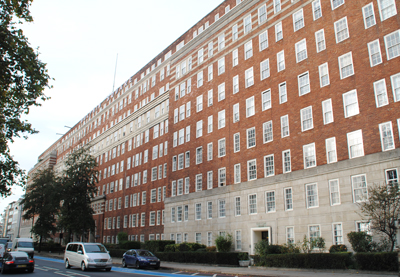
Among the projects constructed at that time was Dolphin Square (pictured) – with more than 1,200 apartments, it was the largest apartment complex in Europe at the time and has since proved particularly popular among politicians keen to be close to the action in Westminster and Whitehall.

Famous residents of Pimlico have included Winston Churchill, who lived briefly at 33 Eccleston Square between 1908-11.

Worth noting is that there is a racecourse in Maryland in the US known as the Pimlico Race Course which is also named for Ben Pimlico’s tavern.

For a photographic essay of Pimlico, check out Brian Girling’s Pimlico Through Time.