What’s in a name?…Great Ormond Street…

Perhaps most closely associated with the Great Ormond Street Hospital for Children, originally, known as the Hospital for Sick Children, this street was originally laid out in the early 18th century through what was then a rural area.
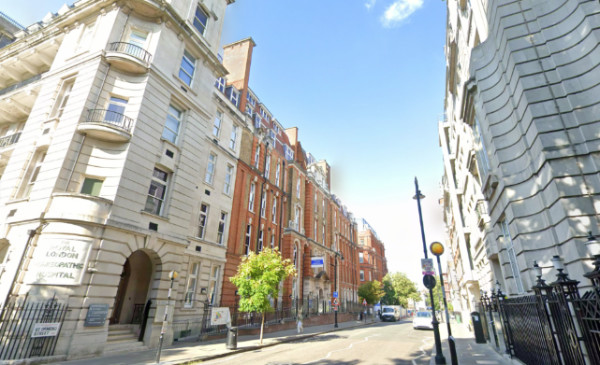
Looking north-west down Great Ormond Street (the London Homeopathic Hospital is to the left and beyond that the Great Ormond Street Hospital for Sick Children). PICTURE: Courtesy of Google Maps

Located in Bloomsbury in the London Borough of Camden, the street runs north-east from Queen Square to Millman Street and was in the early 18th century known for its fine houses, a number of which still remain (Barbon Close, which runs south off the street is named for 17th century property developer Nicholas Barbon believed to have built a number in the street).

It is believed to have been named for James Butler, Duke of Ormonde (1610 and 1688), the Royalist commander in Ireland during the Civil War who was elevated to the dukedom following the restoration of King Charles II (there is an Ormond Yard in St James’s near where his residence was located.)

The hospital, meanwhile, stands on the north side of the street and was founded in 1852 (it’s famous for, among other things, the fact that Peter Pan author JM Barrie donated the copyright to the works to the hospital in 1929; it’s also famous, on a more medically-related note, for being one of the largest transplant centres in the world). The street is also home to The Royal London Homeopathic Hospital and was for about 50 years until 1906 the location of the Working Men’s College.

The street was also home to Powis House, built for William Herbert, 2nd Marquess of Powis, but later serving as the French Embassy. This burned down in 1713, was rebuilt by the French monarchy in an ornate style and went on to serve, between 1764 and 1783, as the Spanish Embassy before being demolished around the turn of the century. The site of the mansion is reflected in the location of Powis Place, which runs to the north off Great Ormond Street today.

Famous residents included prison reformer John Howard who lived at number 23 from 1777 until his death in 1790. Lord Thurlow, Lord Chancellor, was living at number 45 in 1784 when the Great Seal was stolen from his property (forcing the hurried creation of a new one).
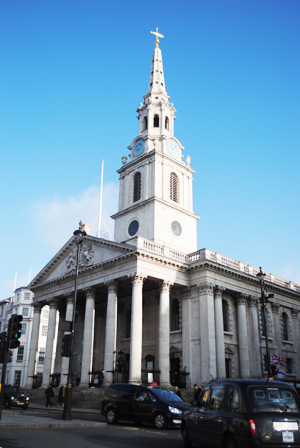
10 significant sites from Georgian London – 4. St Martin-in-the-Fields…

This iconic church on the edge of Trafalgar Square, known for its musical associations, is another of the works of architect James Gibbs and, as with St Mary le Strand, the current building was constructed in the first half of the 18th century to replace an earlier building.

St-Martin-in-the-fieldsThe first references to a church on the site of the present building date back to the 13th century when, constructed upon a Roman burial site, it was apparently used by monks from Westminster. It was replaced by King Henry VIII around 1542 and enlarged in 1602 before finally being demolished in 1721.

Gibbs’ apparently first suggested the design feature a round nave with a dome over the top but the proposal was rejected as too expensive and a simpler, rectangle-shaped church was subsequently agreed upon and eventually completed in 1726. Part of the design inspiration comes from Sir Christopher Wren, although Gibbs’ integration of the tower into the church was a departure from Wren’s designs (the church spire rises 192 foot into the air).

Among the features of the interior are ceiling panels in the nave which feature cherubs and shells and are the work of ceiling experts Giuseppe Artari and Giovanni Bagutti. Other items of interest include Chaim Stephenson‘s sculpture, Victims of Injustice and Violence, remembering all victims during apartheid in South Africa (it was dedicated by Desmond Tutu in 1994), a statue of St Martin and the Beggar by James Butler, and, on the porch, Mike Chapman‘s sculpture marking the millennium, Christ Child. Paintings include one of James Gibbs himself by Andrea Soldi and dating from 1800.

Among those buried in the church are furniture-maker Thomas Chippendale, sculptor Louis-François Roubiliac and notorious robber Jack Sheppard (he’s buried in the churchyard). The crypt also contains a life-sized marble statue of Henry Croft, London’s first pearly king, which was moved there from St Pancras Cemetery in 2002.

As well as being the location of the first religious broadcast, its musical heritage includes performances by Handel and Mozart and being the location of the first performance of its namesake chamber orchestra, the Academy of St Martin in the Fields.

Since the early 20th century, the church has been noted for its work with the homeless (thanks in particular to the work of Vicar Dick Sheppard). Meanwhile, its connections with music – which date back to its rebuilding – continue in the concerts held in the crypt cafe. The crypt also hosts art exhibitions.

The church underwent a £36 million renewal project in the Noughties. Additions included the new east window by Shirazeh Houshiary.

WHERE: St Martin-in-the-Fields on the north-east corner of Trafalgar Square (nearest tube stations are Charing Cross, Leicester Square and Embankment); WHEN: Open weekdays and weekends – times vary, see website for details; COST: free; WEBSITE: www.stmartin-in-the-fields.org.