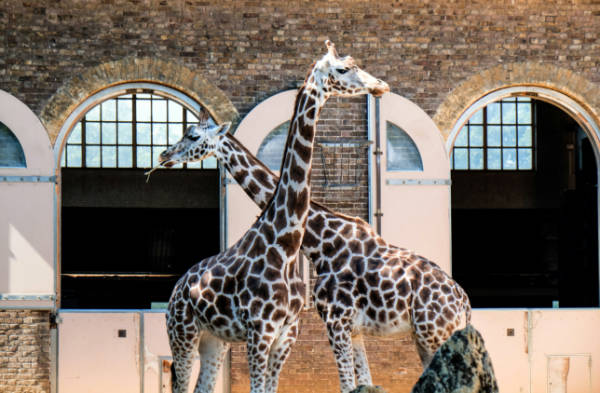
A Moment in London’s History…London Zoo is founded…

PICTURE: Richard Cook/Unsplash

The origins of the modern ZSL London Zoo go back 200 years to the founding of the London Zoological Society by Sir Thomas Stamford Raffles on 29th April, 1826.

While the idea of a zoo had been debated for some years, it was the death of Chunee the bull elephant at Cross’s Menagerie in the Exeter Exchange on the Strand that is said to have been the catalyst for immediate action.

Chunee, who’d been kept in an enclosure at the menagerie for six years, had been put down by a firing squad of soldiers after, having become aggressive during musth (a natural condition in adult male elephants which sees them experience a massive surge of testosterone and is often characterised by erratic behaviour), had injured one of his keepers and killed another. The soldiers, acting on the wishes of the menagerie’s proprietor Edward Cross, had fired 152 musketballs into the elephant but still had to finish him off with a harpoon.

Such was the outrage at this tragic event, that Raffles, famous for having established a trading post at Singapore, moved to to found the society.

Sir Thomas obtained land for the zoo in Regent’s Park before his death on 5th July that year (his birthday) but it was his successor, Whig politician Henry Petty-Fitzmaurice, 3rd Marquess of Lansdowne, who oversaw the construction of the zoo’s first animal houses drawing on the services of architect Decimus Burton.

The zoo opened to fellows of the society on 27th April, 1828, permitting them to study the animals. It was granted a Royal Charter by King George IV in 1829. In 1831, animals held in the Tower of London’s menagerie were transferred to the zoo.

It wasn’t until 1847 that it opened to the public in a plan aimed at raising funds for its upkeep.

Initial animals at the zoo included monkeys, bears, kangaroos and zebras – naturalist Charles Darwin was among those who visited in the early years and was fascinated by an ape named Jenny.

While it wasn’t the first zoo in the world (but was the world’s first scientific zoo), it was later responsible for numerous world firsts with the first reptile house opening in 1849, the first public aquarium in 1853 and the first insect house in 1881. In 1850, Obaysch, the first hippo in Europe since Roman times, came to live at the zoo.

Others among the more famous animals housed at the zoo were the African elephant Jumbo who arrived in 1865, the Black bear Winnie who was part of the inspiration for Winnie-the-Pooh, and Guy the Gorilla who arrived in 1947.

Larger animals were moved out to Whipsnade Zoo, the world’s first open-air zoo, in Bedfordshire in 1931.
Famous Londoners – Jumbo…

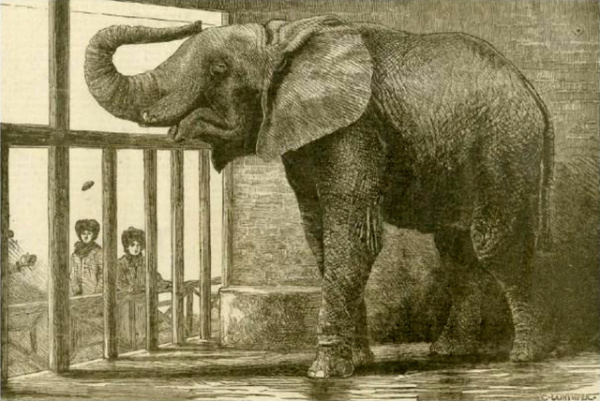
Jumbo greets some visitors as they pass by his den in London Zoo. PICTURE: From ‘Jumbo: This Being the True Story of the Greatest Elephant in the World’ by Paul Chambers

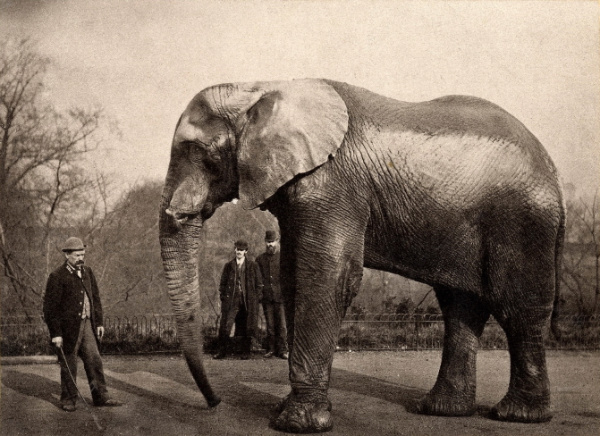
With his name a byword for things of a large size, Jumbo was an African bush elephant who was once one of London Zoo’s most popular residents (but whose life makes for sad reading).

Born in Sudan in about 1860, Jumbo – whose name is apparently a corruption of ‘jumbe’, the Swahili word for chieftain – was captured by hunters after his mother was killed and transported north to Europe. There he was apparently first exhibited in Germany before being sold to the Jardin des Plantes, a zoo in Paris.

In 1865, he was transferred to London Zoo in England where his keeper was Matthew Scott who went on to detail his care of Jumbo in his 1885 autobiography.

Jumbo quickly became a popular exhibit and was trained to give rides to children, including those of Queen Victoria (Teddy Roosevelt and Winston Churchill were apparently also among those who rode the elephant).

But out of public view, Jumbo, particularly as he matured, was growing increasingly destructive, smashing his den and breaking his tusks (it’s said Matthew Scott would pacify him with large quantities of alcohol).

In 1882, protests broke out when, apparently concerned over Jumbo’s growing aggression, then zoo superintendent Abraham Bartlett announced plans to sell Jumbo to American circus founder PT Barnum for £2,000. Some 100,000 school students wrote to Queen Victoria begging her to stop the transaction and a lawsuit was launched to stop the sale. It was unsuccessful.

Despite the protests, the sale went ahead and in March, 1882, Jumbo and Matthew Scott, who had decided to go with the elephant, went to America. In New York, Jumbo was exhibited at Madison Square Garden in a 31 week season. In 1884, he was one of 21 elephants who crossed the Brooklyn Bridge to prove it was safe following the death of 12 people during a collapse caused by a stampede few years earlier.

Jumbo with his keeper Matthew Scott, pictured in June, 1882. PICTURE: From Bierstadt, E ‘Jumbo and trainer.’

Jumbo died on 15th September, 1885, when he was hit by a train as he and other elephants were being led back to their boxcar. According to Barnum, Jumbo was attempting to lead a young elephant Tom Thumb to safety.

Following Jumbo’s death, a postmortem revealed his stomach contents included five English pennies, keys, rivets, and a police whistle.

Sadly, PT Barnum had the body parts separated for display before Jumbo’s skeleton was eventually donated to the American Museum of Natural History in New York City. The elephant’s heart was sold to Cornell University and its hide stuffed and eventually donated to Tufts University where it was destroyed in a fire in 1975 (Jumbo remains the university mascot).

There is a statue of Jumbo near where he died in St Thomas, Ontario, and a six-storey, elephant-shaped building in Margate City, New Jersey, which was built in 1881 is said to be inspired by him. He is also said to have inspired the Disney film, Dumbo.