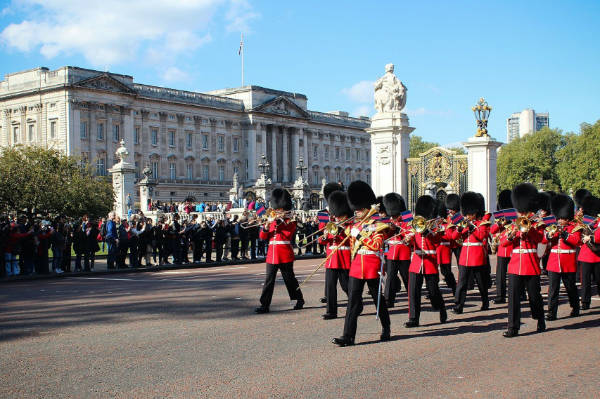
It’s one of the most iconic London traditions – the ceremonial changing of the guard outside Buckingham Palace.
Elite guards have served the monarch since the reign of King Henry VII – he made the Royal Body Guard a permanent institution – and Guards Regiments, among the oldest units in the British Army, were first raised in 1656 to protect King Charles II who was then living in exile in Bruges in modern Belgium.
The Changing of the Guard ceremony originally took place at the (now long-gone) Palace of Whitehall. But when the court moved to St James’s Palace in 1698, the ceremony went with them. And then, when Queen Victoria moved to Buckingham Palace in 1837, a detachment of guards was sent to guard the palace (with the Queen’s Guard also still guarding St James’s, a situation which continues today).
The main ceremonial Changing of the Guard today takes place at Buckingham Palace. It involves the Old Guard (those currently on duty, including the detachment from St James’s Palace) forming up in front of the palace and being relieved by the New Guard which has marched from Wellington Barracks, off Birdcage Walk, with a band which plays New Guard’s Regimental Slow March as it advances towards the Old Guard.
Both the Old and New Guard carry regimental flags, known as “Colours”. The guard duties are traditionally served by one of the five regiments of foot guards (part of the Household Division) which include the Welsh Guards, Grenadier Guards, Coldstream Guards, Scots Guards, Irish Guards.
But regiments from Commonwealth nations and those from the Royal Navy or Royal Air Force also perform the duty from time to time.
The Changing of the Guard currently takes place on Monday, Wednesday and Friday from 11am. The ceremony lasts about 45 minutes.
On days when the ceremony isn’t performed, the guard is still inspected by the Captain at 3pm except on Sunday when the flag (Colour) is incorporated into the ceremony, then known as the Sunday Parade, which takes place at 11am.
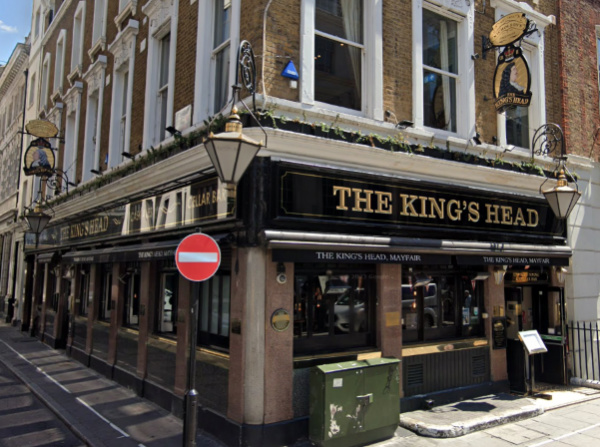
Ignore the rather large no entry sign and look closely to see King George II on the sign to the left of the picture and King Charles II on the sign to the right.PICTURE: Google Maps
It’s a pub dedicated to a king – but which one?
Located at 10 Stafford Street (within walking distance of current royal residences at Buckingham and St James’s Palace), this pub dates back to at least 1710 and has gone through several name changes including, apparently, Shelley’s Hotel and The King John’s Head, but has now returned to its original name of the King’s Head.
While some believe the name refers to King Charles II, there’s another school of thought that says the pub was named for King George II.
With the dispute still apparently live, the owners have cleverly opted to depict the heads of both kings on the pub’s signs.
The pub, which features a cellar bar, is one of a number named The King’s Head in London (we’ll take a look at some others in upcoming posts).
In the lead-up to the coronation of King Charles III and Queen Consort Camilla on 6th May, we’re taking a look at sites in London which have played an important role in coronations past (and, mostly, in this coronation as well).
First up, it’s the Tower of London’s Jewel House which is linked to the coronation through the role it plays in housing the Crown Jewels and, more specifically, the Coronation Regalia.
The centrepiece of the Crown Jewels is St Edward’s Crown, with which King Charles will be crowned in Westminster Abbey.
The crown, which has already been removed from the Tower of London so it could be resized for the occasion, is made from 22 carat gold and adorned with some 444 precious and semi-precious gems. Named for St Edward the Confessor, it dates from 1661 when it was made for the coronation of King Charles II and replaces an earlier version melted down after Parliament abolished the monarchy in 1649.
The crown was subsequently used in 1689 in the coronation of joint monarchs King William III and Queen Mary II and then not used again until 1911 when as used to crown King George V. It was also used to crown King George VI and Queen Elizabeth II in 1953.
St Edward’s Crown is not the only crown that will be used in the coronation ceremony – the King will also wear the Imperial State Crown at the end of the service.
Made by Garrard and Company for the coronation of King George VI in 1937 (replacing a crown made for Queen Victoria in 1838), it features the Black Prince’s Ruby in the front – said to have been a gift to Edward, the Black Prince, in 1357 from the King of Castile.
Further gems in the crown include the Stuart Sapphire, the Cullinan II Diamond and St Edward’s Sapphire, said to have been worn in a ring by St Edward the Confessor and found in his tomb in 1163.
Among other items which will be used in the coronation are the Sovereign’s Sceptre with Cross, the Sovereign’s Orb, and the Coronation Spoon.
The sceptre was made for King Charles II and now features the world’s largest diamond, the Cullinan Diamond, which was added to it in 1911. The orb was also made for King Charles II’s coronation and is topped with a cross.
The spoon, meanwhile, is one of the oldest items in the Crown Jewels, dating from the 12th century. It is used for anointing the new sovereign with holy oil – which comes from the Church of the Holy Sepulchre in Jerusalem – during the ceremony. It survived the abolition of the monarchy after it was purchased by a member of King Charles I’s wardrobe and later returned to King Charles II after the monarchy. The oil is held in a golden vessel known as an ampulla which is shaped like an eagle.
Other items to be used in the coronation are a series of swords – among them the Sword of State, the Sword of Temporal Justice, the Sword of Spiritual Justice, and the Sword of Mercy (this has its tip blunted to represent the Sovereign’s mercy).
The regalia was housed at Westminster Abbey until 1649. They have been kept at the Tower of London since the Restoration (even surviving a theft attempt by Colonel Thomas Blood and accomplices in 1671).
The Crown Jewels, which are now held under armed guard, have been housed in several different locations during their time at the Tower of London including in the Martin Tower and the Wakefield Tower. They were moved into a subterranean vault in the western end of the Waterloo Block (formerly the Waterloo Barracks), now known as the Jewel House (and not to be confused with The Jewel Tower in Westminster), in 1967.
A new Jewel House was opened by Queen Elizabeth II on the ground floor of the former barracks in 1994. The exhibit was revamped in 2012 and following King Charles III’s coronation, the display is again being transformed with a new exhibition exploring the origins of some of the objects for the first time.
WHERE: The Jewel House, Tower of London (nearest Tube station Tower Hill); WHEN: 9am to 4.30pm (last admission), Tuesday to Saturday, 10am to 4.30pm (last admission) Sunday to Monday; COST: £29.90 adults; £14.90 children 5 to 15; £24 concessions (family tickets available; discounts for online purchases/memberships); WEBSITE: https://www.hrp.org.uk/tower-of-london/whats-on/the-crown-jewels/.
Located just to the east of St Edward the Confessor’s Chapel in Westminster Abbey is the lavishly ornate Lady Chapel built on the orders of King Henry VII.
Described as the “last masterpiece of English medieval architecture”, the chapel is the resting place of King Henry VII and his wife Queen Elizabeth of York.
Effigies of King Henry VII and Queen Elizabeth of York. PICTURE: Ann Longmore-Etheridge/Public domain
The couple were the first to be buried in a vault under the floor rather than a tomb but still features an elaborate monument above the floor.
The monument was designed in the Renaissance style by Italian sculptor Pietro Torrigiano and features gilt bronze effigies of the King and Queen lying side-by-side above a black marble base decorated with six medallions representing the Virgin Mary and Henry’s patron saints (who included St Edward the Confessor). At either end of the base are coats of arms supported by cherubs.
A fine grille, designed by Thomas Ducheman, surrounds the monument – once gilded, it featured 30 statues in niches but only six – depicting saints – now remain. The lengthy Latin inscription written on the grille lauds King Henry as “a wise and watchful monarch, a courteous lover of virtue” among other superlatives. There are further inscriptions on the monument.
They’re not the only kings and queen’s buried in the chapel. King James I is buried in the vault under the King Henry VII’s tomb and his wife Queen Anne of Denmark is buried nearby.
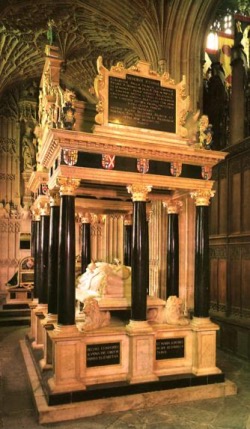
Tomb of Elizabeth I. PICTURE: Wikimedia Commons (licensed under CC BY-SA 4.0)
Queen Elizabeth I is buried in the chapel’s north aisle with a monument above depicting her effigy. Her coffin was placed on top of her half-sister Queen Mary I whose body had been placed there after her death in 1558. The monument was installed on the orders of King James I who, while commissioning a depiction of Queen Elizabeth, didn’t order an effigy of Mary to be made. Instead, she is commemorated with an inscription translated as “Partners both in throne and grave, here rest we two sisters, Elizabeth and Mary, in the hope of the Resurrection.”
The religious differences of the two Queens – Elizabeth being a Protestant and Mary a Catholic – are meanwhile commemorated in an inscription on the floor which reads: “Remember before God all those who divided at the Reformation by different convictions laid down their lives for Christ and conscience sake.”
Buried in a vault beneath the south aisle of the chapel – with just simple inscriptions on stones above (no monuments were erected due to the lack of space apparently – are the remains of the Stuart monarchs King Charles II, Queen Anne (and her husband Prince George), Queen Mary II and King William III.
The rather flamboyant tomb of Mary, Queen of Scots, is also in this aisle. King James I had her remains brought to the abbey from Peterborough Cathedral in 1612 and laid to rest in a marble tomb featuring an elaborate canopy and a white marble effigy at the feet of which stands a crowned Scottish lion. The eldest son of King James I, Henry Frederick, Prince of Wales, was also buried in the Queen’s vault (she was his grandmother), probably due to lack of space.
The young king Edward VI is buried beneath the floor in front of the altar and the last monarch to be buried in the abbey – King George II – lies in a vault under the central aisle along with his wife Queen Caroline and some of their children as well as other family members. On the King’s orders, the sides of the coffins of King George II and that of Queen Caroline were removed so their remains could mingle.
Several other royals – including Princess Mary of Orange, eldest daughter of Charles I and Henrietta Maria, and Prince Rupert of the Rhine – are also buried in the chapel.
HERE: Lady Chapel, Westminster Abbey (nearest Tube stations are Westminster and St James’s Park); WHEN: Times vary – see the website for details; COST: £27 adults/£24 concession/£12 children (discounts for buying online; family rates available); WEBSITE: www.westminster-abbey.org
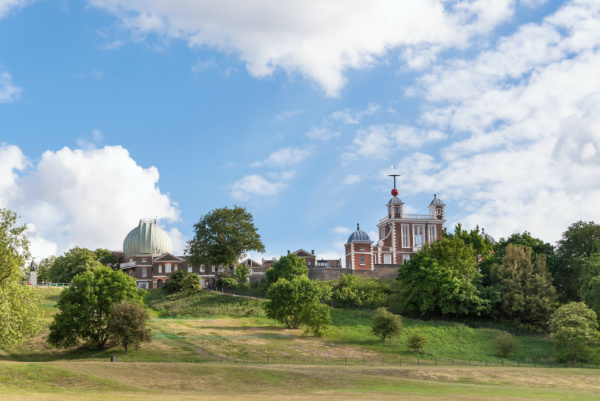
Looking up to the Royal Observatory in Greenwich Park. PICTURE: mkos83/iStockphoto.
The Royal Parks announced recently Greenwich Park, here pictured showing the view up to the Royal Observatory, was to undergo a three year project to restore its 17th century landscape. The formal landscape of the park was commissioned by King Charles II and, designed by French landscape architect André Le Nôtre (who also designed the world-famous Versailles gardens), features tree-lined avenues which frame the view up the hill from the Queen’s House as well as “The Grand Ascent”, a series of giant, grass steps leading up the hill, and a terraced layout – known as a parterre. Massive numbers of visitors – some five million annually – have, however, seen the landscape features erode and slump while the trees – Turkey oaks planted in the 1970s to replace the elms wiped out by Dutch elm disease – are now in decline. The restoration work, which begins next month, will see the terraces restored and the declining tree avenues recreated with 92 new, more resilient trees. The work is scheduled to be completed by March, 2025. For more on Greenwich Park, see www.royalparks.org.uk/parks/greenwich-park.
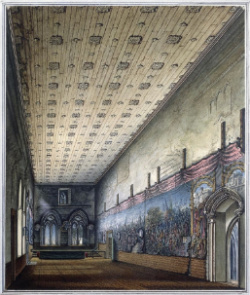
Part of the medieval Palace of Westminster, the Painted Chamber took its name from a series of large paintings which decorated the walls.
A watercolour of the Painted Chamber in Westminster Palace by William Capon made in 1799.
The long and narrow chamber, which stood parallel to St Stephen’s Chapel, was constructed in the 13th century during the reign of King Henry III and was apparently initially intended as a private apartment for the king as well as a reception room.
It featured a state bed at one end positioned under a painting of King Edward the Confessor and also had a “squint” – a small opening at eye level – through which the monarch could view religious services in a chapel located next door.
The chamber was apparently originally known as the King’s Chamber but came to be known as the Painted Chamber when the walls were decorated with paintings depicting vices and virtues and Biblical figures.
These paintings, which were completed over an almost 60 year period from 1226 and which were repaired a couple of times during that period, were added to with commissions by successive monarchs.
The painted chamber was the location for the State Opening of Parliament in the Middle Ages and was where Oliver Cromwell and the others signed King Charles I death warrant in 1649. The body of King Charles II rested here overnight before he was interred in Westminster Abbey.
Later neglected, the walls of the chamber were whitewashed and hung with tapestries and in the early 19th century restoration work was done to reveal the paintings again with artist and antiquarian Charles Stothard commissioned by the Society of Antiquarians in 1819 to make watercolour copies (further copies were also made by the clerk of works at Westminster, Thomas Crofton Croker).
By 1820, the chamber was being used for the Court of Requests, a civil claims court.
The Painted Chamber was gutted when fire devastated much of the Palace of Westminster on the night of 16th October, 1834. It was reroofed and refurnished and used by the House of Lords until 1847 – as well as for the State Opening of Parliament in February, 1835. It was finally demolished in 1851.
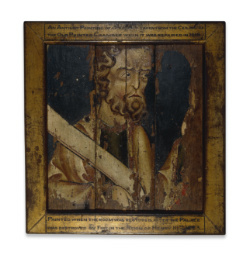
Two ceiling paintings which were removed in 1816 during repairs are now at the British Museum (pictured right).
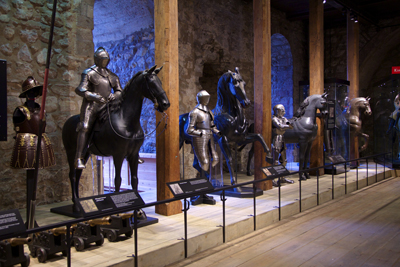
A star sight at the Tower of London for some 350 years, the ‘Line of Kings’ dates back to the mid-17th century and was originally installed in the Royal Armouries at the Tower to promote the restored monarchy of King Charles II and the Stuart dynasty.
Often described as the “world’s longest running tourist attraction” (the first visitor was recorded in 1652), it features the historic armour of monarchs on wooden figures and accompanied by fully decked-out carved horses – the work of Grinling Gibbons and others among Britain’s best woodcarvers.
The line has been added to and redisplayed numerous times over its history, partly to accommodate successive monarchs (17 in all were included with King George II being the last).
Only those monarchs deemed worthy were included – this deemed “bad” kings like King Richard III were omitted while “good” kings like King William the Conqueror, King Edward III and King Henry V were included. Queens were not included – when Queen Mary II and King William III were created joint monarchs, only King William was included.
The display began to be mentioned in guidebooks from the 1750s onwards. In 1825, amid growing scholarship and criticism, the line underwent a major change.
It was dismantled and then redisplayed in a purpose-built gallery adjoining the south side of the White Tower. The new line-up included prominent noblemen as well as kings while the kings themselves were reshuffled with some, like King Edward III, dropped, and King James II added.
It was further enhanced in 1869 but the display closed in 1882. The equestrian figures then appeared on the upper floor of the White Tower.
The Line of Kings, which is now located on the entrance floor of the Tower, last underwent a significant revamp between 2011 and 2013.
Highlights include the earlier surviving armour of King Henry VIII – a silvered and engraved armour which was made in the years following his coronation in 1509 – as well as the gilded armours of King Charles I and King James II.
WHERE: White Tower, Tower of London (nearest Tube station Tower Hill); WHEN: 9am to 5.30pm daily; COST: £29.90 adults; £14.90 children under 15; £24 concession; family tickets from £52.20; WEBSITE: www.hrp.org.uk/toweroflondon/.
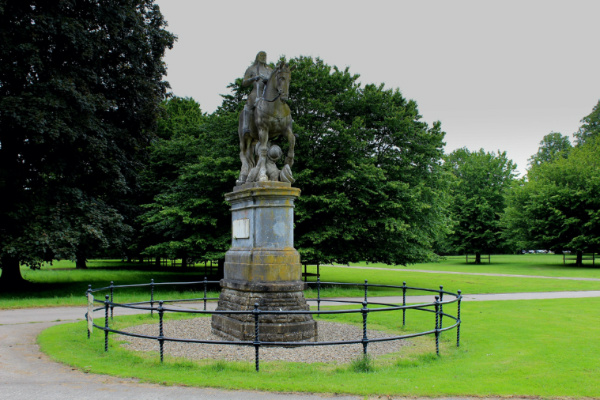
The statue at Newby Hall in North Yorkshire. PICTURE: Chris Heaton (licensed under CC BY-SA 2.0)
Originally installed at the Stocks Market in the City of London, this equestrian statue shows a figure atop a horse which is trampling over a prostrate figure lying on the ground.
The marble statue, which stands on a tall plinth, is believed to have been created in Italy by an unknown sculptor. It originally depicted Polish King John III Sobieski riding down a Turkish soldier. But it was bought to London by goldsmith and banker Sir Robert Vyner in the early 1670s.
A strong supporter of King Charles II, he had the sculpture’s head remodelled by Jasper Latham to depict the King (although the figure beneath was left largely untouched, meaning if it is supposed to represent Cromwell, he’s wearing a turban).
Sir Robert, who had been responsible for making the king’s new coronation regalia to replace items lost or destroyed during the Commonwealth, offered to have the statue installed at the Royal Exchange after it was rebuilt following the Great Fire of 1666. When that was rejected, he had the statue installed at the Stocks Market – originally named for being the only location of fixed stocks in the City – near Cornhill in 1675 (Sir Robert served as Lord Mayor around the same time).
The statue was removed in 1739 to make way for the Mansion House. But all was not lost – given back to Vyner’s grandnephew, also Robert Vyner, it reappeared some years later at the Vyner family estate at Gautby Hall. In 1883, it was relocated to Newby Hall in North Yorkshire (which had come into the family via an inheritance) and still remains there today, about 150 metres east of the hall. It received a Grade II listing in 1967.
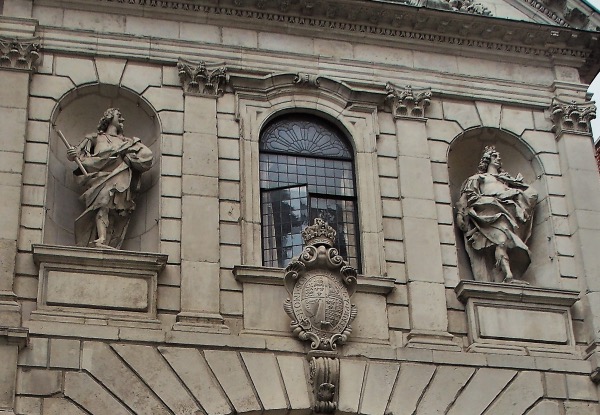
King Charles I (left) and his son King Charles II on what is now the south side of the gateway. PICTURE: haluk ermis (licensed under CC BY 2.0)
The equestrian statue of King Charles I at the top of Whitehall is one of London’s most well-known. But less well-known is the statue of the ill-fated King which can be found standing in a niche on the Temple Bar gateway, located at the entrance to Paternoster Square just outside of St Paul’s Cathedral.
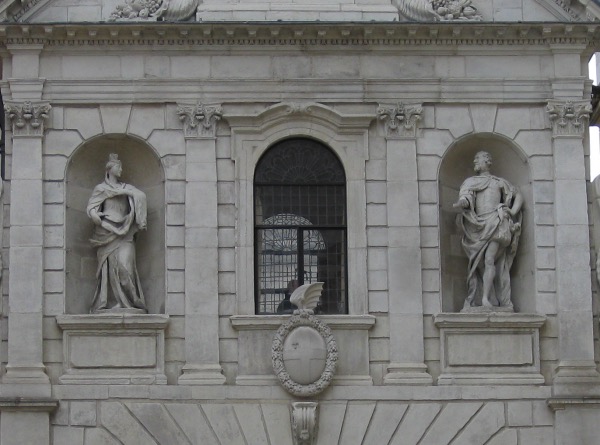
Charles is not alone. Part of the gateway’s purpose was as a dynastic statement in support of the Stuarts so the grand portal also features statues of Charles’ father King James I, his mother Queen Anne of Denmark, and his son King Charles II. King James and Queen Anne can be found on the north side of the gateway (originally the east side) and the two Charles’ on the south side (originally the west side).
The design of the gateway, which originally stood at the intersection of Fleet Street and the Strand as a ceremonial entrance into the City of London, is believed to be the work of Sir Christopher Wren who was acting on the orders of King Charles II after the Great Fire of London.
Queen Anne of Denmark and King James I on the north side of the gateway. PICTURE: lizsmith (licensed under CC BY-NC-ND 2.0)
The statues, which cost a third of the total £1,500 spent on the gateway, are said to have been sculpted by one John Bushnell. They are depicted in Roman attire rather than the dress they would have worn during the period.
They were removed when the gateway was dismantled in 1878 and stored in a yard of Farringdon Road and when the gateway was re-erected at Lady Meux’s Hertfordshire estate at Theobold’s Park, they were placed back in their original locations. And they also accompanied the gateway back to the city when it was positioned its current location in 2004.
The White Tower with external staircase – they’re not the stairs we’re talking about, a remnant of them is located in the niche you can see about half way up the external staircase. PICTURE: Amy-Leigh Barnard/Unsplash.
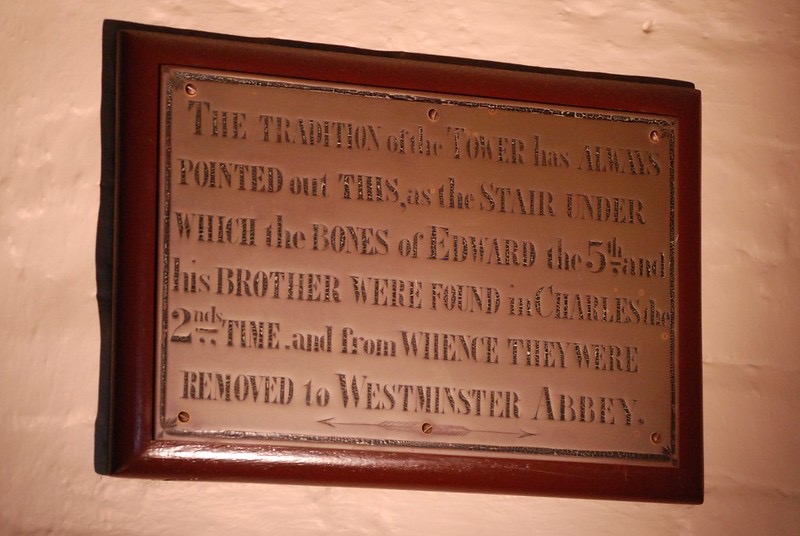
A truncated staircase – really just a few steps – located near the entrance to the White Tower is famous – or perhaps infamous is a better word – for its connection with the so-called ‘Princes in the Tower’ – the 12-year-old King Edward V and his nine-year-old brother, Richard, Duke of York, who disappeared after entering the Tower of London in the late 15th century.
While the princes are believed to have been held in the Bloody Tower, their connection with the staircase, which is located in a doorway niche halfway up the main outer stairway into the White Tower, dates to 1674.
King Charles II had ordered the demolition of what was left of the royal palace to the south of the White Tower and during those works a wooden chest containing two skeletons was discovered beneath the foundations of a staircase which had led up to St John’s Chapel.
Many have subsequently believed the skeletons to be those of the two princes.
A plaque located near the staircase remnant at the Tower of London. PICTURE: Ian McKellar (licensed under CC BY-SA 2.0)
The princes had been taken to the tower in April, 1483, following the death of their father, King Edward IV, on the 9th of that month. Their uncle, Richard, Duke of Gloucester (and the Lord Protector of his nephews), had done so, ostensibly for their protection, while Edward’s coronation was initially scheduled for June.
The last recorded reference to them being in the tower dates from 16th June when they were seen “shooting [arrows] and playing in the garden of the Tower sundry times”.
There has since been much debate over their fate with many believing Richard, who in July of that year was crowned King Richard III, had them murdered to ensure his own ascension to the throne.
The two skeletons found almost 200 years later were put on display for several years following their discovery before King Charles II ordered that they be placed in an urn and reburied in the Henry VII Chapel in Westminster Abbey. In 1933, they were disinterred and forensically examined by LE Tannery and W Wright who concluded they were the skeletons of two boys, aged 10 and 13. They were subsequently reinterred and have remained buried since. They have never been tested for DNA.
Historic Royal Palaces Chief Curator Lucy Worsley and special guests will look at the question of whether the urn should be opened and the bones tested using modern forensic methods in an online event on 16th March at 7pm. Follow this link to register for this event.
WHERE: Tower of London (nearest Tube station Tower Hill); WHEN: 9am to 4.30pm (last admission), Tuesday to Saturday, 10am to 4.30pm (last admission) Sunday to Monday; COST: £29.90 adults; £14.90 children 5 to 15; £24 concessions (family tickets available; discounts for online purchases/memberships); WEBSITE: www.hrp.org.uk/toweroflondon/.
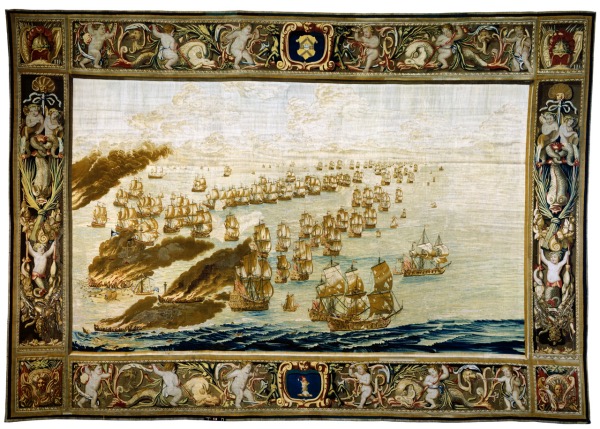
A monumental tapestry – and the only surviving one of its era depicting an English naval scene, the Solebay Tapestry was actually one a series of six designed by father and son team, Willem Van de Velde the Elder and Younger.
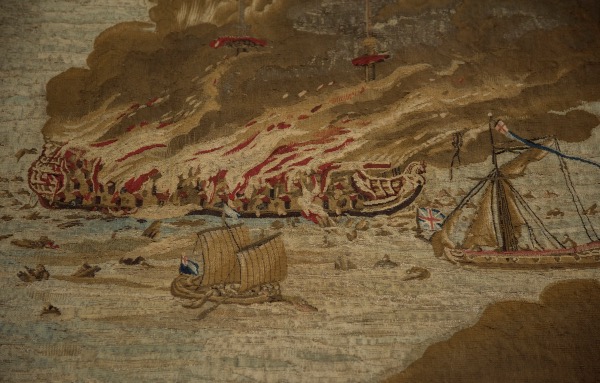
Commissioned by King Charles II and his brother, James, Duke of York (later King James II), the tapestry – known as The Burning of the Royal James at the Battle of Solebay, 28 May 1672 – commemorates the Battle of Solebay, a naval battle fought in Southwold Bay off the coast of Suffolk on 28th May, 1672. The first battle of the Third Anglo-Dutch War, it ended with both sides claiming victory and was the final naval battle in which James was engaged.
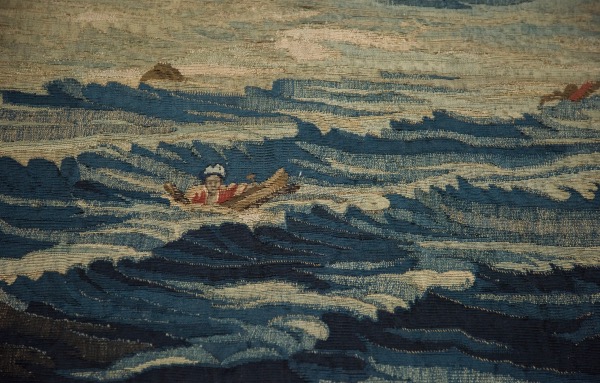
It depicts the dramatic climax of the battle and shows the Royal James engulfed in flames after it wasset alight by Dutch fireships. Edward Montagu, the first Earl of Sandwich whose was aboard the Royal James, died in the attack.
William Van de Veldes the Elder, who was a contemporary of Rembrandt and, along with his son, is considered the founder of English maritime painting, was present at the battle and made a series of sketches from a boat at the scene (he was actually there for the Dutch, not the English).
Subsequently commissioned to reimagine the battle from the English point-of-view, it was the studios of the Van de Velds in the Queen’s House in Greenwich that a series of ‘cartoons’ – large-scale paper designs – were produced using the sketches.
These were then presented to weavers who, once thought to have been based in Mortlake but now believed to have been based in either at Clerkenwell or Hatton Garden, used them to create the tapestries.
The tapestry in the collection of Royal Museums Greenwich was displayed behind King George VI during his speech at the opening of the National Maritime Museum in 1937 but hasn’t been able to be displayed for the past 22 years due to its fragile condition.
In urgent need of repair, the first phase of a conservation project was completed last year. Royal Museums Greenwich has now launched an urgent crowdfunding campaign through ‘Art Happens with Art Fund’ to raise £15,000 for the completion of the project. This will mean the tapestry can be included in an exhibition at the Queen’s House next February marking 350 years since the Van de Veldes’ arrival in England.
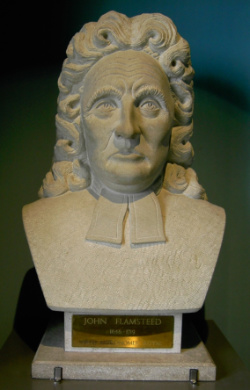
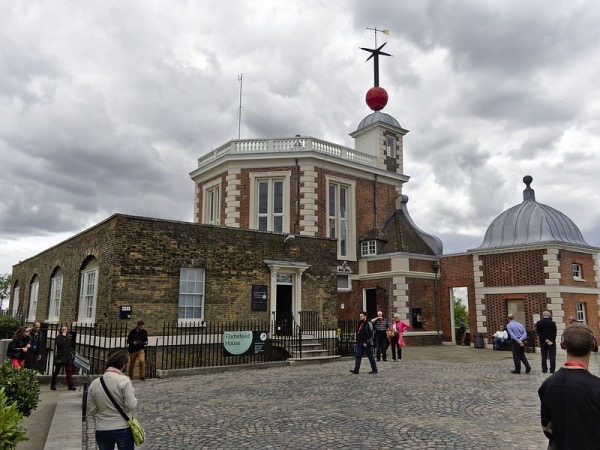
Memorialised in the name of the house where he once lived at the Royal Observatory in Greenwich, John Flamsteed was the first Astronomer Royal.
Flamsteed was born in Denby, Derbyshire, on 16th August, 1646, and was the only child of Stephen Flamsteed, who among other things was involved in the brewing industry, and his first wife Mary (who died when John Flamsteed was still quite young).
A bust of John Flamsteed at the Royal Observatory Greenwich.
He was educated at local schools but left off his studies at the age of 15 due to his own ill health and his father’s need for his assistance in the household and with his business.
His poor health meant he pursued some more sedentary activities and it was during this period that he established interest in astronomy, writing his first paper in 1665. Flamsteed did briefly attend Jesus College in Cambridge in the early 1670s, although it’s not thought he ever took up full residence.
Flamsteed was ordained a deacon and was preparing to take up a living in Derbyshire in 1675 – having by then obtained an MA from Cambridge – when his patron Jonas Moore, whom he’d met in the summer of 1670 during a visit to London and then visited again in mid-1674, invited him to return to the city, ostensibly to establish an observatory which Moore, who was Surveyor-General of the Ordnance, had offered to pay for.
Flamsteed arrived in February, 1675, stayed with Moore in the Tower before, after meeting King Charles II, was made an official assistant to a Royal Commission which the king had established charged with examining the merits of a proposal – put forward by a “le Sieur de St Pierre” to find longitude by the position of the Moon.
The commission decided the proposal wasn’t worth taking further but did recommend the establishment of an observatory from which the movement of the stars and Moon could be mapped in the hope of developing a method of finding longitude. Flamsteed was subsequently appointed “The King’s Astronomical Observator” – the first Astronomer Royal – on 4th March, 1675, by royal warrant, and in June that same year, another royal warrant provided for the founding of the Royal Greenwich Observatory. Flamsteed laid the foundation stone on 10th August.
He was admitted as a fellow of the Royal Society in February the following year and in July he moved into the observatory, now known as Flamsteed House (it contains famed Octagonal Room with large windows from which celestial events could be watched), which was designed by Sir Christopher Wren. It was to serve as Flamsteed’s home for next decade or so.
Flamsteed House, Royal Greenwich Observatory, its named after John Flamsteed. PICTURE: Dmitry Djouce.
Flamsteed’s achievements as an astronomer included the accurate calculation of the solar eclipses of 1666 and 1668 and recording some of the earliest sightings of Uranus which he mistakenly thought was a star. He was also in regular contact with many other scientific luminaries of the day and famously fell out with both Sir Edmond Halley (his one-time assistant and future successor as Astronomer Royal) and Sir Isaac Newton.
Flamsteed’s own catalogue of almost 3,000 stars wasn’t published until after death in 1725 thanks to the effort’s of his wife Margaret – whom he had married on 23rd October, 1692 (they were to have no children although Flamsteed’s niece, Ann Heming, did live with them). Margaret also published his star atlas, Atlas Coelestis, posthumously in 1729.
In 1684, Flamsteed was elevated to the priesthood and made rector of the village of Burstow, near Crawley in Surrey – a post, which, along with that of Astronomer Royal, he held until his death on 31st December, 1719.
He was buried in Burstow and there is a plaque on the wall of the church there marking his grave (which was added long after his death). Aside from his earthly honours – which includes the name of Flamsteed House at the Royal Observatory, a crater on the Moon is named after him as is an asteroid.
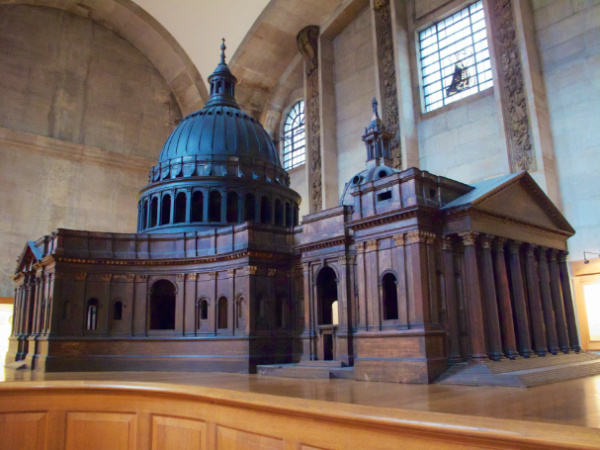
Housed now in the building it depicts, the Great Model of St Paul’s Cathedral was created by architect Sir Christopher Wren to show King Charles II what his proposed grand new English Baroque cathedral would look like (following the destruction of the medieval cathedral in the Great Fire of 1666).
Made of oak, plaster and lime wood, the model was made by William Cleere to Wren’s design in between September, 1673, and October, 1674, at a scale of 1:25. It measures 6.27 metres long, 3.68 metres wide and more than four metres tall, making it one of the largest in the UK.
The model, which cost about £600 to make – an extraordinary sum which could apparently buy a good London house, was designed to be “walked through” at eye level and, as well as being a useful way to show the King what the proposed building would look like, was also something of an insurance policy in case something happened to Wren.
It was based on drawings made by Wren and his assistant Edward Woodroofe on a large table in the cathedral’s convocation or chapter house (later demolished in the early 1690s) and was originally painted white to represent Portland stone with a blue-grey dome and gilded details.
There are some differences between the model and the finished cathedral – among them was a substantial extension of the quire, double-height portico on the west front, and, of course, the bell towers on the west front which were made in place of the cupola which was located halfway down the nave on the model.
Part of an earlier wooden model from 1671 also survives – it was apparently lost for many years and rediscovered in 1935.
The Great Model can be seen on tours of the Triforium.
WHERE: St Paul’s Cathedral (nearest Tube stations are St Paul’s, Mansion House and Blackfriars); WHEN: 8.30am to 4.30pm Monday to Saturday; COST: £21 adults/£18.50 concessions/£9 children/£36 family (these are walk-up rates – online advanced and group rates are discounted); WEBSITE: www.stpauls.co.uk (for tours, head to www.stpauls.co.uk/visits/visits/guided-tours)
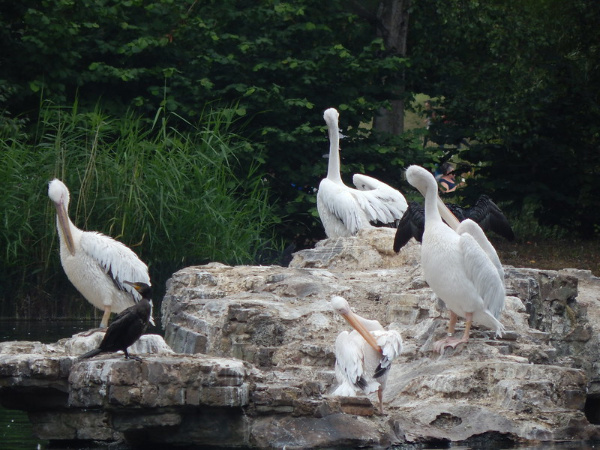
Pelicans were first introduced to St James’s Park in 1664 when a pair of the rather large birds were presented as a gift from the Russian Ambassador to King Charles II. They’ve been there ever since.
More than 40 pelicans have apparently made their home at the park over the years. Past pelicans have included the solitary Daphne – nicknamed the ‘Lady of the Lake’, she lived alone at the park in the early 1970s as well as Astra and Khan, who came from Astrakhan in Russia and were presented by the Russian Ambassador in 1977. There’s also been a Louis, who came from Louisiana in 1982, and Vaclav and Rusalka, who were a gift from Prague Zoo in 1995.
There are currently six members of the ‘scoop’ or ‘squadron’ (just two of the collective nouns used for pelicans) in the park. They include Isla and Tiffany – gifted from Prague in 2013 – and Gargi (gifted in 1996 after he was found in a Southend garden) as well as newer arrivals, brothers Sun and Moon, and a female named Star, all of whom came from Prague Zoo in 2019. Five are Eastern Whites and one is a South American White.
The pelicans are fed fresh fish each day between 2:30pm and 3pm, next to Duck Island Cottage, and while they are free to go where they wish, they rarely go far from the almost 57 acre park. But they did make headlines for eating a pigeon in 2006.
Royal Parks are offering a walking tour of St James’s Park which ends with watching the daily feeding on 5th November. Head here for details.
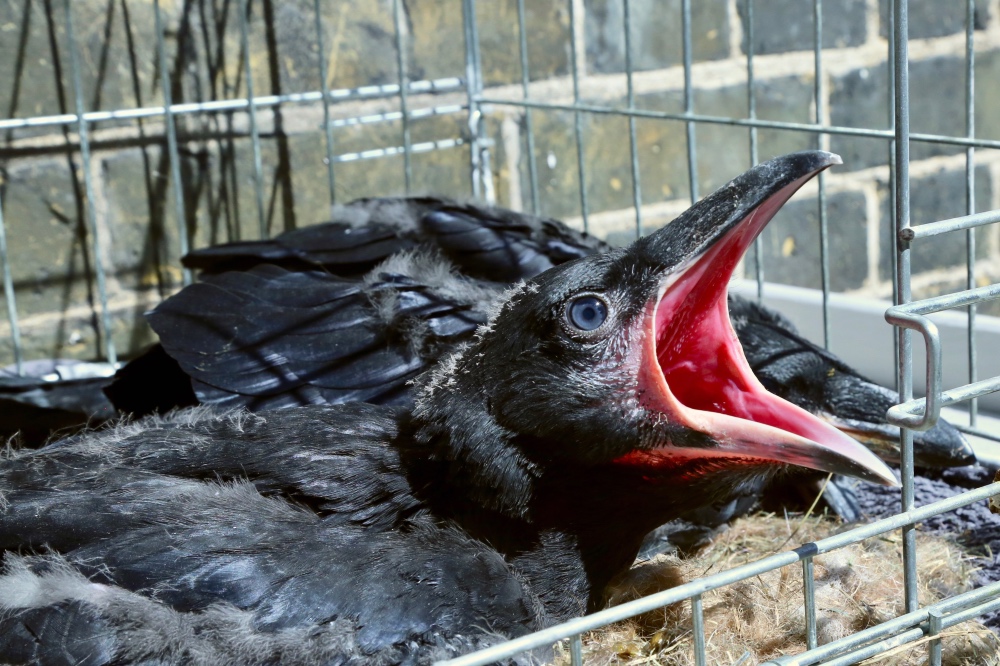
The future of the Kingdom – which legend says will fall should the resident ravens leave the Tower of London – seems secure for now. Three new raven chicks have been born since the country went into lockdown, securing their presence at the Tower for years to come.
The offspring of Huginn and Muninn, who were named after the ravens of the Norse God Odin, the chicks have yet to be named. Born in secrecy, they spent the first couple of weeks with their parents but are now under the care of the Tower’s Ravenmaster, Yeoman Warder Chris Skaife.
The Tower is usually home to six ravens but with eight ravens already in residence, the new chicks will apparently be moving on from the Tower to live with raven breeders in the country, ensuring the future of the Tower ravens bloodline.
They’re not the first chicks to be hatched by Huginn and Muninn – they’re already the parents of Poppy, named for the Tower’s famous 2014 display commemorating the centenary of World War I, and George, who was born on St George’s day at the Tower last year.
The tradition surrounding the special place of the ravens at the Tower is generally attributed to King Charles II following a warning he received that the Kingdom and Crown would fall should they leave.
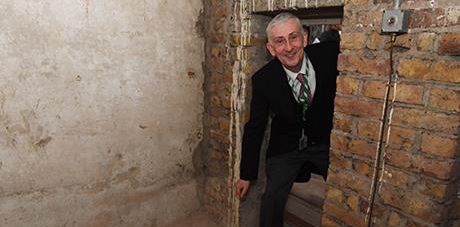
A forgotten door built for festivities surrounding the coronation of King Charles II in 1661 has been rediscovered in the Houses of Parliament.
The door, hidden behind panelling in cloister formerly used as offices by the Parliamentary Labour Party, was originally constructed to allow guests at the coronation to make their way to his celebratory banquet in Westminster Hall.
It was subsequently used by the likes of Robert Walpole, often referred to as the first Prime Minister as well as architect-led rivals Charles James Fox and William Pitt the Younger, and diarist Samuel Pepys.
The door and passageway behind it survived the fire which destroyed much of the Palace of Westminster in 1834 but it was thought the passage had been filled in during restoration works after the Palace of Westminster was bombed in World War II.
Liz Hallam Smith, an historical consultant from the University of York who is working with the team undertaking the renovations, said they were trawling through “10,000 uncatalogued documents relating to the palace at the Historic England Archives in Swindon, when we found plans for the doorway in the cloister behind Westminster Hall”.
“As we looked at the paneling closely, we realised there was a tiny brass key-hole that no-one had really noticed before, believing it might just be an electricity cupboard,” she said. “Once a key was made for it, the paneling opened up like a door into this secret entrance.”
In the small room behind the door, the team discovered the original hinges for two wooden doors some three-and-a-half meters high that would have opened into Westminster Hall. They also found graffiti, scribbled in pencil by bricklayers who worked on the restoration of the palace in 1851 following the 1834 fire.
One section reads “This room was enclosed by Tom Porter who was very fond of Ould Ale” and another, “These masons were employed refacing these groines…[ie repairing the cloister] August 11th 1851 Real Democrats”, the latter a reference suggesting the men were part of the working class male suffrage Chartist movement.
Sir Lindsay Hoyle, the House of Commons Speaker, described the find as “part of our parliamentary history”: “To think that this walkway has been used by so many important people over the centuries is incredible.”
PICTURE: Sir Lindsay Hoyle and the door (UK Parliament/Jessica Taylor)
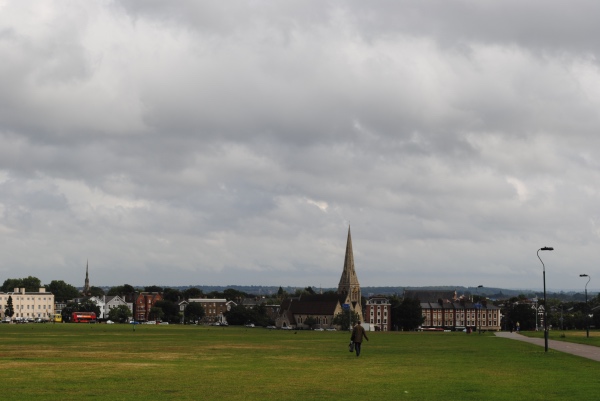
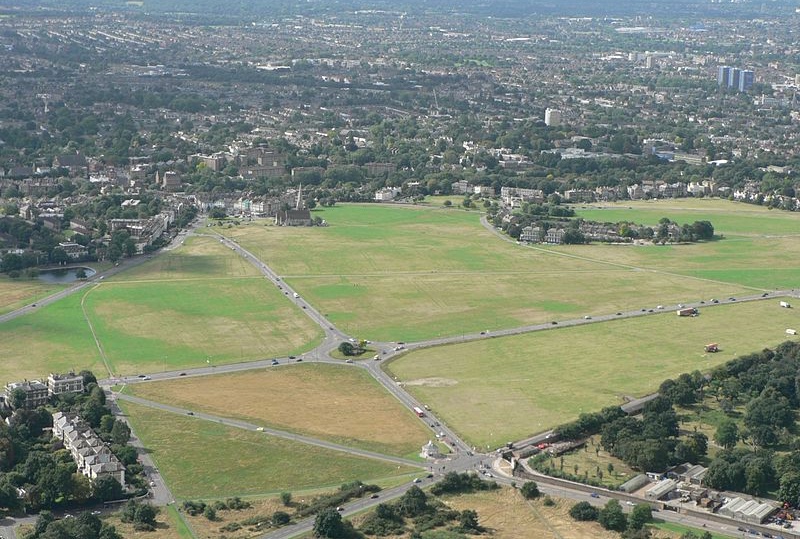
Lying just to the south of Greenwich Park, this famous common apparently derives its name from the colour of the soil (although some suggest it was the colour of the bracken or even the “bleakness” of the location).
On the route from Canterbury and Dover to London, the sometimes windswept locale has seen its share of historical events over the centuries. As well as hosting remains dating to both the Saxon and Roman eras, Blackheath was where the Danes set up camp in 1011-13 (it was during this time that they murdered the Archbishop of Canterbury, Alfege, probably on the site where St Alfege’s Church in Greenwich now stands).
It’s also where Wat Tyler assembled his peasant army during the Peasant’s Revolt of 1381, where Jack Cade and his followers camped in 1450 during the Kentish Rebellion, and where King Henry VII defeated Michael Joseph and his Cornish rebels in 1497.
As well as uprisings, the heath has also seen its share of more joyous events. King Henry IV apparently met Byzantine Emperor Manuel II Palaiologos here in 1400 before taking him back to Eltham Palace, King Henry V was welcomed by the Lord Mayor of London and aldermen here after his momentous victory at the Battle of Agincourt in 1415, and King Charles II was welcomed here on his return to London during the Restoration. Less happily, in 1540 King Henry VIII met Anne of Cleves here for the first time.
During the 18th century, both John Wesley and George Whitefield preached to crowds on Blackheath. Meanwhile, legend has it that King James I founded England’s first golf club here in 1600s (the club joined with the Eltham Golf Club in the 1920s).
The heath, which also had a notorious reputation for highwaymen prior to residential development of the area in the late 18th century, has also been the site of fairs since at least the late 17th century.
But it wasn’t until the early 1800s that the “village” of Blackheath really formed, attracting the moderately well-to-do. The area received a significant boost as a residential locale close to London when the railway opened in 1849.
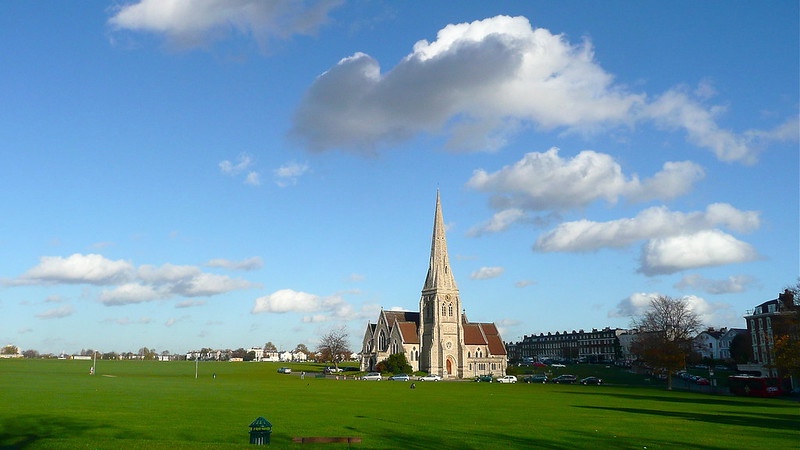
Significant buildings include All Saints’ Church which dates from 1857 and the entertainment venue known as the Blackheath Halls, built in 1895. The Georgian mansion known as the Ranger’s House – which parks on to Greenwich Park – is just to the north.
Notable residents have included early 20th century mathematician and astrophysicist Sir Arthur Eddington, 19th century philosopher and political economist John Stuart Mill, seaside cartoonist Donald McGill and polar explorer Sir James Clark Ross. American writer Nathaniel Hawthorne lived at 4 Pond Road in 1856.
Correction: Wesley and Whitefield preached in the 18th century, not the 19th as originally stated. Apologies for any confusion!
PICTURES: Top – Aerial view of Blackheath (foshie; licensed under CC BY 2.0; image cropped); Below – Looking towards All Saints (Herry Lawford; licensed under CC BY 2.0)
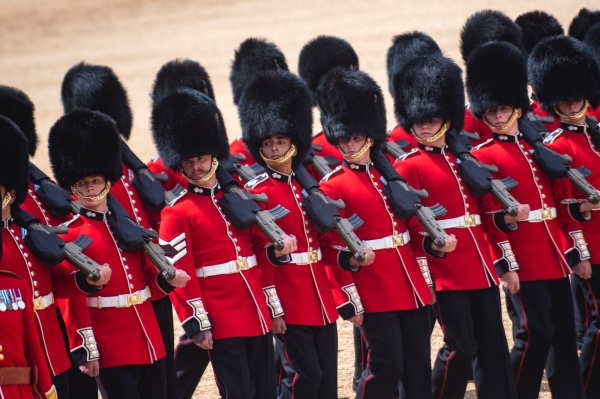
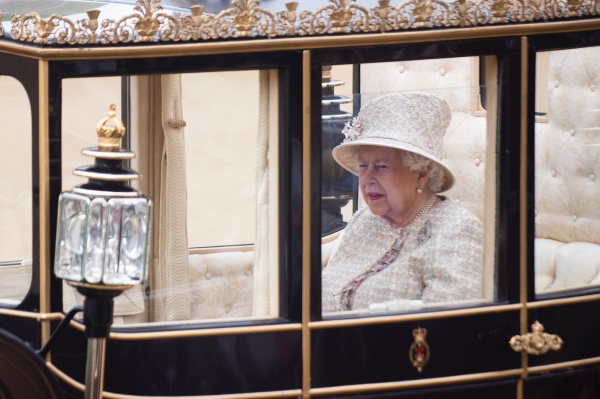
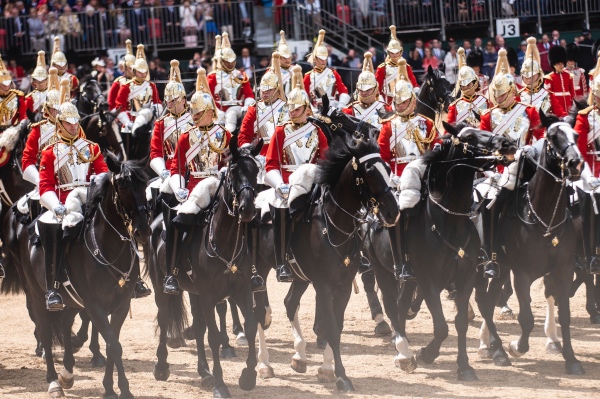
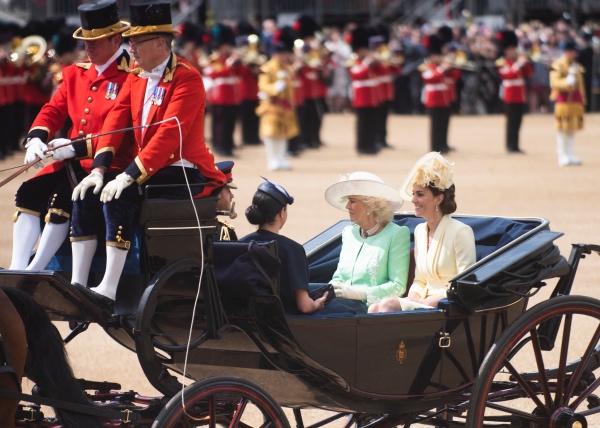
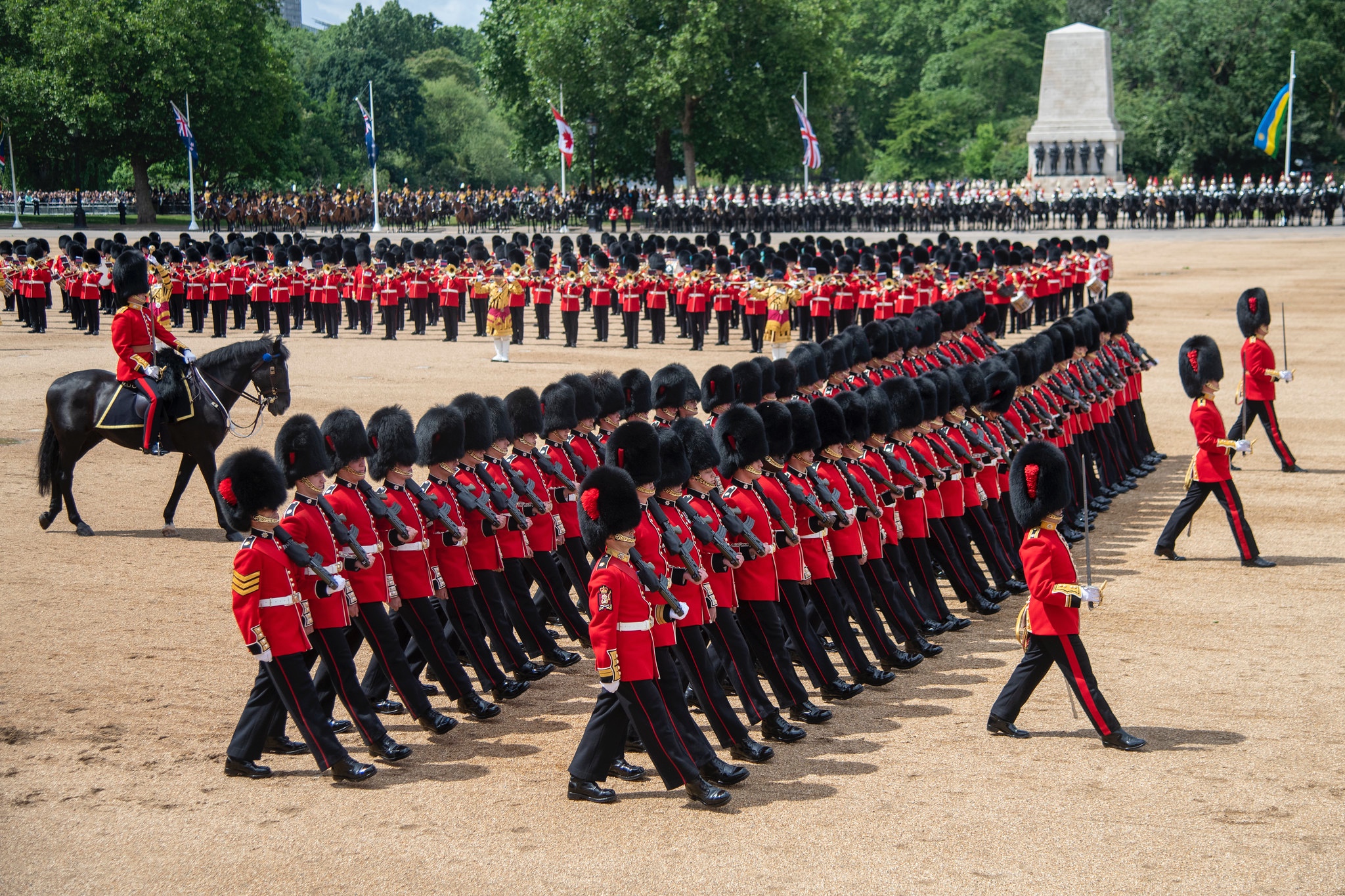
The Queen’s birthday was marked on Saturday with the annual Trooping the Colour in central London. More than 400 soldiers, close to 300 horses and 400 musicians took part in the event, believed to have first been performed during the reign of King Charles II. As well as Queen Elizabeth II, other members of the Royal Family in attendance included Camilla, Duchess of Cornwall, Kate, Duchess of Cambridge, Meghan, Duchess of Sussex, and Prince Harry, Duke of Sussex (see image below). ALL PICTURES: US Department of Defence photo by US Navy Petty Officer 1st Class Dominique A Pineiro (Via Flickr account of the Chairman of the Joint Chiefs of Staff/licensed under CC BY 2.0).
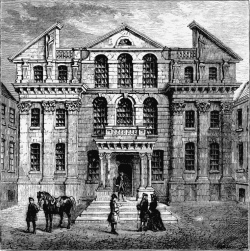
This grand mansion, which once stood on the south side of Soho Square (then called King’s Square), was built for James Scott, the Duke of Monmouth (and ill-fated illegitimate son of King Charles II) in the early 1680s during the early development of the square.
The duke only lived in the property briefly before he headed off to the Netherlands (and was later, in 1685, was executed on Tower Hill for his failed rebellion against the king).
The three storey brick house stood around three sides of a courtyard (some suggest it was designed by Sir Christopher Wren).
The house, which was left unfinished, stood empty for some time after the duke’s death before, in 1689, part of it was briefly turned into a chapel for Huguenot refugees, known as the L’Église du Quarré (they located in 1694).
The house was sold by the Duchess of Monmouth to Sir James Bateman, Lord Mayor of London and a Sub-Governor of the South Sea Company, in 1716, and subsequently remodelled, apparently to the designs of architect Thomas Archer.
Bateman died in 1718 and his eldest son, William (later 1st Viscount Bateman), lived here until 1739. The property was late let to a succession of dignitaries – including the French and Russian ambassadors – and briefly was under consideration for use as a boy’s school.
It was eventually demolished in 1773 and Bateman’s Buildings now occupy the site. A plaque identifies the site as the former location of the mansion.
PICTURE: An 18th century engraving of Monmouth House.
• The lives of convicts in 18th and 19th century London are the subject of a new exhibition opening at the London Metropolitan Archives. Criminal Lives, 1780-1925: Punishing Old Bailey Convicts includes original documents from the Old Bailey archives and items such as a policeman’s truncheon, a reproduction Millbank Prison uniform and convicts’ photographs drawn from collections in Britain and Australia to provide insights into the lives of offenders, from the time of the Gordan Riots in 1760 to the early 20th century. Among those whose lives are featured are prostitute and pickpocket Charlotte Walker, notorious receiver of stolen goods Ikey Solomons and serial thief Thomas Limpus. The exhibition, created in collaboration with the Arts and Humanities Research Council Digital Panopticon Project, opens on Monday and runs until 16th May. Admission is free. There is an accompanying programme of events. For more, see www.cityoflondon.gov.uk/lma.
• The National Gallery is running a season of events aimed at exploring the theme of ‘gold’ in its collection in the run-up to Christmas. Running until 1st January, the programme includes free lunchtime talks, a life drawing session this Friday, a workshop on the traditional intaglio printmaking technique of drypoint, drawing sessions and a series of films. For the full season of events, check out www.nationalgallery.org.uk/whats-on/christmas-at-the-gallery/christmas-events.
Send all items for inclusion to exploringlondon@gmail.com.




 Exploring London