LondonLife – Chocolate kitchens rediscovered at Hampton Court Palace…

Chocolate-kitchen

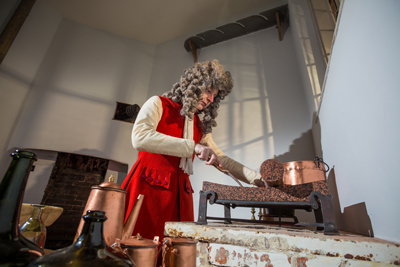
Once making chocolate for kings including William III, George I and George II, a special royal chocolate-making kitchen has opened at Hampton Court Palace – the only surviving example of its kind in the country. The opening – which is part of Historic Royal Palaces’ celebration of the 300th anniversary of the Hanoverian accession – comes after research identified the exact location of the kitchen which, having been used as a storeroom, was found in a “remarkably well preserved” state with original fittings such as the stove and furniture intact. Among those known to have worked in the kitchen is Thomas Tosier (pictured above), personal chocolatier to King George I, and it was in here he prepared special chocolate drinks. (Interestingly, Tosier’s wife Grace apparently traded on her husband’s royal association to promote her own chocolate house in Greenwich). A new display in the kitchen explores how the chocolate was made for the king and features copper cooking equipment and bespoke chocolate serving silverware, glassware and linens from the 18th century. The Royal Chocolate Kitchen will also play host to live Georgian chocolate making sessions. PICTURE: © Historic Royal Palaces/Richard Lea Hair.

WHERE: Hampton Court Palace, East Molesey, Surrey (nearest station is Hampton Court from Waterloo); WHEN: 10am to 4.30pm until 29th March after which it’s open to 6pm); COST: Adult £18.20, Concession £15.40, Child under 16 £9.10 (under fives free), family tickets, garden only tickets and online booking discounts available; WEBSITE:www.hrp.org.uk/HamptonCourtPalace/.

This Week in London – Handel and the royals; David Bailey; and, redefining German art…

• A new exhibition exploring German-born George Frideric Handel and his association with the royal family opens at the Foundling Museum in Bloomsbury tomorrow to mark the 300th anniversary of the coronation of King George I. The museum says no composer has been more closely associated with the British monarchy than Handel, whose anthem Zadok the Priest has been performed at every coronation since King George II in 1727 and whose Water Music was performed on the River Thames during the Diamond Jubilee for Queen Elizabeth II in 2012. By George! Handel’s Music for Royal Occasions features treasures from the Gerald Coke Handel Collection and loans from the British Library, the National Portrait Gallery, the British Museum and Westminster Abbey. Runs until 18th May. For more, see www.foundlingmuseum.org.uk.

A landmark exhibition of David Bailey photographs opens at the National Portrait Gallery today. Bailey’s Stardust – one of the gallery’s largest scale photographic exhibitions, it occupies most of the gallery’s ground floor – features more than 250 portraits including a new portrait of Kate Moss and previously unseen images from Bailey’s travels to the Naga Hills in India in 2012. There’s also rooms devoted to portraits of the Rolling Stones and Catherine Bailey, images from Bailey’s trip to Papua New Guinea in 1974 and from east Africa which Bailey visited in 1985 in support of Band Aid. Admission charge applies. Runs until 1st June. For more, see www.npg.org.uk.

A new exhibition at the British Museum explores how six key artists redefined the notion of art in Germany in the Sixties and Seventies. Germany divided: Baselitz and his generation features some 90 works including some 45 by George Baselitz as well as works by Markus Lupertz, Blinky Palermo, AR Penck, Sigmar Polke and Gerhard Richter. Thirty-four of the works, including 17 by Baselitz, have been donated by Count Christian Duerckheim while a loan of some 60 additional works from the Duerckheim Collection makes up the rest of the exhibition. Runs in Room 90 until 31st August. For more, see www.britishmuseum.org.

Send all items of interest for inclusion to exploringlondon@gmail.com.

Special – 10 facts about royal births of years past…

Buckingham-Palace

As we all know by now, Prince William and Kate, Duchess of Cambridge, are proud parents of a new born son with news of the new arrival provoking celebrations across Britain and, indeed, the world.

To celebrate the royal birth, here are 10 interesting facts about some previous royal births in London…

• The last time a Home Secretary attended a royal birth was in 1936 for the birth of Princess Alexandria, cousin of the Queen. The practice was officially stopped before the birth of Prince Charles in 1948.

• Such was the doubt over whether Mary of Modena, wife of King James II, was really pregnant that more than 40 eminent people were invited to witness the birth of their son Prince James in 1688 (and even then the rumours of that the stillborn baby had been swapped for another were rife).

• Queen Anne, who ruled from 1702-1714, went through 17 pregnancies but, tragically, outlived all of her children, her last surviving child – the Duke of Gloucester – dying in 1700.

• The tradition of firing a 41 gun salute on the news of the birth of a future monarch dates from the birth of the future King Edward VII. Twenty-one shots are fired in honour of the birth with an additional 21 fired because the guns are located in Green Park, a Royal Park.

• Queen Elizabeth II was born by caesarean section at 2.40am on April 21, 1926, at the home of her mother’s parents – 17 Bruton Street in Mayfair. (See our previous post on this here).

• Such was the animosity between Frederick, Prince of Wales, and his father, King George II, that when Frederick’s wife Augusta went into labour at the king’s home of Hampton Court Palace, he bundled her into a coach and had her taken to his home of St James’s Palace. With no preparations made there, his newly born daughter had to be wrapped in a tablecloth (the story is retold in detail in Lucy Worsley’s terrific book, Courtiers: The Secret History of the Georgian Court)

• Queen Victoria, who had nine children, used chloroform for pain relief during later births, despite the concept being frowned upon by some officials.

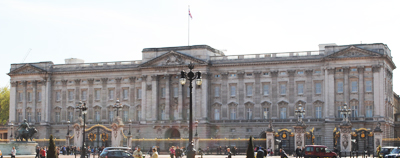
• Buckingham Palace (pictured above) has been the birthplace of numerous Royal Family members. Of course, Prince Charles was born here in 1948 as was his brother Prince Andrew (1960) and Prince Edward (1964) but so too – somewhat earlier – were 14 of King George III and Queen Charlotte’s 15 children when the property was known as Buckingham House and, later, the Queen’s House. King Edward VII was the only monarch who both was born and died in the building.

• Such was the desperation of King Henry VIII for a son, that a document announcing the birth were drawn up to that effect prior to Anne Boleyn giving birth to a daughter, the future Queen Elizabeth I. The document was still issued – the only concession being an ‘s’ added to the end of the word prince.

• The oldest English king to father a child was King Edward I – he was 66-years-old when his last child, Princess Eleanor, was born in 1306. Queen Eleanor of Aquitaine, wife of King Henry II, was the oldest queen to father a child when she gave birth to the future King John at 44-years-of-age in 1166.

LondonLife – Boating on the Serpentine…

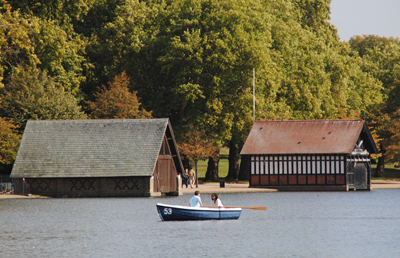
Boating-on-the-SerpentineBoating on the Serpentine in Hyde Park. The 40 acre lake was created in 1730 by the damming of the Westbourne River on the instruction of Queen Caroline, wife of King George II. It was one of the first lakes in England designed to look ‘natural’. There’s a couple of differing explanations for the name of the lake – that it was named for the body of water’s sinuous shape or that it was named for the colour of the water. For more on Hyde Park, check out www.royalparks.org.uk/parks/hyde-parkPICTURE: David Adams


10 Historic London Garden Squares…9. Queen Square…

Queen-Charlotte

This rectangular-shaped square in Bloomsbury, known for its association with the medical profession, was first laid out in the early 1700s and was named for Queen Anne.

Originally known as Devonshire Square, the space was largely laid out between 1716 and 1725 on land owned by Sir Nathaniel Curzon of Kedlestone and, as with so many of London’s squares, attracted it’s fair share of the well-to-do. Among early residents were several bishops and members of the aristocracy.

Queen-SquareOne of the most interesting early associations with Queen Square is that of King George III and his consort Queen Charlotte. The king – better known to many as ‘Mad King George’ – was treated for mental illness in a house on the square and there’s a tradition that Queen Charlotte, stored some of the food to be consumed by the king during his treatment in the base of what is now the pub known as the Queen’s Larder (see our previous entry on the pub here).

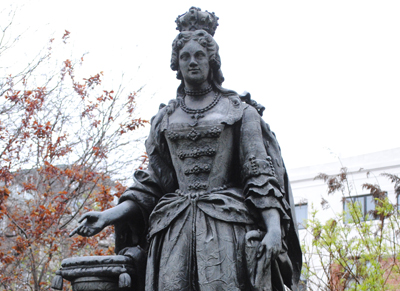
There’s a statue of a queen in the central gardens which was thought to be of Queen Charlotte. Since it was erected in 1775, there has been some confusion over the statue’s identity – it has been thought at different stages to be of Queen Anne, Queen Mary (co-ruler with King William III), and Queen Caroline (consort of King George II) – a fact which has led to some confusion as to which queen the square was named after (although general consensus now seems to be that it was indeed Queen Anne whom the square was named after).

The houses in Queen Square – which was later associated with artists and literary types – were gradually replaced by institutional buildings relating to, among other things, education and the practice of medicine and today it remains a hub for the medical establishment – the National Hospital for Neurology and Neurosurgery and the Royal London Hospital for Integrated Medicine (formerly known as the Royal London Homoeopathic Hospital) are both located on the east side of the square and there are several other medical-related buildings located around it including the former Italian Hospital (Ospedale Italiano) which was founded by Italian businessman Giovanni Battista Ortelli in 1884 for poor Italian immigrants and since about 1990 has been part of the Great Ormond Street Hospital.

SamOther prominent buildings located on the square include the Church of St George the Martyr Holborn (number 44) which, built in 1706, predates the square’s formation. The church is known as the ‘sweep’s church’ due to the practice of a parishioner who provided Christmas dinners for 100 chimney sweep apprentices each year.

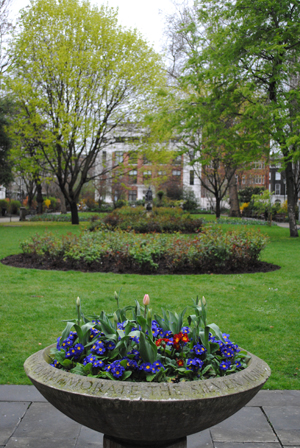
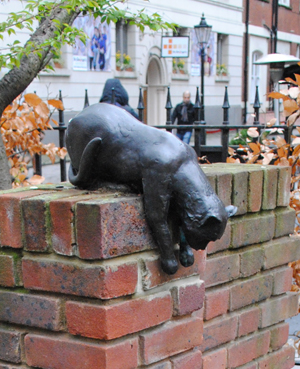
The gardens themselves are protected by an Act of Parliament passed in the 1830s and the gardens are to this day maintained by trustees appointed under that act. Aside from the statue of the queen, monuments in the gardens include a small plaque commemorating the bomb which landed in the square during a Zeppelin raid in World War I (no one was killed), benches commemorating 16 doctors from the homeopathic hospital who died in the Trident air disaster of 1972, and some lines of poetry on a flower bowl and surrounds by Philip Larkin and Ted Hughes in honor of the Queen’s Silver Jubilee of 1977. Statues include a 2001 bronze of Mother and Child and, (this one we love), a sculpture of Sam the cat, apparently a local resident (pictured)!

10 Historic London Garden Squares…1. Leicester Square…

In the first of a new Wednesday series looking at historic London garden squares, we take a look at what next to Trafalgar Square, is the most famous square in the entire city – Leicester Square.

Located in the heart of the West End, Leicester Square’s history finds its origins back in the 17th history when Robert Sidney, the 2nd Earl of Leicester acquired property on the site where the square now stands. Then known as St Martin’s Field and located within the parish of St Martin’s, Sidney purchased four acres in 1630 and constructed Leicester House on land now located at the square’s northern end.
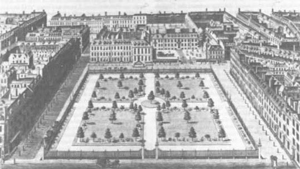
Leicester-SquareThe earl raised the ire of locals, however, when – having subsequently fenced off the land to prevent people from wandering on to his property – he enclosed what had previously been common land.

The people appealed to King Charles I who appointed three members of the Privy Council to look at the issue. Their decision? That the earl keep a section of his land open for the use of the parishioners of St Martin’s.

First known as Leicester Field, it was this land which later became known as Leicester Square. Fine homes were built around the square (its proximity to the Royal Court and centre of government made it a desirable place to live for the well-to-do and those seeking influence) with the centre enclosed with rails (it’s pictured here in 1750).

The square’s reputation also had a royal boost when, in 1717/1718, Leicester House became home to Prince George (later King George II) and his wife Princess Caroline along with their court after the prince fell out with his father King George I and was banished from St James’ Palace (this story is recounted in marvellous detail in Lucy Worsley’s terrific book, Courtiers: The Secret History of the Georgian Court).

The prince remained at the house for 10 years and was proclaimed King George II after his father’s death at its gate. Interestingly, King George II’s eldest son, Prince Frederick, also lived here for a time after he too fell out with his father (King George II). Apparently their relationship was even worse than the previous generation’s had been.

Despite its royal attractions, even at this stage the square apparently had it’s darker side with some less than savoury characters attending the hotels and livery stables that were built there. But things were to get worse as the wealthy moved out – a situation not helped when Leicester House was demolished in the 1790s.

Leicester Square became known as an entertainment venue in the 19th century (among attractions was the short-lived Royal Panopticon of Science and Art which showcased the best in science and art and Wyld’s Great Globe which contained a gigantic model of the earth) and received a new injection of life when theatres and music halls moved in, bringing the crowds back with them.
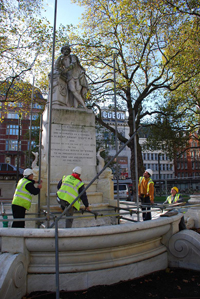
Shakespeare-StatueMeanwhile, the status of the square – and whether it could be built upon – remained a matter of debate well into the 19th century. That ended in 1874 when businessman Albert Grant bought the freehold of the land, had the garden created upon it and then donated it to the Metropolitan Board of Works as a gift to the city.

Responsibility for the management of the square now rests with the City of Westminster. The square area – which is now known for hosting film premieres as well as the tourists who inevitably gather there – was pedestrianised in the 1980s and has just undergone a redevelopment and modernisation which was unveiled last year.

Meanwhile, work to restore the 19th century Shakespeare statue and fountain in the square’s centre is about to be completed (pictured). The square also contains a statue of actor Charlie Chaplin in the square as well as busts of scientist Sir Isaac Newton, painter and first president of the royal Academy Sir Joshua Reynolds, 18th century pioneer surgeon John Hunter, and painter William Hogarth.

The tradition of the entertainment continues in the modern era through the cinemas which now stand in the square and regularly host film premieres (an interesting, if oft-repeated, film-related anecdote connected to the square is that it was in a phone booth located at the square that during the 1960s a young actor Maurice Micklewhite saw a poster for The Caine Mutiny and decided to change his name to Michael Caine).

PICTURES (top) Wikipedia and (below) City of Westminster.
Where is it?…#61…

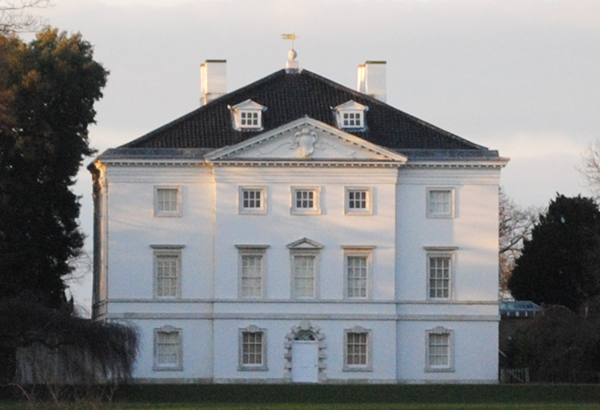
Where-is-it--#61Can you identify where in London this picture was taken and what it’s of? If you think you can, leave a comment below. We’ll reveal the answer early next week. Good luck!

Well done to Sue and Helen – this is, of course, Marble Hill House, located in south-west London on the banks of the River Thames between Richmond and Twickenham (this picture is taken from the opposite side of the Thames). Built for Henrietta Howard, mistress of King George II when he was Prince of Wales, for the lady in her “retirement” from court, the Palladian villa is set among 66 acres of parkland. We’ll look at the house in more detail in a later post.

WHERE: Marble Hill House, Richmond Road, Twickenham (nearest Tube station is Richmond (1 mile) or train station, St Margarets (0.5 mile)); WHEN: 10am-2pm Saturday, 10am to 5pm Sunday (cafe and park are open daily); COST: £5.70 adults/£5.10 concessions/£3.40 child (5-15 years); WEBSITE: www.english-heritage.org.uk/daysout/properties/marble-hill-house/.

Around London – Bedchamber secrets at Hampton Court; Roman remains at the British Museum; Easter chocolate at Kew Gardens; Harry Beck’s blue plaque; and, Underground art…

Happy Easter! We’re taking a break over the Easter weekend…Our next update will be on Tuesday, 2nd April.

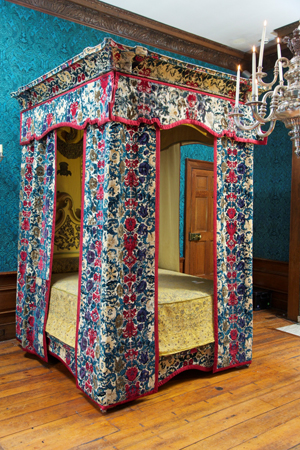
Mary-of-Modena's-bedA new exhibition exploring the secrets of the bedchambers of the Stuart and Hanoverian courts of the 17th and 18th centuries opened at Hampton Court Palace this week. At the heart of Secrets of the Royal Bedchamber are six royal beds which tell the story of why the bedchamber became the most important part of the palace and detail some of the events that took place there before an audience of courtiers, politicians and family members – from births and deaths to the consummation of marriages and the discussion of important affairs of state. It tells of why courtiers would fight for positions such as the ‘groom of the stool’ or ‘necessary woman’ and how beds which could cost the same as a London townhouse were sometimes never slept in. Among the beds on display is the ‘Warming Pan Bed’ (pictured), the State Bed of King James II’s queen, Mary of Modena, and scene of the royal birth that ultimately led to the end of the Stuart line, and the ‘Travelling Bed’ of King George II which travelled as far afield as Hanover and the battlefields of Europe. The exhibition also gives rare access into the Prince of Wales’ Apartments, designed by 17th and 18th architect Sir John Vanbrugh, and now open for the first time in 20 years.  Admission charge applies. Runs until 3rd November. For more, see www.hrp.org.uk. PICTURE: HRP

The Roman cities of Pompeii and Herculaneum are the subject of a major exhibition opening at the British Museum today. Life and death in Pompeii and Herculaneum brings together more than 250 objects from the two cities which were buried in just 24 hours during the eruption of Mount Vesuvius in 79 AD. The objects include celebrated finds and recent discoveries, many of which have never before been seen outside Italy, and help explore what daily life was like for the inhabitants. Artefacts include a beautiful wall painting from Pompeii showing baker Terentius Neo and his wife, wooden furnishings including a linen chest, inlaid stool, and even a baby’s crib from Herculaneum, and casts of victims including a family of four and a dog who died at Pompeii. Runs until 29th September. Admission charge applies. For more, see www.britishmuseum.org.

Find out more about the history of chocolate at Kew Gardens this Easter, from the ritualistic use of cacao in ancient Mayan and Aztec cultures to the arrival of chocolate in 17th century London, where it was a luxury item for high society to indulge in at newly fashionable chocolate houses. Running from tomorrow until 14th April, there will be a range of workshops taking place at the gardens around the chocolate theme along with a traditional Easter Egg Hunt on Easter Sunday (31st March). The garden’s cocoa tree can be found in the Princess of Wales Conservatory. Admission charge applies. See www.kew.org.

Harry Beck, designer of the innovative first diagrammatic Tube map, has been honoured by an English Heritage blue plaque – inscribed in the Underground’s new Johnston typeface – at his birthplace in Leyton in London’s east. Beck, who was born in a small terraced house at 14 Wesley Road in 1902, was working with London Transport as a draughtsman in the London Underground Serial Engineer’s Office, when, in 1931, he produced his first design for a diagrammatic map. He continued to update the map with new stations and lines even after leaving London Transport with the last version of his map published in 1960. Beck died in 1974. Meanwhile, a blue plaque commemorating railway engineer Sir Nigel Gresley (1876-1941) has been returned to King’s Cross station following the completion of building work. It can be found on platform 8. For more, see www.english-heritage.org.uk/discover/blue-plaques/.

On Now: The Underground. A commission from Art on the Underground, this exhibition of artist Mark Wallinger’s work at the Anthony Reynolds Gallery (60 Great Marlborough Street) features some examples of 270 labyrinth designs – one representing each of the Underground stations – which are being installed at the Tube stations themselves. Among those stations represented at this showing are Westminster, St James’s Park, Oxford Circus, Victoria, Embankment, Green Park, King’s Cross St Pancras, Baker Street and Tottenham Court Road. While labyrinths are already in place at these locations, the remainder of Wallinger’s labyrinth designs will be appearing at Tube stations over the coming months. Runs until 27th April. For more, see www.anthonyreynolds.com.

Treasures of London – The Royal Kitchens, Kew…

Given this week’s release of English Heritage’s The London List 2011 – which lists all properties given a new or upgraded heritage listing last year, we thought it was only appropriate to look at one of the properties listed, in this case the Royal Kitchens in Kew Gardens.

Upgraded to a Grade I listing in 2011, the kitchens were opened to the public for the first time in May this year following a £1 million restoration. The origins of the kitchens go back to the 1730s when they were built to the designs of William Kent to serve the White House, the grand mansion of Frederick, Prince of Wales (eldest son and heir of King George II).

While the White House was demolished in 1802, the Georgian kitchens – built in a separate building to mitigate the risk of fire – were kept to serve the nearby premises of Kew Palace (formerly known as the “Dutch House”, it had been originally built in 1631 for a Flemish merchant).

But after the death of Queen Charlotte (wife of King George III) in 1818, members of the Royal family only stayed occasionally and so the kitchen fell into disuse. While the upper floors were given over to accommodation, the lower floor remained untouched, allowing it to survive in a considerable degree of intactness.

The kitchens centre on the double storey ‘Great Kitchen’ featuring three charcoal stoves as well as a rare cooking range with “smoke jack” and fan. Other rooms include a scullery, a bakery, larders and stores for silver and spices while among the surviving furnishings is a preparation table or dresser, cupboards, shelves and baking ovens. Upstairs, the office of the clerk who oversaw the feeding of the Royal Household has been restored.

Historic Royal Palaces, who look after the kitchens, have installed a new permanent exhibition at the site which focuses life on the 6th February, 1789, the date when King George III, having suffered his first bout of ‘madness’ (believed to be porphyria), was given back his knife and fork. William Wybrow was the Master Cook at this time and William Gorton the Clerk of the Kitchen.

WHERE: The Royal Kitchens, Kew Gardens, Kew (nearest Tube Station is Kew Gardens); WHEN: 11am to 5pm daily until 30th September, then Thursday to Sunday until 28th October, then daily again until 4th November; COST: Kew Gardens tickets must be purchased – £16 adults/£14 concessions/children under 16 free – and then tickets to Kew Palace – £6 adults/£4.50 concessions/children under 16 free (or free with annual Historic Royal Palaces membership); WEBSITE: www.hrp.org.uk/kewpalace/stories/palacehighlights/royalkewkitchens.

PICTURE: Forster/HRP

For more on Kew Palace, check out Kew Palace: The Official Illustrated History.

Celebrating the Diamond Jubilee with 10 royal London locations – 2. The Queen’s childhood homes

Having spent the first few months of her life at 17 Bruton Street, the future Queen Elizabeth II moved into her parents’ new property at 145 Piccadilly.

The property, located close to Hyde Park Corner, was previously the townhouse of the Marquesses of Northampton (interestingly, it was while living here that her father the Duke of York first started visiting the Harley Street-based Australian speech therapist Lionel Logue, as depicted in The King’s Speech). The 25 bedroom house was later destroyed by a bomb during the war, long after the Yorks had moved out.

As well as the house at 145 Piccadilly, the young Princess Elizabeth (and from 1930 her younger sister and only sibling Princess Margaret) also lived at White Lodge in the centre of Richmond Park in the city’s south-west. The Lodge, a Georgian property built as a hunting lodge for King George II, now houses part of the Royal Ballet School.

She also considerable time outside the city, staying in places including Scotland with her grandparents at either Balmoral Castle (owned by the Royal Family) or at Glamis Castle (owned by the parents of her mother, the Earl and Countess of Strathmore) as well as, from the age of six, at Royal Lodge in Windsor Great Park, the country home of the Yorks. The princess apparently had her own small house, known as Y Bwthyn Bach (the Little Cottage), in the grounds  – a gift from the people of Wales in 1932.

Following the death of King George V and subsequent abdication of King Edward VIII in 1936, new King George VI and his family moved from 145 Piccadilly to Buckingham Palace. Following the outbreak of World War II in 1939, the princesses lived in Balmoral, Scotland, and Sandringham but spent most of the war at Windsor Castle.

Princess Elizabeth, meanwhile, had met Prince Philip of Greece during the 1930s and in 1947, he asked for permission to marry her.