LondonLife – Location of Shakespeare’s Blackfriars house pinpointed…

It’s exact location has long been a mystery but now new research has pinpointed the exact location of William Shakespeare’s Blackfriars house.
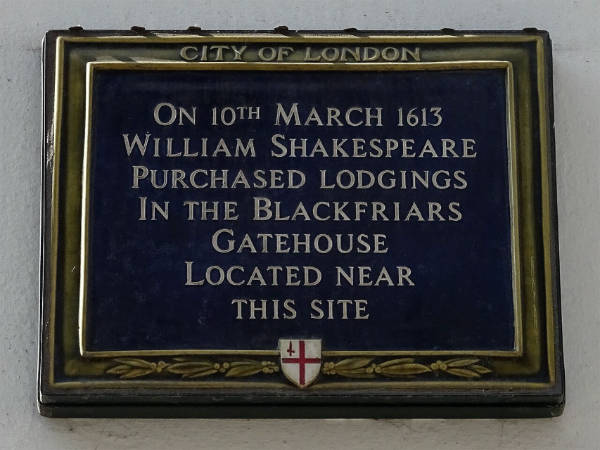
The City of London plaque at 5 St Andrew’s Hill. PICTURE: Spudgun67 (licensed under CC BY-SA 4.0)

The discovery, the results of which were released last week, was made by Shakespeare expert Professor Lucy Munro, of King’s College London.

Professor Munro has been able to shed new light on the location using two documents from The London Archives and one from The National Archives.

One of the documents found in The London Archives – a plan of the Blackfriars precinct drawn up in 1668 – shows exactly where the property, which Shakespeare bought on 10th March, 1613, at the age of 48, was located.

It puts it at what is now the eastern end of Ireland Yard and the bottom of Burgon Street and also covered the land now occupied by sections of 19th century buildings at 5 Burgon Street and 5 St Andrew’s Hill.

Interestingly, the property 5 St Andrew’s Hill bears a City of London blue plaque, placed there in 2013, which suggests the house was located “near this site”. The find shows it was not just near, but actually on, part of the site.

The find also confirmed that the site of the house was partly located on land which had been previously occupied by the “great gate” that led into Blackfriars monastery – long known by historians.

It is possible that Shakespeare wrote the play The Two Noble Kinsmen, which he co-authored with John Fletcher later in 1613, while living in the property.

The property, which was located near a tavern at the Sign of the Cock (the Cockpit pub is now located on the site), was left to Shakespeare’s eldest daughter Susanna and then his grand-daughter Elizabeth Hall Nash Barnard who sold it in 1665, just a year before it was destroyed in the Great Fire of London in 1666.

Professor Munro’s research has been published in The Times Literary Supplement.

We’ve corrected the name of the Shakespeare play.

Treasures of London – William Shakespeare’s last will and testament…

William-Shakespeares-Will

Recently conserved by the National Archives, Shakespeare’s last will and testament is at the heart of a new exhibition on show at Somerset House.

By Me William Shakespeare: A Life In Writing, the first joint exhibition of the National Archives and King’s College London, features four of the six known signatures of Shakespeare still in existence and, along with his last will and testament, shows some of the most significant Shakespeare-related documents in the world tracking his existence as everything from a London citizen, businessman, family man, servant to possibly even a thief and subversive.

But back to the will. While not written in the Bard’s hand, the will is signed by him in three places and indicates the wealth and status he had garnered by the time of his death on 23rd April, 1616.

Evidence shows that Shakespeare revised his will as his estate changed, and just before his death, he added personal bequests including that a silver bowl be given to his second eldest daughter Judith, memorial rings to actor friends in London and his second best bed to his wife Anne. He left most of his property to his eldest daughter, Susanna, although his will, according to the National Archives, indicates that he had hoped to establish a male legacy.

Other beneficiaries named in the will include his sister Joan and her sons and his grand-daughter Elizabeth Hall while Susanna and her husband John Hall were named as his executors.

The exhibition, which is being held in the Inigo Jones Rooms in Somerset House’s East Wing as part of the series of events being held to mark the 400th anniversary of Shakespeare’s death, runs until 29th May. Admission charge applies.

Other documents featured in the display – all of which are registered with UNESCO – include accounts listing the grant of four-and-half yards of red cloth to Shakespeare by King James I for participation in his coronation procession in 1604, accounts from the Master of Revels showing when plays were performed at court (useful for helping to date when Shakespeare wrote particular plays), and a document recording testimony Shakespeare gave in court when his landlord, Christopher Mountjoy, failed to provide his son-in-law with a dowry for his daughter’s hand (Shakespeare is likely to have played a role in arranging the marriage).

For more on the exhibition, see www.bymewilliamshakespeare.org.