LondonLife – Location of Shakespeare’s Blackfriars house pinpointed…

It’s exact location has long been a mystery but now new research has pinpointed the exact location of William Shakespeare’s Blackfriars house.
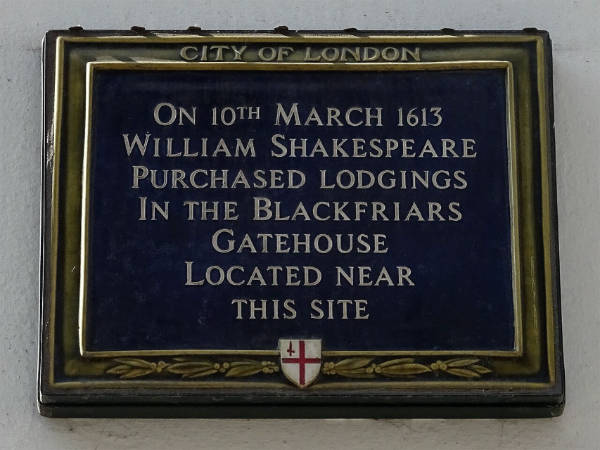
The City of London plaque at 5 St Andrew’s Hill. PICTURE: Spudgun67 (licensed under CC BY-SA 4.0)

The discovery, the results of which were released last week, was made by Shakespeare expert Professor Lucy Munro, of King’s College London.

Professor Munro has been able to shed new light on the location using two documents from The London Archives and one from The National Archives.

One of the documents found in The London Archives – a plan of the Blackfriars precinct drawn up in 1668 – shows exactly where the property, which Shakespeare bought on 10th March, 1613, at the age of 48, was located.

It puts it at what is now the eastern end of Ireland Yard and the bottom of Burgon Street and also covered the land now occupied by sections of 19th century buildings at 5 Burgon Street and 5 St Andrew’s Hill.

Interestingly, the property 5 St Andrew’s Hill bears a City of London blue plaque, placed there in 2013, which suggests the house was located “near this site”. The find shows it was not just near, but actually on, part of the site.

The find also confirmed that the site of the house was partly located on land which had been previously occupied by the “great gate” that led into Blackfriars monastery – long known by historians.

It is possible that Shakespeare wrote the play The Two Noble Kinsmen, which he co-authored with John Fletcher later in 1613, while living in the property.

The property, which was located near a tavern at the Sign of the Cock (the Cockpit pub is now located on the site), was left to Shakespeare’s eldest daughter Susanna and then his grand-daughter Elizabeth Hall Nash Barnard who sold it in 1665, just a year before it was destroyed in the Great Fire of London in 1666.

Professor Munro’s research has been published in The Times Literary Supplement.

We’ve corrected the name of the Shakespeare play.
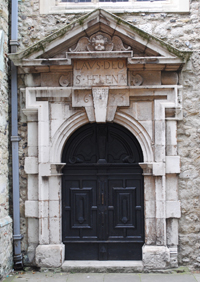
10 sites from Shakespearean London – 3. Shakespeare’s houses…

The playwright is believed to have lived in several different locations in London and is also known to have invested in a property. Here we take a look at a couple of different locations associated with him…

St-Helen'sBishopsgate: Shakespeare is believed to have lived here in the 1590s – in 1596 tax records show he was living in the parish of St Helen’s. The twin-nave church of St Helen’s Bishopsgate (pictured), which would have been his parish church, still stands. In fact, there is a window to Shakespeare’s memory dating from the late 19th century.

•  Bankside: In the late 1590s, Shakespeare apparently moved across the Thames to Bankside where he lived at a property on lands in the Liberty of the Clink which belonged to the Bishop of Winchester. The exact address remains unknown.

Silver Street, Cripplegate: It’s known that in 1604, Shakespeare moved from Bankside back to the City – it’s been speculated outbreaks of plaque may have led him to do so. Back in the City, he rented lodgings at the house of Christopher and Mary Mountjoy in on the corner of Monkwell and Silver Streets in Cripplegate, not far from St Paul’s Cathedral. Mountjoy was a refugee, a French Huguenot, and a tire-maker (manufacturer of ladies’ ornamental headresses). The house, which apparently stood opposite the churchyard of the now removed St Olave Silver Street, was consumed in the Great Fire of London in 1666 (the church was also lost in the Great Fire). The former church site is now located on the south side of London Wall. Silver Street itself was wiped out in the Blitz and is now lost under the Barbican redevelopment but the house lives on in a representation found on a late 16th century map created by Ralph Agas.

Ireland Yard, Blackfriars: In 1613, Shakespeare purchased the former gatehouse of the Blackfriars Priory located here, close to the where the Blackfriars Theatre was located. It is believed the property was purchased as an investment – there’s no evidence he ever lived there but it was passed to his daughter Susanna after his death. Incidentally, there is some speculation that Shakespeare may have lived in Blackfriars when he first came to London – a man believed to have been a boyhood friend from Stratford, Richard Field, who was known to have lived there.

For a more in-depth look at Shakespeare’s time in Silver Street, see Charles Nicholl’s The Lodger: Shakespeare on Silver Street.

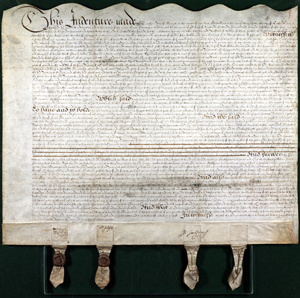
Treasures of London – Shakespeare’s Blackfriars deed…

Shakespeare's-DeedIn 1613, the playwright William Shakespeare – now widely regarded as the greatest writer of the English language – purchased a property in Blackfriars.

The only real estate he was to buy in London, the purchase of the gatehouse – which may have stood on the junction of St Andrew’s Hill and Ireland Yard – was apparently made as an investment (Shakespeare never lived there).

The deed which recorded the sale (dated 10th March, 1613) – only one of six documents in the entire world which bears Shakespeare’s authenticated signature – is in the care of the London Metropolitan Archives.

According to the deed, he bought the property from Henry Walker, a minstrel, paying £140 for the property (he mortgaged £60 of it the next day – the document for this is located in the British Library).

Other parties mentioned on the document are William Johnson, a London-based vintner and possibly landlord of the Mermaid tavern in Cheapside, and two ‘gentlemen’ John Jackson and John Heminges, an actor, manager and editor of Shakespeare’s first folio.

They were appointed as trustees in Shakespeare’s interest and handled the sale of the property after Shakespeare’s death in 1616. The copy of the deed held by the LMA was that of Henry Walker (Shakespeare’s copy is in the Folger Shakespeare Library in Washington).

The deed is currently on display as part of an exhibition surrounding the 400th anniversary of its signing. ‘Shakespeare and London’, a free exhibition, also features other documents from the period as well as maps, prints and models and runs at the LMA (40 Northampton Road) until 26th September. Due to the age and importance of the deed, the deed itself will only be displayed at specific times – check the LMA website for details.