What’s in a name?…Kew…

Kew-PalaceFamed as the location of the Royal Botanic Gardens, Kew is a Thames-side suburb in London’s west.

It’s the riverside location which gives the area its name – Kew is apparently a corrupted form of Cayho, a word first recorded in the early 14th century which is itself made of two words referring to a landing place (the ‘Cay’ part) and a spur of land (the ‘ho’ part). The latter may refer in this case to the large “spur” of land upon which Kew is located, created by a dramatic bend in the Thames. The former may refer to a ford which crossed the river here (explaining the name of Brentford on the other side).

While the area had long been the home of a small hamlet for the local farming and fishing community, more substantial houses began to be developed in Kew in the late 15th and early 16th centuries thanks to the demand for homes for courtiers attending the King Henry VII and his successors at nearby Richmond Palace (the royal connections of the area in fact go back much further to the early Middle Ages).

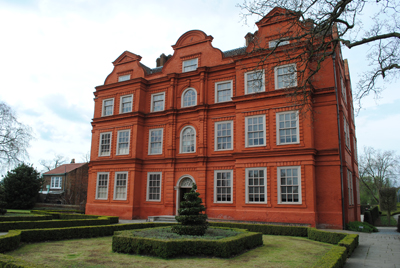
But it was during the Georgian era, when the Royal Botanic Gardens were founded and Kew Palace, formerly known as the Dutch House, became a royal residence (it is pictured above), that Kew really kicked off (and by the way, Kew Palace is not the only surviving 17th century building in the area – West Hall, once home of painter William Harriot, is also still here).

While King George II and his wife Queen Caroline used Richmond Lodge, now demolished but then located at the south end of what is now the gardens, as their summer residence, they thought Kew Palace would make a good home for their three daughters (their heir, Frederick, Prince of Wales, lived opposite his sisters at the now long-gone White House). Kew Palace, meanwhile, would later be a residence of other members of the Royal Family as well, including King George III during his bouts of madness.

Other buildings of note from the Georgian era in Kew include Queen Charlotte’s Cottage, a thatched property built between 1754 and 1771 and granted to Queen Charlotte by her husband, King George III (like the palace, it now lies within the grounds of Kew Gardens). St Anne’s Church, located on Kew Green, dates from 1714 and hosts the tombs of artists Johann Zoffany and Thomas Gainsborough.

In 1840, the gardens which surrounded the palace were opened to the public as a national botanic garden and the area further developed with the opening of the railway station in 1869, transforming what was formerly a small village into the leafy largely residential suburb which we find there today (although you can still find the village at its heart).

As well as Kew Gardens (and Kew Palace), Kew is today also the home of the National Archives, featuring government records dating back as far as 1086.

What’s in a name?…Houndsditch…

This City of London thoroughfare runs between St Botolph and Outwich Streets and its name – first recorded in the 13th century – apparently relates to its location on the outer side of the wall, dating from the Roman era, which once encircled the city.

HoundsditchOn the outer side of the wall lay a ditch which, although filled and redug several times in its history, was eventually filled permanently in the 16th century (and became the street you can now walk upon).

Dogs were associated with this ditch – the skeletons of some dogs were found here in 1989 during an archaeological dig at the wall, possibly dating back to Roman times – although there’s a couple of theories on exactly how.

According to one version, the ditch, before it was finally filled, had become the repository of all sorts of rubbish but was particularly known as a site to deposit the corpses of dogs. An alternate theory, meantime, suggests that kennels which housed dogs used in hunting were once located here.

The name ‘houndsditch’ was apparently used for many sections of the ditch which lay outside the city wall before it came to be associated with this particular stretch of ditch.

The street (and the area in which it sits, also known as Houndsditch) has apparently been associated with several different trades over its history including bell founding, gunmaking and cannon founding and, later for the rag trade. In the 20th century, it was the site of department store, The Houndsditch Warehouse.

It was in Houndsditch that Dr Thomas Barnardo found 11 boys sleeping huddled together on the roof of the old rag market – a fact which helped push him to found the first of the Barnardo’s homes for the destitute in Stepney.

Famously, of course, it was also the scene of an attempted robbery and shoot-out in 1910 which led to the infamous Siege of Sidney Street (see our earlier post here).

For more on the Houndsditch murders, see Donald Rumbelow’s The Houndsditch Murders and the Siege of Sidney Street.