Lost London – The Whitehall Mural…

Known through its many surviving copies, the Whitehall Mural was a dynastic portrait understood to have been created to decorate a privy chamber of King Henry VIII at the Palace of Whitehall.

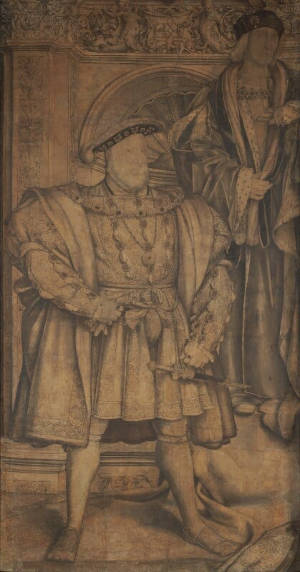
King Henry VIII; King Henry VII
by Hans Holbein the Younger
ink and watercolour, circa 1536-1537
NPG 4027 © National Portrait Gallery, London (licensed under CC BY-NC-ND 3.0)

The mural, which was the work of Hans Holbein the Younger, featured four figures standing around a central plinth. They include King Henry VIII and his wife Jane Seymour at the front with the King’s parents King Henry VII and Queen Elizabeth of York at the back.

It is believed the portrait, commissioned during the King’s brief marriage to Jane Seymour (between 30th May 1536 and 24th October 1537), may have been created to celebrate the birth of Prince Edward (later King Edward VI) in 1537 and may have been commissioned before or after the prince’s birth.

The iconic image of the bearded King Henry VIII – which was created for the purposes of propaganda – shows him as something of an idealised powerful monarch with feet firmly planted apart and his arms out with a dagger hanging at his waist.

The mural was lost when a fire consumed much of the palace on 4th January, 1698. But copies – both of the mural as a whole and of the individual figure of King Henry VIII – survive including one by Flemish artist Remigius van Leemput commissioned by King Charles II the year before the fire.

There’s also a full-sized cartoon (pictured) showing the left-hand section of the mural which was created by Holbein in preparing to create the mural. Depicting King Henry VIII – his head turned in a slightly different aspect to the final version – and King Henry VII, it would been used to mark out the mural on the wall where it stood.

Lost London – Kew Gardens’ flagpole(s)…

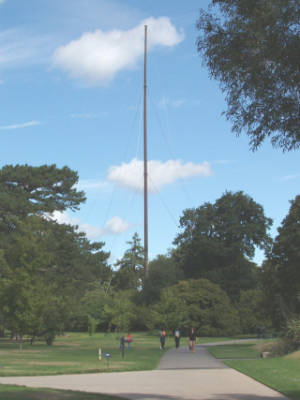
Once the tallest wooden flagpole in the world at 68 (225 feet) tall, the Kew Gardens flagpole stood for almost 50 years before it was dismantled in 2007.

The Kew Gardens flagpole shortly before it was removed. PICTURE: © Copyright David Hawgood (licensed under CC BY-SA 2.0)

The flagpole, a Douglas fir from Copper Canyon on Vancouver Island, was erected on 5th November, 1959, as a gift from the the British Columbia Loggers Association in Canada to mark both the centenary of the Canadian province of British Columbia (1958) and the bicentenary of Kew Gardens (1959).

The tree, which was around 370-years-old when cut, had originally weighed 37 tonnes, but after it was floated up the Thames to Kew and there underwent shaping, this was reduced to 15 tonnes.

Sadly, in 2006, it unfortunately failed its safety inspection – thanks to decay and woodpeckers – and was taken down the following year.

The flagpole was apparently the third (strictly the fourth) erected on the same site at the gardens which had originally been occupied by the ‘Temple of Victory’, a structure which had been built on the orders of King George III to commemorate the Anglo-German victory over the French at the 1759 Battle of Minden during the Seven Years’ War and which was removed in the mid 19th century.

The first flagpole on the site, which stood more than 31 metres (100 feet) tall. was erected in 1861. It had also come from Vancouver Island in British Columbia and replaced one which had snapped when it was in the process of being erected.

The pole was finally taken down in 1913 after being found to be suffering from dry rot.

A replacement, again from British Columbia, was erected in 1919 (its raising having been somewhat delayed by factors related to World War I). It was removed some time before 1959.

After the third giant flagpole was removed (the concrete footing can still be seen), the gardens decided not to erect another as that would mean cutting down another large tree. While far less of a spectacle, there is now a lesser flagpole near Victoria Gate where the flag is flown on special occasions.

Lost London – Hotel Cecil…

Once the biggest hotel in Europe, the opulent Hotel Cecil opened in 1896 on a prominent site overlooking the Thames. But it only survived for little more than three decades.

Subscribe for just £3 a month to support our work and access all of our articles.

Lost London – Gatehouse Prison…

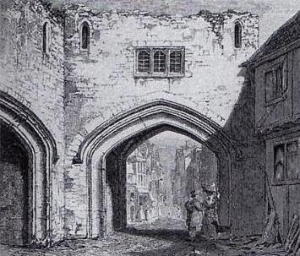
Located in what was the gatehouse of Westminster Abbey, this small prison dates from 1370.

It was built by Walter de Warfield, then the abbey’s Cellarer, and featured two wings, built at right angles to each other.

The Gatehouse Prison in an 18th century depiction. PICTURE: Wikipedia

Under the jurisdiction of the Abbot, the prison had two sections – one for clerics and one for laymen. The Abbey’s Janitor was its warder.

Among the most famous inmates was the Cavalier poet Richard Lovelace who was imprisoned for petitioning to have the Clergy Act 1640 annulled. While inside, he wrote the famous work, To Althea, from Prison which features the famous lines: “Stone walls do not a prison make, Nor iron bars a cage”.

Other notables include Sir Walter Raleigh, held here on the night before he was beheaded in Old Palace Yard on 29th October 1618, diarist Samuel Pepys – detained for a few weeks in 1689 on suspicion of being a Jacobite (but released because of ill health), and Gunpowder Plot conspirator Thomas Bates.

Falling into a state of decay, the prison was demolished in 1776-77 (although one wall stood until the 1830s). A gothic column, the Westminster Scholars’ Memorial which is also known as the Crimea and Indian Mutiny Memorial, now stands on the site.

Lost London – Richmond Lodge…

Located close to the River Thames, Richmond Lodge was a royal hunting lodge before becoming a favoured residence for Hanoverian royals for several decades in the 18th century.

Subscribe for just £3 a month – that’s less than the cost of a cup of coffee – to access all of Exploring London’s content!

Lost London – The Guildhall Chapel…

Used by the Lord Mayor of London and his retinue as a location for weekly worship for more than 200 years, the Guildhall Chapel was once an important part of the City infrastructure.

Please consider supporting our work for just £3 a month.

Lost London – St Benet Fink…

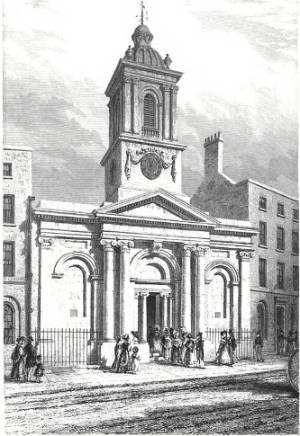
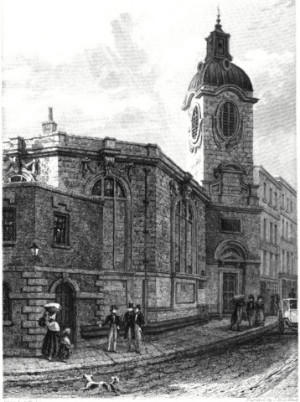
This unusually named church dates back to at least the 13th century and stood on what is now Threadneedle Street.

St Benet is a contraction of St Benedict (he who founded monastic communities in Italy in the 6th century) and this was once of four City churches dedicated to the saint before 1666. The word ‘Fink’, meanwhile, is a corruption of Finch and apparently referred to Robert Finch (or Fink) who paid for a rebuild of the church in the 13th century.

‘The Church of St Benet Fink’ (1839), seen in The Churches of London by George Godwin (1839).

The medieval rectangular church was among those destroyed in the Great Fire of 1666. Rebuilding commenced soon after, thanks in part to a £1,000 donation from a Catholic George Holman (he was rewarded with two pews and a place in the vault). The church was completed in 1675 apparently for a cost at just over £4,000.

Designed by Sir Christopher Wren, the church – due to the irregular shape of the site after the City decided to widen Threadneedle Street, was rebuilt on a decagonal plan, over which sat a dome, with a tower at the west end topped by a bell cage over which sat a ball and cross (apparently this latter feature was unique for a Wren church).

The church survived until the mid-18th century when the Corporation of London petitioned Parliament for permission to demolish the tower of St Benet Fink in order make way for an expanded Royal Exchange (which had burned down in 1838).

Following the demolition of the tower (over which there were some protests), a new entrance was cut into the west wall of the church but it proved less than ideal and the City of London was granted permission to knock down the rest of the church which took place in 1846.

The parish was merged with that of St Peter le Poer. Proceeds of the sale of the site were used to build St Benet Fink Church, Tottenham.

The furniture was sold off and paintings of Moses and Aaron that had formed part of the altarpiece are now in the chapel of Emanuel School in Battersea.

Famous associations include John Henry Newman, the future Catholic cardinal, who was baptised in the church on 9th April, 1801.

An office block now occupies the site. A City of London blue plaque marks the site.

Lost London – Locket’s…

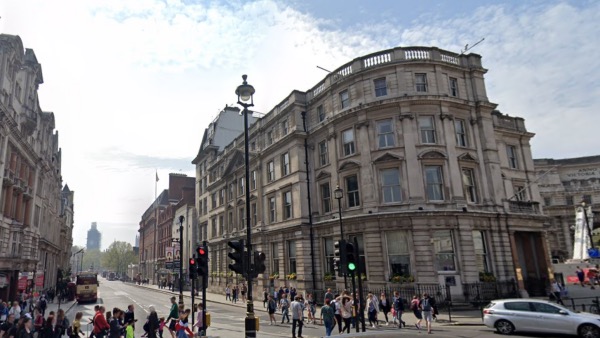
Looking down Whitehall from where the Charing Cross stood today. Locket’s stood on the right. PICTURE: Courtesy of Google Maps.

A famous “ordinary” where meals could be obtained at preset prices, Locket’s was founded by Adam Locket just south of Charing Cross in the 17th century.

A popular meeting place after attending the theatre, the establishment was known for the quality of its food. It was frequented by the well-to-do as well as dramatists like Sir George Etherege (who apparently didn’t pay his bill).

Following Adam Locket’s death in about 1688, he was succeeded by his son Edward who ran it until about 1702. It survived through the reign of Queen Anne but contemporary references – it had been mentioned by writers such as John Vanbrugh and William Congreve – became increasingly scanty and then disappeared altogether after her death in 1714.

Drummond’s Bank later occupied the site where Locket’s had stood.

Treasures of London – Russell Street gas lamps…

One of the lamp-posts in Russell Street, Covent Garden, in 2012. PICTURE: Google Maps

Recently listed as Grade II, these four gas lamps on Russell Street in Westminster were among a series of lamps installed around Covent Garden to mark the beginning of King George V’s reign.

While the columns of the lamps date from 1910, three of the lanterns – described as an ‘Upright Rochester lantern’ and manufactured by William Sugg and Company Limited – are replacements believed to have been installed around 1930. The fourth was installed following a campaign to save Covent Garden from redevelopment in the 1970s.

The newly listed lamp-posts – the first Westminster lamps to be listed in 40 years – are located outside numbers 4-6, 24, 29, and 34-43.

There are currently about 1,300 working gas lamps in London, around 270 of which are in Westminster (and about half of which are listed).

Lost London – Nonsuch House, London Bridge…

Once located at the southern end of London Bridge, Nonsuch House is the earliest documented prefabricated building.

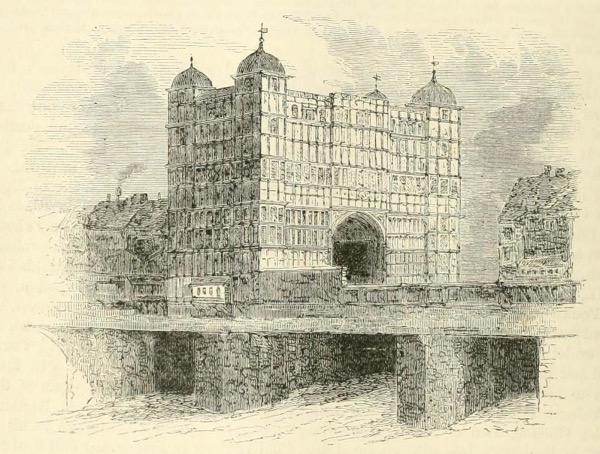
Nonsuch House as seen in ‘Old and New London, Illustrated’ (1873). PICTURE: Via Wikipedia

Originally constructed in what is now The Netherlands, it was shipped to London in pieces – each individually marked – in 1578 with the reassembly completed the following year.

The four storey building, which was said to have been constructed using wooden pegs and no nails, featured an arched tunnel through the middle through which bridge traffic would pass.

The main facade faced toward Southwark and there were towers at each of the four corners, topped with onion domes. The east and west sides of the building, which protruded beyond the bridge out over the Thames were elaborately carved.

The northern facade of the building abutted other properties while the southern side had a clear space in front over which a drawbridge is believed to have been located (it could be raised to allow larger ships through).

The name may have referenced King Henry VIII’s Nonsuch Palace, located near Ewell in Surrey, and was said to refer to the fact there was no such building as splendid.

The property was demolished along with the other buildings on the bridge in about 1757.

Lost London – The London Coffee House…

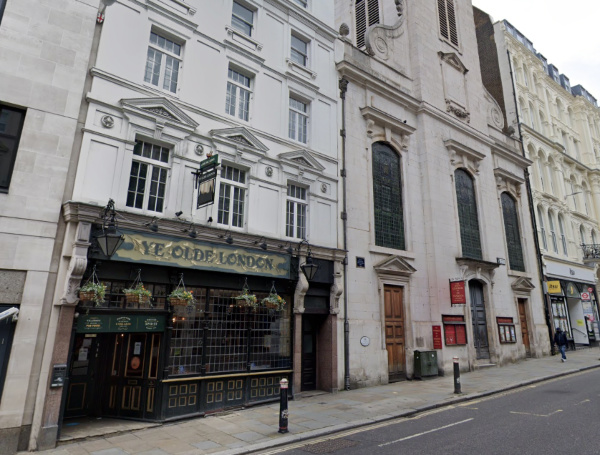
Site of the London Coffee House. PICTURE: Google Maps

Established in the early 1730s on Ludgate Hill (next to St Martin Ludgate), the proprietor of this establishment was one James Ashley (hence the coffee house also being known as Ashley’s London Punch House – the punch was apparently particularly affordable).

It was known to have been frequented by the likes of Joseph Priestley and his friend, American Benjamin Franklin, while James Boswell described its customers as being primarily physicians, dissenting clergy and “masters of academies”.

Its location also meant it served as a place where Old Bailey juries which could not reach a decision were sequestered for the night.

Continued to be favoured by Americans, in 1851 philanthropist George Peabody gave a dinner here for those from the United States who were connected with the Great Exhibition being held in Hyde Park.

In 1806, a statue of Hercules and a hexagonal Roman altar, dedicated to Claudia Martina by her soldier husband, were found here. The coffee house has also been identified as the “Coffee House on Ludgate Hill” mentioned in Charles Dickens’ Little Dorritt.

It closed in 1867. The site is now occupied by a pub, The Ye Olde London.

Lost London – Old Waterloo Bridge…

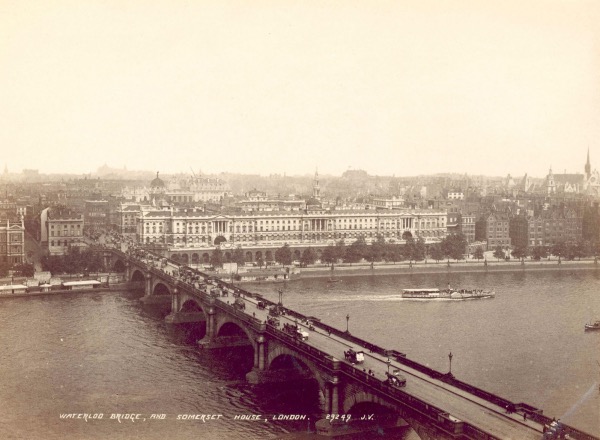
Waterloo Bridge between 1865-1875. PICTURE: Valentine, J, Universitaire Bibliotheken Leiden/licensed under CC BY 4.0)

Built between 1813 and 1817, the first Waterloo Bridge was designed by Scottish civil engineer John Rennie and featured nine elliptical arches, pairs of Doric columns at the piers and a flat roadway.

Originally known as The Strand Bridge, the name was changed by an Act of Parliament in 1816 and commemorated the victory over Napoleon Boneparte at the Battle of Waterloo in 1815.

It was opened by the Prince Regent, accompanied by the Duke of Wellington, on 18th June, 1817 – the second anniversary of the battle.

The bridge originally featured toll booths – the toll was removed in 1877.

In the early 20th century, piers from the bridge settled into the riverbed and created a dip, possibly due to the increasing traffic using it. A temporary steel bridge was placed alongside it and, despite opposition, it was eventually demolished in 1936.

The current bridge, designed by Sir Giles Gilbert Scott, was built over the years 1937 to 1942 (although it wasn’t fully completed until 1945).

Old Waterloo Bridge was famously depicted in a series of works by Claude Monet painted between 1900 and 1904 while he stayed at the Savoy Hotel and by John Constable who created a famous painting of its opening (it’s actually his largest work). The bridge also lends its name to the 1940 American film, Waterloo Bridge, which was adapted from a 1930 play.

Interestingly, granite blocks from the original bridge were sent to Australia and New Zealand while timbers from the bridge were used for shelves and wall panels in the library at Anglesey Abbey in Cambridgeshire (where the famous Constable painting hangs). Some of the original blocks were also incorporated into the foundations and approaches of the new bridge.

The keystone from the original bridge, recovered when it was demolished, is located at the Institution of Civil Engineers in Great George Street.

Lost London – The Painted Chamber, Palace of Westminster…

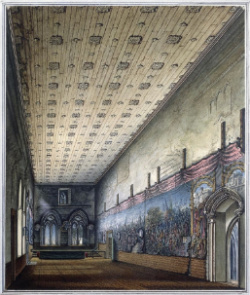
Part of the medieval Palace of Westminster, the Painted Chamber took its name from a series of large paintings which decorated the walls.

A watercolour of the Painted Chamber in Westminster Palace by William Capon made in 1799.

The long and narrow chamber, which stood parallel to St Stephen’s Chapel, was constructed in the 13th century during the reign of King Henry III and was apparently initially intended as a private apartment for the king as well as a reception room.

It featured a state bed at one end positioned under a painting of King Edward the Confessor and also had a “squint” – a small opening at eye level – through which the monarch could view religious services in a chapel located next door.

The chamber was apparently originally known as the King’s Chamber but came to be known as the Painted Chamber when the walls were decorated with paintings depicting vices and virtues and Biblical figures.

These paintings, which were completed over an almost 60 year period from 1226 and which were repaired a couple of times during that period, were added to with commissions by successive monarchs.

The painted chamber was the location for the State Opening of Parliament in the Middle Ages and was where Oliver Cromwell and the others signed King Charles I death warrant in 1649. The body of King Charles II rested here overnight before he was interred in Westminster Abbey.

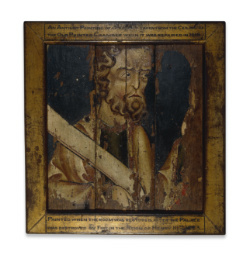
A ceiling panel from the Painted Chamber depicting a prophet, created between 1263-1266 PICTURE: © The Trustees of the British Museum (licensed under CC BY-NC-SA 4.0)

Later neglected, the walls of the chamber were whitewashed and hung with tapestries and in the early 19th century restoration work was done to reveal the paintings again with artist and antiquarian Charles Stothard commissioned by the Society of Antiquarians in 1819 to make watercolour copies (further copies were also made by the clerk of works at Westminster, Thomas Crofton Croker).

By 1820, the chamber was being used for the Court of Requests, a civil claims court.

The Painted Chamber was gutted when fire devastated much of the Palace of Westminster on the night of 16th October, 1834. It was reroofed and refurnished and used by the House of Lords until 1847 – as well as for the State Opening of Parliament in February, 1835. It was finally demolished in 1851.

Two ceiling paintings which were removed in 1816 during repairs are now at the British Museum (pictured right).

Lost London – Northumberland House…

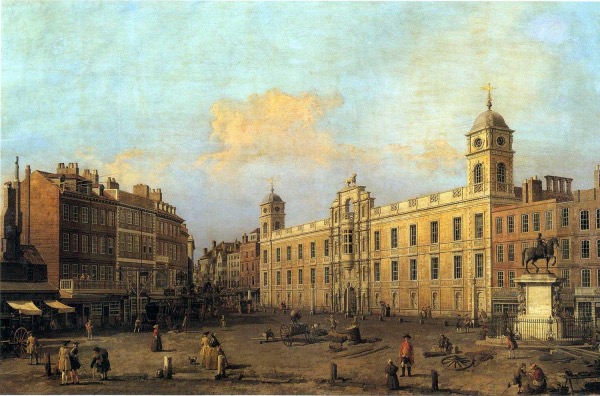
London: Northumberland House painted by Canaletto in 1752.

Among a number of mansions built between the Strand and the River Thames, the property was built for Henry Howard, first Earl of Northampton, in about 1605.

Then known as Northampton House, the Jacobean mansion at Charing Cross was built on the site of a former convent (roughly located on the corner of the modern-day Northumberland Avenue and The Strand).

The property was built around a courtyard with turrets at each corners and had a great hall and apartments for the various members of the household. It featured a four-storey high stone gateway opening onto the Strand and a large garden at the rear but it didn’t apparently reach all the way down to the river unlike many of the neighbouring properties.

The house passed to the Earls of Suffolk and then in the 1640s was sold to Henry Percy, the 9th Earl of Northumberland, at the discounted price of £15,000, as part of a marriage settlement (hence the name change).

Various improvements were made over the years – including relocating the principal living rooms from the Strand side of the building to that facing onto the gardens and adding extra wings which protruded into the gardens.

In the 1770s, Robert Adam was commissioned to redecorate the state rooms on the garden front – the ‘Glass Drawing Room’ at Northumberland House was one of his most celebrated interiors. Shortly after this, part of the Strand front had to be rebuilt after a fire in 1780.

Northumberland House on the Strand, shortly before it was demolished in 1874. PICTURE: London Stereoscopic Company/Hulton Archive/Getty

By the mid-19th century, the mansions on The Strand had all been demolished and the Metropolitan Board of Works wished to acquire Northumberland House to construct a road across the site connecting The Strand to the Embankment.

The Duke of Northumberland resisted but after a fire substantially damaged the property, he agreed to sell which he did for £500,000 in 1874. The house was subsequently demolished and Northumberland Avenue built across the site.

A remnant from the property – a stone lion, known as the ‘Percy Lion’ – was taken from the property by the Duke in 1874 and placed atop Syon House, the Duke’s seat in London’s west. An archway from the property, designed by William Kent, is now the principal entrance to the Bromley by Bow Centre.

Lost London – Greenwich’s Romano-Celtic temple…

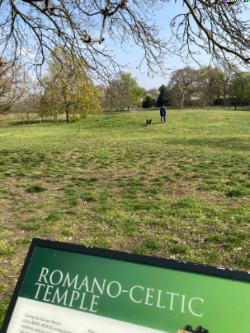
Although little now remains of it (and none to be seen above ground), a mound in Greenwich Park is thought to have once been the location of a Romano-Celtic temple.

Site of the temple remains in Greenwich Park. PICTURE: Matt Brown (licensed under CC BY 2.0)

Given its site close to Watling Street – the main Roman road linking London and the Kent ports, it’s believed that the temple may have served travellers as well as the local community. The Historic England listing for the ruins, which are a scheduled monument, suggests the temple was in use by 100AD and continued to be used until about 400AD.

The remains, which are now located on the eastern side of Greenwich Park on a site known as Queen Elizabeth’s Bower, was excavated in 1902 after they were stumbled across during works on the park. Three different floor surfaces were revealed, one of which was a tessellated pavement, along with the right arm of an almost life-sized statue, fragments of stone inscriptions and more than 300 coins dating between the 1st and 5th centuries.

A further excavation occurred in the early 1970s and another in 1999 – all of which provided further evidence of a temple.

Finds from the 1999 dig – which was undertaken by TV Channel Four’s ‘Time Team’, Birkbeck University of London and the Museum of London in the creation of a programme broadcast the following year – included part of an inscription to Jupiter and the spirits of the emperors and a stamped tile.

It is thought the temple precinct, known as a temenos, would have included a main temple building known as a cella as well as ancillary buildings and been surrounded by a stone wall.

Lost London – ‘Charles II trampling Cromwell’…

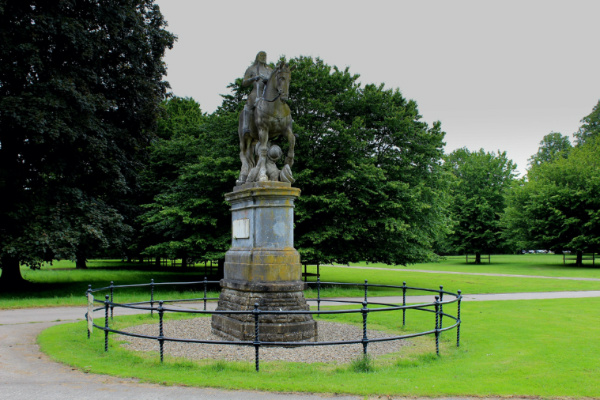
The statue at Newby Hall in North Yorkshire. PICTURE: Chris Heaton (licensed under CC BY-SA 2.0)

Originally installed at the Stocks Market in the City of London, this equestrian statue shows a figure atop a horse which is trampling over a prostrate figure lying on the ground.

The marble statue, which stands on a tall plinth, is believed to have been created in Italy by an unknown sculptor. It originally depicted Polish King John III Sobieski riding down a Turkish soldier. But it was bought to London by goldsmith and banker Sir Robert Vyner in the early 1670s.

A strong supporter of King Charles II, he had the sculpture’s head remodelled by Jasper Latham to depict the King (although the figure beneath was left largely untouched, meaning if it is supposed to represent Cromwell, he’s wearing a turban).

Sir Robert, who had been responsible for making the king’s new coronation regalia to replace items lost or destroyed during the Commonwealth, offered to have the statue installed at the Royal Exchange after it was rebuilt following the Great Fire of 1666. When that was rejected, he had the statue installed at the Stocks Market – originally named for being the only location of fixed stocks in the City – near Cornhill in 1675 (Sir Robert served as Lord Mayor around the same time).

The statue was removed in 1739 to make way for the Mansion House. But all was not lost – given back to Vyner’s grandnephew, also Robert Vyner, it reappeared some years later at the Vyner family estate at Gautby Hall. In 1883, it was relocated to Newby Hall in North Yorkshire (which had come into the family via an inheritance) and still remains there today, about 150 metres east of the hall. It received a Grade II listing in 1967.

Lost London – Columbia Market…

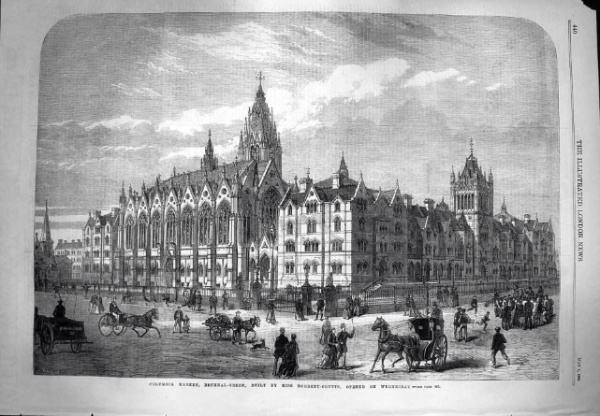
An image of the market in The Illustrated London News.

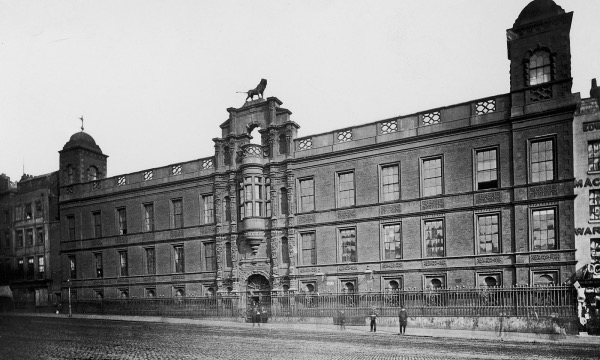
No, this is not the Columbia Road flower market we know today. This was a short-lived vast gothic market place built in the Bethnal Green in the mid-19th century to serve the East End.

The project was financed by philanthropist (and for a time Britain’s richest woman) Angela Burdett-Coutts and represented an attempt to get the costermongers off the streets.

The building, designed by Henry Darbyshire, was built in 1869, constructed of yellow brick with Portland stone cornices and a green slate roof.

It consisted of four blocks of buildings with arcades built around a central quadrangle which was open to the sky and featured some 400 stalls located under cover. There were also a series of shops with residences located above and a clock-tower which sounded every quarter hour.

The market, which sold fresh produce, was run by Burdett-Coutts’ secretary and future husband (they married in 1881) William Burdett-Coutts who built connections with a fishing fleet to supply its vendors.

He had planned a rail link with Bishopsgate to serve the market but that never happed and competition from Billingsgate and other markets – and the fact the costermongers preferred the streets – eventually saw it go out of business. It closed only a relatively few years later in 1886.

Taken over for a short time by the City of London Corporation, it was returned to the Baroness in 1874, briefly reopened 10 years later, then, according to The London Encyclopaedia, let out as workshops before finally being demolished in 1958.

A few remnants, including some rather grand iron railings and lion statues, remain.

10 historic stairways in London – 2. Queen Mary’s Steps, Whitehall…

PICTURE: Paul Farmer (licensed under CC BY-SA 2.0).

This small stone stairway which now sits in the midst of a grassy expanse at the back of the Ministry of Defence was once part of the Palace of Whitehall.

Named for Queen Mary II, wife of King William III, for whom they were designed, the stairs were part of a terrace built in 1691 abutting the Thames in front of an old river wall constructed for King Henry VIII.

Designed by Sir Christopher Wren, the stairs were one of a pair located at either end of the terrace which gave direct access to the river – and state barges – from the Royal Apartments.

Excavations in 1939 during construction of the MoD revealed the Tudor river wall, the terrace and the northern-most of the two flights of steps. The upper part of the steps have been repaired and the terrace and wall reconstructed.

The steps and palace fragments are now a Grade I listed monument.

Lost London – Arundel House…

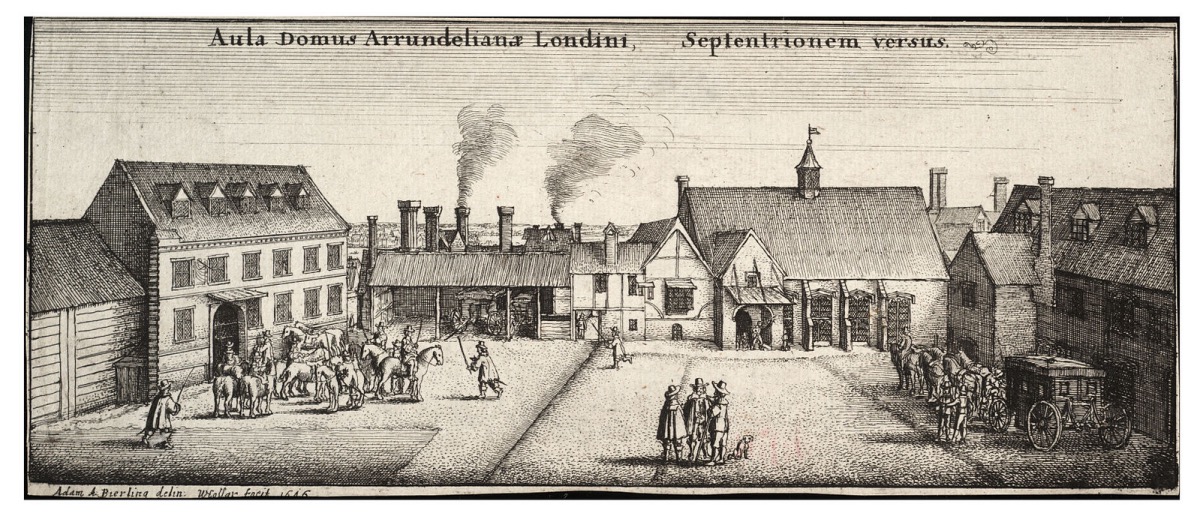
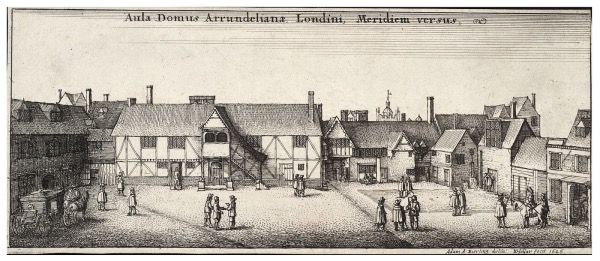
Arundel House, from the south, by Wenceslas Hollar. Via Wikimedia Commons.

One of a string of massive residences built along the Strand during the Middle Ages, Arundel House was previously the London townhouse of the Bishops of Bath and Wells (it was then known as ‘Bath Inn’ and Cardinal Thomas Wolsey was among those who resided here during this period).

Following the Dissolution, in 1539 King Henry VIII granted the property to William Fitzwilliam, Earl of Southampton (it was then known as Hampton Place). After reverting to the Crown on his death on 1542, it was subsequently given to Thomas Seymour, 1st Baron Seymour of Sudeley, a younger brother of Queen Jane Seymour, Henry VIII’s third wife, and known as ‘Seymour Place’. Then Princess Elizabeth (late Queen Elizabeth I) stayed at the property during this period (in fact, it’s said her alleged affair with Thomas Seymour took place here).

Arundel House, from the south, by Wenceslas Hollar. Via Wikimedia Commons.

Seymour significantly remodelled the property, before in 1549, he was executed for treason. The house was subsequently sold to Henry Fitz Alan, 12th Earl of Arundel, for slightly more than £40. He was succeeded by his grandson, Philip Howard, but he was tried for treason and died in the Tower of London in 1595. In 1603, the house was granted to Charles, Earl of Nottingham, but his possession was short-lived.

Just four years later it was repurchased by the Howard family – in particular Philip’s son, Thomas Howard, 14th Earl of Arundel – who had been restored to the earldom.

Howard, who was also the 4th Earl of Surrey, housed his famous collection of sculptures, known as the ‘Arundel Marbles’, here (much of his collection, described as England’s first great art collection, is now in Oxford’s Ashmolean Museum).

During this period, guests included Inigo Jones (who designed a number of updates to the property) and artist Wenceslas Hollar who resided in an apartment (in fact, it’s believed he drew his famous view of London, published in 1647, while on the roof).

Howard, known as the “Collector Earl”, died in Italy in 1646. Following his death, the property was used as a garrison and later, during the Commonwealth, used as a place to receive important guests

It was restored to Thomas’ grandson, Henry Howard, 6th Duke of Norfolk, following the Restoration. Following the Great Fire of London in 1666, for several years the property was used as the location for Royal Society meetings.

The house was demolished in the 1678. It’s commemorated today by the streets named Surrey, Howard, Norfolk and Arundel (and a late 19th century property on the corner of Arundel Street and Temple Place now bears its name).

Lost London – The Holbein portrait of King Henry VIII’s family…

King Henry VIII; King Henry VII
by Hans Holbein the Younger
(ink and watercolour, circa 1536-1537
NPG 4027)
© National Portrait Gallery, London

Thankfully much copied (at least in part), this full length portrait of King Henry VIII, his third wife and parents was the work of Hans Holbein the Younger.

Holbein, appointed the king’s painter in 1536, was commissioned to create the work following the King’s marriage to Jane Seymour on 30th May, 1536, and completed it in 1537 (there’s some speculation it may have been commissioned in celebration of the birth of King Henry’s son, King Edward VI).

The mural featured the King standing in full splendour, although without typical symbols of royalty such as a crown or sceptre, as well as his wife Jane Seymour, and his parents, King Henry VII and Queen Elizabeth of York. They were all standing around a central pillar upon which are inscribed verses in Latin extolling the Tudor dynasty.

The work is understood to have been commissioned for one of the King’s more private chambers in the Palace of Whitehall which Henry had seized after the downfall of Cardinal Thomas Wolsey.

The portrait survived the reign of King Henry VIII but was destroyed in the fire which devastated the palace in 1698.

A full-sized cartoon of the left-hand side of the work which was completed by Holbein in preparation for its creation is held in the collection of the National Portrait Gallery (pictured right).

While there are numerous copies of the figure of King Henry VIII, the only complete copy of the mural is attributed to Remigius van Leemput who created it in 1667 – it can be seen at Hampton Court Palace.