Located just to the east of the Tower of London, St Katharine Docks were opened in 1828 following the demolition of more than 1,000 houses along with a brewery and what was left of the medieval St Katharine’s Hospital.
MV Havengore
10 historic vessels in London’s Thames…8. MV Havengore….
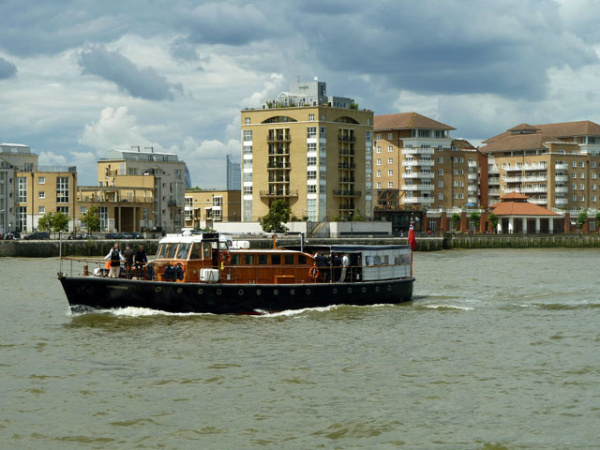
Still plying the waters of the Thames, the MV Havengore is perhaps most famous for having carried the coffin of Sir Winston Churchill on the River Thames as part of his state funeral in 1965.
The MV Havengore – named for a low-lying island off the coast of Essex – was originally constructed as a hydrographic survey launch for the Port of London Authority in 1956. As the PLA’s principal survey vessel and flagship, she was moored at Gravesend and tasked with recording changes to Thames bed and estuary. She became the first survey vessel in the UK to have a computer to record survey data.
The highpoint of her during her almost 40 years of service with the PLA came on 30th January, 1965, when she transported the body of Churchill from Tower Pier to Festival Pier. On the journey, she was saluted by flight of 16 fighter jets while dock cranes were made to bow as she passed (there’s a plaque on board commemorating her role in the funeral).
But the almost 26 metre long vessel also participated in other historic events including the river pageant to celebrate the Queen Elizabeth II’s Silver Jubilee in 1977 and, more recently, the flotilla formed to celebrate the Queen’s Diamond Jubilee in 2012 as well as the Thames tribute to the Queen’s long reign in 2015 and the Queen’s 90th birthday parade in 2016.
The MV Havengore was withdrawn from service in 1995 and sold after which she underwent restoration and refitting at the Chatham Historic Dockyard. The vessel was then used to provide excursions for underprivileged children on the Medway.
Sold again in 2006, she has subsequently undergone further restoration work. The MV Havengore is these days used for a range of ceremonial, corporate and private events. When not on the river, she is berthed at St Katharine Docks. The vessel was listed, as of May this year, as being up for sale.
10 London sites associated with Sir Winston Churchill – 1. St Paul’s Cathedral…
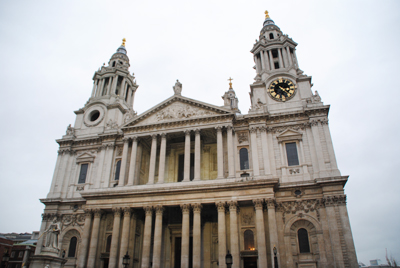 The world recently paused to mark the 50th anniversary of the death of former British PM, Sir Winston Churchill (see our earlier post here), so we’re launching a new series looking at 10 sites associated with Churchill in London.
Given the recent anniversary, we’re starting at a site close to the end of his story, at St Paul’s Cathedral, where his state funeral was held on 30th January, 1965.
Code-named ‘Operation Hope Not’, the funeral had been thoroughly planned in the years leading up to the former PM’s death and took place just six days after he passed. Having lain in state in Westminster Hall for three days (during which time it’s estimated 320,000 filed past his flag draped body), his coffin, carried on a gun carriage pulled by 120 members of the Royal Navy, was escorted by more than 2,300 personnel from the military as it made its way through city streets lined with thousands of people to St Paul’s for the service.
During the service, the catafalque containing Churchill’s body stood on a raised platform beneath the central dome surrounded by six candlesticks. Among the official pallbearers – who marched before it down the aisle – were another former PM, Clement Attlee, along with military figures like Field Marshal Lord Slim and Admiral of the Fleet Lord Mountbatten of Burma.
A plethora of world leaders representing 112 nations attended the funeral service including six sovereigns, six presidents and 16 prime ministers. Among them – in an unprecedented move for a state funeral – was Queen Elizabeth II (sovereigns do not normally attend non-family funerals) along with Prince Philip and Prince Charles.
It’s estimated that as some 350 million people around the globe tuned in to watch the funeral on TV.
After the service, Churchill’s body was taken to Tower Pier (near the Tower of London) where, to the sound of a 19-gun salute fired by the Royal Artillery, he was loaded on the MV Havengore. Sixteen RAF Lightning aircraft then did a flypast as he was transported upriver to Festival Pier with dockers dipping their cranes in salute as the boat passed (this journey was recreated last week using the original barge in commemoration of the 50th anniversary of his death).
On its arrival at Festival Pier, the body was then taken to Waterloo Station from where it went via train in a specially prepared carriage (the refurbished funeral train has been brought back together at the National Railway Museum at York) to be buried in St Martin’s churchyard in Bladon, Oxfordshire – a site not far from his birthplace at Blenheim Palace.
A bronze memorial plaque commemorating where Churchill’s catafalque stood in St Paul’s is set before the Quire steps while in 2004, the Winston Churchill Memorial Screen was unveiled in the crypt where it stands in line with the final resting places of both Admiral Lord Nelson and the Duke of Wellington.
For more on the state funeral, St Paul’s has a great page of detail which you can find here, including downloadable copies of the Order of Service and other documents.
 Exploring London