This Week in London – Kew’s Christmas light trail returns; ‘Time’ at the Old Royal Naval College; and, a royal Christmas shop…

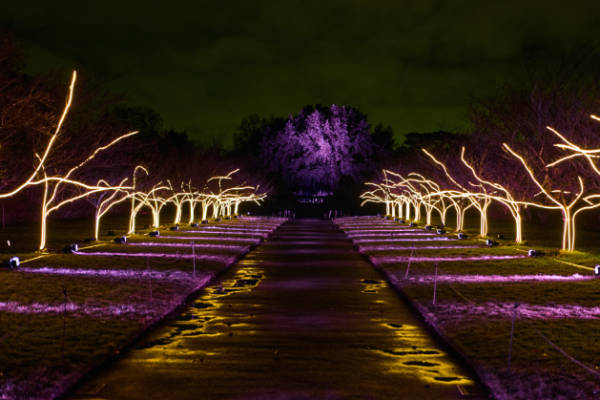
A scene from last year’s light show. PICTURE: James Carter-Johnson/iStockphoto

• Kew Garden’s famous light trail opens tomorrow and this year the three kilometres features eight new world premiere installations, interactive dance floors with giant headphones and, for the first time, the illumination of the Great Pagada. Christmas at Kew will also feature seasonal staples such as illuminated trees, a festive funfair and the ever-popular Christmas Cathedral. Among the new installations are Creative Culture’s Christmas Orchestra featuring festive music coordinated with lights and In Bloom, an installation by Netherlands’ multidisciplinary artist Wilhelmsusvlug said to evoke “delicate petals dancing through the air”. There will be a newly created projection at the Palm House while the Palm House Pond will feature a light display of 100 lillies and the trail concludes with a music and light show at the Temperate House. Runs until 4th January. Admission charge applies. For more, see www.kew.org/christmas.

Time, a sound and light show by Luxmuralis, has transformed the Old Royal Naval College after dark with an “unforgettable journey through history and science”. Visitors start in the Painted Hall where they’s see Peter Walker’s Connection & Identity illuminated after which they’ll move through the Ripley Tunnel, Queen Mary Undercroft and chapel before heading outside across the colonnades and into the courtyard. Runs until 22nd November. Admission charge applies. For more, see https://ornc.org/whats-on/time-by-luxmuralis/.

The Royal Shop in the Royal Mews at Buckingham Palace has been transformed into a Christmas pop-up shop for the first time. The Royal Mews Christmas Shop, which opens tomorrow, features a range of official royal gifts as well as food and drink from the Royal Collection Trust, a department of the Royal Household. Among the new offerings this year are mini 20cl bottles of gins infused with botanicals hand-picked from the grounds of royal residences including Buckingham Palace and Windsor Castle as well as a Property of the Royal Kitchen range of kitchen accessories, which takes its inspiration from the Great Kitchen at Windsor Castle, and wine accessories including crystal wine glasses, delicately etched with a pattern of knotted vines and grape leaves inspired by the Grand Punch Bowl, a majestic wine cistern in the Royal Collection known to have been used by Queen Victoria. To visit the shop online, head to www.royalcollectionshop.co.uk.

Send all items to exploringlondon@gmail.com
This Week in London – The story of Henry VIII’s lost dagger; ‘Secret Maps’ at the British Library; and, ‘Connection and Identity’ at Greenwich…

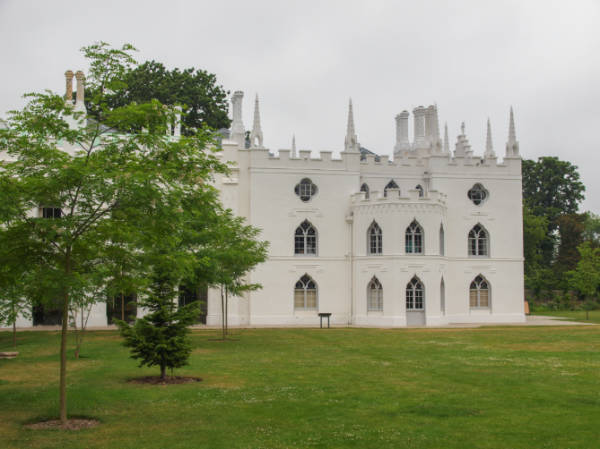
Strawberry Hill House. PICTURE: claudiodivizia/iStockphoto

• The disappearance of a jewelled Ottoman dagger which is believed to have once belonged to King Henry VIII has inspired a new exhibition at Strawberry Hill House, Horace Walpole’s former home in Twickenham in London’s west. Henry VIII’s Lost Dagger: From the Tudor Court to the Victorian Stage looks at the history of the 16th century dagger which, said to have been richly decorated with “a profusion of rubies and diamonds”, was once part of Horace Walpole’s collection. When the collection was sold in 1842, the dagger passed into ownership of the Shakespearean actor Charles John Kean who directed private theatricals for Queen Victoria at Windsor Castle. Kean (1811-1868) pioneered what critics dubbed “living museums” on the Victorian stage by using real artifacts, including the dagger, during performances. But after Kean’s death the dagger vanished without a trace. Dr Silvia Davoli, the principal curator at Strawberry Hill House, launched an investigation to find the dagger and instead found six almost identical daggers scattered around the globe. Two of these daggers – known as the Vienna and Welbeck Abbey examples – are featured in the exhibition alongside reproductions of 18th century materials which related to Walpole’s lost dagger from Yale University’s Lewis Walpole Library. The exhibition can be seen from Saturday until 16th February. Admission charge applies. For more, see www.strawberryhillhouse.org.uk.

The role maps have played in preserving secrets for the benefit of their creators from the 14th century to the present day is the subject of a new exhibition at the British Library. Secret Maps features more than 100 items ranging from hand-drawn naval charts given to Henry VIII to maps of cable networks used to intercept messages between the world wars; and the satellite tracking technology used by apps today. Among highlights are a map from 1596 attributed to Sir Walter Raleigh on an expedition in search of the mythical city of El Dorado in what is now Guyana in South America; a map produced in 1946 of British India (modern-day India, Pakistan and Bangladesh) with a ‘top secret’ report investigating the potential economic and military impact of partition for the proposed state of Pakistan; one of only two known existing copies of a secret map produced by Ordnance Survey during the General Strike of 1926 amid fears of a public uprising; and a 1927 Cable Map of the world which reveals a global network of censorship stations and was used by the British government to intercept messages sent via submarine and overland cables. Runs until 18th January (and accompanied by a programme of events). Admission charge applies. For more, see https://events.bl.uk/exhibitions/secretmaps.

Staffordshire-based artist Peter Walker’s large scale interactive artworks, Connection and Identity, can be seen in the Painted Hall at the Old Royal Naval College in Greenwich from Friday. Identity features eight columns suspended within the hall which shift in colour and light while Connection showcases “a dramatic and modern reinterpretation of Michelangelo’s Creation of Adam“. The installation, which is located in the hall sometimes described as “Britain’s Sistine Chapel”, is accompanied by music specially composed by David Harper. Runs until 25th January. Admission charge applies. For more, see https://ornc.org/whats-on/connection-and-identity/.

Send all items for inclusion to exploringlondon@gmail.com.

This Week in London – Photographing the 80s; Tirzah Garwood at Dulwich; and, Mars comes to Greenwich…

Paul Trevor, ‘Outside police station, Bethnal Green Road, London E2′ 17 July 1978. Sit down protest against police racism’, 1978 © Paul Trevor

The largest survey of the development of photography in Britain across the 1980s to date goes on show at the Tate Britain today. The 80s: Photographing Britain draws on almost 350 images and archive materials from the period to explore how photographers responded to the “seismic social, political, and economic shifts around them” during the decade. It features the work of more than 70 lens-based artists and collectives and features images taken from across the UK – from John Davies’ post-industrial Welsh landscape to Tish Murtha’s portraits of youth unemployment in Newcastle and Don McCullin’s portraits of London’s disappearing East End. Along with documentary photography capturing key political events such as John Harris and Brenda Prince’s images of the miners’ strikes and
Syd Shelton and Paul Trevor’s images of anti-racism demonstrations, the exhibition also includes
a series of thematic displays, featuring works such as Roy Mehta and Vanley Burke images of their multicultural communities, which explore how photography became a compelling tool for representation. Other subjects covered include countercultural movements that took place in the 80s and the presence and visibility of the LGBTQ+ community during the period of the AIDS epidemic. Runs until 5th May. Admission charge applies. For more, see www.tate.org.uk.

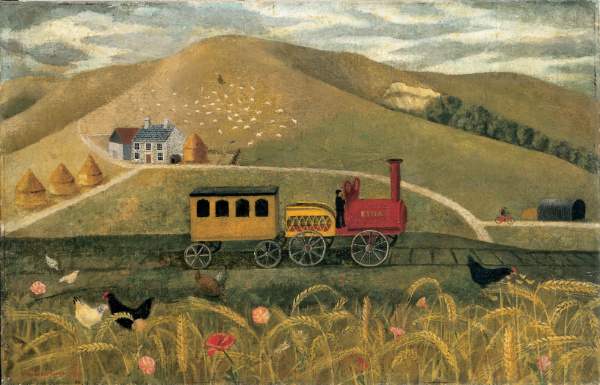
Tirzah Garwood, ‘Etna’, 1944, oil on canvas. PICTURE: Courtesy of Fleece Press/Simon Lawrence

The first major exhibition devoted to the British artist and designer Tirzah Garwood has opened at the Dulwich Picture Gallery. Tirzah Garwood: Beyond Ravilious comes 10 years after the critically acclaimed show celebrating the work of Eric Ravilious, husband of Garwood who was a celebrated artist and printmaker in her own right. More than 80 of Garwood’s work are on show including most of her existing oil paintings. Along with Garwood’s works – which include everything from woodgravings to a series of experimental marbled papers and collaged paper portraits – are 10 watercolours by her husband which draw out the couple’s “thematic similarities, shared interests and distinct artistic personalities”. Runs until 26th May. Admission charge applies. For more, see www.dulwichpicturegallery.org.uk.

Luke Jerram’s massive travelling installation Mars is unveiled at the Painted Hall in Greenwich this Saturday. Measuring seven metres in diameter and internally lit, the work features detailed NASA imagery of the Martian surface, recreated to scale (but about a million times smaller than the actual planet). The installation, which follows on from Jerram’s earlier artworks Gaia and Museum of the Moon, features a surround sound composition by BAFTA-winning composer Dan Jones which includes clips from NASA missions to Mars. Can be seen until 28th January. Admission charge applies. For more, see https://ornc.org/whats-on/mars/.

Send all items to exploringlondon@gmail.com.

This Week in London – ‘The Tudor World’ explored; ‘Crossing Borders’ at the Horniman; and, TfL deal at the Painted Hall…

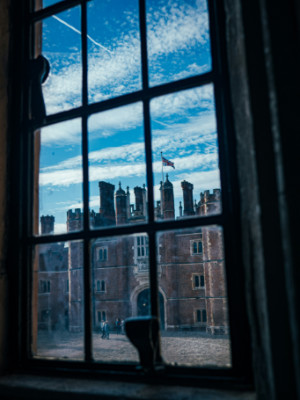
Looking out a window at Hampton Court Palace. PICTURE: Greg Willson/Unsplash

• The oldest surviving rooms at Hampton Court Palace – the Wolsey Rooms which King Henry VIII and Thomas Wolsey once used – are the location of a new display opening today exploring the early years of Henry VIII’s reign and the lives of the ‘ordinary’ men and women who shaped the Tudor dynasty. The Tudor World has, at its centre, rare surviving paintings from the Royal Collection including The Embarkation of Dover – depicting the Tudor navy – and The Field of Cloth of Gold which details Henry VIII’s summit with King Francis I of France in 1520. Also on show is a gold ring believed to have belonged to the Boleyn family, a brightly coloured silk hat linked to King Henry VIII, Wolsey’s portable sundial, a wooden chest used to hide religious contraband by Catholic priests during the reign of Queen Elizabeth I, and, an original Tudor chain pump used to help empty the Hampton Court cesspool. Among the stories of “ordinary” Tudor people being shared is that of Anne Harris, Henry VIII’s personal laundry woman who washed the bandages for his leg ulcers and, Jacques Francis, a free-diver from West Africa who was involved in the expedition to salvage guns from the sunken Mary Rose and who later became one of the first Black African voices heard in an English court, when he was called to testify in a case concerning his employer, Paulo Corsi. Included in palace admission. For more, see www.hrp.org.uk/hampton-court-palace/.

Crossing Borders, a day of free activities, performances and workshops run by local newly arrived people, will be held at the Horniman Museum Gardens in Forest Hill this Saturday. The day will feature arts and crafts workshops led by IRMO, dance performances by Miski Ayllu and the Honduran Folkloric Pride Group, the chance to learn circus skills with young people from Da’aro Youth Project and South London Refugee Association, and the opportunity to make kites with Southwark Day Centre for Asylum Seekers. The free event runs from 11am to 4pm. For more, see https://www.horniman.ac.uk/event/crossing-borders/.

Transport for London customers can save 30 per cent on entry to the Painted Hall at the Old Royal Naval College when using the TfL network until 17th November. Simply show customers show your TfL journey on the day of your visit via the TfL Oyster and Contactless app and receive the discount, taking the adult entry price, when booked online to just £11.55. For bookings, head to https://londonblog.tfl.gov.uk/2022/07/27/in-the-city/.

Send all items for inclusion to exploringlondon@gmail.com.

This Week in London – Wren letter in the Painted Hall; art from America’s South; and, ‘Finding Family’ at the Foundling Museum…

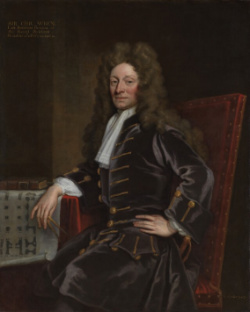
Sir Christopher Wren, by Sir Godfrey Kneller, Bt, oil on canvas, 1711 NPG 113

A letter written by Sir Christopher Wren requesting stone for the construction of the Royal Hospital for Seamen in Greenwich is on display in the Painted Hall vestibule. Wren wrote the letter requesting 2,000 tonnes of Portland stone to Thomas Gilbert, overseer of the King’s Quarries of the Isle of Portland, on 11th October, 1700. It is being displayed along with information explaining how the stone was brought from Dorset to London. The display is one of a series of events taking place at the Old Royal Naval College marking the 300th anniversary of Wren’s death on 25th February, 1723. Can be seen until January, 2024. An admission charge applies. For more, see https://ornc.org/whats-on/painted-hall-display-letter-written-by-sir-christopher-wren/. For more on events surrounding the 300th anniversary of Wren’s death, head to https://ornc.org/celebrating-wren300/.

Slavery, the cruel segregationist policies of the Jim Crow era, and the civil rights movement in the southern United States are all explored in a new exhibition at the Royal Academy. Souls Grown Deep like the Rivers: Black Artists from the American South, features around 64 works – including assemblages, sculpture, paintings, reliefs, and drawings – by 34 artists spanning the period from the mid-20th century to the present. Drawn mostly from the collection of the Souls Grown Deep Foundation in Atlanta, Georgia, many of the works are being seen in Europe for the first time. The display in the Gabrielle Jungels-Winkler Galleries also features quilts by the celebrated quiltmakers of Gee’s Bend, Alabama, and the neighbouring communities of Rehoboth and Alberta. Opening on Friday, the exhibition can be seen until 18th June. Admission charge applies. For more, see royalacademy.org.uk.

Three masterpieces from The National Gallery’s collection – by Hogarth, Gainsborough and the Le Nain Brothers – have gone on show at The Foundling Museum in Bloomsbury as part of a new exhibition exploring what family is and can be. Finding Family examines the ways in which artists have represented and responded to ideas of family with reference to the historic paintings as well as contemporary works of art. The art is accompanied by creative writing created by participants in ‘Tracing Our Tales’ – the museum’s award-winning programme for young care leavers – who have responded to the exhibition’s themes. Opens on Friday and runs until 27th August. Admission charge applies. For more, see https://foundlingmuseum.org.uk/event/finding-family/.

Send items for inclusion to exploringlondon@gmail.com.

This Week in London – Tower of London lowers drawbridge; other openings include Westminster Abbey and The Queen’s Gallery…

The Tower of London will officially lower the drawbridge in a symbolic ceremony this Friday morning to announce its reopening after a 16 week closure, the longest since World War II. A new one-way route has been introduced to allow for social distancing and while the Yeoman Warders, known as Beefeaters, won’t be restarting their tour immediately, they will be able to answer visitor questions. The Crown Jewels exhibition will also be reopening. Online bookings are essential. For more, see www.hrp.org.uk/tower-of-london/.

• Westminster Abbey reopens its doors to visitors on Saturday after the longest closure since it did so to prepare for the coronation of Queen Elizabeth II in 1953. The abbey will initially be open to visitors on Saturdays and on Wednesday evenings, with a limited number of timed entry tickets available solely through advance booking online.

The Queen’s Gallery and the Royal Mews at Buckingham Palace as well as Royal Collection Trust shops reopened to the public this week. The Queen’s Gallery exhibition George IV: Art & Spectacle has been extended until 1st November while Japan: Courts and Culture, which had been originally due to open in June this year, is now expected to open in spring 2022. Tickets must be booked in advance at www.rct.uk/tickets.

• Other reopenings include Kew Gardens’ famous glasshouses (from last weekend) and the Painted Hall, King William Undercroft and interpretation gallery at Greenwich (from Monday 13th July).

Send all items for inclusion to exploringlondon@gmail.com.

PICTURE: Nick Fewings/Unsplash.


This Week in London – Greenwich’s Painted Hall reopens; ‘Christian Dior’ extended; and, merchant shipping explored…

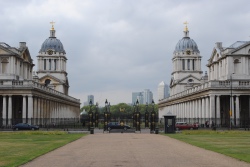
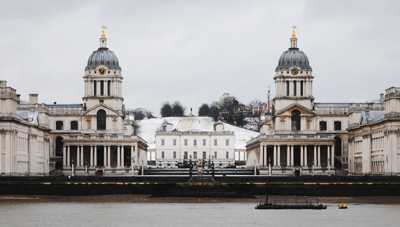
The Painted Hall in Greenwich’s Old Royal Naval College reopens on Saturday following a two-year, £8.5 million restoration project. The hall, known as the UK’s “Sistine Chapel”, was designed by Sir Christopher Wren as a ceremonial dining room for what was then the Royal Hospital for Seamen. Completed in 1705, its 4,000 square metre interior features a decorative scheme painted by Sir James Thornhill, the first British artist to be knighted, which took 19 years to complete. The paintings celebrate English naval power as well as the then newly installed Protestant monarchy with joint monarchs King William III and Queen Mary II as well as Queen Anne and King George I all represented in the artworks along with hundreds of other mythological, allegorical, historical and contemporary figures. The restoration project has also seen the King William Undercroft, located underneath the hall, converted into a new cafe, shop and interpretation gallery. Two cellar rooms from King Henry VIII’s palace – which once stood on the site – were discovered during the restoration works and are also now on public display. Other new touches include the return of a series of carved oak benches to the hall (having been introduced when it was used as an art gallery in the 19th century they were removed 100 years ago), two ‘treasure chests’ containing objects related to the ceiling artworks which can be handled, and new tour options – not just of the hall and undercroft but of the entire Old Royal Naval College site. There’s a host of special activities over the opening weekend, including a parade and official opening ceremony from 9.30am, the chance to meet historical characters, music, food stalls, kids activities and more. Admission charge applies. For more, see www.ornc.org. PICTURED: The Old Royal Naval College, home of the Painted Hall.

The V&A has announced it is extending its sell-out Christian Dior: Designer of Dreams exhibition due to unprecedented demand. The exhibition at the South Kensington museum, which had originally been scheduled to close on 14th July, will now run until 1st September with new tickets made available on 15th of each month (there’s also a limited number of tickets available to purchase daily at 10am from the V&A’s Grand Entrance on a first-come, first-served basis; V&A members, of course, attend free-of-charge with no need to book). The exhibition, which initially sold out of its five month run with 19 days of opening, is the most comprehensive exhibition ever staged in the UK on the House of Dior and the museum’s biggest fashion exhibition since Alexander McQueen: Savage Beauty in 2015. For more, see vam.ac.uk.

On Now: Merchant Navy Treasures: An Introduction to the Newall Dunn Collection. This display at the City of London’s Guildhall Library delves into the Newall Dunn Collection, one of the world’s most comprehensive photographic and reference collections on merchant shipping, and showcases the achievements of shipping historian Peter Newall and artist and writer Laurence Dunn. Alongside images, press releases and newspaper cuttings, on show are company brochures, menus and other items from the ocean liners and cargo vessels of three famous lines from the golden age of shipping: the Cunard, Orient and Union-Castle. Admission is free. Runs until 24th May. For more, follow this link.

Send all items for inclusion to exploringlondon@gmail.com.

LondonLife – Remains of Greenwich Palace unearthed…


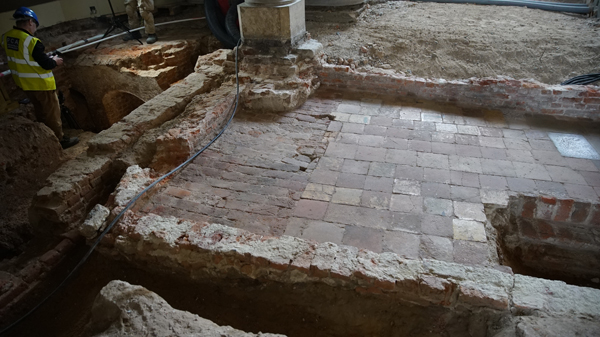
The remains of two rooms, which once formed part of the splendid Greenwich Palace – birthplace of King Henry VIII and his daughters Queen Mary I and Queen Elizabeth I, were discovered during works being undertaken ahead of the construction of a new visitor centre under the Old Royal Naval College’s famed Painted Hall, it was revealed last week.

The rooms, set well back from the river Thames, are believed to have formed part of the service range, believed to be the location of kitchens, a bakehouse, brewhouse and laundry.

As well as the discovery of a lead-glazed tiled floor, one of the rooms, which was clearly subterranean, featured a series of unusual niches where archaeologists believe may have been ‘bee boles’ – where ‘skeps’  (hive baskets) were stored during winter when the bee colonies were hibernating and where, when the bees were outside during summer, food and drink may have been stored to keep cool.

Discussions are reportedly now underway over the possibility of displaying the Tudor finds in situ. Duncan Wilson, chief executive of Historic England, hailed the find as “remarkable”.

“To find a trace of Greenwich Palace, arguably the most important of all the Tudor palaces, is hugely exciting,” he said. “The unusual and enigmatic nature of the structure has given us something to scratch our heads over and research, but it does seem to shine a light on a very poorly known function of the gardens and the royal bees. The most exciting aspect is that the Old Royal Naval College is able and willing to incorporate this into the new visitor centre, so everyone can see a small part of the palace, for the first time in hundreds of years.”

Greenwich Palace was built by King Henry V’s brother, Humphrey, Duke of Gloucester, in 1426 and rebuilt by King Henry VII between about 1500 and 1506.

Substantially demolished at the end of the 17th century (and with plans to build a new Stuart palace on the site never realised), it was replaced with the Greenwich Hospital which became the Royal Naval College designed by Sir Christopher Wren and Nicholas Hawksmoor between 1692 and 1728.

The Painted Hall, located in the Old Royal Naval College, is currently undergoing an 18 month transformation which includes the creation of a new visitor centre, Sackler Gallery and café. Visitors to the hall currently have the unique opportunity to get up close to the famous ceiling of the hall, described as the “Sistine Chapel of the UK”, on special tours. Visit www.ornc.org/painted-hall-ceiling-tours-tickets for more.

PICTURES: © Old Royal Naval College

This Week in London – Lockwood Kipling celebrated; a free ticket for Emma; and, a close-up look at the Painted Hall ceiling…

1-_the_great_exhibition_india_no-_4_by_joseph_nash_ca-_1851_royal_collection_trust_c_her_majesty_queen_elizabeth_ii_2016

A new exhibition celebrating the life of John Lockwood Kipling – described as an “artist, writer, museum director, teacher, 2-_lockwood_kipling_with_his_son_rudyard_kipling_1882__national_trust_charles_thomasconservationist and influential figure in the Arts and Crafts movement” as well as being the father of world famous writer Rudyard Kipling – opens at the V&A in South Kensington on Saturday. The exhibition is the first exploring the life and work of Kipling (1837-1911) who campaigned for the preservation of Indian crafts as well as being a craftsman himself (his terracotta panels can still be seen on the exterior of the V&A) and an illustrator of his son’s books. Lockwood Kipling: Arts and Crafts in the Punjab and London features paintings of the Indian section of the 1851 Great Exhibition as well as objects which were on display (the exhibition was visited by Kipling while a teenager), Kipling’s sketches of Indian craftspeople observed during his many years living in India as well as objects he selected for the V&A while there, designs and illustrations for books, and furniture he helped his former student architect Bhai Ram Singh design for royal residences Bagshot Park and Osborne. The free exhibition, a collaboration between the V&A and the Bard Graduate Centre in New York, runs until 2nd April (it will be on display at the Bard Graduate Center, New York, from 15th September this year). For more, see www.vam.ac.uk/kipling. PICTURES: Top: The Great Exhibition, India no. 4, by Joseph Nash/Royal Collection Trust © Her Majesty Queen Elizabeth II 2016 ©; Right: Lockwood Kipling with his son Rudyard Kipling, 1882/© National Trust, Charles Thomas
Anyone named Emma will receive free entry into the National Maritime Museum’s exhibition on Emma Hamilton this weekend in honour of the 202nd anniversary of her death on 15th January, 1815. Emma Hamilton: Seduction and Celebrity shines a light on the remarkable woman who overcame poverty to become one of the most famous international celebrities of her age. The display features more than 200 objects on loan from public and private collections as well as from the museum’s own collection including paintings, personal letters, prints and caricatures, costumes and jewellery. Simply bring proof that your name is Emma – such as a passport, driver’s licence or utility bill – and gain free entry on 14th and 15th January. The exhibition runs until 17th April. Admission charges usually apply. For more, see www.rmg.co.uk/emmahamilton.

Members of the public will be granted a close-up look of the ceiling of the Painted Hall at the Old Royal Naval College in Greenwich this April. The hall, described as the “Sistine Chapel of the UK” is undergoing a two year transformation which includes conservation of Sir James Thornhill’s famous painted ceiling. As part of the project, a series of ceiling tours will be launched on 1st April this year with visitors taken up close via a lift where they can see the conservators at work. For more, see www.ornc.org.

Send all items for consideration to exploringlondon@gmail.

Special – Five famous London funerals…

With former PM Margaret Thatcher’s funeral held in London today, we take a look at five prominent funerals in the city’s past…

Queen Eleanor of Castile: King Edward I was lavish in his funeral for Queen Eleanor (perhaps in an effort to restore her reputation given suggestions she had been unpopular among the common people although it may well have simply been because of the king’s level of grief) and when she died at Harby, a village near Lincoln, on 28th November, 1290, he ordered her body to be transported from Lincoln Cathedral to Westminster Abbey where the funeral was held, with a series of elaborate memorial crosses to be built close to where-ever her body rested for the night. Twelve of these were built including at Westcheap in the City of London and Charing (hence Charing Cross, see our earlier post here), the latter thanks to her body “resting” overnight at the Dominican Friary at Blackfriars. Her funeral took place on 17th December, 1290, with her body placed in a grave near the high altar until her marble tomb was ready. The tomb (one of three built for the queen – the others were located at Lincoln – for her viscera – and Blackfriars – for her heart) still survives in the abbey.

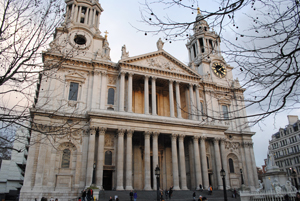
St-Paul's-CathedralVice Admiral Lord Nelson: Heroic in life and perhaps seen as even more so after his death, Nelson’s demise at the Battle of Trafalgar was a national tragedy. His body, preserved in brandy, was taken off the HMS Victory and transported to Greenwich where he lay in state for three days in the Painted Hall. Thousands visited before the body was again moved, taken in a barge upriver to the Admiralty where it lay for a night before the state funeral on 9th January, 1806, more than two months after his death. An escort said to comprise 10,000 soldiers, more than 100 sea captains and 32 admirals accompanied the body through the streets of the city along with seamen from the Victory to St Paul’s Cathedral (pictured)  where he was interred in a marble sarcophagus originally made for Cardinal Wolsey located directly beneath the dome. The tomb can still be seen in the crypt of St Paul’s.

Arthur Wellesley, the Duke of Wellington: Given the last heraldic state funeral ever held in Britain, the Iron Duke’s funeral was held on 18th November, 1852, following his death on 14th September. His body, which had been brought to London from Walmer where it had laid in state by rail, lay in state a second time at Chelsea Hospital. On the morning of the funeral, the cortege set out from Horse Guards, travelling via Constitution Hill to St Paul’s. The body was conveyed in the same funeral car used to convey Nelson’s and accompanied by a guard of honour which included soldiers from every regiment in the army. Masses – reportedly more than a million-and-a-half people – lined the streets to watch funeral procession pass through the city before a service was held in St Paul’s Cathedral under the great dome and he was interred in a monumental sarcophagus alongside that Vice Admiral Lord Nelson. Like Nelson’s, it can still be seen there today.

Sir Winston Churchill: Widely regarded as one of the great wartime leaders of the 20th century, the former British Prime Minister died in his London home on 24th January, 1965, having suffered a stroke nine days earlier. His funeral (plans for which had apparently been code-named ‘Hope-Not’), was the largest state funeral in the world at the time of his death with representatives of 112 nations attending and watched on television by 25 million people in Britain alone. His body lay in state for three days (during which more than 320,000 people came to pay their respects) before on 30th January, it was taken from Westminster Hall and through the streets of London to a funeral service at St Paul’s Cathedral. After the service, a 19 gun salute was fired and the RAF staged a flyby of 16 fighter planes as the body was taken to Tower Hill and then by barge to Waterloo Station. From there it was taken by a special funeral train (named Winston Churchill) to Bladon near Churchill’s home at Blenheim Palace.

Diana, Princess of Wales: Having died in a car crash in Paris on 31st August, 1997, her body was flown back to London and taken to St James’s Palace where it remained for five days before being transported to her former home of Kensington Palace. More than a million people crowded London’s streets on 6th September, 1997, to watch the funeral procession as it made its way from the palace to Westminster Abbey. Among those present at the funeral (which was not a state funeral) were members of the royal family as well as then Prime Minister Tony Blair, former PMs including Margaret Thatcher and foreign dignitaries and celebrities, the latter including Elton John who sang a rewritten version of Candle in the Wind. After the service, Diana’s body was taken to her family’s estate of Althorp in Northamptonshire where the “People’s Princess” was laid to rest.

Our new series will be launched next week due to this week’s events…

Wren’s London – 8. Old Royal Naval College, Greenwich

Hunkering down on the south bank of the Thames, the Old Royal Naval College at Greenwich is yet another Wren masterpiece and the centrepiece of the UNESCO-listed Greenwich Maritime World Heritage Site.

What is now known as the college was originally designed as a ‘hospital’ or retirement home for old or infirm sailors. Established by Royal Charter in 1694, it was King William III who pushed the project into fruition as per the wishes of his then late wife Queen Mary II.

Wren was selected to design the building and along with the diarist John Evelyn, who had been appointed treasurer, laid the foundation stone on 30th June, 1696.

Wren’s initial design – for a three side courtyard facing the river – was rejected by Queen Mary who insisted the view from the existing Queen’s House to the river be maintained. So, instead, the hospital was built as a series of four pavilions, each with its own court, with the Queen’s House standing as it’s centrepiece when viewed from the river.

Wren himself never lived to see the building’s completion – it was in the end completed by a number of other famous architects including Sir John Vanbrugh, Thomas Ripley, and Wren’s pupil Nicholas Hawksmoor. Fortunately Wren had laid out all the foundations which ensured the basic design conformed to his plans.

The first 42 pensioners moved in in 1706 and the numbers grew as buildings were completed to a peak of 2,710 in 1814. However, declining numbers of pensioners by the mid 1800s – thanks to a period of peace on the seas and the success of a program which saw more pensioners living with their families, eventually led to the hospital’s closure in 1860.

In 1873, the Royal Naval College took over the premises, assuming the role of both the former Naval College at Portsmouth and the School or Naval Architecture and Marine Engineering which had been based in South Kensington. The Naval Staff College opened on the site in 1919 and further navy departments including the Department of Nuclear Science and Technology moved there in later years. The Royal Navy left the college in 1998.

Now in the care of the Greenwich Foundation, the college is now used by the University of Greenwich and the Trinity College of Music as well as for public events. The public can also visit certain parts of the former college including the grounds, the spectacular Painted Hall and the Chapel.

The domed Painted Hall, which features a series of classically themed paintings with King William III and Queen Mary II at its heart, was originally planned by Wren to be the hospital’s dining hall but due to the length of time it took for Sir James Thornhill to complete – 19 years – his paintings it was never used as such. Instead it stood empty until the body of Admiral Lord Nelson was brought there to lie in state in January 1806. In 1824 it became the National Gallery of Naval Art but in the 1930s became a dining room again with the gallery’s contents transferred to the National Maritime Museum.

The Chapel of St Peter and St Paul, meanwhile was completed in 1751 to the design of Sir Thomas Ripley but was gutted by fire only 28 years later. It was then rebuilt, largely to the designs of James “Athenian” Stuart with some of the detailing designed by his Clerk of Works William Newton, and was reopened in 1789. Restored in the 1950s, it is said to look “almost as it was” when it opened in 1789. The chapel is still in use for services.

WHERE: Located adjacent to Greenwich Pier with entry from Cutty Sark Gardens, College Approach, Romney Road Gate, Royal Gate or Park Row, Greenwich (nearest DLR station is Cutty Sark for Maritime Greenwich); WHEN: The Painted Hall and Chapel are open daily from 10am to 5pm (chapel used for worship on Sunday mornings, open for sightseeing  from 12.30pm); COST: Free (Booked guided tours are available for £5 an adult/children under 16 free); WEBSITE: www.oldroyalnavalcollege.org