A Moment in London’s History – Peter James Bossy is the last person to standing the pillory in London…

Long used as an instrument of punishment for those found guilty of offences in London, the last person to spend time standing in the pillory in London (and indeed England) – at the Old Bailey – was Peter James Bossy.
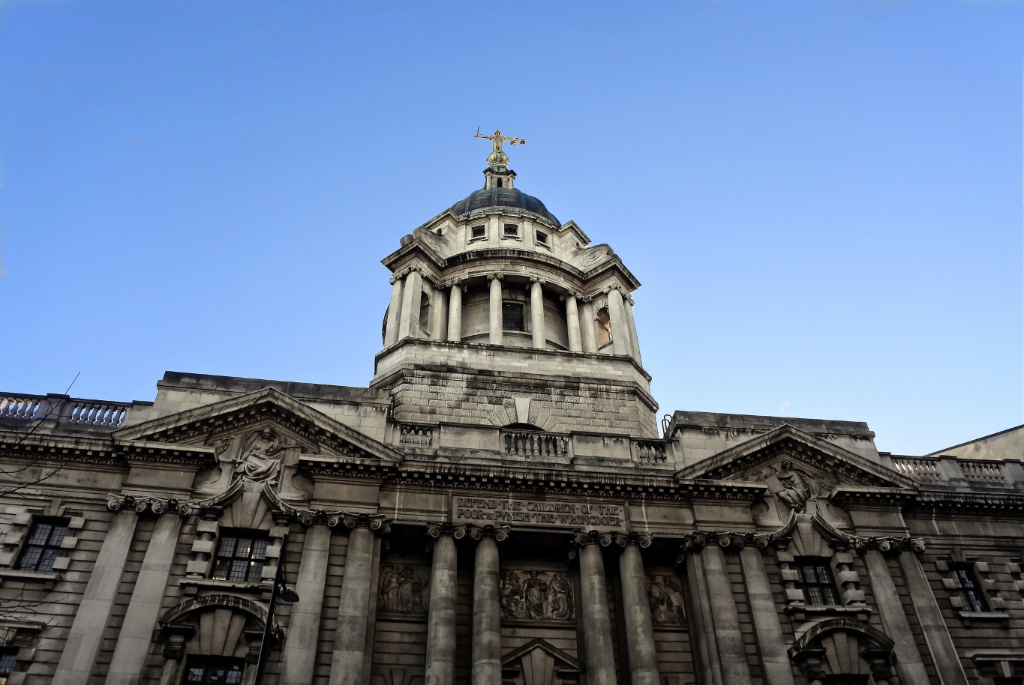
The Old Bailey as it it today. PICTURE: Donnchadh H/Flickr (licensed under CC BY 2.0)

The pillory consisted of a wooden device with holes through which the head and hands were placed, set upon a pole. The person being punished had to stand with their head and hands through the holes and were thus unable to defend themselves should refuse be thrown at them.

It was a very public and humiliating punishment, not to mention extremely uncomfortable, and had been used in London since medieval times.

Bossy was convicted of perjury by the London Oyer and Terminer and received a mixed sentence which an hour in the pillory at the Old Bailey followed by six months in prison at Newgate before being transported to Van Diemen’s Land (now Tasmania in Australia) for seven years.

The pillory part of the sentence was carried out on 22nd June, 1830. After subsequently serving his sentence, Bossy travelled to Australia on board the Gilmore along with 223 other convicts, arriving in March, 1832.

Use of the pillory in England had been restricted by and 1816 Act of Parliament and was formally abolished in England and Wales in another act of 1837.
Lost London – The Pillories…

Once a visible sign of London’s legal system, the city had several pillories which were used to degrade and humiliate those offenders put within them.

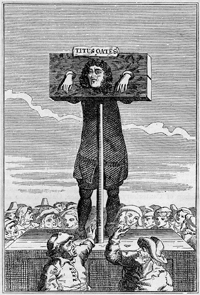
Titus-OatesOriginating in medieval times, the pillories were wooden contraptions in which a standing person’s head and hands were held in place and exposed to the ridicule of the crowd (not to mention their rotten foodstuffs and other less savoury things). They were a similar form of punishment to the stocks and were designed to humiliate those put within them.

They were used to punish a broad range of offenders including everyone from con-men and forgers to traders who didn’t play fair with their customers, people publishing unlicensed literature, and homosexuals.

Some people were pilloried repeatedly and additional punishments could be handed out to some put in the pillory – such as the nailing of the offender’s ears to the structure. There was cases of enraged mobs injuring the person locked in the pillory so badly that they died and the journey to the pillory – a formal parade of the malefactor before the people – was another chance for people to shout abuse and throw things at the offender.

As well as in Charing Cross where the pillory was located just to the south of Trafalgar Square, pillories were found at locations in Cheapside, Cornhill and Old Bailey in the City as well as Old Palace Yard and Tyburn in Westminster.

Among the most famous occupants of London’s pillories was the writer Daniel Defoe. The author of Robinson Crusoe and Moll Flanders, he was placed here on 31st July,1703, due to his publication of pamphlets criticising the church. It didn’t prove the harshest of punishments, however – Defoe was greeted with flowers, not stones, by a crowd rather sympathetic to his cause.

Others to suffer the punishment of the pillory included Titus Oates, who fabricated a plot to kill King Charles II, and puritan William Prynne, who lost both his ears when pilloried for libelling Queen Henrietta Maria  (although they were apparently sewed back on before he lost them again for a subsequent offence).

The punishment was formally abolished in 1837 – the last time it was used was in 1830.

PICTURE: Wikipedia. Image is from Robert Chambers’ Book of Days, 1st edition.