This Week in London – Women of the RNLI; ‘Tropical Modernism’ at the V&A; and, a new memorial to Sir Ernest Shackleton unveiled at Westminster Abbey…

National Maritime Museum in Greenwich. PICTURE: Keith Murray (licensed under CC BY-NC-ND 2.0)

The role of women in the Royal National Lifeboat Institution is being celebrated in a new exhibition at the National Maritime Museum in Greenwich. Women of the RNLI, which marks the bicentenary of the organisation, features a series of 42 photographs depicting women volunteers and the lifeboat stations’ slipways where they work. The images by photographer Jack Lowe are part of his ongoing ‘Lifeboat Station Project’an attempt to photograph all 238 operational RNLI lifeboat stations and their crews.. Lowe uses a 12×10 inch (30×25cm) Thornton-Pickard field camera from about 1905 and develops the photos using a process called ‘wet collodion’, a technique invented in the mid-19th century. The display also features oral histories from some of the sitters. The display can be seen from Saturday until 1st December. For more, see www.rmg.co.uk.

• A new exhibition exploring the architectural style of Tropical Modernism in West Africa and India opens at the V&A on Saturday. Tropical Modernism: Architecture and Independence centres on the work of British architects Jane Drew and Maxwell Fry who developed Tropical Modernism in the 1940s, working primarily in Ghana and India. The style, which valued function over ornamentation, became a symbol of a post-colonial future. The exhibition includes models, drawings, letters, photographs, and archival ephemera as it documents the key figures and moments of the Tropical Modernist movement. There is also a half hour film installation displayed on three screens. Runs until 22nd September. Admission charge applies. For more, see vam.ac.uk.

A new memorial stone dedicated to Antarctic explorer Sir Ernest Shackleton has been unveiled at Westminster Abbey. The triangular-shaped memorial, which can be found on a wall in the south cloister, was unveiled at a service earlier this month attended by Princess Anne and members of Shackleton’s family. Located close to tributes to pioneering sailors Captain James Cook, Sir Francis Chichester and Sir Francis Drake, it was designed and made by sculptor Will Davies and its shape reflects Shackleton’s preference to be at the apex of a triangle in group photographs. The memorial incorporates stones including Connemara marble and Kilkenny limestone in reflection of Shackleton’s Irish heritage, and the names of his expedition ships, Nimrod and Endurance, are inscribed upon it, along with the lifeboat The James Caird, and his family motto, ‘FORTITUDINE VINCIMUS’ (‘By Endurance We Conquer’). For more, see www.westminster-abbey.org.

Send all items to exploringlondon@gmail.com.
10 (more) curious London memorials…2. Animals in War Memorial…

Animals-in-War

This week we take a look at another of London’s war-related memorials but unlike the vast majority, this one, as its name says, commemorates animals, not humans.

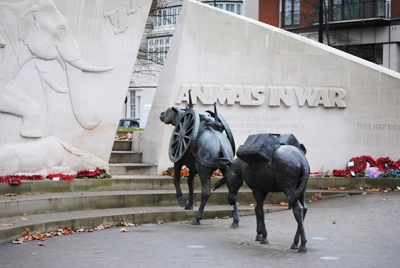
Located in the middle of Park Lane near the intersection with Upper Brook Street on the eastern side of Hyde Park, the memorial is dedicated “to all the animals that served and died alongside British and Allied Forces in wars and campaigns throughout time”. Another inscription on the memorial reads “They had no choice”.

A further dedication at the memorial pays tribute to the “millions” of animals who have died in wars. “From the pigeon to the elephant, they all played a vital role in every region of the world in the cause of human freedom,” it says. “Their contribution must never be forgotten.” It’s been said that as many as eight million horses were killed in World War I alone.

It features a couple of bronze pack mules making their way through a gap in a curved, 58 foot wide Portland stone wall – themselves carrying reliefs of various animals including an elephant, horses, camels and pigeons – while on the other side is a bronze horse and a dog, looking ahead.

The memorial is the work of Somerset-based sculptor David Backhouse and was unveiled by Princess Anne in November 2004, the 90th anniversary of the outbreak of World War I. It was apparently inspired by Jilly Cooper’s book, Animals in War, and commissioned by the Imperial War Museum. It was paid for by £2 million in public donations.

For more, check out www.animalsinwar.org.uk.

LondonLife – An upsized Royal Family…

Like your Royal Family large? The largest ever photograph of Queen Elizabeth II, her husband, the Duke of Edinburgh, and their four children has been displayed on South Bank building, Sea Containers, in celebration of the Queen’s Diamond Jubilee. The iconic picture of the family – which also includes Earl Mountbatten, uncle to Prince Philip, and Princess Anne’s then husband Mark Phillips – was taken during 1977’s Silver Jubilee by an unknown photographer. The 100 by 70 metre image, which weighs nearly two tons, took eight people more than 45 hours to put into place on the building’s facade overlooking the Thames. It was erected by the owner of Sea Containers as a tribute to be seen during this weekend’s Jubilee Flotilla (and also to hide development work taking place behind as the building is transformed into a Mondrian hotel – Europe’s first – and office space.

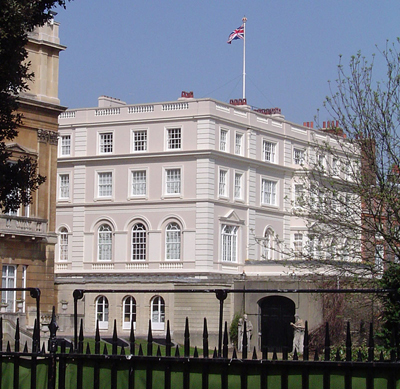
Celebrating the Diamond Jubilee with 10 royal London locations – 3. Married life at Clarence House…

Princess Elizabeth and Prince Philip were married at Westminster Abbey, a highly significant property in the Queen’s story which we’ll be looking at in more depth shortly, on 20th November, 1947 (and, as did other brides in post-war Britain, the princess had to collect coupons for her wedding dress).

Following their honeymoon at Broadland – the home of Lord Mountbatten in Hampshire and at Birkhall, Balmoral, in Scotland, in 1949, they and their baby son, Charles, moved into Clarence House, their home for the next three years.

The house, which still featured Victorian decor, was refurbished although post-war austerity ensured the decor and furnishings – many of which were wedding presents – remained simple. The house still contains a Georgian dining table and 20 ladder-back chairs which were the gift of the Royal Warrant Holders Association and a mahogany sideboard and four side tables which were a present from Queen Mary, the Queen’s grandmother.

Princess Anne, second child of the Queen and Prince Philip, was born in the house in 1950.

Clarence House was originally built between 1825 and 1827 to the designs of John Nash (he also designed Buckingham Palace) and was designed as the home of George III’s third son, Prince William Henry, Duke of Clarence and his wife Adelaide, and incorporated some of the Tudor buildings of St James’ Palace.

Indeed, Prince William Henry liked the house so much that on succeeding to the throne as King William IV in 1830, he decided not to move to Buckingham Palace and instead remained at Clarence House.

Later occupants have included Queen Victoria’s mother, the Duchess of Kent, and two of her sons, Prince Alfred, Duke of Edinburgh, and Prince Arthur, Duke of Connaught as well as Queen Elizabeth, the Queen Mother, who moved in after the property was vacated by Queen Elizabeth II and remained living at the house until her death in 2002.

Today Clarence House is the official London residence of Prince Charles, Prince of Wales, and his wife Camilla, the Duchess of Cornwall, as well as Prince Harry.

Clarence House is usually open for tours during summer but will not be opening this summer due to the Paralympic and Olympic Games blocking the entrance from The Mall. For details on the 2013 opening, see www.royalcollection.org.uk/visit/clarencehouse.

PICTURE: ChrisO, Wikipedia

LondonLife – Trooping the Colour…

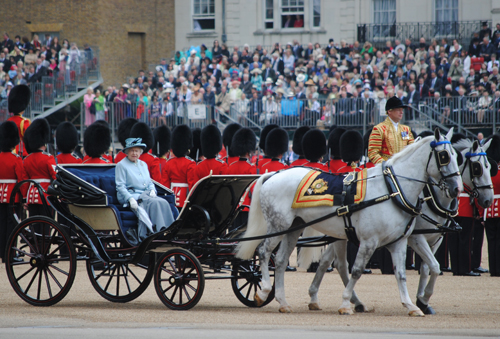
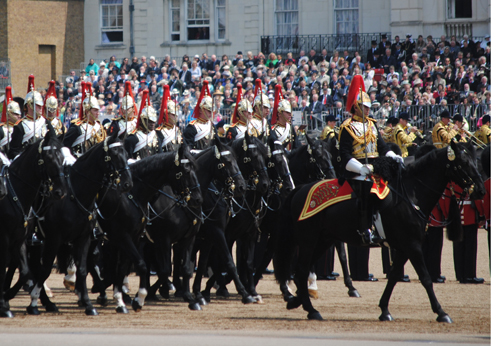
A ceremony first believed to have been performed during the reign of King Charles II, since 1748 the parade has been used to mark the Official Birthday of the Sovereign.

 Queen Elizabeth II inspects the Guards in her phaeton.

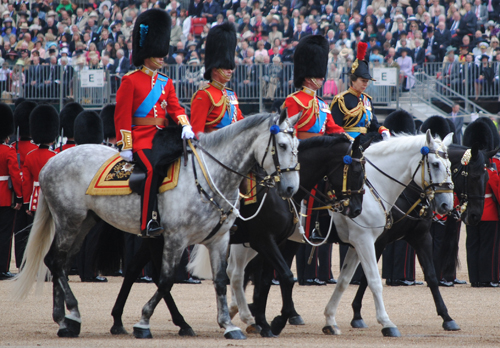
Prince William, Prince Charles, the Duke of Kent and Princess Anne riding Queen’s Escort behind the Queen.

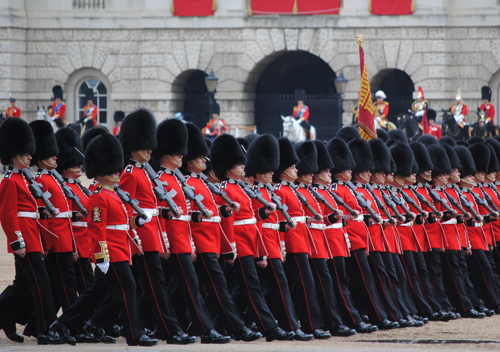
The parade includes six Guards groups. This year it was the turn of the Scots Guards, raised in 1642 at the behest of King Charles I, to parade their colours.

Part of the Household Mounted Cavalry, the Blues and Royals.

At 1pm, back at Buckingham Palace following the firing of a 41 gun salute, the Queen and the Royal Family watch Royal Air Force aircraft performing a fly past overhead.

The RAF’s Red Arrows aerobatic display team perform a colorful flypast over Buckingham Palace.
All images and text are © David S. Adams

The Royal Wedding – London’s Royal Wedding venues

In the first of a series this week looking at aspects of royal weddings in London in days past, we canvas some of the venues which have hosted the sometimes glittering occasions.

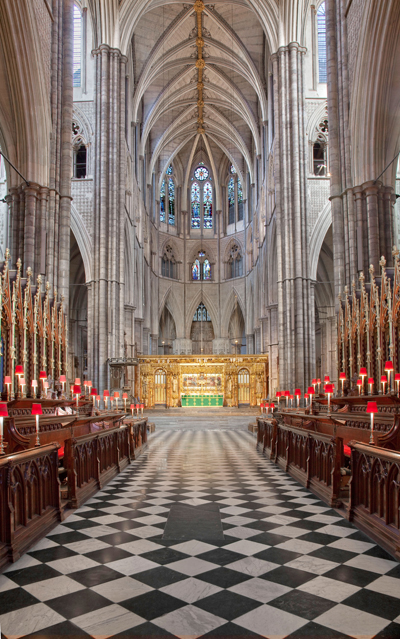
First up is Westminster Abbey (pictured), the location of Prince William and Kate Middleton’s wedding this Friday, which, despite its thousand year history, is only believed to have hosted 15 royal weddings.

Among them is said to have been the wedding of King Henry I to Matilda of Scotland on 11th November, 1100, as well as that of Richard, Earl of Cornwall and brother of King Henry III, who married his second wife, Sanchia of Provence, there on 4th January, 1243, and Joan of Acre, daughter of King Edward I, who married Gilbert, Earl of Gloucester, on 30th April, 1290 (her sister Margaret married John, Duke of Brabant, at the same venue less than three months later). The abbey also hosted the wedding of King Richard II to Anne, daughter of Emperor Charles IV of Bohemia, on 20th January, 1382.

The abbey church has become increasingly favored as a venue for royal weddings in more recent times. Among the most prominent hosted there last century were that of Prince Albert, Duke of York (later King George VI), who married Lady Elizabeth Bowes-Lyon on 26th April, 1923 and that of their daughter Princess Elizabeth (later Queen Elizabeth II) who married Prince Philip of Greece (later the Duke of Edinburgh) there on 20th November, 1947.

Two of the current Queen’s children were also married there – Princess Anne, who married Captain Mark Phillips on 14th November, 1973, and Prince Andrew, who married Sarah Ferguson on 23rd July 1986. (For more on Royal Weddings at the Abbey, see www.westminster-abbey.org/our-history/royals/weddings)

A notable break with the trend in recent times was the marriage of Prince Charles and Lady Diana Spencer – they were married in a fairytale ceremony at St Paul’s Cathedral on 29th July, 1981.

Other London locations for royal weddings have included the now non-existent Greenwich Palace (King Henry VIII married Katherine of Aragon on 11th June, 1509) and Hampton Court Palace (another of King Henry VIII’s marriages – that in which he was wed to Catherine Parr – was held here in a private chapel on 12th July, 1543).

Along with St George’s Chapel at Windsor, the Chapel Royal at St James’s Palace  in London was particularly popular in Victorian times – Queen Victoria married Prince Albert there on 10th February, 1840, and their eldest daughter, Princess Victoria, married Prince Frederick (the future German Emperor Frederick III) there on 25th January, 1858. On 6th July, 1893, the chapel also hosted the wedding of the future King George V and Princess Mary of Teck.

PICTURE: Copyright Dean and Chapter of Westminster