10 historic London homes that are now museums…5. The Freud Museum…

The Freud Museum. PICTURE: A Peace of London (licensed under CC BY-NC 2.0)

The last residence of Sigmund Freud, the founder of psychoanalysis, is located in Hampstead and is now a museum dedicated to his work and that of his daughter, pioneering child psychoanalyst Anna Freud.

The Freuds moved into the property at 20 Maresfield Gardens (having initially briefly stayed at a flat at 39 Elsworthy Road, Primrose Hill) in September, 1938, having left their home in Vienna to escape the Nazi annexation of Austria earlier in the year.

The house dates from 1920 and was built in the Queen Anne Revival Style. A small sun room was added a year after to the rear of the property.

Freud finished his final works Moses and Monotheism and An Outline of Psychoanalysis while at the property and also saw patients there as well as some high profile visitors including Princess Marie Bonaparte, writer HG Wells and literary couple Leonard and Virginia Woolf. Already aged in his 80s when they moved in, he died in the home just a year after on 23rd September, 1939. But his daughter Anna remained in the property until her death in 1982.

As per her wishes, it was subsequently turned into a museum and opened to the public in July, 1986, as The Freud Museum.

Among the rooms which can be visited today are Freud’s study, the library, hall and dining room but some areas – such as Anna Freud’s consulting room – are used as offices and not open to the public.
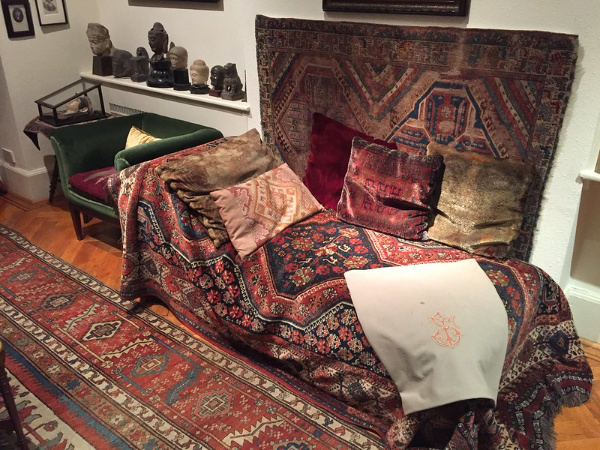
Freud’s couch. PICTURE: John Kannenberg (licensed under CC-BY-NC-ND-2.0)

The star sight inside is undoubtedly Freud’s famous couch. Located in the study, it was originally the gift of a patient, Madame Benvenisti, in 1890, and is covered with a Qashqa’i carpet which Freud added.

Other items which can be seen in the house include several paintings collected by Freud and a series of photographs by Edmund Engelman which depicted Freud’s apartment in Vienna just weeks before he fled. There’s also a portrait of Freud by Salvador Dali who visited him in London, his collection of antiquities and his painted Austrian furnishings as well as many mementoes related to Anna Freud.

The premises also hosts temporary exhibitions and a range of other events.

The garden outside – much loved by the Freuds – has been left largely as Sigmund Freud would have known it.

The house is one of the rare properties in London which features two English Heritage Blue Plaques – one commemorating Sigmund and the other Anna.

There’s a famous statue of Sigmund Freud by Oscar Nemon just a couple of minutes walk away at the corner of Fitzjohns Avenue and Belsize Lane.

WHERE: The Freud Museum, 20 Maresfield Gardens, Hampstead (nearest Tube stations are Finchley Road, Finchley Road & Frognal and Belsize Park); WHEN: 10:30am to 5pm, Wednesday to Sunday; COST: £14 adults/£12 concessions/£9 young persons (aged 12 to 16, under 12s free); WEBSITE: www.freud.org.uk.
This Week in London – The Sun explored; Darwin’s story on stage; Freud meets Dali; and, medallic art in Britain…

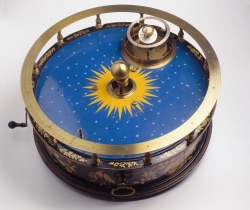
• The biggest ever exhibition exploring the Sun opens at the Science Museum in South Kensington this Saturday. The Sun: Living With Our Star features everything from Nordic Bronze Age artefacts revealing ancient beliefs about how the Sun was transported across the sky to details of upcoming NASA and European Space Agency solar missions. Highlights include the original ‘orrery’ (pictured), an instrument made for the Earl of Orrery in 1712 to demonstrate the motions of the Earth and Moon around the Sun, a rare concave mirror known as a yang-sui which was used for lighting fires in China and dates to between 202 BCE and 9 CE, and a Tokomak ST25-HTS, a prototype nuclear fusion reactor which successfully created and sustained plasma for a record-breaking 29 hours in 2015. There’s also an astronomical spectroscope made for Norman Lockyer, founder of the Science Museum, who used it to identify the element helium in 1868 – the exhibition actually coincides with the 150th anniversary of Lockyer’s discovery, the first of an “extra-terrestrial” element. The exhibition also includes interactive experiences including a huge illuminated wall display allowing visitors to see the Sun rise in different seasons and locations and another in which visitors are able to bask in the sun while sitting in deck chairs under palm trees with sand at their feet. Runs until 6th May next year. Admission charge applies. The exhibition is being accompanied by a programme of events including “family festivals” in early November and early March. For more, see www.sciencemuseum.org.uk/see-and-do/the-sun-living-with-our-star. PICTURE: Science Museum Group Collection/© © The Board of Trustees of the Science Museum.

The story of Charles Darwin is told in a new two hour stage play featuring a cast of seven people and 30 hand-made puppets which opened at The Natural History Museum this week. The Wider Earth, which follows Darwin as he sets out on a daring five year journey aboard the HMS Beagle through uncharted landscapes, is being staged in the museum’s Jerwood Gallery following sold-out seasons in Australia and represents the first time a performance-based theatre has been constructed in the museum. Presented by Trish Wadley Productions and Dead Puppet Society in association with Glass Half Full Productions, the show runs until 30th December. To book tickets, head to www.thewiderearth.com.

This year marks 80 years since Sigmund Freud and Salvador Dalí famously met in London on 19th July, 1938 – a meeting at which Dalí revealed to Freud his recently completed painting The Metamorphosis of NarcissusThe Freud Museum has launched a new exhibition – Freud, Dalí and the Metamorphosis of Narcissus – which explores the extensive influence of Freud on Dalí and on Surrealism as well as Freud’s own reaction to the painting. The painting forms the centrepiece of the exhibition which also includes drawings, photographs and prints as well as documents including letters, manuscripts, books and Freud’s appointment diary. The display is accompanied by a programme of events. Runs until 24th February. Admission charge applies. For more, see www.freud.org.uk.

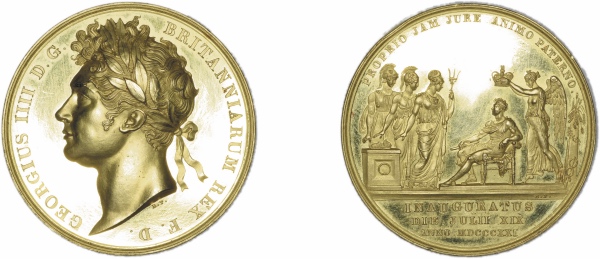
The “invaluable” role artists from abroad played in the development of British medallic art is the focus of a new display at the British Museum. Witnesses: émigré medallists in Britain features medals from six centuries documenting significant historical moments and commemorating famous British figures. The earliest objects date from Elizabethan England when Dutch artist Steven van Herwijck introduced the art of the medal to Britain’s cultural elite while ‘stars’ in the display include a spectacular Waterloo medal conceived by 19th century Italian gem engraver Benedetto Pistrucci which took 30 years to complete and bears the image of the four allied sovereigns – George, Prince Regent, Francis II of Austria, Alexander I of Russia and King Frederick William III of Prussia. The free display can be seen in Room 69a until 7th April next year. For more, see www.britishmuseum.org. PICTURE: Benedetto Pistrucci: Coronation of George IV, 1821, gold, 35mm. © the Trustees of the British Museum M5716. B, 1070. CME6436.

Send all items for inclusion to exploringlondon@gmail.com.