Dr Livingstone honoured; David Bowie at the V&A; Damian Lewis receives Freedom; pocket parks; and, try a new sport…

The President of Malawi, Joyce Banda, attending a wreath-laying ceremony at Westminster Abbey on Tuesday night to mark the bicentenary of the birth of Scottish missionary and explorer Dr David Livingstone. The ceremony took place at the grave of Dr Livingstone – his body was repatriated to London following his death in Zambia in 1873 from malaria and dysentery. The Very Reverand Dr John Hall, the Dean of Westminster, said the ceremony honored a “Scot of humble origins, but clear determination and courage”. “140 years after his death, he remains respected throughout these islands, and especially in Africa, where, for 30 years, he laboured to spread the Gospel, to explore the land’s secrets, and to map what he discovered,” he said. “Treating all people as his equals, he worked to abolish the slave trade in Africa.” Livingstone conducted several expeditions into the interior of Africa – while they included a failed attempt to find the source of the Nile, he is credited with documenting numerous geographical features including Victoria Falls (he named it after Queen Victoria) and Lake Malawi. Celebrated as a hero of the Victorian age, his meeting with Henry Stanley in October 1871 – Stanley had been sent to find him after he had lost contact with the outside world – gave rise to the expression “Dr Livingstone, I presume?” (though whether he actually said the phrase remains a matter of debate).

A landmark exhibition on the career of David Bowie opens at the V&A on Saturday. David Bowie is features more than 300 objects including handwritten lyrics, costumes, photographs, films, Bowie’s instruments and album artwork selected by the V&A’s theatre and performance curators, Victoria Broackes and Geoffrey Marsh. The exhibition takes an in-depth look at Bowie’s music and how it and his “radical individualism” has influenced and been influenced by wider movements in art, design and contemporary culture. Among the more than 60 costumes on display will be a Ziggy Stardust bodysuit (1972) and costumes made for the 1973 Aladdin Sane tour as well as some of Bowie’s own sketches, musical scores and diary entries. This exhibition, which is sponsored by Gucci and Sennheiser,  runs until 11th August. Admission charge applies. For more, see www.vam.ac.uk/davidbowieis.

Homeland star Damian Lewis has received the Freedom of the City of London in a ceremony at Guildhall on Tuesday in recognition of his “outstanding achievements in acting”. Lewis, who graduated from the City of London’s Guildhall School of Music & Drama in 1993, has appeared in The Forsyte Saga, US mini-series Band of Brothers and, of course, in Homeland. Interestingly, his maternal grandfather, Sir Ian Bowater, was Lord Mayor of the City of London from 1938 to 1939. For more, see www.cityoflondon.gov.au.

Work is underway on the first of the Mayor of London, Boris Johnson’s, “pocket parks”. The size of a tennis court, the pocket parks are set to “reinvent some of London’s forgotten nooks and crannies”. Among the first will be an edible park featuring vegetable, herbs, fruit trees and hops located on ‘dead space’ behind a Stockwell bus stop (the hops will be sold to the Brixton Beer Cooperative). All 100 of the pocket parks will be finished by March 2015 at a cost of £2 million. For more, see www.london.gov.uk/priorities/environment/greening-london/parks-green-spaces/pocket-parks.

It’s the chance to try a new sport for the first time in a day of free games and activities which will be held at the Queen Mother Sports Centre in Vauxhall Bridge Road on Saturday. From 10am to 3pm, visitors will be able to try a range of different sporting activities including football, basketball and swimming with athletes and coaches on hand to offer advice. For more, see www.westminster.gov.uk.

Around London – Royal Court treasures at V&A; Sir Michael Caine celebrated; a tunic with a past; and, George Catlin’s American Indian portraits…

Water_potA new exhibition opens at the V&A in South Kensington this Saturday which charts the development of cultural trade and diplomacy between Britain and Russia from the founding of the Muscovy Company in 1555 until the end of King Charles II’s reign in 1685. Treasures of the Royal Courts: Tudors, Stuarts and the Russian Tsars reveals the “majesty and pageantry” of the royal courts of both countries – from that of King Henry VIII to King Charles II in Britain and from that of Ivan the Terrible (Ivan IV) to the early Romanovs in Russia. The display features more than 150 objects including heraldry and processional armour,  furnishings, clothing, jewellery and portraiture including paintings and miniatures painted by court artists. Highlights include a rarely viewed portrait of Queen Elizabeth I, the Barbor Jewel – a pendant set with an onyx cameo of the queen; a hand-colored map of ‘Muscovy’ dating from 1570, and literature including Shakespeare’s First Folio as well as a showcase of British and French silver given to the Tsars by British merchants and kept in the Kremlin. The 20 pieces include the Dolphin Basin, made by Christiaen van Vianen – said to be a favoured silversmith of King Charles I and II – in 1635. The exhibition marks the 400th anniversary of the Romanov dynasty. Admission charge applies. Runs from Saturday, 9th March, until 14th July. For more, see www.vam.ac.uk. PICTURE: Water pot (1604-05), Historic collectino of the Armoury, © The Moscow Kremlin Museums.

The life and work of Sir Michael Caine – who turns 80 this month – is the focus of a new free exhibition at the Museum of London. Michael Caine, which opens tomorrow, features photographs including some never exhibited before as well as iconic portraits by the likes of David Bailey and Terry O’Neill as well as a selection of audio and film clips from movies such as Alfie, The Italian Job, Get Carter, Hannah and Her Sisters and Educating Rita. The exhibition follows Sir Michael’s life from “Cockney rebel, through to Hollywood legend and inspirational Londoner” and looks at how the city influenced his life and career. Runs until 14th July. To coincide with the exhibition, the Museum of London Docklands is running Caine on Screen, a selection of free films which can been voted for by the public (see our earlier post here). The schedule of films will be announced after 14th March. For voting details and more information, see www.museumoflondon.org.uk.

A bullet-pierced military tunic worn during the Indian Mutiny in the mid 19th century has been donated to the National Army Museum in Chelsea. The tunic, worn by Lieutenant Campbell Clark, of the 2nd Bengal European Fusiliers, at Cawnpore in 1857. The lieutenant was ambushed by rebels Indian infantry and shot at point-blank range. Despite being grievously wounded (the musket ball had passed through his stomach and remained in the wound), he survived the injury and the military hospital he was taken to and went on to have a long career, rising to the rank of colonel. He died in 1896 in Sussex. The tunic was donated to the museum by Clark’s great-great-nephew, John Gordon Clark. For more, see www.nam.ac.uk.

On Now: George Catlin: American Indian Portraits. Opening today, this exhibition at the National Portrait Gallery is the first major exhibition of the American artist’s works to be held in Europe since the 1840s and has been designed to demonstrate to the viewer how Catlin constructed a particular view of Native Americans in the minds of his audiences. Catlin made five trips into the western United States in the 1830s before the Native American peoples had been subsumed into the United States and, inspired by those trips, went on to create an Indian Gallery which featured 500 portraits, pictures and indigenous artefacts. He subsequently toured with the gallery in both the US and Europe. The exhibition is organised in collaboration with the Smithsonian American Art Museum in Washington. Runs until 23rd June. Admission charge applies. For more, see www.npg.org.uk.

10 of London’s greatest Victorian projects – 1. Royal Albert Hall…

The London Underground’s first railway journey took place on 9th January, 1863, and to celebrate we’re taking a look at 10 great Victorian-era projects in London. First up is Royal Albert Hall in South Kensington.

Royal-Albert-HallOpened on 29th March, 1871 (and in continuous use ever since), Royal Albert Hall was built in fulfilment of Prince Albert’s dream of creating a hall that would stand in the heart of the South Kensington estate and provide a focal point for the promotion of the arts and sciences.

It was on the back of the success of the Great Exhibition held in Hyde Park in 1851, that Prince Albert, Prince Consort to Queen Victoria, proposed the creation of a permanent arts and sciences precinct in South Kensington and advised the purchase of land for that purpose (the hall is located on land once occupied by Gore House). But it wasn’t until after his death in 1861 that his vision was actually realised.

Construction of the hall – which was to serve as the centrepoint of the cultural precinct which became known, somewhat derisively, as Albertopolis – started in April 1867 (initially to be known as The Central Hall of Arts and Sciences, the hall apparently had its named changed to the Royal Albert Hall of Arts and Sciences by Queen Victoria while she was laying the foundation stone on 20th May that year – around 7,000 people attended the event). It was designed by engineers Captain Francis Fowke and, after his death, Lieutenant Colonel Harry Darracott Scott, based on concepts put forward by the man described as the “driving force” behind the project, Henry Cole (later the first director of what is now the Victoria and Albert Museum). He had been inspired by the Roman amphitheatres he had seen while touring in southern France.

While initial proposals had suggested the hall would accommodate as many as 30,000 people, this was later scaled back to about 7,000 (and today the figure is apparently about 5,500 thanks to fire regulations).

The central auditorium, measuring 185 feet by 219 feet, is covered by a glazed dome constructed of wrought iron girders and was the largest structure of its kind in the world at the time of its building. The hall’s exterior was built from about six million red bricks and features an 800 foot long terracotta frieze showing figures engaged in a range of cultural pursuits. Much of the interior decorative detail was added later.

So overcome was Queen Victoria at the building’s opening in 1871 that Edward, the Prince of Wales, had to speak in her place, declaring it open on her behalf before a crowd which included then Prime Minister Benjamin Disraeli. Her only reported comment on the hall was that it reminded her of the British constitution.

The Grade One listed hall – which thankfully only suffered minor damage during World War II bombing raids (the German pilots apparently used its bulk as a navigation aid) – has since undergone substantial modifications including works undertaken to improve the hall’s acoustics, the replacement of gas lighting (electricity was first demonstrated in the hall in 1873) and demolition in 1889 of an adjoining glass conservatory to its south. A massive programme of improvements was carried out between 1996 and 2004 at the cost of more than £69 million.

The list of those who have performed or spoken at the hall reads something like a who’s who – among them are classical composers Wagner, Verdi, Elgar and Rachmaninov, singers and musicians including Frank Sinatra, Jimi Hendrix, The Beatles, The Who, Eric Clapton, Elton John, Adele, and Jay Z as well as sports personalities including boxer Mohammed Ali and tennis player John McEnroe, explorers like Sir Ernest Shackleton, world figures such as Queen Elizabeth II, Sir Winston Churchill, former South African president Nelson Mandela, the Dalai Lama and former US president Bill Clinton and other high profile personalities such as Albert Einstein, Alan Ginsberg and Paul Robeson.

Among the other events held in the hall have been a marathon race, Greco-Roman wrestling and two Welsh National Eisteddfod’s (in 1887 and 1909). One of the most popular series of events now held there each year are the BBC Promenade Concerts, known as The Proms they include more than 70 events, which have been held in the hall since World War II.

A Victorian masterpiece. For more on the hall, see www.royalalberthall.com.

Treasures of London – The Becket Casket…

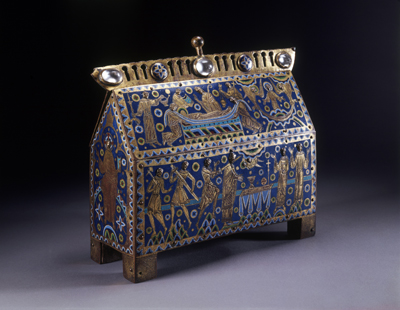
This stunning early medieval casket, dating from around 1180-1190, commemorates one of the most infamous events of the Angevin era – the death of Thomas Becket, Archbishop of Canterbury, who was murdered in Canterbury Cathedral on 29th December, 1170, by four knights of King Henry II.

The murder – for which the king undertook public penance (although whether he ordered the death of Becket, his former chancellor and friend, remains a matter of some dispute) – provoked outrage across Europe and pilgrims soon started flocking to Becket’s tomb.

So much so that the Archbishop was canonised in 1173 and in 1220 a richly decorated shrine was created to house Becket’s remains and serve as a focal point for pilgrims (a pilgrimage to Becket’s shrine is at the heart of Geoffrey Chaucer’s A Canterbury Tale). The shrine was eventually destroyed in 1538 on the orders of King Henry VIII during the Dissolution of the Monasteries.

The beautiful Becket Casket, made of Limoges enamel, depicts, among other things, Becket’s murder, subsequent burial and the ascension of his soul to heaven. On the rear are four long-haired figures who may represent saints or the Cardinal Virtues of Prudence, Justice, Fortitude and Temperance.

One of more than 40 examples still in existence (the British Museum also has one), it was probably made for an important religious house and may have been used to contain relics of the dead saint.

It can now be found in the collection of the V&A’s Medieval and Renaissance Gallery at the museum’s premises in South Kensington.

WHERE: Room 8 (case 20), Victoria & Albert Museum, Cromwell Road, South Kensington (nearest Tube Stations are South Kensington and Knightsbridge). WHEN: 10am to 5.45pm daily (Fridays until 10pm – select galleries after 6pm)COST: Free; WEBSITE: www.vam.ac.uk.

For more on Thomas Becket, see John Guy’s book Thomas Becket: Warrior, Priest, Rebel, Victim: A 900-Year-Old Story Retold.

PICTURE: V&A images

Around London – Dickens at the Museum of London; looking at Leicester Square’s past; Mr Chinnery’s art; and, Wellcome’s Miracles & Charms…

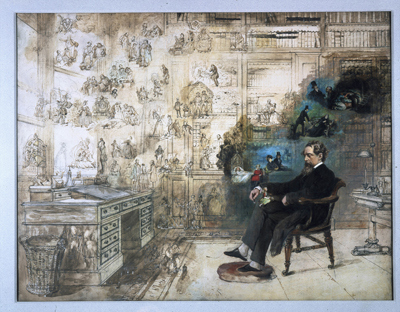
• Dickens fever is well and truly upon us in the lead-up to the bicentenary of his birth in February and tomorrow the Museum of London opens its own unmissable exhibition, Dickens and London. Displays centre on the relationship between Dickens and the city and visitors will be able to follow in the great novelist’s footsteps as they visit some of the places which sparked his imagination as well as confront some of the great social issues of the 19th century – including childhood mortality, prostitution and poverty – and be taking on a tour of some of the age’s greatest innovations – everything from railways and steamboats to the Penny Post. Among the objects on display will be Dickens’ writing desk and chair, his bank ledger, excavated items from Jacob’s Island, a notorious slum which was located near Bermondsey, and manuscript pages describing an East End opium den which was featured in Dicken’s unfinished novel, The Mystery of Edwin Drood (this, along with William Powell Frith’s celebrated portrait of the author, are being lent by the Victoria and Albert Museum). The exhibition also features a specially commissioned film looking at London after dark in Dickens’ time and today. Costumes from the upcoming BBC One drama series, Great Expectations, will also be on display and there is also a specially commissioned window display by acclaimed creative director and set designer Simon Costin showing a wintery London in the mid-19th century. The museum is also offering a new iPhone and iPad graphic novel app, Dickens: Dark London, which will take users on a “journey through the darker side” of Dickens’ London. Opens on 9th December (tomorrow) and runs until 10th June, 2012. Admission charges apply. For more, see www.museumoflondon.org.uk. For more on Dickens, see www.dickens2012.org. PICTURE: Dickens Dream by Robert William Buss (Courtesy Museum of London).

New hoardings have gone up at Leicester Square celebrating the area’s history as work continues on an £18 million plan by Westminster City Council to revitalise the Leicester Square streetscape. The more than 160 square metres of hoardings feature 11 images spanning a period of 250 years (and selected from thousands of archive images of the square). Meanwhile in Trafalgar Square, the famous Norwegian Christmas Tree was lit in a ceremony last Thursday. The tree is an annual gift from the people of Oslo as thanks for British support during Norway’s years of occupation in World War II. It will be lit from noon until midnight every day until 6th January.

And, briefly…..London’s Kew Gardens has been voted the top visitor attraction in Britain at the British Airways magazine travel award while the London Eye and Tate Modern came runner’s up…..Figures released to mark the 10th anniversary of free admission to England’s national museums show that visitor numbers to the museums have more than doubled over the past decade…..and, the first woman Tube driver, Hannah Dadds, reportedly died at the age of 70.

On Now: The Flamboyant Mr. Chinnery: An English artist in India and China. This exhibition at Asia House in New Cavendish Street in the West End, focuses on the work of 19th century artist George Chinnery and features landscapes and portraits he painted while in China and India. Runs until 21st January. Admission is free. For more, see www.asiahouse.org.

• On Now: Miracles & Charms. The Wellcome Collection is hosting this exhibition which features two shows – Infinitas Gracias: Mexican miracle paintings, the first major exhibition of Mexican votive paintings outside of Mexico, and Charmed life: The solace of objects, an exhibition of unseen London amulets from Henry Wellcome’s collection. Runs until 26th February, 2012. For more, see www.wellcomecollection.org.

Around London – New picture gallery at V&A; remembering the 5th of November; War Horse – the exhibition; and, celebrating Private Eye…

The Victoria and Albert Museum has opened a new permanent gallery displaying highlights from its internationally renowned collection of photographs in what amounts to a chronicle of the medium stretching from its invention in 1839 to the 1960s. The gallery, which opened in late October, initially features works such key figures as Henri Cartier Bresson, Man Ray, Alfred Stieglitz, Diane Arbus and Irving Penn. Among highlights are the oldest photograph in the V&A’s collection – a daguerrotype of Parliament Street taken from Trafalgar Square in 1839, a Robert Howlett portrait of Isambard Kingdom Brunel standing in front of the Great Eastern, and an early botanical photography taken without a camera in 1854. The display also includes two “in focus” sections, looking at the lives of two photographers – initially British photographer Julia Margaret and the influential Henri Cartier-Bresson – in depth. The V&A was the first museum to start collecting photographs when it did so in 1856. Entry is free. For more, see www.vam.ac.uk.

• Remember, remember, the 5th of November! This weekend is Bonfire Night (aka Guy Fawkes Night) and across London communities will be gathering around bonfires to gasp at fireworks displays. We don’t have the capacity to collect all the details of where they’re taking place but thankfully the people at View London do. Follow this link to see its listing of where fireworks displays are taking place. To see our previous entry looking at the origins of the night, follow this link. For more on the Gunpowder Plot, see our previous entry here.

• On Now – War Hose: Fact & Fiction. A book, a long running stage performance and a soon to be released film, War Horse is now also the subject of a major exhibition at the National Army Museum. War Hose: Fact & Fiction is a family-friendly exhibition which tells the real-life story of horses in war and includes archive material from the animal charity The Brooke, which was founded after Dorothy Brooke rescued some former war horses being sold into a life of hard labour in Cairo (Brooke, who rescued some 5,000 horses, went on to found the Old War Horse Memorial Hospital in Cairo in 1934). The exhibition also features content from Michael Morpurgo, author of the novel War Horse, as well as the National Theatre’s production and the upcoming Spielberg-directed movie. Entry is free. Runs until August 2012. For more, see www.nam.ac.uk.

On Now: Private Eye: The First 50 Years. A celebration of the irreverent Private Eye magazine which, since it was founded in October 1961, has distinguished itself through a combination of satire and hard-hitting journalism. The exhibition features more than 120 of the magazine’s funniest cartoons and a display of the magazine’s distinctive covers with one of from each year chosen by editor Ian Hislop. It also shows how surprisingly low-tech the magazine’s production remains despite great changes in technology, and there’s a recreation of the editor’s Soho office. Admission is free. Runs until 8th January. For more, see www.vam.ac.uk.

Around London: Talking rubbish; Conan Doyle’s lost manuscript; John Martin’s apocalypse; and, Postmodernism at the V&A…

Twenty-five talking rubbish bins will be installed in Westminster City Council area as part of a campaign to encourage people to use them more. The rubbish bins, which will look no different from normal bins, will start chatting from 13th October and will be in London for two months before embarking on a UK tour after which they may become permanent fixtures. Each bin will have a unique respond when used – from singing a part of the Hallelujah Chorus to a blast of the trombone and will be tailored to suit their location (Covent Garden’s, for example, will be operatic in nature). The talking bins, which are also being trialled in Liverpool, are being put on the streets as part of Keep Britain Tidy’s Love Where You Live initiative.

A hitherto unpublished novel by Arthur Conan Doyle – creator of Sherlock Holmes – was published by the British Library this week. The Narrative of John Smith was Conan Doyle’s first novel and was written between 1883 and 1884 but the manuscript was lost on the way to the publishers. Conan Doyle rewrote it from memory but never resubmitted the work for publication. It serves as a rare insight into his creative development prior to his writing of more famous works like those featuring Holmes (the new book and an audio CD featuring Robert Lindsay, are available from the library shop). The library is also hosting an exhibition of related items in the Treasures Gallery, including one of the four notebooks that comprise the manuscript of The Narrative of John Smith, letters Conan Doyle wrote to his mother, and a “scientific and monthly magazine” he created when he was just 16. The exhibition is open until 5th January. The library is also hosting an event in which author Anthony Horowitz – commissioned by the Conan Doyle Estate to write a new Sherlock Holmes novel, The House of Silk, which will be published in November – will talk about his work and the new novel. To be held on 27th November from 2.30pm to 4pm (admission charge applies). For more, see www.bl.uk.

On Now: John Martin: Apocalypse. The Tate Britain is hosting an exhibition featuring the works of nineteenth century British artist John Martin, in the first show dedicated to his works in more than 30 years. While something of an outsider, Martin was a key figure in the art world of his day, known for his “dramatic scenes of apocalyptic destruction and biblical disaster”. The exhibition brings together some of his most famous paintings as well as previously unseen and newly restored works. Admission charge applies. Runs until 15th January. For more, see www.tate.org.uk/britain/.

• On Now: Postmodernism: Style and Subversion 1970-1990. An “in-depth survey of art, design and architecture of the 1970s and 1980s”, this exhibition at the Victoria & Albert Museum shows how postmodernism evolved from being merely a provocative architectural movement in the 1970s through to ideas that went on to broadly influence popular culture – everything from art and film to music and fashion. The exhibition is divided into three broad chronological sections – the first focuses on architecture, the second on the “proliferation of postmodernism through design, art, music, fashion, performance, and club culture during the 1980s” and the third on the “hyper-inflated commodity culture of the 1980s”. Admission charge applies. Runs until 15th January, 2012. For more, see www.vam.ac.uk.

Around London – Design Festival in full swing; museum acquires rare merchant figure; Olympic medals on display; and, remembering Polish, Czech and Slovak airmen…

• The London Design Festival is in full swing in London this week with more than 250 events taking place across the city over its 10 days. Launched last Saturday, the festival runs until Sunday and there’s still plenty of time to get involved. Among the highlights is a series of events, workshops and talks being held at the Victoria & Albert Museum (where you can also see 12 specially commissioned installations, one of which sees the museum’s grand entrance transformed with a sculptural form), a series of shows focusing on design in six London “design districts” – Brompton, Pimlico Road, Covent Garden, Fitzrovia, Clerkenwell and Shoreditch, and a broad program of ‘partner’ and ‘international’ events – everything from a festival featuring African-Caribbean design through to an exhibition of experimental chairs by the Danish Cabinetmaker’s Association. To find out more, simply head to www.londondesignfestival.com.

The Museum of London has announced the purchase of a rare 18th century clay figure of London druggist and tea merchant Thomas Todd. The figure, which was acquired with the help of the Art Fund and MLA/V&A Purchase Grant Fund,  is one of only two known portrait works attributed to the Chinese artists Chitqua on show in Britain. The figure, which is made from unfired clay held together by bamboo and brightly painted, was acquired from Todd’s great, great, great, great grand nephew, Thomas Todd, and will appear shortly in the Expanding City Gallery in the Galleries of Modern London. Based in Fleet Street, Pat Hardy, the museum’s curator of paintings, prints and drawings, says Todd “epitomised the kind of business acumen which ensured the growth of Britain’s industrial, mercantile and commercial empire in the eighteenth century”. For more, see www.museumoflondon.org.uk

The British Museum has opened an exhibition giving the public their first chance to see next year’s Olympic and Paralympic Games medals. Medals have been awarded at the Olympic Games since the first modern games were held in 1896. The latest Olympic medals were designed by jeweller David Watkins, for many years Professor of Goldsmithing, Silversmithing, Metalwork and Jewellery at London’s Royal College of Art, while the latest Paralympic Medals were designed by jeweller Lin Cheung, a senior lecturer for Jewellery Design at London’s Central Saint Martins College of Art and Design. The exhibition tells how, using minerals mined in the US and Mongolia (Rio Tinto is sponsoring the exhibition), the medals were produced at the Royal Mint in Llantrisant, South Wales. Mine to medals: the London 2012 Olympic and Paralympic Games medals runs until 9th September next year. Admission is free. For more, see www.britishmuseum.org.

• On Now: Brothers in Arms – Airmen of Poland and Czechoslovakia in the Battle of Britain & Beyond. The Royal Air Force Museum in Colindale, north London, is hosting an exhibition looking at the contribution of Polish, Czech and Slovak airmen in the Battle of Britain and their life afterwards. Curated in association with the Polish Institute of National Remembrance, the exhibition features drawings, archival film footage and sculpture as well as uniforms, diaries and combat reports. Opened by Poland’s Foreign Affairs Minister Radoslaw Sirkorski (who later attended the annual banquet held in honor of the Veterans of the Battle of Britain), it runs until 4th March, 2012. Entry is free. For more, visit  www.rafmuseum.org.uk.

Around London – Website to showcase UK’s oil paintings; Arctic explorer John Rae gets Blue Plaque; sharing experiences of kindness; and Toulouse-Lautrec and Jane Avril hit the Courtauld…

• A new website has been launched to showcase the UK’s vast national collection of oil paintings. While the website, which is a partnership between the BBC, the Public Catalogue Foundation, and participating collections and museums, currently hosts around 60,000 works, it is envisaged that by the end of 2012 it will carry digitised images of all 200,000 oil paintings in the UK (in an indicator of how many there are, the National Gallery currently has around 2,300 oil paintings, about one hundredth of all those in the nation). The works on the site will eventually include almost 40,000 by British artists. The 850 galleries and organisations participating so far include 11 in London – among them the National Gallery, the Tate Gallery, the Victoria and Albert Museum, the Bank of England, the Imperial War Museum and Dr Johnson’s House. For more, see www.bbc.co.uk/arts/yourpaintings/

• Arctic explorer John Rae has had a Blue Plaque unveiled in his honor at his former home in Holland Park. Although his feats were relatively unsung in his lifetime, the explorer’s expeditions in the Canadian Arctic saw him travel 13,000 miles by boat and foot and survey more than 1,700 miles of coastline. He is also credited with having “signposted” the only north-west passage around America that is navigable without icebreakers. Rae, who died in 1893, lived at the property at 4 Lower Addison Gardens in Holland Park for the last 24 years of his life.

Transport For London is calling on Londoners to share experiences of “kindness” that they have witnessed or participated in while travelling on the Underground. Artist Michael Landy has created a series of posters which are calling on people to submit their stories. Some of the stories will then be shown at Central Line stations (the first four posters go up on 23rd July at stations including Hollard Park, Holborn and Liverpool Street). For more, go to www.tfl.gov.uk/art.

On the Olympic front, the City of London Corporation has announced Tower Bridge will be bedecked with a set of giant Olympic Rings and the Paralympic Agitos during the 45 days of next year’s Games. Meanwhile, the Corporation has also unveiled it will host next week the launch of a London-wide campaign to get people involved in sport and activity in the lead-up to the Games. More to come on that.

On Now: Toulouse-Lautrec and Jane Avril Beyond the Moulin Rouge. The Courtauld Gallery, based at Somerset House, is running an exhibition celebrating the “remarkable creative partnership” between Jane Avril, a star of the Moulin Rouge in Paris during the 1890s, and artist Henri de Toulouse-Lautrec. Lautrec created a series of posters featuring Avril which ensured she became a symbol of Lautrec’s world of “dancers, cabaret singers, musicians and prostitutes”. Runs until 18th September. See www.courtauld.ac.uk for more.


Around London…

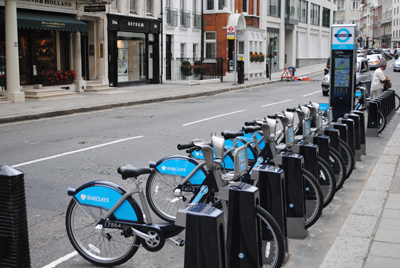
London’s bicycle hire scheme is up and running. The scheme was launched at the end of July and boasts 5,000 bikes which can be found at 315 docking stations. More than 21,000 people signed up in the first weeks and some of the early popular hire sites included Soho Square, Drury Lane in Covent Garden and Wardour Street. The bikes are available 24 hours a day, seven days a week. Members of the scheme must be 18 years old and you must be at least 14 years old to ride the bikes. A membership key costs £3 while the membership itself costs at £1 for a 24-hour membership, £5 for seven days and £45 for an annual membership. The first 30 minutes of any journey is then free (with fees applicable after that). As the bikes don’t come with a lock, it’s expected people will simply make a journey to another docking station before getting off. For more information on the Barclay’s Cycle Hire scheme, see Transport for London’s website at www.tfl.gov.uk. Meanwhile, in other transport news, the first air-conditioned Tube train is now in active service on the Metropolitan Line.

A cafe has been opened at Buckingham Palace, 173 years after Queen Victoria first moved in following her accession to the throne. Located on the West Terrace overlooking the lawn and lake, the Garden Café is open during visiting hours. The Palace’s State Rooms, meanwhile, are open to the public until 1st October. The palace this year hosts The Queen’s Year exhibition which features displays of ceremonial robes, gifts, uniforms, dresses and jewellery, as well as archive photography and film in an illustration of the monarch’s work throughout the year at everything from the State Opening of Parliament to the Garter Day ceremony at Windsor Castle and investitures, garden parties and State Visits. Entry to the State Rooms – which comprise just 19 of the palace’s 775 rooms – is £17.00 an adult, £15.50 concessions, £9.75 for under 17s and under fives are free. Family tickets are £45 and combined tickets – including the Royal Mews and the Queen’s Gallery – are also available. www.royalcollection.org.uk/default.asp?action=article&ID=30. For more on the special exhibition, see www.royalcollection.org.uk/microsites/thequeensyear/

The Tower of London was the most visited royal site in Britain last year, attracting 2.4 million tourists, according to a report from VisitBritain. The tourism agency found that while overseas tourists spent some £4.6 billion while in the UK last year, more than £500 million was spent on tourism associated with the Royal Family. The top 10 most visited sites included several royal attractions – Edinburgh Castle came in at number six with 1.2 million visitors, Windsor Castle at number seven with 987,000 and Buckingham Palace at number 11 with 402,000. Other top London sites included the National Maritime Museum in Greenwich (#2 – 2.4 million), the Victoria and Albert Museum in South Kensington (#3 – 2.3 million), St Paul’s Cathedral (#4 – 1.8 million), Westminster Abbey (#5 – 1.4 million) and Hampton Court Palace (#9 – 541,646).