What’s in a name?…Walthamstow

This north-eastern district of London’s name is apparently owed to a corruption the Anglo-Saxon place name Wilcumestowe.

That name – which means something like “a place where strangers are welcome” – is believed to have become confused with local landmark Waltham Forest, an early name used for the part of Epping Forest that centred on Waltham Abbey which lies to the north beyond the M25.
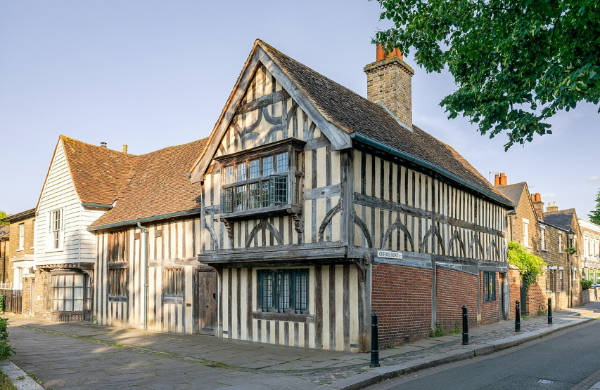
The 15th century ‘Ancient House’ in Walthamstowe. PICTURE: Tilman2007/Wikipedia (licensed under CC BY-SA 4.0)

Hence we ended up with Walthamstow (although the name Waltham Forest is remembered in the name of the London borough of which Walthamstow is part).

The Anglo-Saxon manor existed prior to the Norman invasion of 1066 and was recorded in the Domesday Book. Through marriage it passed into the hands of Norman Ralph de Toni, standard bearer to King William the Conqueror, and remained in his family until the 15th century. The family was responsible for the founding of St Mary’s Church, which still stands today, in the 12th century.

The village remained small – the area was populated by small scale farmers and yeomen – but during the 16th century wealthy people started constructing more substantial properties – these included navigator Sir Martin Frobisher, poet George Gasgoigne and Lord Mayor of London Sir George Monoux who built the Monoux Almshouses and School there (since rebuilt). Even diarist Samuel Pepys, had a connection, being entertained by Admiral Sir William Penn at a property in the village.

The trend for building large properties continued into the 18th century when included Water House was built. It later became a childhood home of Arts and Crafts designer William Morris and is now the home of the William Morris Gallery.
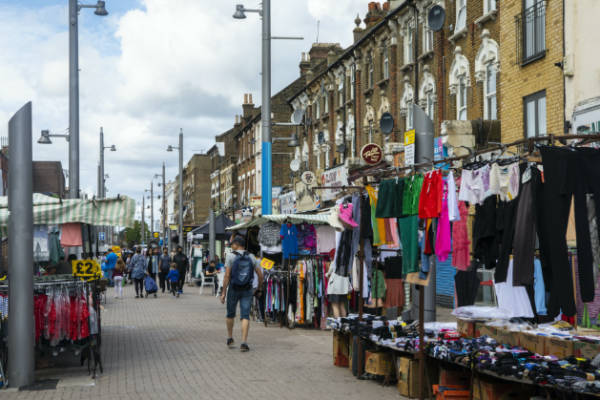
A view of Walthamstow Market on the High Street in Walthamstow, London, UK. PICTURE: Chris Dorney/iStockphoto

Urbanisation picked up pace in the 19th century and in the mid-1800s, more than 120 acres of the Walthamstowe Marshes to the west (the marshes followed the course of the River Lea and are now a site of Special Scientific Interest), were flooded to create reservoirs. Industry also moved in during this period and, in an unusual example of the sort of industry which took place in the area, the first British car with an internal combustion engine, the Brewer Car, was made in Walthamstow in the 1890s.

Development was further spurred by the arrival of the railways and, in 1930, the North Circular Road just to the north. In the late 1930s and early 1940s, the building of a rather grand new town hall and assembly hall moved the civic centre from where it had been on the High Street to Forest Road.

Redeveloped extensively after heavy bombing during World War II, Walthamstow became part of the London Borough of Waltham Forest in 1965.

As well as St Mary’s and Morris’ former home, landmarks include the 15th century “Ancient House”, the Forest School (1834) with a chapel featuring stained glass by William Morris, the Vestry House Museum (1930), the Lighthouse Methodist Church (1893) and the Copper Mill (the latest incarnation of a mill which has been associated with the village since the early Middle Ages). The daily Walthamstow Market, which stretches along the High Street, claims to be the longest daily street market in Europe.

Around London – Captain Kidd at Docklands; London’s Olympic Torch Relay path; St Giles’ seedy past; speech therapist Lionel Logue honored; and, The Seven Seas at Selfridges…

The true story of Captain Kidd and an exploration of London’s links with piracy is the focus of a new major exhibition at the Museum of London Docklands. Pirates: The Captain Kidd Story features original artefacts dating from 300 years ago when London was a site of pirate executions and tells the story of the infamous Captain Kidd’s life until his execution at Wapping’s Execution Dock. Among the artefacts is the original costume worn by actor Johnny Depp as he played Captain Jack Sparrow in the film Pirates of the Caribbean. The exhibition, which opens tomorrow and runs until 30th October, is being held in conjunction with a series of pirate related events including an adults-only pirate night on 27th May where you have the chance to sample some genuine “pirate drink” and take part in pirate speech lessons. Admission charges apply. For more information, visit the Museum of London Docklands website www.museumoflondon.org.uk/Docklands/Whats-on/Exhibitions-Displays/Pirates.htm.

The path of London’s Olympic Torch Relay has been announced and will finish with a week long jaunt through London. The torch will arrive in Waltham Forest on 21st July next year and then pass through Bexley, Wandsworth, Ealing, Haringey and Westminster before its arrival at the Olympic Stadium on 27th July. To find out how to nominate someone to carry the torch or for more information on the relay, visit www.london2012.com/olympic-torch-relay.

• On Now: London’s Underworld Unearthed: the Secret Life of the Rookery. The seedy side of the St Giles Rookery, a once infamous quarter of the capital, is laid bare in this new exhibition at the Coningsby Gallery. Back in 1751, the area was known as “a pit of degradation, poverty and crime” known for its free-flowing gin. Artist Jane Palm-Gold has displayed 18th and 19th century artifacts found during the Museum of London Archaeology’s recent excavation of old St Giles (conducted prior to the construction of the recent Central St Giles development which now covers the site) alongside her paintings, building what has been described as a “multi-layered psycho-geography that both mesmerises and disturbs”. Runs until 3rd June at the Coninsby Gallery at 30 Tottenham Street (nearest tube station is Goodge Street). Admission is free. For more information, see www.coningsbygallery.com

Australian speech therapist Lionel Logue – known for having helped cure King George VI of his stammer, the story of which is told in the recent Oscar-winning film, The King’s Speech – has been honored with a green plaque by Westminster Council. The plaque was expected to be unveiled today at 146 Harley Street, where Logue, who is known to have used fees from wealthier client to subsidise free treatments for those who could not afford them, lived from 1926 until 1952. The plaque is one of 94 which Westminster Council has placed to mark buildings of particular significance for their association with people who have made lasting contributions to society.

• On Now: The Seven Seas at Selfridges in Oxford Street. Conceptual artist Beth Derbyshire’s seven minute video installation features seven films of seven different seas around the globe. On show as part of Project Ocean – an initiative by Selfridges and 20 environmental and conservation groups aimed at celebrating the ocean’s beauty and highlighting the issue of overfishing. Runs until 8th June. For more information, see www.selfridges.com.