10 historic vessels in London’s Thames…8. MV Havengore….

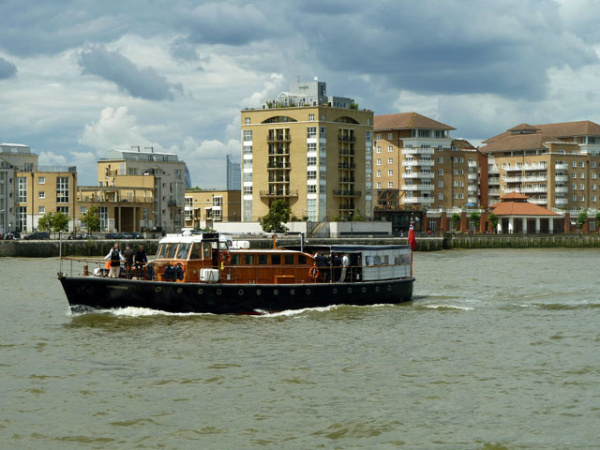
The MV Havengore. PICTURE: Robin Webster (licensed under CC BY-SA 2.0)

Still plying the waters of the Thames, the MV Havengore is perhaps most famous for having carried the coffin of Sir Winston Churchill on the River Thames as part of his state funeral in 1965.

The MV Havengore – named for a low-lying island off the coast of Essex – was originally constructed as a hydrographic survey launch for the Port of London Authority in 1956. As the PLA’s principal survey vessel and flagship, she was moored at Gravesend and tasked with recording changes to Thames bed and estuary. She became the first survey vessel in the UK to have a computer to record survey data.

The highpoint of her during her almost 40 years of service with the PLA came on 30th January, 1965, when she transported the body of Churchill from Tower Pier to Festival Pier. On the journey, she was saluted by flight of 16 fighter jets while dock cranes were made to bow as she passed (there’s a plaque on board commemorating her role in the funeral).

But the almost 26 metre long vessel also participated in other historic events including the river pageant to celebrate the Queen Elizabeth II’s Silver Jubilee in 1977 and, more recently, the flotilla formed to celebrate the Queen’s Diamond Jubilee in 2012 as well as the Thames tribute to the Queen’s long reign in 2015 and the Queen’s 90th birthday parade in 2016.

The MV Havengore was withdrawn from service in 1995 and sold after which she underwent restoration and refitting at the Chatham Historic Dockyard. The vessel was then used to provide excursions for underprivileged children on the Medway.

Sold again in 2006, she has subsequently undergone further restoration work. The MV Havengore is these days used for a range of ceremonial, corporate and private events. When not on the river, she is berthed at St Katharine Docks. The vessel was listed, as of May this year, as being up for sale.

Around London – Borough Market’s new map app; Richard Dimbleby blue plaqued; Manet at the RA; and, Light Show at the Hayward…

Borough Market, which claims to be London’s oldest food and drink market (see our earlier entry on the market here), has introduced a new app which provides smartphone users with an interactive map of the market so they can get information on the go. The app loads automatically when people enter the market website on their phones. Further features of the mobile site are yet to be unveiled. For more information, see www.boroughmarket.org.uk.

Broadcaster Richard Dimbleby (1913-65) has been honored with an English Heritage blue plaque at his former home in Cedar Court, Sheen Lane, East Sheen in London’s south west. Once the nation’s most famous broadcaster, Dimbleby, father of David Dimbleby, lived at the flat between 1937-39 – a time when he delivered some of his earliest radio reports including one on Prime Minister Neville Chamberlain’s return from Munich. Dimbleby’s career on radio and television spanned some 30 years and saw him reporting on some of the great events of his time. He was the BBC’s first war correspondent and was the first reporter to describe the horrors of Belsen concentration camp as well as being among the first reporters to enter Berlin where he reported from the ruins of Hitler’s bunker. Dimbleby was also commentator on television specials such as the Coronation of Queen Elizabeth II in 1953 and Winston Churchill’s funeral in 1965. For more, see www.english-heritage.org.uk/about/news/?topic=Blue%20Plaques.

On Now: Manet – Portraying Life. This display at the Royal Academy of Arts in Piccadilly’s Burlington House is the first major exhibition to showcase Edouard Manet’s portraiture in the UK. It examines the relationship between his portraits and his scenes of modern life and includes more than 50 paintings, gathered from public and private collections in Europe, Asia and the US, spanning his career from the mid 1800s to his death in 1883. The exhibition is arranged thematically with different sections looking at Manet’s family, his artist, literary and theatrical friends as well as his models. Highlights include The Luncheon (1868), Mme Manet in the Conservatory (1879), Berthe Morisot with a Bouquet of Violets (1872), Street Singer (1862), The Railway (1873) and Music in the Tuileries Gardens (1862). Admission charge applies. Runs until 14th April. For more, see www.royalacademy.org.uk.

On Now: Light Show. This installation at the Hayward Gallery in South Bank “explores the experiential and phenomenal aspects of light” and brings together sculptures and installations that use light to sculpt and shape space in different ways. The artworks date from the 1960s to the present day and are the work of 22 different artists. Admission charge applies. Runs until 28th April. For more, see www.haywardlightshow.co.uk.