This Week in London – Art deco at the London Transport Museum; art storage during WWII commemorated; and, William Dobson’s self-portrait…

An exhibition exploring the influence of the art deco movement on graphic poster design in on now at the London Transport Museum in Covent Garden. Art deco: the golden age of poster design features more than a hundred original 1920s and 1930s transport posters and poster artworks alongside photography, short films, ceramics and other objects to mark the centenary of the 1925 Paris exhibition where art deco originated. In the UK, Frank Pick, then-chief executive of London Transport, was the individual most responsible for advancing this form of graphic style, master-minding the publicity for the Underground and LT from 1908 onwards. A number of the posters in the exhibition in the Global Poster Gallery have never been put on public display before. Admission charge applies. For more, see www.ltmuseum.co.uk/whats-on/art-deco.
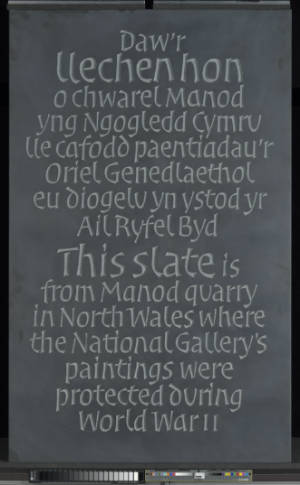
Jeremy Deller, designed and carved by John Neilson ‘Manod Slate Tablet’, 2025 © Jeremy Deller / John Neilson
Photo: The National Gallery, London

An inscribed stone tablet commemorating the Welsh quarry where The National Gallery’s art was protected during World War II has been put on permanent display in the gallery. The tablet, made from slate taken from the Manod quarry in Eryri (Snowdonia), was conceived by the artist Jeremy Deller and designed and carved by letter-carver John Neilson. The work, which was commissioned by Mostyn, an art gallery in Llandudno and supported by CELF – the national contemporary art gallery for Wales, can be seen in the Portico Vestibule, close to Boris Anrep’s floor mosaic of Sir Winston Churchill depicted in war time. The Manod slate mine in north Wales was chosen to store the art after an earlier proposal to evacuate the works to Canada was vetoed over fears of U-boat attacks. At the mine, explosives were used to enlarge the entrance to allow access for the the largest paintings and several small brick ‘bungalows’ were built within the caverns to protect the paintings from variations in humidity and temperature. What was known as an ‘elephant’ case was constructed to transport the paintings on trucks from London and, by the summer of 1941, the entire collection had moved to its new subterranean home, where it was to remain for four years, returning to London only after the end of the war in 1945. For more see www.nationalgallery.org.uk/.
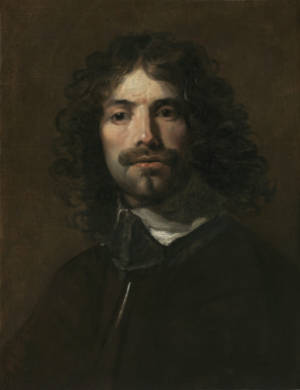
William Dobson, ‘Self-Portrait’, c1635-40. Image courtesy of Tate and the National Portrait Gallery

A self-portrait by William Dobson, widely considered to be the first great painter born in Britain, has gone on display at Tate Britain alongside a Dobson’s portrait of his wife. Dobson’s painting, which was acquired by the Tate and the National Portrait Gallery, was made between 1635 and 1640 and is said to be a “groundbreaking example of English self-portraiture”. His Portrait of the Artist’s Wife (c1635-40), which joined Tate’s collection in 1992, depicts Dobson’s second wife Judith and would have been conceived around the time of their marriage in December, 1637. Dobson rose to the role of King Charles I’s official painter before his career was cut tragically short when he died at the age of 35. For more, see tate.org.uk/visit/tate-britain.

• Send items for inclusion to exploringlondon@gmail.com.
This Week in London – Open House London; Georges Seurat and the Neo-Impressionists; and, the Burma campaign remembered…

The week-long Open House London kicks off this Saturday and features a range of activities across all 33 London boroughs – from “drop-ins” at and guided tours of buildings to talks, exhibitions, workshops and, of course, walking tours. Highlights include architect guided tours of Rana Begum’s Little Citadel retreat compound in Stoke Newington, rare access to the Islip and Nurses’ Chapels in Westminster Abbey, tours of several facilities at Queen Elizabeth Olympic Park including the new Sadler’s Wells theatre, the Lee Valley VeloPark and the Hackney Wick Fish Island Creative Enterprise Zone, and walking tours exploring Roman London. For the full programme, head to https://programme.openhouse.org.uk/.

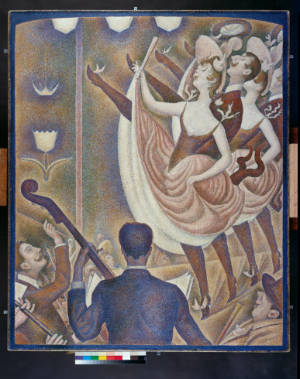
Georges Seurat, Le Chahut (1889-90), Oil on canvas, 141 x 170 cm © Collection Kröller-Müller Museum, Otterlo, the Netherlands

Georges Seurat’s painting of cancan dancers Let Chahut (1889-90) goes on display in the Sainsbury Wing of The National Gallery on Saturday. Radical Harmony: Helene Kröller-Müller’s Neo-Impressionists, which draws on the collection of the German art collector Helene Kröller-Müller (1869‒ 1939), at the Kröller-Müller Museum, Otterlo, in the Netherlands, also features several other works by Seurat as well as other radical works of French, Belgian and Dutch artists, painted from 1886 to the early 20th century. Among the highlights are Seurat’s Sunday at Port-en-Bessin (1888) and The Canal of Gravelines, in the Direction of the Sea (1890), Théo van Rysselberghe’s In July – before Noon (1890), Jan Toorop’s Sea (1899), Henry van de Velde’s Twilight (about 1889) and Paul Signac’s The Dining Room (1886-87). Runs until 8th February. Admission charge applies. For more, see www.nationalgallery.org.uk/exhibitions/radical-harmony-neo-impressionists

Marking 60 years since VJ (Victory over Japan) Day, the National Army Museum is hosting the first national museum exhibition on the Burma campaign during World War II in the 21st century. Beyond Burma: Forgotten Armies features more than 180 objects including artworks, weapons, uniforms and photographs and explores the retreat from Burma in 1942, the transformation and resurgence of British and Indian forces in India in 1943 and the campaign against the Imperial Japanese Army during 1944-45. Highlights include the abstract painting And the World was covered in darkness by Major Conrad ‘Dick’ Richardson Romyn who experienced intense fighting in Burma, a bottle of Army anti-mosquito cream and a vial of anti-malarial tablets representing the treatment of soldiers, a tin identity bracelet and food bowl used by Gunner Moss Simon, who spent three years as a prisoner of war, and a military medal awarded to Corporal Dogo Manga who served with 1st Battalion, the Nigeria Regiment, Royal West African Frontier Force. Opens on Tuesday and runs until 13th April next year. Admission is free. For more, see www.nam.ac.uk/whats-on/beyond-burma.

Send all items for inclusion to exploringlondon@gmail.com

LondonLife – Remembering VJ Day, 80 years on…

PICTURE: Sergeant Rob Kane UK MOD © Crown copyright 2025

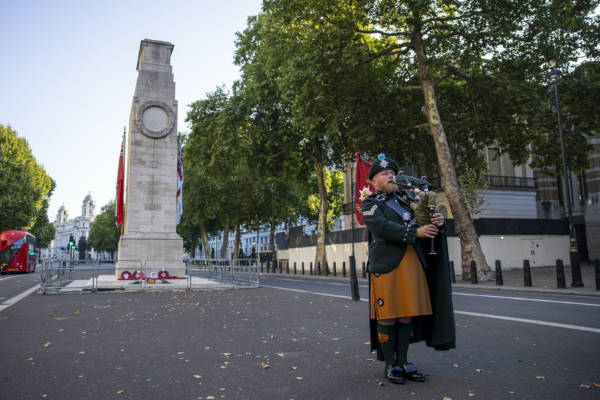
Lance Corporal James Bell plays the bag pipes in front of the Cenotaph to commemorate the 80th anniversary of Victory in Japan Day on Friday, 15th August. Lance Corporal Bell was one of six military pipers who performed solemn laments across the UK, the Far East, and aboard HMS Prince of Wales at sea, to honour the end of World War II and the sacrifices of the Commonwealth forces.

10 World War II memorials commemorating Londoners – 9. Wedding party memorial, Camberwell Green…

This rather poignant monument stands in a park above where an air raid shelter once stood in which a wedding party, 13 people in total, lost their lives in late 1940.

Subscribe for just £3 a month to access all of Exploring London’s content…

10 World War II memorials commemorating Londoners…8. First V2 rocket to strike London…

The first V2 rocket to strike London hit Chiswick in west London in September, 1944.

Subscribe for just £3 a month to access all of Exploring London’s content and support our work!

10 World War II memorials commemorating Londoners…7. First V1 rocket to strike London…

The first V1 rocket attack on London took place in June, 1944, and resulted in six deaths and 30 injuries.

Partner with Exploring London for just £3 a month and access all of our content

10 World War II memorials commemorating Londoners…5. The Stairway to Heaven Memorial, Bethnal Green…

This unique memorial commemorates the worst civilian tragedy of World War II in the UK – the disaster at Bethnal Tube station in east London.

Subscribe for just £3 a month to access all of our stories (and support our work!)

10 World War II memorials commemorating Londoners…4. Following the Leader (Memorial to the Children Killed in the Blitz)…

This unusual – and rather poignant, if overlooked – memorial, located on the side of a housing block in Lambeth, is a sculptural relief depicting a series of children.

Subscribe for £3 a month to access all of our articles and support our work!

10 World War II memorials commemorating Londoners…3. Coronation Avenue bombing…

Weeks after the start of the Blitz, on 13th October, 1940, a bomb struck a residential housing block and the air raid shelter located in Stoke Newington.

Subscribe for just £3 a month to access all of our coverage and support our work.

10 World War II memorials commemorating Londoners…2. Kennington Park air raid shelter…

More than 100 people died when, on the night of 15th October, 1940, a bomb destroyed an air raid shelter located in Kennington Park in Lambeth.

Subscribe for just £3 a month to access all of Exploring London’s content (and support our work!)

While no official death toll was announced at the time, it’s now believed that 104 people died in the bombing. Forty-eight bodies were recovered and buried in Streatham Cemetery while the remainder still lie under the park.

The majority of those killed were women and children with the youngest just three-months-old. The oldest known victim was 75.

While Lambeth’s civilian dead are commemorated in a memorial at Lambeth Cemetery dedicated in 1952, in early 2000s the Friends of Kennington Park raised funds for a permanent memorial to those killed in the tragedy in the park.

The memorial, which was designed by Richard Kindersley and is located in the South Field close to the Tinworth Fountain Gate, is an upright stab of Caithness stone brought from Scotland standing 2.6 metres tall.

It is inscribed with a quote from poet Maya Angelou – “History despite its wrenching pain cannot be unlived but if faced with courage need not be lived again.”

While another inscription around the edge of the stone commemorates the more than “50 men, women and children” who died during the bombing, a nearby interpretation board puts the toll at more than 100.

A list of known victims can be found in a pamphlet by Rob Pateman published by the The Friends of Kennington Park.

WHERE: Kennington Park, inside the Tinworth Fountain Gate, Kennington Park Road, Lambeth (nearest Tube station is Oval); WHEN: Usually 7.30am until 15 minutes before sunset; COST: Free; WEBSITE: www.lambeth.gov.uk/parks/kennington-park

Famous Londoners – Edward R Murrow…

A titan of American broadcast journalism, Edward R Murrow’s name is synonymous with London during World War II from where, as a correspondent for CBS, he famously provided live radio broadcasts at the height of the Blitz.

Edward R Murrow, seen in a screenshot in 1961. PICTURE: Via Wikipedia

Murrow, who joined CBS in the US in 1935, went to London in 1937, initially to serve as director of the network’s European operations. Said to have been deeply committed to exposing the threat Nazism posed to Americans, he was soon deeply involved in reporting events leading up to and during World War II with his first on the scene news report taking place in March, 1938, when he reported live from Vienna, Austria, during Hitler’s annexation.

Following the breakout of the war in 1939, Murrow remained based in London and went on to provide his famous live broadcasts during the Blitz, opening them with the iconic words, “This is London” and, later, ending them with “Good night and good luck”.

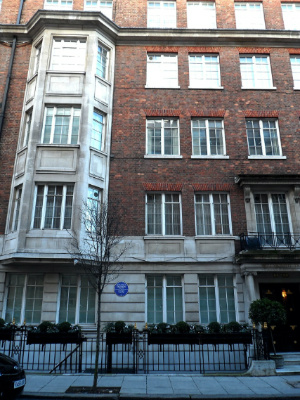
Weymouth House in Westminster where Edward R Murrow stayed during his time in London. PICTURE: Spudgun67 (licensed under CC BY-SA 4.0)

His wartime dispatches – which were broadcast from a studio in the sub-basement of the BBC’s Broadcasting House (which was bombed more than once) as well as from locations including Traflagar Square and a rooftop during the bombing raids – were to win him considerable acclaim and also saw him undertake such feats as joining combat missions in the skies over Europe and being one of the first two reporters to enter Buchenwald concentration camp in Germany in April, 1945.

Such was his standing that then British Prime Minister Winston Churchill even offered to make him joint-director of the BBC (a job offer he declined).

Murrow made his last report from London in March, 1946, before returning to the US to head CBS News. he continued to work with CBS until resigning in 1961 to take up a position as head of the United States Information Agency, a job he held until 1964.

He died at the age of 57 after being diagnosed with lung cancer at his home in Pawling, New York, on 27th April, 1965.

During his time in London, Murrow lived in a flat at Weymouth House, 84-94 Hallam Street in Westminster. An English Heritage Blue Plaque now commemorates his stay there.

Murrow is, of course, also the subject of the 2005 film – and subsequent Broadway production – Good Night, and Good Luck (although that focuses on his later stand against US Senator Joe McCarthy and his hunt for communists).

10 World War II memorials commemorating Londoners…1. Balham Underground Station…

This month, the UK and other nations marked 80 years since VE (Victory in Europe) Day. London suffered greatly during the Blitz and later rocket attacks, so we thought it appropriate to take a look at some key memorials around the city.

Subscribe for just £3 a month to support our work and access all our content…

LondonLife – VE Day remembered 80 years on…

London commenced four days of national commemorations for the 80th anniversary of the end of World War II in Europe – known as Victory in Europe (VE) Day – on Monday.

A military processions of about 1000 members of the Royal Navy, British Army and Royal Air Force made its way from Parliament Gardens along Whitehall before turning through Admiralty Arch and down the Mall to Buckingham Palace. Some 23 aircraft were involved in a flypast.

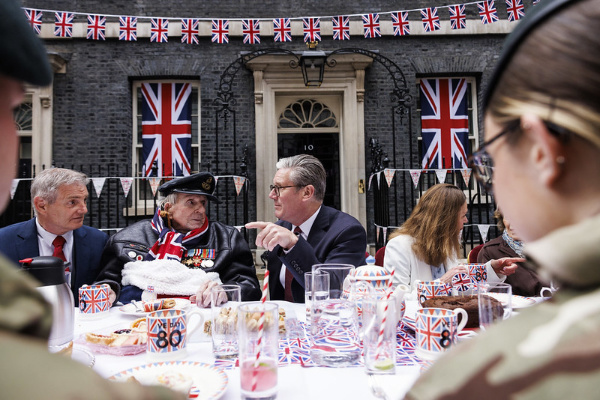
Tea parties were also held across the country to mark the event, including at Buckingham Palace and 10 Downing Street.

The Cenotaph ‘dressed’ in Union flags early this morning before the start of the days events. PICTURE: Stuart Livesey/UK MOD © Crown copyright 2025
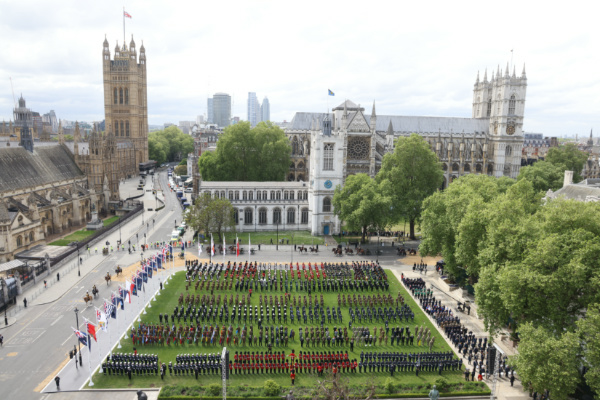
A guard of honour of personnel from the Royal Navy, British Army and Royal Air Force on parade in Parliament Square. PICTURE: Rory Arnold/UK MOD © Crown copyright 2025
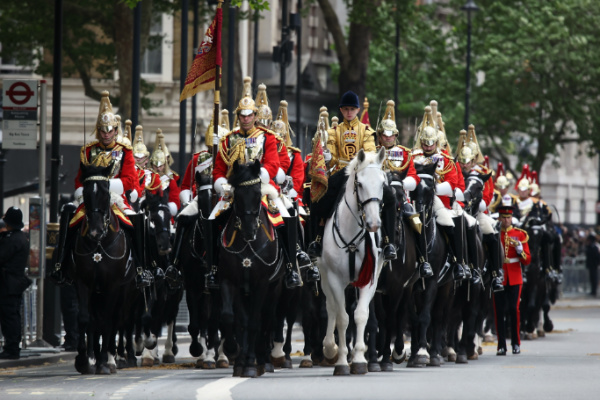
The Life Guards,The Household Cavalry Mounted Regiment ride down Whitehall. PICTURE: POPhot Lee Blease/UK MOD © Crown copyright 2025.
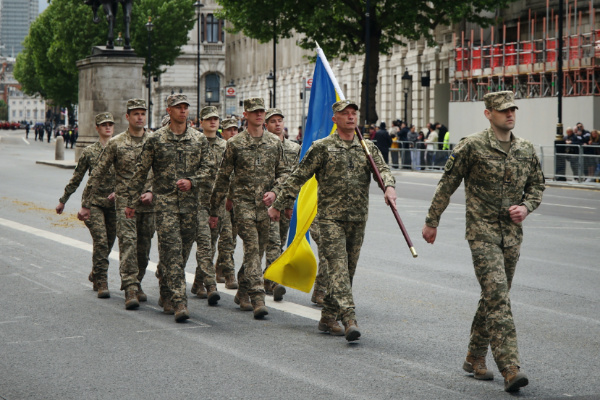
A Ukraine marching detachment comprised of 11 officers of the Armed Forces of Ukraine took part in the procession, see here marching down Whitehall. PICTURE: POPhot Lee Blease/UK MOD © Crown copyright 2025.
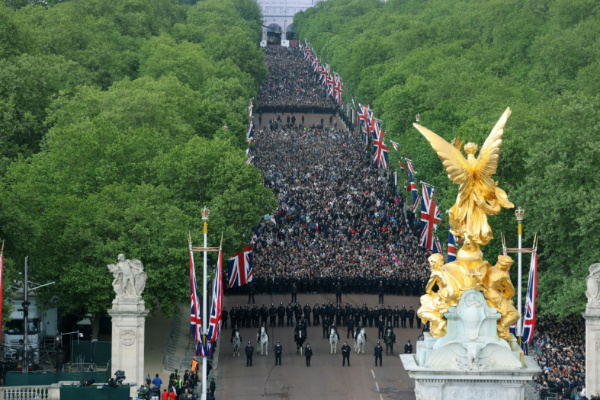
The military procession makes its way down the Mall toward the Queen Victoria Memorial. PICTURE: Cpl Tomas Barnard RAF/UK MOD © Crown copyright 2025
King Charles III salutes as the military procession approaches the Queen Victoria Memorial. PICTURE: Sgt Jimmy Wise/UK MOD © Crown copyright 2025
Crowds make their way down the Mall towards Buckingham Palace after the military procession. PICTURE: Cpl Sarah Barsby RAF/UK MOD © Crown copyright 2025
The Royal Family on the balcony of Buckingham Palace to watch the VE Day 80 flypast. PICTURE: Cpl Tim Hammond/UK MOD © Crown copyright 2025
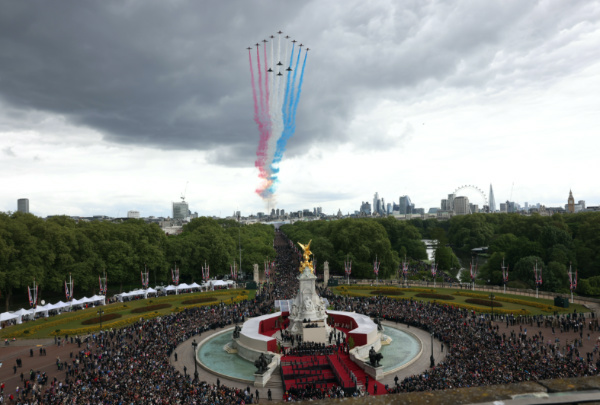
VE Day 80 flypast with the Red arrows and four Typhoon jets flying over the Queen Victoria Memorial in front of Buckingham Palace. PICTURE: Cpl Sarah Barsby RAF/UK MOD © Crown copyright 2025.
Veterans gather in the gardens of Buckingham Palace afer the military procession to watch the flypast. Overhead are The Red arrows, followed by four Typhoon jets. PICTURE: Sgt Rob Kane/K MOD © Crown copyright 2025.
Prime Minister Keir Starmer, and his wife Victoria Starmer host a street party outside 10 Downing Street to celebrate the 80th anniversary of VE Day. PICTURE: Simon Dawson / No 10 Downing Street (licensed under CC BY-NC-ND 2.0)

This Week in London – Hiroshige at the British Museum; poppies return to Tower for VE Day commemoration; and, Do Ho Suh at the Tate Modern…

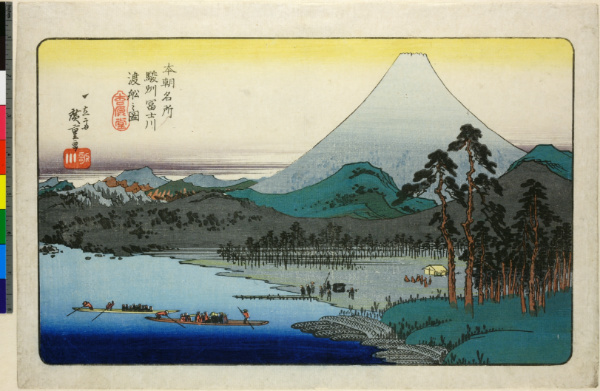
Ferry on the Fuji River. From Famous Places in Japan, Utagawa Hiroshige (1797 – 1858). Colour -woodblock print, about 1832. © The Trustees of the British Museum

An exhibition exploring the art and legacy of Japanese artist Hiroshige opens at the British Museum today. Hiroshige: artist of the open road takes visitors on a “lyrical journey” through Edo-period Japan, exploring both natural landscapes and urban life as well as considering Utagawa Hiroshige’s (1797– 1858) lasting influence on modern and contemporary art. The display marks the major gift of 35 Hiroshige prints to the American Friends of the British Museum from the collection of Alan Medaugh, a leading US collector of the artist’s work with these works being shown alongside 82 Hiroshige prints loaned by Medaugh and other works. Among them are the series Fifty-three Stations of the Tōkaidō Highway (1833–35), One Hundred Famous Views of Edo (1856–58) and Eight Views of Stations along the Main and Secondary Roads (about 1839) as well as examples of his famous bird-and-flower prints Runs in the Joseph Hotung Great Court Gallery (Room 35) until 7th September. Admission charge applies. For more, see britishmuseum.org/hiroshige.

• The 80th anniversary of World War II is being marked with a new display of ceramic poppies in the Tower of London. Almost 30,000 poppies, previously seen in Paul Cummins’ 2014 artwork, Blood Swept Lands and Seas of Red, are being used in the new installation designed by Tom Piper. Opens on 6th May in advance of the 80th anniversary of VE Day, marking the official end of the World War II in Europe, on 8th May. Included in admission with a small section visible from the public footpath. For more, see www.hrp.org.uk/tower-of-london/whats-on/tower-remembers-2025.

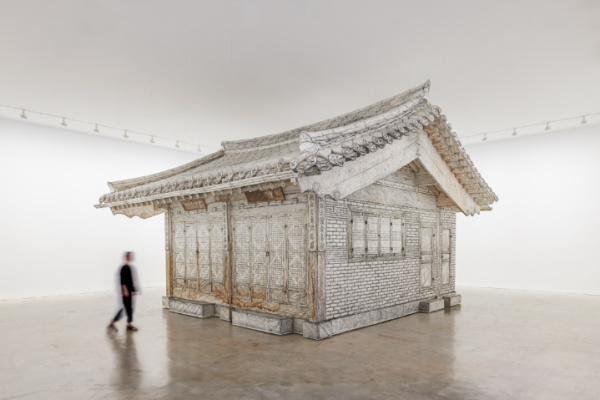
Do Ho Suh, Rubbing/Loving Project: Seoul Home, 2013-2022. Installation view at Museum of Contemporary Art Australia, Sydney, Australia. Photography by Sebastian Mrugalski Courtesy of the artist, Lehmann Maupin, New York, Seoul and London and Victoria Miro. © Do Ho Suh

• The large-scale installations, sculptures, videos and drawings of artist Do Ho Suh are going on show at the Tate Modern from today. The Genesis Exhibition: Do Ho Suh: Walk the House, the title of which comes from a Korean expression referring to the hanok – a house that could theoretically be disassembled, transported and reassembled at a new site, includes works from across three decades. They include the new installation Nest/s (2024) and Perfect Home: London, Horsham, New York, Berlin, Providence, Seoul (2024), Who Am We? (2000_ – a mosaic of tens of thousands of tiny portrait photographs collected from sources including school yearbooks, and his major Rubbing/Loving Project: Seoul Home (2013-22) project. Runs at the Bankside institution until 19th October. Admission charge applies. For more, see tate.org.uk.

Send all items for inclusion to exploringlondon@gmail.com

A Moment in London’s History…New Cross V2 attack…

One of the most devastating moments of World War II in Britain took place 80 years ago this month when, at 12:26pm on 25th November, 1944, a German V2 rocket bomb hit a Woolworths store in New Cross, south-east London.

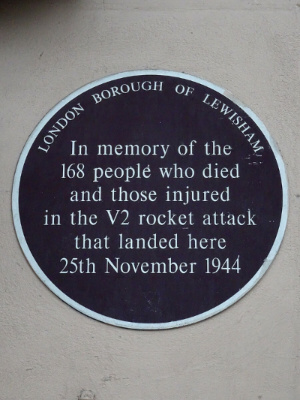
One of the plaques memorialising those killed in the V2 attack outside what is now an Iceland in New Cross. PICTURE: Spudgun67 (licensed under CC BY-SA 4.0)

There were some 30 staff and 100 customers in Woolworths when the rocket struck (a queue had formed at the store after word had spread that tin saucepans had arrived).

The massive blast flattened the shop and spread into nearby streets, bringing down neighbouring houses and shops, overturning an army lorry and causing cars to burst into flames.

Some 168 people, including Woolworths customers and store workers as well as 33 children (some just babies in prams), were killed in the blast. Some of those who died were in the neighbouring Royal Arsenal Co-operative Socierty store, others were sitting at their desks in nearby offices and some were killed while sitting on a passing bus. Some 123 passersby were injured in the blast.

It took three days to clear the debris. Twenty four of those killed were never identified.

It is believed that the nearby New Cross Station was the intended target.

The V2, the world’s first long-range guided ballistic missile, travelled at some 3,000 mph and, as such, few too high and fast to be tracked by radar, put down by anti-aircraft fire or intercepted by fighter aircraft.

V2s had only started to be used in September, 1944, following an order from Adolf Hitler for their manufacture in December, 1942. The first V2 rocket had hit Chiswick on 8th September, 1944, and over the next few months about half of the 3,000 rockets fired at Allied targets were aimed at London.

Such was the fear over the rocket attacks that it had only been on 10th November 1944, that Winston Churchill had publicly admitted the country was facing rocket attacks.

The New Cross attack is commemorated by two memorial plaques at the site, one erected by the Deptford History Group in 1994 and the other by the London Borough of Lewisham in 2009.

10 significant (and historic) London trees…7. D-Day Tree…

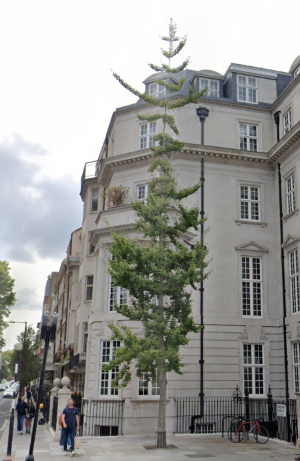
PICTURE: Courtesy of Google Maps

Nations, including the UK, have just marked the 80th anniversary of the D-Day landings in Normandy at a range of locations in France and England. But did you know London has its own “D-Day tree”?

The tree, a Ginkgo biloba or Maidenhair tree, is located outside number 22 in Grosvenor Square in Mayfair (on the corner with Upper Brooks Street). It was planted in 1994 to mark the 50th anniversary of the D-Day landings.

As well as the tree itself, the landings are commemorated with plaques around the base which provide the date of the landings and its code-name, Operation Overlord.

The location apparently relates to 20 Grosvenor Square being, for a time, the headquarters of Dwight D Eisenhower, Supreme Commander of the Allied Expeditionary Force launched on D-Day. There’s a plaque on the building commemorating his tenure.

In fact, the number of Americans working in the square – at locations including the US Embassy – led to it being known colloquially as ‘Eisenhower Platz’).

The tree was planted by the City of Westminster.

Note: There seems to be some conflicting information, not the least on a plaque in Bushy Park about Eisenhower’s connections with Grosvenor Square and Norfolk House in St James’s Square. We’ll be investigating further to clarify.

Treasures of London – Waterloo Station Victory Arch…

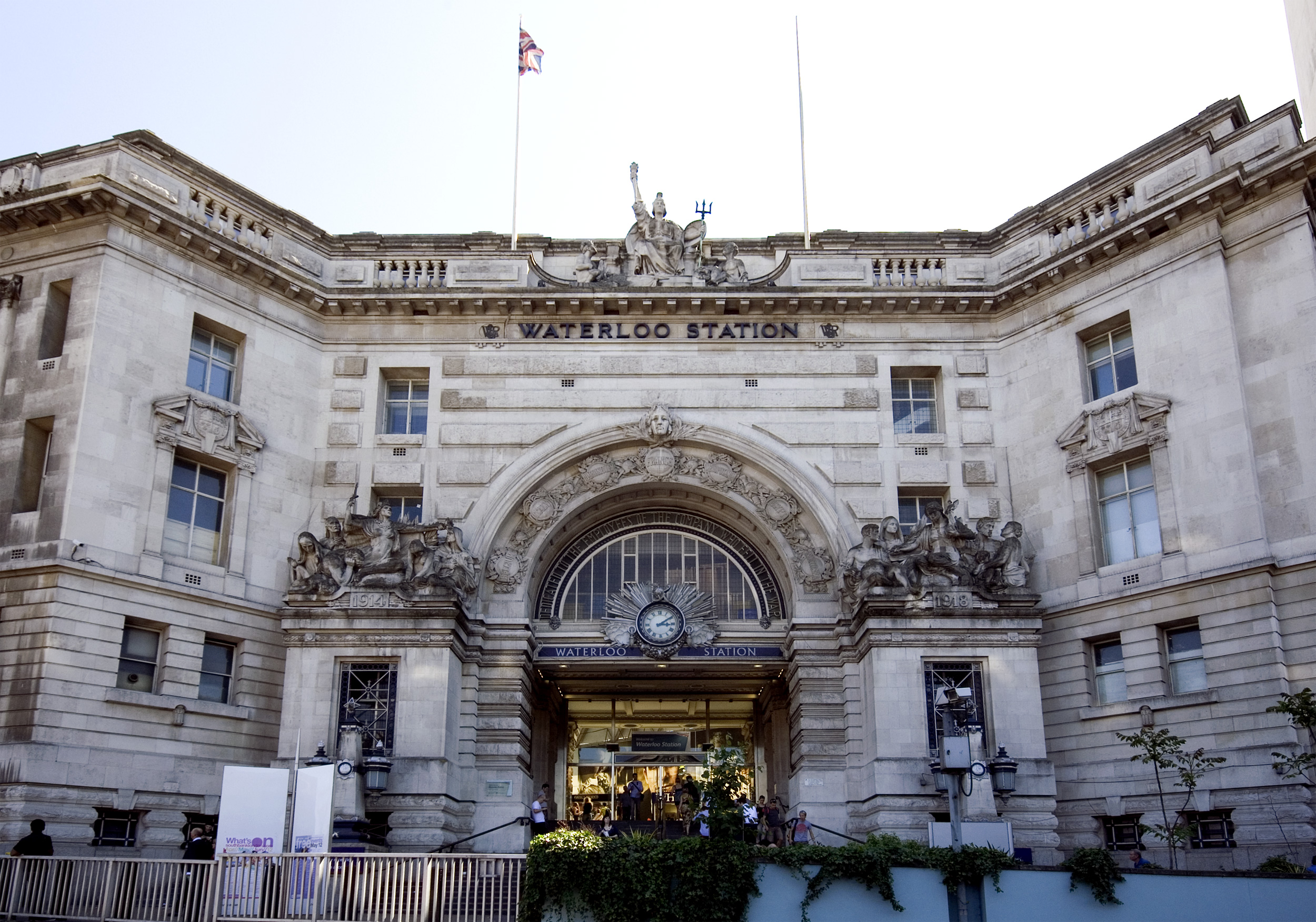
PICTURE: Prioryman (licensed under CC BY-SA 3.0)

Sitting over the main entrance to Waterloo Station is a Victory Arch which commemorates railway personnel who died in World War I and II.

There are several plaques located at the top of the steps under the arch commemorating those who died in the conflicts and among them, particularly notable this week as the world marks the 80th anniversary of D-Day, is one commemorating those who died in the Normandy landings.

The plaque was installed on the 50th anniversary of the landings – 6th June, 1994.

The arch was built as part of a station rebuild in the first couple of decades of the 20th century and added to the design following World War I. The new station was completed in 1922.

The now Grade II-listed memorial, the work of sculptor Charles Whiffen, features two sculptural groups located on either side – one dedicated to Bellona and dated 1914 and the other dedicated to Peace and dated 1918.

Set around a glazed arch are the names of countries where key battles were fought in the conflict and at the centre is a clock set within in a sunburst. Sitting above the arch is a depiction of Britannia holding aloft the torch of liberty.

As well as the D-Day plaque under the arch, a Roll of Honour commemorates the 585 London and South Western Railway employees who lost their lives in World War I. There is also a plaque commemorating the 626 men of the Southern Railway who died in World War II.

10 atmospheric ruins in London – 5. All Hallows Staining…

Located in at the junction of Mark Lane and Dunster Court in the City of London, All Hallows Staining was a medieval church which was mostly demolished in the late 19th century.

All Hallows Staining church tower as seen in July, 2022. PICTURE: Courtesy of Google Maps

These days only the lonely tower remains (above ground at least) as testament to building that once stood there and the lives that were impacted by it.

All Hallows Staining was originally built in the late 12th century and while the origins of its name are somewhat shrouded in mystery, there are a couple of theories.

One says it takes its name from the fact it was built in stone when other churches at the time were wooden (“staining” meaning “stone”) while another says it takes it names from the fact it was built on land belonging to the Manor of Staines.

Princess Elizabeth (later Elizabeth I) is said to have presented the church with new bell ropes after she was released after two months in the Tower of London in 1554 during the reign of her half-sister Queen Mary I (paying tribute to the sound they provided while she was in the Tower).

The church survived the Great Fire of London in 1666 but collapsed just five years later, its foundations apparently weakened by too many graves in the adjoining churchyard.

It was rebuilt in 1674-75 but largely demolished in 1870 when the parish was combined with St Olave Hart Street (and the proceeds were used to fund construction of All Hallows, Bow, in the East End).

Just the tower, parts of which date from the 12th century, remained. The property was bought by the Worshipful Company of Clothworkers. Underneath the adjacent yard they installed the remains of the 12th century crypt of the hermitage chapel of St James in the Wall (later known as Lambe’s Chapel) following the demolition of the chapel in the 1870s.

During World War II, when St Olave Hart Street was badly damaged in the Blitz, a temporary prefabricated church was erected on the site of All Hallows Staining which used the tower as its chancel. It was known as St Olave Mark Lane.

The church was Grade I listed in 1950. In 1957, Clothworkers had a hall for St Olave Hart Street constructed on part of the site of the former church.

The tower is usually able to be seen across a small yard from Mark Lane.

10 atmospheric ruins in London – 2. St George’s Garrison Church…

This mid-18th century church in Woolwich was constructed to serve the soldiers of the Royal Artillery but was badly damaged when hit by a bomb during World War II.

View of the church apse with altar and mosaic. PICTURE: Kleon3 (licensed under CC BY-SA 4.0)

Designed by Thomas Henry Wyatt with the aid of his younger brother, Matthew Digby Wyatt, in the style of an Early Christian/Italian Romanesque basilica, the church was built between 1862 and 1863 on the orders of Lord Sidney Herbert, the Secretary of State for War.

It was among a number of buildings built to provide for the well-being of soldiers after a public outcry about their living conditions during the Crimean War.

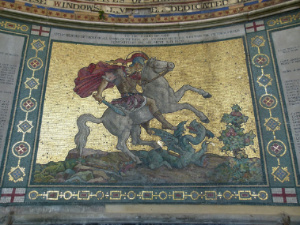
The interior featured lavish decoration including mosaics said to have been based on those found in Roman and Byzantine monuments in Ravenna, Italy. Those that survive at the church’s east end – which include one of St George and the Dragon and others featuring a peacock and phoenix – are believed to have been made in Venice in the workshop of Antonio Salviati.

A mosaic featuring St George and the Dragon. PICTURE: Kleon3 (licensed under CC BY-SA 4.0)

The mural of St George formed part of a memorial to the Royal Artillery’s Victoria Cross recipients located in the church and paid for through public subscription in 1915. The interior also featured five tall stained glass windows which served as memorials to fallen officers.

Plaques on the perimeter walls record the names of soldiers killed in military conflict or Royal Artillery servicemen who died of natural causes. 

The church was visited by King George V and Queen Mary in 1928.

The church, which had survived a bombing in World War I, was largely destroyed on 13th July, 1944, when it was hit by a V1 flying bomb. Most of the interior was gutted in the fire that followed.

While plans to rebuild it after World War II were shelved, in 1970 it became a memorial garden with a roof placed over the church’s east end to protect the mosaics.

Services are still held in the Grade II-listed ruin, located opposite the Woolwich Barracks, and since 2018 it has been under the care of the Woolwich Garrison Church Trust.

WHERE: St George’s Garrison Church, A205 South Circular, Grand Depot Road, Woolwich (nearest DLR station is Woolwich Arsenal); WHEN: 10am to 1pm Sundays (October to March) and 10am to 4pm Sundays (April to September); COST: Free; WEBSITE: https://www.stgeorgeswoolwich.org.

Note that we’ve changed the title of this special series to allow us to explore a bit wider than the medieval period alone!

10 historic vessels in London’s Thames…6. ‘Portwey’…

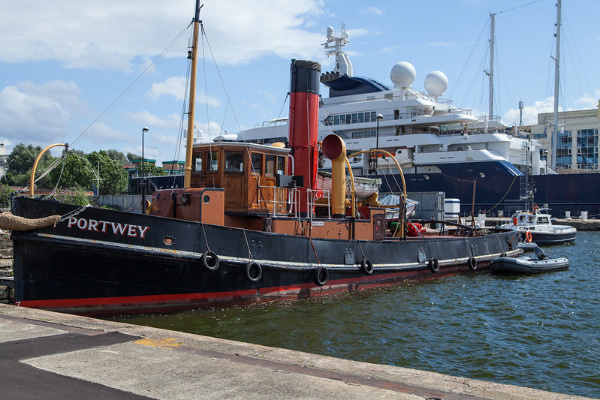
One of only two twin screw, coal fired steam tugs still active in the UK, the steam tug Portwey can these days be found in London’s Docklands.

PICTURE: Paul Gravestock (licensed under CC-BY-NC-ND 2.0)

Ordered by the Portland & Weymouth Coaling Co Ltd, Portwey (the name comes from the company’s) was built by Harland & Wolff at Govan yard in Glasgow and launched on 10th August, 1927.

The 80 foot long vessel was based in Weymouth, Dorset, performed a range of tasks including carrying coal to steamers and being on call for any ship in distress requiring assistance or salvage. This included extinguishing a fire aboard the Danish timber-carrier Bodil in 1928, assisting ships like the cargo steamer Winslow (which had developed a list in heavy seas in 1932), and the Winchester Castle which had run aground in 1936, and even being involved in the search for a sunken submarine in 1932.

The Portwey was seconded by the Admiralty and moved to Dartmouth in Devon during World War II. Narrowly avoiding German bombs while in the harbour, during this time the tug was went to the assistance of ships attacked by the enemy. In 1944, she was assigned to US forces as they prepared for D-Day and her duties including clearing obstructions from the channel and supplying fresh water to naval vessels as well as, when a rehearsal for the landings went wrong at Slapton Sands, rescuing personnel and landing craft.

After the war, the Portwey resumed duties as a harbour tug including ferrying pilots and customs officers out into the Channel. In 1947, she helped put out a fire at the Queen’s Hotel in Dartmouth.

The Portwey was sold to the Falmouth Dock and Engineering Company in Cornwall in 1952. As well as rescuing the captain and first officer of the cargo ship Flying Enterprise, during this period she was involved in the construction of the Lizard Lifeboat Station in Cornwall, and a car ferry slipway at Holyhead in north Wales.

In 1967, with coal-fired steam tugs being replaced by diesel-engined ships, she was laid up to be scrapped. But it wasn’t the end for the Portwey, which was bought by Richard Dobson, the assistant harbour master at Dartmouth. Along with a group of friends, he returned her to working condition and during the 1960s and 1970s, she took part in many events on the River Dart and around Torbay.

In 1982, the Portwey joined the Maritime Trust’s Historic Ship Collection at St Katharine’s Dock where the newly formed Friends of Portwey continued with restoration and operation of the tug.

The Friends of Portwey became the Steam Tug Portwey Trust in 2000 and purchased the tug from the Maritime Trust, moving the vessel to West India Dock.

WHERE: Steam Tug Portwey, West India Dock (South Quay) (nearest DLR station is South Quay); WHEN: 2pm to 9pm Wednesdays; WEBSITE: www.stportwey.co.uk.