With the world’s eyes focused on the Olympic Games in Japan, memories of the Games of the XXX Olympiad held in London nine years ago come flooding back.
With the world’s eyes focused on the Olympic Games in Japan, memories of the Games of the XXX Olympiad held in London nine years ago come flooding back.
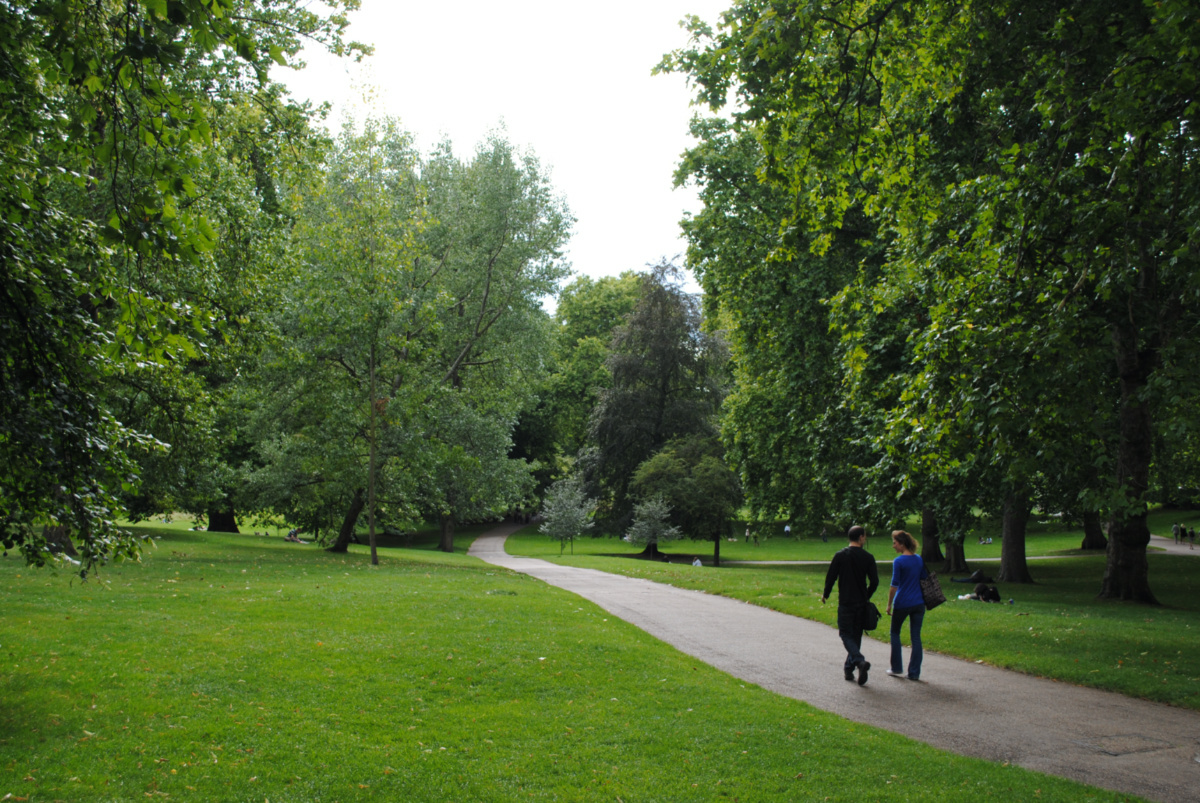
One of the most beautiful features of London are its Royal Parks.
The parks, which covers some 5,000 acres, are owned by the Crown and managed by a charity, The Royal Parks. They include eight of London’s largest open spaces – Hyde Park, The Green Park, Richmond Park, Greenwich Park, St James’s Park, Bushy Park, The Regent’s Park, and Kensington Gardens – as well as some other important open spaces such as Brompton Cemetery, Victoria Tower Gardens, Canning Green and Poet’s Corner.
All eight of the Royal Parks have historically been owned by the Crown with St James’s Park considered the oldest (while Greenwich Park is the oldest enclosed park).
Under an Act of Parliament passed in 1851, the Crown transferred management of the parks to the government. These powers were originally vested in the Commissioners of Works and later transferred to the Minister of Works in 1942. They now rest with the Secretary of State for Culture, Media and Sport.
The Royal Parks charity was created in 2017 when The Royal Parks Agency – a former executive agency of the Department for Culture, Media and Sport – and the Royal Parks Foundation came together. It is governed by a board led by chairman Loyd Grossman.
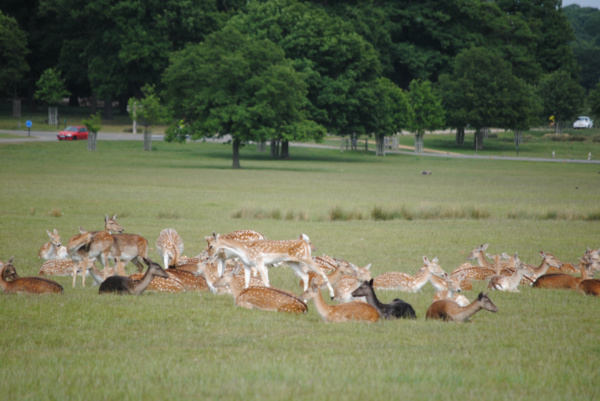
The largest of the eight Royal Parks is Richmond Park which covers some 2,500 acres in London’s south-west (it’s followed by Bushy Park which is just over 1,000 acres). The smallest of the parks is Green Park at just 40 acres.
Interestingly, Hampton Court Palace gardens, which are open to the public are not part of The Royal Parks but instead are under the care of Historic Royal Palaces.
Here’s one fact about each of the eight Royal Parks.
Once located in Hyde Park, this drinking fountain was a gift from Maharajah Meerza Vijiaram Gajapati Raj Manea Sooltan Bahadoor of Vijianagram (a small princely state once located in what is now the Indian state of Andhra Pradesh).
Installed in 1867 by the Metropolitan Drinking Fountain and Cattle Trough Association, the towering structure in the neo-Gothic style was apparently designed by the architect Robert Keirle (also the designer of the Readymoney Fountain in The Regent’s Park).
It was installed close to the park’s north-east corner (between North Carriage Drive and Bayswater Road, not far west of Marble Arch).
The fountain was eventually removed in 1964 (apparently due to the prohibitive cost of repairing it). A plaque these days marks its location.
• The 25 metre high viewpoint in the grass and tree covered Marble Arch Mound opens to visitors on Monday. Created by Westminster City Council, the mound – which has been designed by Dutch architectural studio MVRDV, provides expansive views of Oxford Street, Hyde Park, Mayfair and Marylebone. Visitors can either climb the 130 stairs to the top or take a lift. The mound will be open to the public until January next year. Ticket holders are also invited to visit W1Curates art installation Lightfield, led by British/American artist, Anthony James, which is located inside the mound. For more information and to book tickets, see www.westminster.gov.uk/news/get-set-summit-marble-arch-mound-summer.
• The history, art and culture of the Native Americans who met the passengers of the Mayflower is explored in a new exhibition at the Guildhall Art Gallery. Opening on Friday, Wampum: Stories from the Shells of Native America centres on a newly-crafted wampum belt created by the Wampanoag people of Massachusetts alongside historic material from the British Museum. Wampum belts are the creative expression of the Wampanoag people, with each shell on the belt imbued with memory and meaning. The display is presented by The Box, Plymouth, and supported by Arts Council England as part of commemorations of the 400th anniversary of the sailing of the Mayflower from England to America. Runs until 5th September. Entry is free (booking required). For more, head here.
• On Now: Paula Rego. This exhibition at Tate Britain – the largest retrospective of Paula Rego’s work to date – features more than 100 works including collage, paintings, large-scale pastels, drawings and etchings as it showcases the career of the Portuguese-born artist. As well as early work from the 1950s, the display features her large pastels of single figures from the acclaimed Dog Women and Abortion series and richly layered, staged scenes from the 2000s. Runs until 24th October. Admission charge applies. For more, see www.tate.org.uk/whats-on/tate-britain/exhibition/paula-rego.
Send all items for inclusion to exploringlondon@gmail.com.
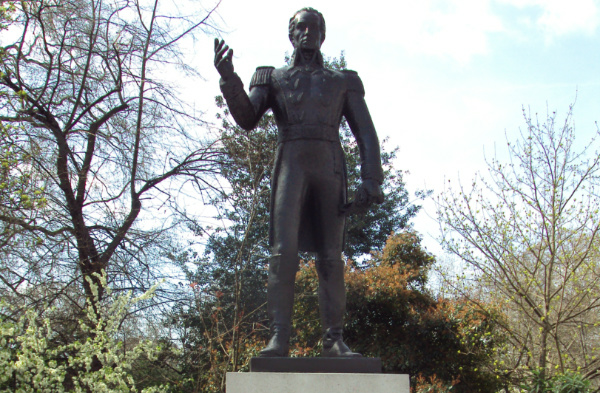
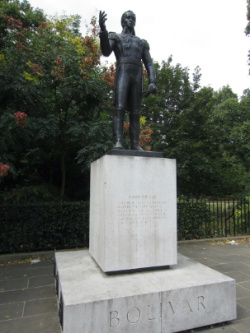
One of a cluster of statues depicting foreign leaders around Belgravia Square (thanks to the presence of so many foreign embassies in the area), this work depicting Simón Bolívar, a towering figure in the early 19th century liberation of South America from colonial powers, was erected in 1974.
The bronze, by Hugo Daini, shows Bolívar standing as though about to make a speech
The inscription describes Bolívar as the liberator of Venezuela, Colombia, Ecuador, Peru, and Panama and the founder of Bolivia and also mentions the details of his birth – Caracas, Venezuela, 24th July, 1783 – and death – Santa Maria, Colombia, 17th December, 1830.
It is accompanied by a quote on the side of the pedestal, featuring words attributed to Bolívar: “I am convinced that England alone is capable of protecting the world’s precious rights as she is great, glorious and wise”.
The statue was erected by the aforementioned nations (the coats-of-arms of which are on the plinth) and unveiled in by James Callaghan, then Foreign Secretary (and later PM).

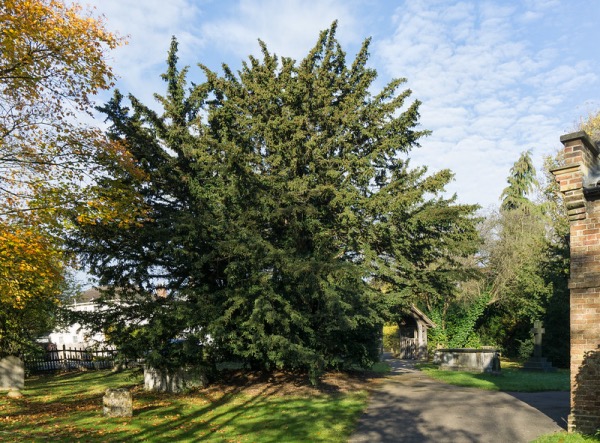
There are a number of ancient trees in London but the oldest is generally believed to be the so-called Totteridge Yew.
Located in the churchyard of St Andrew’s in the village of Totteridge in London’s outer north, this tree was named by the Conservation Foundation, the Ancient Yew Group, and tree officers from Barnet Council in 2008 as possibly the oldest in the city.
It’s estimated the tree – which is on the Great Trees of London list – is some 2000-years-old (some have at it at between 1,000 and 2,000 years-old). It has a 25 foot girth and was a focal point in the area long before the church was built, including for so-called “hundred courts”.
The earliest written mention of this majestic tree reportedly date back to 1677 when Sir John Cullum recorded its girth. But it’s believed that the tree may have been extant as far back as the Roman settlement of Londinium.
Another, possibly apocryphal, story associated with the tree is that of a foundling who was found abandoned under its branches and then brought up by the parish.
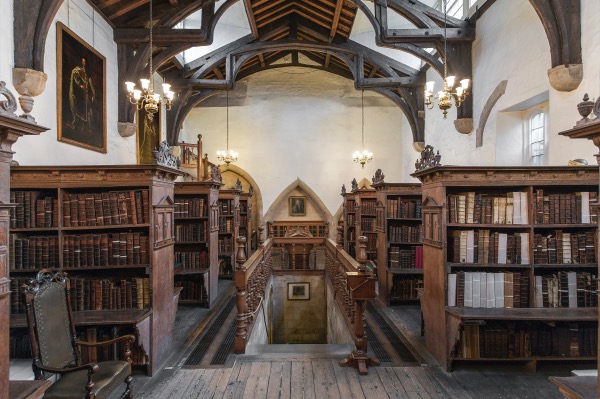
• A lost medieval sacristy used by Westminster Abbey’s monks in the 13th-century which has been revealed in the abbey grounds has been opened to the public. A visit to the dig uncovering the former sacristy is one of the stops on new ‘Hidden Highlights’ tours which also take in other areas not usually open to the public including the Jerusalem Chamber where King Henry IV died in 1413 and, the Library, formerly part of the monk’s dormitory which features a 15th century oak roof and 17th century bookcases (pictured above). The tour, which finishes in the Diamond Jubilee Galleries which have been closed since the start of the pandemic, is part of a summer of events at the abbey which also includes open air cinema, visits to the abbey after dark, live music performances and a chance to look behind the scenes at the abbey’s role in the 2011 wedding of the Duke and Duchess of Cambridge. For more, see www.westminster-abbey.org/abbey-news/lost-medieval-sacristy-opens-to-public-for-summer-festival-of-events.
• A new exhibition looking at the central role food plays in Black entrepreneurship and identity in the city’s south east has opened at the Museum of London Docklands. Feeding Black: Community, Power & Place puts four businesses in the spotlight – Livity Plant Based Cuisine in Croydon, Woolwich businesses African Cash & Carry and Junior’s Caribbean Stall, and Zeret Kitchen in Camberwell – and tells their stories through objects, recipes and videos as well as newly commissioned photography by Jonas Martinez and original oral histories and soundscapes by Kayode ‘Kayodeine’ Gomez. The free display can be seen until 17th July next year in the London, Sugar & Slavery gallery. For more, see www.museumoflondon.org.uk.
• Ride the dodgems at Somerset House. Dodge, described as a “thrilling open air experience” that takes an “inventive twist on the traditional fairground”, features dodgem cars and installations from acclaimed artists as well as food and drink and DJ sets. The event runs until 22nd August. There is free entry to the site but charges apply for the dodgem rides. For more, see www.somersethouse.org.uk. The event is part of the #LetsDoLondon campaign, described as the “biggest domestic tourism the capital has ever seen”.
Send all items for inclusion to exploringlondon@gmail.com.
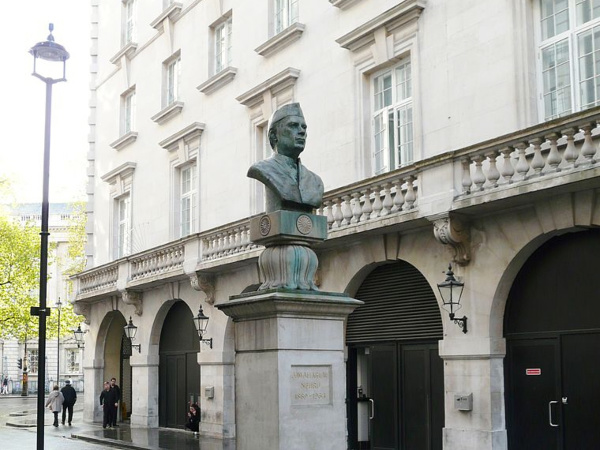
Located on the west side of India House – location of the High Commission of India – is a bust of Jawaharlal Nehru, the first Prime Minister of independent India.
The bust, which stands in India Place between Aldwych and The Strand, is the work of Latika Katt and stands on a granite plinth. It was unveiled in 1990 by the High Commissioner of India LM Singhvi and the Mayor of London.
In 2009, the bronze bust was temporarily dislodged from the plinth but was subsequently returned to its home.
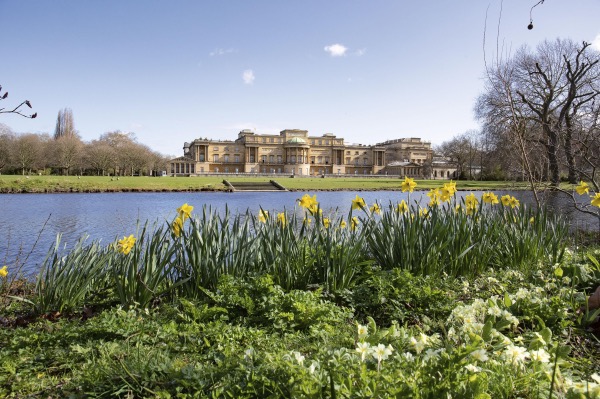
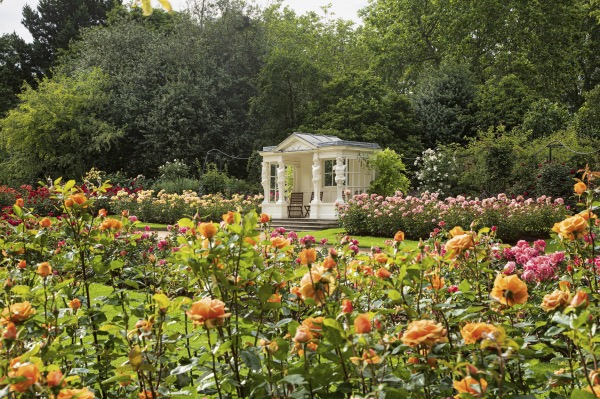
The historic 39 acre garden at Buckingham Palace opened to the public for the first time last Friday as part of the palace’s summer opening. Visitors can follow a route that takes in the 156-metre Herbaceous Border, plane trees which were planted by and named for Queen Victoria and Prince Albert, and views of the island and its beehives across the 3.5-acre lake. There’s also the opportunity to enjoy a picnic on the lawns and guided tours of the south-west of the garden with features including the Rose Garden, summer house and wildflower meadow. The current landscape dates back to the 1820s when King George IV turned Buckingham House into a place. It features more than 1,000 trees, the National Collection of Mulberry Trees (mulberry trees were first planted by King James I in 1608), 320 different wildflowers and grasses, and, since 2008, five beehives. The Queen traditionally hosts three garden parties in the gardens annually which are each attended by 8,000 guests, who consume around 27,000 cups of tea, 20,000 sandwiches and 20,000 slices of cake. The gardens are open until 19th September. Admission charge applies. For more, see www.rct.uk.

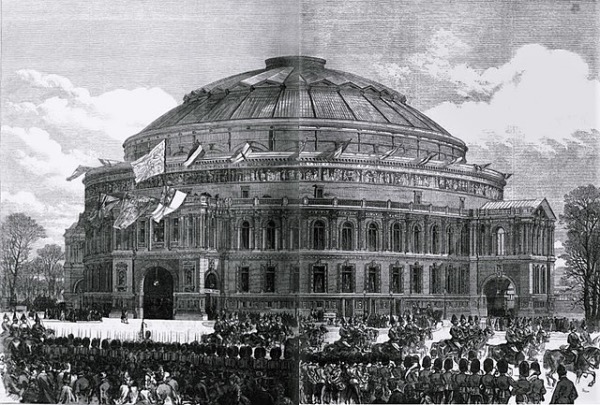
Next week sees the Royal Albert Hall’s 150th anniversary concert taking place, one of a number of events to mark the anniversary of the hall’s opening.
This spectacular building in South Kensington was officially opened on 29th March, 1871, as The Royal Albert Hall of Arts and Sciences (the opening was actually brought forward from 1st May – 20th anniversary of the opening of the Great Exhibition – at the request of Queen Victoria).
The Queen had laid the foundation stone in 1867 and the work on the building, the creation of which was partly funded by profits from the Great Exhibition of 1851, was complete by the end of 1870 (at least its structure – much of the interior decoration was apparently added later).
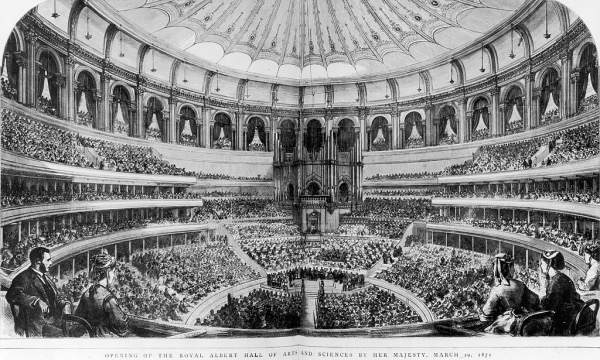
Queen Victoria and members of the Royal Family left Buckingham Palace in a line of state carriages for the event at noon escorted by the Royal Horse Guards Blue. Large crowds lined the route of her passage and a guard of honour composed of the Grenadiers stood opposite the entrance.
On arriving, the Queen was met by the Edward, the Prince of Wales (the future King Edward VII), members of the building committee and some of those who has served as commissioners of the Great Exhibition of 1851.
The Queen processed to a dais inside the building’ auditorium where some 8,000 dignitaries and invited guests waited in the audience. But she was apparently too overcome by memories of her late husband – Prince Albert, after whom the building as named – to give a speech. So it was the Prince who did so, although the Queen did reportedly add her own comments, saying according to an account in The Guardian: “I cannot but express my great admiration for this beautiful building, and my earnest wishes for its complete success.”
A battery of artillery performed a salute in nearby Hyde Park after which the Queen and Royal Family took their seats in the Royal Box to watch the musical program that followed. The Queen then returned to Buckingham Palace.
Interestingly, the first concert at the hall, held to test acoustics, actually took place month earlier on 25th February for an audience of some 7,000 people made up of those who had worked on the building and their families as well as officials and various invited members of the public.
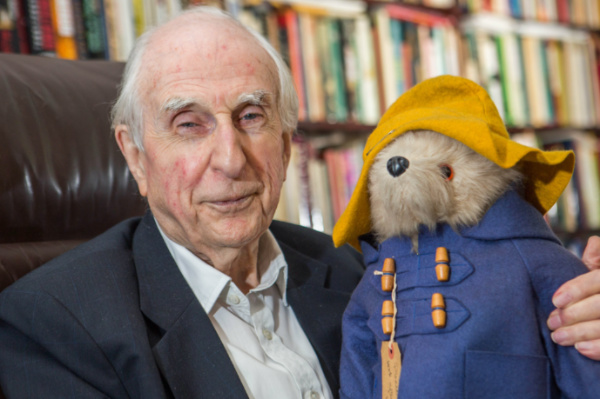
• A new family friendly exhibition celebrating Paddington Bear opens at the British Library tomorrow. The Story of a Bear features more than 50 books, documents, film clips and original artworks as it explores Michael Bond’s creation of the much loved children’s book character. Highlights include a first edition of Bond’s A Bear Called Paddington published in 1958, Barbara Ker Wilson’s original review of the book, photographs and memorabilia of Michael Bond on loan from his family as well as original illustrations of Paddington stories by artists including Peggy Fortnum, David McKee and RW Alley. There are also clips from the Paddington movies and sound recordings featuring Bond speaking about his creation. The exhibition is ticketed (booking in advance recommended). Admission charge applies. For more, see www.bl.uk/events/paddington-the-story-of-a-bear.
• Pioneering neurologist James Samuel Risien Russell has been honoured with an English Heritage Blue Plaque at his former home and practice in Marylebone. Russell, born in 1863 in what was then British Guiana (now Guyana), was one of the UK’s first Black consultants and played a critical role in establishing the British school of neurology in the 1890s. His contribution in furthering our understanding of many conditions of the nervous system and mental health issues has only recently come to light thanks to new research by the Windrush Foundation. Dr Risien Russell lived and worked at 44 Wimpole Street from 1902 until his death in March, 1939. For more, see www.english-heritage.org.uk/visit/blue-plaques.
<iframe width="560" height="315" src="https://www.youtube.com/embed/XACNk26xulk" title="YouTube video player" frameborder="0" allow="accelerometer; autoplay; clipboard-write; encrypted-media; gyroscope; picture-in-picture" allowfullscreen></iframe>• A display of images from Sir Quentin Blake have gone on show at the Foundling Museum in Bloomsbury to mark his gift of 24 drawings to the museum. Curated by children’s author and illustrator Lauren Child, Quentin Blake: Gifted features pictures form two series – Children and Dogs and Children with Birds & Dogs – as well as a range of responses from writers including poetry collective 4 BROWN GIRLS WHO WRITE, children’s author and poet Michael Rosen and Scottish playwright, poet and novelist Jackie Kay. Admission charge applies. Runs until 26 September. For more, see https://foundlingmuseum.org.uk/events/quentin-blake-gifted/.
Send all items for inclusion to exploringlondon@gmail.com.
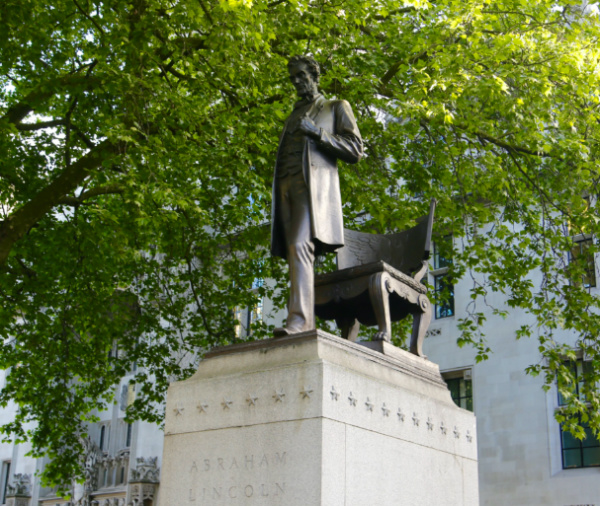
Standing on the edge of Parliament Square opposite the UK’s home of government, this statue of the 16th US President was erected to mark the friendship between Britain and the United States of America.
The statue was proposed by the American Committee for the Celebration of the Hundredth Anniversary of Peace Among English Speaking Peoples to commemorate the centenary of the end of conflict between the two nations in 1915.
But World War I broke out and so it wasn’t until July, 1920 that this statue, a replica of a statue Auguste Saint-Gauden made for the city of Chicago and now Grade II-listed in its own right, was formally presented to then UK Prime Minister David Lloyd George by the US Ambassador and subsequently unveiled by Prince Arthur, the Duke of Connaught.
The 12 foot high, larger than life, monument – which includes a granite plinth – depicts Lincoln wearing a frock coat standing in front of his Grecian chair and about to give a speech. The original was completed in 1887 and was unveiled in Chicago’s Lincoln Park with Abraham Lincoln II, grandson of the President, in attendance as well as a crowd of some 10,000.
Interestingly, the UK wasn’t the only nation given a copy of the statue – a replica was also given to Mexico in 1964 and now stands in the Parque Lincoln in Mexico City.
There is also a replica at Lincoln’s tomb in Springfield, Illinois and in 2016, a newly cast replica of the statue was installed at the Saint-Gaudens National Historic Site – the former home and studio of the sculptor – in Cornish, New Hampshire. There are also numerous smaller replicas including a bust which is sometimes displayed in the Oval Office in the White House.
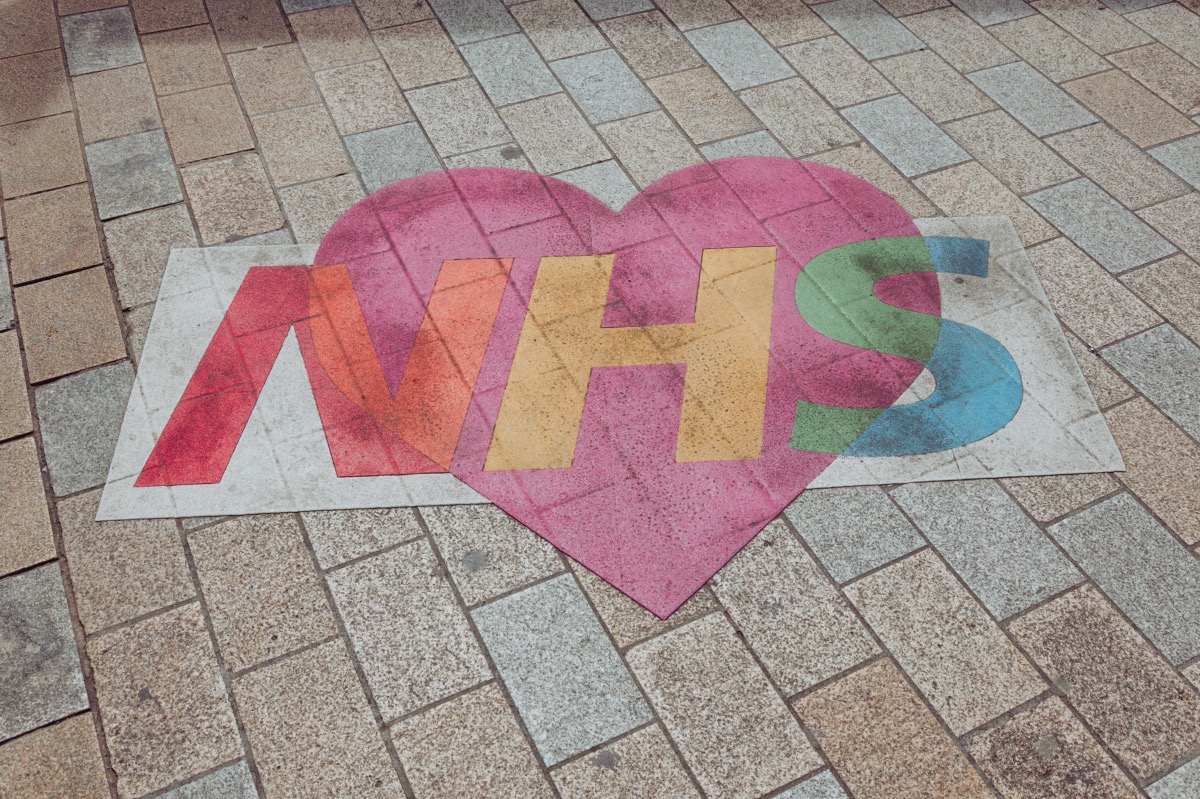
Queen Elizabeth II has awarded the George Cross – the country’s highest civilian gallantry award – to the National Health Service. In an accompanying statement, the Queen said: “It is with great pleasure, on behalf of a grateful nation, that I award the George Cross to the National Health Services of the United Kingdom. This award recognises all NHS staff, past and present, across all disciplines and all four nations. Over more than seven decades, and especially in recent times, you have supported the people of our country with courage, compassion and dedication, demonstrating the highest standards of public service. You have our enduring thanks and heartfelt appreciation.” Details of when the award will be presented are yet to be announced. It is only the third time, the George Cross has been awarded to a collective body, country or organisation, rather than an individual (the first time was when it was collectively awarded to the people of Malta in 1942 by Queen Elizabeth’s father, King George VI, and the second time when it was awarded to the Royal Ulster Constabulary by the Queen in 1999). PICTURE: Nicolas J Leclercq/Unsplash
This City of London pub, located close to Liverpool Street Station, was originally known as The Old Jerusalem and dates back to the mid-18th century.
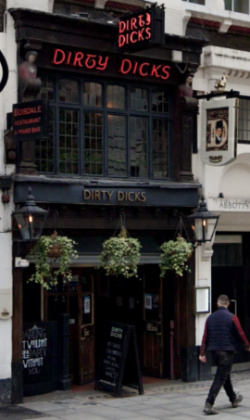
But the pub’s name was changed in the 19th century, inspired by the tragic history of a local businessman by the name of Nathaniel (there are some that suggest his name was Richard) Bentley.
The story goes that Bentley, who owned a hardware shop and warehouse, had been something of a dandy in his youth, earning the nickname, the “Beau of Leadenhall Street”.
But when his fiance died on the eve of their wedding day, he broke down and subsequently refused to clean anything, including himself (there was also speculation that he’d closed the dining room where the wedding breakfast was to be held with the spread still on the table). His home, shop and warehouse in Leadenhall Street became filthy and so famous that letters were apparently addressed to ‘The Dirty Warehouse, London’. He died in 1809 and the warehouse was later demolished.
William Barker, the owner of The Old Jerusalem, subsequently changed the name of his pub to Dirty Dick’s and it apparently became known for its own lack of cleanliness in sympathy with the man after whom it was named.
Charles Dickens is said to have been a patron of this establishment and it’s said that Bentley’s story inspired Dickens to create the character of Miss Havisham for this book, Great Expectations.
In keeping with its name, the cellar bar was for years cluttered with cobwebs and all sorts of items including a mummified cat but more recent years have seen the clutter removed (although some has been preserved and relocated to a glass display case).
The pub, at 202 Bishopsgate, is now owned by Young’s. For more, see www.dirtydicks.co.uk.
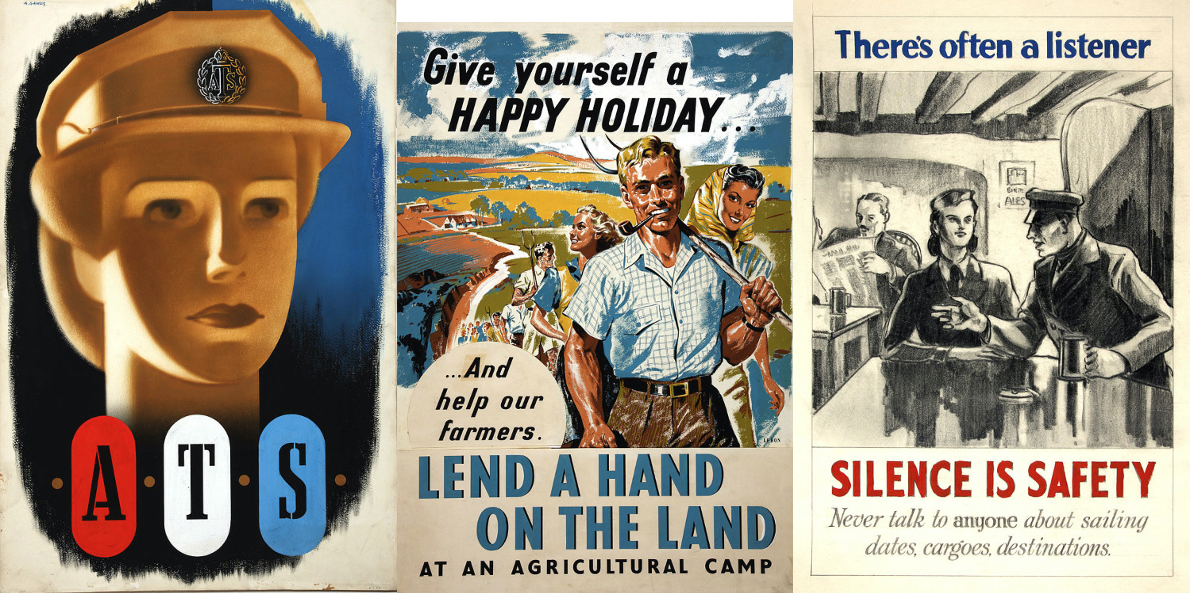
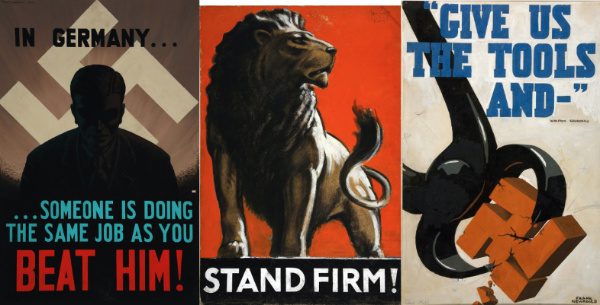
These posters are among almost 2,000 original works created by artists working for the Ministry of Information during World War II now in the collection of The National Archives based in Kew.
The posters tackle a range of issues – from saving on fuel at home to warnings about spies, posters to inspire effort on the homefront and those to recruit new men and women to the service.
Under a partnership with Wikimedia UK, in 2013 The National Archives digitised and released more than 350 images of the posters into the public domain. Here are some those released.
The originals are held at The National Archives.
• A new statue of the late Princess Diana is being unveiled today at Kensington Palace. The statue will be unveiled in the Sunken Garden at Diana’s former home. The garden – originally created on the orders of King Edward VII in 1908 – has been redesigned by designer Pip Morrison to provide a more reflective setting for the memorial. This included planting more than 4,000 of Diana’s favourite flowers including forget-me-nots and tulips. The statue, which is the work of sculptor Ian Rank-Broadley, is expected to be unveiled by Diana’s two sons, William and Harry, who commissioned it in 2017.
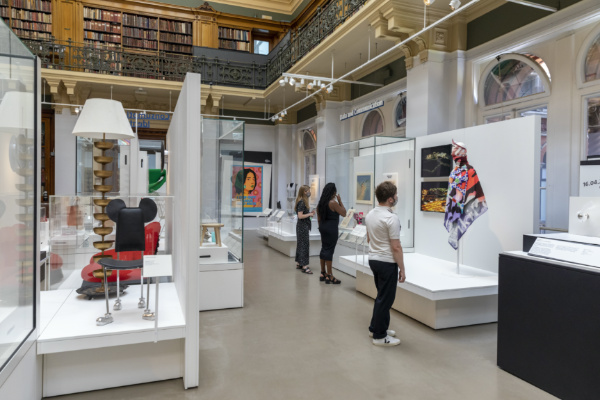
• A new permanent gallery has opened at the V&A which explores the role design plays in shaping, and being shaped by, how we live, work, travel and communicate. Design 1900 is housed within the museum’s former 20th Century Gallery and, among the displays are new acquisitions including Margaret Calvert and Jock Kinneir’s iconic British road signage system, Kim Kardashian’s Selfish book, Nike’s Nigeria football shirt for the 2018 World Cup and a one-of-a-kind desk designed by Future Systems for Condé Nast Chairman Jonathan Newhouse. The display also includes items from the Rapid Response Collecting programme such as 3D-printed door openers, designed to limit the spread of the COVID-19 virus, and the I Believe in Our City bus shelter posters that highlighted increased anti-Asian bias. For more, see www.vam.ac.uk.
• Twentieth century dressmaker and fashion designer Jean Muir has been honoured with an English Heritage Blue Plaque at the Mayfair address she worked for 30 years. The plaque was unveiled at 22 Bruton Street, the location of the showroom and office she operated out of from 1966 to 1995, by her house model, friend and client Joanna Lumley. Others among Muir’s clientele included actress Patricia Hodge and writer Lady Antonia Fraser. For more, see www.english-heritage.org.uk/visit/blue-plaques/.
• The City of London Corporation has unveiled the design for new ‘Digital Service Points’ which will reimagine the concept of the traditional police boxes. ‘The London Stones’, the work of architecture and design studio Unknown Works, will include information screens, life saving emergency equipment and serve as hubs for City of London Police officers and community events. Details from buildings, stories and images of the Square Mile will be collected and ‘digitally carved’ into the exterior of the ‘stones’ which will also be home to a vast array of lichen colonies and species expected to evolve in their colour and appearance as they grow.
Send all items for inclusion to exploringlondon@gmail.com
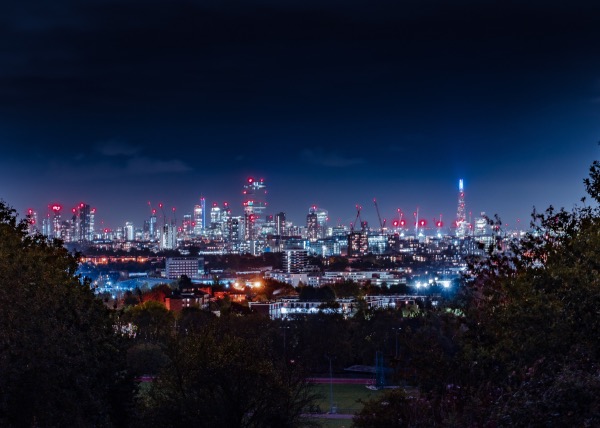
PICTURE: Kamran Chaudhry/Unsplash
Famous for his reform of the postal system, Sir Rowland Hill was a national celebrity during the Victorian era.
Born in Kidderminster, Worcestershire, on 3rd December, 1795, Rowland was the son of schoolmaster Thomas Wright Hill. Educated in his father’s school, Hill Top, in a Birmingham suburb, it was determined he would follow in his father’s footsteps at an early age and by the age of 12 had become a student teacher and in 1819 helped his family establish new model school, Hazelwood, in Edgbaston near Birmingham. In 1827, he was also involved with his family in establishing another new school, Bruce Castle School, in Tottenham, Middlesex.
That same year, Hill married Caroline Pearson, who originally came from Wolverhampton, and together they had four children – three daughters Eleanor, Clara and Louisa and a son Pearson.
In the following years, Hill became involved in campaigns to colonise South Australia and in 1835 he joined the South Australian Colonisation Commission as Secretary, a role which he held until 1839 (interestingly and perhaps not surprisingly given his interest, Hill’s sister Caroline would later emigrate to South Australia with her family).
Hill was in his early 40s when he became interested in reforming the postal system – what to be his life’s great work. In 1837, he published his influential pamphlet, Post Office Reform: Its Importance and Practicability, in which he argued for consistency in the system including pre-payment of standardised charges for sending mail.
Hill believed that if letters were cheap to send, more people – including the poorer classes – would send more and thus the profitability of the system would increase (a thought which proved true). It’s said, although whether it’s true or not is uncertain, that Hill became interested in reforming the postal system after he noticed a young woman who too poor to claim a letter sent to her by her fiancé (at the time it was usually the recipients who paid for the letter’s mailing).
Only three years later, Parliament passed the Penny Postage Act which saw the world’s first official postage stamps – the penny black and the two-penny black – issued. Hill and his family had by then moved to Orme Square in Bayswater (there’s now an English Heritage Blue Plaque on the property).
After the new government of Sir Robert Peel took office in 1841, Hill was dismissed and, joining the London and Brighton Railway as a director in 1843, relocated to Brighton.
But Hill was able to resume his postal reform efforts in 1846 after another change of government saw him appointed Secretary to the Postmaster-General. In 1854, he was appointed Secretary to the Post Office, a job he held until his retirement in 1864 due to ill health.
Hill was knighted in 1860. He spent the last 30 years of his life at Bartram House, Hampstead, and it was there he died 27th August, 1879 (a plaque now marks the house). He was buried in Westminster Abbey.
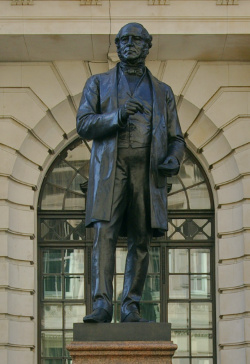
There are several public statues commemorating Hill include a bronze which, created in 1881, stands in King Edward Street in London (pictured).
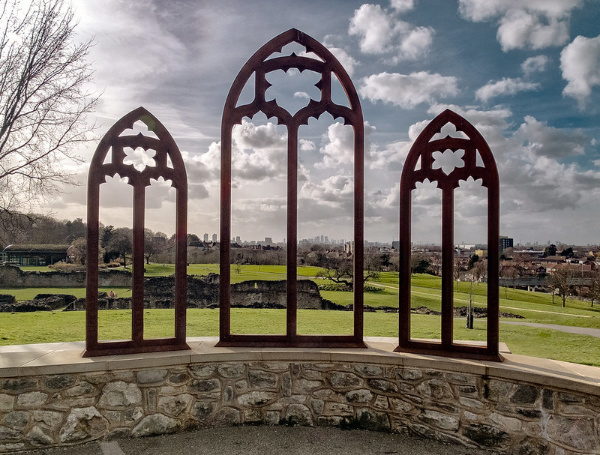
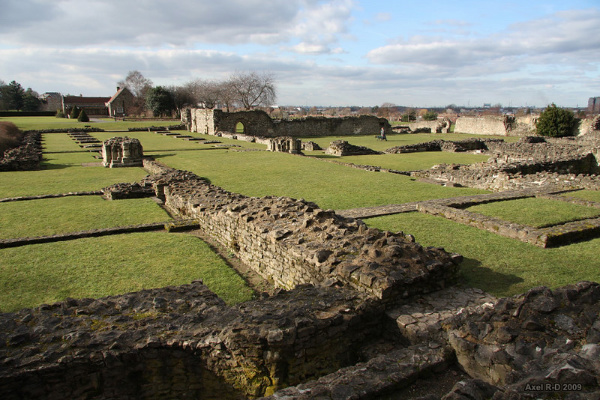
Located in London’s south-east, Lesnes Abbey was founded in 1178 as the Abbey of St Mary and St Thomas the Martyr by Richard de Luci, a joint Chief Justiciar of England at the time.
It’s believed de Luci did so as an act of penance for his support of King Henry II in his dispute with St Thomas Becket (in fact, de Luci was ex-communicated by him twice before Becket was murdered in Canterbury Cathedral in December, 1170). De Luci retired here after resigning his office in 1179 and died soon after. He was buried in the chapter house.
The Augustinian monastery, never a large or wealthy community, had fallen into a state of disrepair and debt by the early 15th century apparently due to mismanagement but at least partly caused by the cost of maintaining the river wall and draining the marshes in which it was located.
Some rebuilding was carried out at the start of the 16th century but in 1525 it was closed or suppressed on Cardinal Thomas Wolsey’s orders and the monastic buildings were demolished with the exception of the Abbot’s lodging.
The site was subsequently sold off and passed through various hands – it spent some 300 years as a possession of Christ’s Hospital – and eventually became farmland with the abbot’s house forming the core of a farmhouse which was demolished in 1844.
The site was excavated under the direction of Sir Alfred Clapham in the early 20th century and was purchased by the London County Council in 1930. It was opened as a public park in 1931. Since 1986, it’s been owned and managed by the London Borough of Bexley.
The site today, a scheduled ancient monument, includes some impressive ruins from the abbey. The nearby woods takes its name from the abbey.