10 of London’s modern icons…5. The London Eye…

Currently known as the Coca-Cola London Eye (it’s had several name and sponsorship changes over its life), this unmissable structure started operations in the year 2000.

Designed by Marks Barfield Architects and located at the south-western corner of Jubilee Gardens on South Bank, it stands 135 metres tall and, with a diameter of 120 metres, is the world’s biggest cantilevered observation wheel. It was also the tallest observation deck in London but lost that title to The Shard.

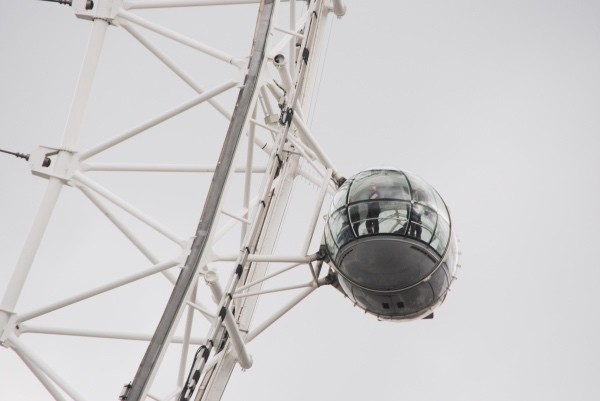
It features 32 sealed, ovoid-shaped capsules for passengers, each of which can hold up to 25 people, and rotates at the rate of about 0.6 mph, meaning a rotation takes around half an hour (a rate which allows most people to get on or off without stopping the wheel).

The Eye, which offers a birds-eye view of surrounding areas including the Houses of Parliament, was formally opened by then PM Tony Blair on 31st December, 1999, but didn’t open to the public until the following March (thanks to a clutch problem on one of the capsules).

It originally intended as a temporary structure built to mark the new millennium (after which it would be dismantled an moved to another location) but its popularity (and the resolution of a dispute over its lease in the mid-Noughties) has seen become a permanent fixture.

The capsules – there’s apparently no number 13 – were upgraded in 2009 and in 2013, one of them was named the Coronation Capsule in honour of the 60th anniversary of the coronation of Queen Elizabeth II.

The Eye has been lit up on numerous occasions to mark special events – among them Prince William and Kate Middleton’s wedding in 2011.

WHERE: Coca Cola London Eye, Riverside Building, County Hall, Westminster Bridge Road (nearest Tube stations are Waterloo, Embankment and Westminster); WHEN: 11am to 6pm daily (till 29th March); COST: See website for details; WEBSITE: www.londoneye.com.
 

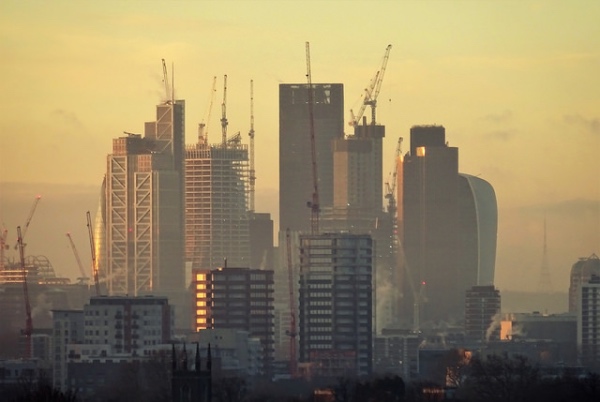
LondonLife – Sunrise over the City…

PICTURE: David Holt (licensed under CC BY 2.0)

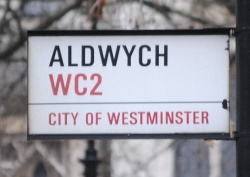
What’s in a name?…Aldwych…

Now the name of a short, crescent-shaped thoroughfare which links the Strand with Kingsway in the West End (and the area surrounding it), the name actually refers back to the Saxon era.

The name Aldwych, which translates roughly as “old trading place” or “old settlement”, referred to a seventh century Anglo-Saxon settlement which was built outside the walls of the Roman city of Londinium. It was after Alfred the Great had the walls of the Roman city refortified in the late 9th century – moving the settlement back inside, that the former Anglo-Saxon settlement eventually became known by the moniker ‘old’.

The modern use of the word for the area dates from just after the dawn of the 20th century when the new street was created, doing away with a number of former streets including the notorious Wych Street. The name was subsequently used for a station on the tramway which ran under Kingsway (closed in the 1950s) and for an Underground station located nearby on the Strand (originally named Strand Station, it was soon changed to Aldwych and closed in 1994).

Notable buildings along Aldwych today include both Australia House and India House, both home to the High Commissions of their nations and both of which date from the early 20th century. It’s also home to Bush House, formerly the headquarters of the BBC World Service and now part of King’s College, London, as well as a number of theatres – including the Aldwych Theatre – and hotels.


This Week in London – Chinese New Year, and, David Milne at Dulwich

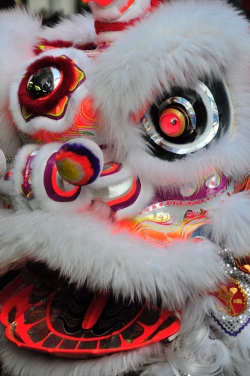
• London’s Chinatown will come alive this Sunday to mark the Year of the Dog. The biggest Chinese New Year celebrations outside of Asia feature a parade – which kicks off at 10am with a dragon and lion dance in Charing Cross Road before making its way through Chinatown where between noon and 6pm people get up close to lion dances,  take selfies with Chinese zodiac animals and enjoy traditional Chinese food. Festivities in Trafalgar Square, meanwhile, kick off at 11am with the Lions’ Eye-Dotting Ceremony at noon while there’s entertainment including live performances, family-friendly entertainments and martial arts displays at a series of West End locations including Charing Cross Road, Leicester Square, Shaftesbury Avenue between noon and 5pm. For more, check out the Visit London guide. Meanwhile the Museum of London Docklands is also celebrating the Year of the Dog with a range of free cultural events on Friday (the actual date of the New Year) including everything from ribbon dancing classes to taekwondo taster lessons, calligraphy and a spectacular dragon dance. For more, see www.museumoflondon.org.uk/museum-london-docklands. PICTURE: Paul (licensed under CC BY 2.0)

The works of one of Canada’s greatest modernist painters, David Milne (1882-1953), have gone on show at the Dulwich Picture Gallery. David Milne: Modern Painting follows Milne’s career chronologically, charting his development as an artist as he moves from New York to the war ravaged landscapes of Europe and back to the fields and open skies of North America. Highlights include Fifth Avenue, Easter Sunday (1912), the watercolour Bishop’s Pond (1916), Montreal Crater, Vimy Ridge (1919) – one of his most famous war paintings, White, the Waterfall (1921) and Summer Colours (1936). Runs until 7th May. Admission charges apply. For more, see www.dulwichpicturegallery.org.uk.

Send all inclusions to exploringlondon@gmail.com.

10 of London’s modern icons…4. One Canada Tower…

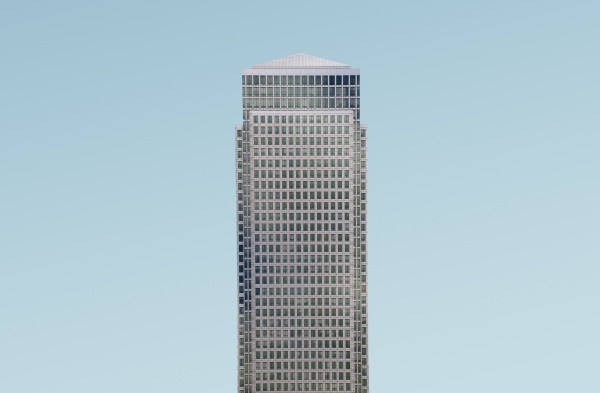
The second tallest building in the UK (and once, very briefly, the tallest building in Europe), Canary Wharf’s One Canada Tower is a symbol of London’s revamped Docklands.

The 50 storey skyscraper  (there’s also three underground) was designed by Cesar Pelli and constructed between 1988 and 1991. Containing some 1.2 million square feet of office space making it the largest office building in the UK, it was officially opened on 26th August of the latter year by Prince Philip.

Often called the Canary Wharf tower, One Canada Tower was apparently the first skyscraper to be clad in stainless steel and was designed to reflect the sky. There’s an aircraft warning light on top which flashes some 57,600 times a day.

An office building with no public observation deck, current tenants include a range of financial institutions as well as other companies such as the Trinity Mirror Group, owner of several UK newspapers.

As with other newer skyscrapers in London, One Canada Tower has been seen in its share of movies including in 28 Weeks Later and  Mission: Impossible – Ghost Protocol.

LondonLife – Taking stock at the ZSL London Zoo…

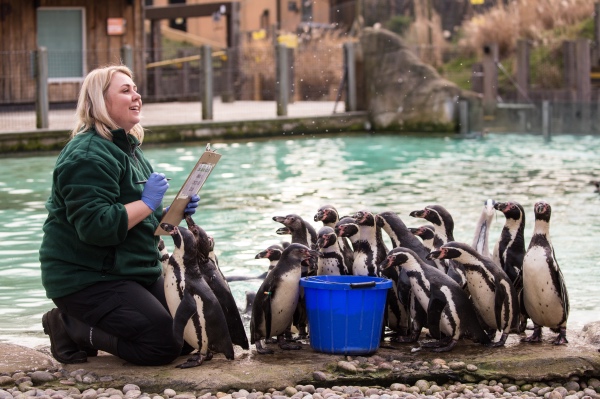
Last week was the ZSL London Zoo’s annual stocktake in which they make a count of all the creatures, great and small, that are residents of the zoo. Some 750 species live at the zoo totalling more than 19,000 animals, meaning it’s quite a mammoth effort which takes almost a week to complete. The information gained is then shared with other zoos around the world via the Species360 database to aid in managing worldwide conservation breeding programmes for endangered animals. While some animals, like the Asiatic lions are easy to count, others are less so due to their tiny size (although ant colonies are simply counted as one). Among first-timers this year were two gibbons – Jimmy and Yoda – as well as 11 Humboldt penguin chicks, eight new Galapagos tortoises and a Hanuman langur baby (a species of leaf-eating monkey). For more on the zoo, see www.zsl.orgPICTURES: Top – Humboldt penguins; Below – Squirrel monkeys, llamas and an Asiatic lion. 

A Moment in London’s History – The passing of the Representation of People Act, 1918

Celebrations were held last week marking the 100th anniversary of the day on which the Representation of People Act was passed, giving women the vote for the first time (well, that who are aged over 30 and who occupied a house – or were married someone who did).

The bill, passed on 6th February, 1918, also extended voting rights to all men aged over 21 (previously it had been restricted to men who owned property) but it wasn’t until 10 years later than women gained the same right.

A further bill was passed in November, 1918, which gave women the right to stand in elections. So when women first cast their votes in the next general election – held in December of that year – several women stood for seats in the House of Commons.

In the end, only one – the Sinn Féin candidate for Dublin St Patrick’s, Constance Markievicz – was elected but she choose to sit in the Dáil Éireann in Dublin. This meant that the first woman to sit in the House of Commons didn’t do so until December, 1919, when Nancy Astor, elected as the MP for Plymouth Sutton, did so.

PICTURE: Representation of the People Act 1918/Courtesy of Parliamentary Archives

Lost London – Poet’s Fountain…

This rather large fountain once stood in Mayfair as a tribute to literary greats Geoffrey Chaucer, William Shakespeare and John Milton.

Designed by Thomas Thorneycroft (and apparently funded from wealth of a lady who died intestate but who had apparently always advocated for the location of a fountain on the site), the fountain stood on the centre of what is now a roundabout at the intersection of Old Park Lane and Hamilton Place.

Unveiled in July, 1875, it featured the three poets standing on various sides of a central pillar (Shakespeare taking pride of place looking towards Hyde Park). Below them sat three muses and above them, on top of a central column, stood a figure representing fame, blowing a trumpet.

The fountain,  and survived until World War II during which it sustained damaged. It was dismantled in 1948 and only the figure of ‘Fame’ is believed to have survived.


This Week in London – Votes for Women! and, Thai orchids…

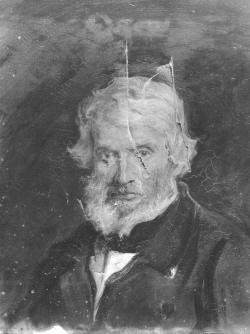
A portrait slashed with a butcher’s cleaver by a suffragette in the National Portrait Gallery has gone back on display for the first time in more than 20 years. The portrait of gallery founder Thomas Carlyle, painted by Sir John Everett Millais, was attacked by Anne Hunt in July, 1914, after Suffragette leader Emmeline Pankhurst was rearrested. Hunt later said that the painting would be “of added value and of great historical importance because it has been honoured by the attention of a Militant”. The portrait has gone on display to coincide with the opening of the Votes for Women! exhibition which features objects including a document issued by Scotland Yard to the gallery following another attack by suffragette – this time by Mary Richardson on a Velázquez painting, The Rokeby Venus (The Toilet of Venus) – in March, 1914, along with a sheet of identity photographs police gave to the gallery featuring images of women serving sentences in Holloway and Manchester prisons, a selection of the gallery’s collection of postcards produced by women’s suffrage organisations, portraits of the Pankhurst sisters and a rarely seen painting of women’s suffrage movement figures Millicent Garrett Fawcett and her husband Henry Fawcett by Ford Madox Ford (Millicent this year becomes the first woman to have a statue in Parliament Square). Votes for Women! – part of the gallery’s year-long Rebel Women season – can be seen in Room 33, Floor 1, until 13th May. Admission is free. There’s also a complementary showcase display highlighting Victorian pioneers of the women’s suffrage movement – Votes for Women: Pioneers – in Room 25. For more on the Rebel Women season, see  www.npg.org.uk/rebelwomen. PICTURE: Emery Walker’s photograph of damage to the portrait of Thomas Carlyle by Sir John Everett Millais (1877) © National Portrait Gallery, London.

Kew Gardens’ 23rd Orchids Festival  – the first to be inspired by Thailand, home to 1,100 species of the plant – kicks off on Saturday. Held inside the Princess of Wales Conservatory, the festival features an orchid ‘palace’, a traditional Thai market boat and rice paddy and a special Thai cart on loan from the Royal Thai Embassy in London. The festival – which runs until 11th March – centres on a series of weekends featuring special food, live Thai music and talks and walks, the latter including drop-in guided walks of the floral displays. There’s also special activities at half term and a number of ‘after hours’ events which feature traditional dance performances, cooking tips, Thai-inspired cocktails and massage treatments. For more, see www.kew.org.

Send all items for inclusion to exploringlondon@gmail.com.

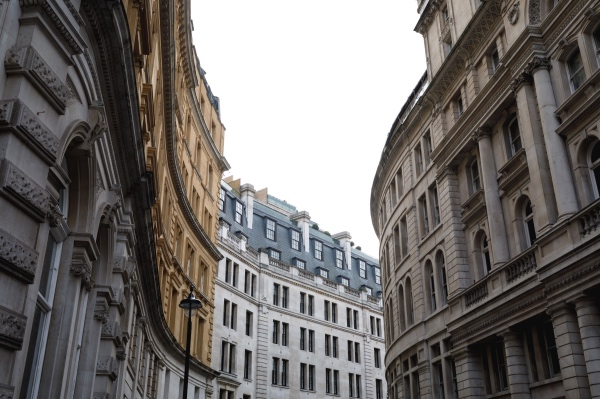
LondonLife – Curved facades…

PICTURE: Ed Robertson/Unsplash

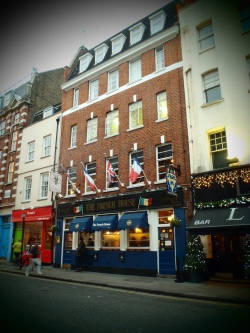
London Pub Signs – The French House…

Opened in 1891 (albeit under a different name), this Soho institution was apparently founded by a German couple named Schmitt who ran it until the outbreak of World War I.

It was then sold to Belgian chef Victor Berlemont and it’s at this point that some say the name, previously said to have been the Wine House, was changed to the York Minister (although there seems to be a bit of confusion about when the name changed).

Its French associations, meanwhile. were given a big boost during World War II when General Charles de Gaulle and Free French Army officers, in London following the fall of France, made it their HQ. In fact, some say that it was in this pub that de Gaulle wrote his famous speech against the Vichy settlement.

While it was often informally called the “French pub” thereafter, the name didn’t officially change until it reopened after a fire in 1984.

M Berlemont’s son Gaston, meanwhile, had succeeded his father in running the pub many years earlier – there’s a story that when he walked into the pub after World War II, still dressed in his uniform, his father handed over the keys and left him to it. A well-loved Soho identity, the moustachioed Gaston remained at the helm until 1989 when the pub passed into the hands of some French House regulars.

Located at 49 Dean Street, The French House is known for its Bohemian links, particularly with the literary and artistic set. Dylan Thomas is said to have accidentally left his handwritten manuscript Under Milk Wood here while others associated with the pub include Irish poet and playwright Brendan Behan, artists Francis Bacon and Lucian Freud, writer John Mortimer (of Rumpole fame) and actor Tom Baker (of Dr Who fame).

For more, see www.frenchhousesoho.com.

PICTURE: Tom (licensed under CC BY-NC 2.0)

This Week in London – Suffragette stories, and, recalling the “golden age” of ocean liners…

Untold stories of suffragettes are uncovered in a new display at the Museum of London marking the centenary of women’s suffrage. Votes for Women tells the story of the likes of Emily ‘Kitty’ Willoughby Marshall – arrested six times and imprisoned three times in Holloway including once for throwing a potato at the resident of then-Home Secretary Winston Churchill, Winefride Mary Rix – sentenced to two months hard labour for smashing a window at the War Office, and Janie Terrero – a suffragist since the age of 18 who was imprisoned in Holloway for four months for window smashing during which time she twice went on a hunger strike and was force-fed. The objects on display include Emmeline Pankhurst’s iconic hunger strike medal, a pendant presented to suffragette Louise Eates on her release from prison, and a silver necklace commemorating Willoughby Marshall’s three prison terms. There’s also a newly commissioned film installation highlighting the individual commitment and courage of the lesser known suffragette women. The exhibition opens tomorrow and there’s a special family-friendly festival this weekend featuring interactive performances, workshops and special events. The exhibition Votes for Women runs until 6th January next year. For more, including the full programme of events, see www.museumoflondon.org.uk.

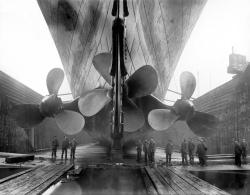
The golden age of ocean liners is recreated in a new exhibition opening at the V&A this Saturday. Ocean Liners: Speed & Style showcases more than 250 objects with highlights including a Cartier tiara recovered from the doomed Lusitania in 1915, a panel fragment from the Titanic‘s first class lounge, Goyard luggage owned by the Duke of Windsor dating from the 1940s, and Stanley Spencer’s painting The Riveters from his 1941 series Shipbuilding on the Clyde. Other artists, architects and designers whose work is featured in the display include Le Corbusier, Albert Gleizes, Charles Demuth and Eileen Gary. Among the “design stories” explored in the exhibition is that of Brunel’s Great Eastern along with Kronprinz Wilhelm, Titanic and its sister ship Olympic (all known for their Beaux-Arts interiors), the Art Deco Queen MaryNormandie and the Modernist SS United States and QE2. The display also features objects related to some of the ocean liner’s most famous passengers as well as the couturiers who saw ocean travel as a means of promoting their designs. These include a Christian Dior suit worn by Marlene Dietrich as she arrived in new York aboard the Queen Mary in 1950, a Lucien Lelong gown worn for the maiden voyage of the Normandie in 1935, and Jeanne Lanvin’s Salambo dress, which, as one of the most important flapper dresses in the V&A collection, once belonged to wealthy American Emilie Grigsby who regularly travelled between the UK and New York aboard the Aquitania, Olympic and Lusitania in the 1910s and 1920s. Runs until 10th June. Admission charge applies. For more, see www.vam.ac.uk/oceanliners.

PICTURE: Titanic in dry dock, c1911, Getty_Images (Courtesy Victoria & Albert Museum).

Send all items for inclusion to exploringlondon@gmail.com.

10 of London’s modern icons…3. The BT Tower…

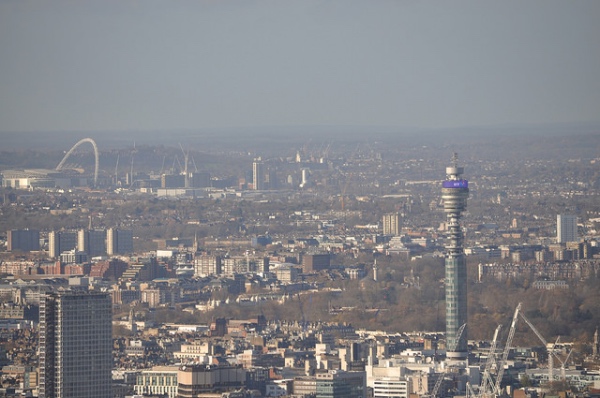
Loved and loathed by Londoners over the years since its construction in the mid-Sixties, the column-like BT Tower, despite growing competition, remains a dominant feature of the city’s skyline.

The tallest building in Britain at the time of its official opening in 1965, the 189 metre tall structure (including a 12 metre tall mast) was commissioned by the General Post Office to support microwave aerials which carried communications from London to the rest of the UK.

Designed by a team led by architect GR Yeats under the direction of Eric Bedford, chief architect of the Ministry of Public Buildings and Works, its narrow, tubular shape was engineering to reduce wind resistance and ensure stability.

Construction of the tower started in June, 1961, and some 13,000 tonnes of steel and 4,600 square metres of specially treated glass were used in building the £2.5 million tower.

Along with the aerials capable of handling up to 150,000 simultaneous telephone calls and 40 TV channels, the tower also housed 16 floors of technical and power equipment, as well as other floors with offices and even a revolving restaurant on the 34th floor (it made one revolution every 22 minutes).

PM Harold Wilson did the honours of officially declaring the tower open on 8th October, 1965. Queen Elizabeth II’s first visit would come on 17th May, 1966, just two days before then Postmaster General Tony Benn opened the tower’s public areas – an observation gallery and a 34th floor cocktail bar and restaurant, called Top of the Tower, which was managed by Butlins. More than 50,000 visited the observation gallery in the first three weeks after its opening.

A bomb exploded in the men’s toilets on the 31st floor – the location of the viewing gallery – in October, 1971, and took two years to repair. Despite this – no-one has apparently ever claimed responsibility for the bombing, public areas continued to remain open until the restaurant closed in 1980 and access to the observation gallery ceased in 1981 (although the restaurant is still used for corporate and charity events).

Originally known as the Post Office Tower, the tower has had many other official names since it was built including the Museum Tower, the London Telecom Tower and the BT Tower while staff suggestions at the time it was being constructed included the Pointer, Spindle, Liaiser and Telebeacon. Interestingly, the tower was apparently designated an official secret when built and didn’t appear on Ordnance Survey maps until after MP Kate Hoey, following on from other members who had “given examples of seemingly trivial information that remains officially secret”, told Parliament of its address – 60 Cleveland Street – in February, 1993.

The now Grade II-listed tower, which is located just off Tottenham Court Road in Fitzrovia, remained the tallest building in London until it was overtaken by the NatWest Tower in 1980. The last of its famous satellite dishes were removed in 2011.

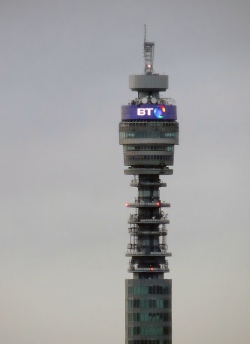
Its wrap-around LED light display, officially called the Information Band, went live in 2009. It has since carried special messages on occasions like Remembrance Day and Valentine’s Day as well as an Olympic countdown and even the first ever tweet sent by the Queen (a message to mark the opening of the BT-sponsored ‘Information Age’ communications gallery at the Science Museum in 2014).

The tower has featured numerous times in literature and film, the latter including Harry Potter and the Chamber of Secrets.

PICTURES: Top – BT Tower with Wembley in the background (Robert Speirs, licensed under CC BY-NC-ND 2.0); Right – View of BT Tower from The Monument (Dun.can, licensed under CC BY 2.0)

LondonLife – New Elizabeth line roundels installed…

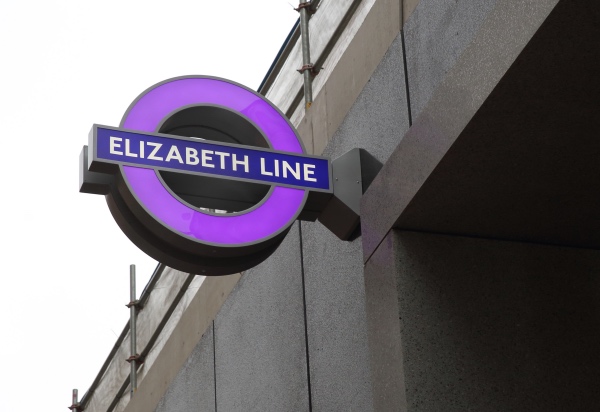
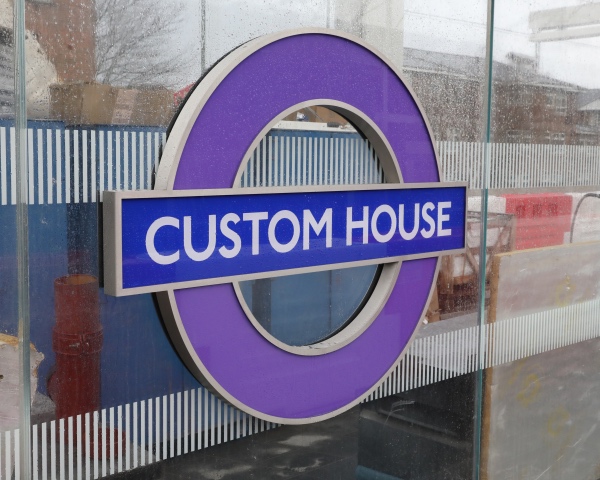
 With just 11 months to go until the launch of London’s Elizabeth line, new purple roundels have been rolled out at stations including Tottenham Court Road (above), Farringdon and Custom House (below). They all feature the iconic Johnston typeface, first commissioned in 1913 and designed by Edward Johnston (with updates made in 2016). Construction of the Elizabeth line, being carried out by Crossrail Ltd, has now entered its final stages and the line will go live from December when 10 new state-of-the-art stations, all step-free, will open. The line, which will enable a journey from Paddington to Canary Wharf in just 17 minutes, will initially offer three services: from Paddington (Elizabeth line station) to Abbey Wood via central London; from Paddington (mainline station) to Heathrow (Terminals 2 & 3 and 4); and, from Liverpool Street (mainline station) to Shenfield. The full route, which will run out to Reading in the east, opens in 2019. For more information on the line, see Transport for London’s page here.

PICTURES: Courtesy of Crossrail: top – Monica Wells; below – James O Jenkins.

Famous Londoners – Yes, (Prime) Minister…

OK, this is an unusual one – a TV show instead of a person, but given it’s 30 years this month since the last episode was broadcast on 28th January, 1988, we thought we’d pause to remember a landmark couple of TV series.

Yes Minister, which starred Paul Eddington as the hapless newly-elevated first time government minister Jim Hacker, first aired on BBC on 25th February, 1980.

The show centred on the trials and tribulations of Mr Hacker as he tried to bring about the sort of changes he had dreamed about as a candidate, opposed by an obstructionist civil service – in particular the Permanent Secretary to the Minister for Administrative Affairs, Sir Humphrey Appleby (played by Sir Nigel Hawthorne). Caught between the two – with loyalties to both – was Mr Hacker’s Principal Private Secretary Bernard Woolley, played by Derek Fowlds.

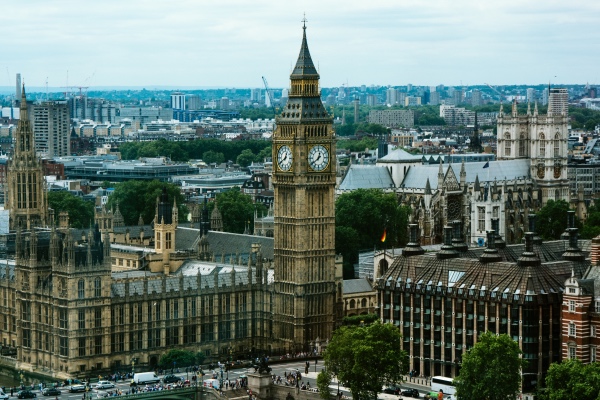
While the Houses of Parliament (pictured above) are shown as a drawing on the opening credits, the action rarely moves to the House of Commons but largely takes place in Mr Hacker’s Whitehall office and other offices and private clubs in the Westminster area under the premise that it’s behind the scenes where the real work of politics does (or doesn’t) get done.

The show was famous for almost always finishing with Sir Humphrey muttering those immortal words “Yes, Minister”, even as he has thwarted another of the minister’s plans.

Three series of seven episodes were made which ran until 1984 (there were also two Christmas specials) . A follow-up series, Yes Prime Minister, first aired in 1986 and centred once again on Jim Hacker, this time following his elevation to the role of PM. Sir Humphrey continued to be a thorn in his side.

The show, which was also adapted for radio, won several BAFTAs and was said to be a favourite of British PM Margaret Thatcher. It was later made into a stage play and this in turn lead to a “revival” series being produced.

The show has been referenced numerous times in popular culture as well as real-life politics – Australian Prime Minister Bob Hawke was a fan and even Humphrey, a former Chief Mouser to the Cabinet Office, was named after Sir Humphrey.

PICTURE: Jamie Street/Unsplash


Treasures of London – Memorial to Admiral Arthur Phillip…

It’s Australia Day in the land Downunder so it’s an appropriate one on which to mention a memorial to Admiral Arthur Phillip.

Phillip, then a captain, was the man who led the First Fleet to found a penal settlement at what is now Sydney, the landing date of which – 26th January, 1788 – is (now somewhat controversially) commemorated on Australia Day itself.

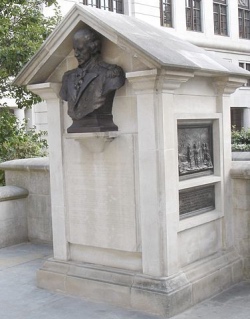
Located near the corner of New Change and Watling Street, this memorial is centred on a bust, housed in a small temple-like structure. The bust is a copy of one created in 1932 by CL Hartwell which can be seen in St Mary-le-Bow on Cheapside.

The original memorial was first installed in St Mildred’s Bread Street and was salvaged from its ruins after that was destroyed during World War II.

The memorial records that Phillip was born in Bread Street on 11th October, 1738, entered the Royal Navy in 1753 and, before died on 31st August, 1814. He had retired in 1805, having relinquished his position as first governor of the fledging colony of New South Wales and returning to England in 1792.

As well as the bust of Admiral Philip, the memorial bears two relief images – one on either side. The first depicts figures in a rowing boat – including Governor Phillip as well as Lieutenant P Gidley King and Lieutenant George Johnston – leaving the HMS Supply to plant the British flag on Australian soil.

The second shows five figures in the act of unfurling the British flag on 26th January, 1788 – they include, as well as Phillip and Lt Johnston, surgeon J White, Captain John Hunter (captain of the naval escort HMS Sirius) and Captain David Collins.

Among the inscriptions on the monument is one which reads: “To his indomitable courage, prophetic vision, forbearance, faith, inspiration and wisdom was due the success of the first settlement in Australia at Sydney on Saturday 26th January 1788.”

This is not the only memorial to Admiral Philip in London (the Mary-le-Bow bust aside) – a memorial stone to him was unveiled at Westminster Abbey in 2014 – the bicentenary of his death.

PICTURE: Lonpicman/Wikimedia Commons/licenced under CC BY-SA 3.0


This Week in London – Charles I’s ‘Royal Collection’ on show; John Constable; and, 18th century satire…

Anthony van Dyck, Charles I, 1635-6, Oil on canvas, 84.4 x 99.4 cm, RCIN 404420 Royal Collection Trust/© Her Majesty Queen Elizabeth II 2017

A landmark exhibition which reunites one of the most extraordinary art collections ever assembled opens in the main galleries of the Royal Academy of Arts in Piccadilly this Saturday. Presented in partnership with the Royal Collection Trust, Charles I: King and Collector features about 150 of the most important of the works collected by King Charles I during his reign, spanning the period from 1600 to 1649. They are among 1,500 paintings and 500 sculptures he collected  prior to his execution in 1649, after which the collection was offered for sale and dispersed across Europe. Many of the works were retrieved by King Charles II during the Restoration but others now form the core of collections at institutions such as the Musée du Louvre and the Museo Nacional del Prado. Among those on show in this exhibition, which includes more than 90 works borrowed from the Royal Collection, are several monumental portraits of the king and his family by Anthony van Dyck as well as the artist’s most celebrated portrait of the king, Charles I (‘Le Roi a la chasse’) (pictured), which returns to England for the first time since the 17th century. Other works include Peter Paul Rubens’ Minerva Protects Pax From Mars (‘Peace and War’) – this was commissioned by Charles and painted between 1629-30, Andrea Mantegna’s series, The Triumph of Caesar (c1484-92), and Titian’s Supper at Emmaus (c1530) while artists including Correggio, Tintoretto, Paolo Veronese, Albrecht Durer, Hans Holbein the Younger and Pieter Bruegel the Elder are also represented. The exhibition also shows off the celebrated Mortlake tapestries depicting Raphael’s Acts of the Apostles (c1631-40) and paintings, statuettes, miniatures and drawings once kept in the Cabinet at Whitehall Palace. Runs until 15th April. Admission charge applies. For more, see www.royalacademy.org.uk.

• John Constable’s oil sketch, Salisbury Cathedral from the Meadows, 1829–31, is one of 10 works which have gone on display at the Guildhall Art Gallery as part of its Victorian Landscapes exhibition. The painting takes centre-stage in the display in the gallery’s Temple Room; other works on show include John Brett’s Echoes of a Far-Off Storm (1890); Edward William Cooke’s Triassic Cliffs, Blue Anchor, North Somerset (1866), and Benjamin Williams Leader’s The Church at Betwys-y-Coed (1863). The paintings can be seen until early May. For more, follow this link.

Eighteenth century satire portrayed on ceramics and prints is the subject of a new free display at the British Museum. Pots with Attitude: British Satire on Ceramics, 1760-1830 features some 80 objects, some of which have not been on show for decades, including mugs and jugs (which make up the bulk of the items on show) as well as items like a cotton handkerchief printed with the “Peterloo Massacre” of 1819 and a rather grisly folding fan showing hidden profiles of executed French sovereigns (1794). Other objects show off copies of prints by satirists such as James Gillray and Charles Williams, with one of the latter’s showing a colossal Napoleon about to cross the Channel into England but prevented from doing so by a pint-sized, sword-carrying John Bull, who has sliced off his toes and is telling him, ‘Paws off, Pompey’ – the comment a reference to a lap-dog known as Pompey the Little who was the hero of a popular novel at the time. The display can be seen in Room 90a, Prints and Drawings Gallery, until 13th March. For more, see www.britishmuseum.org.

Send all items for inclusion to exploringlondon@gmail.com.

10 of London’s modern icons…2. 30 St Mary Axe (aka ‘The Gherkin’)

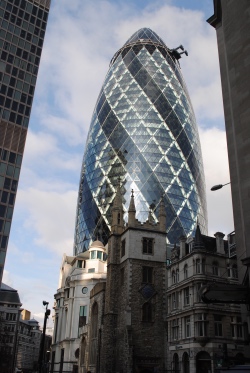
This rocket-ship shaped glass skyscraper made its mark on the City of London skyline in the early Noughties after plans to build a much taller building on the site were shelved.

The award-winning building stands on the site of what was the late Victorian-era Baltic Exchange which was extensively damaged by an IRA bomb which went off in the neighbouring street, St Mary Axe (for more on the origins of the street name, see our earlier post here), in 1992.

It was initially proposed that a 92 storey building, to be known as Millennium Tower, be built on the site – it would have been the tallest building in Europe. But the plan was shelved after both Heathrow and London City Airports objected to the interference it would have on flight paths while others pointed to the rather dramatic impact it would have on the City skyline.

The site was subsequently sold to reinsurance giant Swiss Re who then commissioned Sir Norman Foster (Foster + Partners) to design a building for its UK headquarters. The resulting 41 storey, 180 metre (591 foot) tall skyscraper – which features some 24,000 square metres of glass and was said to be the first environmentally sustainable skyscraper in London – was eventually completed in late 2003 and opened in 2004.

The glass dome which sits at the top of the building offers panoramic, 360 degree views of the surrounds and is said to be a reference to the glass dome that once sat over part of the ground floor of the Baltic Exchange.

Interestingly, the nickname for the building, The Gherkin, is actually an abbreviated form of a name first coined by some design critics  who described the building as an “erotic gherkin”, according to The Guardian. Some wags have also used the nickname ‘Towering Innuendo’ for the property.

PICTURES: Top – Samuel Zeller/Unsplash; Right – David Adams.


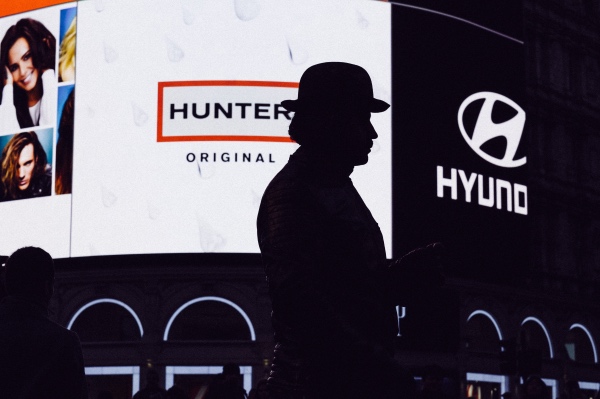
LondonLife – Lights at Piccadilly…

PICTURE: Clem Onojeghuo/Unsplash

Where’s London’s oldest…umbrella shop?

Established back in the early nineteenth century, James Smith & Sons Umbrellas is a West End institution in London and is certainly among the oldest, if not the oldest, surviving business established to sell umbrellas.

The original shop was founded by James Smith in Foubert’s Place, off Regent Street, in 1830 with the umbrellas made in a rear workshop and then sold at the front. The shop then moved to Saville Place but when this building had to be knocked down to make way for road widening, it moved to Burlington Street near Piccadilly Circus.

Business boomed following the invention of Samuel Fox’s lightweight steel frame umbrellas in 1851 and in 1867, a second shop was opened at 53 New Oxford Street (in Hazelwood House, where it remains today). The Burlington Street branch, meanwhile, continued to be operational until it was destroyed by a bomb in World War II, leaving just the shop in New Oxford Street.

The New Oxford Street shop still sells a plethora of types of umbrellas as well as made-to-measure walking sticks. Some of the umbrellas – which include antique and more contemporary models – are reportedly assembled on site.

In the shop you’ll also find a portrait of Jonas Hanway, said to be the first man who owned an umbrella in London. Being an early adopter of this imported fashion trend from France, he apparently attracted the ridicule of London society as well as that of coach drivers who saw the threat to their trade he represented. But history was on Hanway’s side and while the umbrella has survived the past couple of centuries, the coach as a means of transportation has not.

PICTURE: Top –  Jorge Royan/licensed under CC BY-SA 3.0/ Right – Ewan Munro/licensed under CC BY-SA 2.0