This Week in London – Garden art from the Royal Collection; A Royal Welcome at Buckingham Palace; photographic history; and, Joshua Reynolds reconsidered…

GardensKing Henry VIII’s well-thumbed gardening manual, a late 15th century copy of the Ruralia Commoda, and a 16th century portrait of Jacopo Cennini, factor and estate manager to the House of Medici – believed to be the earliest surviving portrait of a gardener – are among more than 150 objects on display at a new exhibition celebrating the art of gardens. Opening at The Queen’s Gallery in Buckingham Palace tomorrow, Painting Paradise: The Art of the Gardens features some of the earliest surviving records of gardens and plants in the Royal Collection including Jan Brueghel the Elder’s Adam and Eve in the Garden of Eden (1615), The Family of Henry VIII (c. 1545) featuring King Henry VIII’s Great Garden at Whitehall Palace – the first real garden recorded in British art, and A View of Hampton Court by Leonard Knyff (c. 1702-14) – described as the “greatest surviving Baroque painting of an English garden”. There are also works by Frenchman Jean-Baptiste Martin, Swiss artist Johan Jacob Schalch and Sir Edwin Landseer. The exhibition runs until 11th October. Admission charge applies. For more, see www.royalcollection.org.uk. PICTURE: Illustration from Henry VIII’s copy of the gardening manual, c. 1490-95. Royal Collection Trust/© Her Majesty Queen Elizabeth II 2015. 

Buckingham Palace, meanwhile, has announced its summer opening under the theme of A Royal Welcome. From 25th July to 27th September, displays in the State Rooms will recreate the settings for some of the many occasions in which the palace welcomes guests – from State Visits and garden parties to investitures and private audiences. The displays will show the behind-the-scenes preparations that go into a state visit and show the ballroom set up for a State Banquet. There will also be a display featuring the knighting stool and a knighting sword and, for the first time ever, visitors will enter the State Rooms through the Grand Entrance, used by those who come to the palace at the invitation of the Queen, including heads of state and prime ministers. The Australian State Coach, most recently used to carry the Duke of Edinburgh and the wife of the Mexican President, Señora Rivera, in March this year, will be displayed in the Grand Entrance portico. Admission charge applies. For more, see www.royalcollection.org.uk.

About 100 of the “most stunning photographs ever created” go on show in the Science Museum’s Media Space in South Kensington from tomorrow. Revelations explores the role of early scientific photography in inspiring later art photographers and will feature rare shots from the National Photography Collection including an original negative of X-Ray, 19th century photographs capturing electrical charge and William Henry Fox Talbot’s experiments with photomicrography. Displayed alongside are images by some of the 20th century’s pre-eminent art photographers such as Trevor Paglen, Idris Khan and Clare Strand. Runs until 13th September. Admission charge applies. For more, see www.sciencemuseum.org.uk/revelations.

On Now: Joshua Reynolds: Experiments in Paint. This exhibition at the Wallace Collection in Marylebone provides a new perspective on the portraits of Reynolds, one of the greatest artists of his day. Works on show including Nelly O’Brien, Mrs Abington as Miss Prue and Self Portrait Shading the Eyes as well as lesser known pictures and a rare history painting. The exhibition reveals discoveries made recently during a four year research project into the works of Reynolds now in the care of the collection. Runs until 7th June. Admission is free. For more, see www.wallacecollection.org.

Send items for inclusion to exploringlondon@gmail.com.

Lost London – The London Colosseum…

Designed by architect Decimus Burton (he of the Kew Palm House fame), the London Colosseum was a vast, 16-sided domed structure erected in the 1820s to the east of Regent’s Park to house a panoramic view of the city.

ColosseumSaid to be the largest ever painting created at the time, Thomas Hornor – a land surveyor – oversaw the creation of the work which was based on drawings he had made from the top of St Paul’s Cathedral (he had apparently sat in a special, temporary hut or “crow’s nest” positioned where the cross and ball would normally sit – but it was in the process of being replaced). Several artists – led by the renowned ET Parris – were involved in creating the work which took four years to make before it was completed in 1829.

The building – located where Cambridge Gate now stands – had been modelled on the Pantheon in Rome (not the Colosseum as the name would suggest) and was constructed from brick rendered with cement to imitate the appearance of stone. It featured a portico with Doric columns at the front and had inside an “ascending room” or lift to take people to see the panorama.

It’s opening was apparently delayed after Horner and his chief backer, MP Rowland Stevenson, took off to the US after running up rather large debts, leaving the property in the hands of trustees.

The Colosseum changed hands several times over the years and its purpose evolved. At one stage it was reinvented as a museum of sculpture displaying some 180 works while other attractions added to the great rotunda and its surrounding gardens over the years included a “Gothic aviary”, a Swiss chalet from which a visitor could look at a real waterfall and a stalactite cavern as well as a theatre and various other panoramas depicting everywhere from Paris to Lisbon.

Among visitors to the attraction were Queen Victoria and Prince Albert.

The Colosseum was put up for auction in 1855 but failed to attract a bid of the size required and, having passed through several hands (with some of the owners at one stage flirting with the idea of turning it into a grand hotel), it was eventually was demolished in the 1870s.

PICTURE: Via Wikipedia.

This Week in London – Gothic literature at the British Library; founder of War Graves Commission honoured; and, New Year’s Eve tickets on sale…

Gothic The UK’s largest exhibition of Gothic literature opens at the British Library in Kings Cross on Saturday (4th October), marking the 250th anniversary of the publication of the breakthrough book, Horace Walpole’s The Castle of Otranto. Terror and Wonder: The Gothic Imagination will feature manuscripts and rare and personal editions of Gothic classics like Bram Stoker’s Dracula, Mary Shelley’s Frankenstein, Robert Louis Stevenson’s Strange Case of Dr Jekyll and Mr Hyde and Charles Dickens’ Oliver Twist as well as the work of contemporary writers like Angela Carter and Mervyn Peake. There will also be Gothic-inspired artworks by the likes of Henry Fuseli and William Blake and modern art, photography, costumes and movies by the likes of Chapman Brothers and Stanley Kubrick. A range of literary, film and music events will accompany the exhibition which runs until 20th January. Admission charge applies. For more, see www.bl.uk/whatson/exhibitions/gothic/. PICTURE: Percival Delivering Belisane from the Enchantment of Urma, Henry Fuselli. © Tate.

The founder of the Imperial (now Commonwealth) War Graves Commission, Sir Fabian Ware (1869-1949), has been honoured with an English Heritage blue plaque at his former home in Marylebone. Sir Fabian lived at the early 19th century Grade II-listed terraced house at 14 Wyndham Place between 1911 and 1919. It was during this period that he served with the British Red Cross in France and first began recording the graves of soldiers killed in battle. In 1917, the Imperial War Graves Commission was formed with the task of reburying the war dead in permanent cemeteries in France. Knighted in 1920, Sir Fabian was to be director of graves registration and enquiries at the War Office during World War II and it was at this time that he extended the war graves scheme to civilians killed in the conflict. The commission changed its name to the Commonwealth War Graves Commission in 1960. Today it cares for cemeteries and memorials at 23,000 locations in 153 countries. For more, see www.english-heritage.org.uk/discover/blue-plaques/.

New Year’s Eve in London will be a ticketed event for the first time this year with 100,000 tickets being made available to the public with each costing a £10 administration fee – the entire sum of which will apparently be used to pay for the ticketing system. Making the announcement last month, the Mayor of London, Boris Johnson’s, office, said the growth in numbers of those who have gathered to watch the fireworks on the Thames – from around 100,000 in 2003 to an estimated 500,000 last year – has put an enormous strain on transport and safety infrastructure and meant people have had to turn up earlier and earlier to get a good view, facing hours waiting in cold and cramped conditions, or risk being among the “hundreds of thousands” unable to get a good view or even see the display at all. Booking tickets – people may secure up to four – will guarantee “good views of the celebrations and a better visitor experience”. To book tickets, head to www.london.gov.uk/nye.

Send all items for inclusion to exploringlondon@gmail.com.

Famous Londoners – Sir Edwin Lutyens…

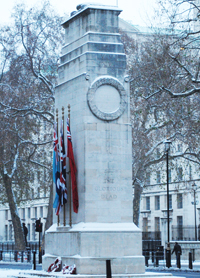
We’re looking at some of London’s World War I memorials so it’s only fitting we look at the life of acclaimed architect Sir Edwin Lutyens, the man credited with designing the Cenotaph – the UK’s national war memorial – in Whitehall (pictured below).

Lutyens was born in London at 16 Onslow Square, South Kensington, on 29th March, 1869, and – the ninth son and 10th of 13 children of soldier Captain Charles Lutyens and his wife Mary – was named for painter and sculptor Edwin Henry Landseer, a friend of his father’s. He grew up in London and Surrey and in 1885 commenced studying architecture at the South Kensington School of Art. In 1887, he left before completing the course, briefly joining the practice of Ernest George and Harold Peto before starting his own practice in 1889.

Cenotaph-in-LondonEarly commissions included country houses and it was during this period that he met with mentor and landscape gardener Gertrude Jekyll, a relationship which led him to design her home, Munstead Wood near Godalming in Surrey.

In 1897, Lutyens, known familiarly as ‘Ned’, married Emily Lytton – daughter of the late Viceroy of India and first earl of Lytton, Edward Buller-Lytton – and by 1908 the couple had five children. The family’s London addresses included 29 Bloomsbury Square (which also served as his office), 31 Bedford Square and 13 Mansfield Street, Marylebone, while his offices were located in numerous places including at 17 Queen Anne’s Gate.

Lutyens continued designing country houses – he eventually designed more than 35 major properties and altered and added many more – and among his commissions were Castle Drogo in Devon and the refurbishment of Northumberland’s spectacularly sited Lindisfarne Castle – both now National Trust properties. He was also involved in helping to plan and design Hampstead Garden Suburb in London, work which included designing two churches.

In 1912, Lutyens was invited to advise on the planning of the new Indian capital in New Delhi and his most important contribution was the design of the Viceroy’s House which combined elements of classical architecture with traditional Indian decoration. He was knighted in 1918 for his contributions in India and for his advice to the Imperial War Graves Commission.

It was his role in this latter effort which led to his becoming a national figure. He was involved in the creation of numerous monuments to commemorate the war dead, the best known of which are the Cenotaph in Whitehall – initially commissioned as a temporary structure (see our earlier post here) –  and the Memorial to the Missing of the Somme in Thiepval in northern France as well as the Australian War Memorial at Villers-Bretonneux and the Anglo-Boer War Memorial in Johannesburg.

He also designed more than 100 war cemeteries in France and Belgium and other war memorials – including overseas in places like Dublin – as well as London’s Tower Hill Memorial (see our earlier post here). Other London buildings he designed included the headquarters of Country Life magazine in Tavistock Street, Britannic House in Finsbury Square, the head office of the Midland Bank in Poultry and the Reuters and Press Association headquarters at 85 Fleet Street (now home to the Lutyens Restaurant, Bar and Private Rooms).

Lutyens was elected a fellow of the Royal Academy in 1920 (he was later president) and in 1924 was appointed a founding member of the Royal Fine Arts Commission. Even as he continued work in Delhi, he took on other commissions – such as the British Embassy in Washington, DC – and in 1924 he completed one of his most lauded – and smallest – designs: that of the one twelfth scale Queen Mary’s Dolls’ House which was shown at the 1924 British Empire Exhibition at Wembley and which can still be seen at Windsor Castle.

In 1929 Lutyens was commissioned to design a new Roman Catholic Cathedral for Liverpool but when he died on 1st January, 1944, this work was still unfinished with only the crypt completed thanks to the outbreak of World War II broke. Lutyens’ funeral was held in Westminster Abbey a few days later and his ashes were subsequently placed in the crypt of St Paul’s Cathedral.

For more information on Lutyens’ life and works, check out The Lutyens Trust, founded in 1984 to preserve and protect his legacy.

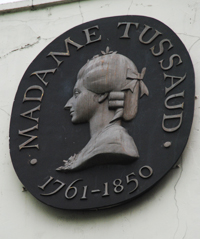
Famous Londoners – Madame Tussaud…

Famed around the world for her London-based wax museum (and the chain of waxworks which now bears her name), French-born Madame Tussaud is a towering figure of the early 19th century.

Born Anna Maria Grosholtz in Strasbourg on 1st December, 1761, Marie Tussaud’s association with waxworks came early when, her father Joseph having apparently died from wounds sustained in the Seven Years War just before her birth, she accompanied her mother Anna Maria Walder to Berne in Switzerland where her mother took up a position as a housekeeper for a physician and anatomical wax sculptor and portraitist Dr Philippe Curtius.

Madame-TussaudIn 1765, Dr Curtius moved to pre-Revolutionary Paris where he was soon to open a couple of establishments – at the Palais-Royal and the Boulevard du Temple (later consolidated at the latter site) – displaying his works in wax. Marie, whom Dr Curtius brought to Paris with her mother in 1768, started working with him on wax models and in 1777, at the age of just 16, produced her first wax figure, that of philosopher Voltaire. Other early works of Madame Tussaud’s depicted Rousseau and Benjamin Franklin.

The story goes that such was the renown of Tussaud and her “uncle” Dr Curtius, that their social circle came to include members of the Royal Family. Tussaud is widely believed to have been an art tutor to King Louis XVI’s sister Elizabeth and may have even taken up residence at Versailles.

Tussaud recounts that she was arrested during the French Revolution – the story goes that she was imprisoned and eventually released thanks to the intervention of family friend and revolutionary Jean-Marie Collot d’Herbois but whether this is true remains a matter of debate.

Tussaud claims she was then forced make death masks of those who ended their life on the scaffold including Louis XVI, Marie Antoinette, Marat and Robespierre. When Curtius died in 1794, she inherited his wax works and the following year married an engineer Francois Tussaud with whom she had two sons, Joseph and Francois (later known as Francis).

In 1802, Madame Tussaud accepted an invitation to go to London to exhibit her work at the Lyceum Theatre but thanks to the outbreak of the Napoleonic Wars, she and her four-year-old son Joseph were unable to return to France. Separated from her husband, she subsequently spent the next three decades travelling with her exhibition – which included relics from the Revolution and, like those of Curtius, was being constantly updated to reflect current affairs – around Britain and Ireland.

Her son Francois joined her in 1822 and Tussaud continued travelling until 1835 when she first established a permanent exhibition in Baker Street, London. Known as the Baker Street Bazaar, it apparently contained more than 400 wax figures. In 1846, Punch Magazine is credited with having invented the term ‘Chamber of Horrors’ for the room where the relics of the French Revolution were displayed.

Tussaud wrote her memoirs in 1838, and, in 1842, completed a wax model of herself. She died in her sleep on 16th April, 1850, in London. Her son Francois became chief artist for the exhibition after her retirement – he was succeeded by his son and then grandson. The exhibition moved to its current site in Marylebone Road in 1884.

Now owned by the Merlin Entertainments Group, Madame Tussauds has branches in cities in some 10 countries as well as its London base. Many of her original models still exist and are on display in the London museum along with the exhibition’s oldest attraction – known as ‘Sleeping Beauty’, it dates from 1863 – a breathing likeness of Louis XV’s sleeping mistress Madame du Barry.

For more on Madame Tussauds today, see www.madametussauds.com.

For more on the life of Madame Tussaud, see Kate Berridge’s book, Waxing Mythical: The Life and Legend of Madame Tussaud.

A Moment in London’s History – The execution of John Austin, the last person hanged at Tyburn…

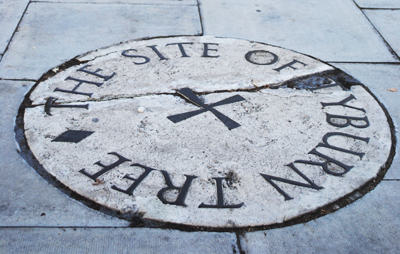
Tyburn-TreeThe site of public executions for hundreds of years, it’s generally accepted that at about 9am on 3rd November, 1783, John Austin became the last person to be hanged there (for more on the history of executions at Tyburn – and in particular the massive gallows known as the Tyburn Tree – see our previous post here).

Austin had been convicted of being a highwayman – specifically for inflicting “robbery with violence” upon labourer John Spicer, two weeks before during which Austin had attacked Spicer, beating and cutting him, “in a cruel manner”.

As he stood on the cart beneath the gallows (a mobile gallows had been in use since 1759 when the Elizabethan-era Tyburn Tree was dismantled), Austin’s last words were somewhat predictable – he requested that the crowd pray for his “departing soul”, that they would heed his example and that Jesus would have “mercy upon my poor soul”.

His death, it is said, was “hard”. As the cart was moved off, the halter around his neck apparently slipped “to the back part of his head” and instead of his neck being broken, Austin slowly choked to death.

The decision to cease executions at Tyburn (near where Marble Arch now stands) and move them to outside Newgate Prison was apparently due to complaints. These came from both City traders who felt the condemned person’s three mile procession from Newgate to Tyburn disrupted making money and the fashionable who sought to live in the city’s outlying western areas like Marylebone and who didn’t want to see the unruly mob that typically accompanied  outside their front doors. Such groups had long been lobbying for the practice to come to an end.

For more on the history of Tyburn see Robert Bard’s Tyburn: The Story of London’s Gallows.

London Pub Signs – The Globe…

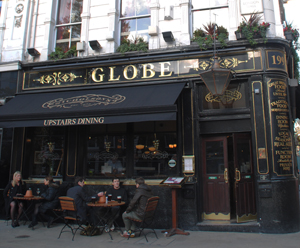
GlobeNo, this pub on Moorgate is not related to William Shakespeare. Its name actually comes from the globe which was used as the emblem of Portugal and advertised the fact that fine Portuguese wines were on sale at the premises.

According the pub’s website, there were eight pubs with the sign of the Globe in London during the reign of King Charles I (when this pub was apparently founded). By the middle of the 19th century, the number had risen to more than 30.

There are still a few other Globe pubs in London – as well as this one, others include the Globe in Marylebone Road and The Globe Bow Street (although we’re not sure whether their names were derived in the same way).

The pub, which is located at 83 Moorgate – close to where Moorgate once punctured London’s city wall and gave access to the fens known as Moorfields. In 2008, the pub merged with the neighbouring pub, the John Keats, now commemorated in the name of the bar (that pub was named for the Romantic poet John Keats, who it has been speculated was born in a pub on the site in 1795).

The pub is now part of the Nicholson’s group. For more, check out its website at www.nicholsonspubs.co.uk/theglobemoorgatelondon/.

This Week in London – Data visualisation at the BL; Kenneth Williams honoured; and, celebrating ‘frost fairs’…

NASA's-Perpetual-Ocean-cropAn examination of the historical use of visual data has opened at the British Library. Beautiful Science, which is running in The Folio Society Gallery, features the work of scientists and statisticians down the ages and focuses on the key themes of public health, weather and evolution. Among items on display are Robert Fludd’s Great Chain of Being (1617), Florence Nightingale’s seminal ‘rose diagram’ (1858) which illustrated that more Crimean War deaths were being caused by poor hospital conditions that battlefield wounds, and a contemporary moving infographic from NASA showing ocean currents (pictured). A programme of events is running with the exhibition which closes on 26th May. Entry is free. For more, see www.bl.uk/beautiful-science. PICTURE: NASA’s Perpetual Ocean © NASA/Goddard Space Flight Center

Comic Kenneth Williams (1926-1988) has been honoured with an English Heritage Blue Plaque at the London apartment he lived in during the hey day of the ‘Carry On’ series of films during the 1960s. Williams lived in flat 62 on the top floor of Farley Court, located between Madame Tussauds and Baker Street station, between 1963 and 1970 during which he starred in such films as Carry on Cleo and Carry on up the Khyber and also appeared in radio comedy programmes such as Round the Horne and Just a Minute. For more, see www.english-heritage.org.uk/discover/blue-plaques/.

Two exhibitions celebrating London’s Frost Fairs are underway at the Museum of London and its Docklands sister. Frozen Thames: Frost Fair 1814 at the Museum of London in the City and Frozen Thames: Frost Fair 1684 at the Museum of London Docklands both feature objects, paintings, keepsakes, engravings and etchings from the museum’s collection. Highlights at the Museum of London exhibition include the only surviving piece of gingerbread from the 1814 fair, the last fair of its kind, as well as etchings by satirical artist George Cruikshank and a print by George Thompson while among the items on display at the Docklands museum are two paintings by a Dutch artist Abraham Hondius (c. 1625-91). Both exhibitions are free and both run until 30th March. For more, see www.museumoflondon.org.uk.

This Week in London – Finds from below London on display; Reassessing the German Renaissance; and, Powell and Pressburger’s Blue Plaque…

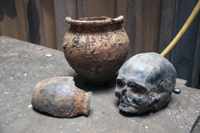
Roman-skull-found-at-Liverpool-Street-ticket-hall-_102065More than 50 objects – including skulls from the Roman era – unearthed as part of the Crossrail project have gone on display to the public for the first time. Portals to the Past also features a Roman cremation pot (which still contained remains when discovered), 16th century jewellery, and flint used by Londoners some 9,000 years ago. The free exhibition runs at the Crossrail Visitor Information Centre behind Centre Point at 6-18 St Giles High Street until 15th March. To coincide with it, Crossrail archaeologists will be running a series of lectures on Wednesday evenings starting at 6pm. No booking is required but numbers are limited so it’s recommended that attendees turn up early. For more information, www.crossrail.co.uk/sustainability/archaeology/archaeology-exhibition-portals-to-the-past-february-2014.

A new exhibition celebrating the artists of the German Renaissance opened at the National Gallery yesterday. Strange Beauty: Masters of the German Renaissance features paintings, drawings and prints by the likes of Hans Holbein the Younger, Albrecht Durer and Lucas Cranach the Elder and examines how perceptions of the pieces have changed over time. Works include Holbein’s Anne of Cleves, Hans Baldung Grien’s Portrait of a Young Man with a Rosary, and Matthias Grunewald’s drawing of An Elderly Woman with Clasped Hands. There is also a reconstruction of the Liesborn altarpiece, created in 1465 and originally housed at the Benedictine Abbey of Liesborn in Germany. Runs until 11th May. Admission charge applies. For more, see www.nationalgallery.co.uk.

Film-makers Michael Powell (1905-1990) and Emeric Pressburger (1902-1988) have been commemorated with the placement of an English Heritage Blue Plaque at the site of their former workplace, a flat in Dorset House, on Gloucester Place in Marylebone. It was from Flat 120 in the apartment block that they oversaw the production of some of their greatest films including The Life and Death of Colonel Blimp (1943), A Matter of Life and Death (1946), Black Narcissus (1947) and The Red Shoes (1948) between 1942 and 1947. Film director Martin Scorsese was among those who unveiled the plaque. For more, see www.english-heritage.org.uk/discover/blue-plaques/.

Send all items of interest for inclusion to exploringlondon@gmail.com.
10 fictional character addresses in London – 1. 221b Baker Street…

221b-Baker-Street

Today we kick off our new Wednesday series with a look at some of the most famous addresses in London where fictional characters once lived. Most, if not all, of the addresses we’ll look at are not fictional in themselves – they do actually exist – but the characters said to have lived there owe their lives solely to the imaginations of their creators and the readers and audiences who have loved and admired them.

To kick it off, we take a quick look at what is certainly the most visited address of a fictional character in London – 221b Baker Street, the home of Sherlock Holmes and his associate Dr John Watson.

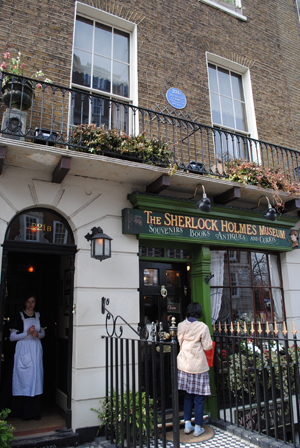
The-Sherlock-Holmes-MuseumWe’ve looked mentioned this Baker Street address in a couple of earlier posts – including a look at the origins of the naming of Baker Street and a piece on Sherlock Holmes himself.

So, to somewhat recap, the writer Sir Arthur Conan Doyle has Holmes and Watson living at this address from 1881 (it becomes their address in the first book featuring them – A Study in Scarlet, published in 1887) to 1904 when Holmes retired (Watson was not a continual presence here, moving in and out a couple of times).

What’s interesting is that the address now belongs to the Sherlock Holmes Museum, although in terms of the other numbers in the street, this is actually located between numbers 237 and 241 (in a street which was, prior to the 1930s, known as Upper Baker Street).

What is now number 221 is a 1930s art deco building formerly known as Abbey House (but this would have been 41 Upper Baker Street in 1887). It was the headquarters of Abbey National which had a long-running dispute with the museum over the right receive mail at the address 221b (since the closure of Abbey House in the early Noughties, the museum has received the mail).

It should be noted that there are also numerous other theories over the ‘real’ location of 221b Baker Street – in particular one which suggests the real address is opposite the former location of Camden House in Baker Street, thanks to a reference in The Empty House.

The museum, which is located in a house built in 1815, is set up as it was in Holmes’ day and contains his first floor study, filled with artefacts relating to the many cases he solved – including his famous pipe as well as his deerstalker hat, magnifying glass, violin, and the wicker chair which was used in Sidney Paget’s famous illustrations.

Other rooms include Dr Watson’s small second floor bedroom and the housekeeper Mrs Hudson’s room.

Worth noting is that there is also reconstruction of Holmes’ study at The Sherlock Holmes pub, located at 10-11 Northumberland Street in Westminster. This had been created for the Festival of Britain in 1951 by the Marylebone Borough Library and Abbey National and was located at Abbey House. For on this, check out the Westminister Libraries & Archives site.

WHERE: The Sherlock Holmes Museum, 221b Baker Street (nearest Tube station is Baker Street);  WHEN: 9.30am to 6pm daily; COST: £8 adults; £5 children (under 16); WEBSITE: www.sherlock-holmes.co.uk.

LondonLife – The Tweed Run London…

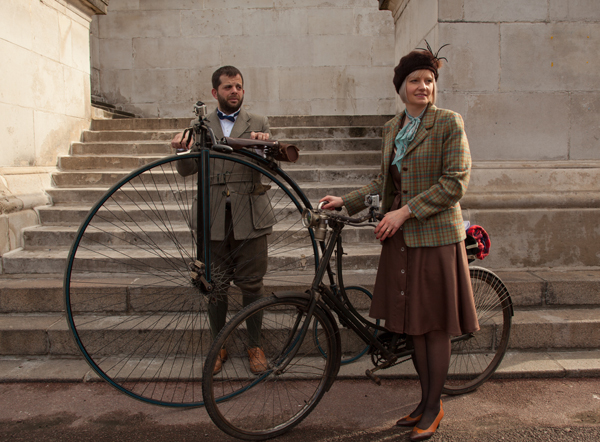
Tweed-RunThe Tweed Run London celebrated its fifth anniversary last Saturday with more than 500 taking part in the rather unusual annual event in which participants combine their passion for British fashion with their love for cycling. Among those taking part (entry was via a lottery system) on bikes of all shapes and sizes were people from as far afield as The Netherlands, Korea, Russia, Australia, Japan and even Afghanistan. The two hour ride took in Marylebone High Street, Savile Row, Regent Street, Piccadilly Circus and the Houses of Parliament before finishing at Trafalgar Square. The ride has been copied by other cities around the world including, Tokyo, Toronto and St Petersburg. For more on the Tweed Run, see www.tweedrun.comPICTURE: Selim Korycki, Tweed Run LLP.

What’s in a name?…Baker Street

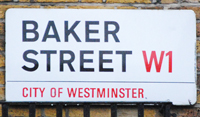
Synonymous with Sherlock Holmes, where does the name Baker Street actually come from? Not from a baker located there, as some might expect. Rather, Baker Street was apparently named after a Dorset luminary, Sir Edward Baker.

Baker-StreetSir Edward, created 1st Baronet Baker of Ranston in Dorset in 1802, was a friend and neighbour of the Portman family who developed the area in the late 1700s and early 1800s. Sir Edward (who later changed his name to Sir Edward Baker Baker) had apparently lent the Portmans a helping hand in developing the area.

A fashionable place to live when it was created, Baker Street remains famous for the house at number 221b, which, according to Sir Arthur Conan Doyle, served as the home to literary characters Sherlock Holmes and Dr John Watson between 1881-1904. The Sherlock Holmes Museum, which actually sits between numbers 237 and 241 Baker Street, now claims the address.

Other attractions to have been located in Baker Street include Madame Tussaud’s waxworks which in 1835 set up in premises known as ‘The Baker Street Bazaar’ before moving to its current premises around the corner on Marylebone Road in 1884.

Among the notable buildings still in Baker Street is the London Beatles Store (located at 231/233) where you can purchase all manner of memorabilia related to the group.

Famous residents have included 19th century Prime Minister William Pitt the Younger, actress Sarah Siddons, author and politician Edward Bulwer-Lytton, explorer Sir Richard Burton, and singer Dusty Springfield. The street was almost immortalised in Gerry Rafferty’s 1970s hit, Baker Street.

LondonLife – Forget the halls, they’re decking the city…part two…

There’s still a weekend to go before Christmas and if, having finished all Christmas shopping, you’re still in the mood for seeing some light displays, here’s some more places to look for some amazing (and in some cases historic), Christmas decorations (for the first part of this overview, head here)…

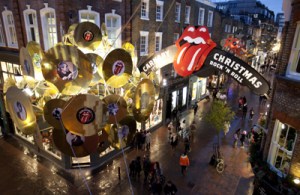
Carnaby-StreetLast week we mentioned some of the key sites to look for light displays in the West End this Christmas. Some of the other places to look include: the iconic shopping strip of Carnaby Street (decorations there this year are inspired by the 50th anniversary of the Rolling Stones – pictured) as well as South Molton Street, off Oxford Street (which again features some beautiful illuminated archways), and streets throughout St James (the St James Christmas lights were this year switched on by opera star Katherine Jenkins who earlier led a carol service at St James’s Church) and Mayfair.

Around Bow Lane and Watling Street in the City of London. Daubed with more than 10,000 lights, these narrow streets provide a wonderful sense of London past.

Marylebone. The lights here are well worth venturing out for. Turned on this year by Strictly Come Dancing‘s Claudia Winkleman.

Historic West End arcades. Still a place for fashionable shopping and tasteful Christmas decor, these include the Burlington Arcade, Royal Arcade, Princes Arcade and the Piccadilly Arcade.

And, of course, throughout London many shops have Christmas window displays. They include that of Fortnum & Mason in Piccadilly which this year have a Dick Whittington theme (see our earlier post here); Harvey Nichols in Knightsbridge which have gone with an oriental theme; Harrods in Brompton Road which have a Disney Princess theme; and Liberty in Great Marlborough Street which have gone with a theme inspired by the age of steam trains.

Of course, our list is by no means been comprehensive and is only confined to London’s heart – please share any other sensational Christmas decorations you’ve come across elsewhere in the city…

10 Historic Sporting Events in London – 5. The ‘Ashes’ are born…

While England and Australia played their first test match as far back as 1877 (at the Melbourne Cricket Ground), the origins of The Ashes go back to a game played at The Oval (now officially known as The KIA Oval) in Kennington in 1882.

Playing their only test of that tour, the Australians only made 63 runs in their first innings, giving England a 38 run lead with a total of 101. Australia followed this up with 122 leaving England just 85 runs to win. They were stopped just eight runs short of victory.

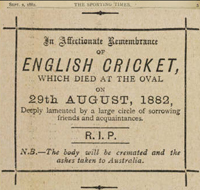
The English team were berated in the press for the loss and on 2nd September that year, a mock obituary for English cricket appeared in The Sporting Times stating that, having died at The Oval on 29th August, 1882, it will be “deeply lamented”. There was a note at the bottom of the obituary (picture right) which said that the body would be cremated and the ashes taken to Australia. And so the name, the Ashes, was born.

English captain Ivo Bligh subsequently promised that he would regain the ashes during the 1882-83 English cricket team’s tour of Australia while the Australian captain WL Murdoch vowed to defend them. It was during a social match played at Rupertswood Estate outside the city of Melbourne that Bligh was presented with the tiny terracotta ashes urn (today on display at the MCC Museum at Lord’s – see our earlier post for more).

The history of The Oval goes back to the mid-1840s when, following the establishment of the Surrey Cricket Club, it was granted a lease for the land from the Duchy of Cornwall (who still own it). The Ashes aside, memorable moments there have included the playing of the first match in the Australian Aboriginal team’s tour of England in 1868 (the first tour of England by a foreign side) and the first England v Australia test match to be played in England (1880). The Oval was also the location for the first international football match, played between England and Scotland in 1870, and the first FA Cup Final, played here in 1872.

Interestingly, The Oval also held a particular attraction for the US billionaire philanthropist,  J Paul Getty II, who built a replica of the ground at his estate at Wormsley Lodge in England’s south.

The history of Lord’s, London’s most famous cricket ground, meanwhile, goes back somewhat further. The current ground is the third to bear the name of Lord’s – the first was created on what is now Dorset Square in Marylebone at the behest of entrepreneur Thomas Lord (from whom it derives its name) and the first match staged there in 1787, the date on which the Marylebone Cricket Club was formed. Between 1811 and 1813, the ground was relocated to Marylebone Bank in Regent’s Park before moving to its current home in St John’s Wood (then the site of a duck pond).

Both grounds continue to host a range of cricketing and other events, such as the current Olympic archery competition being held at Lord’s.

WHERE: The Oval, Kennington Oval, Kennington (nearest Tube stations are Oval, Vauxhall and Kennington); WHEN: 90 minute tours of the ground are available (check website for booking details); COST: Tours cost £10 an adult/£5 under 16s/£25 a family ticket; WEBSITE: www.kiaoval.com.

WHERE: Lord’s Cricket Ground, St John’s Wood Road, St John’s Wood (nearest Tube Stations are Warwick Avenue, St John’s Wood, Marylebone and Maida Vale); WHEN: 100 minute tours of the ground (which include a visit to the MCC Museum) are available daily (check website for times – note that there are no tours during the Olympics, these resume on 21st August); COST: Tours cost £15 an adult/£9 concessions/£40 a family ticket; WEBSITE: www.lords.org.

PICTURE: Wikipedia

10 London sites to celebrate Charles Dickens – 4. Dickens at home…

We’ve already mentioned Charles Dicken’s Doughty Street house (now the Charles Dickens Museum) and his many childhood homes, but where else in London did Dickens reside during his adult life?

Following his marriage to Catherine Hogarth on 2nd April, 1836, at St Luke’s Church in Chelsea, Dickens and his new bride settled into chambers the writer had taken the now non-existent Furnival’s Inn (the author had been living there prior to his marriage), the site of which  is now occupied by the Holborn Bars Building).

In January the following year the couple had their first child – Charles Culliford Boz Dickens – and shortly afterwards made the move to the property at 48 Doughty Street. As we mentioned, the house was where two of his children were born and where Catherine’s 17-year-old sister Mary died (her death is believed to be the inspiration for that of the character Little Nell in the novel The Old Curiosity Shop) as well as being where Dickens wrote some of his most famous novels, including Oliver TwistNicholas Nickleby, and The Pickwick Papers.

In 1839, however, the family upsized into a much grander property at 1 Devonshire Terrace in Marylebone near Regent’s Park. This property at what is now 15-17 Marylebone Road was demolished in the late Fifties but there is a sculptural frieze on the wall marking where the property once stood.

Among the works Dickens wrote while living here were The Old Curiosity Shop, A Christmas Carol, Martin Chuzzlewit and David Copperfield. Six of Dickens’ children were born while he lived in this property. During this time, Dickens also made his first visit to North America and also travelled with his family in Europe for considerable periods.

In November 1851, Dickens moved the family again – this time to Tavistock House, located Tavistock Square in Bloomsbury. The property was demolished in 1901 and the site is now occupied by the headquarters of the British Medical Association (there’s a blue plaque commemorating Dickens’ time here).

Among the works Dickens wrote while living here were Bleak House, Hard Times, Little Dorrit and A Tale of Two Cities. The last of Dickens’ 10 children were born here – Edward Bulwer Lytton Dickens, later an Australian MP – and it was while living here, that in 1858 he separated from his wife Catherine. Dickens also put on amateur theatricals in the property.

Dickens’ time at Tavistock house ended around 1860 when Gad’s Hill in Kent became the main family home.

PICTURE: A section of the sculptural frieze depicting Dickens and some of his characters on the building that now stands at what was 1 Devonshire Terrace now in Marylebone Road. PICTURE: grahamc99 

LondonLife – Waterbus on Regent’s Canal

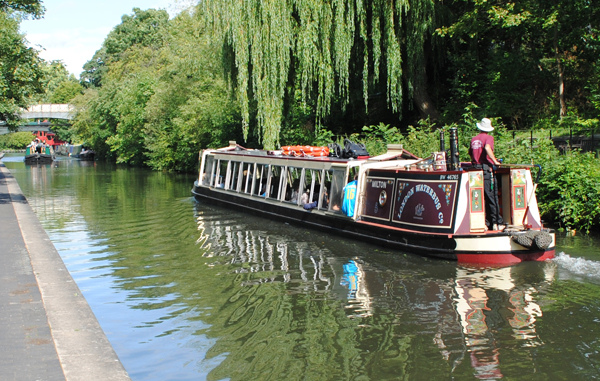
Regent’s Canal was fully opened in 1820 and linked the Grand Junction Canal, which ended at Little Venice in Paddington in London’s west, with the East London Docks and Limehouse in the east. Architect John Nash was one of the directors of the canal company and it was thanks to his friendship with the Prince Regent, the future King George IV, that the canal obtained its name. Nash saw the canal as an integral part of his plans for The Regent’s Park and it now runs along the park’s northern edge. Nash’s assistant James Morgan was the canal’s chief engineer. The waterbus service, which operates between Little Venice and Camden Loch, runs at various times daily until October. See here for timetable details.

LondonLife – The visit of the American President…

President Barack Obama has been in London for the past two days, so Exploring London decided to take a break from our series on King James’ I’s London and instead, in honor of the president’s visit, take a look at where you’ll find some other US presidents in London.

First up, it’s President George Washington. A life-sized statue of the first US president stands outside the National Gallery on the north side of Trafalgar Square. It’s a replica of an eighteenth century marble statue by Jean Antoine Houdon which stands in the State Capitol building in Richmond, Virginia. A gift of the Commonwealth of Virginia in 1924.

Civil War President Abraham Lincoln stands looking toward Parliament Square and the Houses of Parliament (pictured). The statue dates from 1920 – it was originally proposed to put a statue of President Lincoln in Parliament Square to mark the 1915 centenary of the last time the US and Britain were at war but the plans were put on ice until several years later. The statue, a gift of the US government, is a replica of the Chicago Lincoln Memorial by Augustus Saint-Gaudens. (There is also a bust of Lincoln inside the Royal Exchange building).

Next in the chronology is President Franklin D. Roosevelt, whose statue can be found on the north side of Grosvenor Gardens (overlooked by the vast and soon-to-be replaced US embassy). This bronze was unveiled by the president’s wife, Eleanor, on the third anniversary of FDR’s death- 12th April, 1948. The statue depicts the president standing – apparently at Mrs Roosevelt’s insistence – instead of seated in a wheelchair.

Across the gardens stands another wartime president, President Dwight D. Eisenhower. A bronze by sculptor Robert Dean, this life-size statue was the gift of the US city of Kansas in 1989 and was unveiled by British PM Margaret Thatcher and US Ambassador Charles Price. It stands only a short distance from Eisenhower’s wartime HQ. (Grosvenor Square has also been home to then future US President John Adams who lived at number nine as the first US Ambassador to the Court of St James between 1786-97).

A bronze bust of the 35th president, President John F. Kennedy, can be found on the corner of Park Crescent and Marylebone Road. Unveiled by his brother, Senator Robert Kennedy, in 1965, it’s a copy of a bust located in the Library of Congress in Washington DC.

Among those mooted for the future is one of President Ronald Reagan (also in Grosvenor Square), planning permission for which was granted by Westminster City Council in 2009.

What’s in a name?…Marylebone

This curiously named part of London, pronounced Mar-lee-bone, takes it’s name from a church dedicated to St Mary which was originally built near a small river or stream called the Tyburn or Tybourne. Hence St Mary-le-Burn became St Marylebone.

There was a medieval village here which during the 18th century became subsumed into greater London as fashionable people sought land to the west of the city. The area – in particular Harley Street – became known as a location of choice for doctors to site their consulting rooms and is still known for its medical establishments.

Among the significant sites is the St Marylebone Parish Church (pictured right) which, consecrated in 1817, was where poets Robert Browning and Elizabeth Barrett were married in 1846 following their elopement, the John Nash-designed All Souls Church in Langham Place, the Langham Hotel which opened in 1865 and boasted Oscar Wilde and Mark Twain among guests, 221B Baker Street, fictional home of Sherlock Holmes and now the site of the Sherlock Holmes Museum, and the famous wax museum, Madame Tussauds.

Marylebone is also home to the world famous Wallace Collection, bequeathed to the government in 1897, the concert hall Wigmore Hall, the Royal Academy of Music and the Royal Institute of Architects, and the art-deco headquarters of the BBC, Broadcasting House. Marylebone High Street remains a shopping mecca offering a diverse range of independent boutiques and specialty shops while in the south, Marylebone includes one of London’s most famous shopping strips on Oxford Street.

Other famous people connected with the area include four time Prime Minister William Gladstone who lived at 73 Harley Street from 1876 to 1882, writer Charles Dickens who lived at 18 Bentinck Street while working as a court reporter in the 1830s, author Edward Gibbon, who lived at 7 Bentinck Street while writing his landmark text The Decline and Fall of the Roman Empire from the 1770s, and Sir Arthur Conan Doyle, creator of Sherlock Holmes, who worked in Upper Wimpole Street in the 1890s.

Around London – The Magazine gets a new life, Lennon’s former home commemorated, and, The Titanic Exhibition

News this week that The Magazine building in Kensington Gardens – which dates from 1765 and was built to house munitions initially intended to help repel a Napoleonic invasion – is getting a new lease of life as an art gallery. The Royal Parks have awarded the Serpentine Gallery a contract to create a new art space – the Serpentine Sackler Gallery – in the building. Pritzker Prize architect Zada Hadid will oversee the renovation of the building which will be open in time for the Olympic Games in 2012. PICTURE: John Offenbach © The Royal Parks and Serpentine Gallery.

• A Blue Plaque commemorating singer, songwriter and one-time Beatle John Lennon’s stay in a house in Marylebone was unveiled last month. Yoko Ono unveiled the plaque at 34 Montagu Square, where she and John lived in the basement and ground floor flat in the latter half of 1968 when Lennon was working on The Beatles’ White Album. It was the first home the couple shared and, while Lennon lived at a number of London addresses between 1963 and 1971, of those that survive it is the home he occupied for the greatest period. Previous occupants included Ringo Starr, Paul McCartney and Jimi Hendrix.

• ON NOW: Titanic: The Artefact Exhibition will be held at the O2 from 5th November until 1st May. The exhibition traces the Titanic’s final journey, from Cherbourg on 10th April, 1912 to its sinking with the loss of 1,500 lives after striking an iceberg three days later. Featuring more than 200 artefacts from the ship, the exhibition includes recreated interiors from the ship. Tickets start at £13 for adults. For more information, see www.titaniclondon.co.uk.