This Week in London – Prepare to celebrate the Thames; Auerback on show at the Tate; and, Jan van Huysum at Dulwich…

London’s month long celebration of the River Thames kicks off on Monday with a 30 day programme of events ranging from regattas and river races to foreshore archaeology, arts, music and community festivals and environmental and educational activities. Highlights of Totally Thames include the Mayor’s Thames Festival, which runs all month and includes new art, films and performances on the riverside as well as beach combing, bonfires, walks, talks and cruises, the Royal Greenwich Tall Ships Festival, which runs from 5th to 9th September and features the largest fleet of tall ships to visit London in 25 years, the Great River Race on 27th September which has attracted more than 300 crews from across the globe, Handel’s Fireworks Music and Illuminations taking place at Hampton Court Palace on 14th September and, taking place this weekend, The Big Thames Tidy, which sees water charity Thames21 hosting one of the biggest clean-ups the river has ever seen. We’ll be mentioning events in more details as the month unfolds. To see the full programme of events, head to www.totallythames.org.

The most significant private collection of the paintings and drawings of Frank Auerbach – described as one of Britain’s “greatest living artists” – has gone on show at Tate Britain on Millbank. The works, which span the period from Auerbach’s student days in the late 1940s until 2007, were collected by the late artist Lucian Freud and hung in his London house until his death in 2011. They include portraits of Auerbach’s friends and relatives and landscapes of London. BP Spotlight – Frank Auerbach: Painting and Drawings from the Lucian Freud Estate is on display until 9th November. For more, see www.tate.org.uk.

• Now On: An Impossible Bouquet, Four Masterpieces by Jan van Huysum. This exhibition at the Dulwich Picture Gallery features works by the 18th century Dutch artist taken from private collections as well as the Dulwich’s own painting and is aimed at showcasing the “artist’s ingenuity and astonishing ability to paint flowers, fruit and insects with minute attention to detail”. The exhibition only has a month to go – it closes on 28th September. Admission charge applies. For more, see www.dulwichpicturegallery.org.uk.

Send all items for inclusion to exploringlondon@gmail.com.

Vikings at the British Museum; World War I portraits; and, Ruin Lust…

RoskildeThe Vikings come to the British Museum from today with the first major exhibition in more than 30 years. Vikings: life and legend, the first exhibition to be held in the new Sainsbury Exhibition Gallery, was developed with the National Museum of Denmark and the Staatliche Museen zu Berlin (National Museums in Berlin) and looks at the Viking period from the late 8th century to the early 11th century. Featuring many new archaeological discoveries and objects never seen before in the UK alongside items from the British Museum’s own collection, the exhibition is centred on the surviving timbers of a 37 metre long Viking warship excavated from the banks of the Roskilde fjord in Denmark (pictured). Other items include skeletons recently excavated from a mass grave of executed Vikings in Dorset, the Vale of York Hoard (discovered in 2007) and a stunning hoard of silver from Gnezdovo in Russia. A unique live broadcast event presented by historian Michael Wood taking cinema audiences around the exhibition will be shown in cinemas across the nation on 24th April. Admission charge applies. Runs until 22nd June. For more, see www.britishmuseum.org/whats_on/exhibitions/vikings.aspx. PICTURE: Copyright of the National Museum of Denmark. 

The commemorations of the World War I centenary have commenced at the National Portrait Gallery with The Great War in Portraits. The first of a four year programme of events and displays at the gallery, the exhibition features iconic portraits of figures such as Winston Churchill, Kaiser Wilhelm, Siegfried Sassoon and Wilfred Owen as well as major art works by the likes of Lovis Corinth, Max Beckmann, and Kirchner, whose painting Selbstbildnis als Soldat (Self-portrait as a Soldier) is featured, and Harold Gillies’ photographs of facially injured soldiers from the Royal College of Surgeons. Among the highlights are Jacob Epstein’s The Rock Drill, a contrasting pair of British and German films about the Battle of the Somme, and a press photograph of Gavrilo Princip, the student who sparked the flames of war when he assassinated Archduke Franz Ferdinand. Elsewhere among the 80 works on display are portraits of war heroes such as VC winners are contrasted with those of soldiers disfigured by war, POWs and those shot for cowardice. Admission is free. Runs until 15th June. For more, see www.npg.org.uk/whatson/firstworldwarcentenary/exhibition.php.

Our fascination with ruins is the subject of a new exhibition which opened this week at Tate Britain. Including more than 100 works from the likes of JMW Turner, John Constable, John Martin, Eduardo Paolozzi, Rachel Whiteread and Tacita Dean, Ruin Lust examines the craze for ruins that overtook creative types in the eighteenth century and the subsequent revisiting – and at times mocking – of this fascination by later figures. Works on show include Turner’s Tintern Abbey: The Crossing and Chancel, Looking towards the East Window 1794, Constable’s Sketch for ‘Hadleigh Castle’ c 1828-9, Graham Sutherland’s Devastation series 1940-1 – showing the aftermath of the Blitz, Jon Savage’s images of London in the late 1970s, and Whitehead’s Demolished – B: Clapton Park Estate 1996, showing the demolition of Hackney tower blocks. Runs until 18th May. Admission charge applies. For more, see www.tate.org.uk/whats-on/tate-britain/exhibition/ruin-lust.

What’s in a name?…Millbank

Millbank

The origins of this Thames-side district of London are as obvious as they sound – it was the site of a mill which stood on the west bank of the river.

The mill, which had served Westminster Abbey since at least the 16th century, stood here until about 1735 when it was demolished and replaced by a mansion built by Sir Robert Grosvenor, a member of the Grosvenor family responsible for developing parts of Mayfair.

The house was pulled down in 1809 to make way for Millbank Prison, which was the country’s first national prison and which was where prisoners were held before their transportation to Australia.

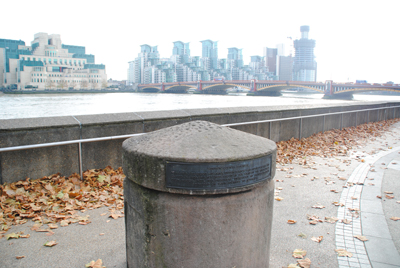
The prison closed about 1890 (a buttress which once stood at the top of the prison’s river steps commemorates the prison – pictured above).

The site is now occupied by some of the more interesting buildings in the area – including the Chelsea College of Arts (buildings formerly used by the  Royal Army Medical School, Tate Britain (which opened in 1897 as the National Gallery of British Art), and a housing development known as the Millbank Estate, constructed to providing housing for 4,500 members of the working class.

While the area was previously known for having been dominated by marshland, land was eventually reclaimed along the waterfront and an embankment established, defining the course of the river.

As well as the district, the name Millbank is also the name of the street which runs along the riverbank between the Houses of Parliament and Vauxhall Bridges.

For more on London’s prisons, check out Geoffrey Howse’s A History of London’s Prisons.

Around London – The Bard is back; Foundling Museum displays; and, exhibitions on iconoclasm and explicit Japanese art…

The Bard is back in Leicester Square with the announcement last week that restoration work on the square’s 19th century Grade II listed statue of William Shakespeare – the only full-length statue the playwright in central London – has been completed. The 11 month restoration was carried out as part of £17 million revamp of the square which has seen the installation of a new fountain. The statue, which was the work of James Knowles, has been in the square since it was completed in its current configuration in 1874. Meanwhile, in other sculpture-related news, Sorry, Sorry Sarajevo – a life-size statue of a man holding  a dead or badly injured man in his arms has been placed in St Paul’s Cathedral where it will remain for the rest of the year. The work by Nicola Hicks dates from 1993 – when the Bosnian war was at its height – and has been placed opposite Henry Moore’s 1983 sculpture, Mother and Child: Hood as part of the cathedral’s approach to next year’s World War I centenary.

Two new displays opened at the Foundling Museum in Bloomsbury last month. Hogarth and Copyright, which runs until 5th January, looks at the role the artist William Hogarth played in the passing of the 1735 Engravers’ Copyright Act (also known as Hogarth’s Act – it was the first law to protect artist’s rights over their work) while Handel and Lucretia, presented in conjunction with The Sir Denis Mahon Charitable Trust and running until 26th January, shows Guercino’s painting Lucretia alongside two early manuscripts of Handel’s cantata La Lucretia. Entry is part of admission price. For more, see www.foundlingmuseum.org.uk.

A new exhibition tracing the history of attacks on artworks in Britain from the 16th century to today opened at Tate Britain in Millbank this week. Art under Attack: Histories of British Iconoclasm looks at why and how monuments have been damaged over the past 500 years. The display includes the remarkable pre-Reformation sculpture, the Statue of the Dead Christ (about 1500-1520), which was discovered in 1954 beneath the chapel floor at the Mercer’s Hall. Already damaged – most likely at the hands of Protestant iconoclasts – it may have been buried there to protect it. Also displayed are fragments of monuments destroyed in Ireland last century, paintings including Edward Burne-Jones’ 1898 painting Sibylla Delphica which was attacked by suffragettes in 1913-14, and Allen Jones’ 1969 work Chair – damaged in a feminist attack in 1986. Runs until 5th January. Admission charge applies. For more, see www.tate.org.uk.

A controversial exhibition of sexually explicit Japanese works of art created between 1600-1900 opened at the British Museum this week. Shunga: sex and pleasure in Japanese Art – which carries a warning of “parental guidance for visitors under 16 years – features 170 works including paintings, prints and illustrated books. Drawn from collections in the UK, Japan, Europe and the US, the exhibition of explores the phenomena of what are known as shunga (‘spring pictures’), looking at why it was produced and to whom it was circulated. Admission charge applies. Runs until 5th January. For more, see www.britishmuseum.org.

Around London – Radio Times celebrated at MoL; IWM reopens; and Lowry at the Tate…

A new exhibition marking the 90th anniversary of the iconic publication, Radio Times, opens at the Museum of London tomorrow (Friday). Cover Story: Radio Times at 90 features some of the magazines most famous covers depicting the likes of Tony Hancock, The Goon Show, Only Fools and Horses and Coronation Street, and charts the history of radio from the BBC’s first transmission to today’s multiple channels. As well as original artwork and photographs used in Radio Times, the display includes a special focus on Doctor Who with the chance for visitors to create their own Radio Times cover as they stand alongside a life-size Dalek. Other highlights include an original 1941 illuminated map used by the Luftwaffe which shows Radio Times‘ Waterlows printing plant in Park Royal alongside other targets. Radio Times was first published by the BBC in London on 29th September, 1923, and since 2011 has been owned by Immediate Media Co. The free exhibition runs until 3rd November. For more, check out www.museumoflondon.org.uk.

The Imperial War Museum has partially reopened this week. As well as the re-opening of its permanent galleries and exhibitions, the museum has launched a major new family-oriented exhibition Horrible Histories: Spies, a new art exhibition entitled Architecture of War and ‘IWM Contemporary’, a new programme showcasing significant works by leading artists in response to war and conflict. The museum will fully reopen in summer next year with the opening of new First World War Galleries. Horrible Histories: Spies, which runs until 4th January (admission charge applies), immerses visitors in the world of World War II spycraft with families able to uncover the techniques used by the most cunning spies. More on Architecture of War and IWM contemporary in upcoming posts. For more, see www.iwm.org.uk.

On Now: Lowry and the Painting of Modern Life. This exhibition at the Tate Britain represents the first to be held by a public London institution featuring  the works of LS Lowry since his death in 1976 and is the first to explore his connections with French art. Among works on display is a little known, untitled painting depicting a busy town square set against the backdrop of industrial Salford which was found on the back of the wooden panel on which Lowry painted his 1937 work The Mission Room. Others among the 90 works on display include Coming Out Of School (1927), The Pond (1950), Industrial Landscape (1955) and Hillside in Wales (1962) as well as Ancoats Hospital Outpatients Hall (1952), The Cripples (1949), Piccadilly Circus, London (1960) and Excavating Manchester (1932). Runs until 20th October. For more, see www.tate.org.uk.

Around London – Olympics at the Museum of London; Oxford wins the Boat Race; restoration project at Kew; and, Phantom Ride at the Tate…

 Diver Tom Daley’s swimming trunks, cyclist Bradley Wiggins’ yellow jersey and a Mary Poppins outfit worn in last year’s Olympic Games’ opening ceremony are among the items on display as part of the Museum of London’s 2012 display. The free display, which opened last week, exactly 200 days after the Paralympics closing ceremony, features a selection of 70 items connected with the Games. Runs in the Galleries of Modern London until 31st October. For more, see www.museumoflondon.org.uk.

Oxford took line honours at the 159th Boat Race, held on the River Thames last weekend. The Dark Blues – whose crew included Olympic medalists Constantine Louloudis and Malcolm Howard – still trail Cambridge (the Light Blues) – whose crew included another Olympic medallist, George Nash, however, with 77 wins to 81 wins. For more, see www.theboatrace.org or our previous articles – here and here.

Kew Garden’s historic Temperate House has received a £14.7 million Lottery Fund grant for conservation of the Grade One listed building, the largest Victorian glasshouse in the world. The grant – which adds to £10.4 million from the government and £7.7 million from private donors – will also be used to create a “more inspiring” public display for visitors with the overall £34.3 million project completed by May, 2018. The building opened in 1863 and was last refurbished 35 years ago. It houses some of the world’s rarest plants, including a South African cycad (Encephalartos woodii). For more, see www.kew.org.

On Now: Phantom Ride. This “haunting” film installation by artist Simon Starling was commissioned by the Tate Britain in Millbank and is located in the neo-classical Duveen galleries. Referencing the late nineteenth century tradition of ‘phantom rides’ – films, often made by cameramen strapped to the front of a train, that gave a dramatic sense of motion as if one is aboard an invisible vehicle – the installation includes a “compelling flow of images” of artworks that once filled the Duveen galleries, creating a sense of movement as the works move up and down the walls. Admission is free. Runs until 20th October. For more, see www.tate.org.uk.

LondonLife – Pre-Raphaelites at the Tate…

Laus Veneris (1873-8) by Edward Burne-Jones was inspired by Algernon Swinburne’s poem Laus Veneris which relates the tale of a knight who falls in love with Venus (shown in red) but then decides to leave her. Usually found in the Laing Art Gallery in Newcastle upon Tyne, it’s among the 180 or so works on display at Tate Britain on Millbank as part of its recently opened exhibition, Pre-Raphaelites: Victorian Avant-Garde. The exhibition, the largest survey of the group in almost 30 years, locates the Pre-Raphaelites as the UK’s first modern art movement and traces the group’s development from its formation in 1848 through to their Symbolist creations of the 1890s. Other works on show, some of which have been rarely seen in the UK, include John Everett Millais’ Ophelia, William Holman Hunt’s The Lady of Shalott, and Dante Gabriel Rossetti’s Found. There are also works by Madox Brown and William Morris and as well as paintings, the display includes sculpture, photography and the applied arts. Runs until 13th January next year. Admission charges apply. For more, see www.tate.org.uk.

Where is it?…#40

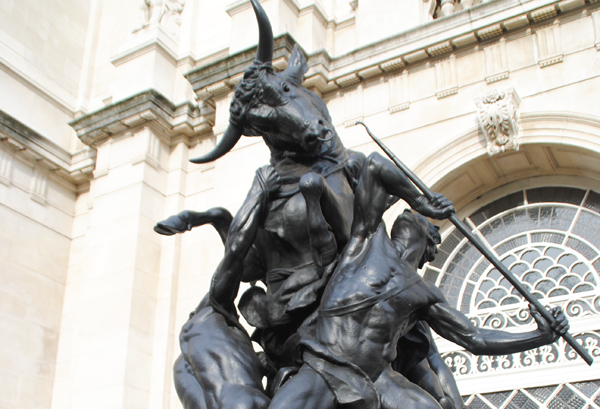
The latest in the series in which we ask you to identify where in London this picture was taken and what it’s of. If you think you can identify this picture, leave a comment below. We’ll reveal the answer early next week. Good luck!

Well done to Angelo – this is indeed located outside the Tate Gallery, just to the left of the main entrance. The statue is The Death of Dirce, a work by Sir Charles Lawes-Wittewronges, and was one of a several copies of the same work he made in the early 1900s (this bronze version was made in 1906), including a couple of bronze versions and a colossal marble version. The sculptural group, based on the Hellenistic sculpture known as the Farnese Bull (which is indeed in Naples), depicts Dirce, the wife of the King of Thebes who was tied to the horns of a bull by Amphion and Zethus as a punishment. Sir Charles was something of a noted athlete in a range of sports as well as a sculptor who exhibited 12 works at the Royal Academy. He was also involved in a famous libel case in the 1880s. The statue was presented to what was then the National Gallery of British Art by his widow after his death in 1911.

Around London – Celebrating the Olympics; Camden Lock’s night market; and, images of London at the Tate…

We’ll kick off this week with just a few more of the plethora of Olympic-related events which are happening around town:

Tower Bridge, site of some spectacular fireworks last Friday night, is currently hosting an exhibition celebrating the 26 cities which have hosted the modern Olympics. Cities of the Modern Games, located on the bridge’s walkways, runs alongside an interactive exhibition looking at the bridge’s construction. Follow the link for details.

The Guildhall Art Gallery is showcasing sculpture and art inspired by sport and the “Olympic values”. The art works are all winning entries from a contest organised by the International Olympic Committee. The chosen works were selected from among 68 submissions made by an international jury. Follow the link for details.

The Design Museum is hosting a new exhibition celebrating the nexus between sport and design. Designed to Win looks at everything from the design of F1 cars to running shoes, bats and bicycles and explores the way in which design has shaped the sporting world. Runs until 9th September. Admission charge applies. See www.designmuseum.org.

• The London Metropolitan Archives is holding an exhibition of playing cards featuring an Olympic theme. Sporting Aces – Playing Cards and the Olympic Games features cards drawn from the collection of the Worshipful Company of Makers of Playing Cards which have an Olympic theme. Admission is free. Runs until 13th September. See www.cityoflondon.gov.uk/lma.

And in other news…

A night market has been launched at Camden Lock over the summer period. Street food stalls and vintage fashion, arts and crafts and book shops will be open until 10pm every Thursday with extras including live music and film screenings. For more, see www.camdenlockmarket.com.

• On Now: Another London: International Photographers and City Life 1930-1980. This exhibition at Tate Britain in Millbank features more than 150 classic photographs of the city and its communities by foreign photographers including such luminaries as Henri Cartier-Bresson. The exhibition features iconic works such as Robert Frank’s London (Stock Exchange) 1951, Cartier-Bresson’s images of King George VI’s coronation, Elliot Erwitt’s depiction of a rain-washed London bus stop, and Bruce Davidson’s image of a child with pigeons in Trafalgar Square alongside works such as Wolfgang Suschitzky’s images of working class families in the East End, from the 1940s, and Karen Knorr’s images of punks in the 1970s. The photographs all come from the Eric and Louise Franck London Collection, which includes more than 1,200 images of London and has been promised as a gift to the Tate. Runs until 16th September. Admission charge applies. See www.tate.org.uk. 

Have we missed something we should be telling others about? Send details in an email to exploringlondon@gmail.com.