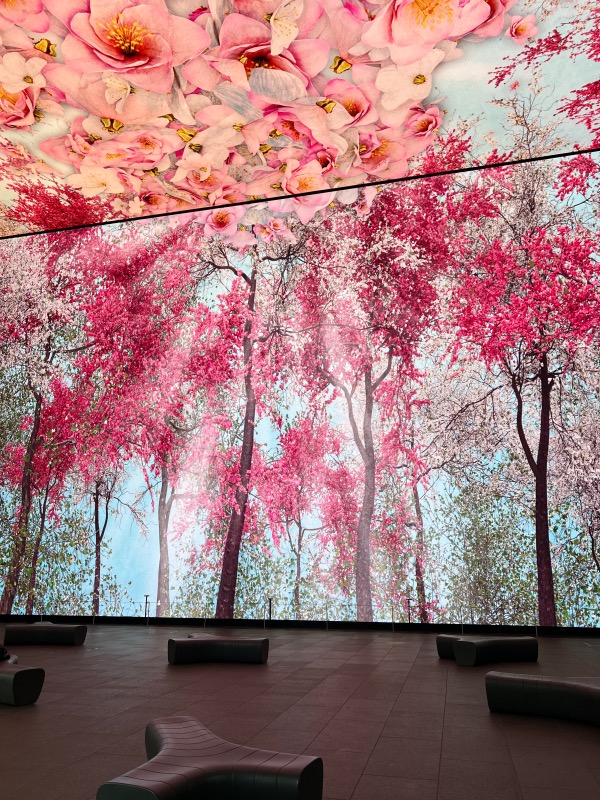
Experience blossoms in all their glory at ‘Nature’s Confetti’ a new installation at Outernet London. Created in partnership with the National Trust as part of its annual “blossom” campaign, this immersive experience in the Now Building at the intersection of Charing Cross and Tottenham Court Roads has been created using shots switching between city vistas and close ups of blossoms accompanied by sound recordings replicating those in nature captured at National Trust properties such as Petworth House and Park in West Sussex. Visitors also have the opportunity to donate to the Trust’s ‘Plant a Tree’ appeal, which will help plant and establish 20 million trees by 2030, four million of which are expected to be blossom varieties. But you’ll have to be quick – Nature’s Confetti only runs until 28th April. Entry is free. For more, see www.outernet.com/news/outernet-and-the-national-trust-launch-natures-confetti-experience.
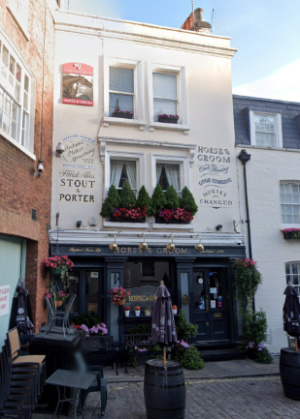
The name of this pub, one assumes, is all about its location.
It’s located on one of Belgravia’s many cobbled mews, the back-streets or courtyards that were traditionally lined by stables and carriage houses located at the back of expansive homes. Hence the pub’s name (a name also associated with its address at 7 Groom Place).
The pub is believed to date from at least as far back as the 1850s and has apparently seen many famous faces over the years including The Beatles and, more recently, Gwyneth Paltrow and Rihanna. It also appeared in the recent Julian Fellowes’ TV drama Belgravia.
One of the lamp-posts in Russell Street, Covent Garden, in 2012. PICTURE: Google Maps
Recently listed as Grade II, these four gas lamps on Russell Street in Westminster were among a series of lamps installed around Covent Garden to mark the beginning of King George V’s reign.
While the columns of the lamps date from 1910, three of the lanterns – described as an ‘Upright Rochester lantern’ and manufactured by William Sugg and Company Limited – are replacements believed to have been installed around 1930. The fourth was installed following a campaign to save Covent Garden from redevelopment in the 1970s.
The newly listed lamp-posts – the first Westminster lamps to be listed in 40 years – are located outside numbers 4-6, 24, 29, and 34-43.
There are currently about 1,300 working gas lamps in London, around 270 of which are in Westminster (and about half of which are listed).
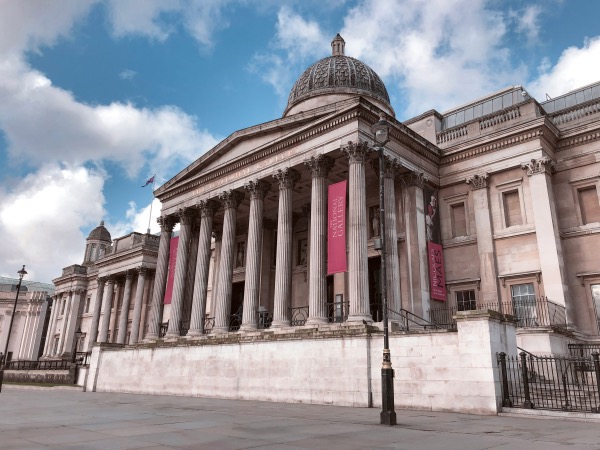
• The National Gallery is celebrating its 200th anniversary with festivities kicking off with a special night of celebrations on Friday, 10th May, and continuing over the weekend. In a special Friday night late, Jools Holland is performing in the Rausing Room with friends including Ruby Turner, Louise Marshall, and Sumudu while across the rest of the gallery there will be DJ sets, music from London Contemporary Voices, soundscapes by Anna Phoebe and poetry from Ben Okri. There will also be a celebration of music collaboration past and present in the Future Room and creative workshops offering sculptural postcard making and ‘Renaissance Selfies’ with London Drawing while outside on Trafalgar Square the building’s facade will be illuminated in a light show featuring projections of paintings from the gallery as well as the story of its history. Meanwhile, across the weekend visitors to the gallery will have the chance to join in the making of a creative “birthday day” by contributing their own paper creations. All events are free but booking is advised and tickets to the public open today. For more, see nationalgallery.org.uk/whats-on/big-birthday-weekend-late.
• Trafalgar Square hosts two days of celebrations this weekend with Eid in the Square on Saturday and St George’s Day festivities on Sunday. Eid in the Square runs from noon to 6pm and features creative arts workshops, storytelling and VR experiences with musical performances on the main stage and food stalls from across the world. Among those performing will be Love’s Pilgrim, Raghad Haddad and Raghad Haddad and members of the Orchestra of Syrian Musicians, Muslim Belal and Chahat Mahmood Ali Qawwal and Group. For more, see www.london.gov.uk/Eid-in-the-Square-2024. Meanwhile, St George’s Day, which also runs from noon to 6pm, features a wide range of entertainment, food stalls and music with artists including The Kurfew, Natalie Shay of Busk in London, West End Kids and Snottledogs. Folkdance Remixed will present a mass barn dance while She’s Got Brass, an all-female brass group, Nick Howe and the Stringbeats Trio and Tom Carradine will lead a cockney sing-a-long. Other activities will include an English Pentathlon – events include welly wanging, pancake tossing, human Crufts, bubble Olympics, the art of Morris Dancing and a chance to meet Pearly Kings and Queens. St George and the dragon will be available for selfies. For more, see www.london.gov.uk/st-georges-day-celebrations-trafalgar-square-sunday-21-april. Both events are free to attend.
• A new display revealing stories of loss from The Troubles in Northern Ireland opens at the National Portrait Gallery opens on Monday.Silent Testimony features 18 large-scale portraits by Belfast-born artist Colin Davidson which were painted between 2014 and 2015 and speak to the impact of the conflict on the sitters, their families and friends and the wider community. The paintings were first displayed at the Ulster Museum in Belfast and most recently at Stormont’s Parliament Buildings and the Irish Arts Center in New York. The display in Room 14, level three, is free to see and runs until 23rd February next year. For more, see www.npg.org.uk.
For all inclusions, email exploringlondon@gmail.com.
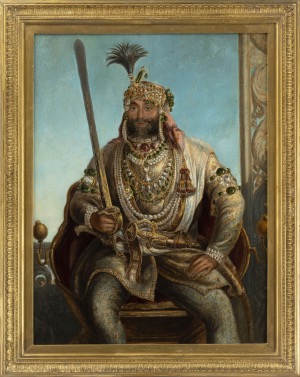
• The remarkable life and legacy of Maharaja Ranjit Singh (1780-1839), the founder of the Sikh Empire, is the subject of a new exhibition which opened at the Wallace Collection this week.Ranjit Singh: Sikh, Warrior, King features historic objects from Ranjit Singh’s court, courtiers and family members, including those personally owned by the Maharaja and the most famous of his wives, Maharani Jind Kaur, as well as their son, Maharaja Duleep Singh. Highlights include a fine miniature painting of Ranjit Singh and his favourite, a Golden Throne made by Hafez Muhammad Multani, and a sword richly mounted in gold and gemstones which was thought to belong to the Maharajah. Runs until 20th October at the Manchester Square institution. Admission charge applies. For more, see www.wallacecollection.org/whats-on/events/ranjit-singh-sikh-warrior-king/.
• A “fresh perspective” on London can be seen in a new exhibition by multi-award-winning wood engraver Anne Desmet at the Guildhall Art Gallery. Inspired by looking at a fragmented view of the world through a toy kaleidoscope, Anne Desmet: Kaleidoscope/London features works created by the artist slicing into prints focused on London from her earlier wood-engravings, linocuts and hand-drawn lithographs to make a new series of digital collages. The display features 150 works including 41 London-themed kaleidoscopic prints created exclusively for this exhibition. Among highlights is a complex collage, Fires of London, created using 18 razor-clam shells to present a theme of the many historic fires of London over the last 1,500 years. Admission is ‘pay what you can’. There are an accompanying series of artist-led tours. Runs until 8th September. For more, see www.cityoflondon.gov.uk/events/anne-desmet-kaleidoscopelondon-exhibition.
• Photographs depicting women and children forced to leave their Ukrainian homes following Russia’s invasion is on at the Foundling Museum in Bloomsbury.Polly Braden: Leaving Ukraine features the work of photographer Polly Braden and includes first-hand photographs, personal films and recorded conversations. It focuses on four central stories – that of three school friends trying to forge new lives and continue their education; that of a young graduate making a fresh start as a lawyer in London; that of a mother whose baby was born shortly after a perilous escape from Kherson to Warsaw; and that of two friends and their children who fled to Moldova with help from a kickboxing club, now struggling to find work in Italy. Admission charges apply. Can be seen until 1st September. For more, see https://foundlingmuseum.org.uk/event/polly-braden-leaving-ukraine/.
Located in Bromley Palace Park – once the home of the Bishops of Rochester and now the grounds of the Bromley Civic Centre – is what appears to be the remains of a medieval church or building.
But the “ruins” actually only date from the Victorian era and were created as a folly for the first private owner of the house.
The ruins, which are Grade II-listed, consists of a brick turret which features a rounded arched window in the Norman style with some raised zig-zag decoration above it and an arched arrow squint. The arch rests upon what is believed to actually be early medieval capitals with a late 12th century column on the left.
The folly, located at the south-western corner of the bishop’s palace grounds, was created in about 1865 on the orders of merchant Coles Child, who bought the house in 1845, and may have been created, along with other garden features, by the company of James Pulham.
Tradition says it was constructed from medieval remnants found in the moat of the bishop’s palace.
• Happy Easter to all our readers! We’ll be taking a break over the next few days with our usual coverage returning next Tuesday.
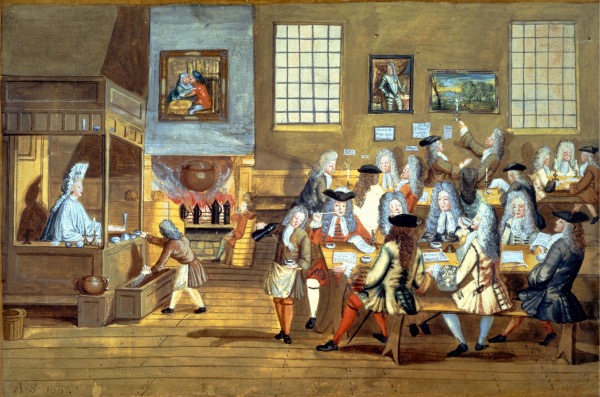
A caricature of Lloyd’s Coffee House from the 17th century.
• Experience a recreation of Grace and Thomas Tosier’s famous ‘royal’ Chocolate House in Greenwich this Easter. Located in the Old Royal Naval College, Chocolate House Greenwich recreates the Tosier Chocolate House which was located in what became known as Chocolate Row, on the edge of Blackheath. A social space for the leading figures of the day, the chocolate house was run by Grace while her husband Thomas served as chocolate maker for King George I, running the chocolate kitchen at Hampton Court Palace. Visitors will be able to immerse themselves in the chocolate house via an audio and visual experience created by Unusual Expo and actor-writer Jonathan Coote. As well as meeting Grace, there is also the chance to listen in to luminaries such as architect and astronomer Sir Christopher Wren, writer and diarist John Evelyn, the first Astronomer Royal, John Flamsteed, and playwright and architect John Vanbrugh. A series of events will accompany the exhibition – which opens tomorrow – including an Easter Trail for families, a gin and chocolate tasting experience and a ‘Choc-o-Late’ event. Admission charge applies. Runs until 3rd November. For more, see https://ornc.org/whats-on/chocolate-house-greenwich/.
• A wig worn by Golda Rosheuvel in Netflix’s hit series Queen Charlotte: A Bridgerton Story goes on display at Kew Palace from the end of this month. The grey wig with accompanying tiara will be showcased in Queen Charlotte’s dressing room, alongside a lock of the real Queen Charlotte’s hair. Visitors will also be able to join daily 30 minute Queen Charlotte: A Kew Palace story tours, walking in the footsteps of famous royals like King George III and Queen Charlotte. Admission charge applies. For more, see https://www.hrp.org.uk/kew-palace/.
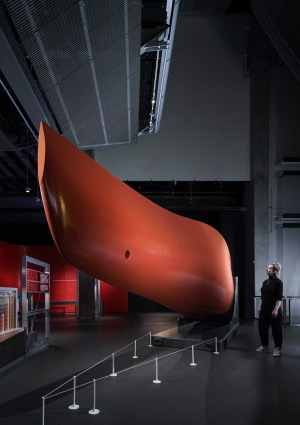
• A major new gallery examining the rapid energy transition and decarbonisation needed globally to limit climate change has opened at the Science Museum. The Energy Revolution: The Adani Green Energy Gallery is divided into three sections – Future Planet, Future Energy and Our Future – and highlights technologies and projects being used to address the climate crisis. Objects on show include a seven metre long tidal turbine blade made by Orbital Marine Power which was used in the Orkneys, rare surviving Edison tube mains cables used to power world’s first public electricity network in London in 1882, and a three metre high CoolAnt passive air-cooling facade from India that reduces dependence on powered air conditioning. At the centre of the gallery sits Only Breath, a kinetic sculpture created by artists Alexandra Carr and Colin Rennie from Torus Torus Studios that moves and blooms, stretching to around five metres in diameter when unfurled. The gallery can be found on Level 2 of the South Kensington museum. Admission is free. For more, see sciencemuseum.org.uk/energy-revolution.
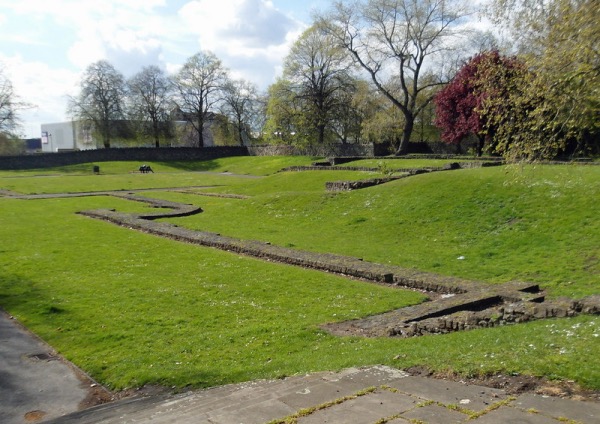
Footings of the abbey (these are modern with the real foundations below ground). PICTURE: diamond geezer (licensed under CC BY-NC-ND 2.0)
Once one of the most important nunneries in the country, Barking Abbey was originally established in the 7th century and existed for almost 900 years before its closure in 1539 during King Henry VIII’s Dissolution.
The abbey was founded by St Erkenwald (the Bishop of London between 675 and 693) for his sister St Ethelburga who was the first abbess.
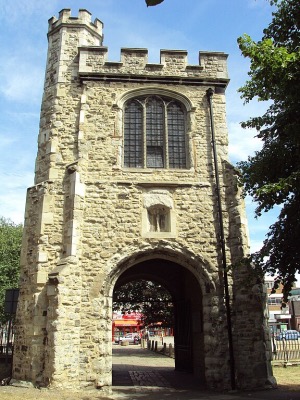
The Curfew Tower. PICTURE: Rept0n1x (licensed under CC BY-SA 3.0)
In the late 900s, St Dunstan, the Archbishop of Canterbury introduced the Rule of St Benedict at the nunnery.
King William the Conqueror stayed here after his coronation while famous abbesses included Mary Becket, the sister of St Thomas Becket, Archbishop of Canterbury, who was given the title in 1173 in reparation for the murder of her brother, as well as several royals including Queen Maud, wife of King Henry I, and Matilda, wife of King Stephen.
The nunnery gained wealth and prestige but this suffered somewhat as a result of floods in 1377 with some 720 acres of land permanently lost. It nonetheless remained one of the wealthiest in England and it’s said the abbess had precedence over all other abbesses in the country.
After the abbey was dissolved, some of the building materials were reused elsewhere and the site was later used as a farm and quarry.
Most of the buildings were demolished – today only the Curfew Tower, which dates from around 1460, remains. The Grade II*-listed tower contains the Chapel of the Holy Rood and now serves at the gateway to the nearby St Margaret’s Church.
Building footings also remain buried under the ground in what is known today as Abbey Green (the layout is marked today by modern additions). There’s a model of how the abbey once appeared inside the gateway.
Gardens at Hampton Court Palace. PICTURE: edwin.11 (licensed under CC BY 2.0)
• The Lindt Gold Bunny hunt returns to Hampton Court Palace this Saturday with families once again invited to search the gardens for those elusive Gold Bunny statues. Each statue offers a chance to match the names of influential characters from Hampton Court Palace’s history to the distinctive red ribbons and a small Lindt bunny chocolate awaits those who succeed in finding the bunnies. Visitors will also have the chance to encounter a selection of the characters roaming the palace over the Easter period. The Gold Bunny hunt is included in general admission. Until 14th March. For more, see www.hrp.org.uk/hampton-court-palace/whats-on/easter-lindt-gold-bunny-hunt/.
• Rare vintage prints by two of art history’s most influential photographers – Francesca Woodman (1958-1981) and Julia Margaret Cameron (1815-1879) – go on show at the National Portrait Gallery today.Francesca Woodman and Julia Margaret Cameron: Portraits to Dream In showcases more than 160 rare vintage prints including 97 by Woodman and 71 by Cameron as well as artist’s books by Woodman which have never been exhibited before in the UK. Key works include Cameron’s self-declared “first success” – a portrait of Annie Wilhemina Philpot taken in 1864, Woodman’s Self-portrait at thirteen, taken during a summer holiday in Italy in 1972, images from Woodman’s Angel series and Cameron’s ethereal portraits of actor Ellen Terry taken in 1864. Also featured are Woodman’s Caryatid pieces and Cameron’s portraits of her niece and favorite model Julia Jackson, Alice Liddell as the goddess Pomona, a portrait of John Frederick William Herschel called The Astronomer (1867), and those of her frequent muses, May Prinsep and Mary Ann Hillier. Runs until 16th June. Admission charge applies. For more, see www.npg.org.uk.
• A new collaboration with the Royal College of Music blends music with spring blooms at Kew Gardens.Sounds of Blossom: Awaken your senses, the first ever spring festival to be held at the gardens, features six bespoke commissions that celebrate Kew’s unique landscape in the spring emerging from locations such as Cherry Walk, Asano Avenue and the Japanese Landscape. And on weekends during the festival, visitors can enjoy live musical performances from the Royal College of Music as they showcase a varied repertoire from classical favourites to jazz melodies. Included in general admission. Runs until 14th April. For more, see www.kew.org/kew-gardens/whats-on/sounds-of-blossom.
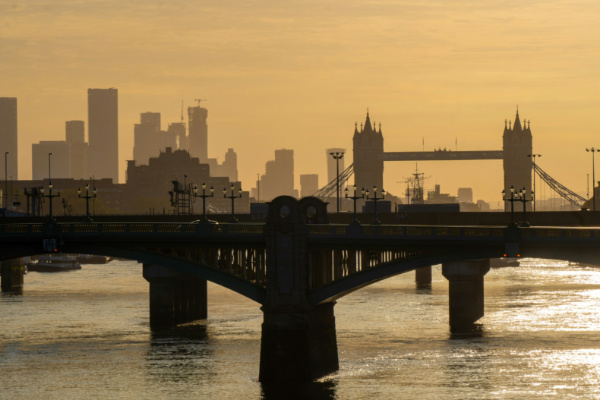
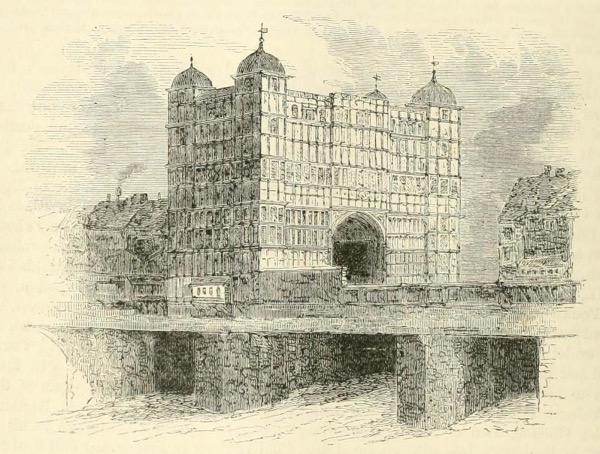
Once located at the southern end of London Bridge, Nonsuch House is the earliest documented prefabricated building.
Nonsuch House as seen in ‘Old and New London, Illustrated’ (1873). PICTURE: Via Wikipedia
Originally constructed in what is now The Netherlands, it was shipped to London in pieces – each individually marked – in 1578 with the reassembly completed the following year.
The four storey building, which was said to have been constructed using wooden pegs and no nails, featured an arched tunnel through the middle through which bridge traffic would pass.
The main facade faced toward Southwark and there were towers at each of the four corners, topped with onion domes. The east and west sides of the building, which protruded beyond the bridge out over the Thames were elaborately carved.
The northern facade of the building abutted other properties while the southern side had a clear space in front over which a drawbridge is believed to have been located (it could be raised to allow larger ships through).
The name may have referenced King Henry VIII’s Nonsuch Palace, located near Ewell in Surrey, and was said to refer to the fact there was no such building as splendid.
The property was demolished along with the other buildings on the bridge in about 1757.
A scene from the Untold Lives exhibition at Kensington Palace. PICTURE: Courtesy of Historic Royal Palaces.
• The “forgotten” stories of those who worked behind the scenes at London’s royal palaces are the subject of a new exhibition at Kensington Palace.Untold Lives: A Palace at Work shines a spotlight on those working in various roles at the palace between 1660 and 1830 – everyone from pages and cooks to wetnurses and seamstresses. Among the items on display is an apron worn by Queen Charlotte’s Wardrobe Maid, Ann Elizabeth Thielcke, a newly conserved portrait depicting a young Black attendant standing by King William III and holding his armour, and a specially commissioned photographic piece by Peter Braithwaite which reimagines figures from the Kensington Palace’s Kings Staircase. Among those whose stories are featured is the “Rat-Killer”, who wore a special rat-embroidered uniform, the Groom of the Stool, who was responsible for looking after the monarch on the toilet, and the Keeper of Ice and Snow, whose job was to cut ice so those at the palace could enjoy cold drinks and iced desserts all year round. The exhibition also explores the unexpected origins of some of those who served at the palaces, such as Abdullah, a wild cat keeper from India, and Mehmet von Könsigstreu, Keeper of the Privy Purse for King George I.. The exhibition, entry to which is included in general admission to the palace, can be seen until 27th October. For more, see https://www.hrp.org.uk/kensington-palace/.
• St Patrick’s Day is being celebrated this Sunday with the annual parade and a free, family-friendly afternoon of entertainment in Trafalgar Square. The procession, which sets off from Hyde Park Corner at noon and winds its way through the city to Whitehall, will include Irish marching bands, dance troupes and pageantry. From 1pm to 6pm, Trafalgar Square will host family concerts, children’s films and youth performances, as well community choirs, schools and dancing with Anna Haugh, International Chef of the Year 2019, running food demos alongside the main stage and children’s workshops. Entry is free. For more, see www.london.gov.uk/events/st-patricks-day-2024.
PICTURE: Esther Dyson (licensed under CC BY-NC 2.0)
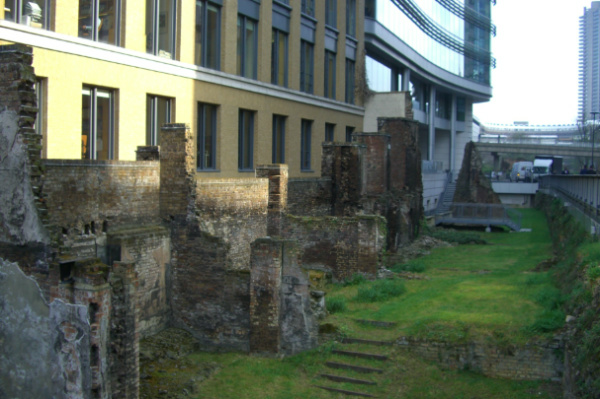
But there are several other stretches of the stone and brick wall left which evoke a sense of the structure it once was and the defensive role it played in protecting Londoners – among them is a substantial section of the wall located in Noble Street on the city’s western side.
The 80 metre long section of Roman and later medieval remains includes two internal turrets on what was the west side of the Roman Cripplegate fort (built between 120 and 150 AD) as well as a substantial bastion located at the southern end of the site.
The highest fragment of the Roman wall can be seen opposite Oat Lane, near the southern end of the site, while the highest section of the wall – which stands some 4.5 metres high and is mostly medieval – can be seen at the northern end of the site.
As well as reflecting the City’s Roman and medieval history, this section of wall also evokes a sense of the horrors of the Blitz.
Projecting eastward on the inside of the wall are party walls from World War II bomb-damaged and later demolished homes which once fronted onto Noble Street.
WHERE: Noble Street, London (nearest Tube stations are Barbican and Bank; WHEN: Anytime; COST: Free.
Murphy and her husband Hugh had both been convicted of “coining” (producing counterfeit coins, then seen as a matter of high treason) at the Old Bailey and sentenced to death on 18th September, 1788.
The following year – on 18th March, 1789 – they and seven other men were executed at Newgate Prison.
All eight of the men were executed by hanging but Murphy was, as the law then stipulated, made to stand on a foot high platform in front of a stake to which she was fastened.
It is believed Murphy, who was reportedly dressed in a striped gown with a black ribbon around her cap, was strangled to death before she was burned. A noose had been placed around her neck and the platform on which she was standing removed a half-an-hour before the faggots were lit about her, leaving her to hang (this had become a somewhat standard practice since the 1650s).
Execution by burning – which was increasingly attracting public opprobrium, not because of its barbarity but because of its impact on local residents offended by the smell and smoke which accompanied such a method of execution – was officially abolished the following year when the Treason Act was passed.
This was apparently on the initiative of Sir Benjamin Hammett, a former sheriff of London and now MP.
• A new photographic exhibition exploring how Underground stations and metro systems provide shelter to citizens during periods of war, both now and in the past, opened at the London Transport Museum in Covent Garden last week.Echoes of the Blitz: Underground shelters in Ukraine and London features 70 images, including historical pictures from the museum’s collection as well as 38 contemporary photographs shot by six renowned, mainly Ukrainian, documentary photographers. The latter include photography showing ordinary Ukrainian citizens sleeping, waiting, cooking, washing clothes, caring for their pets and creating temporary make-shift homes in metro stations of Kyiv and and Kharkiv show alongside black and white archive images of Londoners taking refuge in Tube stations during World War II. The exhibition, which is being run in partnership with Berlin-based journalistic network n-ost, can be seen until spring next year. Admission charge applies. For more, see www.ltmuseum.co.uk.
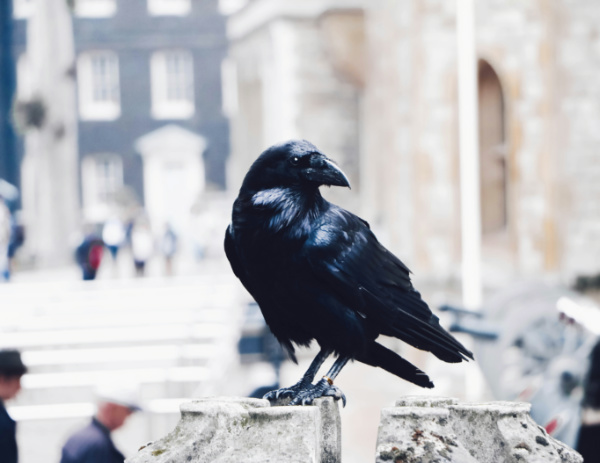
A raven at the Tower of London. PICTURE: Kasturi Roy/Unsplash
• A new Ravenmaster has been appointed at the Tower of London. Yeoman Warder Michael ‘Barney’ Chandler took up the role at the start of this month, 15 years after he first became a Yeoman Warder at the Tower. The Ravenmaster oversees a team of four responsible for the care of the Tower’s seven ravens which legend says must remain at the Tower to ensure its protection. The legend apparently goes back to at least the reign of King Charles II – when the King’s astronomer John Flamsteed complained that the resident ravens were impeding his work at the Tower and requested their removal, the King was told that if the ravens left the Tower then the Kingdom would fall (and so they remained). While the Yeoman Warders have longed cared for the ravens, the post of Ravenmaster was only created in the past 50 years and was first held by Yeoman Warder Jack Wilmington. Yeoman Warder Chandler, who became the 387th Yeoman Warder at the Tower when he was appointed in March, 2009, is only the sixth person to hold the office. For more, see www.hrp.org.uk/tower-of-london/.
• One of the most popular paintings at the Guildhall Art Gallery is being reinstalled to mark International Women’s Day on Friday. Dante Gabriel Rossetti’s La Ghirlandata has been on loan – first to the Tate Britain and then to the Delaware Art Museum in the US – but is now being returned. The painting dates from 1873 and depicts a ‘garlanded woman’ playing an arpanetta and looking directly at the viewer. The muse for the woman is said to have been the actor and model, Alexa Wilding, while the two ‘angels’ in the top corners were posed by William and Jane Morris’ youngest daughter, May Morris. The City of London Corporation acquired the oil on canvas work in 1927. On Saturday, free family activities will be held at the gallery to mark the work’s return. For more, see www.thecityofldn.com/la-ghirlandata.







 Exploring London