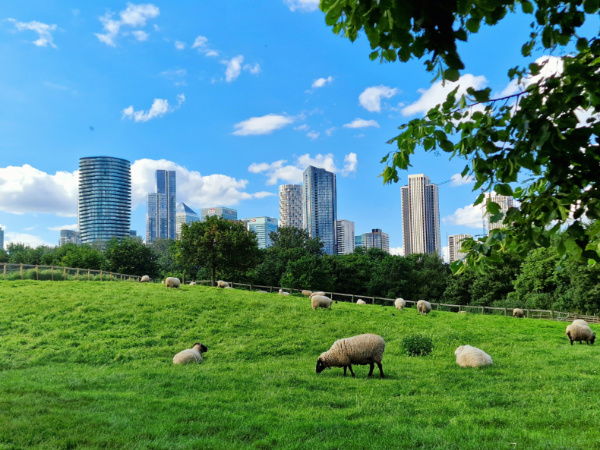
Established in the 1970s, Mudchute Farm and Park – at 32 acres – is one of the largest urban farms in Europe and is home to more than 100 animals including, as well as these sheep, pigs, goats, cows, ducks, geese, chickens, rabbits, and llamas. For more, see www.mudchute.org.
• Members of the public are invited to view a shortlist of ideas for the proposed Memorial to Victims of Transatlantic Slavery to be located in West India Quay. Mayor of London Sadiq Khan pledged £500,000 to fund the memorial which will be the first of its kind in the UK. Short-listed works include Alberta Whittle”s Echoes from beneath the deep and in between the canes (a Caribbean-style pavilion alongside a sugarcane field and cowrie shells which are synonymous with the trade in enslaved people); Zak Ové’s Nana Buluku (an 11 metre tall and richly decorated representation of an African Queen, Nana Buluku); Grada Kilomba’sArchaeology of Contemplation (this uses the image of a boat as a metaphor of remembrance, remembering those who were transported as cargo by the British and other nations); Helen Cammock’sRipple (a large-scale, circular stone structure with six discoverable engraved texts in West African wood); Hew Locke’sMemorial for the victims of the transatlantic slave trade (bronze sculptures of boys and girls carrying buildings which were built in London from money earned by the trade in enslaved people); and, Khaleb Brooks – The Wake(a large scale cowrie shell which represents the perseverance, prosperity and beauty rooted in African and African diasporic heritage). An online exhibition of the shortlisted work is available to view on https://www.london.gov.uk/transatlantic-slavery-memorial and the public is invited to give their feedback.
• Winning entries from the Royal Parks’ photographic competition Creating Spaces for Life can be seen online. Take a gander, which features four goslings under the protective wing of a parent, won the competition which invited visitors to photograph the new life emerging in the eight Royal Parks during the springtime. Other entries among the winners included a swan taking flight, a silhouetted coot appearing to walk on water and a common blue butterfly pictured in the spring sunshine. To see the winning images, head to www.royalparks.org.uk/photography-competition-creating-spaces-for-life.
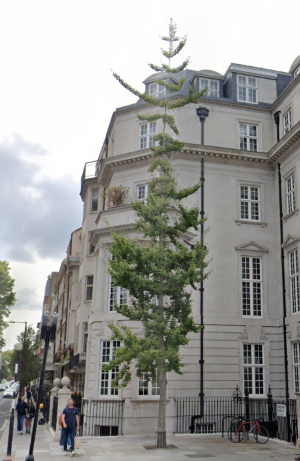
Nations, including the UK, have just marked the 80th anniversary of the D-Day landings in Normandy at a range of locations in France and England. But did you know London has its own “D-Day tree”?
The tree, a Ginkgo biloba or Maidenhair tree, is located outside number 22 in Grosvenor Square in Mayfair (on the corner with Upper Brooks Street). It was planted in 1994 to mark the 50th anniversary of the D-Day landings.
As well as the tree itself, the landings are commemorated with plaques around the base which provide the date of the landings and its code-name, Operation Overlord.
The location apparently relates to 20 Grosvenor Square being, for a time, the headquarters of Dwight D Eisenhower, Supreme Commander of the Allied Expeditionary Force launched on D-Day. There’s a plaque on the building commemorating his tenure.
In fact, the number of Americans working in the square – at locations including the US Embassy – led to it being known colloquially as ‘Eisenhower Platz’).
The tree was planted by the City of Westminster.
Note: There seems to be some conflicting information, not the least on a plaque in Bushy Park about Eisenhower’s connections with Grosvenor Square and Norfolk House in St James’s Square. We’ll be investigating further to clarify.
Members of the Household Division in London rehearse for the King’s Birthday Parade, known as Trooping the Colour. The Colonel’s Review is held one week before and saw some 250 musicians, 20 pipers, 240 military working horses, and almost 1,000 dual role soldiers of the British Army’s Household Division run through their paces on Saturday. Trooping the Colour will take place on 15th June.
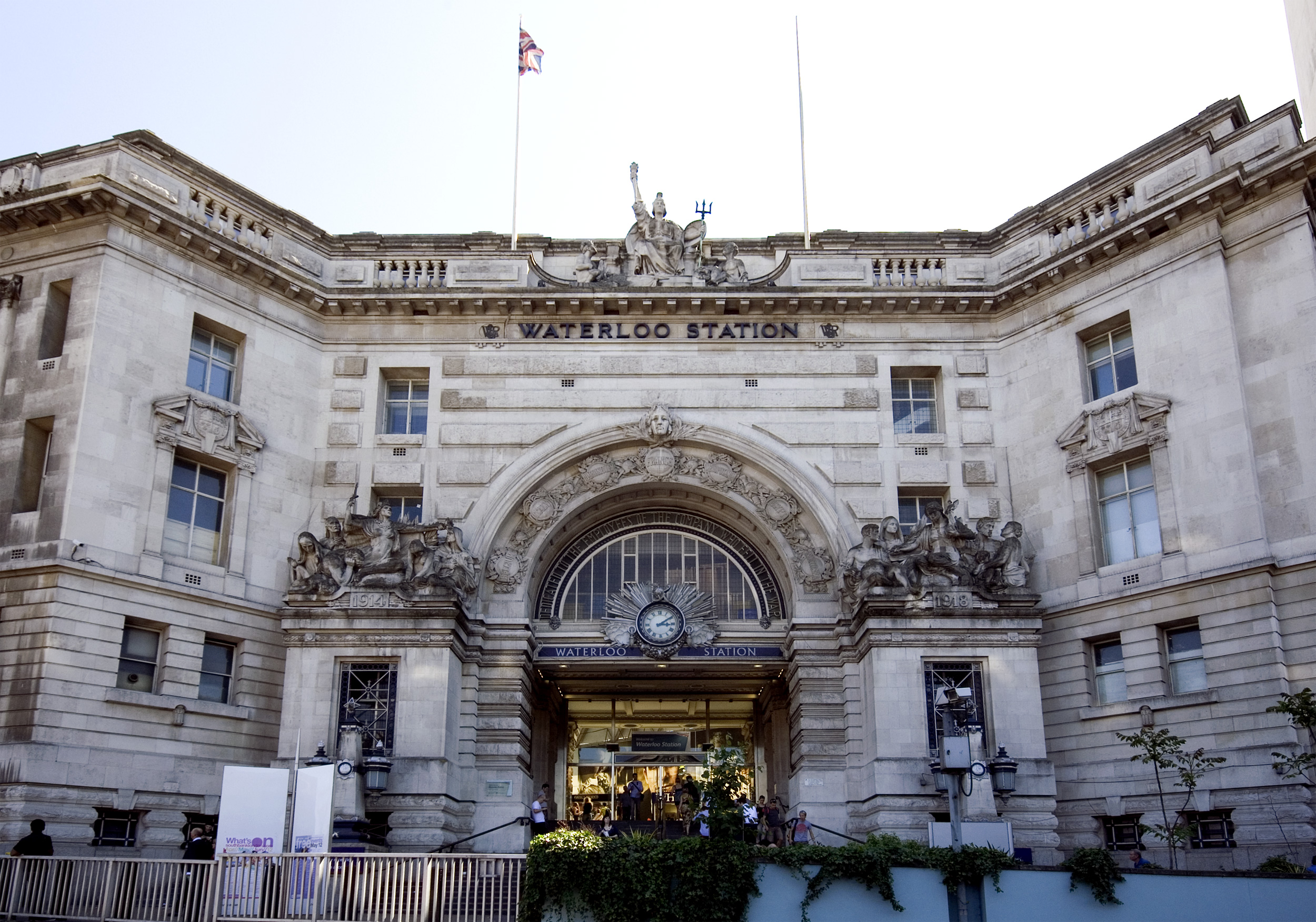
Sitting over the main entrance to Waterloo Station is a Victory Arch which commemorates railway personnel who died in World War I and II.
There are several plaques located at the top of the steps under the arch commemorating those who died in the conflicts and among them, particularly notable this week as the world marks the 80th anniversary of D-Day, is one commemorating those who died in the Normandy landings.
The plaque was installed on the 50th anniversary of the landings – 6th June, 1994.
The arch was built as part of a station rebuild in the first couple of decades of the 20th century and added to the design following World War I. The new station was completed in 1922.
The now Grade II-listed memorial, the work of sculptor Charles Whiffen, features two sculptural groups located on either side – one dedicated to Bellona and dated 1914 and the other dedicated to Peace and dated 1918.
Set around a glazed arch are the names of countries where key battles were fought in the conflict and at the centre is a clock set within in a sunburst. Sitting above the arch is a depiction of Britannia holding aloft the torch of liberty.
As well as the D-Day plaque under the arch, a Roll of Honour commemorates the 585 London and South Western Railway employees who lost their lives in World War I. There is also a plaque commemorating the 626 men of the Southern Railway who died in World War II.
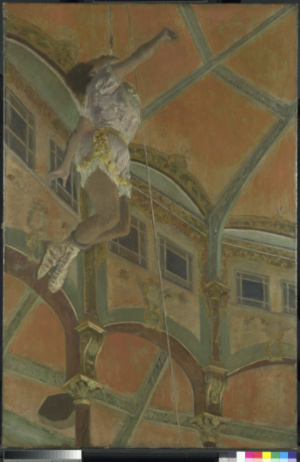
• Edgar Degas’ Miss La La at the Cirque Fernando (1879) takes centre stage in a new free exhibition at The National Gallery. Part of the free ‘Discover’ series of displays, Discover Degas & Miss La La takes a close look at the painting and reveals new information about the sitter, circus artist Miss La La, or Anna Albertine Olga Brown (1858‒1945). The display features new material, from rare, hitherto untraced drawings of her by Degas and entirely unpublished photographic portraits. In the Sunley Room until 1st September. For more, see www.nationalgallery.org.uk.
• Daily life at the Old Royal Naval College has been captured in a series of photographic images now on show at the Greenwich institution.A Year in the Life: People and places of the Old Royal Naval College features 12 images snapped by award-winning photographer Hugh Fox over the past 12 months and includes some portraits of staff show alongside short interviews. Visitors are encouraged to bring their own headphones to better experience the audio-visual display in the Ripley Tunnel. Free to attend, the display can be seen until 1st September. For more, see https://ornc.org/whats-on/.
Send information for inclusion to exploringlondon@gmail.com.
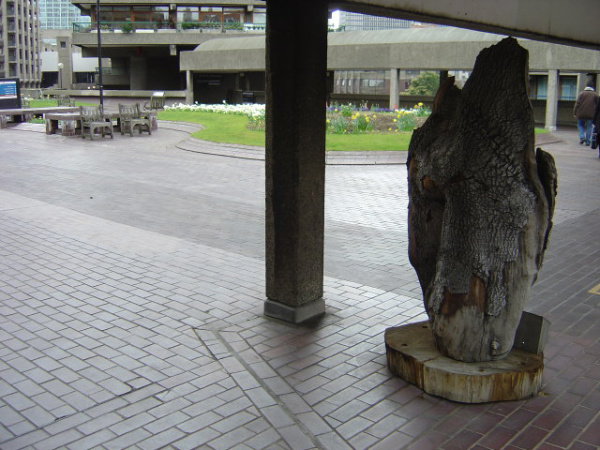
Standing on a Barbican walkway is the remnant of a tree believed to be at least 500-years-old which fell during a storm January, 1990.
The now hollowed-out stub of the beech tree (Fagus Sylvatica) had previously been located in the woodland known as Burnham Beeches, in Buckinghamshire – a woodland which was purchased by the City of London Corporation in 1880.
But what apparently sets this tree out from the others at Burnham Beeches is that it is believed famed German composer Felix Mendelssohn Bartholdy (1808-1847) used to sit under its then leafy branches while staying nearby during his several visits to England.
He is said to have done so to gain inspiration for his compositions and among the works he is said to have composed while here is some “incidental music” for A Midsummer Night’s Dream (although it has been suggested this might not actually be the exact tree under which he sat).
The tree and its plaque were installed in 1993 by the Barbican Horticultural Society and unveiled by conductor and composer Carl Davis.
There is now a replacement “Mendelssohn’s Tree” in Burnham Beeches which was planted in 2005.
WHERE: Barbican, off Aldersgate St (nearest Tube station is Barbican); WHEN: Anytime; COST: Free; WEBSITE: N/A.
A ring-tailed lemur who famously once lived in Eltham Palace, Mah-Jongg was the much-indulged pet of rich-listers Stephen and Virginia Courtauld during the interwar period.
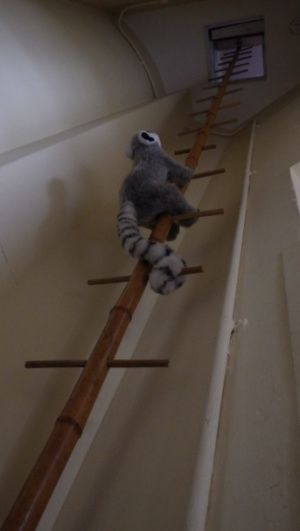
A replica of Mah-Jongg climbs his bamboo ladder at Eltham Palace. PICTURE: BEV Norton (licensed under CC-BY-NC-ND 2.0)
The couple purchased the lemur through Harrod’s then pet department soon after their marriage in 1923. He was immediately christened Mah-Jongg but commonly referred to as “Jongy”.
As well as residing with them in their Grosvenor Square, Mayfair, residence, the lemur also travelled with the Courtaulds.
This included on their luxurious motor yacht, the Virginia, on which he had a specially designed deck chair to lounge in (although Jongy, who had a reputation for being a bit nippy at times, is said to have disgraced himself at a farewell lunch for the British Arctic Air Route Expedition, of which Stephen was a sponsor, when he bit the expedition’s wireless operator, Percy Lemon, and severed an artery; it took Lemon three months to recover).
When the Courtaulds bought Eltham Palace in 1933, Mah-Jongg’s image was incorporated into the building including in a mural in the billiard room and in wooden bosses carved in his likeness in the Great Hall.
Mah-Jongg also had specially designed living quarters on the first floor with a trapdoor opening to a bamboo ladder that led down to the Flower Room on the ground floor. His cage was decorated with Madagascan rainforests by Gertrude Whinfield.
Mah-Jongg died in 1938. A memorial to him was originally installed at Eltham Palace but is now located at the Courthauld’s last home, a replica French villa called La Rochelle, in what is now Zimbabwe.
He’s also famously seen in Leonard Campbell Taylor’s 1934 portrait of the Courthaulds in the music room of their Grosvenor Square home.
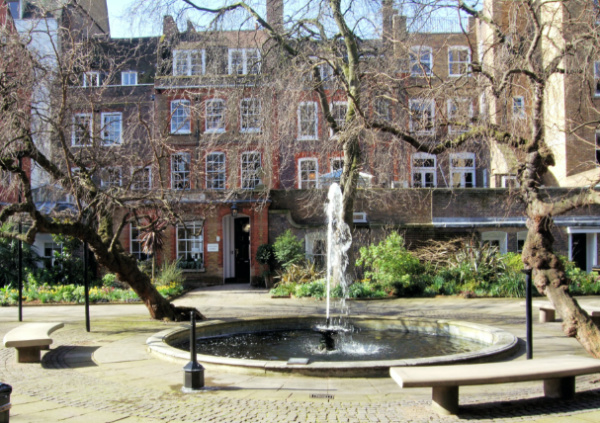
The two gnarled mulberry trees on either side of the fountain. PICTURE: Jim Linwood (licensed under CC BY 2.0)
While there’s been gardens here dating back possibly as far as the middle of the 12th century when the Templars established a preceptory here, these two trees have a more recent historic (and royal) link.
The gnarled black mulberrys (Morus nigra) in the Fountain Court were planted here on 20th June, 1887, to commemorate the Golden Jubilee of Queen Victoria.
There were actually four mulberry trees planted to mark the occasion – which was celebrated with a grand dinner in the nearby Middle Temple Hall – but these two trees are the only survivors, the other two having been removed in the 1970s.
Postcard showing the Empire Stadium. PICTURE: Via Wikipedia/Public Domain
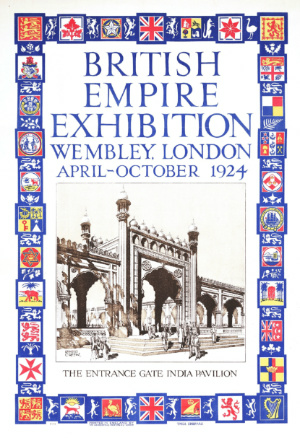
It’s 100 years ago this year that the British Empire Exhibition was held in Wembley Park.
Located on a more than 200 acre site, the exhibition was designed to showcase the diversity and reach of the empire. It ran for two six-month long summer seasons – first opening on 23rd April, 1924, and running until 1st November that year and then reopening on 9th May, 1925, and running until 1st October.
The opening ceremony, which took place on St George’s Day, was attended by King George V and Queen Mary, and the event, in a first for a monarch, was broadcast on BBC radio.
The exhibition, which cost £12 million and attracted some 27 million visitors, featured what was said to be the largest sports arena in the world – Empire Stadium (later known as Wembley Stadium) – as well as four main pavilions dedicated to industry, engineering, the arts and the government, and a series of pavilions for 56 of the empire’s 58 territories as well as some commercial pavilions.
The latter included an Indian pavilion modelled on Jama Masjid in Delhi and the Taj Mahal in Agra, a West African pavilion designed to look like an Arab fort, a Burmese pavilion designed to look like a temple and a Maltese pavilion designed as a fortress with the entrance resembling the famed Mdina Gate.
The Empire Stadium hosted events including military tattoos and Wild West rodeos while other attractions included a lake, a 47 acre fairground, a garden, restaurants and a working replica coal mine.
Star attractions included a replica of King Tutankhamen’s tomb (housed in the fairground), a working model of Niagara Falls and a full-sized sculpture of the Prince of Wales (later Edward VIII) made of butter (both in the Canadian pavilion), a 16 foot diameter ball of wool (Australian pavilion) and dodgem cars (also in the funfair). Queen Mary’s Dollhouse – now housed at Windsor – was designed by Sir Edwin Lutyens and served as a miniature showcase of the finest goods of the period.
Reinforced concrete was the main building material used in its construction, earning it the title of the first “concrete city”. The streets of the exhibition, meanwhile, were named by Rudyard Kipling.
The Malta Pavilion entrance. PICTURE: Wikipedia/Public Domain
Wembley Park Tube station, which had first opened in 1893, was rebuilt for the event and a new station – Exhibition Station (Wembley) added (it was officially closed in 1969).
While many of the buildings were dismantled after the exhibition, some survived for decades afterwards including, of course, the Empire Stadium which became Wembley Stadium and was the home of English football until replaced in 2003.
• The City of London has unveiled a new blue plaque commemorating the Royal National Lifeboat Institution which is this year marking its 200th anniversary. The plaque is on the Furniture Makers’ Hall in Austin Friars which is where the organisation has its first headquarters from 1824 to 1826. The plaque was unveiled by the Lord Mayor of London, Professor Michael Mainelli. The RNLI, which today operates 238 lifeboat stations in the UK and Ireland including four on the River Thames, was founded by Sir William Hillary in the City of London Tavern in Bishopsgate on 4th March, 1824, and early meetings were held at various addresses until it moved into 12 Austin Friars. Meanwhile, ‘Ian Visits’ reports that a new plaque has also been installed at Limehouse Basin to commemorate Lifbåt 416 which was built there by Forrestt & Son’s boatyard in 1868 and sent as a gift to the King of Sweden, Karl XV. The Lifbåt 416, which has been restored, returned to Limehouse Basin this week after attending RNLI commemorations in Poole, Dorset (where it was the oldest lifeboat to take part in a mile-long flotilla).
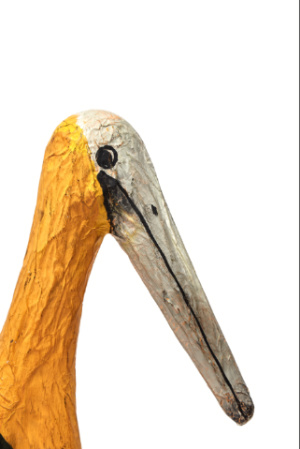
Hargila army papier-mache headdress close up. PICTURE: Courtesy of Natural History Museum
• The “weird and wonderful” ways birds have adapted to survive are celebrated in a new exhibition at the Natural History Museum. Birds: Brilliant and Bizarre, which opens at the South Kensington institution on Friday, has been created in partnership with the Royal Society for the Protection of Birds and features installations and hands-on exhibits which allow visitors to feel how fast a hummingbird’s heart beats when in flight, smell the strange oil one bird uses to protect its eggs and listen to the sound of a dawn chorus of birds in the year 2050. Objects on show include the ‘Wonderchicken’ – the oldest known fossil of a modern bird, a replica of a stork that flew across the world from the African continent with a spear lodged in its neck, and a headdress of the ‘Hargila army’ (pictured), a group of women in the Indian state of Assam who work to protect one of the world’s rarest storks. Admission charge applies. Runs until 5th January. For more, see www.nhm.ac.uk/visit/exhibitions/birds-brilliant-bizarre.html.
• A walk-through photographic exhibition featuring some of the most iconic photos of Princess Diana opens on Saturday.Princess Diana: Accredited Access features 75 life-sized photographs by her official royal photographer, Anwar Hussein, and his two sons – Samir and Zak – which include behind the scenes access. The exhibition at the Dockside Vaults, St Katharine Docks, runs until 2nd September. Admission charge applies. For more, see www.princessdianaexhibit.com.
View of Castletown Road in Barons Court. PICTURE: Courtesy of Google Maps
This district in west London doesn’t have anything to do with any particular baron but rather was named Barons Court by the late 19th century developer Sir William Palliser.
It apparently refers to the Court Baron, a form of manorial court which could be held in medieval times by any Lord of the Manor and is perhaps a nod to nearby Earl’s Court. It’s said by some that it may also be a reference to the Baronscourt estate in County Tyrone, Northern Ireland, where Sir William possibly had connections.
Many of the street names refer to members of the Palliser family or estates and the district, which lies between West Kensington and Hammersmith, features a Tube station which opened in 1905.
Barons Court did suffer bomb damage during World War II.
Landmarks include the London Academy of Music and Dramatic Art (LAMDA), housed in what was formerly a ballet school on Talgarth Road, the Queen’s Club tennis club, and the Margravine or Hammersmith Cemetery, which, laid out by architect George Saunders, opened in 1868.
Danson Mansion and the Charter Oak of Bexley. PICTURE: Brian Toward (Public Domain)
Located in Danson Park in Bexley, south-east London, this tree is another of those in London which has been awarded “Great Tree” status.
Estimated to be around 200-years-old, it was planted in what was originally the grounds of the Danson Mansion Estate.
Danson House, a Palladian villa, was built by Sir John Boyd in 1766 for his second wife Catherine Chapone and designed by Sir Robert Taylor, the architect who also designed the Bank of England.
The Charter Oak of Bexley’s name comes from the charter which changed Bexley from a Urban District Council to the Borough of Bexley. It was presented to the first municipal council by Lord Cornwallis underneath the oak in 1937.
The Charter Oak of Bexley in 2011. PICTURE: Brian Toward (Public Domain)
The oak’s significance is underlined by its presence on the Borough of Bexley’s coat-of-arms.
Visibly deteriorating, in 2017, “revolutionary geo-injector technology” was used to decompact the soil around the tree and feed its roots, successfully extending the tree’s life.
• See a glimpse of London as it was during the Victorian era at a new exhibition opening at the London Metropolitan Archives.Lost Victorian City: a London disappeared features photographs, prints, watercolours and documents depicting buildings, horse-drawn transport, docks and various forms of entertainment along with artists’ views of the capital. Highlights include images taken in 1875 by the Society for Photographing Relics of Old London of the 17th century coaching inn, the Oxford Arms, which was demolished two years later, two images by Philip Henry Delamotte showing the moving of the Crystal Palace from Hyde Park to Sydenham following the Great Exhibition of 1851, and a photograph showing the public disinfects whose job was to remove all textiles after an infectious disease outbreak. The display can be seen at the Clerkenwell-based archives until 5th February next year. For more, see
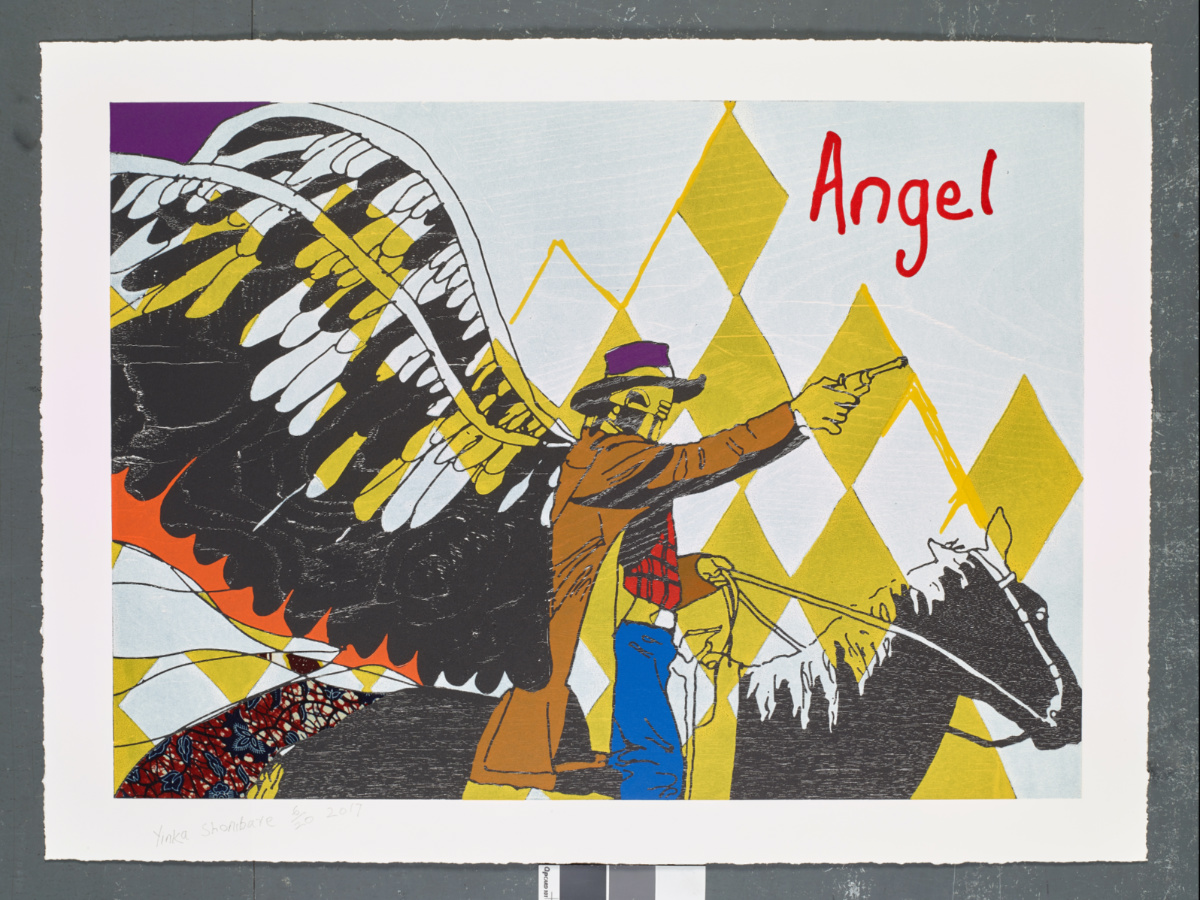
Yinka Shonibare CBE, Cowboy Angel V from the series Cowboy Angels. Colour woodcut and collage of Dutch wax batik fabric. Reproduced by permission of the artist.
• An exhibition has opened featuring works of art acquired by the British Museum over the past two decades including works by David Hockney, Damien Hirst, Julian Opie, Yinka Shonibare and Cornelia Parker. Contemporary collecting: David Hockney to Cornelia Parker features around 100 works acquired since 2001. Many of the works, which span the period from the 1960s onwards, are being exhibited for the first time. Highlights include Hockney’s prints The Marriage (1962) and Henry Seated with Tulips (1976), Parker’s Articles of Glass and Jug Full of Ice from One Day This Glass Will Break (2015), Michael Craig-Martin’s Coathanger, Light bulb and Watch from Drawings (2015); Caroline Walker’s colour lithograph Bathed (2018); Shonibare’s colour woodcuts Cowboy Angel I, II, V (2017) and Joy Gerrard’s Vigil/Protest (Westminster 14th March 2021), a 2023 drawing in Japanese ink. Runs until 29th September in Room 90. Admission is free. For more, see www.britishmuseum.org/david-hockney-cornelia-parker.
Said to be among the oldest still living trees in the City of London, the Cheapside Plane stands in what was once the churchyard of St Peter Cheap.
The church itself was destroyed in the Great Fire of London but how long this leafy tree, which stands more than 70 feet high, has occupied the site remains a matter of some conjecture.
A City of London tree trail puts the age of the tree – which stands at the corner of Wood Street and Cheapside – at 250 years (records held by the City say the tree was originally purchased for sixpence).
Over the years, this landmark tree – which has stood silent witness to everything from the 1854 cholera outbreak to the bombs of the Blitz – has garnered considerable attention appearing in various media, such as the Illustrated London News, and even, so say some, a 1797 poem by William Wordsworth (although some say the poem doesn’t refer to the tree at all).
The tree, which stands behind protective black iron railing, is the only one in the City of London listed among the “Great Trees of London” and planning laws protect it from over-development of the surrounding buildings.
Looking down Whitehall from where the Charing Cross stood today. Locket’s stood on the right. PICTURE: Courtesy of Google Maps.
A famous “ordinary” where meals could be obtained at preset prices, Locket’s was founded by Adam Locket just south of Charing Cross in the 17th century.
A popular meeting place after attending the theatre, the establishment was known for the quality of its food. It was frequented by the well-to-do as well as dramatists like Sir George Etherege (who apparently didn’t pay his bill).
Following Adam Locket’s death in about 1688, he was succeeded by his son Edward who ran it until about 1702. It survived through the reign of Queen Anne but contemporary references – it had been mentioned by writers such as John Vanbrugh and William Congreve – became increasingly scanty and then disappeared altogether after her death in 1714.
Drummond’s Bank later occupied the site where Locket’s had stood.
• A landmark exhibition exploring the final three decades of the life of Renaissance master Michelangelo has opened at the British Museum. Michelangelo: the last decades focuses on how his art and faith evolved and centres on the two metre high Epifania (about 1550–53), which is being displayed for the first time since conservation work on it began in 2018. Showing alongside it is a painting made from it by Michelangelo’s biographer, Ascanio Condivi, as well as preparatory drawings from the Last Judgment, which chart how Michelangelo invented a fresh vision of how the human form would be refashioned at the end of the world, and works created as part of his correspondence with his friends Tommaso de’ Cavalieri and the poet Vittoria Colonna. The latter include The Punishment of Tityus (about 1532) showing an eagle tearing out the liver of a bound naked man which was gifted to Tommaso as moral guidance for the young man. Other highlights include a group of drawings of Christ’s crucifixion which he made during the last 10 years of his life and through which he explored his feelings about mortality, sacrifice, faith, and the prospect of redemption. Runs until 28th July in the Joseph Hotung Great Court Gallery. Admission charge applies. For more, see www.britishmuseum.org/michelangelo.
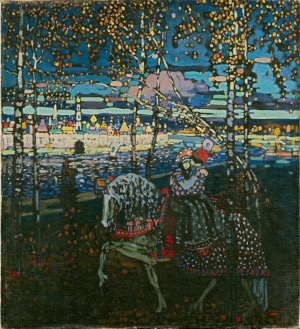
• A new exhibition has opened celebrating the expressionists’ radical experimentations with form, colour, sound and performance at the Tate Modern. Expressionists: Kandinsky, Münter and the Blue Rider features masterpieces from the Lenbachhaus in Munich and includes some works never previously seen in the UK. Among the artists whose work is on display are everyone from renowned artists like Wassily Kandinsky, Gabriele Münter, Franz Marc and Paul Klee, through to lesser known figures like Wladimir Burliuk and Maria Franck-Marc. Highlights include Marianne Werefkin’s Self-Portrait (c1910), Münter’s Listening (Portrait of Jawlensky) (1909), Erma Bossi’s Circus (1909), Kandinsky’s Impression III (Concert) (1911), Franz-Marc’s Deer in the Snow II (1911), Klee’s Legend of the Swamp (1919), and a selection of photographs from the Masterpieces of Muhammadan Art exhibition staged in Munich in 1910. Runs until 20th October. Admission charge applies. For more, see tate.org.uk.
• On Now – Dinosaur rEvolution.This exhibition at the Horniman Museum in Forest Hill highlights discoveries from recent decades which have changed the way we envisage dinosaurs – not all as scaly green reptiles but many with an array of colours, feathers, quills and spikes. At the centre of the display are five large animatronic dinosaur models – including a seven metre-long Tyrannosaurus rex – as well as well as artworks by artist and exhibition curator Luis V Rey. The exhibition also features fossil casts including the horned skull of a Diabloceratops, the claw of a Therizinosaurus, and skeletons of Velociraptor and Compsognathus – a chicken-sized, feathered dinosaur. Runs until 3rd November. Admission charge applies. For more, see www.horniman.ac.uk.