This Week in London – Michelangelo’s last decades; expressionists on show; and, Dinosaur rEvolution…

Michelangelo Buonarro (1475–1564) – study for the ‘Last Judgment’ (Black chalk on paper, about 1534–36); the fall of Phaeton (Black chalk, over stylus underdrawing, on paper, about 1533); and, Christ on the Cross between the Virgin and St John (Black chalk and white lead on paper, about 1555–64.) All images © The Trustees of the British Museum

• A landmark exhibition exploring the final three decades of the life of Renaissance master Michelangelo has opened at the British Museum. Michelangelo: the last decades focuses on how his art and faith evolved and centres on the two metre high Epifania (about 1550–53), which is being displayed for the first time since conservation work on it began in 2018. Showing alongside it is a painting made from it by Michelangelo’s biographer, Ascanio Condivi, as well as preparatory drawings from the Last Judgment, which chart how Michelangelo invented a fresh vision of how the human form would be refashioned at the end of the world, and works created as part of his correspondence with his friends Tommaso de’ Cavalieri and the poet Vittoria Colonna. The latter include The Punishment of Tityus (about 1532) showing an eagle tearing out the liver of a bound naked man which was gifted to Tommaso as moral guidance for the young man. Other highlights include a group of drawings of Christ’s crucifixion which he made during the last 10 years of his life and through which he explored his feelings about mortality, sacrifice, faith, and the prospect of redemption. Runs until 28th July in the Joseph Hotung Great Court Gallery. Admission charge applies. For more, see www.britishmuseum.org/michelangelo.
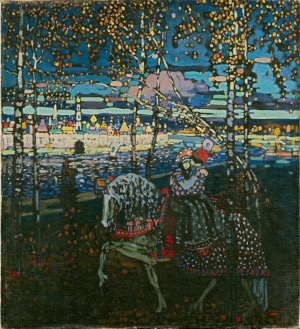
Wassily Kandinsky, ‘Riding Couple’, 1906-1907, Lenbachhaus Munich, Donation of Gabriele Münter, 1957

• A new exhibition has opened celebrating the expressionists’ radical experimentations with form, colour, sound and performance at the Tate Modern. Expressionists: Kandinsky, Münter and the Blue Rider features masterpieces from the Lenbachhaus in Munich and includes some works never previously seen in the UK. Among the artists whose work is on display are everyone from renowned artists like Wassily Kandinsky, Gabriele Münter, Franz Marc and Paul Klee, through to lesser known figures like Wladimir Burliuk and Maria Franck-Marc. Highlights include Marianne Werefkin’s Self-Portrait (c1910), Münter’s Listening (Portrait of Jawlensky) (1909), Erma Bossi’s Circus (1909), Kandinsky’s Impression III (Concert) (1911), Franz-Marc’s Deer in the Snow II (1911), Klee’s Legend of the Swamp (1919), and a selection of photographs from the Masterpieces of Muhammadan Art exhibition staged in Munich in 1910. Runs until 20th October. Admission charge applies. For more, see tate.org.uk.

• On Now – Dinosaur rEvolution. This exhibition at the Horniman Museum in Forest Hill highlights discoveries from recent decades which have changed the way we envisage dinosaurs – not all as scaly green reptiles but many with an array of colours, feathers, quills and spikes. At the centre of the display are five large animatronic dinosaur models – including a seven metre-long Tyrannosaurus rex – as well as well as artworks by artist and exhibition curator Luis V Rey. The exhibition also features fossil casts including the horned skull of a Diabloceratops, the claw of a Therizinosaurus, and skeletons of Velociraptor and Compsognathus – a chicken-sized, feathered dinosaur. Runs until 3rd November. Admission charge applies. For more, see www.horniman.ac.uk.

Send all inclusions to exploringlondon@gmail.com.
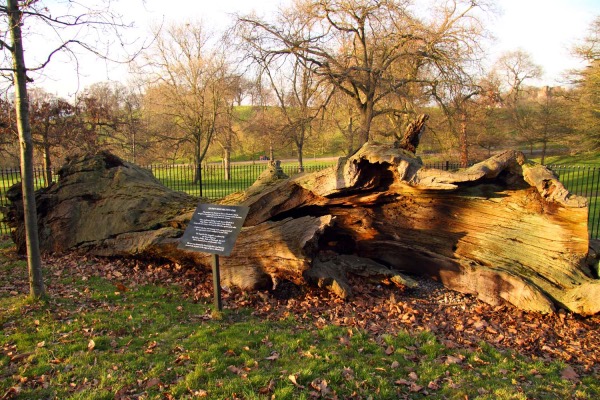
10 significant (and historic) London trees…1. Queen Elizabeth’s Oak, Greenwich…

Spring is upon us, so we thought it an appropriate time to consider some of London’s greatest natural assets – its trees. But, as well as being significant for their environmental impact, each of these trees (or, in some cases, the remains of them), are significant for historic reasons (we’ve previously mentioned a couple including what’s believed to be the oldest tree and the unusual – and sadly now deceased – Hardy Tree).

PICTURE: Steve Daniels (licensed under CC BY-SA 2.0)

First up, it’s the tree known as Queen Elizabeth’s Oak in Greenwich. Thought to date from possibly as far back as the late 13th century, this tree survived until the 19th century before its carcass finally fell to the ground during a storm in 1991. It has lain in Greenwich Park ever since.

The tree, which is located at the end of what is now Lover’s Walk close to the Maze Hill Gate, was located in the grounds of Greenwich Palace (also known as the Palace of Placentia) and was there when King Henry VIII resided at the palace.

In fact, it’s said that he and Anne Boleyn danced around the oak while courting, and (and here’s where the name comes from) that Elizabeth, their daughter (and later Queen Elizabeth I), picnicked under its canopy (some accounts suggest she actually picnicked in the tree’s hollow – but still then upright – trunk).

Following the creation of what is now Greenwich Park, the hollow tree was apparently used as a prison for those caught illicitly on the grounds. They were secured behind a heavy wooden door fitted to the trunk (a park keeper’s lodge was built nearby in the 17th century; it was demolished in the 1850s).

The tree, one of 3,000 in the park, had died in the 19th century and was reduced to an eight metre high stump, partly supported by ivy, when it was blown over by the storm in June, 1991.

A replacement oak, which was donated by the Greenwich Historical Society was planted nearby by the Duke of Edinburgh on 3rd December, 1992, to mark Queen Elizabeth II’s 40 years on the throne.

A ring analysis carried out on the tree found in 2014 it dated back to at least 1569 but with the core missing a precise date of germination couldn’t be found. Estimates, however, place the date of germination to the last 13th or early 14th century. The analysis placed the tree’s death to between 1827 and 1842.

The tree is marked with a plaque and both it and the new tree are surrounded by an iron railing.

WHERE: Queen Elizabeth Oak, Greenwich Park (nearest DLR station is Greenwich); WHEN: 6am to 8pm daily; COST: Free; WEBSITE: https://www.royalparks.org.uk/visit/parks/greenwich-park.

This is an expanded version of a post first made in 2017.

LondonLife – Holland Park walkers…

PICTURE: Ethan/Unsplash

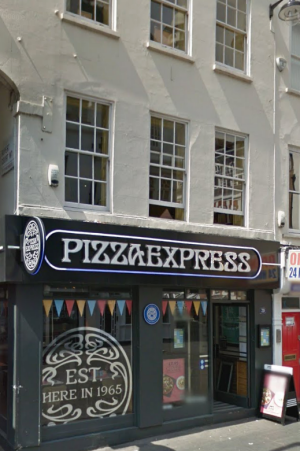
Where (was) London’s oldest…pizzeria?

London’s first Pizza Express in Soho, taken prior to its closure in July, 2014. PICTURE: Google Maps.

While pizza had been available in London restaurants some time before, the first dedicated pizzeria is said to have been the first Pizza Express located in Wardour Street in Soho.

The premises on the corner of Rupert Court and Wardour Street was established by Peter Boizot, who has reportedly first discovered pizza while in Italy in the 1940s, and, having witnessed the appearance of pizzerias elsewhere in Europe, decided to bring the concept to London.

Opening its doors on 27th March, 1965, the establishment was modelled on Italian pizzerias. Boizot had partnered with Italian designer, Enzo Apicella, to create an authentic Italian experience which included an open kitchen, simple furnishings and a wine menu (he also brought in a pizza chef from Sicily).

While the concept apparently wasn’t an instant success, it soon did catch on and Pizza Express opened further branches across the city – the first in Coptic Street next to the British Museum in 1967.

Sadly the Wardour Street premises was among dozens that the chain closed during the coronavirus pandemic in 2020.

This Week in London – Caravaggio’s last painting; Hampton Court’s Tulip Festival; and, ‘Beyond the Bassline’….

• Caravaggio’s last painting – the 1610 work known as The Martyrdom of Saint Ursula – has gone on display in the UK for the first time in almost 20 years. The National Gallery is displaying the work – lent by the Intesa Sanpaolo Collection (Gallerie d’Italia – Naples) – alongside another late work by the Italian artist from the gallery own collection – Salome receives the Head of John the Baptist (about 1609–10). The Martyrdom of Saint Ursula, which features a self-portrait of the artist, was only reattributed to Caravaggio in 1980 following the discovery of an archival letter describing its commission. The letter – which is being displayed along with the painting – was sent from Naples, where Caravaggio created the work, to Genoa, where his patron, Marcantonio Doria, lived. Caravaggio died in Porto Ercole on 18th July, 1610, less than two months after finishing the work. He was attempting to return to Rome where he believed he would be pardoned for a 1606 murder at the time. Admission to the display is free. Runs until 21st July. For more, see www.nationalgallery.org.uk.

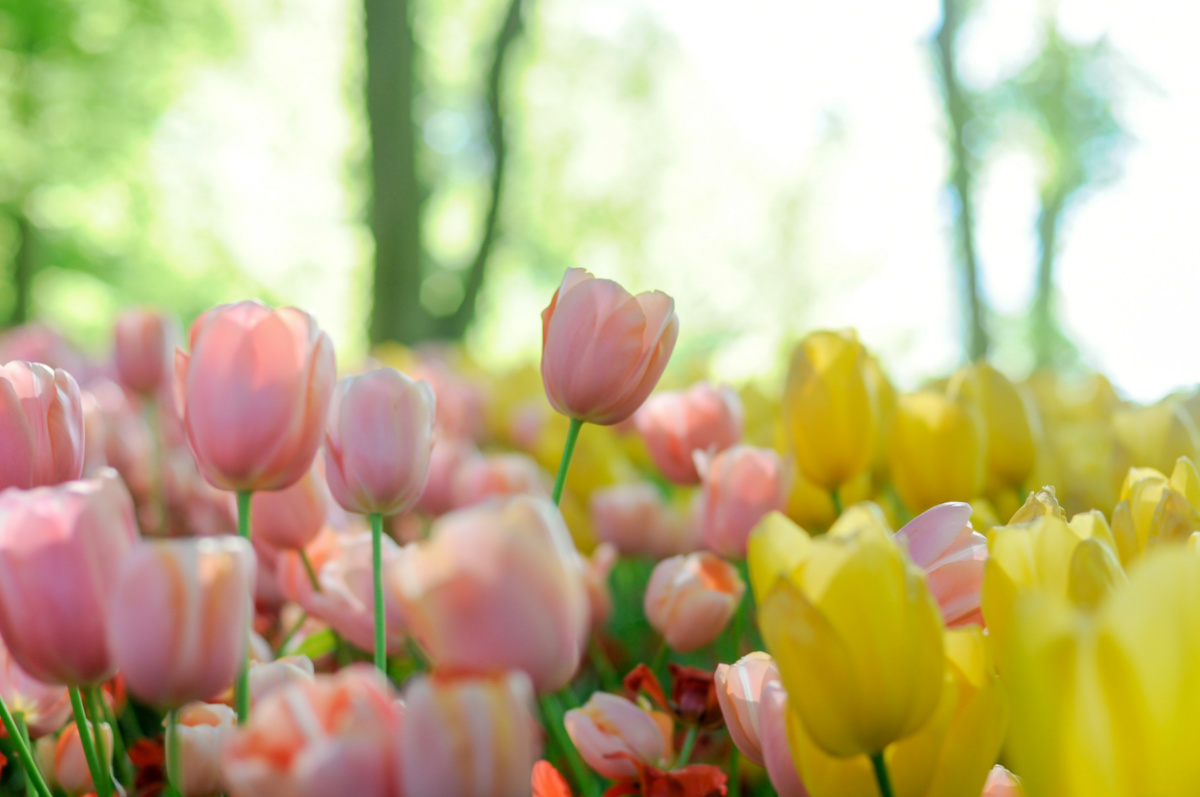
Tulips in the Netherlands. PICTURE: Giu Vicente/Unsplash

• Hampton Court Palace’s Tulip Festival is on again. Displays include thousands of tulips spilling from a Victorian horse cart in the heart of the palace courtyards, giving the appearance of a Dutch flower seller’s cart, ‘floating’ bowls in the Great Fountain, free-style plantings in the kitchen gardens and more than 10,000 tulips in a display in Fountain Court. There are also daily ‘Tulip Talks’ sharing the history of the flower and Queen Mary II, who was responsible for introducing them to Hampton Court. Runs until 6th May (including in palace admission). For more, see www.hrp.org.uk/hampton-court-palace/whats-on/tulip-festival/.

• Five hundred years of Black British music is being celebrated in a new exhibition at the British Library. Beyond the Bassline: 500 Years of Black British Music features soundscapes, artworks and films along with costumes, interactive displays, and of course, music. Highlights among the more than 200 exhibits include letters from 18th-century composer Ignatius Sancho, records by likes of Fela Kuti and Shirley Bassey, a nostalgic video archive of grime’s golden era captured on Risky Roadz DVD, and the equipment that Jamal Edwards used to start SB.TV, theYouTube channel dedicated to Black British music. The display concludes with a multi-screen film installation by South London-based musical movement and curatorial platform Touching Bass. Admission charge applies (with Pay What You Can days on the first Wednesday of each month). Runs until 26th August. For more, see https://beyondthebassline.seetickets.com/timeslots/filter/beyond-the-bassline.

Send all items to exploringlondon@gmail.com

LondonLife – ‘Nature’s Confetti’…

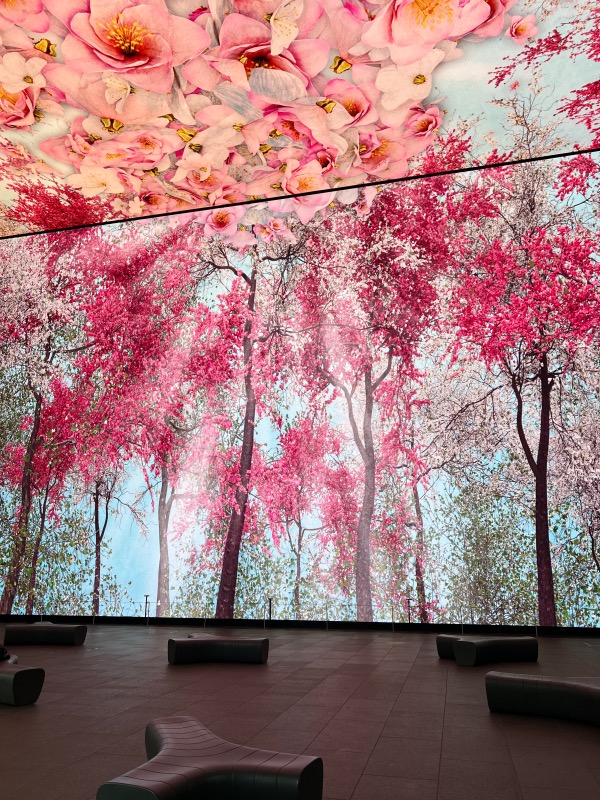
PICTURE: Courtesy of Outernet London

Experience blossoms in all their glory at ‘Nature’s Confetti’ a new installation at Outernet London. Created in partnership with the National Trust as part of its annual “blossom” campaign, this immersive experience in the Now Building at the intersection of Charing Cross and Tottenham Court Roads has been created using shots switching between city vistas and close ups of blossoms accompanied by sound recordings replicating those in nature captured at National Trust properties such as Petworth House and Park in West Sussex. Visitors also have the opportunity to donate to the Trust’s ‘Plant a Tree’ appeal, which will help plant and establish 20 million trees by 2030, four million of which are expected to be blossom varieties. But you’ll have to be quick – Nature’s Confetti only runs until 28th April. Entry is free. For more, see www.outernet.com/news/outernet-and-the-national-trust-launch-natures-confetti-experience.

London pub signs – Horse and Groom, Belgravia…

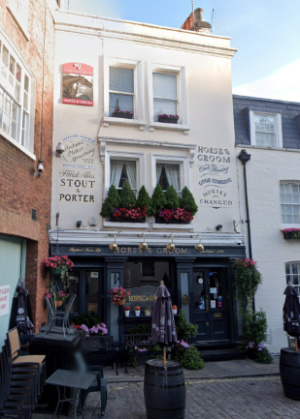
PICTURE: Google Maps

The name of this pub, one assumes, is all about its location.

It’s located on one of Belgravia’s many cobbled mews, the back-streets or courtyards that were traditionally lined by stables and carriage houses located at the back of expansive homes. Hence the pub’s name (a name also associated with its address at 7 Groom Place).

The pub is believed to date from at least as far back as the 1850s and has apparently seen many famous faces over the years including The Beatles and, more recently, Gwyneth Paltrow and Rihanna. It also appeared in the recent Julian Fellowes’ TV drama Belgravia.

For more, see www.horseandgroombelgravia.co.uk.

Treasures of London – Russell Street gas lamps…

One of the lamp-posts in Russell Street, Covent Garden, in 2012. PICTURE: Google Maps

Recently listed as Grade II, these four gas lamps on Russell Street in Westminster were among a series of lamps installed around Covent Garden to mark the beginning of King George V’s reign.

While the columns of the lamps date from 1910, three of the lanterns – described as an ‘Upright Rochester lantern’ and manufactured by William Sugg and Company Limited – are replacements believed to have been installed around 1930. The fourth was installed following a campaign to save Covent Garden from redevelopment in the 1970s.

The newly listed lamp-posts – the first Westminster lamps to be listed in 40 years – are located outside numbers 4-6, 24, 29, and 34-43.

There are currently about 1,300 working gas lamps in London, around 270 of which are in Westminster (and about half of which are listed).

This Week in London – National Gallery prepares for its 200th; Trafalgar Square hosts Eid, St George’s Day celebrations; and, ‘Silent Testimony’ at the National Portrait Gallery…

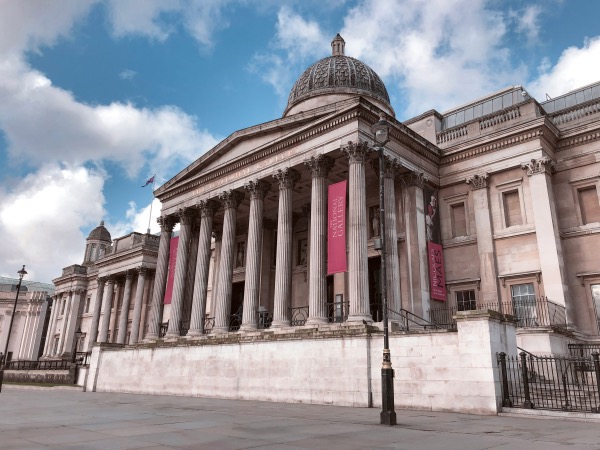
The National Gallery. PICTURE: Lucia Hatalova/Unsplash

• The National Gallery is celebrating its 200th anniversary with festivities kicking off with a special night of celebrations on Friday, 10th May, and continuing over the weekend. In a special Friday night late, Jools Holland is performing in the Rausing Room with friends including Ruby Turner, Louise Marshall, and Sumudu while across the rest of the gallery there will be DJ sets, music from London Contemporary Voices, soundscapes by Anna Phoebe and poetry from Ben Okri. There will also be a celebration of music collaboration past and present in the Future Room and creative workshops offering sculptural postcard making and ‘Renaissance Selfies’ with London Drawing while outside on Trafalgar Square the building’s facade will be illuminated in a light show featuring projections of paintings from the gallery as well as the story of its history. Meanwhile, across the weekend visitors to the gallery will have the chance to join in the making of a creative “birthday day” by contributing their own paper creations. All events are free but booking is advised and tickets to the public open today. For more, see nationalgallery.org.uk/whats-on/big-birthday-weekend-late.

• Trafalgar Square hosts two days of celebrations this weekend with Eid in the Square on Saturday and St George’s Day festivities on Sunday. Eid in the Square runs from noon to 6pm and features creative arts workshops, storytelling and VR experiences with musical performances on the main stage and food stalls from across the world. Among those performing will be Love’s Pilgrim, Raghad Haddad and Raghad Haddad and members of the Orchestra of Syrian Musicians, Muslim Belal and Chahat Mahmood Ali Qawwal and Group. For more, see www.london.gov.uk/Eid-in-the-Square-2024. Meanwhile, St George’s Day, which also runs from noon to 6pm, features a wide range of entertainment, food stalls and music with artists including The Kurfew, Natalie Shay of Busk in London, West End Kids and Snottledogs. Folkdance Remixed will present a mass barn dance while She’s Got Brass, an all-female brass group, Nick Howe and the Stringbeats Trio and Tom Carradine will lead a cockney sing-a-long. Other activities will include an English Pentathlon – events include welly wanging, pancake tossing, human Crufts, bubble Olympics, the art of Morris Dancing and a chance to meet Pearly Kings and Queens. St George and the dragon will be available for selfies. For more, see www.london.gov.uk/st-georges-day-celebrations-trafalgar-square-sunday-21-april. Both events are free to attend.

• A new display revealing stories of loss from The Troubles in Northern Ireland opens at the National Portrait Gallery opens on Monday. Silent Testimony features 18 large-scale portraits by Belfast-born artist Colin Davidson which were painted between 2014 and 2015 and speak to the impact of the conflict on the sitters, their families and friends and the wider community. The paintings were first displayed at the Ulster Museum in Belfast and most recently at Stormont’s Parliament Buildings and the Irish Arts Center in New York. The display in Room 14, level three, is free to see and runs until 23rd February next year. For more, see www.npg.org.uk.

For all inclusions, email exploringlondon@gmail.com.
(More) atmospheric ruins in London…

Further to our recent series on atmospheric ruins in London, here are eight more ruins we’ve previously mentioned that deserve a place on the list:

Lost London – St Dunstan in the East…

Lost London – Winchester Palace

Lost London – Greyfriars…

10 subterranean sites in London – 5. Whitefriars Priory crypt…

Lost London – Billingsgate Roman House and Baths

Roman London – 2. The Temple of Mithras

Roman London – 1. The Roman wall

LondonLife – Nightfall in Kensington High Street…

PICTURE: Ethan/Unsplash

This Week in London – Maharaja Ranjit Singh at the Wallace Collection; Anne Desmet’s Kaleidoscope/London and displaced Ukrainians at the Foundling Museum…

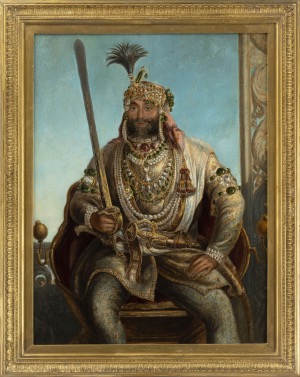
August Schoefft, Maharaja Sher Singh (1807–1843) seated on his father’s golden throne
Lahore, Punjab or Delhi, c 1841–42 © Toor Collection 

• The remarkable life and legacy of Maharaja Ranjit Singh (1780-1839), the founder of the Sikh Empire, is the subject of a new exhibition which opened at the Wallace Collection this week. Ranjit Singh: Sikh, Warrior, King features historic objects from Ranjit Singh’s court, courtiers and family members, including those personally owned by the Maharaja and the most famous of his wives, Maharani Jind Kaur, as well as their son, Maharaja Duleep Singh. Highlights include a fine miniature painting of Ranjit Singh and his favourite, a Golden Throne made by Hafez Muhammad Multani, and a sword richly mounted in gold and gemstones which was thought to belong to the Maharajah. Runs until 20th October at the Manchester Square institution. Admission charge applies. For more, see www.wallacecollection.org/whats-on/events/ranjit-singh-sikh-warrior-king/.

• A “fresh perspective” on London can be seen in a new exhibition by multi-award-winning wood engraver Anne Desmet at the Guildhall Art Gallery. Inspired by looking at a fragmented view of the world through a toy kaleidoscope, Anne Desmet: Kaleidoscope/London features works created by the artist slicing into prints focused on London from her earlier wood-engravings, linocuts and hand-drawn lithographs to make a new series of digital collages. The display features 150 works including 41 London-themed kaleidoscopic prints created exclusively for this exhibition. Among highlights is a complex collage, Fires of London, created using 18 razor-clam shells to present a theme of the many historic fires of London over the last 1,500 years. Admission is ‘pay what you can’. There are an accompanying series of artist-led tours. Runs until 8th September. For more, see www.cityoflondon.gov.uk/events/anne-desmet-kaleidoscopelondon-exhibition.

• Photographs depicting women and children forced to leave their Ukrainian homes following Russia’s invasion is on at the Foundling Museum in Bloomsbury. Polly Braden: Leaving Ukraine features the work of photographer Polly Braden and includes first-hand photographs, personal films and recorded conversations. It focuses on four central stories – that of three school friends trying to forge new lives and continue their education; that of a young graduate making a fresh start as a lawyer in London; that of a mother whose baby was born shortly after a perilous escape from Kherson to Warsaw; and that of two friends and their children who fled to Moldova with help from a kickboxing club, now struggling to find work in Italy. Admission charges apply. Can be seen until 1st September. For more, see https://foundlingmuseum.org.uk/event/polly-braden-leaving-ukraine/.

Send all items to exploringlondon@gmail.com

LondonLife – St Pancras tunnel…

PICTURE: Call Me Fred/Unsplash

Apologies – we accidentally ran a picture we’d run previously! Here’s this week’s instead…

10 atmospheric ruins in London – 10. Bromley Palace Park “medieval ruins”…

We finish with one of London’s more unusual ruins – in that it was actually designed to be one.

PICTURE: Doyle of London (licensed under CC BY-SA 4.0)

Located in Bromley Palace Park – once the home of the Bishops of Rochester and now the grounds of the Bromley Civic Centre – is what appears to be the remains of a medieval church or building.

But the “ruins” actually only date from the Victorian era and were created as a folly for the first private owner of the house.

The ruins, which are Grade II-listed, consists of a brick turret which features a rounded arched window in the Norman style with some raised zig-zag decoration above it and an arched arrow squint. The arch rests upon what is believed to actually be early medieval capitals with a late 12th century column on the left.

The folly, located at the south-western corner of the bishop’s palace grounds, was created in about 1865 on the orders of merchant Coles Child, who bought the house in 1845, and may have been created, along with other garden features, by the company of James Pulham.

Tradition says it was constructed from medieval remnants found in the moat of the bishop’s palace.

WHERE: Bromley Palace Park (Civic Centre Grounds), Stockwell Close, Bromley (nearest rail station is Bromley South); WHEN: Office hours; WEBSITE: https://bromleyparks.co.uk/portfolio/bromley-palace-park/

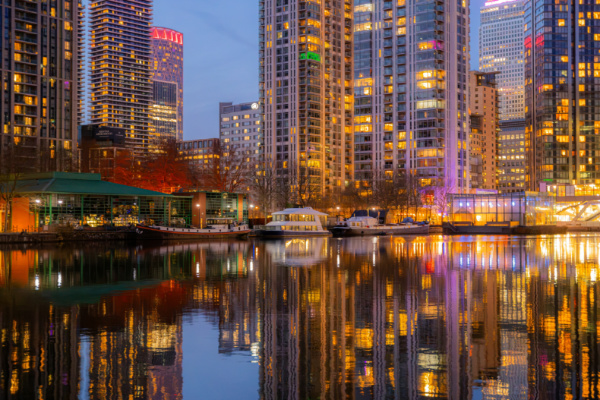
LondonLife – Canary Wharf reflections…

PICTURE: Mirsadra Molaei/Unsplash

This Week in London – A Greenwich chocolate house recreated; Bridgerton wig debuts at Kew; and, climate tech at the Science Museum…

• Happy Easter to all our readers! We’ll be taking a break over the next few days with our usual coverage returning next Tuesday.

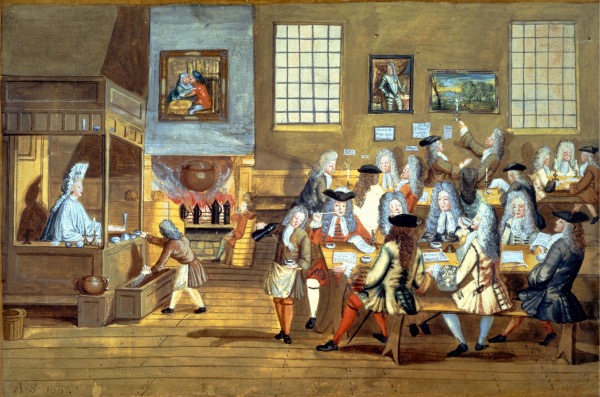
A caricature of Lloyd’s Coffee House from the 17th century.

• Experience a recreation of Grace and Thomas Tosier’s famous ‘royal’ Chocolate House in Greenwich this Easter. Located in the Old Royal Naval College, Chocolate House Greenwich recreates the Tosier Chocolate House which was located in what became known as Chocolate Row, on the edge of Blackheath. A social space for the leading figures of the day, the chocolate house was run by Grace while her husband Thomas served as chocolate maker for King George I, running the chocolate kitchen at Hampton Court Palace. Visitors will be able to immerse themselves in the chocolate house via an audio and visual experience created by Unusual Expo and actor-writer Jonathan Coote. As well as meeting Grace, there is also the chance to listen in to luminaries such as architect and astronomer Sir Christopher Wren, writer and diarist John Evelyn, the first Astronomer Royal, John Flamsteed, and playwright and architect John Vanbrugh. A series of events will accompany the exhibition – which opens tomorrow – including an Easter Trail for families, a gin and chocolate tasting experience and a ‘Choc-o-Late’ event. Admission charge applies. Runs until 3rd November. For more, see https://ornc.org/whats-on/chocolate-house-greenwich/.

• A wig worn by Golda Rosheuvel in Netflix’s hit series Queen Charlotte: A Bridgerton Story goes on display at Kew Palace from the end of this month. The grey wig with accompanying tiara will be showcased in Queen Charlotte’s dressing room, alongside a lock of the real Queen Charlotte’s hair. Visitors will also be able to join daily 30 minute Queen Charlotte: A Kew Palace story tours, walking in the footsteps of famous royals like King George III and Queen Charlotte. Admission charge applies. For more, see https://www.hrp.org.uk/kew-palace/.

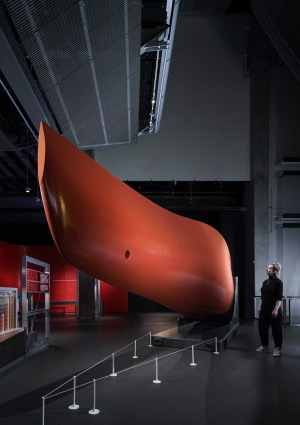
A visitor looks at a tidal turbine blade in Energy Revolution The Adani Green Energy Gallery at the Science Museum © Science Museum Group

• A major new gallery examining the rapid energy transition and decarbonisation needed globally to limit climate change has opened at the Science Museum. The Energy Revolution: The Adani Green Energy Gallery is divided into three sections – Future Planet, Future Energy and Our Future – and highlights technologies and projects being used to address the climate crisis. Objects on show include a seven metre long tidal turbine blade made by Orbital Marine Power which was used in the Orkneys, rare surviving Edison tube mains cables used to power world’s first public electricity network in London in 1882, and a three metre high CoolAnt passive air-cooling facade from India that reduces dependence on powered air conditioning. At the centre of the gallery sits Only Breath, a kinetic sculpture created by artists Alexandra Carr and Colin Rennie from Torus Torus Studios that moves and blooms, stretching to around five metres in diameter when unfurled. The gallery can be found on Level 2 of the South Kensington museum. Admission is free. For more, see sciencemuseum.org.uk/energy-revolution.

Send all items to exploringlondon@gmail.

10 atmospheric ruins in London – 9. Barking Abbey…

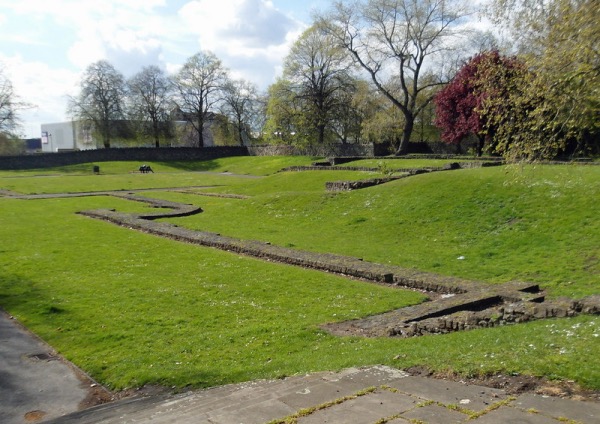
Footings of the abbey (these are modern with the real foundations below ground). PICTURE: diamond geezer (licensed under CC BY-NC-ND 2.0)

Once one of the most important nunneries in the country, Barking Abbey was originally established in the 7th century and existed for almost 900 years before its closure in 1539 during King Henry VIII’s Dissolution.

The abbey was founded by St Erkenwald (the Bishop of London between 675 and 693) for his sister St Ethelburga who was the first abbess.

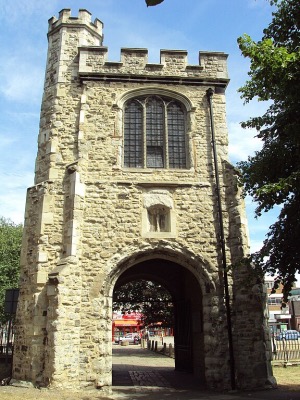
The Curfew Tower. PICTURE: Rept0n1x (licensed under CC BY-SA 3.0)

In the late 900s, St Dunstan, the Archbishop of Canterbury introduced the Rule of St Benedict at the nunnery.

King William the Conqueror stayed here after his coronation while famous abbesses included Mary Becket, the sister of St Thomas Becket, Archbishop of Canterbury, who was given the title in 1173 in reparation for the murder of her brother, as well as several royals including Queen Maud, wife of King Henry I, and Matilda, wife of King Stephen.

The nunnery gained wealth and prestige but this suffered somewhat as a result of floods in 1377 with some 720 acres of land permanently lost. It nonetheless remained one of the wealthiest in England and it’s said the abbess had precedence over all other abbesses in the country.

After the abbey was dissolved, some of the building materials were reused elsewhere and the site was later used as a farm and quarry.

Most of the buildings were demolished – today only the Curfew Tower, which dates from around 1460, remains. The Grade II*-listed tower contains the Chapel of the Holy Rood and now serves at the gateway to the nearby St Margaret’s Church.

Building footings also remain buried under the ground in what is known today as Abbey Green (the layout is marked today by modern additions). There’s a model of how the abbey once appeared inside the gateway.

Barking Abbey ruins, Abbey Road, Barking (nearest Tube Station is Barking); WHEN: Daily: COST: Free; WEBSITE: https://www.lbbd.gov.uk/find-your-nearest/barking-abbey-ruins

LondonLife – Crossings…

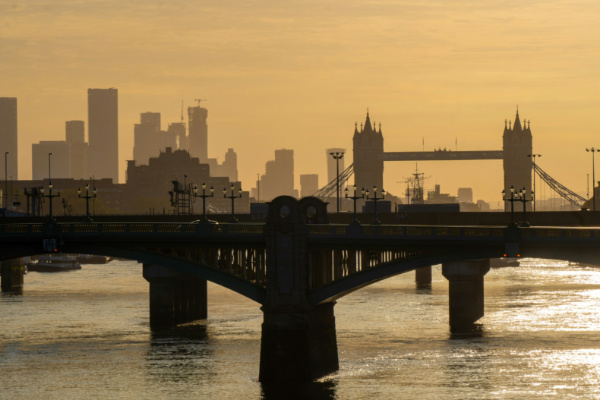
PICTURE: Arun Pushpam Raj/Unsplash

This Week in London – Hampton Court’s bunny hunt returns; vintage prints at the National Portrait Gallery; and, ‘Sounds of Blossom’ at Kew…

Gardens at Hampton Court Palace. PICTURE: edwin.11 (licensed under CC BY 2.0)

• The Lindt Gold Bunny hunt returns to Hampton Court Palace this Saturday with families once again invited to search the gardens for those elusive Gold Bunny statues. Each statue offers a chance to match the names of influential characters from Hampton Court Palace’s history to the distinctive red ribbons and a small Lindt bunny chocolate awaits those who succeed in finding the bunnies. Visitors will also have the chance to encounter a selection of the characters roaming the palace over the Easter period. The Gold Bunny hunt is included in general admission. Until 14th March. For more, see www.hrp.org.uk/hampton-court-palace/whats-on/easter-lindt-gold-bunny-hunt/.

• Rare vintage prints by two of art history’s most influential photographers – Francesca Woodman (1958-1981) and Julia Margaret Cameron (1815-1879) – go on show at the National Portrait Gallery today. Francesca Woodman and Julia Margaret Cameron: Portraits to Dream In showcases more than 160 rare vintage prints including 97 by Woodman and 71 by Cameron as well as artist’s books by Woodman which have never been exhibited before in the UK. Key works include Cameron’s self-declared “first success” – a portrait of Annie Wilhemina Philpot taken in 1864, Woodman’s Self-portrait at thirteen, taken during a summer holiday in Italy in 1972, images from Woodman’s Angel series and Cameron’s ethereal portraits of actor Ellen Terry taken in 1864. Also featured are Woodman’s Caryatid pieces and Cameron’s portraits of her niece and favorite model Julia Jackson, Alice Liddell as the goddess Pomona, a portrait of John Frederick William Herschel called The Astronomer (1867), and those of her frequent muses, May Prinsep and Mary Ann Hillier. Runs until 16th June. Admission charge applies. For more, see www.npg.org.uk.

• A new collaboration with the Royal College of Music blends music with spring blooms at Kew Gardens. Sounds of Blossom: Awaken your senses, the first ever spring festival to be held at the gardens, features six bespoke commissions that celebrate Kew’s unique landscape in the spring emerging from locations such as Cherry Walk, Asano Avenue and the Japanese Landscape. And on weekends during the festival, visitors can enjoy live musical performances from the Royal College of Music as they showcase a varied repertoire from classical favourites to jazz melodies. Included in general admission. Runs until 14th April. For more, see www.kew.org/kew-gardens/whats-on/sounds-of-blossom.

Send all items to exploringlondon@gmail.com

LondonLife – Standing tall…

PICTURE: Barnaby/Unsplash

Looking towards Westminster Cathedral from Cathedral Walk.