PICTURE: Rob Bye/Unsplash
PICTURE: Rob Bye/Unsplash
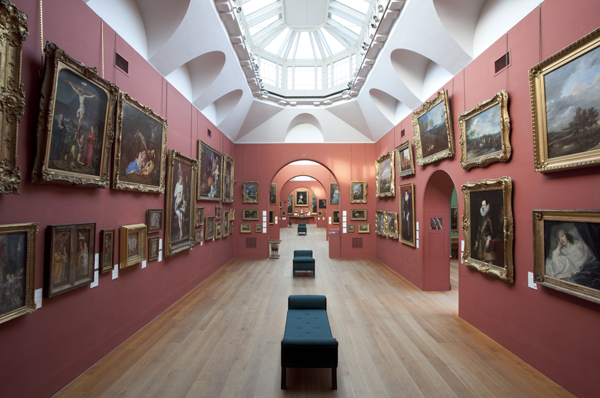
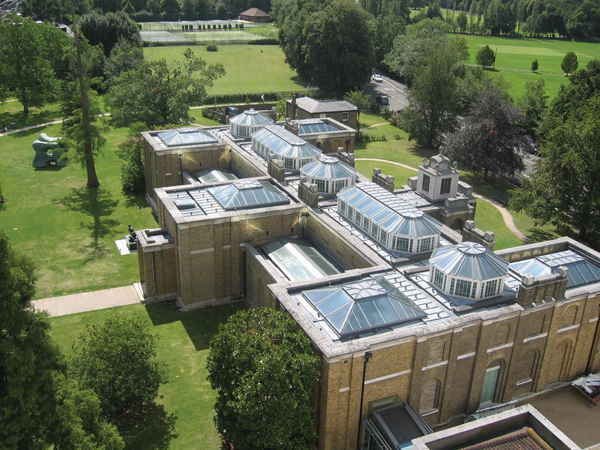
The Dulwich Picture Gallery in London’s south celebrates the 200th anniversary of its public opening this year. It is the oldest public picture gallery in all of England.
The origins of the gallery back owe their existence to an art dealership run by a Frenchman, Noël Desenfans, and his Swiss friend, painter Sir Francis Bourgeois. In 1790, the men were commissioned by King Stanislaus II Augustus of Poland to form a royal collection of art for him.
They spent five years doing so but in 1795, the king was forced to abdicate and the two dealers were left with the collection. They began searching for a new home for it but failed to find one and following Desenfans’ death in 1807, Sir Francis decided to leave the collection to Dulwich College (apparently on the advice of his friend, actor John Philip Kemble). The college had been founded in the early 17th century as the ‘College of God’s Gift’ by Edward Alleyn, actor and theatre entrepreneur, who had left it his estate.
Sir Francis died in 1811 and, under the terms of his will, the paintings left to Dulwich had to be made available to the public to view. There was an existing gallery at Dulwich College (the collection had originally been formed around Alleyn’s collection which included portraits or kings and queens) but, conscious that it might not be ideal for displaying the collection, Sir Francis had left £2,000 in his will to refurbish it and made it clear that should this be required, he wanted his friend, Sir John Soane to oversee the work.
Sir John, visiting the college the day after Sir Francis’ death, inspects the existing building but decides that an entirely new wing will need to be built to house the collection. He submitted numerous designs but the cost – more than £11,000 – was considerably more than the college could afford despite Sir John’s efforts to cut costs and simplify. Eventually, after Margaret Desenfans agreed to donate £4,000 of her own money, the college officials agreed to begin construction.
In 1814, the collection was moved into the building and the following year, the now completed building was opened to Royal Academicians and students. The public opening came two years later, in 1817, and the same year the Desenfanses and Francis Bourgeois were buried in the gallery’s mausoleum as its founders.
Several additions and renovations have since followed (including works after bombing during World War II). The last major works were carried out in the 1990s after which the gallery was formally reopened on 25th May, 2000, by Queen Elizabeth II.
Those who visited the gallery, many as students, have included some big names in the art world – John Constable, JMW Turner and Vincent Van Gogh. Charles Dickens referenced the gallery in his work, The Pickwick Papers, in which he had Samuel Pickwick visit the gallery following his retirement.
The Dulwich Picture Gallery is now an independent registered charity. Its more than 600 works include one of the finest collections of Old Master paintings in the world by artists such as Rembrandt, Gainsborough, Poussin, Watteau, Canaletto, Rubens, Veronese and Murillo. Collection highlights include Rembrandt’s Girl at a Window (1645), Bartolomé Esteban Murillo’s The Flower Girl (1665-70), Thomas Gainsborough’s Elizabeth and Mary Linley (c 1772) and Sir Peter Lely’s Nymphs by a Fountain (early 1650s).
WHERE: Dulwich Picture Gallery, Gallery Road, Dulwich (nearest rail is West Dulwich or North Dulwich); WHEN: 10am to 5pm Tuesday to Sunday; COST: £7 adults/£6 seniors/under 18s free (additional cost for special exhibitions); WEBSITE: www.dulwichpicturegallery.org.uk.
PICTURES: Courtesy Dulwich Picture Gallery.
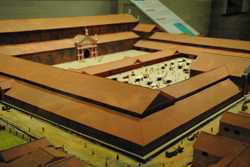 • Nineteenth century Scottish painter David Robert’s painting, The Forum, is at the heart of a new display at the Guildhall Art Gallery exploring the concept of the Roman forum. The display looks at why the forum played such an important role in the Roman world, how it would have looked and what happened there. It also examines the painting in the context of the Robert’s Roman series, his wider body of work and depictions of the ‘grand tour’ by other artists. Admission is free. The exhibition, which is part of Londonium, a series of events, talks and displays focusing on London’s Roman past, runs until 1st January. For more, follow this link. PICTURE: A model of Londinium’s Roman forum in the Museum of London.
• Two young Londoners who were posthumously awarded Victoria Crosses after they were killed on the first day of the Battle of Passchendaele have been honoured with commemoration stones in Victoria Embankment Gardens. Captain Thomas Riversdale Colyer-Fergusson, accompanied by a sergeant and just five men, managed to capture an enemy trench and a machine gun which he turned on his assailants. The 21-year-old attacked again, this time with just his sergeant, and captured another enemy machine gun but soon afterwards was killed by a sniper. Second Lieutenant Dennis George Wyldbore Hewitt, meanwhile, led his company under heavy machine-gun fire while seriously wounded and in pain. The 19-year-old successfully captured and consolidated his objective but he too was killed by a sniper soon after. The two men died on 31st July, 1917. The memorials were erected as part of World War I centenary commemorations which is seeing all 628 Victoria Cross recipients from the war being honoured in their birthplaces.
• On Now: Samuel Fosso: Self-portraits. This exhibition at the National Portrait Gallery features a selection of images from 666 self-portraits taken by Cameroonian-born artist Samuel Fosso in 2015. Each of the shots were taken against the same red backdrop with Fosso adopting an identical head and shoulders pose in each. Photographed every day during October and November, 2015, each work is intended to reflect Fosso’s particular mood at that moment. The photographs, the artist’s first solo display in the UK, are displayed alongside some of the earliest self-portraits that he made while a teenager working in Bangui in the Central African Republic in the 1970s. In these works, Fosso adopted personas which reflected popular West African culture, from musicians and the latest youth fashions to political advertising. He employed special cloth backgrounds, in front of which he dressed up in a range of outfits from authentic European costumes and African folk costumes to navy uniforms, karate keikogis and boxer shorts. Runs until 24th September. Admission is free. For more, see www.npg.org.uk.
Send all items for inclusion to exploringlondon@gmail.com.
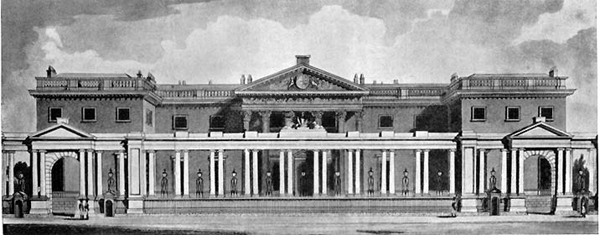
It’s perhaps the most famous of the visits that Jane Austen made during her London stays and while the property no longer exists, we thought it was worth mentioning.
But first, let’s explain. The Prince Regent (later King George IV) was an admirer of Jane’s novels, so much so that when he was aware of the author’s presence in London, he issued – via his librarian and chaplain Rev James Stanier Clarke – an invitation for her to visit the library and tour his palatial London property, Carlton House.
The grand, lavishly decorated property, created from an existing property between 1783 and 1812 by the architect Henry Holland, was among the grandest in London at the time. Facing on to the south side of Pall Mall, the building sat across what is now Waterloo Place while its gardens abutted St James’s Park.
Jane visited on 13th November, 1815, and in the company of Rev Clarke toured the library. During her visit, it was suggested she could dedicate her next novel to the Prince Regent, an idea which didn’t sit that well with Jane who was a supporter of his estranged wife, Princess Caroline.
After her initial equivocation, her publisher John Murray apparently managed to prevail upon Jane to do so and she eventually capitulated, dedicating her novel Emma to him (a special copy of the novel was sent to the Prince at Carlton House).
Carlton House, meanwhile, didn’t last for much longer. King George IV, on his accession to the throne, decided to create a property more fitting for a king and ordered works to be carried out on Buckingham House so it could be his main London residence (as Buckingham Palace).
Carlton House, despite the exorbitant sums the Prince had spent transforming it, was demolished in 1825 and the John Nash-designed Carlton House Terrace built upon the site. Columns from the Carlton House were reused in creating the portico of the National Gallery on Trafalgar Square.
PICTURE: Carlton House (via Wikipedia).
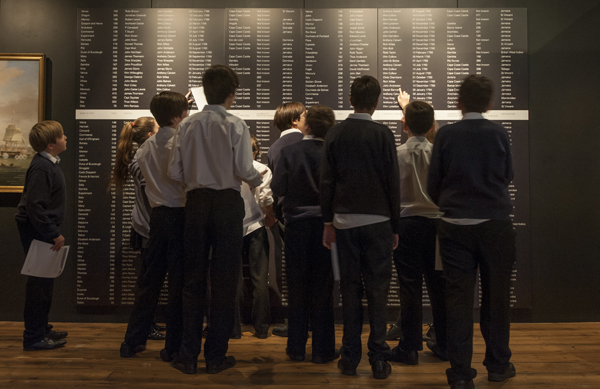
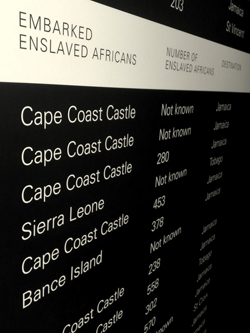 Wednesday marked the International Day for the Remembrance of the Slave Trade and its Abolition, so we thought it an appropriate week to feature one of the most moving displays in the Museum of London Docklands’ ‘London, Sugar and Slavery’ gallery.
The permanent gallery, which opened the museum at West India Quay in 2007 to mark the bicentenary of abolition of the trans-Atlantic slave trade, features a wall bearing a list of the many ships that sailed from London to trade in enslaved Africans over what was just a 10 year period.
In what was known as the ‘Triangular Trade’, the ships on leaving London would sail to West Africa where they would bought enslaved Africans before travelling to the Caribbean to sell them and fill their ships with sugar before returning to London.
Among details recorded on the wall are not only the name of each ship, but the captains, owners and destinations of the ships as well as the number of enslaved Africans carried (but not their names; these were not recorded).
A sad record of a shameful time.
WHERE: ‘London, Sugar and Slavery’ Gallery, Museum of London Docklands, No 1 Warehouse, West India Quay (nearest DLR is West India Quay); WHEN: 10am to 6pm daily; COST: Free; WEBSITE: www.museumoflondon.org.uk/museum-london-docklands
PICTURE: Top – © Museum of London; Below – J D Mack/Flickr/CC BY-ND 2.0
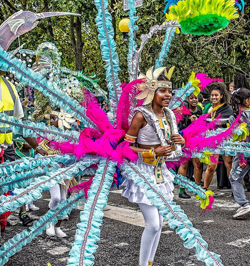 • The world famous Notting Hill Carnival takes places in London’s west this weekend. The biggest event of its kind in Europe, the programme kicks off Saturday evening (from 6pm to 10pm) with a steel band music competition and more Caribbean-themed outdoor entertainment in Emslie Horniman Pleasance Park. Sunday features the Children’s Parade, performances at the World Music Stage in Powis Square and static sound systems and food stalls at Emslie Horniman Pleasance Park (from 9am to 8.30pm). The Grand Finale parade on Monday features dancers, performers, 60 steel bands and mobile sound systems with more music and food stalls in the parade area as well as on the World Music Stage in Powis Square. This year’s event will also feature a minute’s silence at 3pm on both Sunday and Monday to remember the victims of the Grenfell Tower fire disaster. For more, see www.thelondonnottinghillcarnival.com or Visit London’s special guide. PICTURE: Eddie Starck/Flickr/CC-BY-2.0
• Tate Modern is offering a limited number of free tickets to Soul of a Nation: Art in an Age of Black Power exhibition this Friday night (August’s Uniqlo Tate Late event) to coincide with the Notting Hill Carnival weekend. The tickets will be offered a first come, first serve basis from 6pm. The exhibition, which explores what is meant to be an African American artist during the civil rights movement and at the birth of the Black Power movement, runs until 22nd October. For more, see www.tate.org.uk.
• On Now: The City is Ours. This major interactive exhibition at the Museum of London explores some of the key issues that affect Londoners and city dwellers elsewhere the world – from housing affordability and urban planning to transport, green spaces and air quality. Spread across three of the museum’s temporary exhibition spaces, key exhibits include a nine metre wide film, Urban Earth, which visualises and compares data from major cities around the world, an Oculus Rift headset which delivers a virtual view from the top of a Hong Kong skyscraper illustrating the impact of building upwards instead of outwards, and an exhibit which allows visitors to control and monitor CCTV cameras as they reflect on the impacts of increased surveillance. The free exhibition – at the heart of the museum’s year long focus on City Now City Future – can be seen until 2nd January. For more, see www.museumoflondon.org.uk/thecityisours.
Send all items for inclusion to exploringlondon@gmail.
Jane Austen was known as a patron of London’s theatre – in some cases attending shows several times a week while in the city (despite the fact that many, based on her writings – in particular Mansfield Park, believe she wasn’t really a fan).
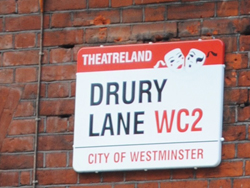 She is known to have visited a number of West End establishments to see performances. They included:
• The Lyceum Theatre: Jane visited this Wellington Street theatre more than once and expressed her frustration on one occasion of her failure to see the incomparable Sarah Siddons perform there.
• The Covent Garden Theatre: The theatre Jane attended was a second iteration, opening in 1809 on the site of what is now the Royal Opera House adjacent to the market as a replacement for the previous theatre which, dating back to 1732, had burned down.
• The Theatre Royal Drury Lane: The oldest of London’s theatres still in use, Jane saw the great actor Edmund Kean famously perform here as Shylock in the Shakespearian play, The Merchant of Venice, in 1814.

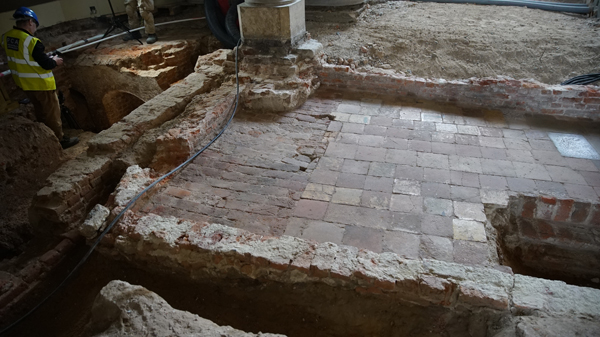
The remains of two rooms, which once formed part of the splendid Greenwich Palace – birthplace of King Henry VIII and his daughters Queen Mary I and Queen Elizabeth I, were discovered during works being undertaken ahead of the construction of a new visitor centre under the Old Royal Naval College’s famed Painted Hall, it was revealed last week.
The rooms, set well back from the river Thames, are believed to have formed part of the service range, believed to be the location of kitchens, a bakehouse, brewhouse and laundry.
As well as the discovery of a lead-glazed tiled floor, one of the rooms, which was clearly subterranean, featured a series of unusual niches where archaeologists believe may have been ‘bee boles’ – where ‘skeps’ (hive baskets) were stored during winter when the bee colonies were hibernating and where, when the bees were outside during summer, food and drink may have been stored to keep cool.
Discussions are reportedly now underway over the possibility of displaying the Tudor finds in situ. Duncan Wilson, chief executive of Historic England, hailed the find as “remarkable”.
“To find a trace of Greenwich Palace, arguably the most important of all the Tudor palaces, is hugely exciting,” he said. “The unusual and enigmatic nature of the structure has given us something to scratch our heads over and research, but it does seem to shine a light on a very poorly known function of the gardens and the royal bees. The most exciting aspect is that the Old Royal Naval College is able and willing to incorporate this into the new visitor centre, so everyone can see a small part of the palace, for the first time in hundreds of years.”
Greenwich Palace was built by King Henry V’s brother, Humphrey, Duke of Gloucester, in 1426 and rebuilt by King Henry VII between about 1500 and 1506.
Substantially demolished at the end of the 17th century (and with plans to build a new Stuart palace on the site never realised), it was replaced with the Greenwich Hospital which became the Royal Naval College designed by Sir Christopher Wren and Nicholas Hawksmoor between 1692 and 1728.
The Painted Hall, located in the Old Royal Naval College, is currently undergoing an 18 month transformation which includes the creation of a new visitor centre, Sackler Gallery and café. Visitors to the hall currently have the unique opportunity to get up close to the famous ceiling of the hall, described as the “Sistine Chapel of the UK”, on special tours. Visit www.ornc.org/painted-hall-ceiling-tours-tickets for more.
PICTURES: © Old Royal Naval College

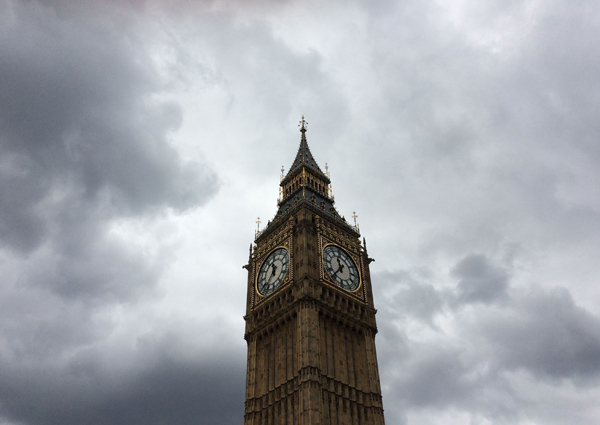
And so the day has finally arrived. Following its usual bonging at midday today, the famous bell nick-named Big Ben has now controversially fallen silent as what have been described as “critical” conservation works are carried out.
How long the 13.7 tonne bell, which sits at the top of Elizabeth Tower (formerly known as the Clock Tower) at the northern end of the Palace of Westminster (also known as the Houses of Parliament) and is officially known as the “Great Bell”, will be silent remains something of a mystery.
Following uproar over the initial announcement that the bell would be silent for four years (until 2021), officials have now said that the plan will now be reviewed. There have also been claims that the bell will continue to toll for significance events such as Remembrance Sunday and New Year’s Eve (Conservative MPs also reportedly want the bell to toll as the UK leaves the EU on 29th March, 2019).
It should be noted that while the mechanism which strikes the bell will be stopped from doing so during works to protect the ears of those working on it, the clock faces on the tower will continue to show the time.
The giant bell, which was cast by the Whitechapel Bell Foundry, went into action on 11th July, 1859, and has been bonging almost continually since. It apparently stopped for two years during World War I for fears it would attract Zeppelins to the site and was silent during the funerals of former PMs Winston Churchill and Margaret Thatcher. It was last silent in 2007 when maintenance was carried out.
PICTURE: Athena/Unsplash
PICTURE: Gordon Williams/Unsplash
Jane Austen is known to have patronised many shops while in London (mainly concerned with fabrics) – here’s just a few…
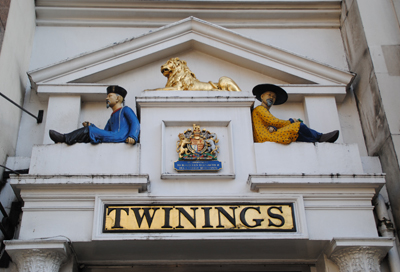 • Twinings – The Austen family is known to have bought their tea from the famous merchant’s 300-year-old premises which still stands in the Strand near Temple Bar; a letter survives which Jane wrote to her sister Cassandra in reference to an order.
• Newton’s – A linen drapers formerly located at 14 Coventry Street just off Leicester Square. Jane is known to have visited here with her niece Fanny.
• Wilding & Kent – Upmarket drapers, located in Grafton House on the corner of New Bond and Grafton Streets. Jane, who is known to have visited frequently, complained of the queues there.
• Layton & Shear’s – A fashionable mercer’s shop located at 9 Henrietta Street, Covent Garden, conveniently located next door to where Jane lived for a time with her brother Henry.
There are others – this is just a sample!
Correction: The Fanny mentioned who visited Newton’s with Jane Austen was her niece, not her sister (although she apparently thought of her like “almost another sister”).
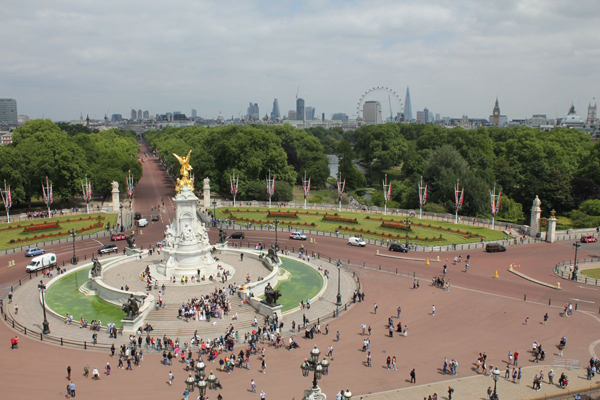
The Queen Victoria Memorial, looking from Buckingham Palace across to St James’s Park. PICTURE: Robin Bilney/Royal Parks
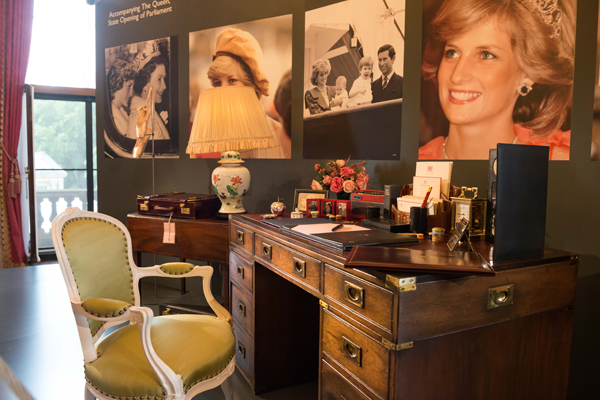 • A special tribute to Diana, Princess of Wales – who died 20 years ago this month, is included in this year’s Summer Opening of Buckingham Palace. Located in the Music Room, the display features the desk at which the Princess worked in her Kensington Palace sitting room along with selected objects, many of which have been chosen by her two sons, Prince William and Prince Harry. They include a silver Cartier calendar – a gift to the Princess from President Ronald Reagan and his wife Nancy when the Prince and Princess of Wales visited in 1985, a wooden tuck box which belonged to the then Lady Diana Spencer when she was at school, her childhood typewriter, and small round enamel boxes which were commissioned as gifts for the Princess to give to hosts on official overseas trips – among those shown are one decorated with an image of Rio’s Christ the Redeemer statue which was taken on a 1991 official visit to Brazil. Meanwhile, this Saturday, a special family festival is being held at the palace, and adjoining Royal Mews and Queen’s Gallery. Featuring drop-in arts and crafts activities, dance and drama workshops and story-telling sessions, the festival runs from 10.30am to 3pm. Entry is included in the admission price. For more on the festival, see www.royalcollection.org.uk/whatson/event/847051/Family-Festival. The summer opening of the palace, and the special exhibition on Royal Gifts, runs until 1st October. See www.royalcollection.org.uk for more. PICTURE: Royal Collection Trust/© Her Majesty Queen Elizabeth II 2017 .
• An exhibition exploring how artist Henri Matisse’s personal collection of treasured objects were both subject matter and inspiration for his work opens at the Royal Academy of Arts this Saturday. Matisse in the Studio features about 35 objects displayed alongside 65 of Matisse’s paintings, sculptures, drawings, prints and cut outs. The collection of objects includes everything from a Roman torso and African masks to Chinese porcelain and North African textiles, with most of them on loan from the Musée Matisse in Nice. The display is arranged around five thematic sections – ‘The Object as an Actor’, ‘The Nude’, ‘The Face’, ‘The Studio as Theatre’ and ‘The Language of Signs’. Runs until 12th November. Admission charge applies. For more, see www.royalacademy.org.uk.
• On Now – Plywood: Material of the Modern World. This exhibition in the V&A’s Porter Gallery celebrates that most versatile of building materials – plywood – and features more than 120 objects ranging from the fastest plan of World War II – the de Havilland Mosquito – to the downloadable, self-assembly WikiHouse. While fragments of layered board have been discovered in ancient Egyptian tombs, plywood really came into its own during the 19th century and has since been used to construct everything from an experimental elevated railway in mid-19th century New York to tea chests, hat boxes, and surfboards. Highlights include a 1908 book printed during Ernest Shackleton’s Nimrod expedition to Antarctica and bound with plywood covers, pieces by modernist designers including Alvar Aalto, Marcel Breuer, Grete Talk, Robin Day and Charles and Ray Eames, and striking examples of transport design including a 1917 moulded canoe, a 1960s British racing car with plywood chassis and some of the first ever surf and skate boards. A cluster of ice-skating shelters designed in plywood by Patkau Architects can be seen in the John Madejski Garden during the exhibition. Admission is free. Runs until 12th November. For more, see www.vam.ac.uk/plywood.
Send all items for inclusion to exploringlondon@gmail.com.

This Grade II*-listed building is the former site of the offices of publisher, John Murray, who published four of Jane Austen’s six novels including Emma (1815), Mansfield Park (1814), Persuasion (1818) and Northanger Abbey (1818) (the last two after Austen’s death on 18th July, 1817).
Murray, whose offices were located here from 1812 onwards, published, along with Austen, many of the great literary names of the age including everyone from Lord Byron to Sir Walter Scott and Washington Irving (the company also later published the likes of Herman Melville and Sir Arthur Conan Doyle).
The John Murray with whom Austen dealt (and it seems her brother Henry must have played a considerable part in getting Murray to publish his sister’s works given Murray had already won considerable fame with the publication of Byron’s epic poem Childe Harold’s Pilgrimage in 1811) was actually John Murray II, of whom Austen wrote to her sister Cassandra: “He is a rogue, of course, but a civil one”.
His father John Murray I had founded the business in Fleet Street in 1768 and his son, John Murray III, continued it after his father (in fact, there were a succession of John Murrays down to John Murray VII).
The business was acquired in 2002 by Hodder Headline, itself then acquired by the French Lagardère Group. John Murray is now an imprint of Hachette UK.
PICTURE: Google Maps
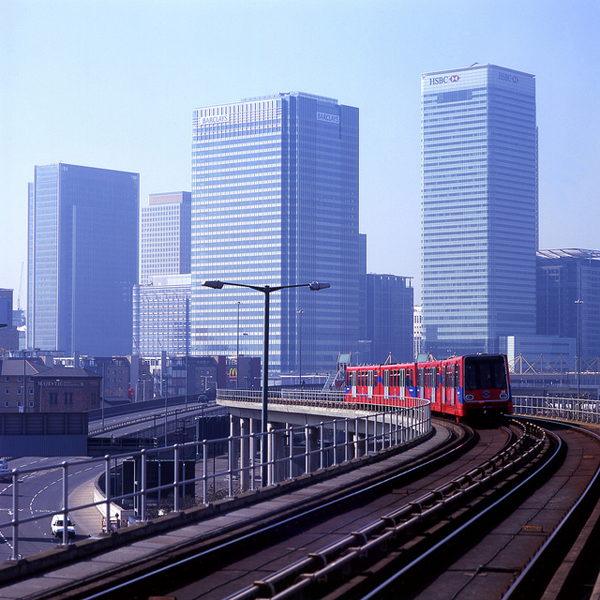
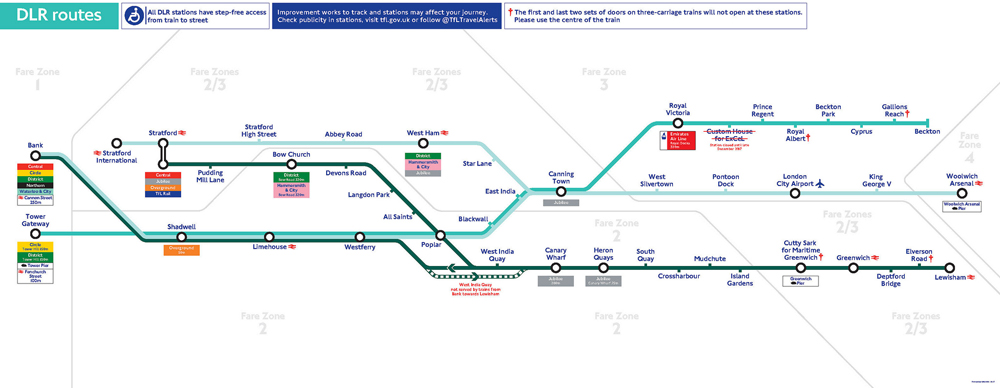
London’s Docklands Light Railway – the DLR as it’s better known – is celebrating 30 years of operation. The railway was officially opened by Queen Elizabeth II in the summer of 1987 and then had just 11 single carriage trains serving 15 stations. Extended six times since and now including some 38 kilometres of track, it now serves 45 stations using mainly three carriage trains. Carrying some 6.7 million passengers in its first year, it now carries a massive 122 million people annually. To mark the occasion, Transport for London has released a Destination DLR travel guide featuring 30 attractions across east and south-east London all easily reached by the DLR, ranging from the National Maritime Museum at Greenwich and the Tower of London to Queen Elizabeth Olympic Park and Wilton’s Music Hall. Transport for London have also released a new diagram of the DLR system (pictured below). PICTURES: Transport for London.
This important Bayswater thoroughfare, which runs north from Bayswater Road, is one of numerous streets and districts of the city which take their name from the monarch – in this case Queen Victoria.
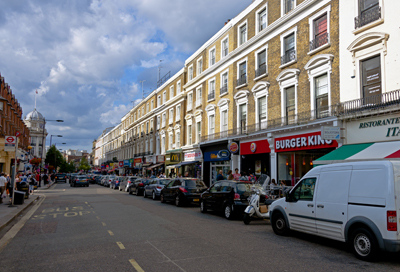
The street was once known as Black Lion Lane (named after a local inn) and was renamed the Queens Road in honour of Queen Victoria, soon after she came to the throne in 1837. It was changed to Queensway in 1938 to give the name a bit more distinctiveness.
It’s suggested that was reason for the renaming was that the road was one of the Queen’s favourite horse-riding routes when she was living at Kensington Palace (also her place of birth).
The street was the site of an early department store which was opened by William Whiteley and the origins of which go back to the mid-19th century (the building was rebuilt and most recently reopened as a shopping centre in 1989).
Other associations with the street include portrait painter Augustus Egg, who lived in a cottage in Black Lion Lane, and the Hitchcock film, Frenzy, scenes for which were apparently firmed at the then Coburg Hotel on the corner with Bayswater Road.
View north up Queensway from Bayswater tube station. PICTURE: Daniel Case/Wikipedia/CC BY-SA 3.0
• The life of gladiators in Roman Londinium and that of those who watched them are explored in a new exhibition opening in the remains of the city’s 7000 seat amphitheatre under the Guildhall Art Gallery. Featured as part of the display will be a Roman skull uncovered during excavations in the Walbrook Stream which, dated to around 150 AD, shows evidence of substantial head trauma at the time of death and is the closest archaeologists have come to identifying a potential gladiator in Londinium. Trauma, which is free to enter, opens tomorrow and runs until 29th October. For more, see www.cityoflondon.gov.uk/guildhallartgallery.
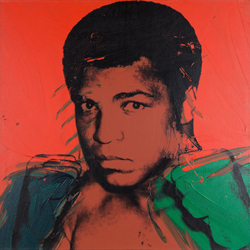 • A landmark exhibition examining what it was like to be a black artist in the US during the civil rights movement and the purpose and audience of art during the emergence of ‘black power’ has opened at the Tate Modern. Soul of a Nation: Art in the Age of Black Power spans the era from 1963 to 1983, a time when race and identity become major issues across many spheres of society including music, sports and literature thanks to the likes of Aretha Franklin, Muhammad Ali and Toni Morrison. The display features more than 150 works by more than 60 artists, many of which are on display in the UK for the first time. Running until 22nd October, it is accompanied by a programme of talks and events. Admission charge applies. For more, see www.tate.org.uk. PICTURE: Muhammad Ali by Andy Warhol/Tate Modern
• The future of the world’s major cities – including London – is the subject of a new major exhibition which has opened at the Museum of London. The City is Ours is split into three sections: ‘Urban Earth’, centred on a 12 minute infographic film with comparative data about megacities such as London, Sydney, Tokyo, New York and Sao Paolo; ‘Cities Under Pressure’, which provides an overview of the risks, challenges and demands facing global cities through digital and physical interactive displays; and, ‘Urban Futures’, which presents solutions to the challenges increasing urbanisation poses. In addition, the exhibition takes a look at 25 innovative projects which are now taking place across London to improve life for its inhabitants. The free exhibition, part of the year-long City Now City Future season, can be viewed until 2nd January. For more, check out www.museumoflondon.org.uk/thecityisours.
Send all items for inclusion to exploringlondon@gmail.com.
Another of the places Jane Austen stayed when visiting London, the terraced house at 23 Hans Place was the address her brother Henry moved to from his flat in Covent Garden (see last week’s entry)
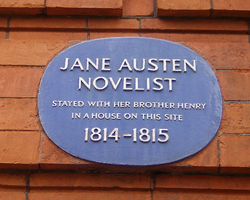 Jane stayed at the premises for almost two years over 1814 and 1815 (it was her last known visit to London). Austen, who stayed in a bedchamber at the front of the house on the top floor (a plaque commemorating Jane’s occupancy is located on the building), described the home as “delightful” and expressed her love of the garden.
The house has been considerably altered since although the original property still is said to lie underneath the brick skin now upon it.
It was while Jane was staying there that she was invited by the Prince Regent (later King George IV) – a fan of her writing – to Carlton House on 13th November, 1815, where she was permitted to dedicate one of her future works to him (Emma was duly dedicated the following year).
Henry, meanwhile, lived here until 1816 – the complete collapse of the bank in which he was partner had come in March of that year after which Henry was declared bankrupt. Following the financial disaster, he took up a post as curate at Chawton in Hampshire where the family were based.
While we’re in the area, we should also mention another property around the corner – 64 Sloane Street. It was here that Henry lived before moving to Covent Garden and here that, in April and May 1813, Jane stayed with Henry as his wife Eliza was dying (she passed away on 25th April).
Henry and Eliza had moved into the the Sloane Street property in 1809 (from Brompton) and Jane had visited several times (among the books she worked on while there was Sense and Sensibility).
Both properties were part of the Hans Town development which dated from the late 1770s.
PICTURE: Gwynhafyr/CC BY-NC 2.0
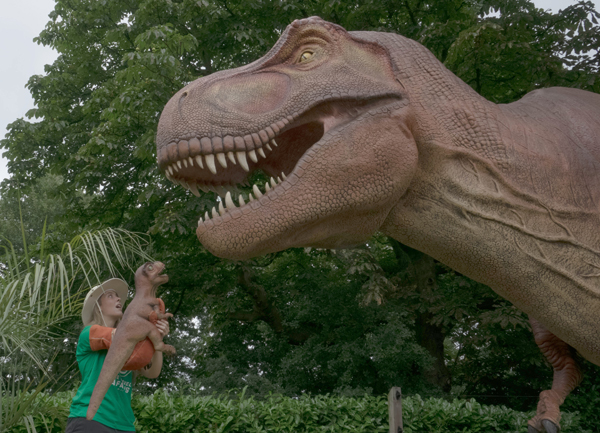
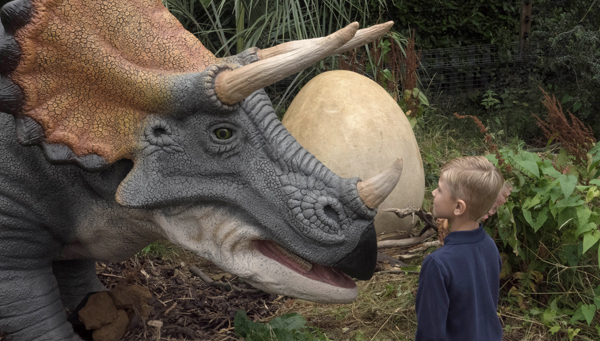
ZSL London Zoo opened the gates to its new Zoorassic Park last weekend enabling families to step back in time to the Mesozoic era and experience life with the dinosaurs. Featuring life-size, moving dinosaurs ranging from a tyrannosaurus rex (above) to a triceratops (below), the exhibit, will provide insight into the lives of the extinct giants as well as the important work conservationists are doing now to help save today’s animals from the same fate Included in the price of entry into the zoo, the exhibit is only open until 3rd September. For more, see www.zsl.org. PICTURES: ZSL London Zoo.
This month marks 300 years since composer George Frideric Handel premiered his composition (and one of the most famous pieces of classical music in the world) Water Music – and it was in a rather fitting setting.
 The first performance of the composition – which was deliberately created for
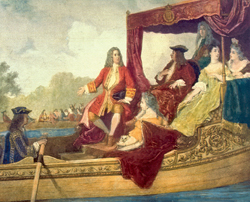
playing outdoors (and carrying across water) – took place at about 8pm on 17th July, 1717, aboard a City of London barge in the River Thames.
Some 50 musicians played the piece – using everything from flutes and recorders to trumpets, horns, violins and basses – with Handel himself fulfilling the role of conductor.
The barge was part of a rather grand flotilla which made its way up the river from the Palace of Whitehall to Chelsea, at the centre of which was a royal barge upon which King George I and members of the nobility, including various duchesses, rode.
Numerous other Londoners also turned out to hear the performance aboard all manner of watercraft and the king was apparently so impressed with what he heard that he requested several encores both on the trip to Chelsea and on the return journey.
The story goes that the somewhat unpopular king had apparently requested the concert on the river to upstage his son, the Prince of Wales (and future King George II), who was stealing the limelight by throwing lavish parties (the king and his son were famously at odds and it was therefore no shock when the prince didn’t attend the performance).
There’s another story, meanwhile, that suggested Handel composed the piece to regain the favour of the King which he had apparently lost when, seeking to capitalise on his growing fame, he left his employment as conductor at the court of the then Elector of Hanover (a position George held before he was king) and moved from Germany to London during the reign of Queen Anne (although some claim the future king knew he would one day follow Handel to London and actually approved of his decision to move there).
Water Music, meanwhile, has since become part of popular culture – it’s generally said that most people will recognise at least one part of it – but interestingly, no-one is said to be exactly sure how the music, which is generally broken into three separate suites, should be performed, given that the original score has been lost.
PICTURE: Edouard Hamman’s painting showing Handel (on the left) with King George I aboard a barge on 17th July, 1717. Via Wikipedia
 Exploring London