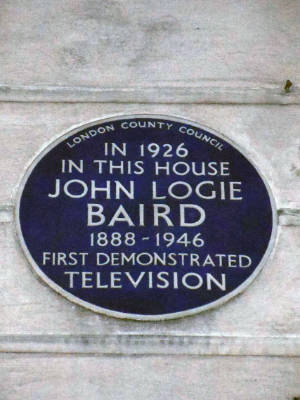
It was 100 years ago last month that on a wet Tuesday evening in Soho, Scottish engineer and inventor John Logie Baird demonstrated an experimental prototype that provided live moving pictures – the precursor to what we now know as television.
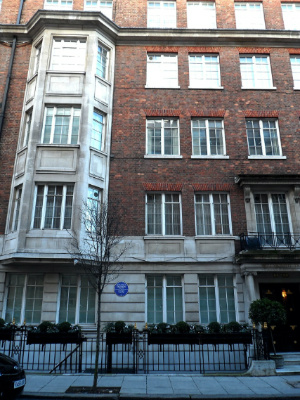
The successful, albeit rather low key, demonstration took place before some 40 members of the Royal Institution, all reportedly attired in evening dress, in an upper room which served as his laboratory at 22 Frith Street on 26th January, 1926.
According to a report in The Times on 28th January, the “transmitting machine” consisted of a “large wooden revolving disc containing lenses, behind which was a revolving shutter and a light sensitive cell”.
The first image to be transmitted was that of the head of a ventriloquist’s dummy but the image of a human face was transmitted later, “first on a receiver in the same room as the transmitter and then on a portable receiver in another room”.
“The image as transmitted was faint and often blurred, but substantiated a claim that through the ‘Televisor’, as Mr Baird has named his apparatus, it is possible to transmit and reproduce instantly the details of movement, and such things as the play of expression on the face,” TheTimes reported.
Present at the demonstration was William Edward Taynton, a 20-year-old office boy whose face Baird had transmitted in an experiment at the property the previous October.
Baird continued to refine his invention in the following months with the picture becoming clearer and was recognised in the years following for being the first to show television in colour,
In 1928 he completed a demonstration in which live images sent by radio from London were received in New York and the same year he demonstrated colour television. In 1929, the first television programmes were officially transmitted by the BBC using Baird’s system.
An English Heritage Blue Plaque todays marks the property where the demonstration took place (there’s also one at Baird’s former home at 3 Crescent Wood Road in Sydenham, where he lived from 1933 until 1945).
• The lights will be turned on the Trafalgar Square Christmas tree tonight. This year marks the 78th anniversary of the gift of the first Christmas tree to the people of London from the Norwegian city of Oslo in acknowledgement of the support Britain gave to Norway during World War II. The festivities will include the choir of St-Martin-in-the-Fields singing some well known Christmas carols to music led by the Regent Hall Band of the Salvation Army, the reading of a poem written by children who live in Westminster, a display by The Corps of Drums from the Band of His Majesty’s Royal Marines Collingwood and a performance by Det Norske Jentekor, The Norwegian Girls’ Choir, conducted by Anne Karin Sundal-Ask. Festivities start at 5pm and the lights switch on at 6pm. The tree will be in the square until 5th January after which it will be recycled. You can follow the tree on Instagram at @TrafalgarTree, on TikTok at @TrafalgarTree, and on X at @TrafalgarTree.
• A Blue Plaque commemorating Alice in Wonderland illustrator and political cartoonist Sir John Tenniel has been returned to London’s streets – but to a different location than that where it was first positioned. The plaque, which is actually jade-green and white, was originally unveiled by the London County Council in 1930 at Tenniel’s longtime Maida Vale home (the colour was due to the request of the house-holder). But following its removal when the house was demolished in 1959, the plaque was so damaged that its destruction was authorised. But this wasn’t carried out and the plaque, which features an early “wreathed” design, has been in storage since. Following restoration, however, it has now been relocated to a new home – a property at 52 Fitz-George Avenue in West Kensington where Tenniel spent the final years of his life.
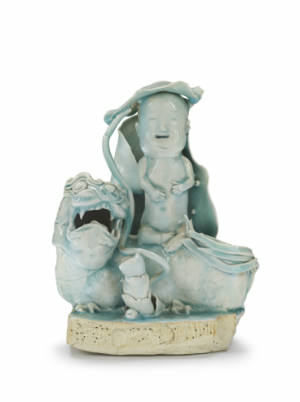
Figure from the ‘Century Doll’ series, glazed porcelain, by Yao Yongkang, 2004, Jingdezhen, China
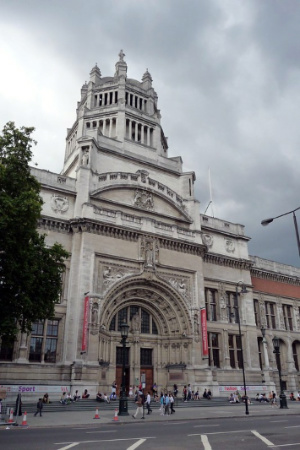
• The first major UK exhibition exploring contemporary studio crafts in China is on now at the V&A South Kensington.Dimensions: Contemporary Chinese Studio Crafts features more than 80 objects including almost 50 new acquisitions and puts a spotlight on “contemporary and modern makers who build upon longstanding tradition to reinvent ancient practices, pioneer alternative techniques, and develop new channels for self-expression”. Many of the objects – displayed in the China and Ceramics galleries – sit in dialogue alongside permanent displays of historic Chinese craftsmanship. Highlights include large scale works such as Lin Fanglu’s She’s Bestowed Love (2025), that transforms intricate tie-dye practices into a monumental textile sculpture, more delicate pieces such as Zhang Huimin’s Golden Mammary 4 (2025), a brooch produced by pushing the boundary of filigree in a reinvention of traditional practice, a wall hanging by pioneering artist of studio pottery Tan Chang, as well as works by the three potters who were the first to be exhibited in China under the mantle of ‘modern ceramics’: Mei Wending, Zeng Li and Zeng Peng. Runs until 27th September next year. Free admission. For more, see www.vam.ac.uk/exhibitions/dimensions-contemporary-chinese-studio-crafts.
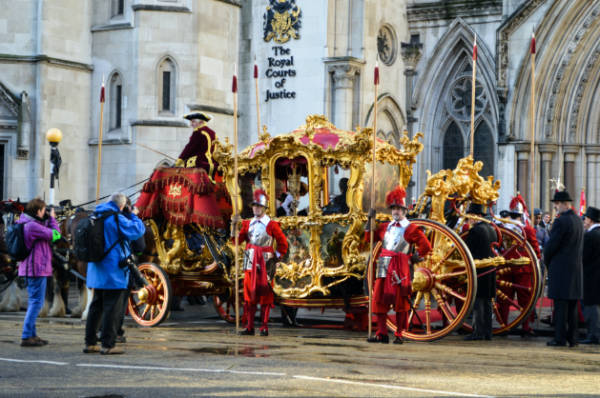
The State Coach at the Royal Courts of Justice in the 2013 Lord Mayor’s Show. PICTURE: S Pinter/iStockphoto.
• The Lord Mayor’s Show – or this year, for the first time in its 800 year history, the Lady Mayor’s Show – takes place on Saturday as Dame Susan Langley is celebrated as the City of London’s 697th Lord Mayor of London. Langley, who takes office at Guildhall on Friday in the ancient ‘Silent Ceremony’, is the third woman to hold the role and the first to adopt the title “Lady Mayor”. The more than three mile-long procession, which kicks off at 11am, features around 7,000 participants, 200 horses and more than 50 decorated floats and travels from the Mansion House, the official mayoral residence, through the City to the Royal Courts of Justice, via St Paul’s Cathedral, before returning. The centrepiece as always is the State Coach carrying the Lady Mayor as she fulfills the dual purpose of showing herself to residents and swearing allegiance to the crown. For more – including details of the procession’s route, head to https://lordmayorsshow.london/.
• The first exhibition dedicated to the work of 18th century artist Joseph Wright ‘of Derby’ opens at The National Gallery tomorrow.Wright of Derby: From the Shadows focuses on his career between 1765 and 1773 when he created his candlelight series. On show are a number of works from this series including Three Persons Viewing the Gladiator by Candlelight (1765), A Philosopher giving that Lecture on the Orrery in which a lamp is put in place of the Sun (1766), and the gallery’s own An Experiment on a Bird in the Air Pump (1768). Mezzotint prints of Wright’s works – key to the establishment of his international reputation – will also be on display. The exhibition, in the Sunley Room, runs until 10th May. Admission charge applies. For more, see www.nationalgallery.org.uk/exhibitions/wright-of-derby-from-the-shadows.
• Hollywood icon Audrey Hepburn has been honoured with an English Heritage Blue Plaque on her former home in Mayfair. The plaque at 65 South Audley Street was where Hepburn lived in a flat with her mother between 1949 to 1954 as she launched her career as an actor. It was from here that she travelled to the West End to perform in chorus lines, appeared in British films such as 1951’s The Lavender Hill Mob and while living here that she was cast as the lead in Gigi on Broadway – a key stepping stone towards her breakthrough performance in 1953’s Roman Holiday. Hepburn was born in Brussels but had strong ties to London, training at the Ballet Rambert and working as a dancer and model before moving on to acting. Of course, as well as Roman Holiday, Hepburn performed notable roles Sabrina, Funny Face, Breakfast at Tiffany’s, My Fair Lady, and Charade. She later dedicated herself to humanitarian work, serving as a UNICEF Goodwill Ambassador, and was awarded the Presidential Medal of Freedom shortly before her death in 1993. For more on English Heritage Blue Plaques, see www.english-heritage.org.uk/visit/blue-plaques/.
This district in the Borough of Lambeth in south London was formerly a rural manor located on the southern edge of London.
The name, variants of which date back to at least the late 12th century, is said to relate to the Old English words for a tree trunk – ‘stoc’ – and a well or spring, ‘wella’, and has been interpreted as meaning the well or spring by a tree stump, tree truck or perhaps a wood (there was apparently a Stockwell Wood which has long since disappeared).
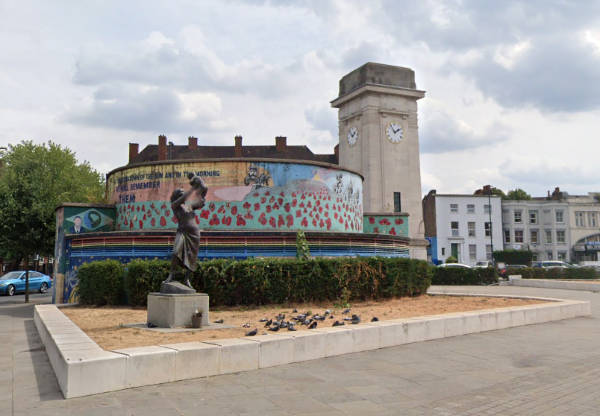
The War Memorial and mural painted on a ventiliation house in Stockwell. PICTURE: Courtesy of Google Maps
The manor of Stockwell was formed at the end of the 13th century when King Edward I acquired the manor of South Lambeth and divided it into two, creating the manors of Stockwell and Vauxhall (the manor house itself, parts of which survived until the 19th century, stood on the north side of Stockwell Road).
The area become known for its market gardens and was transformed into an urban landscape until the mid-19th century. Remnants of the 19th century housing stock can still be found in areas including the Stockwell Park Conservation Area in the west of the district.
The area around Stockwell Tube station, which first opened in 1890 and has since been rebuilt a couple times, was heavily bombed during World War II and rebuilt following the war. New developments included a number of social housing estates.
Today, Stockwell and nearby South Lambeth host the district known as Little Portugal which, centred on South Lambeth Road, is home to one of the UK’s largest Portuguese communities. The area is also home to several other immigrant communities.
Local landmarks include the oldest surviving building in the area – St Andrew’s Church, Stockwell Green (built in 1767), the Stockwell Congregational Church (1798) and the Stockwell War Memorial.
The latter – a white stone tower – is located on a site first laid out in the 1920s and features a mural on an adjoining ventilation shelter commemorating French Resistance fighter Violette Szabo (there’s a Blue Plaque on her former home in Burnley Road) and other Stockwell residents who died in war. There is also the ‘Bronze Woman’ statue which was unveiled in 2008 as a tribute to Black Caribbean women.
Residents of Stockwell have included artist Arthur Rackham and pioneering theatre director Joan Littlewood as well as musician David Bowie (born in Stansfield Road), actors Joanna Lumley (who still lives there) and Roger Moore (born in Aldebert Terrace).
Tragically, Stockwell Tube station was where Brazilian man Jean Charles de Menezes was fatally shot by police on 22nd July, 2005, after being misidentified as one of four suicide bombers who were on the run after their devices had failed to detonate the previous day (the attempts had come just two weeks after the 7th July bombings in which more than 50 people had been killed).
A titan of American broadcast journalism, Edward R Murrow’s name is synonymous with London during World War II from where, as a correspondent for CBS, he famously provided live radio broadcasts at the height of the Blitz.
Edward R Murrow, seen in a screenshot in 1961. PICTURE: Via Wikipedia
Murrow, who joined CBS in the US in 1935, went to London in 1937, initially to serve as director of the network’s European operations. Said to have been deeply committed to exposing the threat Nazism posed to Americans, he was soon deeply involved in reporting events leading up to and during World War II with his first on the scene news report taking place in March, 1938, when he reported live from Vienna, Austria, during Hitler’s annexation.
Following the breakout of the war in 1939, Murrow remained based in London and went on to provide his famous live broadcasts during the Blitz, opening them with the iconic words, “This is London” and, later, ending them with “Good night and good luck”.
Weymouth House in Westminster where Edward R Murrow stayed during his time in London. PICTURE: Spudgun67 (licensed under CC BY-SA 4.0)
His wartime dispatches – which were broadcast from a studio in the sub-basement of the BBC’s Broadcasting House (which was bombed more than once) as well as from locations including Traflagar Square and a rooftop during the bombing raids – were to win him considerable acclaim and also saw him undertake such feats as joining combat missions in the skies over Europe and being one of the first two reporters to enter Buchenwald concentration camp in Germany in April, 1945.
Such was his standing that then British Prime Minister Winston Churchill even offered to make him joint-director of the BBC (a job offer he declined).
Murrow made his last report from London in March, 1946, before returning to the US to head CBS News. he continued to work with CBS until resigning in 1961 to take up a position as head of the United States Information Agency, a job he held until 1964.
He died at the age of 57 after being diagnosed with lung cancer at his home in Pawling, New York, on 27th April, 1965.
During his time in London, Murrow lived in a flat at Weymouth House, 84-94 Hallam Street in Westminster. An English Heritage Blue Plaque now commemorates his stay there.
Murrow is, of course, also the subject of the 2005 film – and subsequent Broadway production – Good Night, and Good Luck (although that focuses on his later stand against US Senator Joe McCarthy and his hunt for communists).
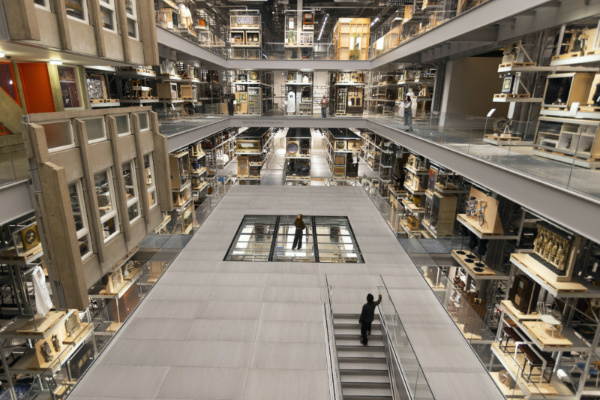
Visitors in the central Weston Collections Hall at V&A East Storehouse, a working store and new visitor attraction from the V&A located in Queen Elizabeth Olympic Park in Stratford, London, opening this Saturday, 31st May. PICTURE: David Parry/PA Media Ass
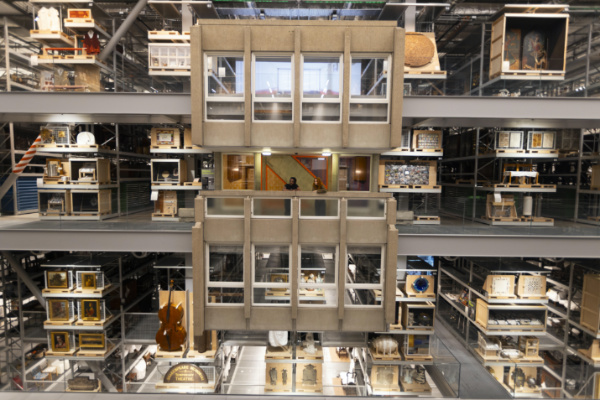
• The V&A East Storehouse opens to the public for the first time in Queen Elizabeth Olympic Park this Saturday. The venue features more than 100 mini-displays centred on the themes of ‘Collecting Stories’, ‘Sourcebook for Design’ and ‘The Working Museum’ and boasting more than 1,500 items from across the V&A’s collections with works by Hew Locke, Zaha Hadid, Daniel Liebskind and Thomas Heatherwick’s London 2012 Olympic cauldron model among those featured. A massive 11-metre-wide stage cloth designed by Pablo Picasso for the Ballets Russes’ 1924 production, Le Train Bleu, will be displayed for first time in more than 10 years while among large scale objects are a section of the now-demolished housing estate, Robin Hood Gardens, and Frank Lloyd Wright’s 1930s Kaufmann Office – the only Frank Lloyd Wright interior outside of the US. Anyone can book access to any object in the storehouse for free via the ‘Order an Object’ process and the venue is also hosting a series of live events including back2back: Archival Bodies, and new programming strand, A Life in the Work of Others– featuring Turner-Prize-winning artist, Jasleen Kaur. Admission to the Storehouse at Queen Elizabeth Olympic Park in Stratford, is free. For more, see www.vam.ac.uk/east.
Visitors looking at a two-storey section of Robin Hood Gardens, at V&A East Storehouse, a working store and new visitor attraction from the V&A located in Queen Elizabeth Olympic Park in Stratford, London, opening this Saturday, 31st May. PICTURE: David Parry/PA Media Assignme
• The home where novelist Barbara Pym began writing her celebrated 1952 novel Excellent Women has been given an English Heritage Blue Plaque. Pym lived at the second floor flat at 108 Cambridge Street in Pimlico with her sister Hilary between November 1945 to autumn 1949. It was from a corner room, overlooking Warwick Square and St Gabriel’s Church, that she meticulously recorded her observations, and laid the groundwork for her distinctive literary voice. Her work during this period also included revising the text for her first published novel, Some Tame Gazelle (1950). In March, three more Blue Plaques were unveiled commemorating women: Una Marson (1905–1965), the BBC’s first Black woman producer at The Mansions, Mill Lane in West Hampstead where she lived from at least 1939 to 1943; and, Rhoda Garrett (1841–1882) and Agnes Garrett (1845–1935), at 2 Gower Street in Bloomsbury where they founded Britain’s first female-run interior-decorating business. For more, see www.english-heritage.org.uk/visit/blue-plaques/.
• A free family trail inspired by Jessie Burton’s new children’s book, Hidden Treasure, has launched at the London Museum Docklands. Inspired by the tale of two young mudlarks, the trail takes families on a journey around the museum’s galleries to learn more about centuries of life by the river. It’s aimed at children under 12-years-old, who also have free entry into the museum’s mudlarking exhibition, Secrets of the Thames. For more, see www.londonmuseum.org.uk.
Send all items for inclusion to exploringlondon@gmail.com
• The V&A in South Kensington is celebrating the 100th anniversary of its Theatre and Performance collections with Enthoven Unboxed: 100 Years of Collecting Performance, which opened last weekend. The exhibition commemorates the 1924 donation of more than 80,000 playbills, programmes, and ephemera from collector, humanitarian, and campaigner Gabrielle Enthoven. Highlights among the objects on display include John Pasch’s artwork featuring the original Rolling Stonestongue and lips, a pair of semi-quaver spectacles worn by Elton Johnduring his 1981-2 British and world tours, a self-portrait bust by 18th century actress Sarah Siddons, a set model designed by Misty Buckley for Stormzy’s headline set at Glastonbury Festival in 2019, and, a prompt script used by Phoebe Waller-Bridge for Fleabag in the West End. The free display can be seen in the Theatre and Performance Galleries (Rooms 103-106) until 4th January. For more., see www.vam.ac.uk,
• Diana Beck, the first female neurosurgeon in Britain, has been honoured with an English Heritage Blue Plaque. Unveiled earlier this month, the plaque marks the site of her former home and consulting rooms at 53 Wimpole Street in Marylebone. Beck lived at the property from 1948 to 1954, a period during which she created and ran a neurosurgical department at Middlesex Hospital. It was also during this period that Beck operated on her most famous patient – Winnie the Pooh author AA Milne, who had suffered a stroke in 1952. For more, see www.english-heritage.org.uk/visit/blue-plaques/
• The largest retrospective of the work of artist (and Royal Academician) Michael Craig-Martin has opens at the Royal Academy on Saturday. The exhibition in Royal Academy’s Main Galleries features more than 120 works spanning the period from the 1960s through to today and includes sculpture, installation, painting and drawing, as well as works newly created for the display. Among the highlights are the installations On the Table (1970) and An Oak Tree (1973), the large scale wall drawing in tape, Interlocked (MoMA project 1990) and the large scale painting Eye of the Storm (2003) as well as his depictions of single objects and word paintings. The exhibition runs until 10tH December. Admission charge applies. For more, see www.royalacademy.org.uk.
• Two pioneering photographers are being commemorated with English Heritage Blue Plaques today. Christina Broom (1862-1939) is believed to have been Britain’s first female press photographer while John Thomson (1837-1921) was a ground-breaking photo-journalist working at the advent of the medium. Broom’s plaque – the first to be located in Fulham – is being placed on 92 Munster Road, a terraced house of 1896, where she lived and worked for 26 years. Thomson’s plaque, meanwhile, will be located at what is now 15 Effra Road in Brixton where he and his family were living when one of his best-known and influential works, Street Life in London (1877-8), was published. For more, see www.english-heritage.org.uk/visit/blue-plaques/.
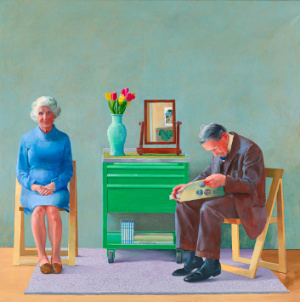
• Two of David Hockney’s key works – My Parents (1977) and Looking at Pictures on a Screen (1977) – which feature reproductions of 15th-century Italian painter Piero della Francesca’s The Baptism of Christ (probably about 1437–45) have gone on display alongside the Renaissance work at The National Gallery. Hockney and Piero: A Longer Look explores Hockney’s “lifelong association” with the National Gallery and its collections, particularly in the works of Piero della Francesca (1415/20–1492). Hockney once confessed that he would love to have The Baptism of Christ so he could look at it for an hour each day. My Parents features a reproduction of Piero’s work shown reflected in a mirror on a trolley behind the sitters while Looking at Pictures on a Screen depicts Hockney’s friend Henry Geldzahler, the Belgian-born American curator of 20th-century art at The Metropolitan Museum of Art in New York, peering at a folding screen in the artist’s studio on which are stuck four posters of National Gallery pictures including The Baptism of Christ. The display in Room 46 is free. Runs until 27th October. For more, see www.nationalgallery.org.uk.
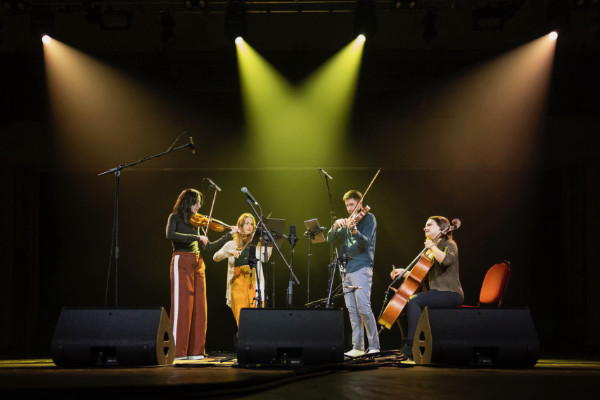
The City String Ensemble. PICTURE: Catherine Frawley
• Experience a prelude of Taylor Swift at Wembley Park with with City String Ensemble playing more than a dozen interpretations of Taylor Swift songs. The free open air concert comes ahead of Swift’s return to Wembley Stadium later this month. ‘Taylor on Strings’ will be held at the Sound Shell from 6:30pm on 13th August. Tickets are free but must be booked with 30 released at 10am each day in the lead-up to the concert. For more, head to wembleypark.com/taylor-on-strings.
Send all items for inclusion to exploringlondon@gmail.com
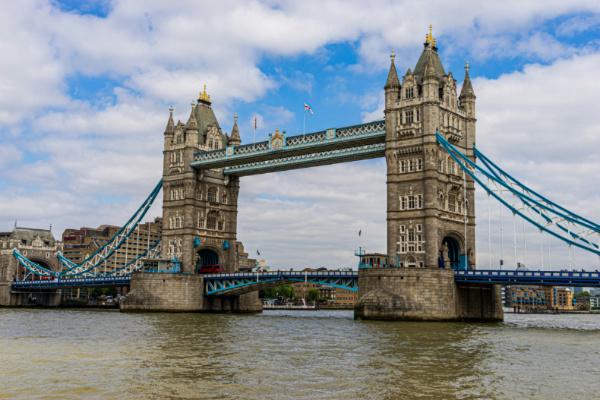
• Tower Bridge marks its 130th birthday this year and to mark the event, the London Metropolitan Archives are hosting a free exhibition charting its history at the City of London’s Heritage Gallery. Designed by Horace Jones, the bridge opened on 30th June, 1894, and the display reflects on the splendour of that royal event as well as examining how and why the bridge was built, the engineering involved and how the bridge played a role in defending London during World War I. The exhibition runs until 19th September at the gallery, located in the Guildhall Art Gallery. Booking tickets is recommended. For more, see https://www.cityoflondon.gov.uk/events/tower-bridge-at-the-heritage-gallery.
• Actor Dame Peggy Ashcroft and Dublin-born novelist Iris Murdoch have been honoured with English Heritage Blue Plaques. A leading figure in 20th century theatre, Dame Peggy has been remembered with a plaque on her childhood home in South Croydon. It was in what was then a “leafy market town” that at the age of 13 Peggy first dreamt of performing on the stage while standing outside the local grocers on George Street and to which she returned in 1962 to open a theatre named after her. The plaque honouring Murdoch, meanwhile, has been placed on 29 Cornwall Gardens, part of a Italianate stucco-fronted mid-Victorian terrace in Kensington where she occupied a top floor flat. Murdoch lived in London for more than 25 years and during that time would spend three days a week in the flat. For more, see www.english-heritage.org.uk/visit/blue-plaques/
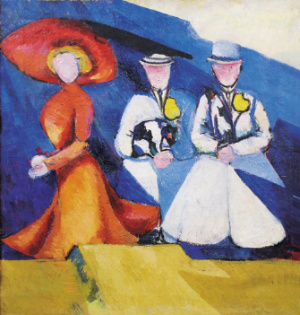
Alexandra Exter, ‘Three Female Figures’, 1909-10Oil on canvas, 63 x 60 cmNational Art Museum of Ukraine
• The most comprehensive UK exhibition to date of modern art in Ukraine opens at the Royal Academy on Saturday.In the Eye of the Storm: Modernism in Ukraine, 1900–1930s, features some 65 works, many on loan from the National Art Museum of Ukraine and the Museum of Theatre, Music and Cinema of Ukraine. Artists represented in the display, which is divided into six sections, include such renowned names as Alexander Archipenko, Sonia Delaunay, Alexandra Exter and Kazymyr Malevych as well as lesser-known artists such as Mykhailo Boichuk, Oleksandr Bohomazov and Vasyl Yermilov. Runs in the The Gabrielle Jungels-Winkler Galleries until 13th October. Admission charge applies. For more, see www.royalacademy.org.uk.
• The work of artists who have illustrated Michael Rosen’s many books for children are the subject of a new exhibition at the Heath Robinson Museum.Michael Rosen: The Illustrators explores Rosen’s books and the many artists who illustrated them over his 50 year career including the likes of Quentin Blake, Helen Oxenbury, Chris Riddell and Korky Paul. Among the works on show are original drawings for titles including We’re Going on a Bear Hunt, Michael Rosen’s Sad Book and Michael Rosen’s Book of Nonsense! Runs until 22nd September. Admission charge applies. For more, see https://www.heathrobinsonmuseum.org/.
Send all items for inclusion to exploringlondon@gmail.com.
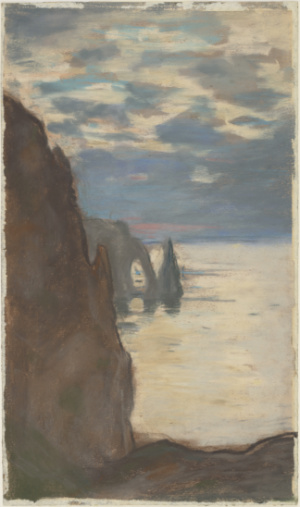
Claude Monet, ‘Cliffs at Etretat: The Needle Rock and Porte d’Aval’, c 1885. National Galleries of Scotland.
• A new exhibition exploring how Impressionist and Post-Impressionist artists in late 19th-century France radically transformed the status of works on paper opens at the Royal Academy on Friday. Impressionists on Paper: Degas to Toulouse-Lautrec features around 80 works on paper by artists including Mary Cassatt, Paul Cézanne, Edgar Degas, Paul Gauguin, Eva Gonzalès, Claude Monet, Berthe Morisot, Odilon Redon, Pierre-Auguste Renoir, Georges Seurat, Henri de Toulouse-Lautrec and Vincent van Gogh. Among the highlights are Degas’ Woman at a Window (1870-71), van Gogh’s The Fortifications of Paris with Houses (1887), Monet’s Cliffs at Etretat: The Needle Rock and Porte d’Aval (c1885) and Toulouse-Lautrec’s images of the urban underworld of Montmartre. The display can be seen in The Gabrielle Jungels-Winkler Galleries until 10th March. Admission charges apply. For more, see royalacademy.org.uk.
• English Heritage have unveiled their final Blue Plaque for 2023 and it celebrates two of the most influential painters of the early-to-mid 20th century, Vanessa Bell and Duncan Grant. The plaque was unveiled at number 46 Gordon Square in Bloomsbury, from where the Bloomsbury Group – of which Bell and Grant were leading members – drew its name. Bell first lived at number 46 with her siblings, including Virginia Stephen (later Woolf), and, in 1914, Grant moved in with Vanessa and her husband, Clive Bell. Paintings the pair made at number 46 include Grant’s Interior at Gordon Square (c1915) and Bell’s Apples: 46 Gordon Square (c1909-10), a still-recognisable view from the drawing-room balcony to the square. For more on the English Heritage Blue Plaques scheme, head to www.english-heritage.org.uk/visit/blue-plaques/.
• The history of Burnham Beeches has been brought to life with a new augmented reality app. The app allows users to superimpose periods of Burnham Beeches’ history – from the Iron Age, Middle Ages and World War II – over what they see when visiting the site and incorporates sounds from selected era as well. It can be accessed via a QR code which is being published on signs at Burnham Beeches. Burnham Beeches, located near the village of Burnham in Buckinghamshire, was acquired by the City of London in 1880 when the area was threatened by development and is managed as a free open space. For more, head here.
• The work of 30 young artists celebrating African community and culture is being showcased on billboards across the city in conjunction with Tate Modern’s current exhibition, A World in Common. The photographs have been selected following a call from the Tate Collective for 16-to-25-year-olds to submit images responding to the exhibition. More than 100 entries were submitted by young people based across the UK and beyond and Londoners will be able to view the 30 shortlisted works on billboards in Haringey, Lambeth, Southwark and Tower Hamlets over the next two weeks.
• An iconic red coat worn by Princess Diana when she announced she was pregnant with Prince William is going on show in a new exhibition at the Museum of London Docklands at West India Quay. Fashion City: How Jewish Londoners shaped global style – the first major exhibition in two decades centred on the museum’s extensive dress and textile collection – tells the story of Jewish designers, makers and retailers responsible for some of the most recognisable looks of the 20th century. As well as the David Sassoon-designed coat,it also features a newly acquired Alexon tweed coat worn by EastEnders character Dot Cotton, hats relating to the ‘milliner millionaire’, Otto Lucas, who changed the global reputation of British fashion in the mid-20th century, and garments designed by Mr Fish, a leading figure of the Peacock Revolution whose flamboyant menswear was worn by stars including Jimi Hendrix, David Bowie, and Muhammad Ali. The fashion items are joined by personal items from some of the 200,000 Jewish people who arrived in Britain between the late 19th and mid 20th century, such as a small travelling case used by a child arriving in London as part of the Kindertransport (the rescue effort of children from Nazi-controlled territory in 1938-1939), and a leather bag owned by a woman who fled from Vienna in 1938. Opens on Friday and runs until 14th April next year. Admission charges apply. For more, see www.museumoflondon.org.uk/museum-london-docklands/whats-on/exhibitions/fashion-city
• Drawing on everything from Hokusai to Pokémon and Studio Ghibli, the influence of Japanese folklore on Japan’s art and design is the subject of the first exhibition at the new Young V&A. Japan: Myths to Manga is divided into four sections – Sky, Sea, Forest, and City – and features more than 150 historic and contemporary objects along with hands-on activities for visitors of all ages ranging from manga-making to Taiko drumming and yōkai interactive. Highlights in the display include works by celebrated 19th century Japanese artists, such as Hokusai’s Great Wave (1831), Sylvanian families matched with historic netsuke (small sculptures), a stage model for the Royal Shakespeare Company’s production of My Neighbour Totoro, and a Hello Kitty rice cooker from 2014. An installation of 1,000 paper cranes, a symbol of remembrance from the Hiroshima Peace Memorial Park in Japan, will also be present. The display, which opens at the Bethnal Green premises on Saturday, runs until 11th August next year. Admission charges apply. A series of events linked to the exhibition are also being run. For more, see www.vam.ac.uk/exhibitions/japan-myths-to-manga.
• Anti-racism activist and a ‘founding spirit’ of the Notting Hill Carnival, Claudia Jones, has been honoured with an English Heritage Blue Plaque in Vauxhall. The plaque marks the mid-19th century terraced house that was her home for almost four years during which she founded the West Indian Gazette and came up with the idea of bringing Caribbean carnival to London (the first carnival took place in It was during her time living in this shared dwelling that Jones founded the West Indian Gazette and came up with the idea of bringing Caribbean carnival to London (the first carnival took place in St Pancras Town Hall on 30th January, 1959; the Notting Hill Carnival, an outdoor event, came later). For more, see www.english-heritage.org.uk/visit/blue-plaques/.
Send all items for inclusion to exploringlondon@gmail.com.
• English Heritage has unveiled its 1000th Blue Plaque in London. The plaque – located on a three storey building at number 1, Robert Street in Westminster – marks the former London headquarters of the suffragist organisation, the Women’s Freedom League. The league, which was formed in 1907, worked out of the building between 1908 and 1915 – its most active period. The blue plaques scheme has been running for more than 150 years and honours everyone from John Keats and Charles Dickens to Ada Lovelace and Alan Turing. For more, see www.english-heritage.org.uk/visit/blue-plaques/.
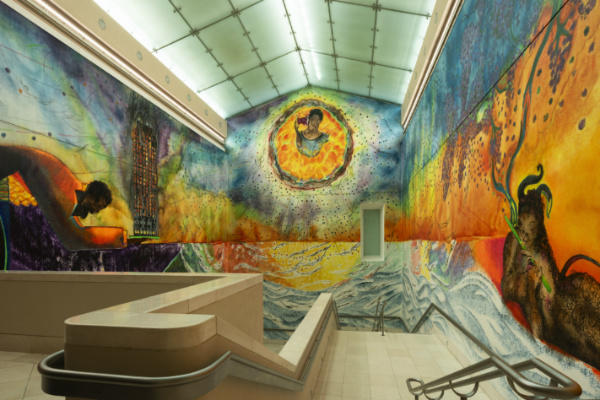
• A major new work by Chris Ofili commemorating fellow artist Khadija Saye and the tragedy of the Grenfell Tower fire in which Saye died, has gone on display at the Tate Britain in Millbank.Requiem, a site-specific work which is shown across three walls, is described as a “journey through an imagined landscape of giant skies with vast horizons and flowing water” which unfolds in three chapters. Ofili says that when making the work, he recalled the feelings he had when creating No Woman, No Cry in 1998 as a tribute to murdered Black teenager Stephen Lawrence and his mother Doreen. “That feeling of injustice has returned,” he said. “I wanted to make a work in tribute to Khadija Saye. Remembering the Grenfell Tower fire, I hope that the mural will continue to speak across time to our collective sadness.” For more, see tate.org.uk/visit/tate-britain.
• The Astronomy Photographer of the Year display has opened at the National Maritime Museum in Greenwich featuring the competition’s winning image, Andromeda. The picture, the work of Marcel Drechsler, Xavier Strottner and Yann Sainty, depicts a huge plasma arc next to the Andromeda Galaxy. Other winners include two 14-year-old boys from China – Runwei Xu and Binyu Wang – who won the Young Astronomy Photographer of the Year award for The Running Chicken Nebula as well as Argentinian Eduardo Schaberger Poupeau who won the ‘Our Sun’ category for A Sun Question which captures a huge filament in the shape of a question mark, China’s Angel An, who won the ‘Skyscapes’ category for Grand Cosmic Fireworks – a photograph of the extremely rare phenomenon of atmospheric luminescence, and the UK’s John White who won the Annie Maunder Prize for Image Innovation for Black Echo which used audio source material from NASA’s Chandra Sonification Project, to visually capture the sound of the black hole at the centre of the Perseus Galaxy. For more, see www.rmg.co.uk/astrophoto.
Send all items for inclusion to exploringlondon@gmail.com
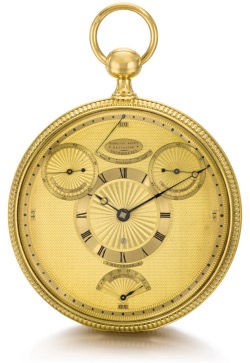
A gold pocket watch made for King George III. PICTURE: Courtesy of the Clockmakers’ Museum/Science Museum
• A new display featuring timepieces by one of the greatest watchmakers of all time, Abraham-Louis Breguet, opens in Clockmakers’ Museum at the Science Museum on Tuesday. Marking the bicentenary of Breguet’s death on 17th September, 1823, Abraham-Louis Breguet: The English Connection features 25 items seldom seen in public before. They include an exceptionally rare gold four-minute tourbillon pocket watch made for George III in 1808, a ‘Simple à 2 aiguilles equation’ pocket watch made for politician Thomas Noel Hill, 2nd Baron Berwick of Attingham, and, a gilt bronze carriage clock ‘Pendule de voyage petite’ which originally belonged to Robert Henry Herbert, the 12th Earl Pembroke. The museum is located on level 2 of the Science Museum. Entry is free. For more, see www.sciencemuseum.org.uk/clocks.
• An electrical engineer whose ground-breaking work in engineering culminated in the creation of the world’s first ever large-scale programmable digital computer has been honoured with an English Heritage Blue Plaque. The plaque is located at the former workplace of Tommy Flowers at Chartwell Court, in Dollis Hill. Now flats, the property was the former Post Office Research Station where Flowers designed, built and tested the computer known as ‘Colossus’. Flowers, who spent a brief period at Bletchley Park working the code-breakers in 1941, successfully demonstrated Colossus at the research station in 1943 after just 11 months of work. For more, see www.english-heritage.org.uk/visit/blue-plaques/. Meanwhile, news this week that the UK Government, inspired by London’s Blue Plaques, is introducing a national blue plaques scheme. Historic England will work together with English Heritage, local partners, and current plaque schemes to develop and roll out the national programme.
• Artist Sara Shamma’s thought-provoking interpretations of works by artists including Rembrandt van Rijn, Peter Lely, Anthony van Dyck and Peter Paul Rubens go on display at Dulwich Picture Gallery from Saturday. With a focus on women, Bold Spirits addresses themes including identity, death, motherhood and unexpected beauty. Runs until 25th February. Admission charge applies. For more, see www.dulwichpicturegallery.org.uk.
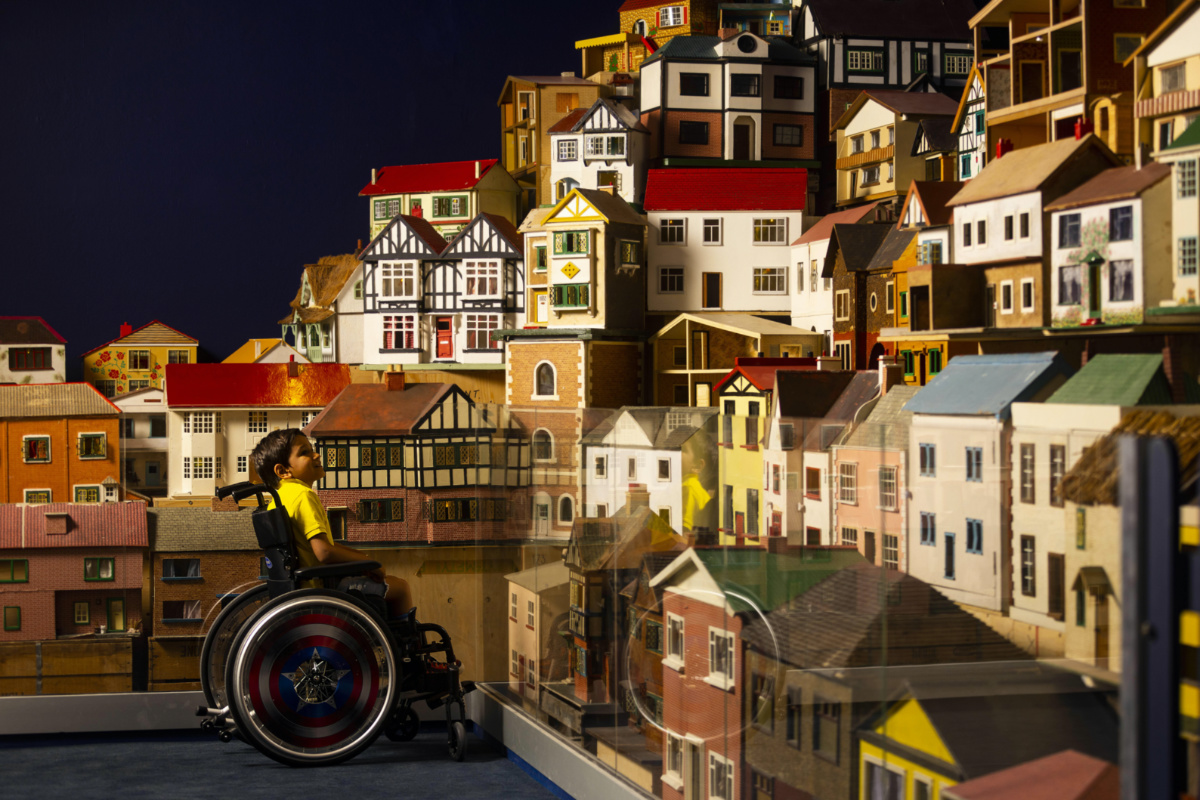
• The new Young V&A in Bethnal Green has opened its doors and a free summer festival takes place this weekend. Designed with and for children aged up to 14-year-olds, the Young V&A features more than 2,000 objects, dating from 2,300 BC to today, found across three galleries – ‘Play’, ‘Imagine’ and ‘Design’. The ‘Play’ gallery includes a ‘Mini Museum’ as well as a construction zone called ImaginationPlayground in which children can build dens, The Arcade in which they can explore Minecraft worlds and Adventure in which they can create stories inspired by objects on show. The ‘Imagine’ gallery features a new performance space, portraits of local children and luminaries such as Quentin Blake, Kenneth Branagh and Linda McCartney, while ‘Design’ showcases innovative objects and case studies that explore how things are designed, made and used, and the ways in which design can change the world. Among the objects on show at the museum is everything from a life-size Joey the War Horse puppet to a Microline car suspended from the ceiling, Harry Potter’sNimbus 2000 broomstick, Christopher Reeve’s original Superman costume and a large-scale installation of doll’s houses – Place (Village) – by Rachel Whiteread. Meanwhile, the free Summer Festival, which takes place on Saturday and Sunday, invites visitors to explore the museum as well as join in free and creative activities and see performances from young talent including Britain’s Got Talent finalists IMD Legion, the east London-based Grand Union Orchestra, and hula-hoop performance group Marawa’s Majorettes. There’s also the chance help create a large-scale art installation with Leap then Look. For more see vam.ac.uk/young.
• A major new exhibition celebrating contemporary African photography has opened at the Tate Modern. Featuring works by 36 artists, A World in Common: Contemporary African Photography is spread across seven thematic sections and highlights contemporary perspectives on cultural heritage, spirituality, urbanisation and climate change. As well as illuminating alternative visions of Africa’s many histories, cultures and identities, the display also explores the rise of studio photography across the continent during the 1950s and 1960s – a time when many African nations gained independence – before moving on to document the expansion and transformation of cities today as well as exploring themes of migration and climate activism. Runs until 14th January, 2024. Admission charge applies. For more, see tate.org.uk.
• Celebrated 20th century violinist and conductor Yehudi Menuhin has been honoured with an English Heritage Blue Plaque at his former home in Belgravia. The six-storey house at 65 Chester Square, built by Thomas Cubitt in 1838, was where Menuhin lived and worked for the last 16 years of his life. The lower-ground floor vaults provided space for his collection of violins while an open space on the fourth floor served as his studio, a place which hosted much of his teaching and mentoring and where he also practiced yoga – including his famous headstand.
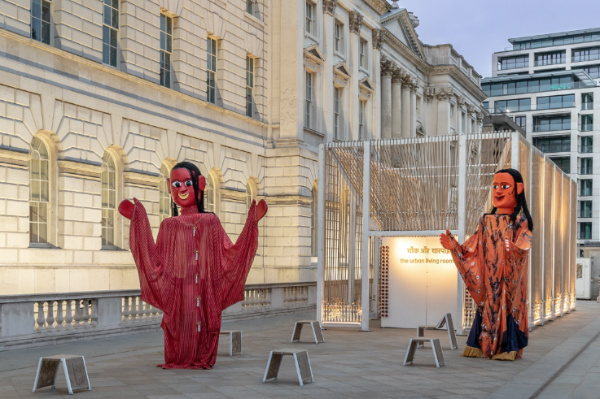
The Indian Pavilion at the London Design Biennale. PICTURE: Courtesy of London Design Biennale.
• The almost month-long London Design Biennale kicks off at Somerset House today under the theme of ‘The Global Game: Remapping Collaborations’. The fourth edition of the biennale is artistically directed by the Nieuwe Instituut – the Dutch national museum and institute for architecture, design and digital culture – and takes over the entirety of Somerset House. Among the exhibits is the India pavilion (pictured above) featuring a multi-sensory evocation of the essence of a contemporary Indian city chowk – an open market at the junction of streets – through the visual metaphor of a charpai – a traditional woven daybed, Malta’s large-scale ‘village-square’ installation that merges traditional city planning with the Phoenician-Maltese tradition of fabric production and dyeing of the multiple colours of Phoenician purple, the Ukrainian Pavilion which features am interior construction symbolising the country’s industrial, natural resource, and creative richness and a series of external projects which tell stories about new design collaborations in times of crisis for Ukraine and the vital role of design in creating new progressive connections. There’s also the chance to see the Ai-Da Robot, the world’s first humanoid robot artist, which will make history by showing her unique ability to design objects. Running alongside is the EUREKA exhibition which will share design-led innovation from leading research centres. Runs until 25th June. Admission charge applies. For more, see www.somersethouse.org.uk/whats-on/london-design-biennale-eureka-2023.
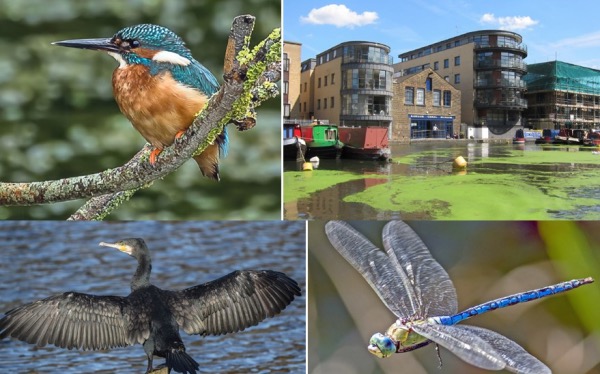
London canal wildlife. PICTURES: Courtesy of the London Canal Museum
• A new exhibition highlighting the flora and fauna of London’s canals has opened at the London Canal Museum in King’s Cross. Many of the canals were derelict by the end of the 20th century but have received a new lease of life in recent times as leisure destinations. These days, they provide a “highway” for fauna including birds, fish and mammals to move in and out of the capital, some of which is showcased in this new display. Entry with general admission and for an extra fee, guided narrowboat trips along The Regent’s Canal are available on selected days. For more, see www.canalmuseum.org.uk.
• Princess Sophia Duleep Singh, a suffragette, daughter of the last Maharajah of the Punjab, and god-daughter to Queen Victoria, has been commemorated with an English Heritage Blue Plaque. The plaque marks Faraday House in Hampton Court, granted to the princess and her sisters as a grace and favour apartment by Queen Victoria. Also known as ‘Apartment 41’, the property – which was named after scientist Michael Faraday – was home to Princess Sophia for more than 40 years and her base when she was campaigning for women’s suffrage. For more, see www.english-heritage.org.uk/visit/blue-plaques/.
• The ‘Polar Silk Road’ – a channel opened up thanks to melting Arctic Sea ice – is the subject of a new exhibition at the Natural History Museum. Gregor Sailer: The Polar Silk Road features 67 photographs taken by acclaimed Austrian artist and photographer Gregor Sailer showcasing manmade structures – from isolated research centres to Icelandic geothermal power stations – captured across four countries in the Arctic circle. There’s also a short film discussing the impacts of the climate crisis. The exhibition is free to visit. For more, see www.nhm.ac.uk/visit/exhibitions/the-polar-silk-road.html.
Send all items for inclusion to exploringlondon@gmail.com.
• Three of the City of London’s oldest charters go on display at the City of London Heritage Gallery on Saturday as part of a series of events commemorating the coronation of King Charles III. On display will be the William Charter, which, drawn up in 1067 following the coronation of King William the Conqueror, was the earliest known royal document in Europe to guarantee the collective rights of all people in a town and not just a select few. Also to be seen is the Shrievalty Charter, which, issued by King John in 1199, confirms the rights of Londoners to elect their own sheriffs, and the Mayoralty Charter, which, also issued by King John – this time in 1215, confirmed that the Mayor of London could also chosen by Londoners with the proviso that they were publicly presented. Visitors can also see the beautifully illustrated Cartae Antiquae which records charters and statutes covering laws enacted from the reign of Edward III (1327 onwards) to the accession of Henry VII in 1485 and was used as an essential reference tool by City officials, as well as prints of the 19th century coronations of Queen Victoria, King William IV and King George IV. Admission is free but booking is recommended. Runs until 5th October. For more, see www.cityoflondon.gov.uk/events/heritage-gallery-exhibition.
• Other events marking the coronation kick off in the City of London in the coming week. Among the extensive list of activities is a pop-up well-being garden in Seething Lane where you can pose for pictures with a floral crown installation, a guided walking tour of the City entitled ‘1000 Years of Royalty – the Best, the Worst and the Very Horribilus’, and a “Cockney knees-up” with Pearly King and Pearly Prince at Leadenhall Market. For more details and the full list of events, head to www.cityoflondon.gov.uk/events/coronation.
• A new exhibition commemorating the expansive career of Sir Christopher Wren opens today in St Paul’s Cathedral – the extraordinary building designed by Wren to replace the medieval cathedral destroyed in the Great Fire of London in 1666 Part of a series of events marking the 300th anniversary of the death of Sir Christopher in 1723, Sir Christopher Wren: The Quest for Knowledge explores not only his early life and career as an architect but also his lesser-known contributions to the fields of mathematics, astronomy and physiology. The display, located in the north aisle of the crypt, features drawings, photographs and objects from the cathedral’s collections. Entry to the exhibition is included in general admission. For more, see www.stpauls.co.uk/whats-on/exhibition-christopher-wren-quest-for-knowledge.
• The Pre-Raphaelite model and artist, Marie Spartali Stillman, has been honoured with an English Heritage Blue Plaque at what was her family home in Battersea. It was while living at The Shrubbery – a 1770s Grade II-listed property now located on Lavender Gardens – that Stillman first modelled for Pre-Raphaelite artists. Tutored by Ford Madox Brown, she went on to become one of a small number of professional women artists in the late 19th century, creating more than 150 works over a period spanning 50 years. Stillman is the first female Pre-Raphaelite artist and one of only very few female artists to receive a Blue Plaque. For more, see www.english-heritage.org.uk/visit/blue-plaques/.
Send all items for inclusion to exploringlondon@gmail.com
• London’s annual St Patrick’s Day Parade will be held on Sunday with more than 50,000 people expected to take part. The festivities will kick off at noon with a spectacular parade featuring Irish marching bands, dancers and pageantry which will wind its way from Green Park through Piccadilly Circus to Trafalgar Square. From noon until 6pm, Trafalgar Square will feature performances from the likes of Sharon Shannon & Band, Celaviedmai, The Craicheads, Celtic Youth Orchestra, Biblecode Sunday’s, and AIS as well as the Maguire O’Shea School of Dance and spoken word artist Leon Dunne. There will also be family-friendly workshops run by Irish youth creative programme Junk Kouture, a selection of food and drinks stalls including demonstrations by celebrity chef Anna Haugh and stalls where you can learn about Irish culture and community staffed by representatives of the Irish Cultural Centre, London Irish Centre, Irish in Britain, Irish Film London and London Gaelic Athletic Association. For more, check out www.london.gov.uk/events/st-patricks-festival-2023.
• London’s first female mayor, Ada Salter, and Welsh philosopher and preacher Dr Richard Price have both been honoured with English Heritage Blue Plaques. A social reformer and activist, Salter became mayor of Bermondsey in 1922 and so became the first female mayor of a London borough as well as the first Labour woman to be elected as a mayor in Britain. The plaque has been placed on 149 Lower Road in Rotherhithe, the Women’s House of the Bermondsey Settlement where Salter lived in the late 1890s. Price, meanwhile, is considered to be one of the greatest Welsh thinkers of all time and, as well as a preacher and philosopher, was also a pioneer of actuarial science. A plaque has been placed on a red brick house at 54 Newington Green which dates from 1658 and is believed to be the oldest surviving terrace in London. Price, who was born 300 years ago this year, lived in the house from 1758 to 1787 and while there wrote letters to the likes of Benjamin Franklin and Thomas Jefferson with whom he enjoyed close friendships. For more, see www.english-heritage.org.uk/visit/blue-plaques/.
• Joseph Wright’s painting A Philosopher Giving That Lecture on the Orrery in Which a Lamp is Put in Place of the Sun has gone on show at the Foundling Museum. The painting is at the heart of Seeing the Light, an exhibition which explores the connections between Wright, who hailed from Derby, his large network of friends and acquaintances, and key people in the Foundling Hospital’s history as well as objects in the museum’s collection. This includes the story of the founding of the Lunar Society. Admission charge applies. Runs until 4th June. For more, see https://foundlingmuseum.org.uk/event/seeing-the-light/.
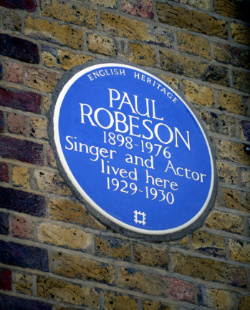
Walk the streets of London and chances are you’ll soon come across an English Heritage Blue Plaque commemorating someone famous.
There are now more than 990 Blue Plaques in London, commemorating everyone from diarist Samuel Pepys to writer Virginia Woolf and comedian Tony Hancock.
An English Heritage Blue Plaque commemorating singer and actor Paul Robson. PICTURE: Brett Jordan/Unsplash
The scheme was started in 1866 by the Society of Arts (later the Royal Society of Arts) having been proposed by MP William Ewart three years before. The first two plaques were erected in 1867 – one commemorating poet Lord Byron at his birthplace, 24 Holles Street in Cavendish Square (although this property was later demolished) and the other commemorating Napoleon III in King Street, Westminster (this is now the oldest survivor of the scheme).
Thirty-five years – and 35 plaques – later, the London County Council took over the scheme. It was this body that standardised the plaque’s appearance (early plaques come in various shapes and colours) and while ceramic blue plaques were standard by 1921, the modern simplified Blue Plaque didn’t appear until 1938 when an unnamed student at the Central School of Arts and Crafts, who was paid just four guineas for their troubles, came up with what is now an iconic design.
In 1965, the LCC, having created almost 250 new Blue Plaques, was abolished and its successor, the Greater London Council, took over the scheme, expanding its area of coverage to includes places like Richmond, Redbridge and Croydon. In 1984, the GLC appointed artisan ceramicists Frank and Sue Ashworth of London Plaques to make the Blue Plaques (and they continue to do so).
The GLC placed some 262 Blue Plaques before, in 1986, English Heritage took over management of the scheme. Since then it’s placed more than 360 plaques.
The plaques, which are 495mm (19½ inches) in diameter and 50mm (two inches) thick, are slightly domed in a bid to encourage self-cleaning in the rain.
Anyone can propose a subject for a new plaque – but generally only one plaque is erected per person (although there have been some exceptions to this), only a maximum of two plaques are allowed per building (there are 18 buildings with two), and proposals, if turned down, must wait 10 years before they are reconsidered.
In addition, new Blue Plaques are only erected a minimum of 20 years after the subject’s death, the building on which one is placed must “survive in a form that the commemorated person would have recognised, and be visible from a public highway”, and buildings which may have many different personal associations, such as churches, schools and theatres, are not normally considered.
The Blue Plaques panel meet three times a year to decide on proposals. Among those currently serving on the 12 person body are architectural historian Professor William Whyte, who chairs the panel, award-winning journalist and author Mihir Bose, Emily Gee, regional director for London and the South East at Historic England, and, Susie Thornberry, assistant director at Imperial War Museums.
The plaques don’t confer any legal protection to buildings but English Heritage says they can help preserve them through raising awareness.
Recently unveiled plaques have commemorated pioneering social research organisation Mass-Observation, lawyer Hersch Lauterpacht – who played a key role in prosecuting the Nazis at the Nuremberg trials, and, Dadabhai Naoroji, an Indian Nationalist and the first Indian to win a popular election to Parliament in the UK. Among those being unveiled this year are plaques commemorating anti-racist activist Claudia Jones, suffragette Emily Wilding Davison and Ada Salter, the first female mayor of a London borough.
English Heritage’s Blue Plaques scheme isn’t the only one commemorating people in London. Others include the City of London’s Blue Plaques scheme (there is only one English Heritage Blue Plaque in the City of London – it commemorates Dr Samuel Johnson), Westminster City Council’s Green Plaques and Heritage Foundation plaques which commemorate figures who worked in entertainment.
The last residence of Sigmund Freud, the founder of psychoanalysis, is located in Hampstead and is now a museum dedicated to his work and that of his daughter, pioneering child psychoanalyst Anna Freud.
The Freuds moved into the property at 20 Maresfield Gardens (having initially briefly stayed at a flat at 39 Elsworthy Road, Primrose Hill) in September, 1938, having left their home in Vienna to escape the Nazi annexation of Austria earlier in the year.
The house dates from 1920 and was built in the Queen Anne Revival Style. A small sun room was added a year after to the rear of the property.
Freud finished his final works Moses and Monotheism and An Outline of Psychoanalysis while at the property and also saw patients there as well as some high profile visitors including Princess Marie Bonaparte, writer HG Wells and literary couple Leonard and Virginia Woolf. Already aged in his 80s when they moved in, he died in the home just a year after on 23rd September, 1939. But his daughter Anna remained in the property until her death in 1982.
As per her wishes, it was subsequently turned into a museum and opened to the public in July, 1986, as The Freud Museum.
Among the rooms which can be visited today are Freud’s study, the library, hall and dining room but some areas – such as Anna Freud’s consulting room – are used as offices and not open to the public.
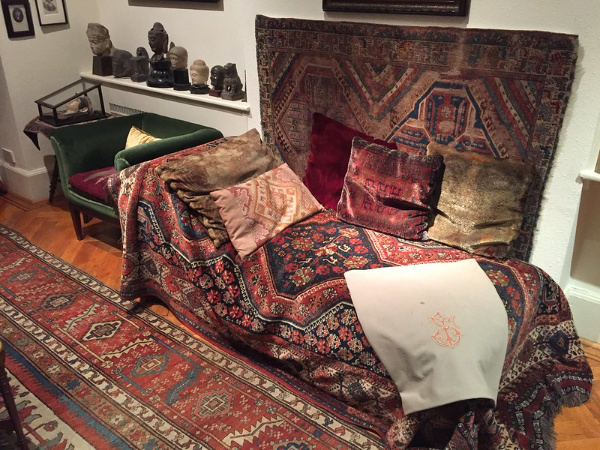
The star sight inside is undoubtedly Freud’s famous couch. Located in the study, it was originally the gift of a patient, Madame Benvenisti, in 1890, and is covered with a Qashqa’i carpet which Freud added.
Other items which can be seen in the house include several paintings collected by Freud and a series of photographs by Edmund Engelman which depicted Freud’s apartment in Vienna just weeks before he fled. There’s also a portrait of Freud by Salvador Dali who visited him in London, his collection of antiquities and his painted Austrian furnishings as well as many mementoes related to Anna Freud.
The premises also hosts temporary exhibitions and a range of other events.
The garden outside – much loved by the Freuds – has been left largely as Sigmund Freud would have known it.
The house is one of the rare properties in London which features two English Heritage Blue Plaques – one commemorating Sigmund and the other Anna.
There’s a famous statue of Sigmund Freud by Oscar Nemon just a couple of minutes walk away at the corner of Fitzjohns Avenue and Belsize Lane.
WHERE: The Freud Museum, 20 Maresfield Gardens, Hampstead (nearest Tube stations are Finchley Road, Finchley Road & Frognal and Belsize Park); WHEN: 10:30am to 5pm, Wednesday to Sunday; COST: £14 adults/£12 concessions/£9 young persons (aged 12 to 16, under 12s free); WEBSITE: www.freud.org.uk.





 Exploring London