Around London – Design Festival in full swing; museum acquires rare merchant figure; Olympic medals on display; and, remembering Polish, Czech and Slovak airmen…

• The London Design Festival is in full swing in London this week with more than 250 events taking place across the city over its 10 days. Launched last Saturday, the festival runs until Sunday and there’s still plenty of time to get involved. Among the highlights is a series of events, workshops and talks being held at the Victoria & Albert Museum (where you can also see 12 specially commissioned installations, one of which sees the museum’s grand entrance transformed with a sculptural form), a series of shows focusing on design in six London “design districts” – Brompton, Pimlico Road, Covent Garden, Fitzrovia, Clerkenwell and Shoreditch, and a broad program of ‘partner’ and ‘international’ events – everything from a festival featuring African-Caribbean design through to an exhibition of experimental chairs by the Danish Cabinetmaker’s Association. To find out more, simply head to www.londondesignfestival.com.

The Museum of London has announced the purchase of a rare 18th century clay figure of London druggist and tea merchant Thomas Todd. The figure, which was acquired with the help of the Art Fund and MLA/V&A Purchase Grant Fund,  is one of only two known portrait works attributed to the Chinese artists Chitqua on show in Britain. The figure, which is made from unfired clay held together by bamboo and brightly painted, was acquired from Todd’s great, great, great, great grand nephew, Thomas Todd, and will appear shortly in the Expanding City Gallery in the Galleries of Modern London. Based in Fleet Street, Pat Hardy, the museum’s curator of paintings, prints and drawings, says Todd “epitomised the kind of business acumen which ensured the growth of Britain’s industrial, mercantile and commercial empire in the eighteenth century”. For more, see www.museumoflondon.org.uk

The British Museum has opened an exhibition giving the public their first chance to see next year’s Olympic and Paralympic Games medals. Medals have been awarded at the Olympic Games since the first modern games were held in 1896. The latest Olympic medals were designed by jeweller David Watkins, for many years Professor of Goldsmithing, Silversmithing, Metalwork and Jewellery at London’s Royal College of Art, while the latest Paralympic Medals were designed by jeweller Lin Cheung, a senior lecturer for Jewellery Design at London’s Central Saint Martins College of Art and Design. The exhibition tells how, using minerals mined in the US and Mongolia (Rio Tinto is sponsoring the exhibition), the medals were produced at the Royal Mint in Llantrisant, South Wales. Mine to medals: the London 2012 Olympic and Paralympic Games medals runs until 9th September next year. Admission is free. For more, see www.britishmuseum.org.

• On Now: Brothers in Arms – Airmen of Poland and Czechoslovakia in the Battle of Britain & Beyond. The Royal Air Force Museum in Colindale, north London, is hosting an exhibition looking at the contribution of Polish, Czech and Slovak airmen in the Battle of Britain and their life afterwards. Curated in association with the Polish Institute of National Remembrance, the exhibition features drawings, archival film footage and sculpture as well as uniforms, diaries and combat reports. Opened by Poland’s Foreign Affairs Minister Radoslaw Sirkorski (who later attended the annual banquet held in honor of the Veterans of the Battle of Britain), it runs until 4th March, 2012. Entry is free. For more, visit  www.rafmuseum.org.uk.

LondonLife – London’s celebrates one year to the Olympic Games…

Late last month, London celebrated one year to go until the Opening Ceremony of the 2012 Olympic Games. The milestone was marked with a series of events in Trafalgar Square and at Olympic venues, including here at the Olympic Stadium in London’s east where the number one was mown into the grass. In Trafalgar Square, meanwhile, International Olympic Committee president Jacques Rogge formally invited the world’s athletes to attend the games and unveiled the medals while at the newly completed Aquatic Centre, British diver Tom Daley became the first athlete to break the waters. For more see www.london2012.com.

PICTURE: LOCOG

Around London – Yuri Gagarin honored; Londinium by iPhone; celebrating a year to the Olympics; and, British Museum hopes to buy Europe’s oldest book…

Earlier this month it was former US President Ronald Reagan’s turn to be honored with statue in Grosvenor Square. Last week it was the turn of former Soviet Cosmonaut Yuri Gagarin – the first man in space – to be so honored with a new statue located outside the British Council’s offices in the Mall (opposite another explorer, Captain James Cook). The statue, a gift of the Russian Space Agency Roscosmos, was unveiled to mark the 50th anniversary of Gagarin’s celebratory visit to London on 14th July, 1961, just three months after he completed his orbit of the earth on 12th April that year. The 3.5 metre high zinc alloy figure stands close to Admiralty Arch which was where Gagarin met then Prime Minister Harold MacMillan after he was invited to the UK by the National Union of Foundrymen. Among those present for the unveiling of the statue – which is a replica of one in the town of Lubertsy where Gagarin worked as a foundryman as a teenager – was Gagarin’s daughter Elena Gagarina, now director of the Kremlin Museums, and Vladimir Popovkin, head of the Russian Federal Space Agency. The British Council is running an exhibition, Gagarin in Britain, which looks at the life of Gagarin and the early Soviet space programme, until 14th September – among the objects on display is the first space suit and an ejector seat similar to that Gargarin used when he ejected out of Vostok 1. Entry is by registration only and space is limited – email gargarin@britishcouncil.org is you’d like to register for a place. For more information, see www.britishcouncil.orgPICTURE: Frank Noon/British Council

A new iPhone app which directs people to key sites in what was Roman London (Londinium) will go live on Monday. Developed by the Museum of London and the History Channel, Streetmuseum Londonium will bring to life some of the city’s most significant Roman sites, such as the amphitheatre at Guildhall, using “augmented reality video” which will overlay scenes of Roman London over the modern city while soundscapes will allow users to listen to a ritual at the Temple of Mithras or traders at the forum. In addition, users will be able to ‘digitally excavate’ Roman artifacts including leather bikini briefs and an ancient manicure set. Navigation to these “immersive experiences” will be via a specially created new map of Roman London which will be superimposed on a modern map of the capital, allowing users to see how the city has changed. The launch follows the earlier creation of the Streetmuseum app which guides people to more than 200 sites across the city. More than 200,000 people from across the world have so far downloaded this. Streetmuseum Londinium will be available free to download from 25th July. See www.museumoflondon.org.uk/apps for more.

London will mark one year to go until the Olympic Games next Wednesday with a ceremony in Trafalgar Square which will be broadcast live on BBC1. Among those present with be the International Olympic Committee (IOC) President Jacques Rogge, London Organising Committee of the Olympic and Paralympic Games (LOCOG) chairman Sebastian Coe and Mayor of London Boris Johnson. The event will also feature a live cross to the Aquatics Centre in Olympic Park where Olympic hopeful Tom Daley will make the first dive into the pool.

• The British Library hopes to raise £2.75 million to acquire the world’s earliest surviving intact European book, the 7th century St Cuthbert Gospel. A copy of the Gospel of St John, the book was buried with St Cuthbert on the isle of Lindisfarne in 698 and later found in the saint’s coffin in Durham Cathedral in 1104. The National Heritage Fund Memorial has already awarded £4.5 million to obtain the St Cuthbert Gospel and the Art Fund and The Garfield Weston Foundation have donated £250,000 each. The book has been on long-term loan to the library since 1979 and is regularly on view in the Sir John Ritblat Treasures Gallery. The library was approached last year and given first option to acquire the text after the Society of Jesus (British Province) decided to sell it. A price of £9 million has been agreed, of which £2.75 million remains outstanding. For more, see www.bl.uk.

Around London – Website to showcase UK’s oil paintings; Arctic explorer John Rae gets Blue Plaque; sharing experiences of kindness; and Toulouse-Lautrec and Jane Avril hit the Courtauld…

• A new website has been launched to showcase the UK’s vast national collection of oil paintings. While the website, which is a partnership between the BBC, the Public Catalogue Foundation, and participating collections and museums, currently hosts around 60,000 works, it is envisaged that by the end of 2012 it will carry digitised images of all 200,000 oil paintings in the UK (in an indicator of how many there are, the National Gallery currently has around 2,300 oil paintings, about one hundredth of all those in the nation). The works on the site will eventually include almost 40,000 by British artists. The 850 galleries and organisations participating so far include 11 in London – among them the National Gallery, the Tate Gallery, the Victoria and Albert Museum, the Bank of England, the Imperial War Museum and Dr Johnson’s House. For more, see www.bbc.co.uk/arts/yourpaintings/

• Arctic explorer John Rae has had a Blue Plaque unveiled in his honor at his former home in Holland Park. Although his feats were relatively unsung in his lifetime, the explorer’s expeditions in the Canadian Arctic saw him travel 13,000 miles by boat and foot and survey more than 1,700 miles of coastline. He is also credited with having “signposted” the only north-west passage around America that is navigable without icebreakers. Rae, who died in 1893, lived at the property at 4 Lower Addison Gardens in Holland Park for the last 24 years of his life.

Transport For London is calling on Londoners to share experiences of “kindness” that they have witnessed or participated in while travelling on the Underground. Artist Michael Landy has created a series of posters which are calling on people to submit their stories. Some of the stories will then be shown at Central Line stations (the first four posters go up on 23rd July at stations including Hollard Park, Holborn and Liverpool Street). For more, go to www.tfl.gov.uk/art.

On the Olympic front, the City of London Corporation has announced Tower Bridge will be bedecked with a set of giant Olympic Rings and the Paralympic Agitos during the 45 days of next year’s Games. Meanwhile, the Corporation has also unveiled it will host next week the launch of a London-wide campaign to get people involved in sport and activity in the lead-up to the Games. More to come on that.

On Now: Toulouse-Lautrec and Jane Avril Beyond the Moulin Rouge. The Courtauld Gallery, based at Somerset House, is running an exhibition celebrating the “remarkable creative partnership” between Jane Avril, a star of the Moulin Rouge in Paris during the 1890s, and artist Henri de Toulouse-Lautrec. Lautrec created a series of posters featuring Avril which ensured she became a symbol of Lautrec’s world of “dancers, cabaret singers, musicians and prostitutes”. Runs until 18th September. See www.courtauld.ac.uk for more.


Around London – Captain Kidd at Docklands; London’s Olympic Torch Relay path; St Giles’ seedy past; speech therapist Lionel Logue honored; and, The Seven Seas at Selfridges…

The true story of Captain Kidd and an exploration of London’s links with piracy is the focus of a new major exhibition at the Museum of London Docklands. Pirates: The Captain Kidd Story features original artefacts dating from 300 years ago when London was a site of pirate executions and tells the story of the infamous Captain Kidd’s life until his execution at Wapping’s Execution Dock. Among the artefacts is the original costume worn by actor Johnny Depp as he played Captain Jack Sparrow in the film Pirates of the Caribbean. The exhibition, which opens tomorrow and runs until 30th October, is being held in conjunction with a series of pirate related events including an adults-only pirate night on 27th May where you have the chance to sample some genuine “pirate drink” and take part in pirate speech lessons. Admission charges apply. For more information, visit the Museum of London Docklands website www.museumoflondon.org.uk/Docklands/Whats-on/Exhibitions-Displays/Pirates.htm.

The path of London’s Olympic Torch Relay has been announced and will finish with a week long jaunt through London. The torch will arrive in Waltham Forest on 21st July next year and then pass through Bexley, Wandsworth, Ealing, Haringey and Westminster before its arrival at the Olympic Stadium on 27th July. To find out how to nominate someone to carry the torch or for more information on the relay, visit www.london2012.com/olympic-torch-relay.

• On Now: London’s Underworld Unearthed: the Secret Life of the Rookery. The seedy side of the St Giles Rookery, a once infamous quarter of the capital, is laid bare in this new exhibition at the Coningsby Gallery. Back in 1751, the area was known as “a pit of degradation, poverty and crime” known for its free-flowing gin. Artist Jane Palm-Gold has displayed 18th and 19th century artifacts found during the Museum of London Archaeology’s recent excavation of old St Giles (conducted prior to the construction of the recent Central St Giles development which now covers the site) alongside her paintings, building what has been described as a “multi-layered psycho-geography that both mesmerises and disturbs”. Runs until 3rd June at the Coninsby Gallery at 30 Tottenham Street (nearest tube station is Goodge Street). Admission is free. For more information, see www.coningsbygallery.com

Australian speech therapist Lionel Logue – known for having helped cure King George VI of his stammer, the story of which is told in the recent Oscar-winning film, The King’s Speech – has been honored with a green plaque by Westminster Council. The plaque was expected to be unveiled today at 146 Harley Street, where Logue, who is known to have used fees from wealthier client to subsidise free treatments for those who could not afford them, lived from 1926 until 1952. The plaque is one of 94 which Westminster Council has placed to mark buildings of particular significance for their association with people who have made lasting contributions to society.

• On Now: The Seven Seas at Selfridges in Oxford Street. Conceptual artist Beth Derbyshire’s seven minute video installation features seven films of seven different seas around the globe. On show as part of Project Ocean – an initiative by Selfridges and 20 environmental and conservation groups aimed at celebrating the ocean’s beauty and highlighting the issue of overfishing. Runs until 8th June. For more information, see www.selfridges.com.

LondonLife – The Olympic countdown…

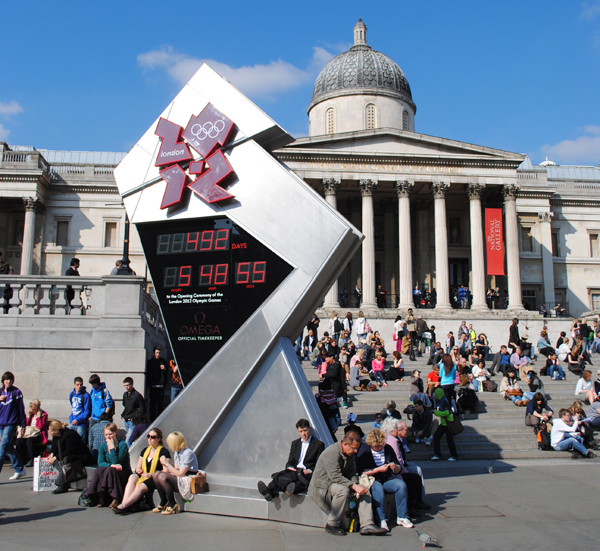
OK, it’s had some teething issues (stopping less than 24 hours after it was launched was one; being daubed with paint another). But the countdown to next year’s Olympics on the official 6.5 metre high clock located in Trafalgar Square continues unabated. The clock was unveiled in mid-March, 500 days before the start of the Games.

Around London – Transport depot open day; Brixton Windmill to reopen; and, St Pancras’ Olympic Rings

The London Transport Museum Depot’s ‘Open Weekend’ kicks off on Saturday. The weekend of events at the depot in Gunnersbury Lane, Acton, will feature model railways, the chance to ride the Acton Miniature Railway – on either a replica 1938 tube train or a Metropolitan steam train – as well as heritage buses, and talks by author and broadcaster Christian Wolmar on his books Engines of War and Subterranean Railway. There will also be events specifically for children. The depot is home to more than 370,000 objects including road and rail vehicles, posters and artwork, and ticket machines. Events run from 11am to 5pm (last entry 4pm). There is an admission charge. For more information, see www.ltmuseum.co.uk/whats-on/museum-depot/events

Brixton Windmill, the only surviving windmill in inner London, will be open to the public from 2nd May after a major restoration project. The Grade II* listed building, located in Windmill Gardens in Brixton, south-east London, was built in 1816 and was owned by the Ashby family until it ceased production in 1934. It was purchased by the London County Council in 1957 but had since fallen into disrepair. The restoration project, which kicked off in October last year, was partly funded by a £397,700 Heritage Lottery Fund grant obtained by Friends of Windmill Gardens and Lambeth Council. It is envisaged that interpretation materials will be installed and a programme of educational activities run at the site – including growing wheat and mixing flour – after the completion of the restoration work. See www.brixtonwindmill.org for more information.

Giant Olympic Rings were unveiled at St Pancras International earlier this month. The 20 metre wide and nine metre high rings, which have been suspended from the station’s roof, weigh 2,300 kilograms and are made from aluminium. Built in Hertfordshire over four weeks, they took seven nights to install. They’re the first in a series of Olympic Rings that will appear around the city in the lead-up to the 2012 Games. The Olympics was last held in London in 1948.