Lost London – St Benet Fink…

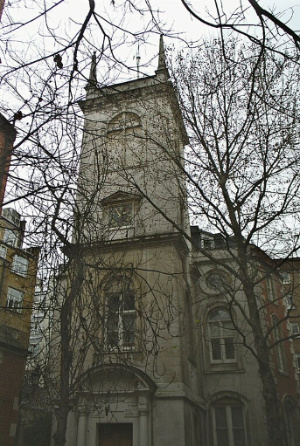
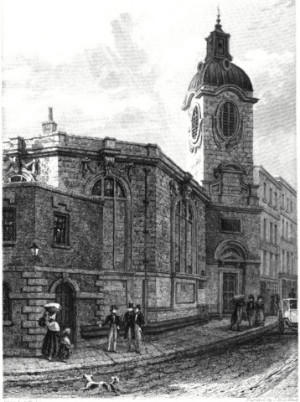
This unusually named church dates back to at least the 13th century and stood on what is now Threadneedle Street.

St Benet is a contraction of St Benedict (he who founded monastic communities in Italy in the 6th century) and this was once of four City churches dedicated to the saint before 1666. The word ‘Fink’, meanwhile, is a corruption of Finch and apparently referred to Robert Finch (or Fink) who paid for a rebuild of the church in the 13th century.

‘The Church of St Benet Fink’ (1839), seen in The Churches of London by George Godwin (1839).

The medieval rectangular church was among those destroyed in the Great Fire of 1666. Rebuilding commenced soon after, thanks in part to a £1,000 donation from a Catholic George Holman (he was rewarded with two pews and a place in the vault). The church was completed in 1675 apparently for a cost at just over £4,000.

Designed by Sir Christopher Wren, the church – due to the irregular shape of the site after the City decided to widen Threadneedle Street, was rebuilt on a decagonal plan, over which sat a dome, with a tower at the west end topped by a bell cage over which sat a ball and cross (apparently this latter feature was unique for a Wren church).

The church survived until the mid-18th century when the Corporation of London petitioned Parliament for permission to demolish the tower of St Benet Fink in order make way for an expanded Royal Exchange (which had burned down in 1838).

Following the demolition of the tower (over which there were some protests), a new entrance was cut into the west wall of the church but it proved less than ideal and the City of London was granted permission to knock down the rest of the church which took place in 1846.

The parish was merged with that of St Peter le Poer. Proceeds of the sale of the site were used to build St Benet Fink Church, Tottenham.

The furniture was sold off and paintings of Moses and Aaron that had formed part of the altarpiece are now in the chapel of Emanuel School in Battersea.

Famous associations include John Henry Newman, the future Catholic cardinal, who was baptised in the church on 9th April, 1801.

An office block now occupies the site. A City of London blue plaque marks the site.

This Week in London – Celebrating Tower Bridge’s 130th; Dame Peggy Ashcroft and Iris Murdoch honoured; modern art in Ukraine; and, Michael Rosen’ illustrators…

PICTURE: Sung Shin/Unsplash

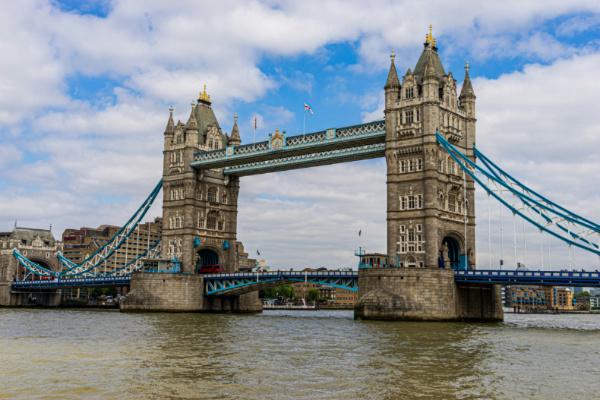
Tower Bridge marks its 130th birthday this year and to mark the event, the London Metropolitan Archives are hosting a free exhibition charting its history at the City of London’s Heritage Gallery. Designed by Horace Jones, the bridge opened on 30th June, 1894, and the display reflects on the splendour of that royal event as well as examining how and why the bridge was built, the engineering involved and how the bridge played a role in defending London during World War I. The exhibition runs until 19th September at the gallery, located in the Guildhall Art Gallery. Booking tickets is recommended. For more, see https://www.cityoflondon.gov.uk/events/tower-bridge-at-the-heritage-gallery.

Actor Dame Peggy Ashcroft and Dublin-born novelist Iris Murdoch have been honoured with English Heritage Blue Plaques. A leading figure in 20th century theatre, Dame Peggy has been remembered with a plaque on her childhood home in South Croydon. It was in what was then a “leafy market town” that at the age of 13 Peggy first dreamt of performing on the stage while standing outside the local grocers on George Street and to which she returned in 1962 to open a theatre named after her. The plaque honouring Murdoch, meanwhile, has been placed on 29 Cornwall Gardens, part of a Italianate stucco-fronted mid-Victorian terrace in Kensington where she occupied a top floor flat. Murdoch lived in London for more than 25 years and during that time would spend three days a week in the flat. For more, see www.english-heritage.org.uk/visit/blue-plaques/

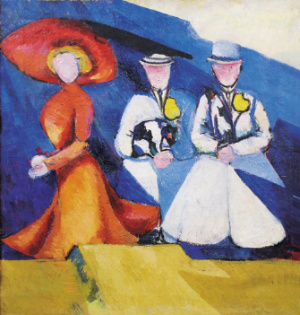
Alexandra Exter, ‘Three Female Figures’, 1909-10Oil on canvas, 63 x 60 cmNational Art Museum of Ukraine

The most comprehensive UK exhibition to date of modern art in Ukraine opens at the Royal Academy on Saturday. In the Eye of the Storm: Modernism in Ukraine, 1900–1930s, features some 65 works, many on loan from the National Art Museum of Ukraine and the Museum of Theatre, Music and Cinema of Ukraine. Artists represented in the display, which is divided into six sections, include such renowned names as Alexander Archipenko, Sonia Delaunay, Alexandra Exter and Kazymyr Malevych as well as lesser-known artists such as Mykhailo Boichuk, Oleksandr Bohomazov and Vasyl Yermilov. Runs in the The Gabrielle Jungels-Winkler Galleries until 13th October. Admission charge applies. For more, see www.royalacademy.org.uk.

The work of artists who have illustrated Michael Rosen’s many books for children are the subject of a new exhibition at the Heath Robinson Museum. Michael Rosen: The Illustrators explores Rosen’s books and the many artists who illustrated them over his 50 year career including the likes of Quentin Blake, Helen Oxenbury, Chris Riddell and Korky Paul. Among the works on show are original drawings for titles including We’re Going on a Bear HuntMichael Rosen’s Sad Book and Michael Rosen’s Book of Nonsense! Runs until 22nd September. Admission charge applies. For more, see https://www.heathrobinsonmuseum.org/.

Send all items for inclusion to exploringlondon@gmail.com.

LondonLife – Trooping the Colour…

King Charles III salutes. PICTURE: Sgt Donald C Todd/©MoD Crown Copyright 2021.

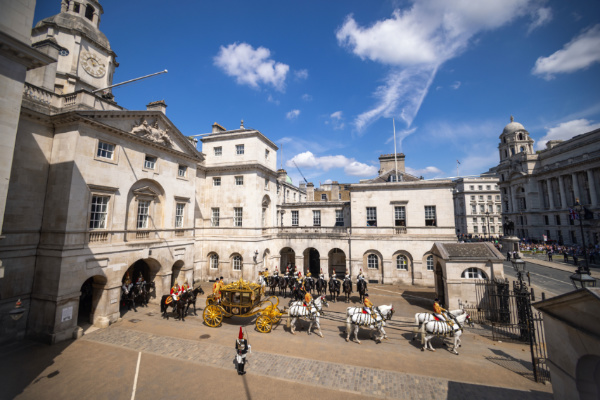
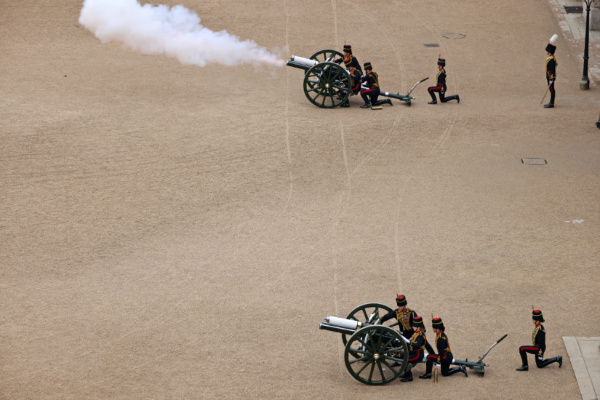
The King’s Birthday Parade took place in central London on Saturday featuring some 242 military working horses, 250 military musicians, 40 pipers and drummers, and more than 1,000 dual role soldiers of the British Army’s Household Division. The parade is a gift from the British Army’s Household Division to the King and is traditionally held on the second Saturday in June, regardless of the Sovereign’s actual date of birth.

Formations at Horse Guards. PICTURE: WO1 Rupert Frere, RLC/©MoD Crown Copyright 2021
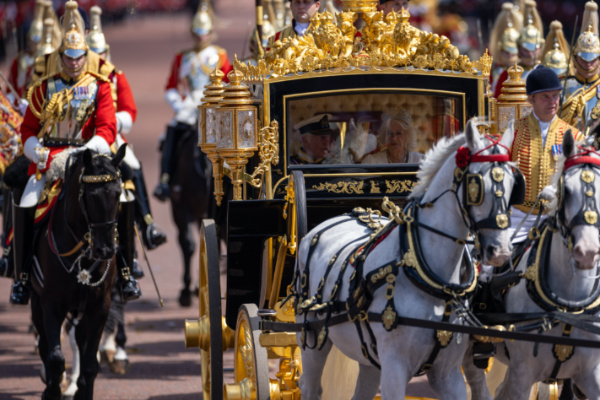
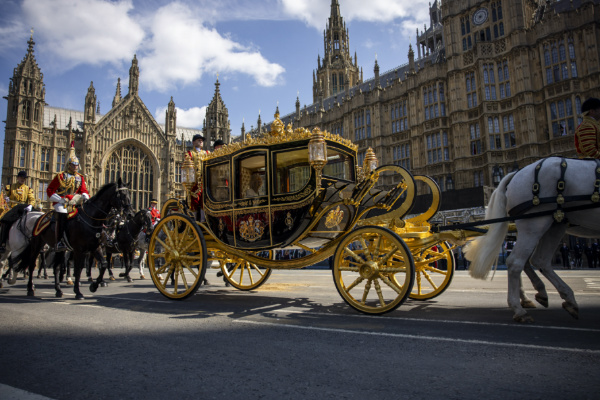
Participants in the King’s Birthday Parade. PICTURE: Sgt Donald C Todd/©MoD Crown Copyright 2021
King Charles III and Queen Camilla at Horse Guards. PICTURE: Corporal Danielle Dawson/© MoD Crown Copyright 2024
The Royal Family, including King Charles III and Queen Camilla, gather on the Buckingham Palace balcony to watch the Fly Past. PICTURE: Corporal Squires/©MoD Crown Copyright 2021
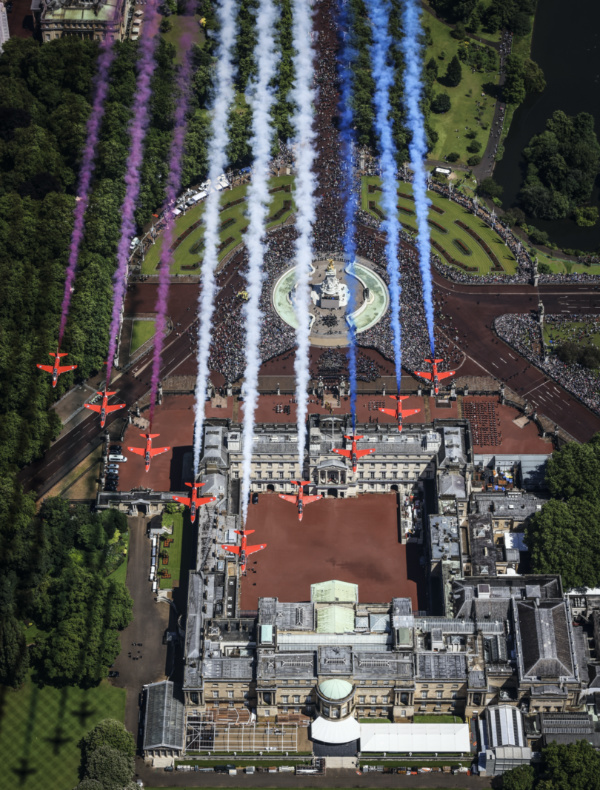
An aerial view of the Kings Birthday Fly Past featuring the Red Arrows over Buckingham Palace. PICTURE: AS1 Kirwan-Taylor/©UK MOD Crown Copyright 2024

10 significant (and historic) London trees…7. D-Day Tree…

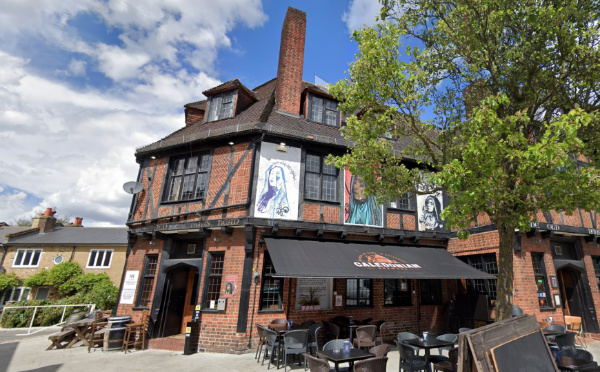
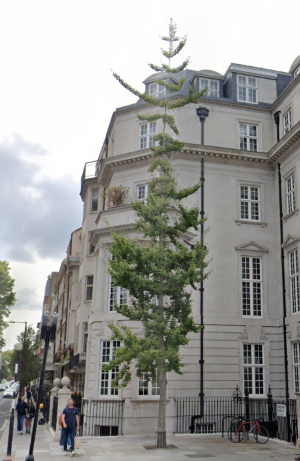
PICTURE: Courtesy of Google Maps

Nations, including the UK, have just marked the 80th anniversary of the D-Day landings in Normandy at a range of locations in France and England. But did you know London has its own “D-Day tree”?

The tree, a Ginkgo biloba or Maidenhair tree, is located outside number 22 in Grosvenor Square in Mayfair (on the corner with Upper Brooks Street). It was planted in 1994 to mark the 50th anniversary of the D-Day landings.

As well as the tree itself, the landings are commemorated with plaques around the base which provide the date of the landings and its code-name, Operation Overlord.

The location apparently relates to 20 Grosvenor Square being, for a time, the headquarters of Dwight D Eisenhower, Supreme Commander of the Allied Expeditionary Force launched on D-Day. There’s a plaque on the building commemorating his tenure.

In fact, the number of Americans working in the square – at locations including the US Embassy – led to it being known colloquially as ‘Eisenhower Platz’).

The tree was planted by the City of Westminster.

Note: There seems to be some conflicting information, not the least on a plaque in Bushy Park about Eisenhower’s connections with Grosvenor Square and Norfolk House in St James’s Square. We’ll be investigating further to clarify.

LondonLife – Dress rehearsal…

Members of the Household Division in London rehearse for the King’s Birthday Parade, known as Trooping the Colour. The Colonel’s Review is held one week before and saw some 250 musicians, 20 pipers, 240 military working horses, and almost 1,000 dual role soldiers of the British Army’s Household Division run through their paces on Saturday. Trooping the Colour will take place on 15th June.

Members of the Household Division are seen here in London today (08/06/2024), rehearsing for the King’s Birthday Parade. PICTURE: Sgt Donald C Todd © MoD Crown Copyright 2024
Members of the Household Division, including the regimental mascot Turlough Mor, an Irish Wolfhound, rehearse for the King’s Birthday Parade in The Mall. PICTURE: Sgt Donald C Todd
© MoD Crown Copyright 2024
The Irish Guards slow marching back to their positions after marching past Lieutenant General James Bucknall who took the salute at the event. PICTURE: Sergeant Rob Kane © MoD Crown Copyright 2024

Treasures of London – Waterloo Station Victory Arch…

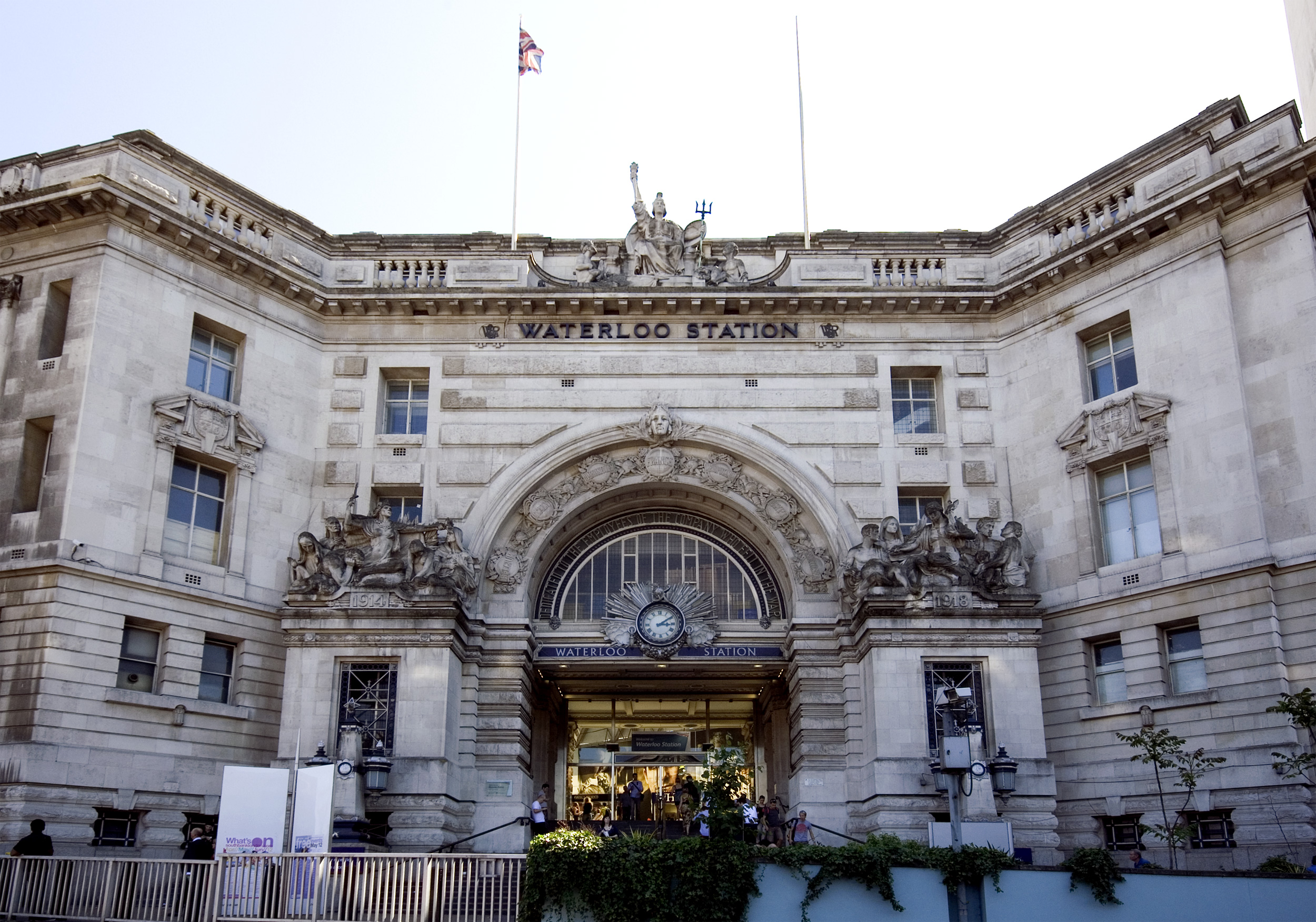
PICTURE: Prioryman (licensed under CC BY-SA 3.0)

Sitting over the main entrance to Waterloo Station is a Victory Arch which commemorates railway personnel who died in World War I and II.

There are several plaques located at the top of the steps under the arch commemorating those who died in the conflicts and among them, particularly notable this week as the world marks the 80th anniversary of D-Day, is one commemorating those who died in the Normandy landings.

The plaque was installed on the 50th anniversary of the landings – 6th June, 1994.

The arch was built as part of a station rebuild in the first couple of decades of the 20th century and added to the design following World War I. The new station was completed in 1922.

The now Grade II-listed memorial, the work of sculptor Charles Whiffen, features two sculptural groups located on either side – one dedicated to Bellona and dated 1914 and the other dedicated to Peace and dated 1918.

Set around a glazed arch are the names of countries where key battles were fought in the conflict and at the centre is a clock set within in a sunburst. Sitting above the arch is a depiction of Britannia holding aloft the torch of liberty.

As well as the D-Day plaque under the arch, a Roll of Honour commemorates the 585 London and South Western Railway employees who lost their lives in World War I. There is also a plaque commemorating the 626 men of the Southern Railway who died in World War II.

What’s in a name?…Barons Court…

View of Castletown Road in Barons Court. PICTURE: Courtesy of Google Maps

This district in west London doesn’t have anything to do with any particular baron but rather was named Barons Court by the late 19th century developer Sir William Palliser.

It apparently refers to the Court Baron, a form of manorial court which could be held in medieval times by any Lord of the Manor and is perhaps a nod to nearby Earl’s Court. It’s said by some that it may also be a reference to the Baronscourt estate in County Tyrone, Northern Ireland, where Sir William possibly had connections.

Many of the street names refer to members of the Palliser family or estates and the district, which lies between West Kensington and Hammersmith, features a Tube station which opened in 1905.

Barons Court did suffer bomb damage during World War II.

Landmarks include the London Academy of Music and Dramatic Art (LAMDA), housed in what was formerly a ballet school on Talgarth Road, the Queen’s Club tennis club, and the Margravine or Hammersmith Cemetery, which, laid out by architect George Saunders, opened in 1868.

This Week in London – Victorian London captured; and, contemporary art at the British Museum…

See a glimpse of London as it was during the Victorian era at a new exhibition opening at the London Metropolitan Archives. Lost Victorian City: a London disappeared features photographs, prints, watercolours and documents depicting buildings, horse-drawn transport, docks and various forms of entertainment along with artists’ views of the capital. Highlights include images taken in 1875 by the Society for Photographing Relics of Old London of the 17th century coaching inn, the Oxford Arms, which was demolished two years later, two images by Philip Henry Delamotte showing the moving of the Crystal Palace from Hyde Park to Sydenham following the Great Exhibition of 1851, and a photograph showing the public disinfects whose job was to remove all textiles after an infectious disease outbreak. The display can be seen at the Clerkenwell-based archives until 5th February next year. For more, see

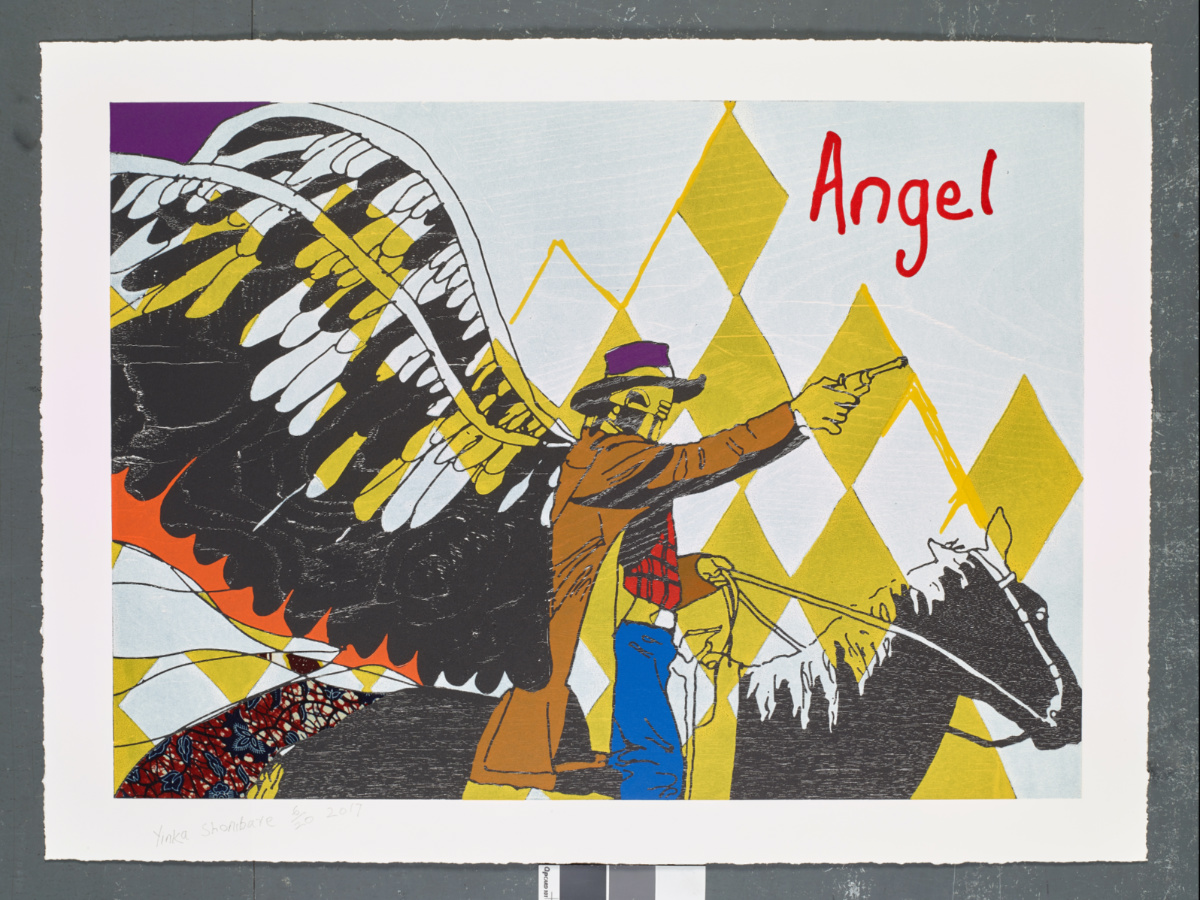
Yinka Shonibare CBE, Cowboy Angel V from the series Cowboy Angels. Colour woodcut and collage of Dutch wax batik fabric. Reproduced by permission of the artist.

An exhibition has opened featuring works of art acquired by the British Museum over the past two decades including works by David Hockney, Damien Hirst, Julian Opie, Yinka Shonibare and Cornelia Parker. Contemporary collecting: David Hockney to Cornelia Parker features around 100 works acquired since 2001. Many of the works, which span the period from the 1960s onwards, are being exhibited for the first time. Highlights include Hockney’s prints The Marriage (1962) and Henry Seated with Tulips (1976), Parker’s Articles of Glass and Jug Full of Ice from One Day This Glass Will Break (2015), Michael Craig-Martin’s CoathangerLight bulb and Watch from Drawings (2015); Caroline Walker’s colour lithograph Bathed (2018); Shonibare’s colour woodcuts Cowboy Angel I, II, V (2017) and Joy Gerrard’s Vigil/Protest (Westminster 14th March 2021), a 2023 drawing in Japanese ink. Runs until 29th September in Room 90. Admission is free. For more, see www.britishmuseum.org/david-hockney-cornelia-parker.

Where (was) London’s oldest…pizzeria?

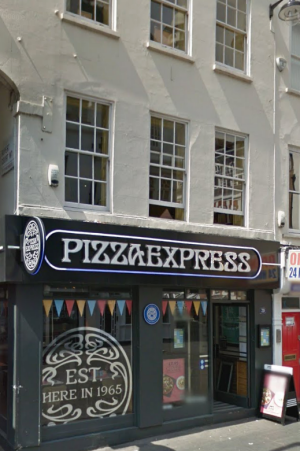
London’s first Pizza Express in Soho, taken prior to its closure in July, 2014. PICTURE: Google Maps.

While pizza had been available in London restaurants some time before, the first dedicated pizzeria is said to have been the first Pizza Express located in Wardour Street in Soho.

The premises on the corner of Rupert Court and Wardour Street was established by Peter Boizot, who has reportedly first discovered pizza while in Italy in the 1940s, and, having witnessed the appearance of pizzerias elsewhere in Europe, decided to bring the concept to London.

Opening its doors on 27th March, 1965, the establishment was modelled on Italian pizzerias. Boizot had partnered with Italian designer, Enzo Apicella, to create an authentic Italian experience which included an open kitchen, simple furnishings and a wine menu (he also brought in a pizza chef from Sicily).

While the concept apparently wasn’t an instant success, it soon did catch on and Pizza Express opened further branches across the city – the first in Coptic Street next to the British Museum in 1967.

Sadly the Wardour Street premises was among dozens that the chain closed during the coronavirus pandemic in 2020.

10 atmospheric ruins in London – 8. Coldharbour Gate…

Located within the outer walls of the Tower of London are the remains of some early 13th century fortifications built by King Henry III.

The foundations of Coldharbour Gate in the foreground beside the White Tower with the remnants of the Inmost Ward Wall beyond. PICTURE: Elizabethe (licensed under CC BY-NC-ND 2.0)

These include the foundations of Coldharbour Gate which once adjoined the south-west corner of the White Tower as well as the western wall of the Inmost Ward which ran down to the Wakefiekd Tower.

The gate was defended by two cylindrical turrets while the Inmost Ward Wall has arrow loops installed, allowing archers to fire down on attackers who had breached the outer fortifications.

The gate was later used as a prison. Alice Tankerville, who was charged with piracy on the River Thames, became one of the most famous prisoners housed there when, despite having apparently been chained to the wall, she escaped with the help of two guards in 1533 (she was recaptured just outside the Tower).

The gateway was demolished in about 1675 and lead from the roof taken to Greenwich where it was redeployed at the Royal Observatory.

Much of the wall was hidden away behind later buildings but was re-exposed after being bomb damaged during World War II.

Not much remains to be seen today but the foundations do evoke a sense of the royal palace in times past and serve as a reminder that the buildings we see at the Tower today are not all that has existed here.

Other ruins at the Tower of London include the remains of the Wardrobe Tower, which lies at the south-east corner of the White Tower. It is thought to have dated from 1190 and incorporates the base of a Roman bastion.

WHERE: Tower of London (nearest Tube station Tower Hill); WHEN: 9am to 5.30pm (last admission 3.30pm), Tuesday to Saturday; 10am to 5.30pm (last admission 3.30pm) Sunday to Monday; COST: £34.80 adults; £17.40 children 5 to 15 (family tickets available; discounts for online purchases/memberships); WEBSITE: www.hrp.org.uk/toweroflondon/.

10 atmospheric ruins in London – 7. London Wall, Noble Street…

There’s many remnants of the Roman and later medieval wall which once surrounded the City of London – the towering section at Tower Hill near the Tower of London no doubt the most famous.

PICTURE: Esther Dyson (licensed under CC BY-NC 2.0)

But there are several other stretches of the stone and brick wall left which evoke a sense of the structure it once was and the defensive role it played in protecting Londoners – among them is a substantial section of the wall located in Noble Street on the city’s western side.

The 80 metre long section of Roman and later medieval remains includes two internal turrets on what was the west side of the Roman Cripplegate fort (built between 120 and 150 AD) as well as a substantial bastion located at the southern end of the site.

The highest fragment of the Roman wall can be seen opposite Oat Lane, near the southern end of the site, while the highest section of the wall – which stands some 4.5 metres high and is mostly medieval – can be seen at the northern end of the site.

As well as reflecting the City’s Roman and medieval history, this section of wall also evokes a sense of the horrors of the Blitz.

Projecting eastward on the inside of the wall are party walls from World War II bomb-damaged and later demolished homes which once fronted onto Noble Street.

WHERE: Noble Street, London (nearest Tube stations are Barbican and Bank; WHEN: Anytime; COST: Free.

This Week in London – Underground shelters in wartime – then and now; new Ravenmaster at the Tower; and, ‘La Ghirlandata’ back at the Guildhall Art Gallery…

A new photographic exhibition exploring how Underground stations and metro systems provide shelter to citizens during periods of war, both now and in the past, opened at the London Transport Museum in Covent Garden last week. Echoes of the Blitz: Underground shelters in Ukraine and London features 70 images, including historical pictures from the museum’s collection as well as 38 contemporary photographs shot by six renowned, mainly Ukrainian, documentary photographers. The latter include photography showing ordinary Ukrainian citizens sleeping, waiting, cooking, washing clothes, caring for their pets and creating temporary make-shift homes in metro stations of Kyiv and and Kharkiv show alongside black and white archive images of Londoners taking refuge in Tube stations during World War II. The exhibition, which is being run in partnership with Berlin-based journalistic network n-ost, can be seen until spring next year. Admission charge applies. For more, see www.ltmuseum.co.uk.

A raven at the Tower of London. PICTURE: Kasturi Roy/Unsplash

A new Ravenmaster has been appointed at the Tower of London. Yeoman Warder Michael ‘Barney’ Chandler took up the role at the start of this month, 15 years after he first became a Yeoman Warder at the Tower. The Ravenmaster oversees a team of four responsible for the care of the Tower’s seven ravens which legend says must remain at the Tower to ensure its protection. The legend apparently goes back to at least the reign of King Charles II – when the King’s astronomer John Flamsteed complained that the resident ravens were impeding his work at the Tower and requested their removal, the King was told that if the ravens left the Tower then the Kingdom would fall (and so they remained). While the Yeoman Warders have longed cared for the ravens, the post of Ravenmaster was only created in the past 50 years and was first held by Yeoman Warder Jack Wilmington. Yeoman Warder Chandler, who became the 387th Yeoman Warder at the Tower when he was appointed in March, 2009, is only the sixth person to hold the office. For more, see www.hrp.org.uk/tower-of-london/.

One of the most popular paintings at the Guildhall Art Gallery is being reinstalled to mark International Women’s Day on Friday. Dante Gabriel Rossetti’s La Ghirlandata has been on loan – first to the Tate Britain and then to the Delaware Art Museum in the US – but is now being returned. The painting dates from 1873 and depicts a ‘garlanded woman’ playing an arpanetta and looking directly at the viewer. The muse for the woman is said to have been the actor and model, Alexa Wilding, while the two ‘angels’ in the top corners were posed by William and Jane Morris’ youngest daughter, May Morris. The City of London Corporation acquired the oil on canvas work in 1927. On Saturday, free family activities will be held at the gallery to mark the work’s return. For more, see www.thecityofldn.com/la-ghirlandata.

Send items to exploringlondon@gmail.com.
10 atmospheric ruins in London – 4. Spitalfields Charnel House…

Located under glass beneath a modern square just to the north-east of the line of the City of London’s walls are the ruins of a medieval building which once held human bones.

Charnel House detail. PICTURE: Ben Rimmer (licensed under CC BY-NC-ND 2.0)

Built on what had originally been a Roman burial ground, the medieval hospital known as St Mary Spital was constructed towards the end of the 12th century and a graveyard was located on the site for the burial of those who died there.

A small chapel was built on the site in about 1320, the crypt of which became a charnel house housing the bones of those remains disturbed when

The hospital, which had been run by Austin canons, was dissolved by King Henry VIII in 1539 and most of the bones removed. The crypt was later used as a house which was demolished around 1700 and later lost between the gardens of terraced houses.

The remains of the charnel house was discovered in the late 1990s during excavation works – complete with some 10,000 skeletons – and now lies under a glass floor in Bishop’s Square just to the west of Spitalfields Market (it can also be seen through a glass window in the basement level accessed via stairs in the square).

PICTURE: Matt Brown (licensed under CC BY 2.0)

Two statues can be seen inside the ruins – a greenish figure crouching over a prone purple-red figure. Installed in 2014, they are the work of David Teager-Portman and are called Choosing the Losing Side and The Last Explorer.

Spitalfields Chapel and Charnel House, Bishops Square, London, Spitalfields (nearest Tube station is Liverpool Street; nearest Overground is Liverpool Street and Shoreditch High Street).

What’s in a name?…Basinghall Street…

Looking north up Basinghall Street from Gresham Street. The buildings on the left are part of the Guildhall complex. PICTURE: Google Maps

This City of London street, which sits on the eastern side of the Guildhall complex, is named for the wealthy Basing (or Bassing) family who had a hall here in the 13th century.

The street, which links Gresham Street in the south to Basinghall Avenue in the north, has been the site of numerous prominent buildings including the medieval hall of the Weaver’s Company (demolished in 1856, having replaced an earlier hall which burnt down in the Great Fire of London in 1666, the hall is now located in Gutter Lane), the Cooper’s Company (demolished in 1867, the hall is now located in Devonshire Square) and the Girdler’s Company (destroyed in the Blitz in 1940; the hall is now located in Basinghall Avenue).

It was also the location of the Sir Christopher Wren-designed Church of St Michael Bassishaw until 1899 after it was seriously damaged when the crypt was being cleared of human remains in line with the orders of City authorities. The parish with united with St Lawrence Jewry.

Famous denizens included the goldsmith, banker and civil engineer Sir Hugh Myddelton, most renowned for his design of the New River scheme to bring clean water to the City, who, according to The London Encyclopaedia, would sit in the doorway of his office and smoke his pipe while chatting with the likes of Sir Walter Raleigh.

The family also gave their name to the City of London’s Bassishaw Ward.

10 atmospheric ruins in London – 2. St George’s Garrison Church…

This mid-18th century church in Woolwich was constructed to serve the soldiers of the Royal Artillery but was badly damaged when hit by a bomb during World War II.

View of the church apse with altar and mosaic. PICTURE: Kleon3 (licensed under CC BY-SA 4.0)

Designed by Thomas Henry Wyatt with the aid of his younger brother, Matthew Digby Wyatt, in the style of an Early Christian/Italian Romanesque basilica, the church was built between 1862 and 1863 on the orders of Lord Sidney Herbert, the Secretary of State for War.

It was among a number of buildings built to provide for the well-being of soldiers after a public outcry about their living conditions during the Crimean War.

The interior featured lavish decoration including mosaics said to have been based on those found in Roman and Byzantine monuments in Ravenna, Italy. Those that survive at the church’s east end – which include one of St George and the Dragon and others featuring a peacock and phoenix – are believed to have been made in Venice in the workshop of Antonio Salviati.

A mosaic featuring St George and the Dragon. PICTURE: Kleon3 (licensed under CC BY-SA 4.0)

The mural of St George formed part of a memorial to the Royal Artillery’s Victoria Cross recipients located in the church and paid for through public subscription in 1915. The interior also featured five tall stained glass windows which served as memorials to fallen officers.

Plaques on the perimeter walls record the names of soldiers killed in military conflict or Royal Artillery servicemen who died of natural causes. 

The church was visited by King George V and Queen Mary in 1928.

The church, which had survived a bombing in World War I, was largely destroyed on 13th July, 1944, when it was hit by a V1 flying bomb. Most of the interior was gutted in the fire that followed.

While plans to rebuild it after World War II were shelved, in 1970 it became a memorial garden with a roof placed over the church’s east end to protect the mosaics.

Services are still held in the Grade II-listed ruin, located opposite the Woolwich Barracks, and since 2018 it has been under the care of the Woolwich Garrison Church Trust.

WHERE: St George’s Garrison Church, A205 South Circular, Grand Depot Road, Woolwich (nearest DLR station is Woolwich Arsenal); WHEN: 10am to 1pm Sundays (October to March) and 10am to 4pm Sundays (April to September); COST: Free; WEBSITE: https://www.stgeorgeswoolwich.org.

Note that we’ve changed the title of this special series to allow us to explore a bit wider than the medieval period alone!

This Week in London – Life in the Roman army explored; clockwork treasures from China; and, Kew Gardens’ Orchid Festival…

A major new exhibition on life as a Roman legionary opens at the British Museum today. Legion: Life in the Roman army shares stories of real legionaries and shows how the army was as much an “engine of social change” as it was a war machine. More than 200 objects, many of which are on display in the UK for the first time, are on show including the world’s only intact legionary shield, on loan from Yale (pictured), and the oldest and most complete classic Roman segmental body armour, found in Kalkriese, Germany, in 2018. There are also the remains of a soldier found at Herculaneum, reunited with his belt and equipment for the first time outside of Italy, as well as the Crosby Garrett mask helmet – found in Cumbria in 2010, and a unique dragon standard found in Germany. The exhibition, which can be seen in the Sainsbury Exhibitions Gallery until 23rd June, also features a specially designed Horrible Histories themed trail of the exhibition with interactive family stations. Admission charge applies. For more, see www.britishmuseum.org.

More than 20 mechanical clocks collected by Chinese emperors are being displayed together for the first time in the UK in a new exhibition opening today at the Science Museum. Among those on display in Zimingzhong 凝时聚珍Clockwork Treasures from China’s Forbidden City is the ‘Pagoda Zimingzhong’ which, was made in London in the 1700s during the Qing Dynasty in China, ‘Zimingzhong with Turbaned Figure’ which mixes imagery associated with China, Japan and India to present a generalised European view of an imagined East, and the Zimingzhong with mechanical lotus flowers’, which, when wound, reveals a flock of miniature birds swimming on a glistening pond as potted lotus flowers open. Runs until 2nd June. Visitors are invited to pay what they can to visit the exhibition, with a minimum ticket cost of £1 per person. For more, see www.sciencemuseum.org.uk/see-and-do/zimingzhong.

Kew Gardens’ Orchid Festival returns from this Saturday, this year drawing inspiration from the unique flora and fauna of Madagascar. The display features a specially commissioned film showcasing the beauty of Madagascar – the world’s fourth largest island – as well as themed floral displays and living installations in the Princess of Wales Conservatory. The latter include ‘Lovers Baobab’ on the waterlily pond, floral sculptures recreating some of Madagascar’s most iconic wildlife, including ring-tailed lemurs, chameleons and the aye-aye, the world’s largest nocturnal primate, and a small selection of Madagascan orchids including Angraecum sesquipedale (also known as Darwin’s orchid). Visitors will also hear Malagasy music composed by the Boriza Borothers and be able to purchase food made according to a range of authentic Malagasy recipes, thanks to a menu curated by Malagasy chef Lilia Andrianovy of Lilia’s Kitchen. Orchids After Hours will also return for this year’s festival. Runs until 3rd March. Admission charge applies. For more, see www.kew.org.

Send all items for inclusion to exploringlondon@gmail.com

10 atmospheric ruins in London – 1. The Church of St Alphege London Wall…

Ruins of St Alphege London Wall. PICTURE: The wub (licensed under CC BY-SA 4.0)

The ruins of this church – which now sit in a public garden – are actually the remains of the second church in the vicinity.

Dedicated to the murdered Archbishop of Canterbury (there’s a similarly named church in Greenwich), the first St Alphege (also known as St Alphege London Wall and St Alphege Cripplegate) dated from at least the 11th century but was closed and demolished during the Dissolution (the other part of its name comes from its location abutting London Wall).

The second church started life as the priory church of the nunnery of St Mary-within-Cripplegate which later became a hospital before it too was closed in the Dissolution.

The church, however, became the parish church and, subsequently repaired, it survived the Great Fire of 1666. Further repairs followed and a more comprehensive rebuilding in the 18th century (with the medieval tower retained).

But by 1900, parts of the church were in a poor state and after the church was damaged during an air raid in World War I, the parish was amalgamated with St Mary Aldermanbury (the combined parish was later united with St Giles Cripplegate) and it was eventually mostly demolished in the early 1920s.

The medieval tower remained but was gutted by fire in 1940. Its ruins were subsequently surrounded by a small public garden. Further restoration work was done as part of works to install a raised walkway in 2018-19.

The remains of the church – which include the tower and arches on three sides – are Grade II-listed and while it’s surrounded these days by modern office buildings, it remains a small piece of a bygone era.

The gardens are free to visit.

Happy New Year!

PICTURE: studio-fi/iStockphoto

Wishing all our readers a great start to 2024!

Have a Merry Christmas!

Wishing you a safe and happy Christmas and New Year.

PICTURE: SHansche/iStockphoto

Keep an eye out for our annual countdown of the most popular posts for 2023 next week!

LondonLife – St Pancras ‘book tree’…

PICTURE: JuliaC2006/Flickr (licensed under CC BY 2.0)

A Christmas tree with a difference, this year’s festive display at St Pancras International features a 12 metre high ‘book tree’ with a winding staircase and 270 shelves adorned with over 3,800 hand-painted books, including classics like Charles Dickens’ A Christmas Carol and CS Lewis’ The Lion, The Witch, and the Wardrobe. There’s also a series of nooks where passerby can ensconce themselves and listen to a five minute excerpt from an audio book. The display is the result of a collaboration with bookseller Hatchards.