This Week in London – London’s World War I transport in focus; Museums at Night; and, Tony Hancock remembered…

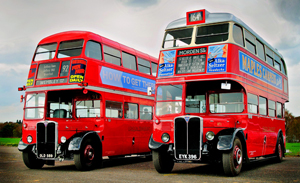
Opening tomorrow, a major exhibition at the London Transport Museum will take an in-depth look at the role transport played in London during World War I – from how London bus drivers took their vehicles to the front lines to the advance of women into the transport workforce for the first time and, of course, how Londoners fared under the deadly aerial attack of the Luftwaffe. Key among the objects on display as part of Goodbye Piccadilly at the Covent Garden site will be ‘Ole’ Bill’ – a 1911 bus on loan from the Imperial War Museum which was requisitioned for the front and, taking its name from Bruce Bairsfather’s popular cartoon character, featured regularly in Armistice Day parades until the 1960s. Other highlights include World War I recruitment posters, a 1914 female bus conductor’s uniform and a newly acquired piece of ‘trench art’ – a decorated Daimler bus steering wheel. Runs until 8th March. Admission charge applies. For more, see www.ltmuseum.co.uk.

The annual Museums at Night event kicks off tonight and runs until Saturday night. Among the premises participating this year is the Hunterian Museum at the Royal College of Surgeons in Lincoln’s Inn Fields which is showing a selection of rarely seen materials from its archives, the Banqueting House in Whitehall, Keat’s House in Hampstead and the Petrie Museum of Egyptian Archaeology at University College London which is running a murder mystery event Friday night. Some events are ticketed and some have an admission charge so check out the website before you go. For more, see www.culture24.org.uk/places-to-go/museums-at-night.

The late comedian Tony Hancock was honoured with an English Heritage Blue Plaque at his former home in South Kensington on Monday on what would have been his 90th birthday. Hancock, famous for Hancock’s Half Hour on radio and TV, lived on the fourth floor of a Grade II-listed building at 20 Queen’s Gate Place with his wife Cicely Romanis between 1952 and 1958. It was the longest time he lived at any property in London and coincided with the most creative and successful period of his career with the show first board cast on BBC radio in 1954 and also appearing on TV from 1956 onwards. Hancock died in 1968. For more, see www.english-heritage.org.uk/discover/blue-plaques/.

Send all items of interest for inclusion to exploringlondon@gmail.com.
This Week in London – UK’s largest ever exhibition on comics; wedding dresses at the V&A; ‘La Dolce Vita’ at the Estorick; and, architecture and the Italian renaissance…

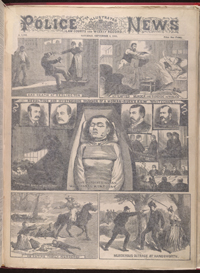
Jack-the-Ripper,-Illustrated-Police-News,-1888-(c)-British-Library-BoardThe UK’s largest ever exhibition on comics opens at the British Library tomorrow. Comics Unmasked: Art and Anarchy in the UK examines the history of the comic book in the UK – from 19th century illustrated reports of Jack the Ripper to 1970s titles like 2000AD and Action and more recent works – and examines how they have been used to explore confronting subjects like violence, sexuality and drugs. Among the highlights is a specially commissioned work by Tank Girl and Gorillaz co-creator Jamie Hewlett and works by the likes of Neil Gaiman (Sandman), Alan Moore (Watchmen, V for Vendetta), Grant Morrison (Batman: Arkham Asylum) and Posy Simmonds (Tamara Drewe). Admission charge applies (and due to the graphic nature of some exhibits, the Library has issued a parental guidance warning for under 16s). Runs until 19th August. For more, see www.bl.uk/whatson/exhibitions/comics-unmasked/index.html. PICTURE: Jack the Ripper’s victims, Illustrated Police News, 1888 © British Library Board.

The history of the white wedding dress goes under scrutiny at the V&A with its Wedding Dresses 1775-2014 exhibition opening on Saturday. The display includes more than 80 extravagant outfits from the museum’s collection – they include the Anna Valentine embroidered silk coat worn by The Duchess of Cornwall for the blessing of her marriage to The Prince of Wales in 2005, a purple Vivienne Westwood dress chosen by Dita von Teese for her wedding in 2005 and Dior outfits worn by Gwen Stefani and Gavin Rossdale on their wedding day in 2000. Some of the earliest examples in the chronological display including a silk satin court dress from 1775 and a ‘polonaise’ style brocade gown with straw bergere hat dating from 1780 lent by Chertsey Museum. The exhibition will also explore the growth of the wedding industry and the increasing media focus on wedding fashions. Admission charge applies. Runs until 15th March. For more, see www.vam.ac.uk.

The golden era of Italian film during the 1950s and 1960s and the birth of celebrity culture – did you know the term paparazzi was coined in the 1960 Federico Fellini film La Dolce Vita? – are the subject of a new exhibition which opened at The Estorick Collection this week. The Years of La Dolce Vita features 80 photographs from the period depicting Italian movie stars and the Hollywood “royalty” like John Wayne, Charlton Heston, Lauren Bacall and Liz Taylor who were working in Italy at the time. Juxtaposed against Marcello Geppetti’s images of this “real-life dolce vita” are behind-the-scenes shots from the set of La Dolce Vita taken by cameraman Arturo Zavattini. Runs until 29th June. Admission charge applies. For more, see www.estorickcollection.com.

The first British exhibition to explore the role of architecture in the Italian Renaissance opened at the National Gallery this week. Building the Picture: Architecture in Italian Renaissance Painting looks at the works of Italian masters such as Duccio, Botticelli and Crivelli with highlights including Sebastiano del Piombo’s The Judgment of Solomon – on display in London for the first time in 30 years – and Andrea del Verrochio’s The Ruskin Madonna. Five short films also form part of the display. Entry to the exhibition in the Sunley Room is free. Runs until September 21. For more information, see www.nationalgallery.org.uk.

Send all items of interest for inclusion to exploringlondon@gmail.com.
This Week in London – A rare chance to walk through a Thames tunnel; Matisse at the Tate; and, Spitting Image on show…

It’s a rare chance to walk the historic Thames Tunnel between Wapping and Rotherhithe – the first tunnel ever dug under a navigable waterway. Transport for London and London Overground are offering the chance to purchase tickets to walk the tunnel – built by Marc Brunel, it’s now used by the London Overground – over the May Bank Holiday weekend on 24th to 26th May. Tickets, which cost £18 plus booking fee, go on sale today at 10am via the London Transport Museum in Covent Garden and are strictly limited (with no on the day admissions allowed). Proceeds from the day will go to the Railway Children’s Charity and the Brunel Museum. Also, worth noting is that the London Transport Museum is offering tours of its depot this Friday and Saturday. Admission charge applies. For more, see www.ltmuseum.co.uk.

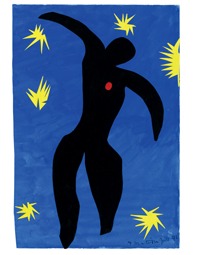
MatisseThe paper cut-outs of Henri Matisse are the focus of a landmark exhibition which opened at Tate Modern last week. Henri Matisse: The Cut-Outs features about 130 works created between 1937 and 1954 with many seen together for the first time. Highlights include maquettes featured in the 1947 book Jazz, The Snail and its sister work Memory of Oceania (both 1953) and the largest number of the Blue Nudes ever shown together. The display takes an in-depth look at the methods and materials Matisse used in the production of the cut-outs. Runs until 7th September (and keep an eye out for the accompanying film, Matisse: Live in cinemas). Admission charge applies. For more, see www.tate.org.uk. PICTURE: Henri Matisse, Icarus 1946, Maquette for plate VIII of the illustrated book Jazz 1947, Digital image: © Centre Pompidou, MNAMCCI, Dist. RMN-Grand Palais / Jean-Claude Planchet, Artwork: © Succession Henri Matisse/DACS 2014.

On Now: Spitting Image. This exhibition at the Cartoon Museum in Bloomsbury centres on the partnership of three dimensional artists Peter Fluck and Roger Law and their key role in the creation of what became known as Spitting Image. It features caricature drawings and photographs created for magazines in the 1970s and 1980s of the likes of Paul McCartney, Michael Jackson, Kate Moss, Saddam Hussein, Billy Connolly, Rupert Murdoch, Jo Brand and John Paul II as well as members of the Royal Family and politicians including Margaret Thatcher. Also present are some of the puppets used in the TV show which ran for 18 series between 1984 and 1996 – these include those of Thatcher, The Queen, Princess Diana and Mr Spock. Runs until 8th June (with selected late opening nights). Admission charge applies. For more, see www.cartoonmuseum.org.

Send all items of interest for inclusion to exploringlondon@gmail.com.
This Week in London – Meet King George I this Easter; celebrating Shakespeare’s 450th; and feasting with St George in Trafalgar Square…

Historic Royal Palaces are offering you the chance to meet King George I and explore the world in which he lived at his former real-life home of  Hampton Court Palace this Easter weekend. A re-enactment marking the 300th anniversary of his accession will have the new Hanoverian king arrive by royal barge on the River Thames and will also include courtiers taking part in a “stately dance”, the King’s troupe of Hanoverian horses performing a “horse ballet” and a Georgian Army encampment with soldiers involved in firing displays. Visitors to the palace will also be able to see a new re-presentation of the Queen’s State Apartments which explores who the Hanoverians were, how they came to rule and their many and bitter family feuds. Runs from tomorrow (18th April) to 21st April. Admission charge applies. For more, see www.hrp.org.uk/HamptonCourtPalace/.

The 450th anniversary of Shakespeare’s birth is being celebrated with a week of events at the Guildhall Library next week. Kicking off on Tuesday, 22nd April, and running until Friday, 25th April, events include talks – with subjects including ‘Shakespeare’s London Theatreland’ and ‘Imaging Shakespeare’s Indoor Theatre’, and a six hour complete reading of Shakespeare’s sonnets with readers including actor Damian Lewis, author Alan Hollinghurst and Lord Mayor of City of London Fiona Woolf as well as Shakespeare-themed walks around the City and Southwark, and the free Shakespeare in Print exhibition at the Library. For more, see www.cityoflondon.gov.uk/things-to-do/visiting-the-city/archives-and-city-history/guildhall-library/Pages/default.aspx. Meanwhile, the V&A is also holding a Shakespeare Festival, kicking off next Monday and running until 4th May. Highlights of the festival include screenings of some of the best theatre productions of Shakespeare in the last 20 years, live performances by actors and musicians and a series of debates and talks including the “interactive lecture” Marchpane to Mutton – A Taste of Shakespeare’s Time by food historian and artists Tasha Marks. There’s also a competition – Cakespeare – in which the public are invited to design, bake and decorate a Shakespeare-themed cake and share an image of it on social media (#Cakespeare) by 4th May with the winner to receive a weekend for two to Stratford-upon-Avon and tickets to the Royal Shakespeare Company. The festival is being complemented by a display in the Theatre and Performance Galleries, Shakespeare: Greatest Living Playwright which features the First Folio as its centrepiece. Admission is free. See www.vam.ac.uk for more.

It might be two days ahead of the official saint’s day, but the Feast of St George will be celebrated in Trafalgar Square this Bank Holiday Monday with a banquet and guests including a five metre high interactive dragon. The festivities, hosted by Mayor of London Boris Johnson, will also include an English Farmers’ Market featuring 20 stalls, a kid’s marquee and traditional wooden garden games, harlequins on stilts, swing boats and circus lessons for children, a bandstand located in front of Nelson’s Column and a 12 foot tall Maypole. Runs from noon to 6pm. For more, see www.london.gov.uk/feast.

Send all items of interest for inclusion to exploringlondon@gmail.com. 
10 significant sites from Georgian London – 7. Somerset House…

Somerset-House

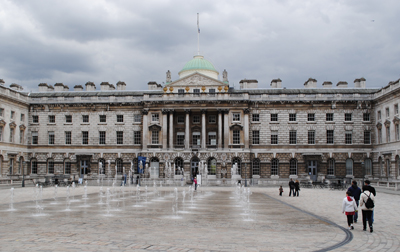
Constructed on the site of the Duke of Somerset’s Tudor-era mansion, Somerset House as we know it today owes its origins to a national scheme aimed at creating public buildings in London which would rival those of Continental cities.

The campaign led to the passing of an Act of Parliament in 1775 for the construction of a new public building at Somerset House to house government agencies such as the Navy Office, Salt Office, Surveyor General of Lands, the King’s Bargemaster and the offices of the Duchy of Lancaster and Cornwall as well as various learned societies.

The former building – which had been worked on by the likes of Sir Christopher Wren and which had been used as a residence for the likes of King Charles II’s queen, Catherine of Braganza, following his death, had fallen into a state of considerable disrepair and was demolished in 1775.

William Robinson, secretary of the Office of Works, was initially given the job of designing the new building (much to the discontent of some) but after his sudden death the same year, the task was given to Sir William Chambers, comptroller of the Office of Works and one of England’s leading architects.

The basic design was as it appears today – four ranges built around a central court (now named the Edmond J Safra Fountain Court). The Strand Block, located to the north and the most highly decorated of the buildings inside and out, was built first and largely completed by 1780, the Embankment Building (home of the Navy Office) in 1786 and the east and west ranges two years later.

When Chambers died with the work unfinished in 1796, it was carried to completion by James Wyatt and declared complete in 1801, despite the fact elements of Chambers’ design were still outstanding. It had cost more than £460,000, in excess of three times Robinson’s original estimate.

One of the first new occupants – thanks to a decision by King George III – was the fledgling Royal Academy of Arts (it had been one of the last occupants of the former premises) and its focal point was the Great Exhibition Room where exhibitions were held until 1836. Others in the new building included The Royal Society (it remained until 1837 when, like the RA, it moved to Burlington House) and the Society of Antiquaries (it moved to Burlington House in 1874).

As well as being home to various offices of the Navy Board (the southern building, where it was housed, contains the stunning, now restored, Nelson stair), Somerset House was also home to the Inland Revenue.

New additions were made to the original design in the nineteenth century – the extension of the south block to the east and addition of a New Wing to the west – and the construction of the Victoria Embankment (see our earlier post here) meant the two watergates Chambers had designed became landlocked. Somerset House no longer rose directly from the water as he’d intended but from a roadway (as it does today – we’ve mentioned this before but you can see the original riverbank by looking through the glass floor of the building’s Embankment entrance).

Somerset House is these days home to a range of cultural and artistic organisations – from the British Fashion Council to the National Youth Orchestra and, in the north wing, the Courtauld Institute of Art. And as well as hosting various art installations, the central courtyard is host to an ice-skating rink over winter.

For more on Somerset House, see www.somersethouse.org.uk.

This Week in London – Queen Elizabeth Olympic Park opens fully this weekend; Shakespeare at the Guildhall Library; and, the V&A celebrates Italian fashion…

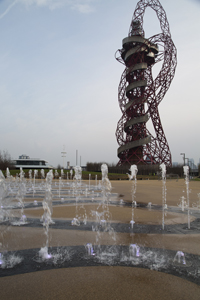
QEOP• The UK’s tallest sculpture, the ArcelorMittal Orbit, will be open to the public in Queen Elizabeth Olympic Park – described as the “biggest new park to open in Europe in 150 years” – in London’s east from this weekend. While the northern part of the 560 acre park, the Copper Box Arena, Lee Valley VeloPark and Aquatics Centre have been open to the public since July last year, from Saturday visitors will be able to visit the southern part of the park featuring the 114.5 metre high sculpture. Features in the southern part of the park include a new tree-lined promenade with giant globes, interactive water fountains, an adventure playground and four themed walking trails focusing on the 2012 Games, nature and biodiversity, education, and art and culture. Visitors who head to the top of ArcelorMittal Orbit will be able to view across 20 miles of London from a 76 or 80 metre high platform (admission charges apply – £15 adults/£7 children/£40 for a family of four – and, be warned, you may need to book) while at the base of the sculpture is a cafe and event space. The opening weekend will see a host of special events including a parade of children, an aerial acrobatic performance, choirs, bands, dancers, poets, circus performers and story tellers and ‘try out’ sports and fitness sessions. There’s more yet to come with the Lee Valley Hockey and Tennis Centre opening to the public in June and the Olympic Stadium reopening for the 2015 Rugby World Cup next year. For more on the park, see www.queenelizabetholympicpark.co.uk and for tickets to the ArcelorMittal Orbit, see http://arcelormittalorbit.com.

The printed works of William Shakespeare are the focus of a new exhibition which opened at the Guildhall Library in the city this week. Shakespeare in Print explores the library’s Shakespearean works and looks at how they were produced. Among the treasures on display will be a First Folio, the first collected edition of his plays, contemporary writers quartos and later editions of the Bard’s plays and poetry. This free exhibition is running until 29th May. The library will be hosting a series of Shakespeare-related events in the week of 22nd to 25th April to mark the 450th anniversary of his birth. For more, head here.

Italian fashion from 1945 until today is the subject of the V&A’s spring exhibition opening on Saturday. The Glamour of Italian Fashion 1945-2014 will feature 100 ensembles and accessories by leading Italian fashion houses including Dolce & Gabbana, Giorgio Armani, Gucci, Prada, Valentino and Versace as well as creations from the “next generation of talent” including Giambattista Valli and Fausto Puglisi and will also showcase the creativity of less well remembered figures such as Sorelle Fontana and Walter Albini. As well as charting the shifting international perception of Italian style, the display will also highlight techniques and materials used in the creation of Italian fashion with a digital map visualising the industry. Runs until 27th July. Admission charge applies. For more, see www.vam.ac.uk.

Send all items of interest for inclusion to exploringlondon@gmail.com.
This Week in London – William Kent at the V&A; new City Visitor Trail; and, Veronese at the National Gallery…

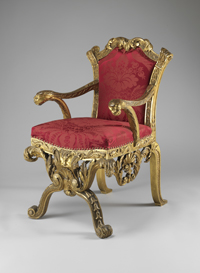
Armchair_for_Devonshire_House_ca._1733-40__Devonshire_Collection_Chatsworth._Reproduced_by_permission_of_Chatsworth_Settlement_Trustees._Photography_by_Bruce_WhiteThe life and work of William Kent, the leading architect and designer of early Georgian Britain, is the subject of a new exhibition opening at the V&A on Saturday. William Kent: Designing Georgian Britain covers the period 1709 to 1748 which coincides with the accession of the first Hanoverian King George I. the tercentenary of which is being celebrated this year. The display features more than 200 examples of Kent’s work – from architectural drawings for buildings such as the Treasury (1732-37) and Horse Guards (1745-59), to gilt furniture designed for Houghton Hall (1725-25) and Chiswick House (1745-38), landscape designs for Rousham (1738-41) and Stowe (c 1728-40 and c 1746-47) as well as paintings and illustrated books. The exhibition, the result of a collaboration between the Bard Graduate Center, New York City, and the V&A,  features newly commissioned documentary films and will have a section focusing on designs Kent created for the Hanovarian Royal family including those he produced for a Royal Barge for Frederick, the Prince of Wales (1732) and a library for Queen Caroline at St James’ Palace (1736-37). Runs until 13th July. Admission charge applies. See www.vam.ac.uk. PICTURE: Armchair for Devonshire House ca. 1733-40, © Devonshire Collection, Chatsworth. Reproduced by permission of Chatsworth Settlement Trustees.

A new City Visitor Trail has been unveiled by the City of London, taking visitors on a 90 minute self-guided tour of some of the City’s main attractions (or longer if you want to linger in some of the places on the itinerary). The trail – a map of which can be picked up from the City Information Centre – goes past iconic buildings such as St Paul’s Cathedral, Guildhall, Mansion House, Monument, the Tower of London and Tower Bridge as well as lesser-known sites. As well as the main route, there’s also five specially themed routes – ‘Law and literature’, ‘London stories, London people’, ‘Culture Vulture’, ‘Skyscrapers and culture’, and ‘Market mile’ – and a City Children’s Trail, provided in partnership with Open City, which features three self-guided routes aimed at kids. As well as the map, the City has released an app – the City Visitor Trail app – which provides a commentary at some of the city’s main attractions which can either by read or listened to as it’s read by people closely associated with the locations (available for both iPhone and Android). For more, follow this link.

The works of the 16th century Venetian artist known as Veronese (real name Paolo Caliari) are being celebrated in a new exhibition, Veronese: Magnificence in Renaissance Venice at the National Gallery. More than 50 of his works are featured in the display including two altarpieces never before seen outside Italy: The Martyrdom of Saint George (about 1565) from the church of San Giorgio in Braida, Verona, and The Mystic Marriage of Saint Catherine (1565-70) from the Gallerie dell’Accademia, Venice. Others include early works like The Supper at Emmaus (about 1565), the beautiful Portrait of a Gentleman (c 1555) and the artist’s last autograph work, the altarpiece for the high altar of San Pantalon in Venice (1587). Runs until 15th June. Admission charge applies. For more, see www.nationalgallery.org.uk.

Send all items of interest for inclusion to exploringlondon@gmail.com.
This Week in London – Copying Hans Holbein; the Needlemakers’ 350th; and, 16th century woodcuts…

ThomasCromwellA new display exploring the demand for copies and remakes of portraits originally created by Tudor court painter Hans Holbein the Younger has opened at the National Portrait Gallery. Hans Holbein Re-made features a selection of copies of Holbein’s works from the gallery’s collection including portraits of William Warham, John Fisher, Sir Thomas More and Sir Richard Southwell, all of which have undergone new technical analysis as part of the gallery’s Making Art in Tudor Britain project. The research reveals new details about how and when the paintings were made and the techniques used. The display also includes a portrait of Thomas Cromwell, Earl of Essex – thought to be one of the first miniatures Holbein painted alongside a digital screen which enables this work of Holbein’s to be compared with that of another artist working in his studio. In Room 3. Runs until 31st August. Admission is free. For more, see www.npg.org.uk. PICTURE: Thomas Cromwell, Earl of Essex, after Hans Holbein the Younger, early 17th century (1533-1534). © National Portrait Gallery, London.

This year marks the 350th anniversary of King Charles II’s granting of a Royal Charter to The Worshipful Company of Needlemakers and to commemorate the occasion, the Guildhall Library is hosting an exhibition of some of the company’s treasures and history. Among the displays are tools used in 19th and 20th centuries, 18th century silverware, and the Company Arms (gifted to it in 1995) as well as examples of their craft from both early and recent periods. The exhibition closes on 29th March, so you’ll have to be quick. Admission is free. For more, see www.cityoflondon.gov.uk/things-to-do/visiting-the-city/archives-and-city-history/guildhall-library/exhibitions/Pages/The-Worshipful-Company-of-Needlemakers.aspx

A new display of revolutionary sixteenth century woodcuts opens at the Royal Academy of Arts on Saturday. Renaissance  Impressions: Chiaroscuro woodcuts from the Collections of Georg Baselitz and the Albertina, Vienna, looks at the development of the printing technique of the chiaroscuro woodcut and presents more than 100 rare prints by artists from Germany, Italy and The Netherlands which have come from the collection of the Albertina Museum in Vienna and the personal collection of Honorary Royal Academician Georg Baselitz. The new technique – the first known example of which is widely believed to have been created by Hans Burgkmair the Elder with his 1508 depiction of Emperor Maximilian on Horseback – involved supplementing the key ‘black line block’ with one or several ‘tone blocks’ with chiaroscuro woodcuts the first colour woodcuts to make dramatic use of light and shadow to suggest form, volume and depth. Runs until 8th June in the Sackler Wing of Galleries. Admission charge applies. For more, see www.royalacademy.org.uk.

Vikings at the British Museum; World War I portraits; and, Ruin Lust…

RoskildeThe Vikings come to the British Museum from today with the first major exhibition in more than 30 years. Vikings: life and legend, the first exhibition to be held in the new Sainsbury Exhibition Gallery, was developed with the National Museum of Denmark and the Staatliche Museen zu Berlin (National Museums in Berlin) and looks at the Viking period from the late 8th century to the early 11th century. Featuring many new archaeological discoveries and objects never seen before in the UK alongside items from the British Museum’s own collection, the exhibition is centred on the surviving timbers of a 37 metre long Viking warship excavated from the banks of the Roskilde fjord in Denmark (pictured). Other items include skeletons recently excavated from a mass grave of executed Vikings in Dorset, the Vale of York Hoard (discovered in 2007) and a stunning hoard of silver from Gnezdovo in Russia. A unique live broadcast event presented by historian Michael Wood taking cinema audiences around the exhibition will be shown in cinemas across the nation on 24th April. Admission charge applies. Runs until 22nd June. For more, see www.britishmuseum.org/whats_on/exhibitions/vikings.aspx. PICTURE: Copyright of the National Museum of Denmark. 

The commemorations of the World War I centenary have commenced at the National Portrait Gallery with The Great War in Portraits. The first of a four year programme of events and displays at the gallery, the exhibition features iconic portraits of figures such as Winston Churchill, Kaiser Wilhelm, Siegfried Sassoon and Wilfred Owen as well as major art works by the likes of Lovis Corinth, Max Beckmann, and Kirchner, whose painting Selbstbildnis als Soldat (Self-portrait as a Soldier) is featured, and Harold Gillies’ photographs of facially injured soldiers from the Royal College of Surgeons. Among the highlights are Jacob Epstein’s The Rock Drill, a contrasting pair of British and German films about the Battle of the Somme, and a press photograph of Gavrilo Princip, the student who sparked the flames of war when he assassinated Archduke Franz Ferdinand. Elsewhere among the 80 works on display are portraits of war heroes such as VC winners are contrasted with those of soldiers disfigured by war, POWs and those shot for cowardice. Admission is free. Runs until 15th June. For more, see www.npg.org.uk/whatson/firstworldwarcentenary/exhibition.php.

Our fascination with ruins is the subject of a new exhibition which opened this week at Tate Britain. Including more than 100 works from the likes of JMW Turner, John Constable, John Martin, Eduardo Paolozzi, Rachel Whiteread and Tacita Dean, Ruin Lust examines the craze for ruins that overtook creative types in the eighteenth century and the subsequent revisiting – and at times mocking – of this fascination by later figures. Works on show include Turner’s Tintern Abbey: The Crossing and Chancel, Looking towards the East Window 1794, Constable’s Sketch for ‘Hadleigh Castle’ c 1828-9, Graham Sutherland’s Devastation series 1940-1 – showing the aftermath of the Blitz, Jon Savage’s images of London in the late 1970s, and Whitehead’s Demolished – B: Clapton Park Estate 1996, showing the demolition of Hackney tower blocks. Runs until 18th May. Admission charge applies. For more, see www.tate.org.uk/whats-on/tate-britain/exhibition/ruin-lust.

10 significant sites from Georgian London – 2. Burlington House…

Now the home of the Royal Academy of Arts, the origins of Burlington House on Piccadilly go back to the 1660s but it was Richard Boyle, the 3rd Earl of Burlington, who had the property reworked into the Palladian building it is today. 

It was Sir John Denham, Surveyor-General of the King’s Works for King Charles II, who first began building a red brick mansion on the site in the 1660s before he sold the still unfinished building to Richard Boyle, the 1st Earl of Burlington, in about 1667. He completed the house the following year.

Burlington-HouseThe property next underwent major changes during the minority of the 3rd Earl (also Richard Boyle, 1612-1698) – his mother, the 2nd Countess, Lady Juliana, had architect James Gibbs carry out some alterations including the addition of a semi-circular colonnade at the front of the house and reconfiguration of the main staircase.

But around 1717-1718, the 3rd Earl (1694-1753), who himself was something of an architect, commissioned architect Colen Campbell to take over from Gibbs. The property was then reworked to a Palladian design – particularly the southern front of the building and William Kent was summoned to redesign interiors – the surviving interior of the Saloon is credited as the first ‘Kentian’ interior in England.

Lord Burlington soon shifted his attention to Chiswick House (see our earlier post here), and on his death in 1753, the house passed to the Dukes of Devonshire before it was eventually purchased by the 4th Duke’s younger son, Lord George Cavendish, around 1812. He had some of the interiors reworked by Kent admirer Samuel Ware, keeping them sympathetic to the Palladian vision.  Four years after the purchase, Burlington Arcade was built along the western side of the premises.

In 1854, the property was sold to the British Government who initially intended demolishing the structure and using the site for the University of London but after strong opposition to the plan, it was occupied by the Royal Society, the Linnean Society and the Chemical Society while the Royal Academy – which had been founded by King George III in 1768 – took over the main block on a 999 year lease in 1867.

The building subsequently underwent further alterations – among them Sidney Smirke added a third floor to the main building – the Diploma Galleries – and the Main Galleries and the Art School on a garden to the north of the house. Later, three story ranges were raised around the courtyard and the three aforementioned learned societies moved into these and were later joined by the Geological Society of London, the Royal Astronomical Society and the Society of Antiquities.

The Royal Society left in 1968 and the British Academy moved in but this august institution moved out in 1998, leaving the building now home to the Royal Academy and the five learned societies, the Geological Society of London, the Linnean Society of London, the Royal Astronomical Society, the Society of Antiquaries of London, and the Royal Society of Chemistry.

More recent works at the property – the last survivor of four townhouses built along Piccadilly in the 1660s – have included a 1991 remodelling of the Diploma Galleries by Norman Foster – now known as The Sackler Wing of Galleries – and the restoration of the former state rooms including The Saloon, reopened as the John Madejski Fine Rooms.

WHERE: Royal Academy of Arts, Burlington House, Piccadilly (nearest Tube stations are Piccadilly Circus and Green Park);  WHEN: 10am to 6pm Saturday to Thursday/10am-10pm Friday (opening times for the John Madejski Fine Rooms may vary); COST: Varies depending on the exhibition (there are free guided tours of the John Madejski Fine Rooms – check the website for details); WEBSITE: www.royalacademy.org.uk

PICTURE: Installation by Ãlvaro Siza, part of the Sensing Spaces: Architecture Reimagined exhibition which runs until 6th April. Photo: Royal Academy of Arts. Photography: James Harris/Ãlvaro Siza 

This Week in London – Data visualisation at the BL; Kenneth Williams honoured; and, celebrating ‘frost fairs’…

NASA's-Perpetual-Ocean-cropAn examination of the historical use of visual data has opened at the British Library. Beautiful Science, which is running in The Folio Society Gallery, features the work of scientists and statisticians down the ages and focuses on the key themes of public health, weather and evolution. Among items on display are Robert Fludd’s Great Chain of Being (1617), Florence Nightingale’s seminal ‘rose diagram’ (1858) which illustrated that more Crimean War deaths were being caused by poor hospital conditions that battlefield wounds, and a contemporary moving infographic from NASA showing ocean currents (pictured). A programme of events is running with the exhibition which closes on 26th May. Entry is free. For more, see www.bl.uk/beautiful-science. PICTURE: NASA’s Perpetual Ocean © NASA/Goddard Space Flight Center

Comic Kenneth Williams (1926-1988) has been honoured with an English Heritage Blue Plaque at the London apartment he lived in during the hey day of the ‘Carry On’ series of films during the 1960s. Williams lived in flat 62 on the top floor of Farley Court, located between Madame Tussauds and Baker Street station, between 1963 and 1970 during which he starred in such films as Carry on Cleo and Carry on up the Khyber and also appeared in radio comedy programmes such as Round the Horne and Just a Minute. For more, see www.english-heritage.org.uk/discover/blue-plaques/.

Two exhibitions celebrating London’s Frost Fairs are underway at the Museum of London and its Docklands sister. Frozen Thames: Frost Fair 1814 at the Museum of London in the City and Frozen Thames: Frost Fair 1684 at the Museum of London Docklands both feature objects, paintings, keepsakes, engravings and etchings from the museum’s collection. Highlights at the Museum of London exhibition include the only surviving piece of gingerbread from the 1814 fair, the last fair of its kind, as well as etchings by satirical artist George Cruikshank and a print by George Thompson while among the items on display at the Docklands museum are two paintings by a Dutch artist Abraham Hondius (c. 1625-91). Both exhibitions are free and both run until 30th March. For more, see www.museumoflondon.org.uk.

This Week in London – Finds from below London on display; Reassessing the German Renaissance; and, Powell and Pressburger’s Blue Plaque…

Roman-skull-found-at-Liverpool-Street-ticket-hall-_102065More than 50 objects – including skulls from the Roman era – unearthed as part of the Crossrail project have gone on display to the public for the first time. Portals to the Past also features a Roman cremation pot (which still contained remains when discovered), 16th century jewellery, and flint used by Londoners some 9,000 years ago. The free exhibition runs at the Crossrail Visitor Information Centre behind Centre Point at 6-18 St Giles High Street until 15th March. To coincide with it, Crossrail archaeologists will be running a series of lectures on Wednesday evenings starting at 6pm. No booking is required but numbers are limited so it’s recommended that attendees turn up early. For more information, www.crossrail.co.uk/sustainability/archaeology/archaeology-exhibition-portals-to-the-past-february-2014.

A new exhibition celebrating the artists of the German Renaissance opened at the National Gallery yesterday. Strange Beauty: Masters of the German Renaissance features paintings, drawings and prints by the likes of Hans Holbein the Younger, Albrecht Durer and Lucas Cranach the Elder and examines how perceptions of the pieces have changed over time. Works include Holbein’s Anne of Cleves, Hans Baldung Grien’s Portrait of a Young Man with a Rosary, and Matthias Grunewald’s drawing of An Elderly Woman with Clasped Hands. There is also a reconstruction of the Liesborn altarpiece, created in 1465 and originally housed at the Benedictine Abbey of Liesborn in Germany. Runs until 11th May. Admission charge applies. For more, see www.nationalgallery.co.uk.

Film-makers Michael Powell (1905-1990) and Emeric Pressburger (1902-1988) have been commemorated with the placement of an English Heritage Blue Plaque at the site of their former workplace, a flat in Dorset House, on Gloucester Place in Marylebone. It was from Flat 120 in the apartment block that they oversaw the production of some of their greatest films including The Life and Death of Colonel Blimp (1943), A Matter of Life and Death (1946), Black Narcissus (1947) and The Red Shoes (1948) between 1942 and 1947. Film director Martin Scorsese was among those who unveiled the plaque. For more, see www.english-heritage.org.uk/discover/blue-plaques/.

Send all items of interest for inclusion to exploringlondon@gmail.com.
This Week in London – William Shakespeare’s influence; new Fourth Plinth commissions; the car and landscape; and London Stories…

First up, apologies that we were unable to launch our new Wednesday series yesterday due to some technical difficulties (stayed tuned for next week). And now, on with the news…

Sarah_Bernhardt_by_Lafayette_Ltd_1899_c__Victoria_and_Albert_Museum_London__William Shakespeare’s influence on successive generations of theatrical performance is the subject of a new exhibition at the V&A to mark the 450th anniversary of his birth on 23rd April. Shakespeare: Greatest Living Playwright centres on the Bard’s First Folio which, published in 1623, contains 36 plays including 18 works – Macbeth, The Tempest and Twelfth Night among them – which would be unknown without it. The display includes interviews, archive footage and photography and objects from the V&A collections as well as an audio-visual presentation by Fifty Nine Productions featuring interviews with contemporary theatre practitioners such as actors, directors and designers. Objects on display include a skull used by Sarah Bernhardt when playing Hamlet in 1899, an embroidered handkerchief used by Ellen Terry when playing Desdemona in 1881 at the Lyceum Theatre, and a pair of red boots worn by actor-manager Henry Irving in an 1887 production of Richard III. Runs in the V&A’s Theatre and Performance Galleries until 21st September. Admission is free. For more, see www.vam.ac.uk. PICTURE: Sarah Bernhardt as Hamlet, 1899, © Victoria and Albert Museum, London.

A skeletal horse and a giant hand giving a thumbs up will adorn the Fourth Plinth in Trafalgar Square during 2015-16. Hans Haacke’s Gift Horse is derived from an etching by painter George Stubbs and, while being a comment on the equestrian statue of King William IV which was intended for the plinth, also features an electronic ribbon displaying a live ticker of the London Stock Exchange on its front leg. Meanwhile David Shrigley’s Really Good is a 10 metre high hand giving a thumbs up – sending a positive message to those who see it. For more, see www.london.gov.uk/priorities/arts-culture/fourth-plinth.

The impact of the car on England’s landscape and the listed buildings of motoring history are the focus of a new exhibition in Wellington Arch. Carscapes: How the Motor Car Reshaped England features archive photographs, historic advertising, cartoons and motoring magazines as well as a 1930s traffic light, a petrol pump and other accessories and memorabilia. Wellington Arch, which is managed by English Heritage, is a fitting location for the exhibition – it was moved to its current position due to increasing traffic back in 1883. Admission charge apply. For more, see www.english-heritage.co.uk.

A new exhibition exploring some of the true and not-so-true stories inspired by and produced in London opens at the London Transport Museum in Covent Garden tomorrow. London Stories features the best entries from The Serco Prize for Illustration 2014 with more than 50 works of art on display depicting a well-known or obscure London narrative. The short-listed illustrations tackle everything from ghost buses to Buffalo Bill’s Wild West Show of 1887, a Pearly King and Queen, Lenin’s ‘Love letter to London’ and an escaped monkey jazz band. There’s also a host of musical and literary references – everything from Mary Poppins to Sweeney Todd and Oranges and Lemons. Tomorrow there will be a late opening of the exhibition complete with cash bar, DJ and story-telling for adults as well as the chance to create your own London story with illustration workshops and a photo-booth. Organised by London Transport Museum in partnership with the Association of Illustrators, it runs until 6th April. Admission charge applies. For more, see www.ltmuseum.co.uk.

Send all items of interest for inclusion to exploringlondon@gmail.com.
This Week in London – Handel and the royals; David Bailey; and, redefining German art…

• A new exhibition exploring German-born George Frideric Handel and his association with the royal family opens at the Foundling Museum in Bloomsbury tomorrow to mark the 300th anniversary of the coronation of King George I. The museum says no composer has been more closely associated with the British monarchy than Handel, whose anthem Zadok the Priest has been performed at every coronation since King George II in 1727 and whose Water Music was performed on the River Thames during the Diamond Jubilee for Queen Elizabeth II in 2012. By George! Handel’s Music for Royal Occasions features treasures from the Gerald Coke Handel Collection and loans from the British Library, the National Portrait Gallery, the British Museum and Westminster Abbey. Runs until 18th May. For more, see www.foundlingmuseum.org.uk.

A landmark exhibition of David Bailey photographs opens at the National Portrait Gallery today. Bailey’s Stardust – one of the gallery’s largest scale photographic exhibitions, it occupies most of the gallery’s ground floor – features more than 250 portraits including a new portrait of Kate Moss and previously unseen images from Bailey’s travels to the Naga Hills in India in 2012. There’s also rooms devoted to portraits of the Rolling Stones and Catherine Bailey, images from Bailey’s trip to Papua New Guinea in 1974 and from east Africa which Bailey visited in 1985 in support of Band Aid. Admission charge applies. Runs until 1st June. For more, see www.npg.org.uk.

A new exhibition at the British Museum explores how six key artists redefined the notion of art in Germany in the Sixties and Seventies. Germany divided: Baselitz and his generation features some 90 works including some 45 by George Baselitz as well as works by Markus Lupertz, Blinky Palermo, AR Penck, Sigmar Polke and Gerhard Richter. Thirty-four of the works, including 17 by Baselitz, have been donated by Count Christian Duerckheim while a loan of some 60 additional works from the Duerckheim Collection makes up the rest of the exhibition. Runs in Room 90 until 31st August. For more, see www.britishmuseum.org.

Send all items of interest for inclusion to exploringlondon@gmail.com.
This Week in London – Van Gogh’s Sunflowers reunited; Sir Leslie Constantine’s Blue Plaque; and, the ‘Anatomy of a Suit’…

• Two versions of Vincent van Gogh’s iconic Sunflowers have been reunited for the first time in 65 years in London at the National Gallery. The two paintings – one from the National Gallery and the other from the Van Gogh Museum in Amsterdam – come from a five-painting series the artist created in 1888 while staying in Arles. They were apparently painted while he was waiting for his friend Paul Gaugain to arrive and were to decorate the bedroom Gaugain would stay in as gift to him. The free display in Room 46 of the Trafalgar Square Gallery and will be shown until 27th April. Meanwhile, the gallery is celebrating the donation of another van Gogh – Head of a Peasant Woman, the first early work by the artist to enter its collection. It is one of a series of around 40 portraits of the peasants of the village of Nuenen, in The Netherlands, which were painted in late 1884/early 1885. For more, see www.nationalgallery.org.uk.

West Indian cricketer and politician Sir Learie Constantine’s former home in Earl’s Court has been commemorated with an English Heritage Blue Plaque. Constantine, who played a significant role in securing the independence of Trinidad and Tobago and as an advocate for black people, was the first person of African descent to sit in the House of Lords. He lived at the property at 101 Lexham Gardens between 1949-1954. For more, see www.english-heritage.org.uk/discover/blue-plaques/.

On Now: The Anatomy of a Suit. This free display at the Museum of London looks at  the technicalities of making a suit and the city’s influence on menswear globally. Exhibits include a double-breasted pinstripe jacket from about 1965, a morning jacket from about 1927 and a black dress suit from about 1933 – all of which was sourced by curator Timothy Long from markets including Brick Lane, Broadway and Portobello Road. Runs until June. For more, see www.museumoflondon.org.uk.

Send all items of interest for inclusion to exploringlondon@gmail.com.

This Week In London: The London that might have been; the V&A’s Christmas tree; Christmas celebrations at the Geffrye; and, World War II recollections…

A new exhibition looking at the London that might have been opened at Wellington Arch near Hyde Park Corner yesterday. Almost Lost: London’s Buildings Loved and Loathed uses digital technology to look at how several redevelopment proposals – including a 1950s conceptual scheme for a giant conservatory supporting tower blocks over Soho and a 1960s plan to redevelop Whitehall which including demolishing most of the Victorian and Edwardian buildings around Parliament Square – would have changed the face of the city. The exhibition also looks at how the latest developments in digital mapping can be used in the future and features ‘Pigeon-Sim’ which provides a bird’s-eye view of the city’s buildings with an interactive flight through a 3D photorealistic model of the city. The exhibition runs until 2nd February. Admission charge applies. For more, see www.english-heritage.org.uk/daysout/properties/wellington-arch/.

A specially commissioned Christmas tree has been unveiled at the V&A in South Kensington. The 4.75 metre high ‘Red Velvet Tree of Love’ is the work of artists Helen and Colin David and will stand in the museum’s grand entrance until 6th January. The design of the tree – which is coated in red flocking and decorated with 79 sets of hand cast antlers and 67 white, heart shaped baubles – was inspired by an 1860 HFC Rampendahl chair in the V&A’s collection which features a real antler frame and velvet upholstery. For more, see www.vam.ac.uk.

The annual Christmas Past exhibition is once again open at the Geffrye Museum in Shoreditch. Festive decorations have transformed the museum’s rooms and give an insight into how the English middle classes celebrated in times gone past. The exhibition runs until 5th January. Admission is free. Accompanying the exhibition are a series of events including an open evening celebrating an Edwardian Christmas between 5pm-8pm tonight. For more, see www.geffrye-museum.org.uk/whatson/christmas-past-2013/.

The World War II experience of Chelsea Pensioners are being commemorated in a new display in the White Space Gallery at the National Army Museum in Chelsea. The Old and the Bold is the culmination of a year long collaboration between the museum and the Royal Hospital Chelsea and features nine interviews with 14 In-Pensioners. Their accounts span iconic moments in World War II history – from D-Day to North Africa and the Falklands and are supported by items from the museum’s collection. Runs until 3rd January. Admission is free. For more, see www.nam.ac.uk.

This Week In London – Kenwood House reopens; robot safari at the Science Museum; Kew Gardens illuminates for Christmas; Vivien Leigh at the NPG; and more…

Kenwood House in north London is being reopened to the public today following a £5.95 million restoration project which has seen the library returned to what Scottish architect Robert Adam had intended it to be. The project, which saw the Hampstead property closed since March last year, has also seen the restoration of three other Robert Adam-designed rooms – the entrance hall, Great Stairs and antechamber or entrance to the library – as well as the redecoration of four rooms in 18th century style, repainting of the exterior and the repair of the home’s roof – a job aimed at protecting the rooms and its stellar

Kenwood-House-Librarycollection of artworks by the likes of Rembrandt and Vermeer. English Heritage has also endeavoured to make the property more homely, replacing ticket desks and rope barriers with an open fire, warm rugs and leather couches on which visitors can relax. The library (pictured) was built and decorated to Adam’s designs between 1767 and 1770 as part of a wider remodelling of the villa for its owner Lord Chief Justice William Murray, 1st Earl of Mansfield. Redecorated many times since, it was restored in the 1960s but this redecoration was later found to be inaccurate. The Caring for Kenwood restoration project, which has also seen restoration of the Kenwood Dairy, was funded by a £3.89 million grant from the Heritage Lottery Fund as well as support from the Wolfson Foundation and other donors. To coincide with the reopening, a new app exploring Kenwood House has been released which can be downloaded for free from the iTunes store. For more, see www.english-heritage.org.uk/daysout/properties/kenwood/. PICTURE: English Heritage/Patricia Payne.

Head out on a “robot safari” this weekend with a special free event at Science Museum in South Kensington. Robot SafariEU, part of Eurobotics week, features 13 biometric robots from across Europe including an underwater turtle robot, a shoal of luminous fish robots, a robotic cheetah cub and Pleurobot, a robotic salamander. Roboticists from across Europe will be on hand to help visitors interact with the bots. Suitable for all ages, the event kicked off on Wednesday night and runs again on the weekend. Admission is free but timed tickets are required. For more, see www.sciencemuseum.org.uk/RobotSafari.

A memorial to author, scholar and apologist CS Lewis was dedicated at Westminster Abbey last Friday – the 50th anniversary of his death. Conducting the service, the Dean of Westminster, the Very Reverend Dr John Hall, said Lewis was “one of the most significant Christian apologists of the 20th century” and the author of stories that had “inspired the imagination and faith of countless readers and film-goers”. Douglas Gresham, younger stepson of Lewis, read from the author’s book, The Last Battle, at the service. The memorial is located in Poet’s Corner in the abbey’s south transept. For more see www.westminster-abbey.org.

A Blue Plaque commemorating Al Bowlly – described as “Europe’s most popular crooner and famous radio and record star” – will be unveiled at his home in Charing Cross Road this week. Bowlly, who lived between 1899 and 1941, was the voice beyond songs like Goodnight Sweetheart and The Very Thought Of You. The English Heritage Blue Plaque will be unveiled at Charing Cross Mansions, 26 Charing Cross Road – his home during the pinnacle of his career. For more, see www.english-heritage.co.uk/discover/blue-plaques/.

Kew Gardens has opened its gates after dark for the first time with a “captivating show of lights, sound and landscape” this festive season. A mile long illuminated trail, created in partnership with entertainment promoter Raymond Gubbay, will take visitors’ through the garden’s unique tree collections, kicking off at Victoria Gate where a Christmas village (and Santa’s Woodland Grotto) is located. The gardens will be open every Thursday to Sunday until 23rd December and then be open every night from 26th December to 4th January from 4.45pm to 10pm. Admission charge applies. For more, see www.kew.org/Christmas.

VivienLeighActress Vivien Leigh is the star of a new exhibition opening on Saturday at the National Portrait Gallery. Starring Vivien Leigh: A Centenary Celebration tells her story with a focus on her Academy Award-winning role in 1939’s Gone With The Wind. The display features more than 50 portraits of Leigh by the likes of Cecil Beaton, Angus McBean and Madame Yevonde – many of which have never been exhibited in the gallery before – and a selection of memorabilia including magazine covers, vintage film stills and press books. Among the photos will be a newly acquired image of Leigh and her husband, Laurence Olivier, taken by British photojournalist Larry Burrows at a garden party in 1949 (pictured), along with two rarely seen portraits of Leigh – one taken on the set of The School for Scandal by Vivienne in 1949 and the other by Paul Tanqueray in 1942. The exhibition will be held in Room 33 and runs until 20th July. Admission is free. For more, see www.npg.org.uk. PICTURE:  Copyright – Larry Burrows Collection 2013.

This Week in London – JMW Turner and the sea; welcoming the ‘new’ Tate Britain; Hyde Park Winter Wonderland; and more…

The-Fighting-Temeraire,-tugged-to-her-last-Berth-to-be-broken-up,-1838-©-The-National-Gallery,-LondonA major exhibition on painter JMW Turner’s fascination with the sea opens at the National Maritime Museum in Greenwich tomorrow. Turner and the Sea is the first “full scale” examination of the artist’s relationship with the sea and features works on loan from some of the world’s greatest art institutions. Highlights among the oils, watercolours, prints and sketches on show include The Fighting Temeraire (1839) (pictured), Snow Storm – Steam-Boat off a Harbour’s Mouth (1842), Staffa, Fingal’s Cave (1832), Whalers (1845) and Calais Pier (1803) as well as Turner’s largest painting and only royal commission, The Battle of Trafalgar (1824). The works are being exhibited alongside works by other notable British and European artists including Thomas Gainsborough, Willem van de Velde, Claude-Joseph Vernet and John Constable. Runs until 21st April. Admission charges apply. See www.rmg.co.uk for more details. PICTURE: The Fighting Temeraire, tugged to her last Berth to be broken up, 1838 by JMW Turner, 1839, oil on canvas. © The National Gallery, London.

• The ‘new’ Tate Britain was unveiled to the public this week following a £45 million upgrade and refurbishment and the house-warming party is on this weekend. The work has seen the oldest part of the Grade II* listed building in Millbank transformed thanks to architects Caruso St John and sees the main entrance reopened as well as The Whistler Restaurant, new learning studios an a new archive gallery as well as a new cafe and bar for Tate members. It’s unveiling follows the opening in May of 10 new galleries and new BP displays including the chronological presentation of the Tate’s collection of British art. The house-warming party, a free event, takes place on Saturday from 3pm to 10pm and features music, the giving out of free limited edition prints and a series of talks, film screenings, workshops and even a treasure hunt. For more, see www.tate.org.uk.

Hyde Park Winter Wonderland kicks off again tomorrow with highlights including the ice sculptures of ‘The Magical Kingdom’, the giant observation wheel, the ice rink and Santa Land. There will also be more than 200 chalets in the Angels Christmas & Yuletide Markets, the Bavarian village is back, and Zippo’s Circus will also be returning with a range of shows include Cirque Berserk for the evening crowd. Entry is free but tickets for various attractions can be bought at www.hydeparkwinterwonderland.com. Runs until 5th January.

ON NOW: The Young Durer: Drawing the Figure. This exhibition at the Courtauld Gallery looks at the figure drawing of the young Albrect Durer (1471-1528), focusing on works created in his formative years between 1490-1496. Among the exhibition’s highlights is Mein Agnes (My Agnes), A Wise Virgin, and Three Studies of Durer’s left hand. The exhibition runs until 12th January.

• FURTHER AFIELD: Only a hop, skip and jump from London lies Down House, former home of naturalist Charles Darwin, in Kent. English Heritage are this weekend marking the anniversary of publication of his controversial book On the Origin of Species by Means of Natural Selection (it was published on 24th November, 1859) with a range of specialist talks and tours at the property this weekend. For more on the weekend, see www.english-heritage.org.uk/daysout/events/origin-weekend-dh-23-nov/

What’s in a name?…Millbank

Millbank

The origins of this Thames-side district of London are as obvious as they sound – it was the site of a mill which stood on the west bank of the river.

The mill, which had served Westminster Abbey since at least the 16th century, stood here until about 1735 when it was demolished and replaced by a mansion built by Sir Robert Grosvenor, a member of the Grosvenor family responsible for developing parts of Mayfair.

The house was pulled down in 1809 to make way for Millbank Prison, which was the country’s first national prison and which was where prisoners were held before their transportation to Australia.

The prison closed about 1890 (a buttress which once stood at the top of the prison’s river steps commemorates the prison – pictured above).

The site is now occupied by some of the more interesting buildings in the area – including the Chelsea College of Arts (buildings formerly used by the  Royal Army Medical School, Tate Britain (which opened in 1897 as the National Gallery of British Art), and a housing development known as the Millbank Estate, constructed to providing housing for 4,500 members of the working class.

While the area was previously known for having been dominated by marshland, land was eventually reclaimed along the waterfront and an embankment established, defining the course of the river.

As well as the district, the name Millbank is also the name of the street which runs along the riverbank between the Houses of Parliament and Vauxhall Bridges.

For more on London’s prisons, check out Geoffrey Howse’s A History of London’s Prisons.

This Week in London – The Hadron Collider at the Science Museum; John Richard Arthur honoured; Christmas at Carnaby; and South American gold at the British Museum…

First up, we’ve changed the name of the Thursday update of what’s happening in London to This Week in London which we think better describes what the column’s about. So, to some events we think you might be interested in…

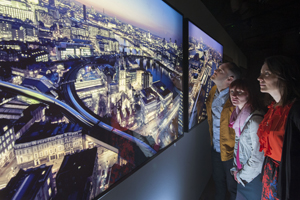
• An exhibition that transports visitors to the heart of the Large Hadron Collider (LHC) opened at the Science Museum yesterday. In the first exhibition of its kind, Collider offers visitors the closest thing to actually being at the CERN particle physics laboratory, blending theatre, video and sound to enable visitors to explore the control room, meet virtual scientists and engineers and see inside a huge underground ‘detector’ cavern. There’s also the chance to follow the journey of particle beams as they race around the 27 kilometre long LHC tunnel (incidentally about the same length as the Circle Line) and the exhibition’s highlight is a wrap around projection which takes watchers from an enormous experiment cavern to the heart of a particle collision. On show will be artefacts from the actual LHC including a 15 metre magnet used to steer the particle beam and objects from the museum’s collection including the accelerator used by Cockcroft and Walton to split the atom in 1932. Admission charge applies. Runs until 6th March. For more, see www.sciencemuseum.org.uk.

John Richard Arthur, a former Mayor of Battersea and the first black man to hold senior public office in London, was honoured with an English Heritage Blue Plaque this week. The plaque was unveiled by Cr Angela Graham, the Mayor of Wandsworth, at his former home at 55 Brynmaer Road in Battersea – his residence during the major milestones of his political career. Elected on 10th November 1913, Archer lived at the home from about 1898 to about 1918. He has been described as a “key figure in the story of the Black contribution in Britain in the early part of the Twentieth century”. For more, see www.english-heritage.org.uk/discover/blue-plaques/.

Christmas comes to the West End this afternoon with the Carnaby Christmas Shopping Party taking place in 13 streets around the iconic fashion strip. More than 100 shops, restaurants and bars are delivering 20 per cent discounts and there’s also complimentary drinks, music, talks on fashion trends and the chance for the “best dressed” to win goodie bags. The party runs from 5pm to 9pm with the Christmas lights turned on at 6pm. Head to www.carnaby.co.uk for more.

El-Dorado• On Now: Beyond El Dorado: power and gold in ancient Colombia. This exhibition in Room 35 of the British Museum features items including ceramics and stone necklaces taken from Lake Guatavita near modern Bogota (The phrase El Dorado, “the golden one”, actually refers to a ritual which took place at the lake in which a newly elected leader of the Muisca people was covered in powdered gold before diving into the lake and washing it off to emerge as the new leader). They are just some of the more than 300 items in the display which come from the Museo del Oro Bogata – one of the best collections of pre-Hispanic gold in the world – as well as the British Museum’s own collection. Other objects include large scale gold masks, a painted Muisca textile, avian pectorals and necklaces with feline claws and one of the few San Agustin stone sculptures held outside Colombia. The exhibition, sponsored by Julius Baer, runs until 23rd March. Admission charge applies. For more, see www.britishmuseum.orgPICTURE: Anthropomorphic bat pectoral, Tairona, gold alloy, AD900-1600. Copyright Museo del Oro, Banco de la Republica, Colombia.