What’s in a name?…Archway…

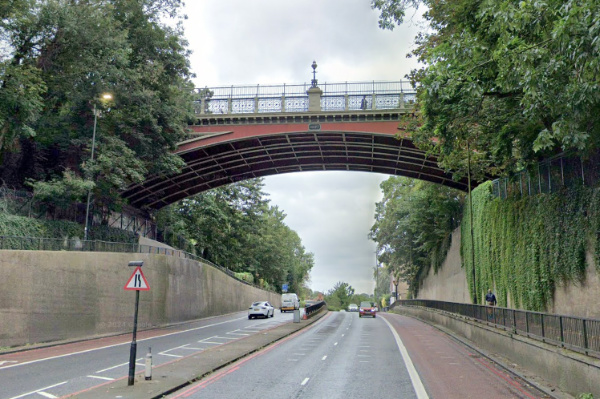
This north London district in the London Borough of Islington owes its name to a bridge which straddles Archway Road (part of the Great North Road or A1).

The bridge’s origins go back to the early 19th century when work began on a 230 metre-long tunnel underneath Highgate Hill which would allow users to bypass the hill’s steep gradient. If completed, it’s said it would have been the earliest road tunnel in Britain.

But in April, 1812, the tunnel collapsed and a cutting through the hill, utilising the work done on the collapsed tunnel, was then proposed. It would become Archway Road.

Hornsey Lane, however, ran across the top of the hill linking Highgate to its west to Crouch End in the east, and to ensure the lane remained when the cutting was completed, it was decided to build a viaduct to carry the lane across the cutting.

The bridge over Archway Road (the A1) as it is today. PICTURE: Google Maps

The resultant structure was designed by none other than John Nash in the style of a Roman aqueduct and opened in 1813.

Archway Road, which ran underneath the arch, was operated as a toll road until 1871.

The bridge, meanwhile, was demolished in 1900 and replaced by a cast iron bridge, designed by Alexander Binnie, which still stands.

The area was referred to as Highgate Archway but gradually the Highgate was dropped and plain Archway adopted.

This was reinforced by the naming of the Tube station in Junction Road which was originally named Highgate when it opened in 1907 as the terminus of the Northern Line but was renamed Archway (Highgate) in 1939 and then just Archway in 1947.

Landmarks in this predominantly leafy residential area include the Whittington Hospital, originally built as the Holborn Union Infirmary 1877-79, on Highgate Hill.

On a similar theme, the Whittington Stone can also be found at the bottom end of Highgate Hill. It is said to commemorate the spot where Dick Whittington, having decided to leave London after failing to make his fortune, heard the Bow Bells ringing and turned back (the stone is topped with a statue of Whittington’s famous cat).

The green expanse of Hampstead Heath lies just to the west.

10 towers with a history in London – 9. The Queen’s Tower, Imperial College London…

This free-standing, 287 foot-high tower is a survivor – it’s all that remains of the Imperial Institute.

Subscribe for just £3 a month to get access to all Exploring London’s stories – that’s less than the cost of a cup of coffee!

10 towers with a history in London – 4. Caledonian Park Clock Tower…

Located in Islington, the Caledonian Park Clock Tower is a local landmark and among all that now remains of the 19th century Metropolitan Cattle Market.

Subscribe for just £3 a month – less than the cost of a coffee – to get access to all of Exploring London’s content!

London Explained – The M25…

The M25 is an 117 mile-long orbital roadway which encircles most of the Greater London area.

Part of the M25 seen from a plane looking north as it took off from Heathrow. PICTURE: RFBailey (licensed under CC BY-SA 3.0)

Originally mostly built as a dual three lane motorway, widening has since taken place in more than half of it – to as much as six lanes in parts.

The idea was first proposed in the early 20th century and then re-mooted several times in subsequent decades before construction began in 1973.

The final section of the M23 was opened by then-Prime Minister Margaret Thatcher in 1986 (it was Europe’s longest ring road when it opened and has since been bypassed by the Berliner Ring).

The M25, which has 31 junctions, is these days one of the busiest motorways in Europe. It connects to 10 other motorways.

Connect Plus – a joint venture between Balfour Beatty, Atkins and Egis – works on behalf of National Highways to manage and operate the M25 network. 

Famous Londoners – Mah-Jongg…

A ring-tailed lemur who famously once lived in Eltham Palace, Mah-Jongg was the much-indulged pet of rich-listers Stephen and Virginia Courtauld during the interwar period.

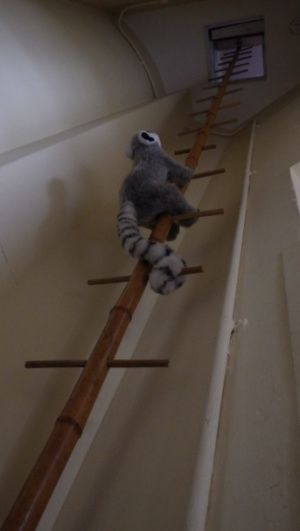
A replica of Mah-Jongg climbs his bamboo ladder at Eltham Palace. PICTURE: BEV Norton (licensed under CC-BY-NC-ND 2.0)

The couple purchased the lemur through Harrod’s then pet department soon after their marriage in 1923. He was immediately christened Mah-Jongg but commonly referred to as “Jongy”.

As well as residing with them in their Grosvenor Square, Mayfair, residence, the lemur also travelled with the Courtaulds.

This included on their luxurious motor yacht, the Virginia, on which he had a specially designed deck chair to lounge in (although Jongy, who had a reputation for being a bit nippy at times, is said to have disgraced himself at a farewell lunch for the British Arctic Air Route Expedition, of which Stephen was a sponsor, when he bit the expedition’s wireless operator, Percy Lemon, and severed an artery; it took Lemon three months to recover).

When the Courtaulds bought Eltham Palace in 1933, Mah-Jongg’s image was incorporated into the building including in a mural in the billiard room and in wooden bosses carved in his likeness in the Great Hall.

Mah-Jongg also had specially designed living quarters on the first floor with a trapdoor opening to a bamboo ladder that led down to the Flower Room on the ground floor. His cage was decorated with Madagascan rainforests by Gertrude Whinfield.

Mah-Jongg died in 1938. A memorial to him was originally installed at Eltham Palace but is now located at the Courthauld’s last home, a replica French villa called La Rochelle, in what is now Zimbabwe.

He’s also famously seen in Leonard Campbell Taylor’s 1934 portrait of the Courthaulds in the music room of their Grosvenor Square home.

A Moment in London’s History – The British Empire Exhibition…

Postcard showing the Empire Stadium. PICTURE: Via Wikipedia/Public Domain

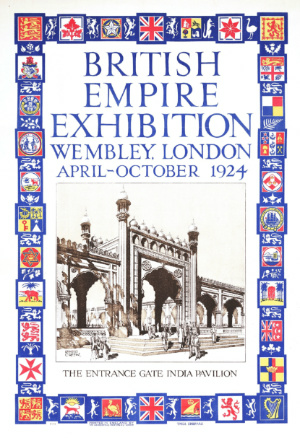
It’s 100 years ago this year that the British Empire Exhibition was held in Wembley Park.

Located on a more than 200 acre site, the exhibition was designed to showcase the diversity and reach of the empire. It ran for two six-month long summer seasons – first opening on 23rd April, 1924, and running until 1st November that year and then reopening on 9th May, 1925, and running until 1st October.

PICTURE: Via Wikipedia/Public Domain

The opening ceremony, which took place on St George’s Day, was attended by King George V and Queen Mary, and the event, in a first for a monarch, was broadcast on BBC radio.

The exhibition, which cost £12 million and attracted some 27 million visitors, featured what was said to be the largest sports arena in the world – Empire Stadium (later known as Wembley Stadium) – as well as four main pavilions dedicated to industry, engineering, the arts and the government, and a series of pavilions for 56 of the empire’s 58 territories as well as some commercial pavilions.

The latter included an Indian pavilion modelled on  Jama Masjid in Delhi and the Taj Mahal in Agra, a West African pavilion designed to look like an Arab fort, a Burmese pavilion designed to look like a temple and a Maltese pavilion designed as a fortress with the entrance resembling the famed Mdina Gate.

The Empire Stadium hosted events including military tattoos and Wild West rodeos while other attractions included a lake, a 47 acre fairground, a garden, restaurants and a working replica coal mine.

Star attractions included a replica of King Tutankhamen’s tomb (housed in the fairground), a working model of Niagara Falls and a full-sized sculpture of the Prince of Wales (later Edward VIII) made of butter (both in the Canadian pavilion), a 16 foot diameter ball of wool (Australian pavilion) and dodgem cars (also in the funfair). Queen Mary’s Dollhouse – now housed at Windsor – was designed by Sir Edwin Lutyens and served as a miniature showcase of the finest goods of the period.

Reinforced concrete was the main building material used in its construction, earning it the title of the first “concrete city”. The streets of the exhibition, meanwhile, were named by Rudyard Kipling.

The Malta Pavilion entrance. PICTURE: Wikipedia/Public Domain

Wembley Park Tube station, which had first opened in 1893, was rebuilt for the event and a new station – Exhibition Station (Wembley) added (it was officially closed in 1969).

While many of the buildings were dismantled after the exhibition, some survived for decades afterwards including, of course, the Empire Stadium which became Wembley Stadium and was the home of English football until replaced in 2003.

This Week in London – Victorian London captured; and, contemporary art at the British Museum…

See a glimpse of London as it was during the Victorian era at a new exhibition opening at the London Metropolitan Archives. Lost Victorian City: a London disappeared features photographs, prints, watercolours and documents depicting buildings, horse-drawn transport, docks and various forms of entertainment along with artists’ views of the capital. Highlights include images taken in 1875 by the Society for Photographing Relics of Old London of the 17th century coaching inn, the Oxford Arms, which was demolished two years later, two images by Philip Henry Delamotte showing the moving of the Crystal Palace from Hyde Park to Sydenham following the Great Exhibition of 1851, and a photograph showing the public disinfects whose job was to remove all textiles after an infectious disease outbreak. The display can be seen at the Clerkenwell-based archives until 5th February next year. For more, see

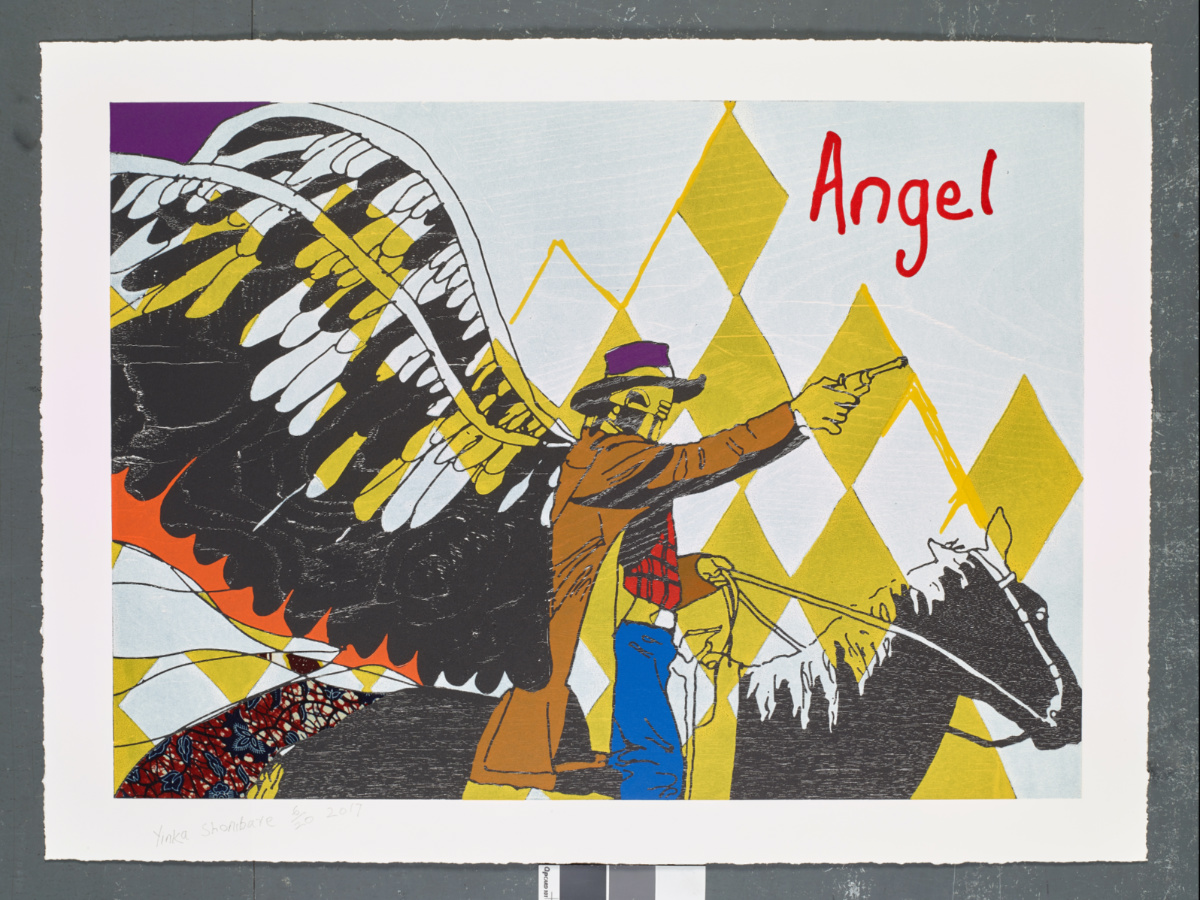
Yinka Shonibare CBE, Cowboy Angel V from the series Cowboy Angels. Colour woodcut and collage of Dutch wax batik fabric. Reproduced by permission of the artist.

An exhibition has opened featuring works of art acquired by the British Museum over the past two decades including works by David Hockney, Damien Hirst, Julian Opie, Yinka Shonibare and Cornelia Parker. Contemporary collecting: David Hockney to Cornelia Parker features around 100 works acquired since 2001. Many of the works, which span the period from the 1960s onwards, are being exhibited for the first time. Highlights include Hockney’s prints The Marriage (1962) and Henry Seated with Tulips (1976), Parker’s Articles of Glass and Jug Full of Ice from One Day This Glass Will Break (2015), Michael Craig-Martin’s CoathangerLight bulb and Watch from Drawings (2015); Caroline Walker’s colour lithograph Bathed (2018); Shonibare’s colour woodcuts Cowboy Angel I, II, V (2017) and Joy Gerrard’s Vigil/Protest (Westminster 14th March 2021), a 2023 drawing in Japanese ink. Runs until 29th September in Room 90. Admission is free. For more, see www.britishmuseum.org/david-hockney-cornelia-parker.

10 significant (and historic) London trees…1. Queen Elizabeth’s Oak, Greenwich…

Spring is upon us, so we thought it an appropriate time to consider some of London’s greatest natural assets – its trees. But, as well as being significant for their environmental impact, each of these trees (or, in some cases, the remains of them), are significant for historic reasons (we’ve previously mentioned a couple including what’s believed to be the oldest tree and the unusual – and sadly now deceased – Hardy Tree).

PICTURE: Steve Daniels (licensed under CC BY-SA 2.0)

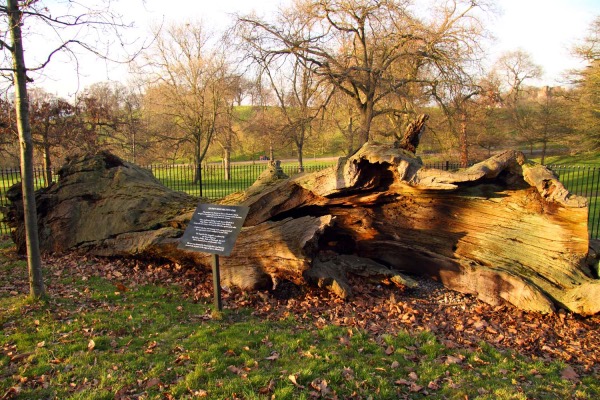
First up, it’s the tree known as Queen Elizabeth’s Oak in Greenwich. Thought to date from possibly as far back as the late 13th century, this tree survived until the 19th century before its carcass finally fell to the ground during a storm in 1991. It has lain in Greenwich Park ever since.

The tree, which is located at the end of what is now Lover’s Walk close to the Maze Hill Gate, was located in the grounds of Greenwich Palace (also known as the Palace of Placentia) and was there when King Henry VIII resided at the palace.

In fact, it’s said that he and Anne Boleyn danced around the oak while courting, and (and here’s where the name comes from) that Elizabeth, their daughter (and later Queen Elizabeth I), picnicked under its canopy (some accounts suggest she actually picnicked in the tree’s hollow – but still then upright – trunk).

Following the creation of what is now Greenwich Park, the hollow tree was apparently used as a prison for those caught illicitly on the grounds. They were secured behind a heavy wooden door fitted to the trunk (a park keeper’s lodge was built nearby in the 17th century; it was demolished in the 1850s).

The tree, one of 3,000 in the park, had died in the 19th century and was reduced to an eight metre high stump, partly supported by ivy, when it was blown over by the storm in June, 1991.

A replacement oak, which was donated by the Greenwich Historical Society was planted nearby by the Duke of Edinburgh on 3rd December, 1992, to mark Queen Elizabeth II’s 40 years on the throne.

A ring analysis carried out on the tree found in 2014 it dated back to at least 1569 but with the core missing a precise date of germination couldn’t be found. Estimates, however, place the date of germination to the last 13th or early 14th century. The analysis placed the tree’s death to between 1827 and 1842.

The tree is marked with a plaque and both it and the new tree are surrounded by an iron railing.

WHERE: Queen Elizabeth Oak, Greenwich Park (nearest DLR station is Greenwich); WHEN: 6am to 8pm daily; COST: Free; WEBSITE: https://www.royalparks.org.uk/visit/parks/greenwich-park.

This is an expanded version of a post first made in 2017.

Where (was) London’s oldest…pizzeria?

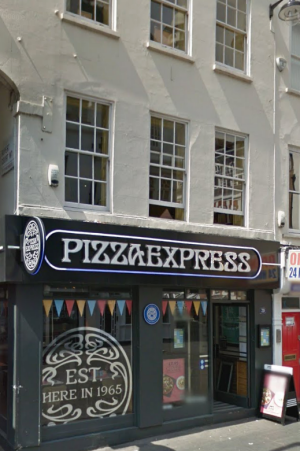
London’s first Pizza Express in Soho, taken prior to its closure in July, 2014. PICTURE: Google Maps.

While pizza had been available in London restaurants some time before, the first dedicated pizzeria is said to have been the first Pizza Express located in Wardour Street in Soho.

The premises on the corner of Rupert Court and Wardour Street was established by Peter Boizot, who has reportedly first discovered pizza while in Italy in the 1940s, and, having witnessed the appearance of pizzerias elsewhere in Europe, decided to bring the concept to London.

Opening its doors on 27th March, 1965, the establishment was modelled on Italian pizzerias. Boizot had partnered with Italian designer, Enzo Apicella, to create an authentic Italian experience which included an open kitchen, simple furnishings and a wine menu (he also brought in a pizza chef from Sicily).

While the concept apparently wasn’t an instant success, it soon did catch on and Pizza Express opened further branches across the city – the first in Coptic Street next to the British Museum in 1967.

Sadly the Wardour Street premises was among dozens that the chain closed during the coronavirus pandemic in 2020.

This Week in London – Underground shelters in wartime – then and now; new Ravenmaster at the Tower; and, ‘La Ghirlandata’ back at the Guildhall Art Gallery…

A new photographic exhibition exploring how Underground stations and metro systems provide shelter to citizens during periods of war, both now and in the past, opened at the London Transport Museum in Covent Garden last week. Echoes of the Blitz: Underground shelters in Ukraine and London features 70 images, including historical pictures from the museum’s collection as well as 38 contemporary photographs shot by six renowned, mainly Ukrainian, documentary photographers. The latter include photography showing ordinary Ukrainian citizens sleeping, waiting, cooking, washing clothes, caring for their pets and creating temporary make-shift homes in metro stations of Kyiv and and Kharkiv show alongside black and white archive images of Londoners taking refuge in Tube stations during World War II. The exhibition, which is being run in partnership with Berlin-based journalistic network n-ost, can be seen until spring next year. Admission charge applies. For more, see www.ltmuseum.co.uk.

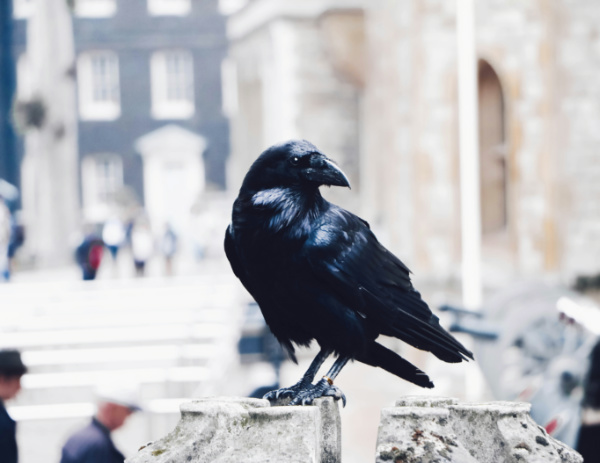
A raven at the Tower of London. PICTURE: Kasturi Roy/Unsplash

A new Ravenmaster has been appointed at the Tower of London. Yeoman Warder Michael ‘Barney’ Chandler took up the role at the start of this month, 15 years after he first became a Yeoman Warder at the Tower. The Ravenmaster oversees a team of four responsible for the care of the Tower’s seven ravens which legend says must remain at the Tower to ensure its protection. The legend apparently goes back to at least the reign of King Charles II – when the King’s astronomer John Flamsteed complained that the resident ravens were impeding his work at the Tower and requested their removal, the King was told that if the ravens left the Tower then the Kingdom would fall (and so they remained). While the Yeoman Warders have longed cared for the ravens, the post of Ravenmaster was only created in the past 50 years and was first held by Yeoman Warder Jack Wilmington. Yeoman Warder Chandler, who became the 387th Yeoman Warder at the Tower when he was appointed in March, 2009, is only the sixth person to hold the office. For more, see www.hrp.org.uk/tower-of-london/.

One of the most popular paintings at the Guildhall Art Gallery is being reinstalled to mark International Women’s Day on Friday. Dante Gabriel Rossetti’s La Ghirlandata has been on loan – first to the Tate Britain and then to the Delaware Art Museum in the US – but is now being returned. The painting dates from 1873 and depicts a ‘garlanded woman’ playing an arpanetta and looking directly at the viewer. The muse for the woman is said to have been the actor and model, Alexa Wilding, while the two ‘angels’ in the top corners were posed by William and Jane Morris’ youngest daughter, May Morris. The City of London Corporation acquired the oil on canvas work in 1927. On Saturday, free family activities will be held at the gallery to mark the work’s return. For more, see www.thecityofldn.com/la-ghirlandata.

Send items to exploringlondon@gmail.com.

10 atmospheric ruins in London – 5. All Hallows Staining…

Located in at the junction of Mark Lane and Dunster Court in the City of London, All Hallows Staining was a medieval church which was mostly demolished in the late 19th century.

All Hallows Staining church tower as seen in July, 2022. PICTURE: Courtesy of Google Maps

These days only the lonely tower remains (above ground at least) as testament to building that once stood there and the lives that were impacted by it.

All Hallows Staining was originally built in the late 12th century and while the origins of its name are somewhat shrouded in mystery, there are a couple of theories.

One says it takes its name from the fact it was built in stone when other churches at the time were wooden (“staining” meaning “stone”) while another says it takes it names from the fact it was built on land belonging to the Manor of Staines.

Princess Elizabeth (later Elizabeth I) is said to have presented the church with new bell ropes after she was released after two months in the Tower of London in 1554 during the reign of her half-sister Queen Mary I (paying tribute to the sound they provided while she was in the Tower).

The church survived the Great Fire of London in 1666 but collapsed just five years later, its foundations apparently weakened by too many graves in the adjoining churchyard.

It was rebuilt in 1674-75 but largely demolished in 1870 when the parish was combined with St Olave Hart Street (and the proceeds were used to fund construction of All Hallows, Bow, in the East End).

Just the tower, parts of which date from the 12th century, remained. The property was bought by the Worshipful Company of Clothworkers. Underneath the adjacent yard they installed the remains of the 12th century crypt of the hermitage chapel of St James in the Wall (later known as Lambe’s Chapel) following the demolition of the chapel in the 1870s.

During World War II, when St Olave Hart Street was badly damaged in the Blitz, a temporary prefabricated church was erected on the site of All Hallows Staining which used the tower as its chancel. It was known as St Olave Mark Lane.

The church was Grade I listed in 1950. In 1957, Clothworkers had a hall for St Olave Hart Street constructed on part of the site of the former church.

The tower is usually able to be seen across a small yard from Mark Lane.

A Moment in London’s history – The first Selfridges Christmas windows display…

Oxford Street department store Selfridges is known for many firsts and among them is that it was the first department store in the UK to have window displays for Christmas.

It was in 1909, having opened the store in March that year, that American Harry Gordon Selfridge, drawing on his experience in the states where Macy’s in New York had featured Christmas window displays since the 1870s, decided to illuminate the display windows at his store in a bid to allow passersby to see the goods on display.

Selfridges Christmas window from 2014. PICTURE: Oast House Archive (licensed under CC BY-SA 2.0)

The windows were just one of the many innovations aimed at celebrating Christmas Selfridge – who is credited with having been the first to use the line “only (x) number of shopping days till Christmas” while working at Marshall Field’s in Chicago – embraced in the store.

Christmas displays were said to almost cover an entire floor and there were mince pies for customers, a chance to visit with Santa Claus, and a gift advice service as well as men-only tours of the store to help them with buying gifts for the females in their lives.

This year’s Christmas display at Selfridges was created around the theme of ‘showtime’ and reportedly took 100 hours to put together. It features characters including Santa Claus and the elves in a workshop.

London pub signs – The Sir John Hawkshaw…

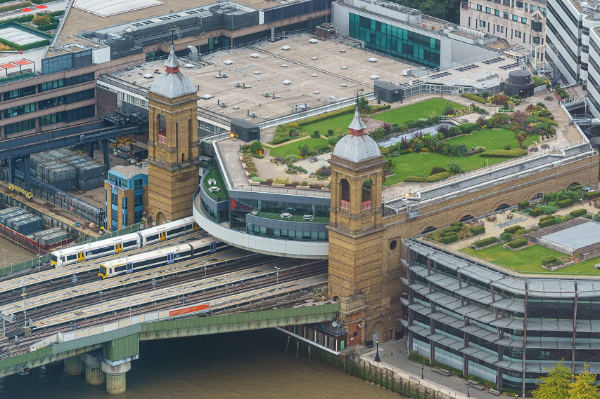
The Sir John Hawkshaw is located inside the Cannon Street Station (with good reason). PICTURE:© User:Colin / Wikimedia Commons / CC BY-SA 4.0.

This establishment in the Cannon Street Station in the City of London is a modern take on the pub but thanks to the name and location comes with built-in history.

Sir John Hawkshaw (1811-1891) was a railway engineer who, importantly given this pub’s location, is recognised for his work on the original Cannon Street railway station – which he designed with JW Barry – as well as the adjoining Cannon Street Railway Bridge over the Thames (it was originally named ‘Alexandra Bridge’ in honour of Princess Alexandra of Denmark, wife of Edward, the Prince of Wales)

The original Cannon Street station, which opened on 1st September, 1866, featured two “Wren-style” towers which stand 135 feet high and faced the Thames (these two towers, now Grade II listed, are still there today). They helped support the station’s single arched iron and glass roof which stretched some 700 feet in length to cover the railway platforms (an adjoining Italianate-style hotel and forecourt designed by Barry opened the following year).

While Hawkshaw’s two towers remain (and it should be noted that the engineer was also famous for his work on other projects including, among others, the Severn Tunnel and Suez Canal), the current Cannon Street Station is a much more modern structure dating originally from the 1980s with some works being completed in the last decade or so.

The site’s known history, meanwhile, goes back much further, however. Prior to Hawkshaw’s station, since 1690 the site had been occupied by the livery hall of the Worshipful Company of Plumbers. Prior to that it was the site of the Steelyard and, much further back in time, the remains of a Roman palace have been found beneath the site which date from the 1st century.

The modern pub, located in the station, is part of the JD Wetherspoon chain.

For more on the pub, see https://www.jdwetherspoon.com/pub-histories/england/london/the-sir-john-hawkshaw-cannon-street.

This Week in London – ‘Spies, Lies and Deception’ at IWM London; the printing of Shakespeare’s plays; and, Georgian illuminations at the Sir John Soane’s Museum…

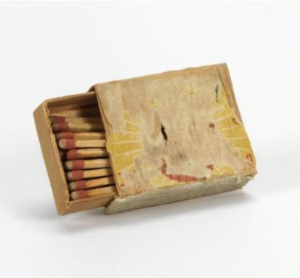
A box of matches containing one match specially adapted for writing
secret messages used during World War II.
© IWM (EPH 178)

A free exhibition exploring the “tricks, tools and elaborate plots that make up the secret world of spying and deception” has opened at IWM London. Spies, Lies and Deception features more than 150 objects including gadgets, official documents, art and newly digitised film and photography. Highlights include Operation Mincemeat mastermind Ewen Montagu’s private papers relating to the World War II plot – which fooled German High Command about the location of the next major Allied assault by planting a dead body with fake military documents off the Spanish coast – along with an oar from the submarine’s dinghy which deposited the body. There is also a box of matches with a match specially adapted for writing secret messages (pictured), footprint overshoes made by SOE (Special Operations Executive) in South-East Asia during World War II to disguise the wearer’s real footprints, and papier-mâché heads used to deceive snipers in World War I trenches. The exhibits also detail the work of the World War I Postal Censorships department – which examined letters sent to foreign locations including testing letters for invisible ink and tell the story of SOE operative Noor Inayat Khan – the first female wireless operator sent by SOE into Occupied France, she successfully transmitted messages to London for four months before being betrayed, captured and executed. There’s also a newly commissioned interview with Eliot Higgins, founder of Bellingcat, an international collective of researchers who used open source data to uncover the real identities of those responsible for the Salisbury Novichok poisonings in 2018, along with a photo album of double agent Kim Philby in Siberia after he escaped to the Soviet Union following his discovery in 1963. The free display can be seen until 14th April next year. For more, see iwm.org.uk/events/spies-lies-and-deception.

A exhibition looking at the history of printing William Shakespeare’s plays has opened at the Guildhall Library. Folio 400: Shakespeare in Print covers everything from the printing of the small ‘Quartos’ of the late 16th century to the reworking of the text in the 18th century and the rediscovery of original texts in the 19th century. Running in parallel is a display at the City of London Heritage Gallery at Guildhall Art Gallery which features the library’s copy of the First Folio, widely regarded as one of the finest and most complete. Entry is free. Runs until 30th January. For more, see www.cityoflondon.gov.uk/things-to-do/history-and-heritage/guildhall-library.

An exhibition centring on the spectacular light illuminations of the Georgian period has opened at Sir John Soane’s Museum. Georgian Illuminations celebrates the light shows of the period and the impressive and the elaborate temporary architectural structures created for them, often designed by leading architects and artists, including Sir John Soane. It features newly discovered linen transparencies, which were back-lit in Georgian windows as patriotic decoration during the Napoleonic Wars, as well as a contemporary work by light artist Nayan Kulkarni light artist which sees the facade of the museum at Lincoln’s Inn Fields illuminated each night from dusk until about 11pm. A series of events accompanies the exhibition. Runs until 7th January, 2024. Entry is free. For more, see www.soane.org/exhibitions/georgian-illuminations,

Send all items to exploringlondon@gmail.com for inclusion.

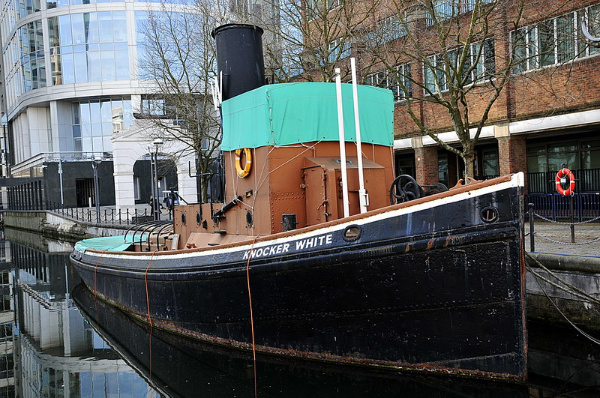
10 historic vessels in London’s Thames…10. The ‘Knocker White’…

The ‘Knocker White’ in 2013. PICTURE: martin_vmorris (licensed under CC BY-SA 2.0)

A Dutch-built tugboat, the Knocker White (originally called the steam tug Cairnrock) was built in 1924 by T Van Duijvendijk’s yard at Lekkerkek near Rotterdam, Netherlands for Harrisons (London) Lighterage Ltd.

Following the installation of a steam engine and boiler at Great Yarmouth, the steel-hulled Cairnrock – which was designed for general towage work and featured a drop-down funnel for travelling under bridges – was initially used to Tow the Harrisons’ floating steam-powered coal elevator Wotan around the lower reaches of the Thames. 

In 1960, the 77 foot long tug was sold and passed through the hands of a couple of different owners and ended up, by 1962, in the hands of WE White and Sons. It was during this time that its name was changed (after a White family nickname), marine diesel engines installed and the steam engines and boilers removed.

The Knocker White continued in service, operating out of the WE White & Sons base at Hope Wharf in Rotherhithe, working on the Thames and the Solent until 1982.

In November of that year, it was sold for scrap to Todd (Breakers) Ltd of Dartford but, after being drawn to the attention of the Museum of London, was acquired by them in March 1985 as a classic example of an early tall-funnelled Thames steam tug.

In November, 2016, the Knocker White – along with the Varlet – was acquired by Trinity Buoy Wharf with the aim of restoring the vessel and putting on public display. It can be seen moored at the wharf today.

10 historic vessels in London’s Thames…7. Lightship 95…

Lightship 95 at Trinity Buoy Wharf. PICTURE: Steve James (licensed under CC BY-NC-ND 2.0/image cropped)

This red-painted vessel once served as a beacon at South Goodwin Sands off the Kentish coast but, now permanently moored at Trinity Buoy Wharf, has been converted into a recording studio.

The 550 tonne ship was built in 1939 by Philip and Sons of Dartmouth for Trinity House, a company established during the reign of King Henry VIII initially to regulate pilotage on the River Thames. It later established lighthouses and floating lightships and took over responsibility for all buoys in England. It currently maintains 65 automated lighthouses.

The steel-hulled vessel, one of three built to the same design (one, converted into a home, is now at Victoria Dock in Silvertown – and currently for sale with an asking price of £595,000 – and another in Rotterdam, The Netherlands), features a central light tower and originally had crew quarters.

It was mostly used to mark South Goodwin Sands but was also deployed to other locations including Inner Dowsing off the coast of Norfolk.

In the 1990s, it became the first light vessel in the UK to be converted to solar power to enable unmanned operation and underwent a complete refit in 1999.

Lightship 95 in 2012. PICTURE: Reading Tom (licensed under CC BY 2.0)

It was taken out of service in 2003 and subsequently sold at auction by Trinity House. Initially bought by the Port Werburgh Marina on the Medway, it was later onsold to Ben Phillips who converted it to a floating music recording studio. Since 2008, it has been based at Trinity Buoy Wharf.

10 historic vessels in London’s Thames…6. ‘Portwey’…

One of only two twin screw, coal fired steam tugs still active in the UK, the steam tug Portwey can these days be found in London’s Docklands.

PICTURE: Paul Gravestock (licensed under CC-BY-NC-ND 2.0)

Ordered by the Portland & Weymouth Coaling Co Ltd, Portwey (the name comes from the company’s) was built by Harland & Wolff at Govan yard in Glasgow and launched on 10th August, 1927.

The 80 foot long vessel was based in Weymouth, Dorset, performed a range of tasks including carrying coal to steamers and being on call for any ship in distress requiring assistance or salvage. This included extinguishing a fire aboard the Danish timber-carrier Bodil in 1928, assisting ships like the cargo steamer Winslow (which had developed a list in heavy seas in 1932), and the Winchester Castle which had run aground in 1936, and even being involved in the search for a sunken submarine in 1932.

The Portwey was seconded by the Admiralty and moved to Dartmouth in Devon during World War II. Narrowly avoiding German bombs while in the harbour, during this time the tug was went to the assistance of ships attacked by the enemy. In 1944, she was assigned to US forces as they prepared for D-Day and her duties including clearing obstructions from the channel and supplying fresh water to naval vessels as well as, when a rehearsal for the landings went wrong at Slapton Sands, rescuing personnel and landing craft.

After the war, the Portwey resumed duties as a harbour tug including ferrying pilots and customs officers out into the Channel. In 1947, she helped put out a fire at the Queen’s Hotel in Dartmouth.

The Portwey was sold to the Falmouth Dock and Engineering Company in Cornwall in 1952. As well as rescuing the captain and first officer of the cargo ship Flying Enterprise, during this period she was involved in the construction of the Lizard Lifeboat Station in Cornwall, and a car ferry slipway at Holyhead in north Wales.

In 1967, with coal-fired steam tugs being replaced by diesel-engined ships, she was laid up to be scrapped. But it wasn’t the end for the Portwey, which was bought by Richard Dobson, the assistant harbour master at Dartmouth. Along with a group of friends, he returned her to working condition and during the 1960s and 1970s, she took part in many events on the River Dart and around Torbay.

In 1982, the Portwey joined the Maritime Trust’s Historic Ship Collection at St Katharine’s Dock where the newly formed Friends of Portwey continued with restoration and operation of the tug.

The Friends of Portwey became the Steam Tug Portwey Trust in 2000 and purchased the tug from the Maritime Trust, moving the vessel to West India Dock.

WHERE: Steam Tug Portwey, West India Dock (South Quay) (nearest DLR station is South Quay); WHEN: 2pm to 9pm Wednesdays; WEBSITE: www.stportwey.co.uk.

This Week in London – Wren at Work; music moments captured in photographs; and, the RA’s 255th Summer Exhibition…

Wren’s monument – St Paul’s Cathedral. PICTURE:
Aaron Gilmore/Unsplash

A recreation of Sir Christopher Wren’s office while he was working on St Paul’s Cathedral can be seen at the Guildhall Art Gallery from today. The faux 17th century environment, created by Chelsea Construction, will allow visitors to explore the building methods and tools of the age, as well as the daily lives of 17th century diarists including Robert Hooke, John Evelyn and Margaret Cavendish, and a case study of how citizens lost and regained their properties during and after the Great Fire of 1666. A specially commissioned map by artist/cartographer Adam Dant will provide insight’s into Wren’s life and times and will be displayed alongside illustrations by architect George Saumerez-Smith and members of the Worshipful Company of Chartered Architects, a scale model of St Paul’s Dome by students at Kingston University, and stone models from master mason Pierre Bidaud. The Wren at Work exhibition is part of Wren300. Admission is free but booking are recommended. For more, see www.cityoflondon.gov.uk/events/wren-at-work-wren300-exhibition.

Photographs capturing Pete Townshend’s guitar flying through the air at Madison Square Garden and Noel Gallagher during the making of the video for Wonderwall are just two of the images on show in a new exhibition at the Barbican Music Library. Celebrating the 25th anniversary of music photography collection Rockarchive.com, In The Moment: The Art of Music Photography also features images of everyone from David Bowie to Debbie Harry, Queen, Biggie Smalls, led Zeppelin, Lady Gaga and Amy Winehouse, capturing them in recording sessions at live gigs and at photo shoots. The free exhibition, which opens on Friday, can be seen until 25th September. For more, see www.cityoflondon.gov.au/services/libraries/barbican-music-library. Meanwhile, a bust of Sir Simon Rattle is being unveiled today at the library in tribute to his five decades in classical music. Sir Simon, who has made over 100 recordings. became music director of the Barbican’s resident orchestra, the London Symphony Orchestra, in 2017 and will conclude his tenure this year.

The Royal Academy’s 255th annual Summer Exhibition opened this week under the theme of ‘Only Connect’ (inspired by a quote from the novel Howards End by EM Forster). Exhibiting artists include British sculptor Lindsey Mendick, Barbados-born painter Paul Dash, American multi-media artist Ida Applebroog, St Lucia born painter Winston Branch, Colombian sculptor Carlos Zapata and British painters Caragh Thuring and Caroline Walker, and Irish fashion designer Richard Malone, who has created a dramatic mobile installation which hangs in the Central Hall. There are also works by Royal Academicians including Frank Bowling, Michael Craig-Martin, Tracey Emin, Gillian Wearing and the late Paula Rego. Runs until 20th August. Admission charge applies. For more, see royalacademy.org.uk.

Send all items to exploringlondon@gmail.com

10 historic vessels in London’s Thames…4. ‘Massey Shaw’…

The Massey Shaw in The Thames in 2015. PICTURE: R~P~M (licensed under CC BY-NC-ND 2.0)

Moored at West India Dock, the Massey Shaw is a former London Fire Brigade fireboat.

The fireboat was constructed in 1935 for a cost of £18,000 by the J Samuel White company in Cowes on the Isle of Wight. Named for Sir Eyre Massey Shaw – the first Chief Officer of what was then named the Metropolitan Fire Brigade, the vessel was designed to London County Council specifications with a deliberately low profile so it could fit under the Thames bridges in all tides.

The vessel, which was was powered by two eight cylinder diesel engines and featured a main deck monitor as well as eight deck outlets (and a wheelhouse which was added later), soon proved its worth, playing an important role in saving what the press said was a million pounds worth of stock at a large warehouse fire on Colonial Wharf.

During World War II, the Massey Shaw took part in Operation Dynamo, forming part of the small boat flotilla which evacuated British troops from the beach at Dunkirk. She ferried more than 500 troops to a larger ship offshore and transported almost 100 back to England and it’s believed she was the last of the small boats to leave Dunkirk harbour (rescuing survivors from a French vessel which struck a mine along the way).

Back in London, Massey Shaw performed a critical role during the Blitz, pumping large quantities of Thames water to douse fires along the city’s waterfront.

It remained in service until the early 1970s, although it had operated as a reserve boat since 1960 with newer models taking over frontline duties.

Decommissioned in 1971, the Massey Shaw was found abandoned 10 years later at St Katharine Dock by a group who went on to found The Massey Shaw Fireboat Society with a view to preserving the vessel. They were granted a 50 year lease on the vessel.

In 1985, the Massey Shaw joined the Association of Dunkirk Little Ships on their return to Dunkirk for the first time since 1965 and two years later, she attended the centenary of Sir Eyre Massey Shaw’s review of 1000 firemen at Oxford.

In 1990 the Massey Shaw was sunk close to the London Fire Brigade headquarters at Lambeth but was subsequently salvaged and the following year, after restoration work, joined the 50th anniversary return trip to Dunkirk.

The society gained full ownership of Massey Shaw in 2002 and restoration work was carried out by the TV programme Salvage Squad (a second appearance on the show and more work followed two years later).

In 2008, a £500,000 Heritage Lottery Grant was used to fund the restoration of the vessel at Gloucester docks. She returned to London by road in 2013 where the restoration was completed and in 2015 was officially launched back on the River Thames with an event at the Westminster Boating Base.

Later that year she participated in another “little ships” armada to Dunkirk, this time commemorating the 75th anniversary of the evacuation. Massey Shaw has since taken part in other events including celebrations marking Queen Elizabeth II’s record as longest reigning monarch in 2015.

The vessel is now moored at the eastern end of West India Docks on the Isle of Dogs.

While Massey Shaw did appear in the 1958 film, Dunkirk, recapturing its role as one of the “little ships”, it did not appear in the 2017 film of the same name.

WHERE: Massey Shaw, West India Dock, Poplar (nearest DLR station is South Quay; nearest Tube station is Canary Wharf); WHEN: Between March and November, from 11am to 3pm daily (check website for details); WEBSITE: https://masseyshaw.org.

10 historic vessels in London’s Thames…2. HQS Wellington…

A former World War II convoy escort ship, the HQS Wellington, which is moored alongside Victoria Embankment in the River Thomas, is unusual in that for the past 75 years it has served as the headquarters of the Honourable Company of Master Mariners.

The HQS Wellington seen in 2007. PICTURE: JPLon (licensed under CC BY-SA 3.0)

Constructed in the Devonport Dockyard, Plymouth, in 1934 for the Royal Navy as a two-masted Grimsby-class sloop, the HMS Wellington served in the Pacific in the lead-up to World War II, based mainly in New Zealand (she was named for the capital of New Zealand) and patrolling the South Pacific.

Following the outbreak of war, the HMS Wellington – which featured two 4.7-inch guns and one 3-inch gun as well as carrying other anti-aircraft guns and depth charges – served mainly as a convoy escort in the North Atlantic.

During this time, the vessel was involved in the sinking of an enemy U-boat, the evacuation of Allied forces from St Valery-en-Caux, north of Le Havre, and the Allied landings in North Africa in late 1942. In 1943, the HMS Wellington was one of the first escort ships to be fitted with Hedgehog, an anti-submarine weapon, which replaced the three inch gun.

The ship ended the war having travelled almost 250,000 miles and escorting 103 convoys.

Following the war, the 265 foot long ship was initially transferred to the Reserve Fleet in Milford Haven before, in 1947, the Admiralty made the ship available to the Honourable Company of Master Mariners to serve as a floating livery hall. She was converted for that purpose – and renamed the HQS Wellington – at Chatham Dockyard using funds raised through a public appeal.

The interior features a grand wooden staircase taken from the 1906 Isle of Man ferry SS Viper which was being broken up at the time.

The HQS Wellington arrived at Victoria Embankment in 1948 for service as the livery company HQ.

The ship had a major refit in 1991, during which it was fitted out with carpet and new displays showing off the Company’s collections, and in 2005, ownership of the ship was transferred to The Wellington Trust.

In April this year it was announced that due to safety concerns the Honourable Company of Master Mariners would have to leave the vessel. The company, which has relocated to a temporary on-shore headquarters in Greenwich, are now developing plans for a new floating headquarters.