Around London – Workhouse life; funds needed for Salter statues; and Saloua Raouda Choucair at the Tate…

Life as an inmate inside a Victorian workhouse is explored in an exhibition at the Florence Nightingale Museum in Lambeth Palace Road. The exhibition, Workhouse – Segregated Lives, examines the design of the workhouses as well as the inmate’s diet, work and health while living there. Rare artefacts, firsthand accounts, pictorial representations and publications will all help to bring to life the “world of the workhouse” in this display which opened in February and runs until 5th July. There’s a program of events accompanying the exhibition including lectures by historians looking at subjects like the food served in the workhouse and how to find your workhouse ancestors. Admission charges apply. For more, see www.florence-nightingale.co.uk.

The Salter Statues campaign is appealing for funds for a new statue of former Bermondsey resident Dr Albert Salter after a famous statue of the doctor, known for his work with the area’s poor in the early part of the 20th century, was stolen from its location on Bermondsey Wall in 2011. A fundraising campaign has so far raised more than £16,000 with Southwark Council matching all donations made but £100,000 is needed. As well as a replacement statue of Dr Salter, the funds will also be used to buy a new statue of his wife, Ada, who was the first female Labour councillor in London. The new statues have been designed by artist Diane Gorvin, sculptor of the original group of statues which were erected in 1991 and, as well as the seated statue of Dr Salter, also included the couple’s daughter Joyce – who died aged eight of scarlet fever – and her cat (the statues of Joyce and her cat were removed after the theft and are being held in safekeeping). Donations can be made via www.salterstatues.co.uk.

The community of a residential complex at the former Arsenal football stadium in North London – Highbury Stadium Square – comes under examination in a new exhibition running at the Geffrye Museum in Hoxton. Photographer Simone Novotny, who is a resident of the complex herself, looks at the lives and stories of residents in 30 of the 700 new homes in a series of intimate portraits. Runs until 26th August. Admission charge applies. See www.geffrye-museum.org.uk for more.

On Now: Saloua Raouda Choucair. This exhibition at the Tate Modern on South Bank is the first major museum exhibition of the works of Lebanese artist Saloua Raouda Choucair and consists of more than 120 works – many of which have never been seen before – including paintings, sculptures and other objects. The Beirut-born artist, now aged 97-years-old, is credited as being a pioneer of abstract art in the Middle East and her works reflect her diverse interests in science, maths, Islamic art and poetry. Works in display include sculptures in wood, metal, stone and fibreglass (1950s-1980s) as well as early paintings including Self-Portrait (1943) and Paris-Beirut (1948). Runs until 20th October. Admission charge applies. For more, see www.tate.org.uk.

10 Historic London Garden Squares…1. Leicester Square…

In the first of a new Wednesday series looking at historic London garden squares, we take a look at what next to Trafalgar Square, is the most famous square in the entire city – Leicester Square.

Located in the heart of the West End, Leicester Square’s history finds its origins back in the 17th history when Robert Sidney, the 2nd Earl of Leicester acquired property on the site where the square now stands. Then known as St Martin’s Field and located within the parish of St Martin’s, Sidney purchased four acres in 1630 and constructed Leicester House on land now located at the square’s northern end.

Leicester-SquareThe earl raised the ire of locals, however, when – having subsequently fenced off the land to prevent people from wandering on to his property – he enclosed what had previously been common land.

The people appealed to King Charles I who appointed three members of the Privy Council to look at the issue. Their decision? That the earl keep a section of his land open for the use of the parishioners of St Martin’s.

First known as Leicester Field, it was this land which later became known as Leicester Square. Fine homes were built around the square (its proximity to the Royal Court and centre of government made it a desirable place to live for the well-to-do and those seeking influence) with the centre enclosed with rails (it’s pictured here in 1750).

The square’s reputation also had a royal boost when, in 1717/1718, Leicester House became home to Prince George (later King George II) and his wife Princess Caroline along with their court after the prince fell out with his father King George I and was banished from St James’ Palace (this story is recounted in marvellous detail in Lucy Worsley’s terrific book, Courtiers: The Secret History of the Georgian Court).

The prince remained at the house for 10 years and was proclaimed King George II after his father’s death at its gate. Interestingly, King George II’s eldest son, Prince Frederick, also lived here for a time after he too fell out with his father (King George II). Apparently their relationship was even worse than the previous generation’s had been.

Despite its royal attractions, even at this stage the square apparently had it’s darker side with some less than savoury characters attending the hotels and livery stables that were built there. But things were to get worse as the wealthy moved out – a situation not helped when Leicester House was demolished in the 1790s.

Leicester Square became known as an entertainment venue in the 19th century (among attractions was the short-lived Royal Panopticon of Science and Art which showcased the best in science and art and Wyld’s Great Globe which contained a gigantic model of the earth) and received a new injection of life when theatres and music halls moved in, bringing the crowds back with them.

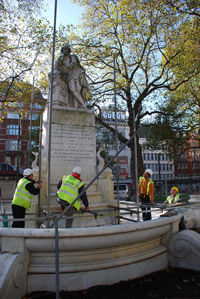
Shakespeare-StatueMeanwhile, the status of the square – and whether it could be built upon – remained a matter of debate well into the 19th century. That ended in 1874 when businessman Albert Grant bought the freehold of the land, had the garden created upon it and then donated it to the Metropolitan Board of Works as a gift to the city.

Responsibility for the management of the square now rests with the City of Westminster. The square area – which is now known for hosting film premieres as well as the tourists who inevitably gather there – was pedestrianised in the 1980s and has just undergone a redevelopment and modernisation which was unveiled last year.

Meanwhile, work to restore the 19th century Shakespeare statue and fountain in the square’s centre is about to be completed (pictured). The square also contains a statue of actor Charlie Chaplin in the square as well as busts of scientist Sir Isaac Newton, painter and first president of the royal Academy Sir Joshua Reynolds, 18th century pioneer surgeon John Hunter, and painter William Hogarth.

The tradition of the entertainment continues in the modern era through the cinemas which now stand in the square and regularly host film premieres (an interesting, if oft-repeated, film-related anecdote connected to the square is that it was in a phone booth located at the square that during the 1960s a young actor Maurice Micklewhite saw a poster for The Caine Mutiny and decided to change his name to Michael Caine).

PICTURES (top) Wikipedia and (below) City of Westminster.

Special – Five famous London funerals…

With former PM Margaret Thatcher’s funeral held in London today, we take a look at five prominent funerals in the city’s past…

Queen Eleanor of Castile: King Edward I was lavish in his funeral for Queen Eleanor (perhaps in an effort to restore her reputation given suggestions she had been unpopular among the common people although it may well have simply been because of the king’s level of grief) and when she died at Harby, a village near Lincoln, on 28th November, 1290, he ordered her body to be transported from Lincoln Cathedral to Westminster Abbey where the funeral was held, with a series of elaborate memorial crosses to be built close to where-ever her body rested for the night. Twelve of these were built including at Westcheap in the City of London and Charing (hence Charing Cross, see our earlier post here), the latter thanks to her body “resting” overnight at the Dominican Friary at Blackfriars. Her funeral took place on 17th December, 1290, with her body placed in a grave near the high altar until her marble tomb was ready. The tomb (one of three built for the queen – the others were located at Lincoln – for her viscera – and Blackfriars – for her heart) still survives in the abbey.

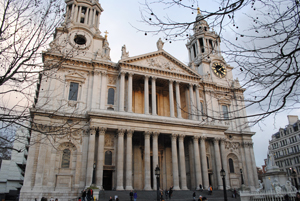
St-Paul's-CathedralVice Admiral Lord Nelson: Heroic in life and perhaps seen as even more so after his death, Nelson’s demise at the Battle of Trafalgar was a national tragedy. His body, preserved in brandy, was taken off the HMS Victory and transported to Greenwich where he lay in state for three days in the Painted Hall. Thousands visited before the body was again moved, taken in a barge upriver to the Admiralty where it lay for a night before the state funeral on 9th January, 1806, more than two months after his death. An escort said to comprise 10,000 soldiers, more than 100 sea captains and 32 admirals accompanied the body through the streets of the city along with seamen from the Victory to St Paul’s Cathedral (pictured)  where he was interred in a marble sarcophagus originally made for Cardinal Wolsey located directly beneath the dome. The tomb can still be seen in the crypt of St Paul’s.

Arthur Wellesley, the Duke of Wellington: Given the last heraldic state funeral ever held in Britain, the Iron Duke’s funeral was held on 18th November, 1852, following his death on 14th September. His body, which had been brought to London from Walmer where it had laid in state by rail, lay in state a second time at Chelsea Hospital. On the morning of the funeral, the cortege set out from Horse Guards, travelling via Constitution Hill to St Paul’s. The body was conveyed in the same funeral car used to convey Nelson’s and accompanied by a guard of honour which included soldiers from every regiment in the army. Masses – reportedly more than a million-and-a-half people – lined the streets to watch funeral procession pass through the city before a service was held in St Paul’s Cathedral under the great dome and he was interred in a monumental sarcophagus alongside that Vice Admiral Lord Nelson. Like Nelson’s, it can still be seen there today.

Sir Winston Churchill: Widely regarded as one of the great wartime leaders of the 20th century, the former British Prime Minister died in his London home on 24th January, 1965, having suffered a stroke nine days earlier. His funeral (plans for which had apparently been code-named ‘Hope-Not’), was the largest state funeral in the world at the time of his death with representatives of 112 nations attending and watched on television by 25 million people in Britain alone. His body lay in state for three days (during which more than 320,000 people came to pay their respects) before on 30th January, it was taken from Westminster Hall and through the streets of London to a funeral service at St Paul’s Cathedral. After the service, a 19 gun salute was fired and the RAF staged a flyby of 16 fighter planes as the body was taken to Tower Hill and then by barge to Waterloo Station. From there it was taken by a special funeral train (named Winston Churchill) to Bladon near Churchill’s home at Blenheim Palace.

Diana, Princess of Wales: Having died in a car crash in Paris on 31st August, 1997, her body was flown back to London and taken to St James’s Palace where it remained for five days before being transported to her former home of Kensington Palace. More than a million people crowded London’s streets on 6th September, 1997, to watch the funeral procession as it made its way from the palace to Westminster Abbey. Among those present at the funeral (which was not a state funeral) were members of the royal family as well as then Prime Minister Tony Blair, former PMs including Margaret Thatcher and foreign dignitaries and celebrities, the latter including Elton John who sang a rewritten version of Candle in the Wind. After the service, Diana’s body was taken to her family’s estate of Althorp in Northamptonshire where the “People’s Princess” was laid to rest.

Our new series will be launched next week due to this week’s events…

Around London – Olympics at the Museum of London; Oxford wins the Boat Race; restoration project at Kew; and, Phantom Ride at the Tate…

 Diver Tom Daley’s swimming trunks, cyclist Bradley Wiggins’ yellow jersey and a Mary Poppins outfit worn in last year’s Olympic Games’ opening ceremony are among the items on display as part of the Museum of London’s 2012 display. The free display, which opened last week, exactly 200 days after the Paralympics closing ceremony, features a selection of 70 items connected with the Games. Runs in the Galleries of Modern London until 31st October. For more, see www.museumoflondon.org.uk.

Oxford took line honours at the 159th Boat Race, held on the River Thames last weekend. The Dark Blues – whose crew included Olympic medalists Constantine Louloudis and Malcolm Howard – still trail Cambridge (the Light Blues) – whose crew included another Olympic medallist, George Nash, however, with 77 wins to 81 wins. For more, see www.theboatrace.org or our previous articles – here and here.

Kew Garden’s historic Temperate House has received a £14.7 million Lottery Fund grant for conservation of the Grade One listed building, the largest Victorian glasshouse in the world. The grant – which adds to £10.4 million from the government and £7.7 million from private donors – will also be used to create a “more inspiring” public display for visitors with the overall £34.3 million project completed by May, 2018. The building opened in 1863 and was last refurbished 35 years ago. It houses some of the world’s rarest plants, including a South African cycad (Encephalartos woodii). For more, see www.kew.org.

On Now: Phantom Ride. This “haunting” film installation by artist Simon Starling was commissioned by the Tate Britain in Millbank and is located in the neo-classical Duveen galleries. Referencing the late nineteenth century tradition of ‘phantom rides’ – films, often made by cameramen strapped to the front of a train, that gave a dramatic sense of motion as if one is aboard an invisible vehicle – the installation includes a “compelling flow of images” of artworks that once filled the Duveen galleries, creating a sense of movement as the works move up and down the walls. Admission is free. Runs until 20th October. For more, see www.tate.org.uk.

LondonLife – Farewell to the BBC Television Centre…

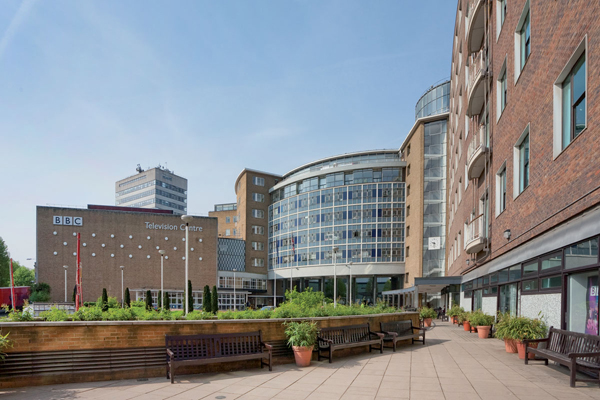
BBC-Television-CentreThe BBC Television Centre in London’s west closed its doors on Sunday, almost 53 years after it was officially opened on 29th June, 1960.  The 14 acre site in Wood Lane, White City, was sold for £200 million to developers Stanhope Plc. It will be redeveloped into new premises including a hotel, offices, flats, townhouses and a cinema. The Television Centre – the main building of which was affectionately known as the ‘doughnut’ thanks to its circular shape – has hosted some of the UK’s most iconic television shows – from The Two Ronnies to NewsnightMonty Python’s Flying Circus to Dr Who, Fawlty Towers and Blue Peter. It’s far from the end of the relationship between the site and the BBC. Various arms of the BBC will return to the site in coming years and other plans reportedly include the creation of a ‘virtual attraction’ where visitors can experience the creation of shows like Top Gear and EastEnders. BBC stars including Sir Michael Parkinson, Penelope Keith, Ronnie Corbett, Sir Terry Wogan and Sir David Jason have paid tribute to the building in a TV special, Goodbye Television Centre, broadcast on 22nd March. For more, see www.bbc.co.uk.

10 of London’s greatest Victorian projects – 9. The Underground…

Apologies for the delay in posting this piece – next week we’ll post the final in this series!

The first underground railway system in the world, the London Underground – fondly known as the ‘Tube’ –  is this year celebrating the 150th anniversary of its creation. 

Born out of an idea to link the inner city with the various large rail termini on the outskirts, the first section of what is now the underground system – a six kilometre stretch between Paddington and Farringdon – opened on 9th January, 1863, and was run by the Metropolitan Railway, known less formally as the ‘Met’.

South-Kensington-stationIt was constructed using the ‘cut and cover’ method in which streets were dug up and tracks laid in a trench before being covered by brick-lined tunnels and the street above replaced (the method was later abandoned, apparently due to the disruption it caused to traffic). The first trains were steam-driven locomotives and drew gas-lit wooden carriages behind them (the first journey was re-enacted earlier this year – see our earlier post here. Other events commemorating the 150th included a visit to Baker Street Station by Queen Elizabeth II, Prince Philip and the Duchess of Cambridge).

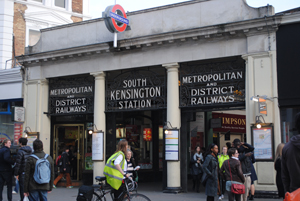
The idea proved a success – 26,000 people used the new railway every day during the first six months of its operation – and the Metropolitan District Railway opened a new line between Westminster and South Kensington (station is pictured) in December, 1868, while the first Tube tunnel under the Thames, from the Tower of London to Bermondsey, opened in 1880, and what is now the Circle Line was completed in 1884.

In December 1890, the world’s first deep-level electric railway opened, running between King William Street in the City and passing under the Thames to Stockwell. Ten years later the ‘Twopenny Tube’, more formally known as the Central London Railway, opened between Shepherd’s Bush and Bank (it was from this that the use of the word ‘Tube’ to describe the Underground system caught on).

The uniting of the system began the following year with the creation of the Underground Electric Railway Company of London and by World War I, all but the Met were within a single group organisation. The name Underground first appeared on stations in 1908, the same year electric ticket machines were introduced.

In 1933, the Underground came under the control of the London Passenger Transport Board – the same year that Harry Beck’s first diagrammatic map of the underground system appeared.

Stations in the system were used as air raid shelters during World War II – part of the Piccadilly Line was closed and used as a storage site for treasures from the British Museum. Following the war, the organisation running the system went through various name changes until the formation of London Underground in 1985.

The system has since expanded – the Victoria Line was opened in the late 1960s and the Jubilee Line a decade later – and now consists of more than 408 kilometres of railway lines and 275 stations which serve more than three million passengers a day – equating to more than a billion a year, the same as the entire national rail network.

For more on the history of the Underground, see our earlier 10 Questions with London Transport Museum curator Simon MurphyPoster Art 150 – London Underground’s Greatest Designs runs at the London Transport Museum until October. Admission charge applies. For more (including the many events around the exhibition), see www.ltmuseum.co.uk/whats-on/events/events-calendar#posterart150.

For more, check out David Bownes’ Underground: How the Tube Shaped London or Andrew Martin’s Underground, Overground: A Passenger’s History of the Tube.

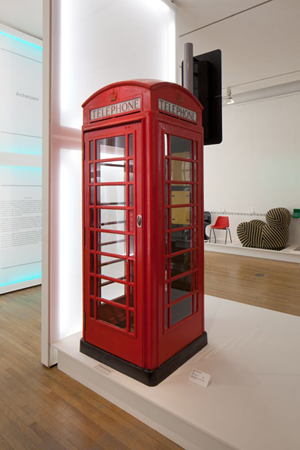
Treasures of London – K2 telephone kiosk at the Design Museum…

This version of the iconic British ‘institution’ – the red phone box – was designed by architect Sir Giles Gilbert Scott in 1924 (you may know him as the designer of the Battersea Power Station).

K2-KioskFormally known as the K2 telephone kiosk, Scott’s design was selected after a competition organised by the Royal Fine Art Commission (there’s a wooden prototype of Scott’s K2 located under the entrance to the Royal Academy of Arts in Piccadilly – the location where it was originally positioned).

The design featured a classical-looking dome (said to have been influenced by the work of architect Sir John Soane) which featured the royal crest of King George V (done in perforation, so it also provided ventilation). The phone box was made in cast iron and painted red (Scott had apparently suggested silver). From 1926 onwards, around 1,700 of the K2s – which weighed more than a ton – were deployed around London (very few were ever erected outside the city).

The surviving K2s – there are said to be slightly more than 200 – are now listed buildings.

The telephone box is a part of the Design Museum’s permanent collection which is currently held in two locations but from 2015 will be housed in a new purpose-built museum in High Street Kensington.

The box, which will be displayed on the museum’s top floor which will be dedicated to the display of 20th century artefacts, is currently featured in a special exhibition, Design Museum Collection: Extraordinary Stories About Ordinary Things, which runs at the museum’s current premises until January, 2015.

To further explore the Design Museum’s collection, you can download a free Design Museum Collection App for iPad app via iTunes.

WHERE: Design Museum, 28 Shad Thames (nearest Tube stations are London Bridge and Tower Bridge); WHEN: 10am to 5.45pm daily (last admission 5.15pm); COST: £11.85 adults/£10.70 concessions/£7.50 students (children under 12 are free); WEBSITE: www.designmuseum.org