This Week in London – Art deco at the London Transport Museum; art storage during WWII commemorated; and, William Dobson’s self-portrait…

An exhibition exploring the influence of the art deco movement on graphic poster design in on now at the London Transport Museum in Covent Garden. Art deco: the golden age of poster design features more than a hundred original 1920s and 1930s transport posters and poster artworks alongside photography, short films, ceramics and other objects to mark the centenary of the 1925 Paris exhibition where art deco originated. In the UK, Frank Pick, then-chief executive of London Transport, was the individual most responsible for advancing this form of graphic style, master-minding the publicity for the Underground and LT from 1908 onwards. A number of the posters in the exhibition in the Global Poster Gallery have never been put on public display before. Admission charge applies. For more, see www.ltmuseum.co.uk/whats-on/art-deco.

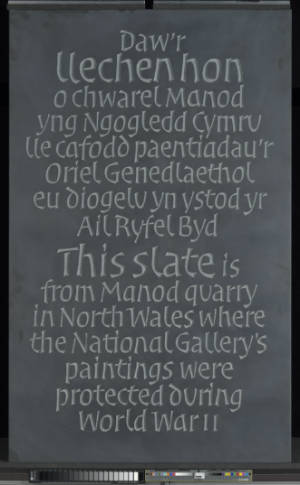
Jeremy Deller, designed and carved by John Neilson ‘Manod Slate Tablet’, 2025 © Jeremy Deller / John Neilson
Photo: The National Gallery, London

An inscribed stone tablet commemorating the Welsh quarry where The National Gallery’s art was protected during World War II has been put on permanent display in the gallery. The tablet, made from slate taken from the Manod quarry in Eryri (Snowdonia), was conceived by the artist Jeremy Deller and designed and carved by letter-carver John Neilson. The work, which was commissioned by Mostyn, an art gallery in Llandudno and supported by CELF – the national contemporary art gallery for Wales, can be seen in the Portico Vestibule, close to Boris Anrep’s floor mosaic of Sir Winston Churchill depicted in war time. The Manod slate mine in north Wales was chosen to store the art after an earlier proposal to evacuate the works to Canada was vetoed over fears of U-boat attacks. At the mine, explosives were used to enlarge the entrance to allow access for the the largest paintings and several small brick ‘bungalows’ were built within the caverns to protect the paintings from variations in humidity and temperature. What was known as an ‘elephant’ case was constructed to transport the paintings on trucks from London and, by the summer of 1941, the entire collection had moved to its new subterranean home, where it was to remain for four years, returning to London only after the end of the war in 1945. For more see www.nationalgallery.org.uk/.

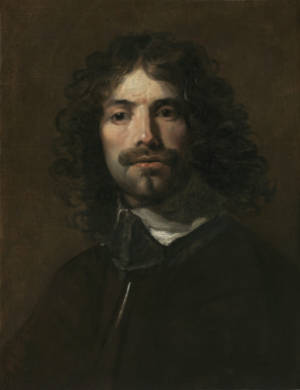
William Dobson, ‘Self-Portrait’, c1635-40. Image courtesy of Tate and the National Portrait Gallery

A self-portrait by William Dobson, widely considered to be the first great painter born in Britain, has gone on display at Tate Britain alongside a Dobson’s portrait of his wife. Dobson’s painting, which was acquired by the Tate and the National Portrait Gallery, was made between 1635 and 1640 and is said to be a “groundbreaking example of English self-portraiture”. His Portrait of the Artist’s Wife (c1635-40), which joined Tate’s collection in 1992, depicts Dobson’s second wife Judith and would have been conceived around the time of their marriage in December, 1637. Dobson rose to the role of King Charles I’s official painter before his career was cut tragically short when he died at the age of 35. For more, see tate.org.uk/visit/tate-britain.

• Send items for inclusion to exploringlondon@gmail.com.

10 London bishop’s palaces, past and present – 3. Winchester Palace…

Now a few scant ruins located in Southwark, this was once the opulent palace of one of the most powerful clergymen in the country.

We’ve written about Winchester Palace before but we thought it was worth a second look in our current series.

Subscribe for just £3 a month to access all of our content…

10 London bishop’s palaces, past and present – 2. York Place…

The precursor to Whitehall Palace, York Place was the London residence of the Archbishops of York between the 13th and 16th centuries.

Subscribe for just £3 a month to access all of Exploring London’s content…

This Week in London – Christmas at Hampton Court; Caravaggio’s Victorious Cupid; and, Romani art, culture and heritage…

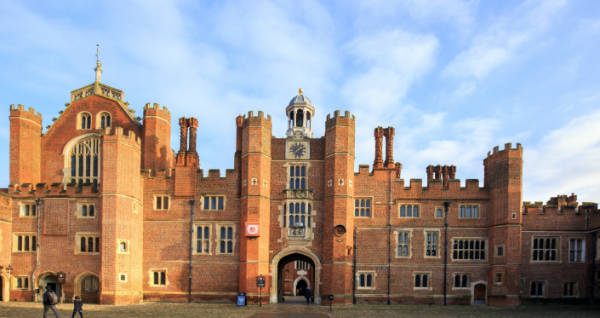
PICTURE: paulafrench/iStockphoto

Christmas has come to Hampton Court Palace with the one-time home of King Henry VIII decorated with traditional decorations and hosting a range of Christmas-related activities. Musicians located throughout the palace are playing a mixture of classical tunes and familiar Christmas melodies while in the Wine Cellar “intriguing history” of Christmas is being brought to life in story-telling sessions. The culinary Christmas traditions of the Tudors, meanwhile, are on display in the historic kitchens with, between 20th December and 4th January, the Historic Kitchens team recreating recipes from the Tudor court. The Magic Garden is hosting a special playful outdoor adventure for younger ones between 17th December and 4th January. The Hampton Court Palace Ice Rink has also returned (until 4th January) and there’s a Christmas market being held in the Great Fountain Garden on 5th to 7th December and again on 12th to 14th December. The Festive Fayre will feature more than 100 independent exhibitors offering artisan food and drink, unique gifts and stocking fillers while there will be live music on the East Front bandstand and horse and cart rides in the grounds. Admission charge applies. For more on Christmas activties at the palace head to www.hrp.org.uk/hampton-court-palace/whats-on/christmas-festivities/.

Caravaggio’s Victorious Cupid – never-before seen in public in the UK – is at the centre of a new exhibition which has opened at the Wallace Collection. The sculpture is presented with two Roman sculptures that along with the Caravaggio were all once part of the portfolio of Marchese Vincenzo Giustiniani (1564–1637), one of the most celebrated collectors of his day. The life-sized Cupid was once displayed along with works by the likes of Raphael, Titian and Giorgione in his grand palazzo located near the Pantheon in Rome along with an extensive gallery of classical sculpture. Caravaggio’s Cupid, which is free to enter, can be seen in the Exhibition Galleries until 12th April. For more, see www.wallacecollection.org/whats-on/exhibitions-displays/caravaggios-cupid/.

A new display honouring the livelihoods, creativity and craft of Romani communities and their contribution to British society has opened at the London Museum Docklands. By Appointment Only: Romani art, culture and heritage centres on three works, Sugar Coated (2025) by Corrina Eastwood, Tap Your Heels Together Three Times (2025) by Delaine Le Bas and What Makes a Home? (2025) by Dan Turner. There’s also timeline by John-Henry Phillips which illustrates the history of Romani communities from 500-1000 up to 2022. This is displayed along with the Historic England film Searching for Romani Gypsy Heritage with John Henry Phillips (2024) and an oral history piece both of which contextualise the timeline. The exhibition in the Reflections Room is free. For more, see www.londonmuseum.org.uk/whats-on/by-appointment-only/.

Send all items for inclusion to exploringlondon@gmail.com.

10 London bishop’s palaces, past and present – 1. Lambeth Palace…

Dame Sarah Mullally, Bishop of London since 2018, was named as the 106th Archbishop of Canterbury in October so we thought it a good time to explore some of the grand palaces which served as bishop’s palaces, some of them still standing and others not.

And what more appropriate place to start than Lambeth Palace, the official Thames-side residence of the Archbishop of Canterbury.

Subscribe for just £3 a month to access all of Exploring London’s content…

LondonLife I – Marking 80 years since the end of World War II…

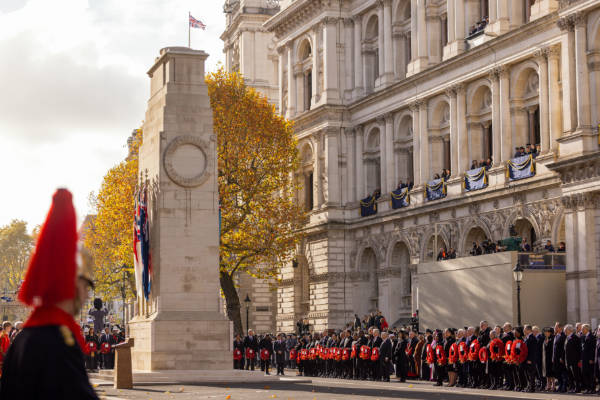
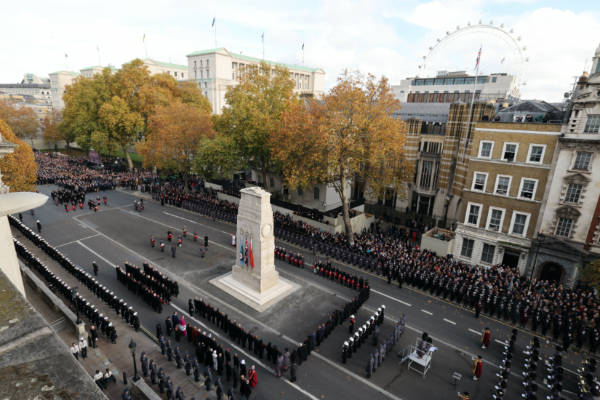
Poppies being laid at remembrance at the Cenotaph on Sunday, 9th November 2025. PICTURE: Cpl Danielle Dawson/© MoD Crown Copyright 2025
The Royal Party in front of the Cenotaph. King Charles II led the nation in a two-minute silence to remember those who gave their lives serving in the armed forces at the National Service of Remembrance at the Cenotaph on Sunday. PICTURE: Cpl Tim Hammond/UK MOD © Crown copyright 2025.
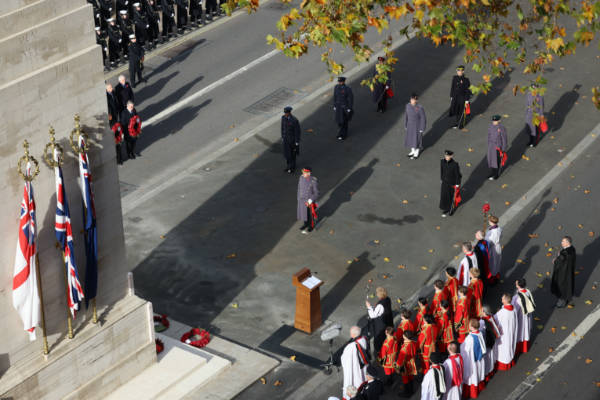
The Hollow Square formed around Cenotaph on Remembrance Sunday. PICTURE: LPhot Ollie Leach/UK MOD © Crown copyright 2025

Earlier…

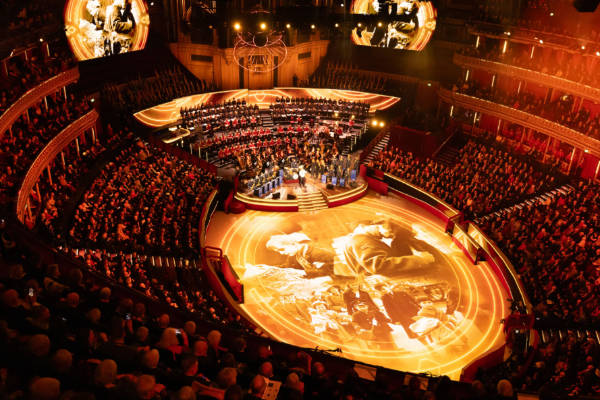
Rod Stewart plays with the RAF band at the Festival of Remembrance in the Royal Albert Hall, London on Saturday. The audience included the King, Queen and other members of the Royal Family. PICTURE: Cpl Danielle Dawson/UK MOD © Crown copyright 2025
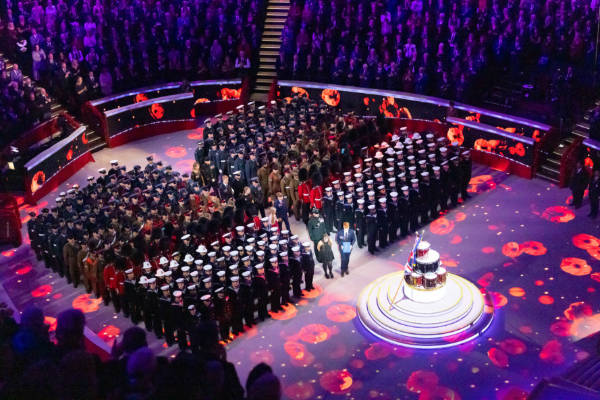
Members of the British Army, Royal Navy and Royal Air Force muster and the book of remembrance is presented at the Festival of Remembrance in the Royal Albert Hall, London on Saturday. PICTURE: Cpl Danielle Dawson/UK MOD © Crown copyright 2025
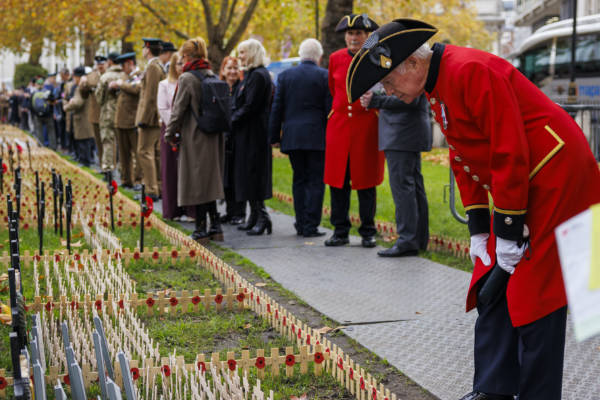
A Chelsea Pensioner at the Field of Remembrance outside Westminster Abbey on Friday. The field has been an annual feature since November, 1928, to commemorate those who have lost their lives serving in the armed forces. PICTURE: Sergeant Anil Gurung/©MOD Crown Copyright 2025
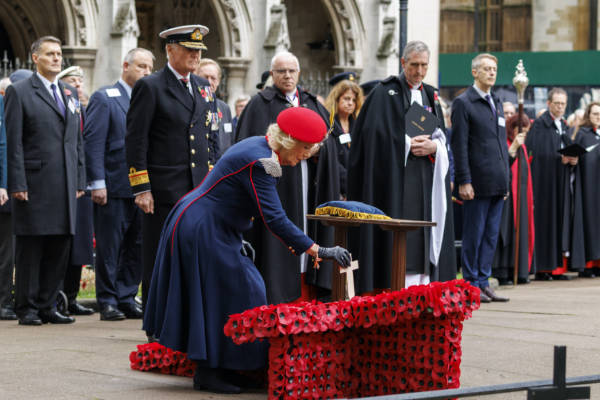
Queen Camilla places a wooden cross of remembrance at the Field of Remembrance outside Westminster Abbey on Friday. PICTURE: Sergeant Anil Gurung/©MOD Crown Copyright 2025

Bonfire Night – Five places in London featured in the events of the Gunpowder Plot…

It’s 5th November and that means Bonfire Night, the annual event featuring bonfires, effigies of Guy Fawkes (and others), and fireworks displays in commemoration of the November, 1605, foiling of a conspiracy to kill King James I (and many others) by blowing up the House of Lords (you can read more about it in earlier posts here and here).

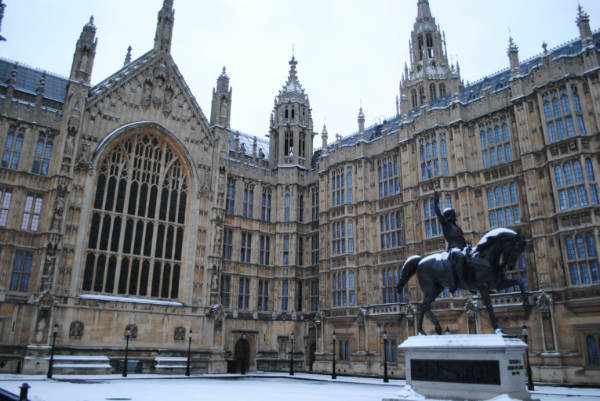
Looking across Old Palace Yard outside the Houses of Parliament to the southern end of Westminster Hall. PICTURE: David Adams

Here’s five places of significance to the story of the plot:

1. The Houses of Parliament: It was in the undercroft beneath the House of Lords that Guy Fawkes was found with 36 barrels of gunpowder. The cellar is now gone – having been destroyed when the Houses of Parliament burned down in 1834.

Subscribe for just £3 a month to support our work and access all of our stories…

Lost London – The Whitehall Mural…

Known through its many surviving copies, the Whitehall Mural was a dynastic portrait understood to have been created to decorate a privy chamber of King Henry VIII at the Palace of Whitehall.

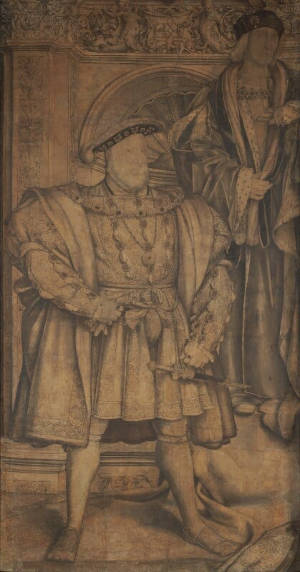
King Henry VIII; King Henry VII
by Hans Holbein the Younger
ink and watercolour, circa 1536-1537
NPG 4027 © National Portrait Gallery, London (licensed under CC BY-NC-ND 3.0)

The mural, which was the work of Hans Holbein the Younger, featured four figures standing around a central plinth. They include King Henry VIII and his wife Jane Seymour at the front with the King’s parents King Henry VII and Queen Elizabeth of York at the back.

It is believed the portrait, commissioned during the King’s brief marriage to Jane Seymour (between 30th May 1536 and 24th October 1537), may have been created to celebrate the birth of Prince Edward (later King Edward VI) in 1537 and may have been commissioned before or after the prince’s birth.

The iconic image of the bearded King Henry VIII – which was created for the purposes of propaganda – shows him as something of an idealised powerful monarch with feet firmly planted apart and his arms out with a dagger hanging at his waist.

The mural was lost when a fire consumed much of the palace on 4th January, 1698. But copies – both of the mural as a whole and of the individual figure of King Henry VIII – survive including one by Flemish artist Remigius van Leemput commissioned by King Charles II the year before the fire.

There’s also a full-sized cartoon (pictured) showing the left-hand section of the mural which was created by Holbein in preparing to create the mural. Depicting King Henry VIII – his head turned in a slightly different aspect to the final version – and King Henry VII, it would been used to mark out the mural on the wall where it stood.

This Week in London – The story of Henry VIII’s lost dagger; ‘Secret Maps’ at the British Library; and, ‘Connection and Identity’ at Greenwich…

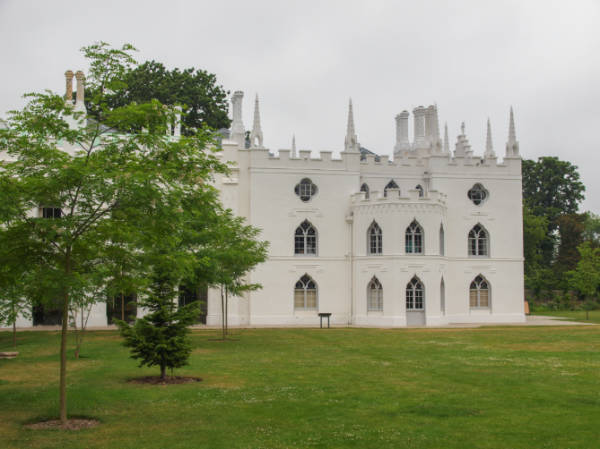
Strawberry Hill House. PICTURE: claudiodivizia/iStockphoto

• The disappearance of a jewelled Ottoman dagger which is believed to have once belonged to King Henry VIII has inspired a new exhibition at Strawberry Hill House, Horace Walpole’s former home in Twickenham in London’s west. Henry VIII’s Lost Dagger: From the Tudor Court to the Victorian Stage looks at the history of the 16th century dagger which, said to have been richly decorated with “a profusion of rubies and diamonds”, was once part of Horace Walpole’s collection. When the collection was sold in 1842, the dagger passed into ownership of the Shakespearean actor Charles John Kean who directed private theatricals for Queen Victoria at Windsor Castle. Kean (1811-1868) pioneered what critics dubbed “living museums” on the Victorian stage by using real artifacts, including the dagger, during performances. But after Kean’s death the dagger vanished without a trace. Dr Silvia Davoli, the principal curator at Strawberry Hill House, launched an investigation to find the dagger and instead found six almost identical daggers scattered around the globe. Two of these daggers – known as the Vienna and Welbeck Abbey examples – are featured in the exhibition alongside reproductions of 18th century materials which related to Walpole’s lost dagger from Yale University’s Lewis Walpole Library. The exhibition can be seen from Saturday until 16th February. Admission charge applies. For more, see www.strawberryhillhouse.org.uk.

The role maps have played in preserving secrets for the benefit of their creators from the 14th century to the present day is the subject of a new exhibition at the British Library. Secret Maps features more than 100 items ranging from hand-drawn naval charts given to Henry VIII to maps of cable networks used to intercept messages between the world wars; and the satellite tracking technology used by apps today. Among highlights are a map from 1596 attributed to Sir Walter Raleigh on an expedition in search of the mythical city of El Dorado in what is now Guyana in South America; a map produced in 1946 of British India (modern-day India, Pakistan and Bangladesh) with a ‘top secret’ report investigating the potential economic and military impact of partition for the proposed state of Pakistan; one of only two known existing copies of a secret map produced by Ordnance Survey during the General Strike of 1926 amid fears of a public uprising; and a 1927 Cable Map of the world which reveals a global network of censorship stations and was used by the British government to intercept messages sent via submarine and overland cables. Runs until 18th January (and accompanied by a programme of events). Admission charge applies. For more, see https://events.bl.uk/exhibitions/secretmaps.

Staffordshire-based artist Peter Walker’s large scale interactive artworks, Connection and Identity, can be seen in the Painted Hall at the Old Royal Naval College in Greenwich from Friday. Identity features eight columns suspended within the hall which shift in colour and light while Connection showcases “a dramatic and modern reinterpretation of Michelangelo’s Creation of Adam“. The installation, which is located in the hall sometimes described as “Britain’s Sistine Chapel”, is accompanied by music specially composed by David Harper. Runs until 25th January. Admission charge applies. For more, see https://ornc.org/whats-on/connection-and-identity/.

Send all items for inclusion to exploringlondon@gmail.com.

10 places to encounter London’s animal life…4. Bushy Park…

Famous for its herd of Red and Fallow deer, the expansive Bushy Park in south-west London is also a haven for many other kinds of wildlife – from birds and fish to insects and small mammals.

Subscribe now for access to all Exploring London’s stories and support our work!

What’s in a name?…Stockwell…

This district in the Borough of Lambeth in south London was formerly a rural manor located on the southern edge of London.

The name, variants of which date back to at least the late 12th century, is said to relate to the Old English words for a tree trunk – ‘stoc’ – and a well or spring, ‘wella’, and has been interpreted as meaning the well or spring by a tree stump, tree truck or perhaps a wood (there was apparently a Stockwell Wood which has long since disappeared).

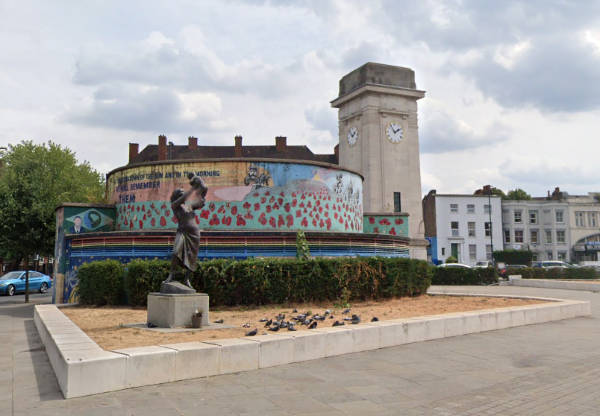
The War Memorial and mural painted on a ventiliation house in Stockwell. PICTURE: Courtesy of Google Maps

The manor of Stockwell was formed at the end of the 13th century when King Edward I acquired the manor of South Lambeth and divided it into two, creating the manors of Stockwell and Vauxhall (the manor house itself, parts of which survived until the 19th century, stood on the north side of Stockwell Road).

The area become known for its market gardens and was transformed into an urban landscape until the mid-19th century. Remnants of the 19th century housing stock can still be found in areas including the Stockwell Park Conservation Area in the west of the district.

The area around Stockwell Tube station, which first opened in 1890 and has since been rebuilt a couple times, was heavily bombed during World War II and rebuilt following the war. New developments included a number of social housing estates.

Today, Stockwell and nearby South Lambeth host the district known as Little Portugal which, centred on South Lambeth Road, is home to one of the UK’s largest Portuguese communities. The area is also home to several other immigrant communities.

Local landmarks include the oldest surviving building in the area – St Andrew’s Church, Stockwell Green (built in 1767), the Stockwell Congregational Church (1798) and the Stockwell War Memorial.

The latter – a white stone tower – is located on a site first laid out in the 1920s and features a mural on an adjoining ventilation shelter commemorating French Resistance fighter Violette Szabo (there’s a Blue Plaque on her former home in Burnley Road) and other Stockwell residents who died in war. There is also the ‘Bronze Woman’ statue which was unveiled in 2008 as a tribute to Black Caribbean women.

Residents of Stockwell have included artist Arthur Rackham and pioneering theatre director Joan Littlewood as well as musician David Bowie (born in Stansfield Road), actors Joanna Lumley (who still lives there) and Roger Moore (born in Aldebert Terrace).

Tragically, Stockwell Tube station was where Brazilian man Jean Charles de Menezes was fatally shot by police on 22nd July, 2005, after being misidentified as one of four suicide bombers who were on the run after their devices had failed to detonate the previous day (the attempts had come just two weeks after the 7th July bombings in which more than 50 people had been killed).

This Week in London – Wildlife Photographer of the Year is coming; ‘Vanishing Africa’; and, ‘Black Chiswick Though History’…

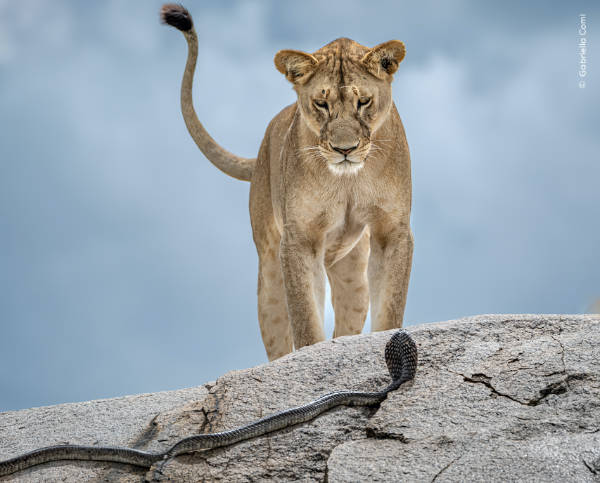
‘Wake-up Call’ by Gabriella Comi, Italy, (Highly Commended, Behaviour: Mammals). PICTURE: Courtesy of the Wildlife Photographer of the Year, Natural History Museum

Depicting a dramatic stand-off between a lion and a cobra in the Serengeti National Park in Tanzania, Gabriella Comi’s impressive image is among the 60,636 entries, from across 113 countries and territories, received in the Natural History Museum’s 61st annual Wildlife Photographer of the Year competition. The competition’s category winners and the prestigious ‘Grand Title’ and ‘Young Grand Title’ awards will be announced on 14th October, 2025, after which, from 17th October, 100 of the images will go on show at the museum in South Kensington. Other images revealed this week include Amit Eshel’s portrait of an inquisitive pack of Arctic wolves and photographs of flamingoes, coyotes and red deer by emerging young photographers as young as nine-years-old. For more, see https://bit.ly/WPY61Exhibition.

One of the images in ‘Vanishing Africa’. PICTURE: © Mirella Ricciardi

The Science Museum has launched a new online exhibition, Vanishing Africa, which features images by Kenyan-born photographer Mirella Ricciardi and reveal how much climate change is changing the continent. Taken in East Africa over two years in the 1960s, the photographs are a visual record of the Indigenous peoples of the region, including the Maasai, Samburu, Turkana, Orma, Pokot and Rendille people, and “capture a land of untamed wilderness, diverse wildlife, and Indigenous communities attuned to nature”, an East Africa which many no longer recognise. The exhibition has been published to celebrate the ‘UK/Africa Season of Culture’ and launches ahead of the international climate summit, COP30. To view it, head to www.sciencemuseum.org.uk/objects-and-stories/vanishing-africa-through-mirella-ricciardis-lens.

On Now: Black Chiswick Through History. This project, launched in 2011, looks at how the history of Chiswick House is connected to Black history and people of colour. This year’s installation explores the life of 18th-century Chiswick House resident James Cumberlidge – one of the few people of African heritage in Britain whose likeness was captured and preserved for posterity – and traces his journey from  page boy at Chiswick House to trumpeter in the Royal Court of King George III. There’s also a painting dating from the 1870s which depicts Queen Victoria attending a fashionable garden party right here at Chiswick House in July, 1875. Runs until 28th September. Admission charge applies. For more, see https://chiswickhouseandgardens.org.uk/event/visit-chiswick-house/.

Send all items for inclusion to exploringlondon@gmail.com.

Lost London – Kew Gardens’ flagpole(s)…

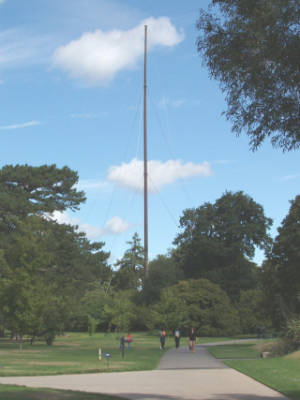
Once the tallest wooden flagpole in the world at 68 (225 feet) tall, the Kew Gardens flagpole stood for almost 50 years before it was dismantled in 2007.

The Kew Gardens flagpole shortly before it was removed. PICTURE: © Copyright David Hawgood (licensed under CC BY-SA 2.0)

The flagpole, a Douglas fir from Copper Canyon on Vancouver Island, was erected on 5th November, 1959, as a gift from the the British Columbia Loggers Association in Canada to mark both the centenary of the Canadian province of British Columbia (1958) and the bicentenary of Kew Gardens (1959).

The tree, which was around 370-years-old when cut, had originally weighed 37 tonnes, but after it was floated up the Thames to Kew and there underwent shaping, this was reduced to 15 tonnes.

Sadly, in 2006, it unfortunately failed its safety inspection – thanks to decay and woodpeckers – and was taken down the following year.

The flagpole was apparently the third (strictly the fourth) erected on the same site at the gardens which had originally been occupied by the ‘Temple of Victory’, a structure which had been built on the orders of King George III to commemorate the Anglo-German victory over the French at the 1759 Battle of Minden during the Seven Years’ War and which was removed in the mid 19th century.

The first flagpole on the site, which stood more than 31 metres (100 feet) tall. was erected in 1861. It had also come from Vancouver Island in British Columbia and replaced one which had snapped when it was in the process of being erected.

The pole was finally taken down in 1913 after being found to be suffering from dry rot.

A replacement, again from British Columbia, was erected in 1919 (its raising having been somewhat delayed by factors related to World War I). It was removed some time before 1959.

After the third giant flagpole was removed (the concrete footing can still be seen), the gardens decided not to erect another as that would mean cutting down another large tree. While far less of a spectacle, there is now a lesser flagpole near Victoria Gate where the flag is flown on special occasions.

10 places to encounter London’s animal life…1. Deer in Richmond Park…

We start a new series looking at places to encounter (at a distance, for some), London’s wildfire and we start by heading west to Richmond Park.

Subscribe for just £3 a month to access all of Exploring London’s articles – and support our work!

This Week in London – Rare Tudor choirbook at Lambeth; Sculpture in the City returns; and, picturing Blondie…

One of only two surviving choirbooks from the reign of King Henry VIII is on display in a new exhibition at the Lambeth Palace Library. Sing Joyfully: Exploring Music in Lambeth Palace Library displays the ‘Arundel’ or ‘Lambeth’ Choirbook (Arundel, Sussex, c. 1525) – this year marking its 500th birthday – along with other items from the library’s collection such as two leaves of a 14th century polyphony recently discovered in the binding of an early printed book. The exhibition, which is free, can be seen until 6th November. For more, see www.lambethpalacelibrary.info/sing-joyfully/.

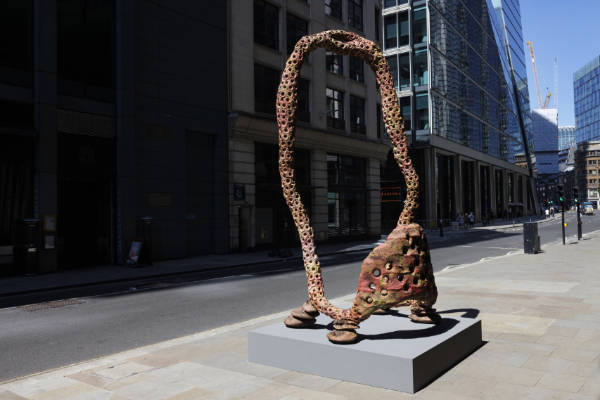
Looping Loop, © Andrew Sabin, Courtesy of the artist and Brooke Benington. PICTURE © Nick Turpin

On Now: Sculpture in the City. The 14th edition of the annual sculpture exhibition in the City of London features 11 pieces including three new works as well as six works which have been retained from previous iterations of the exhibition and two permanent acquisitions. The new works include: Ai Weiwei’s Roots: Palace, a cast-iron tree root sculpture located outside St Botolph without Bishopsgate which, as part of a series created in collaboration with Brazilian artists and communities, explores the concept of unrootedness; Jane and Louise Wilson’s Dendrophiles which, located beneath the escalators of The Leadenhall Building, combines ink drawings based on images of DNA with 3D scans of ancient oak wooden samples; and, Andrew Sabin’s Looping Loop which, located outside 70 St Mary Axe, which forms a continuous loop creating what’s described as a “lively, pulsating sensation”. Runs until April. For more – including a map of the locations – see https://www.sculptureinthecity.org.uk/.

Rare, behind the scenes images of US band Blondie have gone on show at the Barbican Music Library from today. Taken by photographer Martyn Goddard during the group’s breakthrough year of 1978, the 50 images show the band in concert, backstage, in the studio and during photo shoots. The display of photographs is complemented by poster prints, album covers, tour and concert memorabilia, period cameras, and photographic equipment. There are also items lent by Alan Edwards, who has handled Blondie’s publicity since 1978, from his private collection. Blondie in Camera 1978 runs until 5th January. Admission is free. For more see, www.cityoflondon.gov.uk/services/libraries/barbican-music-library.

Send all items for inclusion to exploringlondon@gmail.com.

Treasures of London – Shackleton’s Crow’s Nest…

This barrel-shaped object, which can be found in the church of All Hallows by the Tower in the City of London, was used the crow’s nest on the ship Quest during Sir Ernest Shackleton’s third – and last – Antarctic voyage in the early 1920s.

Subscribe for just £3 a month to access all of Exploring London’s content…

(In)famous Londoners – Alice Tankerville…

The only woman prisoner recorded as having escaped from the Tower of London, Alice Tankerville was accused, along with her common-law husband John Wolfe, of committing piracy in 1533.

The Tower of London on the bank of the Thames. PICTURE: Juhi Sewchurran/Unsplash

It was alleged that Tankerville had lured two wealthy Italian merchants into a wherry out in the Thames where her accomplices – including Wolfe and two men disguised as watermen – had robbed and murdered them. They were also accused of burgling a home near St Benet Gracechurch where the two men had been staying.

Despite apparently having attempted to seek sanctuary in a special precinct near Westminster Abbey, the couple were arrested, charged with piracy and murder among other things, and, following a trial neither apparently attended, found guilty.

Taken to the Tower of London in 1534 (Wolfe had done a previous stint there for the theft of 366 gold crowns from a ship berthed at the Hanseatic League’s Steelyard but had eventually been released due to a lack of evidence), Alice is said to have been imprisoned in Coldharbour Gate.

Alice wasn’t done yet, however. On 23rd March that year, she managed to escape, apparently with the aid of gaoler John Bawde who provided her with ropes and a key.

It was a short-lived liberation – believed to have been wearing man’s clothes, she and Bawde were arrested trying to reach waiting horses on a road just outside the Tower (it’s worth noting that not only was Alice the only women prisoner to ever escape the Tower of London, she was also the only escapee during the reign of King Henry VIII).

Both she and Wolfe were subsequently executed and due to the nature of their crime, their execution took place on the Thames.

They were hanged in chains in the Thames near the site of their crime and, before a small flotilla of boats filled with sight-seers come to witness the event, were slowly drowned as the tide rose. Their bodies were then left hanging on the spot as a warning to others.

Lost London – The Chinese Bridge and Pagoda, St James’s Park…

Briefly a sizeable landmark on London’s skyline, this seven-storey high structure and bridge were built over the canal in St James’s Park in 1814 as part of celebrations over the 100th anniversary of the accession of the House of Hanover, the 16th anniversary of Nelson’s victory at the Battle of the Nile and the signing of Treaty of Paris with France on 30th May following Napoleon’s abdictation in April.

British Library digitised image from “A Topographical and Historical Description of London and Middlesex” By Brayley, Brewer, and Nightingale

The pagoda and bridge, designed by none other than John Nash and Auguste Pugin, were among a number of structures built for the celebrations held in Royal Parks on 1st August – others included a ‘Temple of Concord’ and a naval arch. There was also a naval re-enactment on The Serpentine in Hyde Park.

As well as bands, food stalls and marquees for guests, the event, which was billed (among other names) as the Grand Jubilee, also included balloon ascents and fireworks.

The latter wasn’t good news for the pagoda – it was hit by a stray firework and destroyed (and tragically at least one person lost their life). The bridge lasted a few years longer – it apparently survived until 1825.

What’s in a name?….Giltspur Street

This City of London street runs north-south from the junction of Newgate Street, Holborn Viaduct and Old Bailey to West Smithfield. Its name comes from those who once travelled along it.

Looking south down Giltspur Street, with the dome of the Old Bailey visible, in 2018. PICTURE: Courtesy of Google Maps

An alternative name for the street during earlier ages was Knightrider Street which kind of gives the game away – yes, the name comes from the armoured knights who would ride along the street in their way to compete in tournaments held at Smithfield. It’s suggested that gilt spurs may have later been made here to capitalise on the passing trade.

The street is said to have been the location where King Richard II met with the leaders of the Peasant’s Revolt who had camped at Smithfield. And where, when the meeting deteriorated, the then-Lord Mayor of London William Walworth, ending up stabbing the peasant leader Wat Tyler who he later captured and had beheaded.

St Bartholomew’s Hospital can be found on the east side of the street. On the west side, at the junction with Cock Lane is located Pye Corner with its famous statue of a golden boy (said to be the place where the Great Fire of London was finally stopped).

There’s also a former watch house on the west side which features a monument to the essayist late 18th century and 19th century Charles Lamb – the monument says he attended a Bluecoat school here for seven years. The church of St Sepulchre-without-Newgate stands at the southern end with the Viaduct Tavern on the opposite side of the road.

The street did formerly give its name to the small prison known as the Giltspur Street Compter which stood here from 1791 to 1853. A prison for debtors, it stood at the street’s south end (the location is now marked with a City of London blue plaque).

This Week in London – Royal art on tour; ‘More than Human’ at the Design Museum; and, the St Paul’s Watch celebrated…

Richard Foster, Their Royal Highnesses on North Seymour Island, 2009. PICTURE: © Richard Foster Royal Collection Trust

More than 70 works of art from the King’s private collection – many of which have never been shown publicly before – go on show from today as part of the summer opening of Buckingham Palace’s State Rooms. The King’s Tour Artists, which can be seen in the ballroom, features works by 43 artists who have travelled with the King and Queen during the past 40 years. They include the earliest work on show – From the Afterdeck of HMY Britannia by John Ward, the inaugural tour artist – as well as Basilica of San Vitale, created by Fraser Scarfe who became the first tour artist to create digital artwork on an iPad when he accompanied the King and Queen on a State Visit to Italy. Other works include a pair of portraits of the King and Queen when Prince of Wales and Duchess of Cornwall which were painted by James Hart Dyke following a tour to the Gulf States in 2007, a drawing by Claudette Johnson made after the first official royal visit to Rwanda in 2022, and a terracotta head by Marcus Cornish, the only sculptor ever to have been chosen as a tour artist, which depicts a war veteran met by the royal party during a visit to Slovakia in 2000. Other highlights of the summer opening include the chance to see the recently installed Coronation State Portraits of the King and Queen in their permanent home. Runs until 28th September. Admission charge applies. To book, head to www.rct.uk.

Artworks for octopii and an immersive seaweed installation are among artworks in a new exhibition at the Design Museum focusing on a growing movement of ‘more-than-human’ design. More than Human brings together more than 140 works spanning contemporary and traditional practices, fine art, product design, architecture and interactive installations – the work of more than 50 artists, architects and designers. As well as the artworks for octopuses by Japanese artist Shimabuku and the seaweed installation by artist Julia Lohmann, other highlights include a vast new tapestry that explores the perspectives of pollinators by Alexandra Daisy Ginsberg and an eight metre long mural by MOTH (More Than Human Life Project), depicting the growing movement to award legal rights to waterways around the world. Runs until 5th October. Admission charge applies. For more, see https://designmuseum.org/exhibitions/more-than-human.

On Now: Saving St Paul’s: The Watch and the Second World War. This free outdoor exhibition – part of St Paul’s Cathedral’s commemorations around the 80th anniversary of World War II, honours the volunteers known as the St Paul’s Watch and their efforts to protect the cathedral during the Blitz. That included during the two direct hits to the cathedral – in October, 1940, and April, 1941. A short film accompanies the display which can be seen in the cathedral garden. The exhibition can be seen until October, 2025. For more, see www.stpauls.co.uk.