This Week in London – Art deco at the London Transport Museum; art storage during WWII commemorated; and, William Dobson’s self-portrait…

An exhibition exploring the influence of the art deco movement on graphic poster design in on now at the London Transport Museum in Covent Garden. Art deco: the golden age of poster design features more than a hundred original 1920s and 1930s transport posters and poster artworks alongside photography, short films, ceramics and other objects to mark the centenary of the 1925 Paris exhibition where art deco originated. In the UK, Frank Pick, then-chief executive of London Transport, was the individual most responsible for advancing this form of graphic style, master-minding the publicity for the Underground and LT from 1908 onwards. A number of the posters in the exhibition in the Global Poster Gallery have never been put on public display before. Admission charge applies. For more, see www.ltmuseum.co.uk/whats-on/art-deco.
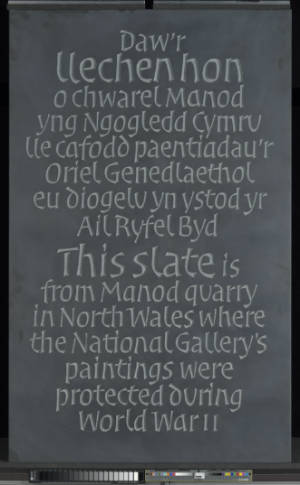
Jeremy Deller, designed and carved by John Neilson ‘Manod Slate Tablet’, 2025 © Jeremy Deller / John Neilson
Photo: The National Gallery, London

An inscribed stone tablet commemorating the Welsh quarry where The National Gallery’s art was protected during World War II has been put on permanent display in the gallery. The tablet, made from slate taken from the Manod quarry in Eryri (Snowdonia), was conceived by the artist Jeremy Deller and designed and carved by letter-carver John Neilson. The work, which was commissioned by Mostyn, an art gallery in Llandudno and supported by CELF – the national contemporary art gallery for Wales, can be seen in the Portico Vestibule, close to Boris Anrep’s floor mosaic of Sir Winston Churchill depicted in war time. The Manod slate mine in north Wales was chosen to store the art after an earlier proposal to evacuate the works to Canada was vetoed over fears of U-boat attacks. At the mine, explosives were used to enlarge the entrance to allow access for the the largest paintings and several small brick ‘bungalows’ were built within the caverns to protect the paintings from variations in humidity and temperature. What was known as an ‘elephant’ case was constructed to transport the paintings on trucks from London and, by the summer of 1941, the entire collection had moved to its new subterranean home, where it was to remain for four years, returning to London only after the end of the war in 1945. For more see www.nationalgallery.org.uk/.
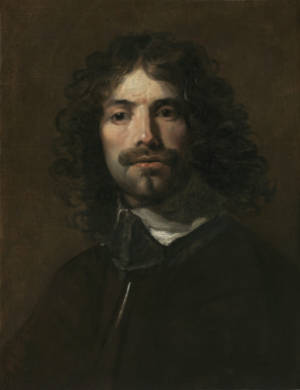
William Dobson, ‘Self-Portrait’, c1635-40. Image courtesy of Tate and the National Portrait Gallery

A self-portrait by William Dobson, widely considered to be the first great painter born in Britain, has gone on display at Tate Britain alongside a Dobson’s portrait of his wife. Dobson’s painting, which was acquired by the Tate and the National Portrait Gallery, was made between 1635 and 1640 and is said to be a “groundbreaking example of English self-portraiture”. His Portrait of the Artist’s Wife (c1635-40), which joined Tate’s collection in 1992, depicts Dobson’s second wife Judith and would have been conceived around the time of their marriage in December, 1637. Dobson rose to the role of King Charles I’s official painter before his career was cut tragically short when he died at the age of 35. For more, see tate.org.uk/visit/tate-britain.

• Send items for inclusion to exploringlondon@gmail.com.
10 places to encounter London’s animal life…1. Deer in Richmond Park…

We start a new series looking at places to encounter (at a distance, for some), London’s wildfire and we start by heading west to Richmond Park.

Subscribe for just £3 a month to access all of Exploring London’s articles – and support our work!

This Week in London – VE Day commemorated at St Paul’s; the National Gallery redisplayed; and, Tate Modern celebrates its 25th…

VE Day commemorations continue in London this week with an Evensong service to be held outside St Paul’s Cathedral this evening. The service to commemorate the 80th anniversary of the end of the war in Europe will be held between 5pm and 6pm. Following the service will be a lamp-lighting ceremony and blessing on the cathedral’s west steps with the cathedral bells being tolled as part of a national bell-ringing at 6:30pm. A replica of a World War II Spitfire can also be seen in front of the West Steps. The service is free and unticketed – entry is via Paternoster Square. For more, see www.stpauls.co.uk/whats-on/special-evensong-to-commemorate-80th-anniversary-of-end-of-second-world-war-in-europe-ve80.

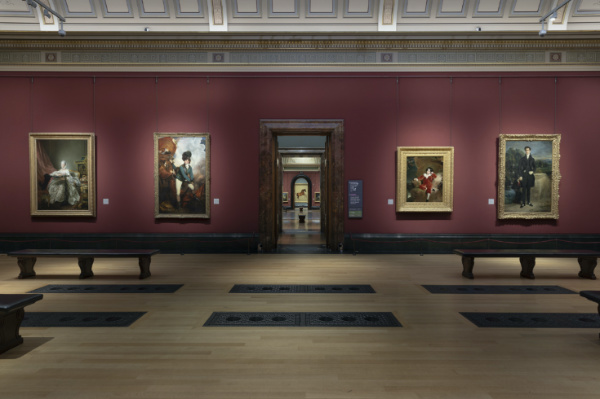
Central Hall, The National Gallery. Image and Identity: Full-Length Portraits 1550-1900. Part of ‘C C Land: The Wonder of Art’. PICTURE: © The National Gallery, London

A major redisplay of the National Gallery’s collection – created as part of its bicentenary celebrations – can be seen from Saturday. C C Land: The Wonder of Art, which coincides with the opening of the transformed Sainsbury Wing after more than two years of building works, features more than 1,000 works and traces the development of painting in the Western European tradition from the 13th to 20th centuries. Among the works displayed are the Coronation State Portraits, commissioned from the artists Peter Kuhfeld and Paul S Benney and unveiled by King Charles III and Queen Camilla this week, which will be on display until 5th June when they will be moved to the Throne Room at Buckingham Palace. There are also newly restored works including the Pollaiuolo brothers’ The Martyrdom of San Sebastian and Jan van Eyck’s Portrait of a Man (Self Portrait?) and newly acquired works such as Eva Gonzalès’ The Full-length Mirror (about 1869‒70), Sir Lawrence Alma-Tadema’s After the Audience (1879) and Nicolas Poussin’s Eucharist (about 1637‒40) – one of the greatest paintings of the Last Supper. Meanwhile, a series of rooms have been dedicated to the work of individual artists including the likes of Titian (active about 1506‒1576), Rembrandt (1606‒1669) and Monet (1840‒1926) and one part of the new display focuses on King Charles I (1600‒1649) as a collector of art and includes major loans from the Royal Collection. Finally, in a first for the gallery, Segna di Bonaventura’s Crucifix (about 1310‒15) has been suspended from the gallery’s ceiling, enabling today’s audiences to view the work in the way it would have been seen in the 14th century. Entry to the gallery is free. For more, see nationalgallery.org.uk.

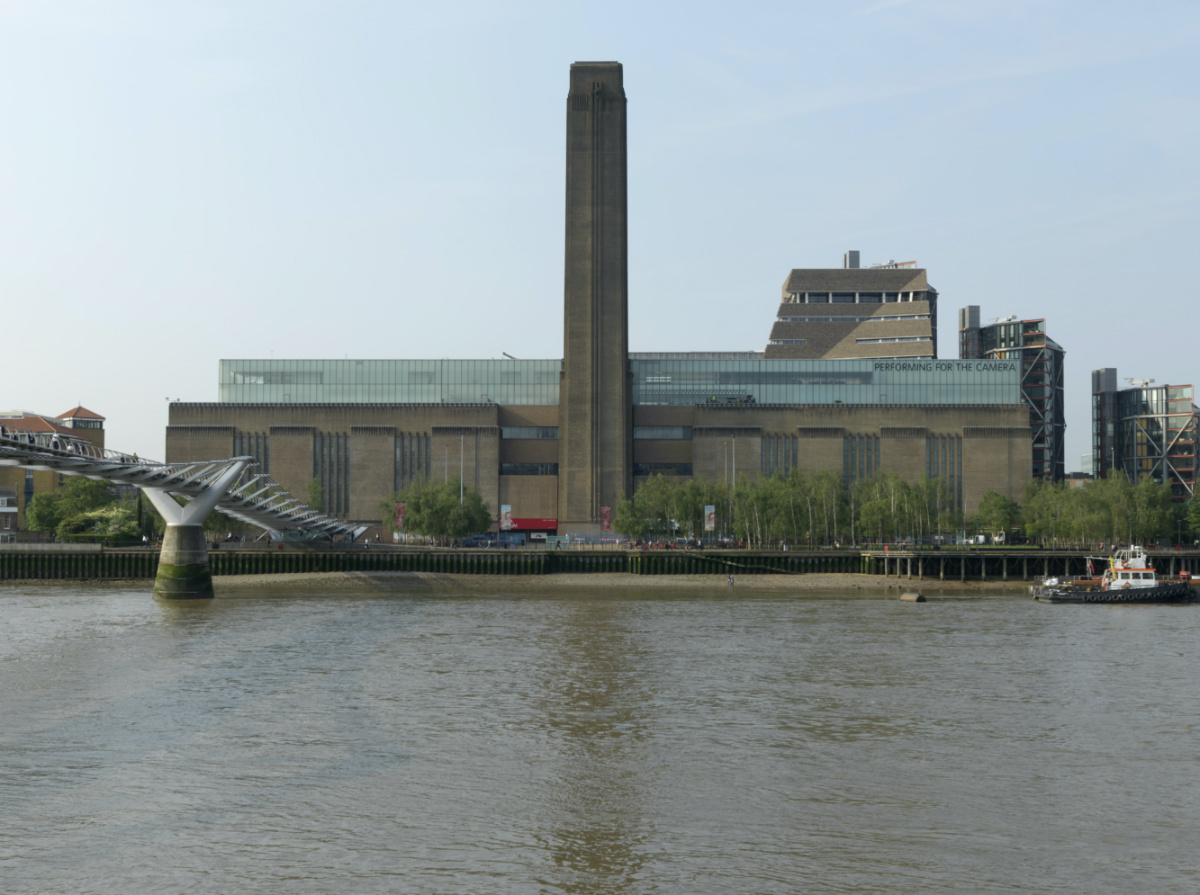
Tate Modern. PICTURE: Courtesy of the Tate Modern.

The Tate Modern is celebrating 25 years this weekend with four days of festivities starting from tomorrow (Friday). A number of recent additions to Tate’s collection will go on display around the building for the anniversary and some of the most iconic works from Tate Modern’s history are coming back including Louise Bourgeois’s 10 metre high bronze spider Maman which was the first work to greet visitors when Tate Modern opened in 2000. Other returning works include Mark Rothko’s Seagram murals and Dorothea Tanning’s Eine Kleine Nachtmusik while among contemporary works being highlighted over the weekend is an immersive multi-screen film installation by Nalini Malani. Two new exhibitions are also open for the anniversary weekend – A Year in Art: 2050 which explores how artists imagine possible futures, and, Gathering Ground which features international contemporary art united by a deep connection to land and community. The weekend also features live music and performances, pop-up talks and tours, and special food and drink offers. For more, see https://www.tate.org.uk/whats-on/tate-modern/birthday-weekender.

Send all items for inclusion to exploringlondon@gmail.com

10 significant (and historic) London trees…4. The Royal Oak, Richmond Park…

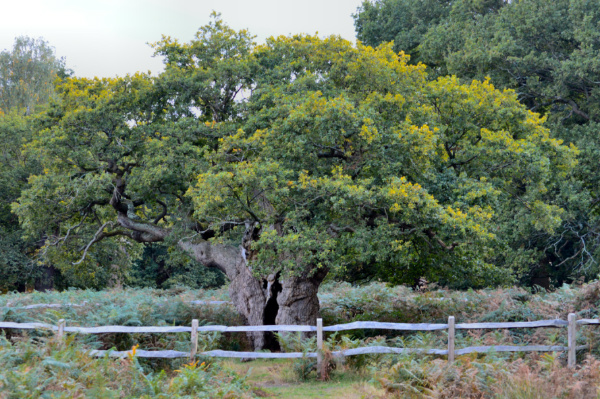
The Royal Oak. PICTURE: AndyScott (licensed under CC BY-SA 4.0)

Estimated to be more than 750-years-old, the tree known as the Royal Oak is located near Pen Ponds and Richmond Gate.

This massive English oak (Quercus robur), which is hollow, doesn’t have any direct connections to royalty but it did survive the felling of trees which took place in Richmond Park and across the south-east of England so King Henry VIII’s navy could be built.

That may have been thanks to the King himself, who wisely passed a law to spare every 10th tree in the park for future seed.

While the park had been used by King Henry VIII as a hunting ground, it wasn’t until 1637 – during the reign of King Charles I – that it was first enclosed.

The tree, which is said to be one of 1,400 “veteran trees” in the park, was pollarded for several hundred years which helped create its shape – this is a method of pruning which removes the top-most branches to form a denser head (and creates wood which can be used for a variety of purposes).

WHERE: Near Pen Ponds, Richmond Park; WHEN: 24/7 pedestrian access; COST: Free; WEBSITE: www.royalparks.org.uk/visit/parks/richmond-park

This Week in London – The Indian Army at Hampton Court Palace; Chanel at the V&A; and, Mantegna’s ‘The Triumphs Caesar’ at the National Gallery…

Part of the Indian Army at the Palace display at Hampton Court Palace: PICTURE © Historic Royal Palaces.

A rare charity pin badge like those sold by Indian princess and suffragette Sophia Duleep Singh to raise funds for the Indian Army has gone on show at Hampton Court Palace. It’s part of a new display which shares the stories of Indian soldiers who took up residence on the Hampton Court estate four times: for the coronations of King Edward VII in 1902, King George V in 1911 and King George VI in 1937, as well as for the World War I Victory Parade in London. The Indian Army at the Palace explores their experiences in the camp and in London more generally – everything from food and rationing to entertainment, travel and religious accommodations. Highlights of the display include objects from the Historic Royal Palaces’ collection – such as an official plan from one of the camps, press cuttings depicting the soldiers’ arrival at Hampton Court station, and Indian soldiers in and around the Palace grounds – as well as items on loan from the South Asian community, including a 32nd Sikh Pioneers Indian Army Officer’s tunic, medals and photos belonging to soldiers from the 1902 and 1911 contingents, original photographs of the Gurkha regiment in the 1919 parade and newspaper articles depicting the visits. The display can be seen until 3rd March next year and entry is included in general admission. For more, see www.hrp.org.uk/hampton-court-palace/.

A scene from the ‘Gabrielle Chanel. Fashion Manifesto’ display. PICTURE: ©Victoria & Albert Museum, London.

The first UK exhibition dedicated to the work of pioneering fashion designer Gabrielle ‘Coco’ Chanel opens at the V&A on Saturday. Gabrielle Chanel. Fashion Manifesto, which is being presented in partnership with Palais Galliera, Fashion Museum of the City of Paris, Paris Musées, charts the evolution of Chanel’s iconic design style and the establishment of the House of Chanel, from the opening of her first millinery boutique in Paris in 1910 to the showing of her final collection in 1971. The display’s 10 sections feature more than 200 “looks” as well as accessories, perfumes and jewellery. Highlights include one of the earliest surviving Chanel garments from 1916; original Chanel-designed costumes for the 1924 Ballets Russes production of Le Train Bleu; outfits created for Hollywood stars Lauren Bacall and Marlene Dietrich; an early example of Chanel’s ground-breaking evening trousers; and, ensembles from Chanel’s final collection of 1971. Runs until 25th February. Admission charge applies. For more, see vam.ac.uk/chanel.

Six of Andrea Mantegna’s monumental paintings The Triumphs of Caesar go on display at The National Gallery from Monday. On loan from the Royal Collection, the Renaissance artist’s greatest masterpiece will be on show at the gallery for around two years, while their usual home, the Mantegna Gallery at Hampton Court Palace, is closed for maintenance. Mantegna painted a total of nine canvasses for the Gonzaga family in Mantua, between about 1485 and 1506. They were acquired by King Charles I in 1629 and taken to Hampton Court Palace soon after their arrival in England. The paintings, which are being displayed in specially made frames, will be able to be seen in Room 14, along with Peter Paul Rubens’ A Roman Triumph (about 1630) to show a later artistic response to the Triumphs. Other works by Mantegna from the National Gallery’s collection including The Introduction of the Cult of Cybele at RomeSamson and DelilahTwo Exemplary Women of Antiquity and The Virgin and Child with the Magdalen and Saint John the Baptist are displayed nearby in Room 5 while Mantegna’s The Agony in the Garden can be seen in Room 29. Admission is free. For more, see www.nationalgallery.org.uk.

Send all items to exploringlondon@gmail.com

Four sites related to royal coronations in London – 3. Westminster Abbey…

Westminster Abbey has been centre-stage at coronations since at least the Norman Conquest.

William the Conqueror set the precedent for coronations at the abbey when he decided not to get crowned at Winchester Cathedral (where Edward the Confessor had been crowned) and instead chose to be crowned at the minster built by Edward the Confessor (there is some suggestion King Harold Godwinson, the last Saxon King, was crowned at Westminster Abbey before the Conquest but no documentary evidence exists for this).

William the Conqueror’s coronation was held on Christmas Day, 1066, and since then some 39 coronations have been carried out (King Charles III’s will be the 40th).

A view of the pulpit and to the right the Cosmati Pavement and behind it the High Altar inside Westminster Abbey. PICTURE: PJ photography/Shutterstock

Arrangements for the coronation ceremony are the responsibility of the Earl Marshal and the coronation committee but the abbey’s dean acts as a liaison with the sovereign and assists the Archbishop of Canterbury who is usually the bishop who crowns the monarch.

Since the late 14th century, the service has largely followed that laid down in the Liber Regalis (Royal Book), an illuminated manuscript created in around 1390.

Since 1308, the heart of the coronation service has taken place on the Cosmati Pavement, located just before the High Altar, in what is known as the “Coronation Theatre”.

Having processed into the abbey and been acclaimed or “recognised” as sovereign by those present, the monarch then makes promises to God and the people they rule in what is known as the Oath, before being presented with a Bible.

Then, seated in the Coronation Chair, the monarch is anointed with holy oil while a canopy is held over them to shield this most sacred part of the ceremony from the eyes of those gathered.

Still seated, the monarch is then invested with the coronation regalia, including the Sovereign’s Ring, the Sovereign’s Orb, the Sceptre with Cross and the Sceptre with Dove, before St Edward’s Crown is brought from the altar and placed on the monarch’s head (it’s only since that coronation of King James I in 1603 that both the anointing and the crowning are carried out while the monarch is seated on the Coronation Chair – before that, the chair was used for only one aspect of the ceremony).

The monarch then moves to a throne and receives the homage of the royal princes and senior peers. It’s at this point that the coronation of a Queen Consort typically takes place in a simpler form of the ceremony.

The monarch then retires into St Edward’s Chapel where they dress on a purple robe known as the Imperial State Robe or Robe of Estate as well as the Imperial State Crown before processing back out through the abbey.

Other elements of the coronation include music which since the Coronation of King George II has included the George Fredric Handel anthem, Zadok the Priest. The introit I was glad has been sung at every coronation since that of King Charles I in February, 1626.

The abbey is currently closed in preparation for the Coronation of King Charles III. It reopens on Monday, 8th May. The Coronation Theatre will remain in place for visitors to see until 13th May.

WHERE: Westminster Abbey, Westminster (nearest Tube station is Westminster or St James’s Park); WHEN: Open to tourists everyday except Sunday  (times vary so check the website); COST: £27 an adult/£24 for seniors (65+)/£12 a child (6-17 years); WEBSITE: www.westminster-abbey.org.

Four sites related to royal coronations in London – 1. The Jewel House…

In the lead-up to the coronation of King Charles III and Queen Consort Camilla on 6th May, we’re taking a look at sites in London which have played an important role in coronations past (and, mostly, in this coronation as well).

First up, it’s the Tower of London’s Jewel House which is linked to the coronation through the role it plays in housing the Crown Jewels and, more specifically, the Coronation Regalia.

The entrance to the Jewel House in the Waterloo Block. PICTURE: Dave Campbell (licensed under CC BY-NC-ND 2.0)

The centrepiece of the Crown Jewels is St Edward’s Crown, with which King Charles will be crowned in Westminster Abbey.

The crown, which has already been removed from the Tower of London so it could be resized for the occasion, is made from 22 carat gold and adorned with some 444 precious and semi-precious gems. Named for St Edward the Confessor, it dates from 1661 when it was made for the coronation of King Charles II and replaces an earlier version melted down after Parliament abolished the monarchy in 1649.

The crown was subsequently used in 1689 in the coronation of joint monarchs King William III and Queen Mary II and then not used again until 1911 when as used to crown King George V. It was also used to crown King George VI and Queen Elizabeth II in 1953.

St Edward’s Crown is not the only crown that will be used in the coronation ceremony – the King will also wear the Imperial State Crown at the end of the service.

Made by Garrard and Company for the coronation of King George VI in 1937 (replacing a crown made for Queen Victoria in 1838), it features the Black Prince’s Ruby in the front – said to have been a gift to Edward, the Black Prince, in 1357 from the King of Castile.

Further gems in the crown include the Stuart Sapphire, the Cullinan II Diamond and St Edward’s Sapphire, said to have been worn in a ring by St Edward the Confessor and found in his tomb in 1163.

Among other items which will be used in the coronation are the Sovereign’s Sceptre with Cross, the Sovereign’s Orb, and the Coronation Spoon.

The sceptre was made for King Charles II and now features the world’s largest diamond, the Cullinan Diamond, which was added to it in 1911. The orb was also made for King Charles II’s coronation and is topped with a cross.

The spoon, meanwhile, is one of the oldest items in the Crown Jewels, dating from the 12th century. It is used for anointing the new sovereign with holy oil – which comes from the Church of the Holy Sepulchre in Jerusalem – during the ceremony. It survived the abolition of the monarchy after it was purchased by a member of King Charles I’s wardrobe and later returned to King Charles II after the monarchy. The oil is held in a golden vessel known as an ampulla which is shaped like an eagle.

Other items to be used in the coronation are a series of swords – among them the Sword of State, the Sword of Temporal Justice, the Sword of Spiritual Justice, and the Sword of Mercy (this has its tip blunted to represent the Sovereign’s mercy).

The regalia was housed at Westminster Abbey until 1649. They have been kept at the Tower of London since the Restoration (even surviving a theft attempt by Colonel Thomas Blood and accomplices in 1671).

The Crown Jewels, which are now held under armed guard, have been housed in several different locations during their time at the Tower of London including in the Martin Tower and the Wakefield Tower. They were moved into a subterranean vault in the western end of the Waterloo Block (formerly the Waterloo Barracks), now known as the Jewel House (and not to be confused with The Jewel Tower in Westminster), in 1967.

A new Jewel House was opened by Queen Elizabeth II on the ground floor of the former barracks in 1994. The exhibit was revamped in 2012 and following King Charles III’s coronation, the display is again being transformed with a new exhibition exploring the origins of some of the objects for the first time.

WHERE: The Jewel House, Tower of London (nearest Tube station Tower Hill); WHEN: 9am to 4.30pm (last admission), Tuesday to Saturday, 10am to 4.30pm (last admission) Sunday to Monday; COST: £29.90 adults; £14.90 children 5 to 15; £24 concessions (family tickets available; discounts for online purchases/memberships); WEBSITE: https://www.hrp.org.uk/tower-of-london/whats-on/the-crown-jewels/.

What’s in a name?…Shoe Lane…

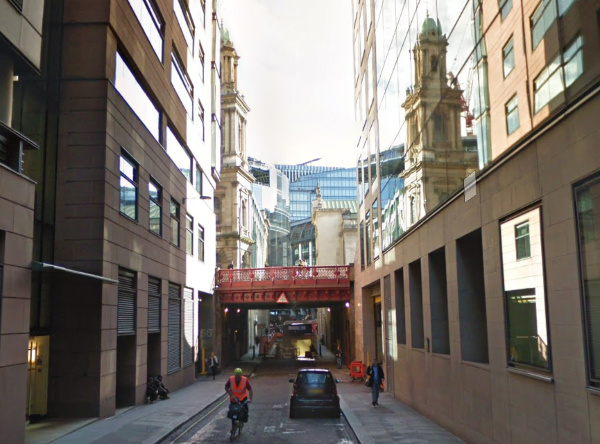
Looking south down Shoe Lane from near Charterhouse Street where it passes under the Holborn Viaduct. PICTURE: Courtesy of Google Maps.

This name of this rather long laneway, which runs from Charterhouse Street, under Holborn Viaduct, all the way south to Fleet Street, doesn’t have anything to do with footwear.

The name is actually a corruption of the Sho Well which once stood at the north end of the thoroughfare (and which itself may have been named after a tract of land known as Shoeland Farm thanks to it resembling a shoe in shape).

In the 13th century the lane was the London home of the Dominican Black Friars – after they left in the late 13th century, the property became the London home of the Earl of Lincoln and later became known as Holborn Manor.

In the 17th century, the lane was known as for its signwriters and broadsheet creators as well as for a famous cockpit which was visited by none other than diarist Samuel Pepys in 1663. It was also the location of a workhouse.

Prominent buildings which have survived also include St Andrew Holborn, designed by Sir Christopher Wren (it actually survived the Great Fire of London but was in such a bad state of repair that it was rebuilt anyway). The street these days is lined with office buildings.

Famous residents have included John de Critz, Serjeant Painter to King James I and King Charles I, preacher Praise-God Barebone who gave his name to Barebone’s Parliament held in 1653 during the English Commonwealth, and Paul Lovell, who, so the story goes, refused to leave his house during the Great Fire of 1666 and so died in his residence.

This Week in London – London’s history of executions; myth-making around Alexander the Great; and, Édouard Manet’s ‘Eva Gonzalès’ examined…

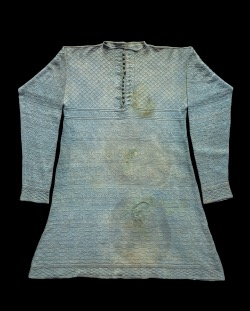
Charles I vest, Executions 2022 © Museum of London

• The history of public executions in London – spanning a period of some 700 years – is the subject of a landmark new exhibition at the Museum of London Docklands in West India Quay. Executions explores how capital punishment became embedded in the city’s landscape – from the first recorded public execution in 1196 to the last in 1868 – and looks at the rarely told and often tragic human stories behind them. Items on display include an intricately woven silk vest said to have been worn by King Charles I at his execution outside the Banqueting House (pictured), a 300-year-old bedsheet embroidered with a love note in human hair and personal items which once belonged to prison reformer Elizabeth Fry. Visitors can also stand in front of the Newgate Prison door, marking the last steps for prisoners heading to the scaffold, and see a dramatic recreation of the Tyburn “Triple Tree” gallows. Visitors will also learn about the 200 offences that became punishable by death and the spectacle and rituals of execution days as well as what led celebrity criminals to the gallows. Admission charge applies. Runs until 16th April next year. For more, see https://www.museumoflondon.org.uk/museum-london/whats-on/exhibitions/executions.

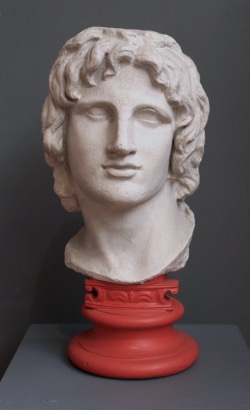
Marble head of Alexander © Museum of Classical Archaelogy

The first exhibition exploring the rich history of story-telling around one of the most famous figures of the ancient world – Alexander the Great – opens at the British Library tomorrow. Alexander the Great: The Making of a Myth features almost 140 exhibits from 25 countries including astrological clay tablets, ancient papyri and medieval manuscripts as well as comics, films and video games. It reveals how Alexander’s character has been adapted and appropriated by different cultures and religions, with conflicting interpretations. Runs until 19th February. Admission charge applies. A season of in-person and online events accompanies the exhibition. For more, see www.bl.uk/events/alexander-the-great-the-making-of-a-myth.

• Portraits of the Euro 2020 England men’s football squad and its manager, Gareth Southgate, will be shown at the City of London Corporation’s Guildhall Art Gallery from today. The free exhibition, This is England, features the most successful men’s national team – finalists in Euro 2020 – since the winners of the World Cup in 1966, from Harry Kane and Jude Bellingham to Bukayo Saka and Raheem Sterling. The paintings are the work of artist Matt Small and were commissioned by the FA and exhibited at the St George training ground during the Euro 2020 finals. The paintings can be seen until 19th February. For more, see www.cityoflondon.gov.uk/events/this-is-england.

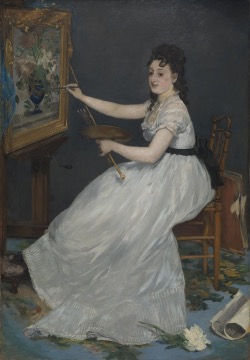
Edouard Manet, ‘Eva Gonzalès’, 1870

Édouard Manet’s 1870 portrait of Eva Gonzalès is the subject of a new exhibition at The National Gallery opening on Friday. The painting was considered by the early 20th century to be the most famous modern French painting in the UK and Ireland. The exhibition, the first in a new series of ‘Discover’ exhibitions to be staged in the Sunley Room with the aim of exploring well-known paintings in the collection through a contemporary lens, examines the lifelong artistic dialogue and the complexities of the friendship and mentorship between Manet and Gonzalès, his only formal pupil. It also looks at the broader context of female self portraits from the 18th to early 20th centuries, alongside portraits of women artists by male friends, husbands, and teachers The free exhibition includes works by Eva Gonzalès, Elisabeth Louise Vigée Le Brun, Edouard Manet, Berthe Morisot, Alfred Stevens and Laura Knight. Runs until 15th January. For more, see www.nationalgallery.org.uk/exhibitions/discover-manet-eva-gonzalès.

Send all items for inclusion to exploringlondon@gmail.com.
Lost London – The Painted Chamber, Palace of Westminster…

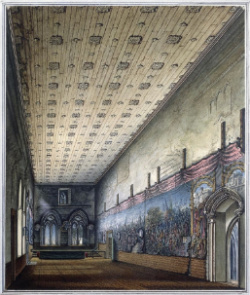
Part of the medieval Palace of Westminster, the Painted Chamber took its name from a series of large paintings which decorated the walls.

A watercolour of the Painted Chamber in Westminster Palace by William Capon made in 1799.

The long and narrow chamber, which stood parallel to St Stephen’s Chapel, was constructed in the 13th century during the reign of King Henry III and was apparently initially intended as a private apartment for the king as well as a reception room.

It featured a state bed at one end positioned under a painting of King Edward the Confessor and also had a “squint” – a small opening at eye level – through which the monarch could view religious services in a chapel located next door.

The chamber was apparently originally known as the King’s Chamber but came to be known as the Painted Chamber when the walls were decorated with paintings depicting vices and virtues and Biblical figures.

These paintings, which were completed over an almost 60 year period from 1226 and which were repaired a couple of times during that period, were added to with commissions by successive monarchs.

The painted chamber was the location for the State Opening of Parliament in the Middle Ages and was where Oliver Cromwell and the others signed King Charles I death warrant in 1649. The body of King Charles II rested here overnight before he was interred in Westminster Abbey.

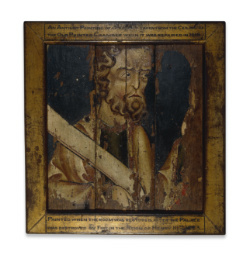
A ceiling panel from the Painted Chamber depicting a prophet, created between 1263-1266 PICTURE: © The Trustees of the British Museum (licensed under CC BY-NC-SA 4.0)

Later neglected, the walls of the chamber were whitewashed and hung with tapestries and in the early 19th century restoration work was done to reveal the paintings again with artist and antiquarian Charles Stothard commissioned by the Society of Antiquarians in 1819 to make watercolour copies (further copies were also made by the clerk of works at Westminster, Thomas Crofton Croker).

By 1820, the chamber was being used for the Court of Requests, a civil claims court.

The Painted Chamber was gutted when fire devastated much of the Palace of Westminster on the night of 16th October, 1834. It was reroofed and refurnished and used by the House of Lords until 1847 – as well as for the State Opening of Parliament in February, 1835. It was finally demolished in 1851.

Two ceiling paintings which were removed in 1816 during repairs are now at the British Museum (pictured right).

Treasures of London – The ‘Line of Kings’…

PICTURE: HRP/Newsteam

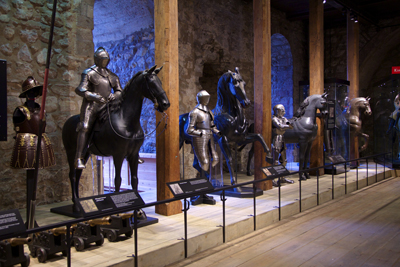
A star sight at the Tower of London for some 350 years, the ‘Line of Kings’ dates back to the mid-17th century and was originally installed in the Royal Armouries at the Tower to promote the restored monarchy of King Charles II and the Stuart dynasty.

Often described as the “world’s longest running tourist attraction” (the first visitor was recorded in 1652), it features the historic armour of monarchs on wooden figures and accompanied by fully decked-out carved horses – the work of Grinling Gibbons and others among Britain’s best woodcarvers.

The line has been added to and redisplayed numerous times over its history, partly to accommodate successive monarchs (17 in all were included with King George II being the last).

Only those monarchs deemed worthy were included – this deemed “bad” kings like King Richard III were omitted while “good” kings like King William the Conqueror, King Edward III and King Henry V were included. Queens were not included – when Queen Mary II and King William III were created joint monarchs, only King William was included.

The display began to be mentioned in guidebooks from the 1750s onwards. In 1825, amid growing scholarship and criticism, the line underwent a major change.

It was dismantled and then redisplayed in a purpose-built gallery adjoining the south side of the White Tower. The new line-up included prominent noblemen as well as kings while the kings themselves were reshuffled with some, like King Edward III, dropped, and King James II added.

It was further enhanced in 1869 but the display closed in 1882. The equestrian figures then appeared on the upper floor of the White Tower.

The Line of Kings, which is now located on the entrance floor of the Tower, last underwent a significant revamp between 2011 and 2013.

Highlights include the earlier surviving armour of King Henry VIII – a silvered and engraved armour which was made in the years following his coronation in 1509 – as well as the gilded armours of King Charles I and King James II.

WHERE: White Tower, Tower of London (nearest Tube station Tower Hill); WHEN: 9am to 5.30pm daily; COST: £29.90 adults; £14.90 children under 15; £24 concession; family tickets from £52.20; WEBSITE: www.hrp.org.uk/toweroflondon/.  

10 (lesser known) statues of English monarchs in London…7. Three Stuart Kings and a Queen… 

King Charles I (left) and his son King Charles II on what is now the south side of the gateway. PICTURE: haluk ermis (licensed under CC BY 2.0)

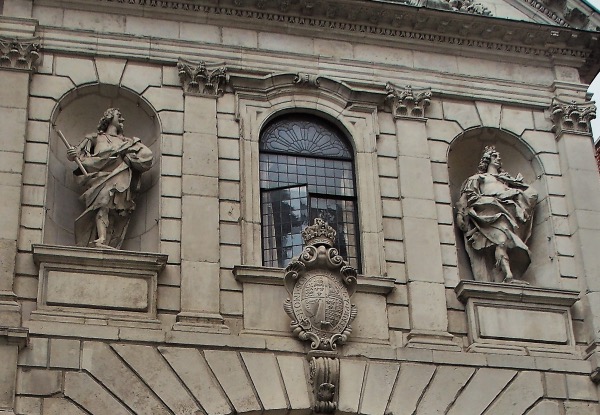
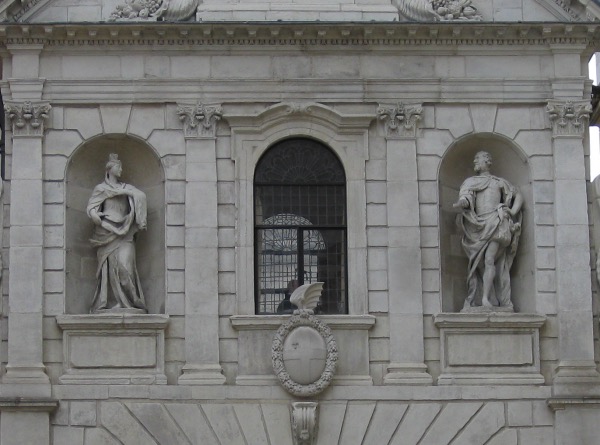
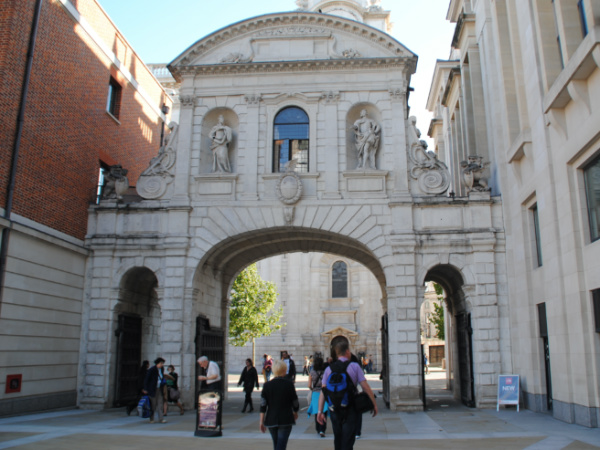
The equestrian statue of King Charles I at the top of Whitehall is one of London’s most well-known. But less well-known is the statue of the ill-fated King which can be found standing in a niche on the Temple Bar gateway, located at the entrance to Paternoster Square just outside of St Paul’s Cathedral.

Charles is not alone. Part of the gateway’s purpose was as a dynastic statement in support of the Stuarts so the grand portal also features statues of Charles’ father King James I, his mother Queen Anne of Denmark, and his son King Charles II. King James and Queen Anne can be found on the north side of the gateway (originally the east side) and the two Charles’ on the south side (originally the west side).

The design of the gateway, which originally stood at the intersection of Fleet Street and the Strand as a ceremonial entrance into the City of London, is believed to be the work of Sir Christopher Wren who was acting on the orders of King Charles II after the Great Fire of London.

Queen Anne of Denmark and King James I on the north side of the gateway. PICTURE: lizsmith (licensed under CC BY-NC-ND 2.0)

The statues, which cost a third of the total £1,500 spent on the gateway, are said to have been sculpted by one John Bushnell. They are depicted in Roman attire rather than the dress they would have worn during the period.

They were removed when the gateway was dismantled in 1878 and stored in a yard of Farringdon Road and when the gateway was re-erected at Lady Meux’s Hertfordshire estate at Theobold’s Park, they were placed back in their original locations. And they also accompanied the gateway back to the city when it was positioned its current location in 2004.

Treasures of London – The Green Closet, Ham House…

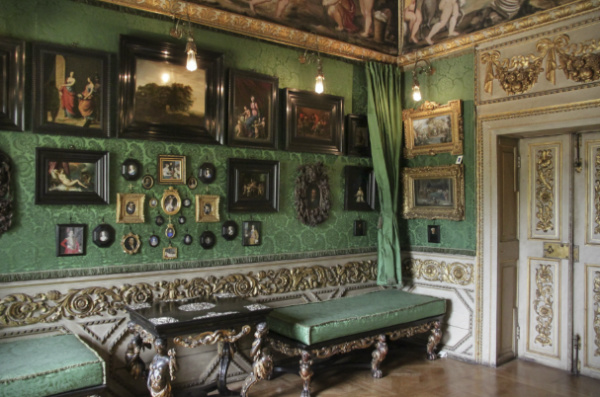
The Green Closet, Ham House. PICTURE: Kotomi_ (licensed under CC BY-NC 2.0)

This small chamber off The Long Gallery at Ham House – which was designed as an up-close and personal gallery to display both cabinet pictures and miniatures – is a rare survivor from the reign of King Charles I.

It retains many of its original contents and features carved woodwork and painted ceilings installed by Franz Cleyn during a 1637-39 refurbishment of the chamber carried out on the orders of the home’s then owner, William Murray.

The room, which would have been used for private meetings, was hung with green silk damask in 1655 (the present hangings are copies) and architecturally the room has remained unchanged since 1672 when a door into the North Dining Room was opened.

Of the many pictures hanging in the chamber, 22 were here in 1683 and another 10 of those now hanging here were hanging elsewhere in the house at the time.

The more than 80 works on show include a miniature of Queen Elizabeth I by Nicholas Hilliard created around 1590, a couple of David Paton – one of King Charles II (dated 1668) and one depicting John Maitland, the Duke of Lauderdale (dated 1669), one of the owners of Ham House.

The larger works include Gerard Dou’s Bust of an Old Man (1635), a rare posthumous portrait of Edward Seymour, the 1st Duke of Somerset (18th century) and the convivial scene, Boors smoking and drinking, by Adriaen Brouwer which, regarded as an original work in 1683, was then one of the most highly valued works at the house.

WHERE: Ham House, Ham Street, Ham, Richmond (nearest Tube station is Richmond). WHEN: Selected dates – check the website; ADMISSION CHARGE: Yes (National Trust members free); WEBSITE: www.nationaltrust.org.uk/ham-house-and-garden.

10 London hills – 8. Harrow Hill…

The Harrow School (left) and St Mary’s Church on top of Harrow Hill. PICTURE: Google Maps

This hill in outer north-west London, which rises 124 metres (408 feet) above sea level, is the location of the village Harrow-on-the-Hill.

The hill’s name is said to refer to a Saxon place of worship and was later taken to mean the Christian church that stood upon it.

That church – the historic St Mary’s, the latest incarnation of a Christian church which has stood on the hill since the Norman Conquest – dominates the hill to this day. Nearby is a spot called King Charles’ Well where King Charles I is said to have stopped and taken one last look at London as he made his way from Oxford to surrender to the Scottish army in Nottinghamshire.

The other famous landmark atop the hill, opposite the church, is the world renowned Harrow School, founded under a Royal Charter by John Lyon in 1572, during the reign of Queen Elizabeth I.

The hill is also host to a Grade II-listed war memorial and a fine array of historic homes dating from the Georgian period to the early 20th century. Among this who have lived on the hill are 19th. century critic and writer Matthew Arnold and 19th century Scottish author RM Ballantyne.

Panoramic views of Central London can be seen from the top of the hill and there is a famous viewpoint in the churchyard known as Lord Byron’s View, which looks away to the north-west. It’s so-called because Byron, while a schoolboy at Harrow, was a frequent visitor to the spot by a tombstone – called the “Peachy Tomb”- where he would apparently spend time “dreaming”.

Byron’s View atop Harrow on the Hill. PICTURE: Google Maps

A Moment in London’s History – The “execution” of Oliver Cromwell…

It was 360 years ago late last month that the body of Oliver Cromwell, one time Lord Protector of the Commonwealth, was, having previously been exhumed from his grave in Westminster Abbey, hanged from a gallows at Tyburn before being beheaded.

Cromwell had died two years previously on 3rd September, 1658, at the age of 59. It’s thought he died of septicaemia brought on by a urinary infection (although the death of his favourite daughter Elizabeth a month before is also believed to have been a significant factor in his own demise).

He (and his daughter) were buried in an elaborate funeral ceremony in a newly created vault in King Henry VII’s chapel at Westminster Abbey.

Cromwell’s son Richard had succeeded him as Lord Protector but he was forced to resign in May, 1659, and divisions among the Commonwealth’s leadership soon saw Parliament restored and the monarchy restored under King Charles II in 1660.

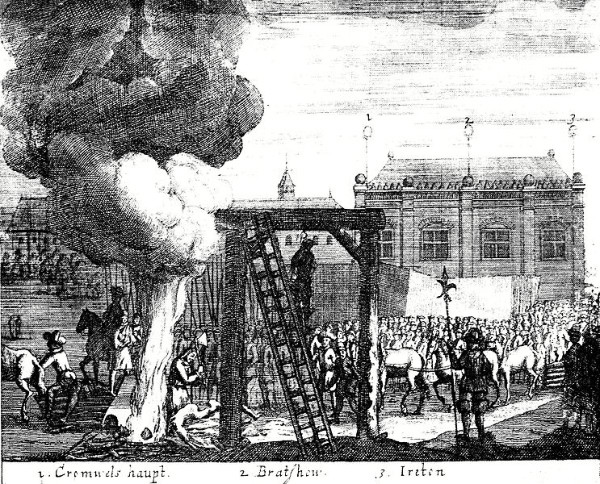
In late January, 1661, on Parliament’s order, Cromwell’s body as well as those of John Bradshaw, President of the High Court of Justice for the trial of King Charles I, and Henry Ireton, Cromwell’s son-in-law and a general in the Parliamentary army during the English Civil War, were all exhumed from their graves.

A contemporary engraving of the execution of Cromwell, Ireton and Bradshaw. PICTURE: Via Wikipedia.

The bodies of Cromwell and Ireton were taken to the Red Lion Inn in Holborn where they lay under guard overnight and were joined by that of Bradshaw the following day.

That morning – the 30th January, a date which coincided with the 12th anniversary of the execution of King Charles I in 1649 – the shrouded bodies in various states of decomposition and laying in open coffins were dragged on a sledge to gallows at Tyburn were they were publicly hanged.

The bodies remained on the gallows until sunset when they were removed and beheaded (Cromwell’s beheading apparently took eight blows). The bodies were believed to have been subsequently thrown into a common grave at Tyburn (although there’s all sorts of speculation surrounding the fate of Cromwell’s – indeed some believe his body had already been removed from Westminster Abbey before the exhumation took place and that it was the body of someone else which was hanged and beheaded).

The decapitated heads, however, were kept. They were placed on 20 foot long spikes at Westminster Hall for public display (Samuel Pepys was among those who saw them).

In 1685, however, the spike holding Cromwell’s head broke in a storm. Cromwell’s head is said to have ended up in the possession of a soldier who took it and hid it in his chimney (a reward was offered but searches were unsuccessful). The fate of the head then remains somewhat clouded but in 1710 it was being displayed in the London museum of Swiss-French collector Claudius Du Puy.

It subsequently passed through various hands until it was eventually bought by Dr Josiah Henry Wilkinson in the early 19th century. It remained in the possession of his family until, following tests which concluded it was indeed Cromwell’s head, it was offered to Sydney Sussex College, Cromwell alma mater, where, in 1960, it was buried in a secret location.

This Week in London – Exploring the ‘Raphael Cartoons’; using art to bridge Brexit divide; a 21st century police box; and, COVID’s viral tweets…

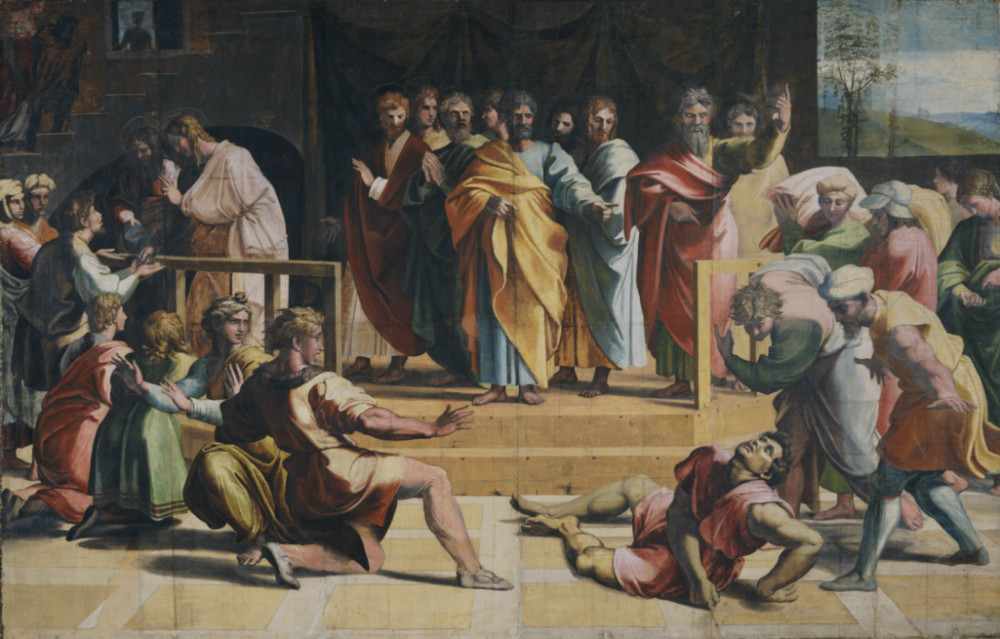
One of the Raphael Cartoons depicting ‘The Death of Ananias (Acts 5: 1-5)’, by Raphael, 1515 –16, Italy. Photo: © Victoria and Albert Museum, London. Courtesy Royal Collection Trust / Her Majesty Queen Elizabeth II 2021as.

An in-depth exploration of the so-called ‘Raphael Cartoons’ has gone online at the V&A ahead of the reopening of the newly transformed Raphael Court later this year. Among the greatest Renaissance treasures in the UK, the cartoons were commissioned by Pope Leo X for the Sistine Chapel in the Vatican shortly after his election in 1513. The Pope asked artist Raphael to create a series of 10 designs illustrating the lives of St Peter and St Paul which could then be turned into tapestries to grace the walls of the chapel. Created in the workshop of merchant-weaver Pieter van Aelst in Brussels, the 10 tapestries were each five metres wide and 3.5 metres high. Seven of Raphael’s original cartoons survive – they were brought to Britain in the early 17th century by the Prince of Wales (later King Charles I) and remained behind closed doors in the Royal Collection until they were lent to the South Kensington Museum – now the V&A – by Queen Victoria in 1865 in memory of Prince Albert. The cartoons have been on public display in the museum ever since. The new online offering traces the story of the cartoons and using ultra- high-resolution photography, infrared imagery, and 3D scans, and is the first time people have been able to explore the cartoons in such detail. It was produced as part of the V&A’s ‘Raphael Project’, marking the 500th anniversary of Raphael’s death in 2020, which includes a landmark renovation of the Raphael Court – home to the cartoons. The refurbished gallery will be unveiled when the museum reopens. To see the new online display, head to vam.ac.uk/raphael-cartoons.

A participatory art project exploring the relationship between the UK and France in a post-Brexit world has commenced this week. I Love You, Moi Non Plus – presented in partnership by Somerset House, Dover Street Market London, The Adonyeva Foundation, Collectif Coulanges, Eurostar and coordinated by Sabir, invites artists to share their interpretation of what the British-French relationship means to them with works to be displayed in a new online gallery alongside bespoke pieces from “project ambassadors” including Chinese artist Ai Weiwei, fashion designer Stella McCartney, English electronic musician Brian Eno, English National Ballet artistic director Tamara Rojo,and British artist Bob and Roberta Smith. The project seeks to highlight how art and creativity can “maintain connections between communities across the channels, unifying voices from across Britain and the EU”. Participants are asked to contribute either by sharing their creations on social media with hashtags #ILoveYouMoiNonPlus, #ILYMNP and #LifeAfterBrexit or submit them directly to the website here

Does this mean a new Tardis for Dr Who? The City of London Corporation is calling on architects, landscape architects, designers and artists to submit ideas for the design of a “21st century police box”. The competition, which is being run by the City in conjunction with the City of London Police, New London Architecture (NLA) and Bloomberg Associates, aims to provide “a modern and engaging way to provide information and safety” to the Square Mile’s residents, workers and visitors. Up to six shortlisted teams will be awarded funding to develop their idea into a design proposal and the winning design will be unveiled in the summer. For more, head to nla.london/submissions/digital-service-point-open-call-competition.

The Museum of London has acquired 13 tweets shared by Londoners during the initial coronavirus-related lockdown as part of its ongoing ‘Collecting COVID’ project. The tweets, which were collected under the ‘Going Viral’ strand of the Collecting COVID project, now form part of the museum’s permanent collection and lay bare what people were experiencing during 2020. The Going Viral project focused on collecting text, memes, videos and images that were ‘shared’ or ‘liked’ on Twitter more than 30,000 times. Additional tweets will be considered for acquisition this year.

Send all items for inclusion to exploringlondon@gmail.com.
10 London buildings that were relocated…8. Temple Bar…

This ornate Baroque archway only stands with walking distance from where it originally stood marking the entrance to the City of London. But it came to this position by a somewhat roundabout route.

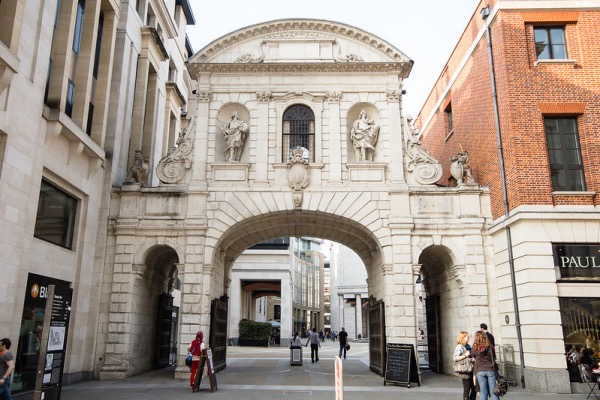
Temple Bar – with statues of Queen Anne and King James I (looking towards St Paul’s Cathedral) PICTURE: David Adams.

The gate was originally constructed at the junction where Fleet Street becomes the Strand, it marked the boundary between the City of London and Westminster.

While the first gate on the site dates back to the 14th century (prior to that the boundary was apparently marked with a chain two posts), the gate we see today dates from 1672 when, despite having survived the Great Fire of London, the previous gate – a crumbing wooden structure – was demolished and this upmarket replacement built to the design of none other than Sir Christopher Wren (earlier designs for the gate created by Inigo Jones were never acted upon).

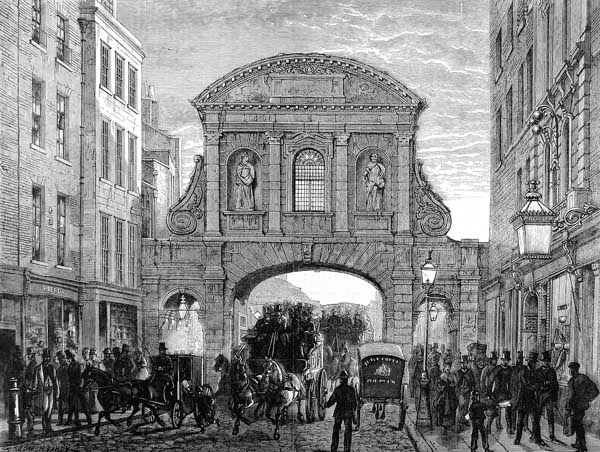
An artist’s impression of the Temple Bar in 1870 from Illustrated London News.

Made of Portland stone, the new structure featured figures of King Charles I and King Charles II on the west side and King James I and Queen Anne of Denmark on the east (it’s said that a third of the total £1,500 cost was spent on the statuary alone).

Shortly after its construction, it became a location for the display of the remains of traitors (usually heads), the first of which were the body parts of Rye House plotter Sir Thomas Armstrong and the last of which was the head of Jacobite Francis Towneley in 1746 (there’s also a story that such was the interest when the heads of the Rye House plotters – who had planned to assassinate King Charles II and crown his brother, the future King James II, in his place – were displayed, telescopes were rented out so people could get a closer look).

Temple Bar with statues of King Charles I and King Charles II (looking into Paternoster Square). PICTURE: Eric Heupel (licensed under CC BY-NC-ND 2.0)

Among the luminaries who passed under the central arch were Anne Boleyn (the day before her coronation) and Queen Elizabeth I. The Queen did so most famously on her way to give thanks in St Paul’s Cathedral for the English victory over the Spanish Armada and since then, whenever a Sovereign has wanted to enter the City past Temple Bar, there’s been a short ceremony in which the Sovereign asks permission of the Lord Mayor of London to enter. Granting this, the Mayor then offers the Sword of State as a demonstration of loyalty and this is subsequently carried before the Sovereign as they proceed through the City as a sign of the Lord Mayor’s protection.

The Temple Bar stood in its original location until 1878 when, to help traffic flow, it was carefully removed brick-by-brick over a period of 11 days (the City of London Corporation well aware of its historical significance) . It was initially intended that the gateway would be rebuilt somewhere else in the city, but time passed and no suitable site was found.

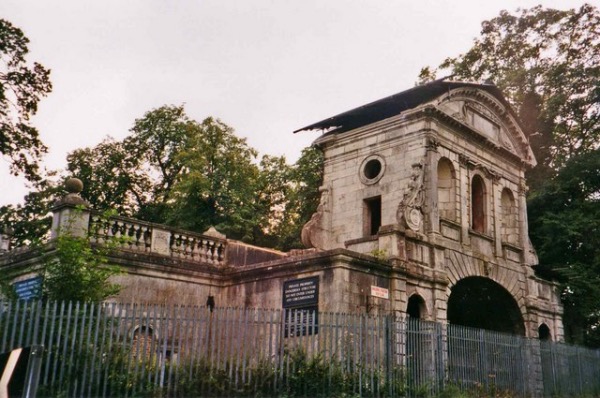
Instead, the gate lay in pieces in a yard in Farringdon Road before, in the mid 1880s, Sir Henry Bruce Meux had all 2,500 stones transported via trolleys pulled by horses to his estate at Theobalds Park in Hertfordshire and re-erected there as a gateway (the Lady Meux apparently used the small upper room for entertaining – among those said to have dined here was King Edward VII and Winston Churchill).

Temple Bar at Theobolds Park. PICTURE: Christine Matthews (licensed under CC BY-SA 2.0)

In 1976, the Temple Bar Trust was formed to have the archway returned to London – they eventually succeeded 30 years later in 2004 when it was re-erected on its current site between St Paul’s and Paternoster Square at a cost of some £3 million.

The original site of the Temple Bar is now marked with a Victorian era memorial – erected in 1888 – which features statues of Queen Victoria and Edward, the Prince of Wales.

Treasures of London – The Diana Fountain…

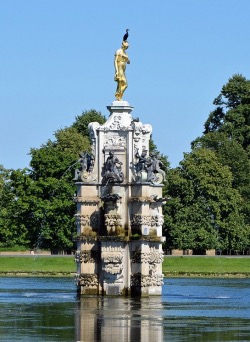
No, it’s not a memorial to that Diana, but a bronze statue depicting a mythological figure which forms the centrepiece of the Great Basin in Bushy Park.

Commissioned by King Charles I for his wife Queen Henrietta Maria, the statue (and other statuary on the monument) was the work of sculptor Hubert Le Sueur (he was also the sculptor of the famous equestrian statue of King Charles I which sits at the top of Whitehall).

While the 2.38 metre tall bronze statue, which weighs some 924 kilograms, is commonly referred to as Diana – the Roman goddess of hunting, she has none of the usual attributes of Diana, such as a bow, and is believed by some to actually represent Arethusa, a nereid or sea nymph from Greek mythology.

The statue is set on a marble and stone fountain carved with depictions of shells and sea life, and is surrounded, at a lower level, by groups of bronze statues -depicting boys holding fish or dolphins and water nymphs or mermaids astride sea monsters – through which water is discharged into four bronze basins.

The bronze figures were originally commissioned for a fountain, designed by Inigo Jones and built in the 1630s, in the Queen’s garden at Somerset House. Oliver Cromwell had the statues moved to the Hampton Court Palace’s Privy Garden in 1656 where they were incorporated into a fountain designed by Edward Pearce the Younger in 1689-90.

In 1713 the ensemble was moved again, this time to onto a new purpose-built podium in the middle of the Great Basin, located at the end of Bushy Park’s Chestnut Avenue, a grand avenue of trees designed by Sir Christopher Wren. While most of the statuary is believed to be from the original fountain designed by Inigo Jones, it’s thought some of the statues of the boys were recast for the new fountain.

The Grade I-listed monument was restored in 2009 and and during this process a stone which uncovered on its base which had a crown and the date AR 1712 (AR for ‘Anne Regis’) which would have been added when the statue and fountain were installed in the basin.

WHERE: The park lies north of Hampton Court Palace, just west of Kingston and Hampton Wick and south of Teddington (nearest train station is Hampton Wick or Hampton Court). WHEN: 24 hours except in September and November when it’s open between 8am and dusk; COST: Free; WEBSITE: www.royalparks.org.uk/parks/bushy-park

PICTURE: The Diana Fountain. PICTURE: It’s No Game (licensed under CC BY 2.0)

Lost London – Church of St Stephen Coleman Street…

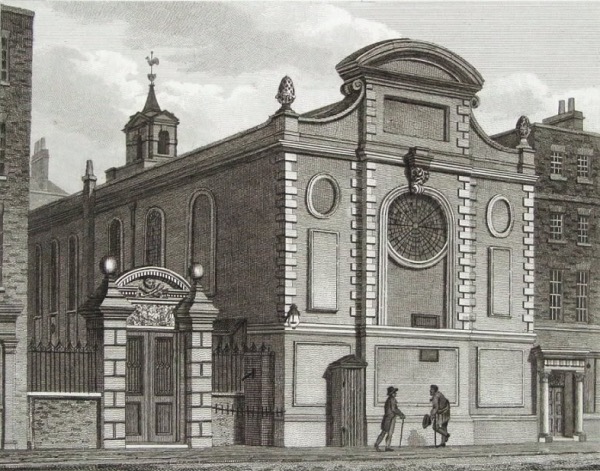
Among the buildings destroyed in the Blitz, St Stephen Coleman Street was one of the more than 50 City of London churches designed by the office of Sir Christopher Wren in the wake of the Great Fire of London of 1666.

The church was located on the corner of Coleman and Gresham Streets and replaced an earlier medieval building, the origins of which date back to at least the 13th century (the earliest mention occurs during the reign of King John) and which had also been known as St Stephen in the Jewry due to the number of Jewish people living in the vicinity.

St Stephen’s had apparently become a Puritan stronghold by the early 17th century when the vicars included John Davenport, who later went on to found a colony in Connecticut.

Five members of Parliament whom King Charles I attempted to arrest on 4th January, 1642, hid here as his troops searched for them. During the Commonwealth, the church instituted rules under which only those who were approved by a committee including the vicar and 13 parishioners – two of whom had apparently signed King Charles I’s death warrant, could receive Communion.

Following its destruction in the Great Fire of 1666, the church was rebuilt its former foundations – the new building incorporating some of the ruins of the former and featuring a bell lantern with a gilded weathervane on top – and was largely completed by 1677. In the early 1690s, additional funds gained through a coal tax provided for the construction of a burial vault and a gallery.

Notable vicars after the rebuild included Rev Josiah Pratt (1768-1844) who served for 21 years as secretary of the Church Missionary Society.

While the church suffered some minor damage during an air-raid in World War I, it was repaired. But it was finally destroyed during an air raid on 29th December, 1940, after which the church was not rebuilt but its parish joined with that of St Margaret Lothbury.

A City of London Corporation plaque at the intersection of Coleman Street and Kings Arms Yard marks the site of the former church.

PICTURE: An etching of St Stephen’s Coleman Street published in 1819.

What’s in a name?…Great Queen Street…

Wondering which ‘great’ Queen this street name is referring to? Perhaps Queen Victoria, our own Queen Elizabeth or even her namesake, Queen Elizabeth I?

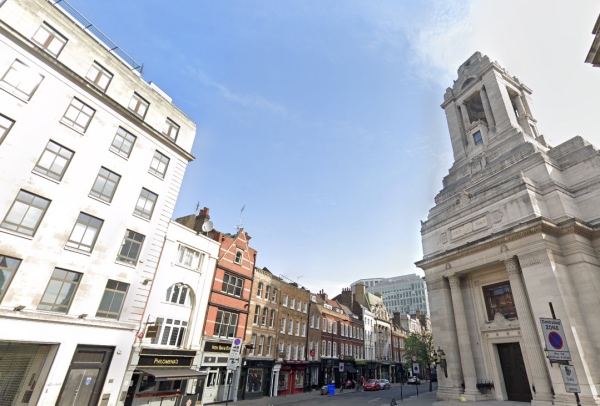
None of the above – the West End thoroughfare which runs between Drury Lane and Kingsway, is named for Queen Anne (of Denmark), consort of King James I (and the ‘great’ in Great Queen Street, we imagine, refers to the size of the thoroughfare and not the ‘greatness’ of the Queen).

Originally a residential street dating from the first half of the 17th century (one of which apparently sported a statue of another queen, Henrietta Maria, wife of King Charles I, on its facade), the houses were gradually replaced  over the years but some early 18th century abodes do remain.

Famous residents include everyone from Civil War Parliamentarian General Thomas Fairfax and 18th century composer Thomas Arne to late 17th and early 18th century portrait painter Sir Godfrey Kneller and James Boswell, biographer of Samuel Johnson.

Freemason’s Hall, home of the United Grand Lodge of England, is located on the corner with Wild Street and the De Vere Grand Connaught Rooms next door stand on the site of the former Freemasons Tavern where, in 1863, the Football Association was founded.

PICTURE: View down Great Queen Street with the edifice of Freemason’s Hall on the right. (Google Street View)