Around London – South Bank marks 60 years since the Festival of Britain; Royal wedding cakes; and, a new cable car for London…

• South Bank is celebrating the 60th anniversary of the 1951 Festival of Britain with a four month series of events. The official celebrations kicked off yesterday and will run until early September. Highlights of the celebrations include the Museum of 1951 – a temporary museum located in Royal Festival Hall featuring exhibits relating to the 1951 festival, themed weekends including next weekend’s ‘London in Love’, featuring performances by Billy Bragg, and a Festival of Britain-inspired ‘Meltdown’ curated by Ray Davies of The Kinks (runs from 10th to 19th June). The original Festival of Britain was opened on 3rd May, 1951, with the intention of developing a sense of “recovery and progress” among the British in the aftermath of World War II and marked the centenary of the 1851 Great Exhibition. The South Bank Exhibition was at the heart of what were national celebrations and was attended by more than eight million people. For more information on what’s happening, see www.southbankcentre.co.uk.

• Historic royal wedding cakes have been recreated this Easter weekend  in an exhibition celebrating the lead-up to this Friday’s Royal Wedding. The English Heritage-event Let Them Eat Cake, which is being held at Wellington Arch near Hyde Park Corner, features a “four-and-20 blackbirds pie” of the sort King Henry VIII gave to his new wife Anne Boleyn as well as recreations of Prince Charles and Lady Diana’s wedding cake and that of Queen Elizabeth II. The event, which is sponsored by Tate & Lyle Sugars, involves some of Britain’s leading bakers. For more, see www.english-heritage.org.uk/daysout/events/765107/. See Exploring London this week for more on the upcoming Royal Wedding.

• The Mayor of London, Boris Johnson, confirmed this week that work will begin on a new cable car to cross the Thames River in East London this summer. The 34 gondola cable car will stretch for 1.1 kilometres, connecting Greenwich Peninsula and the O2 on the river’s south bank with Royal Victoria Docks and the ExCel centre on the north and carrying up to 2,500 people every hour. Construction will be carried out by a consortium of firms led by Mace – the company currently building the Shard Tower – and it is hoped it will be completed before next year’s Olympics.
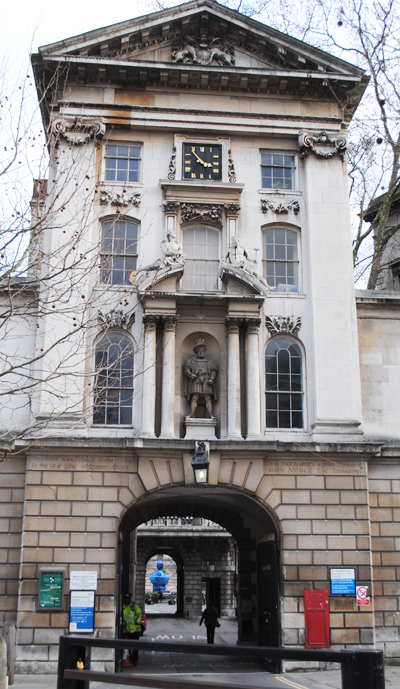
Where’s London’s oldest…hospital?

London’s oldest hospital – St Bartholomew’s Hospital in what is known now as Smithfield – was founded in the 12th century.

The hospital owes its foundations – like the neighbouring Priory of St Bartholomew (London’s oldest church – see our previous story on this here) – to Rahere, a courtier (possibly a minstrel or jester) at the court of King Henry I who, tired with triviality, may have become a priest.

In any event, after the death of Henry’s son William – he is believed to have drowned when the White Ship foundered in November 1120 – and that of his wife Queen Matilda, Rahere went on pilgrimage to Rome. He did so but contracted malaria while there and, while under the care of  monks, he vowed to found a hospital for poor men if he recovered.

He did recover and on his return journey had a vision of St Bartholomew who informed him that it was he who had helped him to recover and now desired him to found a church in Smithfield (then known as Smedfield).

Back in London, Rahere as he’d promised and, after petitioning the king, was granted a royal charter in 1122 to found the priory of Augustinian canons and the hospital.Work began in March 1123 and it was completed by 1145 when Rahere died (his tomb can still be seen in the church).

The hospital – one of a number in London at the time – was probably little more than a single hall with a chapel at one end. Other buildings and some cloisters were added later as was the Church of St Bartholomew the Less.

Under a charter of 1147, it was open to the needy, orphans, outcasts and the poor as well as sick people and homeless wanderers. In the 14th century, the definition was honed to include the sick until they recovered, pregnant women (until delivery) and for the maintenance of children born there until they were seven-years-old.

As well as the master (Rahere was the first), other ‘staff’ at the hospital initially included eight Augustinian brothers and four sisters but the hospital gradually became independent of the priory and by 1300, the hospital has its own dedicated master. By 1420, the two institutions had apparently become completely separate.

Following the Dissolution in 1539, the hospital was refounded in the 1540s thanks to a deal brokered between King Henry VIII and the Corporation of the City of London. Along with Bethlem, Bridewell and St Thomas’, St Bartholomews was one of four Royal Hospitals administered by the City.

The first regular physician – a Portuguese man by the name of Roderigo Lopez – was appointed around 1567 (he was later hung, drawn and quartered for an allegedly plotting against Queen Elizabeth I). Among the most famous physicians to serve at St Barts in later years was William Harvey, renowned for having ‘discovered’ the circulatory system.

The hospital survived the Great Fire in 1666 but in the 1700s most of the medieval buildings, with the exception of the tower in the Church of St Bartholomew the Less, were demolished as the hospital was rebuilt to the design of James Gibbs. The new design featured a central courtyard with a Great Hall contained in the north wing, reached by a ‘Grand Staircase’ decorated with images of the Good Samaritan and Christ at the Pool of Bethesda by celebrated artist William Hogarth.

The famous Henry VIII gate (pictured above) dates from 1702, slightly before Gibb’s rebuilding project. Other buildings have been added in more recent times.

In more recent times, the hospital was amalgamated with The Royal London and the London Chest Hospitals in 1994 with the establishment of The Royal Hospitals NHS Trust (now known as the Barts and The London NHS Trust). St Barts is now a specialist cancer and cardiac hospital.

There is a museum at the hospital which houses exhibits including a facsimile of Rahere’s grant of 1137 (now in the hospital’s archives), amputation instruments dating from the early 1800s once used by surgeon John Abernathy and a display on William Harvey. Hogarth’s paintings are visible from the museum.  There are also guided tours of the hospital.

WHERE: Museum at St Barts Hospital (nearest tube station is Barbican); WHEN: 10am to 4pm Tuesday to Friday ; COST: Free (donations welcomed); WEBSITE:  www.bartsandthelondon.nhs.uk/about-us/museums-and-archives/st-bartholomew-s-museum/

Treasures of London – ‘The Ambassadors’

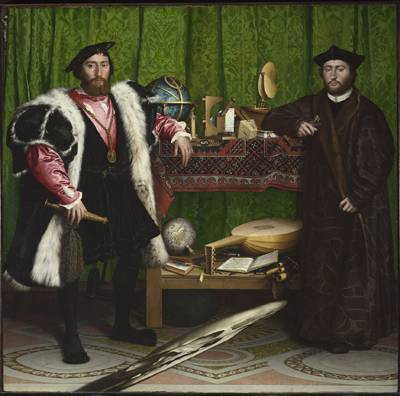
A stunning portrait on a grand scale, The Ambassadors depicts two influential figures from the 16th century – Jean de Dinteville, the then 29-year-old French ambassador to England and Georges de Selve, the then 25-year-old bishop of Lavaur and sometime French ambassador to the Emperor, the Venetian Republic and the Holy See.

The oil on oak work, which is housed in room four of the National Gallery and is also one of the images featured online as part of the Google Art Project, was painted by Hans Holbein the Younger in 1533 and is meant as a portrait to show the men’s power, learning and wealth – they are surrounded by objects which include celestial and terrestrial globes, a portable sundial, a lute (and its case), and books including one of hymns and another of arithmetic as well as richly decorated furnishings.

Yet there’s more to this painting than initially meets the eye – a closer look reveals a distorted skull in the foreground which, when viewed from the painting’s right-hand side comes into its proper perspective. A reflection on mortality perhaps?

And though no typically viewed as a religious work, there are also some striking religious overtones to this image including a broken string on the lyre – often seen as a Christian symbol of disharmony – and, partly hidden behind the curtain on the far left of the painting as you look at it, a crucifix hanging on the wall.

Holbein painted the work during his second stint in England while depicting life at the Tudor court. Among his most famous other images are one of King Henry VIII (held in the National Portrait Gallery) and another of Christina of Denmark (also in the National Gallery – painted to show Henry VIII the image of a potential future wife although the relationship never went any further than that).

PICTURE: Ng1314, Hans Holbein the Younger, Detail of Jean de Dinteville and George de Selve (‘The Ambassadors’), 1533 © The National Gallery, London.

WHERE: Room 4, National Gallery, Trafalgar Square (nearest tube stations Leicester Square and Charing Cross); WHEN: 10am to 6pm (Fridays 10am to 9pm); COST: Free; WEBSITE: www.nationalgallery.org.uk. The image is also available online as part of the Google Art Project here:www.googleartproject.com/museums/nationalgallery/the-ambassadors.

King James I’s London – 2. St James’s Park

Although royal connections with St James’s Park, the oldest royal park in London, go back to the time of King Henry VIII – it was he who first purchased the marshy watermeadow in 1532 with the idea of creating another of his many deer parks, it was on the accession of King James I that orders were given for the swamp to be drained and landscaped.

The landscape features included a large pool known as Rosamond’s Pond at the west end and, at the east end, a collection of waterways and islands used to attract birds that could then stock the royal larder. There was also a flower garden next to St James’s Palace (this had been built by King Henry VIII).

Among the other uses King James I had for the park were as a site to keep the royal menagerie which included exotic animals like crocodiles and camels. There were also bird aviaries placed along what is now appropriately named Birdcage Walk.

The layout of the park became more formal during the later reign of King Charles II who had been inspired by what he’d seen while in exile in France.

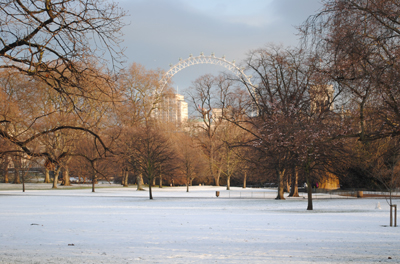
PICTURE: Looking across St James’s Park toward Whitehall in the snow.

WHERE: St James’s Park (nearest tube station is St James’s Park); WHEN: 5am to midnight daily; COST: Free entry; WEBSITE: www.royalparks.gov.uk/St-Jamess-Park.aspx

Famous Londoners – Sir Thomas Gresham

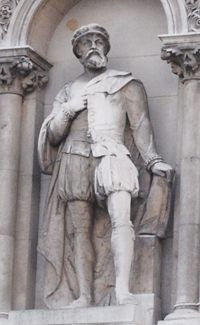
Remembered primarily for having founded the Royal Exchange as a centre for commerce in London and Gresham College, Sir Thomas Gresham was one of London’s leading merchants and financiers and an important advisor to successive monarchs during the sixteenth century.

Gresham was born in Milk Lane, London, to merchant Sir Richard Gresham (himself Lord Mayor of London in 1537-38) around 1518-19. He studied at Cambridge before being apprenticed to learn the family trade with his uncle, Sir John Gresham.

In 1543, he was admitted to the Mercers’ Company and subsequently spent time in the Low Countries, residing principally in Antwerp and acting as an agent for King Henry VIII. In 1544 he married Anne Fernley, widow of another London merchant. He also had a house in Lombard Street at this time.

Sir Thomas became an important advisor  to King Edward VI, helping him alleviate financial concerns, a role he continued to play during the successive reigns of Queen Mary I and Queen Elizabeth I (although he spent some time out of favor during Mary’s reign).

Knighted for his services to the crown in 1559, he proposed to built his ‘exchange’ in 1565, offering to pay for it himself if the City of London and Mercers’ Company provided the land. Modelled on the bourse in Antwerp with a trading floor and shops and offices set around a large central courtyard, it was officially awarded the title ‘royal’ by Queen Elizabeth I in 1571.

Sir Thomas died suddenly in 1579, apparently of a heart attack, and left the majority of his wealth to his widow but included clauses in his will stating that after her death rents from the Royal Exchange be used to create a college which would see seven professors offer free lecturers on subjects ranging from astronomy and geometry to rhetoric and divinity.

Known as Gresham College, it became the first institution of higher education in London when it was founded in 1597 and was initially based at Sir Thomas’ mansion in Bishopsgate (it’s now based in Barnard’s Inn Hall and, as it has for the past 400 years, still offers free public lectures).

In 1666, Sir Thomas’ Royal Exchange burnt down along with much of London but it was rebuilt immediately afterward (King Charles II laid the foundation stone of the new building) and rebuilt again following another fire in 1838 (at the time the building was largely occupied by two insurance companies, one of which was Lloyds of London).

It’s this third building, designed by Sir Thomas Tite to resemble the original plan, which stands on the site today. While trading has long since ceased there – it’s now a luxury-end shopping centre – Sir Thomas’s symbol, the gold ‘Gresham Grasshopper’, can still be seen on the weathervane. For more information on the Royal Exchange, see www.theroyalexchange.co.uk.


Lost London – Winchester Palace

This week we look at another “lost” palace of London but this time it’s not one built primarily for kings and queens. Rather we’re taking a look at the former Thameside home of the Bishops of Winchester.

Located in Southwark, Winchester Palace (also known as Winchester House) was built in the 12th century as the London residence of the bishop, a major landowner in the area.

The palace’s hall was extravagantly decorated and is known to have played host to royalty including King James I of Scotland and Joan Beaufort whose wedding feast was held there in 1424. It’s also suggested that King Henry VIII may have met wife number five, Catherine Howard, there.

The remainder of the palace was arranged around two courtyards and as well as buildings including its own prison and brewhouse, it also boasted a tennis court, bowling alley and pleasure gardens. It was used up until the Civil War – during which it served as a prison – before, in a growing state of deterioration, being let out for tenements and warehouses. Much of what remained was destroyed by fire in 1814.

Today all that remains above ground is a wall which stood at the west end of the great hall, mostly dating for the 14th century. Now in the care of English Heritage, it features a magnificent (albeit glassless) rose window, 13 feet in diameter, and three doors, believed to have led to the buttery, pantry and kitchen.

The palace was located in what was known variously as the ‘Manor of Southwark’, the ‘Liberty of Winchester’ or the ‘Liberty of the Clink’ (the word ‘clink’ refers to the bishop’s notorious prison – more on this another time). This was an area of land under the direct jurisdiction of the Bishop of Winchester and outside the jurisdiction of the City of London and become particularly known for prostitution – the Bishop was granted the power to licence prostitutes in the 12th century – with the prostitutes referred to as “Winchester Geese”.

The current ruins were found during the area’s redevelopment in the 1980s. Remains of Roman buildings were also found underneath where the palace once stood.

WHERE: Clink Street, Southwark (nearest tube station is London Bridge); WHEN: Anytime; COST: Free; WEBSITE: www.english-heritage.org.uk/daysout/properties/winchester-palace/

Curious London Memorials – 7. Tower Hill scaffold memorial

Nestled on Tower Hill, somewhat overshadowed by the monumental memorial to the merchant naval casualities of World War I and II nearby, lay a series of plaques commemorating more than 125 people who were executed there.

The plaques, which stand on the site of the former scaffold, list the names of some of the most prominent who died there including Simon of Sudbury, Archbishop of Canterbury, who was beheaded by an angry mob during the Peasant’s Revolt in 1381, John Fisher, the Bishop of Rochester, and former chancellor Sir Thomas More – both of whom were executed in 1535 on the orders of King Henry VIII, and Thomas Cromwell, another chancellor who fell foul of King Henry VIII and was executed in 1540.

Later executions include William Laud, another Archbishop of Canterbury who was executed in 1645, James, Duke of Monmouth, the illegitimate son of King Charles II who was executed in 1685, and Simon Fraser, Lord Lovat, who became the last man to be executed there in 1747 (and the last man in England to be beheaded) after his capture following the Battle of Culloden in Scotland.

An inscription at the site reads that the memorial was created to “commemorate the tragic history and in many cases the martyrdom of those who for the sake of their faith, country or ideals staked their lives and lost”.

It’s worth noting that contrary to popular belief only 10 people were ever executed on Tower Green inside the Tower of London including two of King Henry VIII’s queens – Anne Boelyn (1536) and Catherine Howard (1542) – as well as the tragically young Lady Jane Grey, queen for only nine days before she was beheaded in 1554, and three Black Watch soldiers who were shot in 1743 after being charged with mutiny.

What’s in a name?…Covent Garden

Now a favored place for people-watching among Londoners and visitors alike, Covent Garden takes its name from the ‘Convent Garden’ which occupied the site in medieval times.

The ‘convent garden’, said to be a 40 acre kitchen garden, belonged to the Abbey or ‘Convent’ of St Peter in Westminster (Westminster Abbey was once the church of this religious foundation) which owned the site from the 13th century until 1548 when the land passed into control of King Henry VIII during the Great Dissolution.

He granted much of the land to John Russell, the 1st earl of Bedford, and it was the 4th earl, Francis Russell, who commissioned Inigo Jones to design a great public square. The new square featured grand houses along the northern and eastern sides and a church – St Paul’s (pictured right) – on the west while to the south, between the square and the Strand, stood the mansion of the Bedford family.

A fruit and vegetable market was licensed in 1670 but its growth – and the development of other squares offering a much greater level of privacy – led the wealthy who had originally occupied the houses to move elsewhere. The market, meanwhile, continued to grow and in the 1830s, the main market building which still stands there today was constructed.

Further buildings followed in the 1800s and the market continued to occupy the site until as recently as 1973 when it was finally moved out to Nine Elms and the area began a transformation into the shopping precinct it now is.

Lost London – York Watergate

There’s several places along Victoria Embankment where it’s possible to see where the River Thames bank stood before the massive mid-19th century project to reclaim land. Not the least of them is located in the downstairs foyer to Somerset House, where looking through the glass floor, you can see the pebbles of the original riverbank.

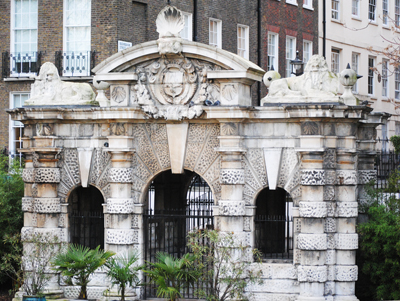
Another is York Watergate, once the river entrance to the Duke of Buckingham’s London mansion, and now stranded some distance from the water in Victoria Embankment Gardens.

The mansion, known as York House, was originally located on the southside of the Strand. Originally built in the 13th century, it was later acquired by King Henry VIII and granted to the Archbishop of York, Nicholas Heath, in 1556 (hence its name). The house became the home of George Villiers, the first Duke of Buckingham and somewhat sycophantic favorite of King James I, in the early 1620s.

When the duke was stabbed to death in 1628, the property passed to his son, the second Duke of Buckingham (also George), who later sold it to a land developer. It was apparently as a condition of the sale that the streets there now include the duke’s full name – hence George Court, Villiers Street, Duke Street, the slightly ludicrous Of Alley, and Buckingham Street.

The impressive Italianate watergate, which stands below the junction of Buckingham Street and Watergate Walk just a short walk into the gardens from Embankment tube station, was designed by the irrepressible Inigo Jones and built in 1626. Though weathered, it still bears the coat of arms of the Duke of Buckingham on the front.

What’s in a name?…Isle of Dogs

Located in a great bend of the River Thames to the east of the City, the Isle of Dogs isn’t really an isle at all but a broad peninsula of land jutting out to the south of Poplar, opposite Greenwich.

Formerly known as Stepney Marsh, for centuries the area was protected by a great embankment and in the 13th and 14th centuries came to be home to a small agricultural community. After the embankment was breached, however, the area reverted to marshland and only came back into more intensive use with the opening of the West India and East India docks in the early 1800s (amalgamated in 1838) and Millwall Dock in the 1860s. The linking of these docks in the early 1900s apparently made the “isle” an island for the first time.

At the same time, the area also became noted for shipbuilding – among the vessels constructed here was Isambard Kingdom Brunel’s SS Great Eastern, the biggest ship ever built when launched in the late 1850s.

The population of the area rose thanks to the docks and by 1901 – following the development of Cubitt  Town, named for developer William Cubitt – the population had risen to 21,000. Heavily bombed in World War II, the isle saw a resurgence in the Fifties and Sixties but gradually declined in the following years as new shipping technologies made the docks obsolete. The last of the docks closed in 1980.

The area has since been redeveloped in a project initially driven by the London Docklands Development Corporation and is now in effect a city within a city, housing homes, apartments, retail precincts and office buildings – including One Canada Square, the highest tower in London, at Canary Wharf (the highest tower in London until recently surpassed by the currently-under-construction Shard in Southwark), linked to the rest of the city via the Docklands Light Railway (DLR).

But what about the name Isle of Dogs? One theory is that it was here King Henry VIII kept his hunting dogs (the earliest reference to the Isle of Dogs is apparently on a map dated 1588) while others suggest the name comes from dogs King Edward III kept there. Others have suggested the name is a corruption of ‘Isle of Ducks’, that the area is named for packs of dogs who roamed wild in the marshlands here or that it comes from the fact dead dogs washed up on banks of the Thames here. As for which is the truth? Take your pick.

Tower Hamlets, the local authority, offers a great free walk through the area which gives you a glimpse into its history. See http://bit.ly/dRzcP9.

Lost London – Nonsuch Palace

Built as a symbol of the triumphal reign of the Tudor dynasty (not to mention as a response to the French King Francis I’s palace Château de Chambord), Nonsuch Palace near Ewell in Surrey, now part of greater London, was the last palace constructed by King Henry VIII.

Construction on the palace started in 1538, the 30th year of Henry’s reign and only six months after the birth of Henry’s son and heir, later King Edward VI. The medieval village of Cuddington was demolished to make way for the new premises.

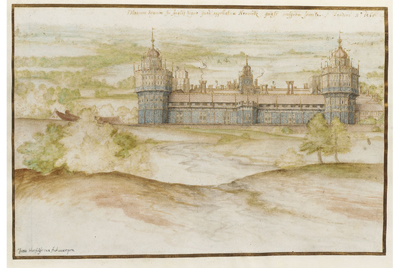
The multi-storied building was designed around an inner and an outer courtyard, each entered through a fortified gatehouse, with the royal apartments located in the latter. While plain on the outside, the inner courtyard interior was decorated with stucco reliefs depicting, among other things, Roman emperors, gods and goddesses and Henry VIII with his son Edward. To cap it off, there were two great octagonal towers built at either end.

While the bulk of of the work had been completed when Henry died in 1547, it is believed that the palace may still have been unfinished. In any case, it only remained a royal property for a short time before Queen Mary I sold it to Henry Fitzalan, the Earl of Arundel. It passed back into royal hands when the earl’s son-in-law, John Lumley, was forced to sell it back to Queen Elizabeth I to settle a debt. The queen was said to have stayed frequently at the palace.

King James I granted the palace to his wife, Queen Anne of Denmark, and it was also used by his son Henry, Prince of Wales. King Charles I also granted the palace to his wife, Queen Henrietta Maria, before it was sold off by Parliamentary commissioners after the Civil War. When King Charles II came to the throne, the palace was once again given to Henrietta Maria and then, when she died in 1669, to Barbara Villers, Countess of Castlemaine, a mistress of the king.

The building was demolished in 1682 with the materials and sale of the land used to pay off the countess’ gambling debts. While some parts of the building were carted off to be incorporated into others, no trace of the building remains above the ground but its former site, on the west side of what is now Nonsuch Park in Cheam, is marked by three granite bollards. A separate banqueting house and extensive gardens were also built near the site.

The building, which was only depicted a few works, can be confused with Nonsuch Mansion House, the oldest parts of which date from the 18th century, which still stands on the east side of the park and was probably built on the site of a former keeper’s lodge.

There are exhibitions on the palace in the Honeywood Museum (the heritage centre for the London Borough of Sutton) in Carshalton and in the Tudor house known as Whitehall in Cheam. The Epson and Ewell History Explorer website also have a trail you can follow which encompasses the former site of the palace.

PICTURE: Nonsuch Palace in an engraving by Joris Hoefnagel. Source: Wikipedia.

Where’s London’s oldest…surviving building?

The oldest intact building in London is generally believed to be the White Tower, which stands in the heart of the Tower of London.

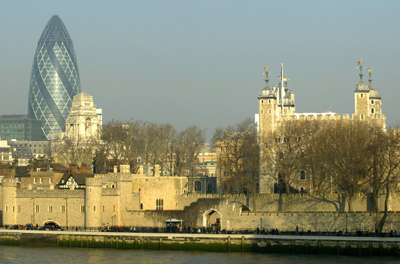
Construction on the White Tower (which stands to the right in the picture) was started on the orders of William the Conqueror some time prior to 1070 and was completed by 1100. The newly appointed Bishop of Rochester, Gundulf, was placed in charge of the project which used stone imported from Normandy (much of this was replaced in later centuries).

Built as a towering stronghold and fortress for the English kings, the walls of the tower at 15 feet (4.5 metres) thick and 90 feet (27 metres) high. It was later enclosed by a curtain wall and moat, taking the shape of the Tower of London as we now know it by about 1350.

The White Tower, also known as the Great Tower, has been the scene of many dramatic events in British history – from the deposition of Richard II in 1399 to the disappearance (and possible murder) or the Princes in the Tower – Edward V and his brother Richard, Duke of York, around 1483 (two skeletons, which some believed to be theirs, were unearthed here in 1674).

The White Tower, which is now part of a World Heritage Site, contains the splendid 11th century Chapel of St John the Evangelist. While three of the turrets at the corners of the tower are square, the fourth – the north-east turret, is round and once contained the first royal observatory.

The onion-shaped domes and weathervanes on the turrets were added in the 1520s.

These days the tower contains an exhibition of royal armour – including that worn by King Henry VIII – as well as exhibits on the tower’s history.

WHERE: Tower of London (nearest tube station is Tower Hill); WHEN: Tuesday to Saturday 9am to 4.30pm; Sunday to Monday 10pm to 4.30pm (closing times are 5.30pm between March and October); COST £18.70 an adult/£15.95 concessions/£10.45 a child (children under five free)/£51.70 for a family of two adults and up to six children; WEBSITE: www.hrp.org.uk/TowerOfLondon/

PICTURE: Stephen Pond/Historic Royal Palaces

What’s in a name?…Whitehall

Running southward from Trafalgar Square towards the Houses of Parliament (the southern part of Whitehall is actually known as Parliament Street), Whitehall is lined with government buildings – everything from the Foreign Office to the Cabinet Office, from the Scotland and Wales Offices to the Ministry of Defence – and has become so identified with government that its very name is now used to mean just that. But where does the name come from?

Whitehall takes its name from the Palace of Whitehall which once stood on the site of the current street. The palace’s origins go back to the 14th century when a grand house known as York Place was built as the London residence of the Archbishops of York.

The building was gradually expanded over the years – work which continued when Thomas Wolsey was made Archbishop of York in 1513. When Cardinal Wolsey fell from favour in the late 1520s, however, King Henry VIII seized the house along with his other assests.

With the royal Palace of Westminster badly damaged in a fire in 1512, King Henry VIII had been staying at Lambeth Palace. He saw the newly acquired palace, renamed Whitehall, as a suitable new home and continued expansion works, constructing a series of recreationally-oriented buildings on the west side of what is now Whitehall including tennis courts, a cockfighting pit and a tiltyard for tournaments. By the time of Henry VIII’s death in 1547, the palace covered 23 acres and was the largest in Europe.

The palace continued to be used by subsequent monarchs until much of it was destroyed by fire in 1698. These days the only surviving part of the palace is the Banqueting House. Built by Inigo Jones for King James I, it was from a window on the first floor of this 1622 building that King Charles I stepped onto a scaffold where his head was cut off.

Apart from the Banqueting House, other significant sites in Whitehall including the Cenotaph, the focus of Remembrance Sunday commemorations. Downing Street, meanwhile, runs off the south-eastern end of Whitehall and behind gates which have blocked it off since 1989, stands the Prime Minister’s official residence.

Wren’s London – 4. Hampton Court Palace

Hampton Court Palace in London’s outer south-west is known to many as the palace of Henry VIII. Yet a considerable part of the complex of buildings we see today was also created during the reign of some time joint rulers William III and Mary II.

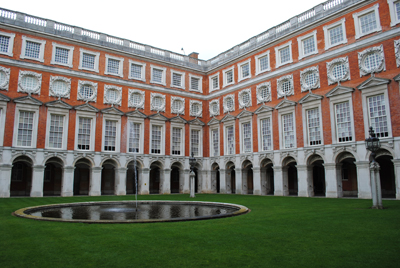
It was to Christopher Wren – assisted by the able Nicholas Hawksmoor – that the rulers turned when looking to update the Royal Apartments. Wren’s designs for a domed baroque palace to rival Versailles in France were apparently so ambitious that they were only half-built (and built in haste – two workmen died and another 11 were injured when the main wall collapsed in 1689). The death of the queen in 1694 also meant work on the palace stopped – it was resumed in 1697 (under control of Wren’s deputy William Talman who had offered a lower price than Wren) but again stalled after the death of the king in 1702.

Wren’s imprint is on the palace we see today is nonetheless considerable and includes the Baroque-style South and East Front (the size of the formal gardens which radiate out from the latter give a glimpse into the grand plans Wren had for the palace), Fountain Court which replaced the Tudor Cloister Court and around which were located new state apartments for both the king and queen, and the Orangery.

Among those who worked on the interiors of were the famous woodcarver Grinling Gibbons and painter Antonio Verrio.

WHERE: Hampton Court Palace, East Molesey, Surrey (nearest station is Hampton Court from Waterloo); WHEN: 10am to 6pm everyday (winter hours 10am to 4.30pm from 31st October to 26th March); COST: Adult £15.40, Concession £12.65, Child under 16 £7.70 (under fives free), family tickets, garden only tickets and online booking discounts available; WEBSITE: www.hrp.org.uk/HamptonCourtPalace/

Wren’s London – 3. The Royal Observatory, Greenwich

Leaving Wren’s churches momentarily, we turn this week to another of Wren’s designs, that of the Royal Observatory in Greenwich in London’s east.

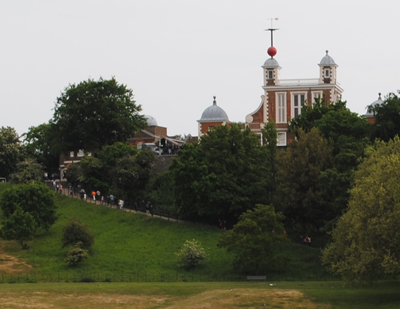
Commissioned in 1675 by King Charles II, the first part of the observatory – Flamsteed House, named for the first Astronomer Royal, John Flamsteed – was designed by Wren with, it is believed, the assistance of architect and scientist Robert Hooke.

Built using second-hand materials including stone brought from a Tudor fort at Tilbury, Flamsteed House was located on the former site of Greenwich Castle which had been previously used as a guest house and hunting lodge by Henry VIII. It is said to be the first purpose-built scientific research facility in the country.

The turreted building includes the Octagon Room from which Flamsteed made observations of events in the skies (although its position meant its use for this was somewhat limited), as well as living quarters for the astronomer. On top of the house is a red time ball which, since it was first used in 1833, has marked the time by falling at 1pm each day.

These days part of the National Maritime Museum and a UNESCO World Heritage Site since 1997, the site also hosts the Prime Meridian and is the place from where Greenwich Mean Time, since 1884 the basis for all world time, is calculated.

WHERE: Blackheath Avenue, Greenwich (nearest DLR station is Cutty Sark); WHEN: 10am to 5pm Monday to Sunday; COST: Entry is free; WEBSITE: www.nmm.ac.uk/places/royal-observatory/

10 sites in London you may not know about – 5. Richmond Park

OK, something this big can’t exactly be a secret but due to the fact it lies well out of the city centre, the vast expanse of Richmond Park in the city’s outer south-west, not far from the Thames, can get overlooked.

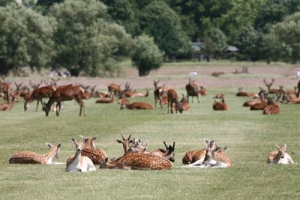
At almost 1,000 hectares, Richmond Park is the largest open space in the city and is home to some 650 Red and Fallow deer who roam about at will.
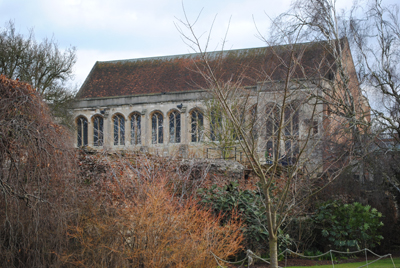
While the park’s royal connections go back to Edward I (1272-1307) when the area was known as the Manor of Sheen, a name which was changed to Richmond during the reign of Henry VII (1485-1509), it wasn’t until 1637 that Charles I decided to enclose the land with walls that remain to this day.

Deer aside, the park is also home to Pembroke Lodge which in 1847 became the home of then Prime Minister Lord John Russell (and is now a restaurant). The park’s features include King Henry’s Mound – which boasts great views on a clear day including that of St Paul’s Cathedral (12 miles away) – and the Isabella Plantation – an ornamental woodland garden.

WHERE: The park is located south of the Thames-side village of Richmond. Nearest tube is Richmond.  WHEN: 7am in summer to dusk; COST: Free to enter; WEBSITE: www.royalparks.org.uk/parks/richmond_park/

Image: Courtesy of Royal Parks. © Giles Barnard

10 London sites you may not know about – 1. Eltham Palace

London is a vast city and whether you’re a first-time visitor or a seasoned Londoner, there’s probably still many places you haven’t yet visited. So over the next few posts we’re running a list of 10 of the less well-known sites for your perusal…

1. Eltham Palace. While Henry VIII’s final home, Hampton Court Palace, remains among London’s top 10 tourist sites, less well known is his childhood home, Eltham Palace. True, nowhere near as much of it remains from the Tudor and earlier medieval times, but with a later adjoined 1930s mansion housing some amazing Art Deco interiors, the medieval remains are just the start.

The palace’s history can be traced back to the Domesday survey of 1086. It passed into royal ownership in 1305 when then owner, Anthony Bek, Bishop of Durham, gave it to King Edward I.

Numerous kings and their families spent time at Eltham including Edward III, Henry IV, and Henry VI, and it was Edward IV who, between 1475 and 1480, ordered the Great Hall built – a treasure which still survives.

Henry VIII was the last English monarch to spend considerable time at Eltham – it was elipsed by Greenwich Palace as a royal residence – and, after falling into disrepair into the seventeenth century, it passed back into ‘non-royal’ hands.

Much of what stands at Eltham today dates from the 20th century when millionaire socialites Sir Stephen and Lady Virginia Courtauld oversaw the restoration of the medieval Great Hall and the construction of an adjoining mansion which is a masterpiece of 1930s style incorporating a combination of Art Deco, “ocean-liner style” and Swedish design.

The Courtaulds left for a new life in Southern Rhodesia in 1944 and from then until the early 1990s the military occupied the property. English Heritage subsequently oversaw a major restoration and opened it to the public in 1999.

It’s well worth a visit to see the medieval Great Hall (which apparently boasts the third largest hammer-beam roof in England) and the 1930s property (aside from the stunning interiors – including Virginia’s gold-plated bathroom and warmed sleeping quarters for the Courtauld’s pet lemur – there’s also some great Courtauld family movies on show which give an amazing insight into the family which once lived there and an audio guide tour fittingly narrated by David ‘Poirot’ Suchet). There’s also 19 acres of gardens to explore, including a magnificent medieval bridge spanning what remains of the moat, and a cafe to while away the afternoon.

WHERE: Off Court Road, SE9. Half a mile from Eltham and Mottingham train stations. COST: £8.30 adult/£7.20 concession/£4.20 child (garden only tickets are available). English Heritage members free. WEBSITE: www.elthampalace.org.uk