What’s in a name?…Putney…

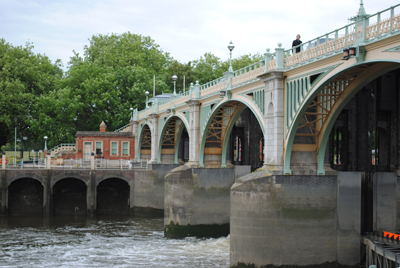
PutneyThis south-west London Thames-side district (and the bridge named after it), traces the origin of its name back to Saxon times.

Putney2Recorded in the Domesday Book as Putelei and known in the Middle Ages as Puttenhuthe, it apparently goes back to a Saxon named Puttan who lived in the area and the Old English word ‘hyp’, which means ‘landing place’. Hence, “Puttan’s landing place” (or Puttan’s wharf).

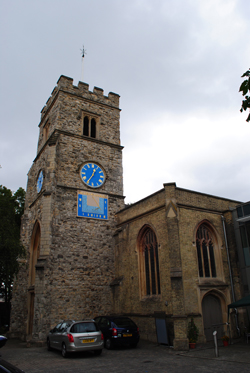
Putney has something of a storied history – it was the birthplace of Tudor heavyweight Thomas Cromwell, Georgian-era author Edward Gibbon and it was here, in the still-standing parish church of St Mary the Virgin (pictured), that the Putney Debates were held in 1647 among members of the New Model Army.

The first bridge was apparently built here in the first half of the 18th century and the present stone bridge in the 1880s.

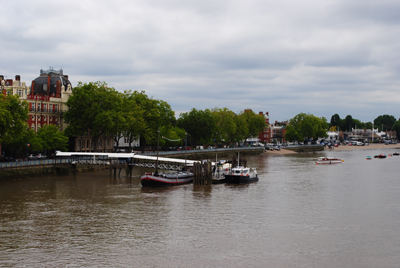
Today a sought-after riverside residential district, Putney boasts a sizeable high street, great riverside pubs and eateries and is particularly popular every April when The Boat Race is held between Oxford and Cambridge universities thanks to the starting point being just upstream of Putney Bridge.

The area also is home to the 400 acre Putney Heath (which adjoins Wimbledon Common), a popular site for duels in the 18th century, and also home to a stone and brick obelisk, erected in 1770 to mark the 110th anniversary of the Great Fire of London (more on that in an upcoming post).

This Week in London – Remembering the Great Fire of 1666; rediscovering the Palace of Whitehall; and, the Queen’s dresses go on show…

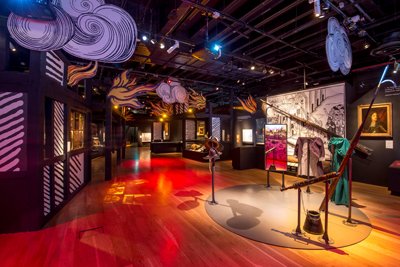
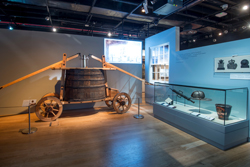
Fire2• A new “theatrical” exhibition marking the 350th anniversary of the Great Fire of London is opening at the Museum of London on Saturday. Fire! Fire! takes visitors on an interactive journey from before, during and after the great fire, looking at how the fire started and spread and the personal stories of Fire1Londoners present at the time. Visitors will be able to step in Pudding Lane and see what life was like for 17th century Londoners, walk into the bakery where the fire started, and identify objects melted by the flames. Exhibits on show include a restored 17th century fire engine, originally built in London in the last 1670s, other firefighting equipment including a squirt, a leather bucket and fire hook, a pair of bed hangings, a burnt Geneva Bible, and letters written in the fire’s aftermath. Admission charges apply. Can be seen until 17th April next year. A series of events, including walks, tours, lectures, workshop and family activities, accompanies the exhibition. For more, see www.museumoflondon.org.uk/fire-fire.  The museum has also commissioned a Minecraft building group recreate London as it was in 1666 with the first of three interactive maps to be released next week (available for free download from www.museumoflondon.org.uk) and further maps to follow in September and February. For more information on other events surrounding the anniversary, see www.visitlondon.com/greatfire350.

The long lost Palace of Whitehall is the subject of a new visitor experience which kicks off at the last surviving part of the palace – the Banqueting House – today. Handheld devices, binaural 3D sound and haptic technology is being made available to guests as they stroll around the streets of modern Whitehall, allowing them to immerse themselves in the former palace during the time of the Tudors and the Stuarts. The Lost Palace experience, created in a collaboration between Historic Royal Palaces and Chomko & Rosier and Uninvited Guests, includes a chance to see the jousts which so delighted Queen Elizabeth I at Horse Guards Parade, accompany King Charles I as he walks through St James’s Park to his execution at the Banqueting House, meet Guy Fawkes following his arrest in the Gunpowder Plot, take part in a performance of King Lear and eavesdrop on an encounter between King Henry VIII and Anne Boleyn before their doomed love affair began. The Palace of Whitehall was once the largest palace in Europe with 1,500 rooms spread across 23 acres. Tickets can be purchased at the Banqueting House. Runs until 4th September. For more details, see www.hrp.org.uk/thelostpalace.

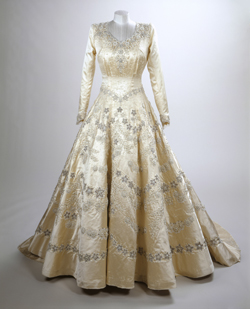
DressDresses worn by Queen Elizabeth II during two of the most significant events in Her Majesty’s life – her wedding and her coronation – can be seen as part of the Summer Opening of the State Rooms at Buckingham Palace from Saturday. The two dresses will form part of a special exhibition – Fashioning a Reign: 90 Years of Style from The Queen’s Wardrobe, the largest display of the Queen’s dress ever held. Alongside the two feature dresses, both designed by British couturier Sir Norman Hartnell, are around 150 outfits created by designers including Hartnell, Hardy Amies and Ian Thomas. The then Princess Elizabeth’s wedding dress (pictured), made for her marriage to the Duke of Edinburgh on 20th November, 1947, was made in ivory silk, decorated with crystals and 10,000 seed pearls and attached to a 15 foot long train, while the Queen’s Coronation dress – created for the event on 2nd June, 1953, is made of white duchesse satin and encrusted with seed pearls, sequins and crystals (along with an extra four-leaf shamrock on the left side of the skirt, added secretly by Sir Norman, to bring her good luck). The exhibition, open to 2nd October, is being accompanied by special displays at both Windsor Castle and Holyroodhouse in Edinburgh. Admission charges apply. For more, see www.royalcollection.org.uk. PICTURE: Royal Collection Trust/© Her Majesty Queen Elizabeth II 2016. 

The world’s largest collection of London images – more than 250,000, dating from 1450 to now – are being made available on a free-to-access website hosted by the London Metropolitan Archives from today. Collage – The London Picture Archive features more than 8,000 historical photographs of capital’s streets as well as images of the Great Fire of London in 1666 and photographs of the construction of Tower Bridge along with maps, prints, paintings and films, all drawn from the collections at the City of London Corporation’s Guildhall Art Gallery and the Clerkenwell-based London Metropolitan Archives. The collection can be accessed at www.collage.cityoflondon.gov.uk.

It’s hands-on gaming at the Science Museum for two weeks from Friday with more than 160 systems and hundreds of games available to play on. Power UP spans 40 years of gaming with games ranging from classics like Pong and Pac-Man to modern games like Halo and systems from Atari and SEGA to PS4 and Xbox One. Ninety minute sessions are being held four times daily from 11am tomorrow until 7th August. Ticket charges apply. For more , see www.sciencemuseum.org.uk/powerup.

Send all items for inclusion to exploringlondon@gmail.com.

A Moment in London’s History – The “first PM” moves into 10 Downing Street…

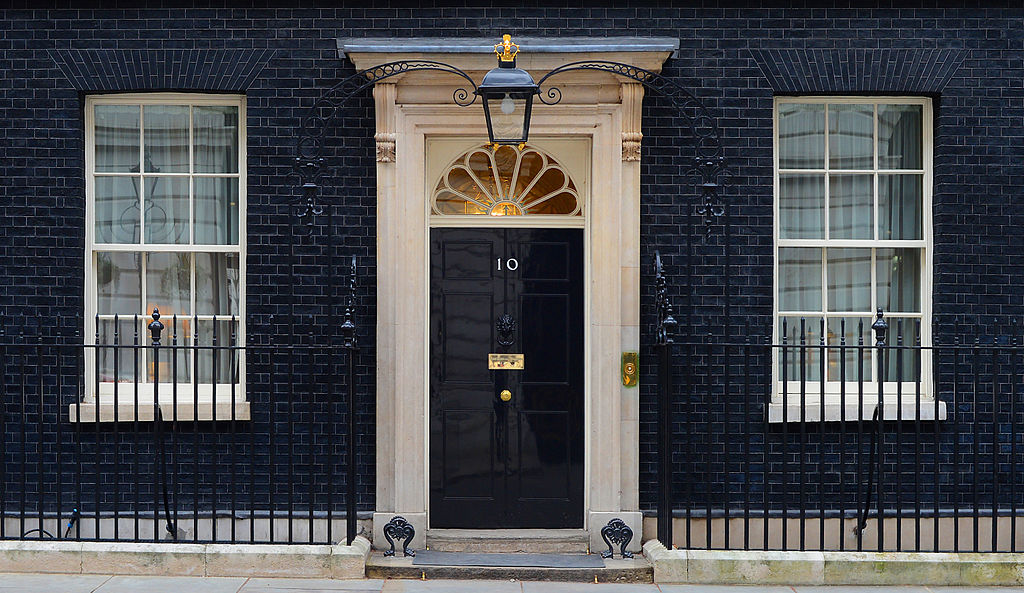
With the recent change at 10 Downing Street – David Cameron out/Theresa May in – we thought it a good time to look back at when the man considered Britain’s first PM moved in.

10_Downing_StreetSir Robert Walpole, commonly considered Britain’s first Prime Minister although he was never formally known by that title, was actually First Lord of the Treasury when in early 1730s King George II presented him with the terrace house at 10 Downing Street, off Whitehall, and the large mansion behind it (in fact the title of ‘First Lord of the Treasury’ can still be seen inscribed on the brass letter-box on the property’s front door).

Sir Robert accepted the king’s gift, but only on condition that it be made available to all future First Lords of the Treasury  And he didn’t move in until 22nd September, 1735, having had architect William Kent join the terrace house with the mansion behind it before doing so.

Kent had joined the houses on two levels with the main entrance facing onto Downing Street instead of Horse Guards. The Walpoles would live at the back of the new house where Kent had created a series of grand rooms – suitable for receiving honoured guests – and had built an unusual three sided staircase which remains a star sight of the building today.

Walpole used the ground floor of the new property for business and set-up his study in what is now the Cabinet Room. Lady Walpole used the upstairs room now known as the White Drawing Room as her sitting room and what is now called the Terracotta Room (although the name of this room changes with the colour scheme) as the dining room.

Among those who attended 10 Downing Street during the Walpole’s residency were luminaries such as Queen Caroline (wife of King George II) as well as prominent politicians, writers and military figures.

The Walpoles left in 1742 and it was more than 20 years later before another First Lord of the Treasury moved in.

For more on 10 Downing Street (including its earlier history), check out our previous entries here and here.

PICTURE: Sergeant Tom Robinson RLC/ Contains public sector information licensed under the Open Government Licence v3.0.

Treasures of London – Great Parchment Book…

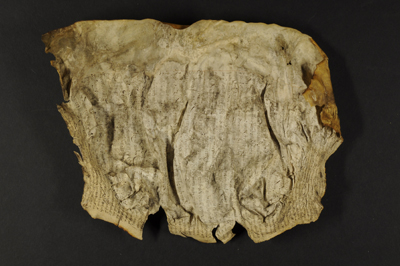
Great-Parchment-BookHeld in the collections of the London Metropolitan Archives, the Great Parchment Book of The Honourable the Irish Society was recently inscribed upon the UK register of the UNESCO Memory of the World.

Described as a “hugely significant record of the Ulster Plantation of the early 17th century”, the book was compiled in 1639 by a commission instituted under the Great Seal of King Charles I and is a survey of all the estates in Derry managed by the City of London Corporation through the Irish Society and City of London livery companies.

As such, manuscript and provides a unique insight into this important period in the history of Northern Ireland, containing key data about landholdings and the population in Ulster at the time of its creation including for both English and Scottish settlers and the native Irish population (as well as, exceptionally, for many women at all levels of society).

The Great Parchment Book was badly damaged in a fire in 1786 and as a result was unavailable to researchers for more than 200 years until its successful reconstruction using cutting edge digital imaging technology.

It is the fourth item in the care of the London Metropolitan Archives to be inscribed to the UK register of the UNESCO Memory of the World, a programme which aims to facilitate preservation of the world’s documentary and audio-visual heritage, to assist universal access and to increase awareness worldwide of the existence and significance of this documentary heritage.

The three other objects inscribed on the list which are in the LMA’s care include the Charter of William I to the City of London, London County Council Bomb Damage Maps and Robert Hooke’s Diary 1672-83.

~ www.greatparchmentbook.org

WHERE: London Metropolitan Archives, 40 Northampton Road, Clerkenwell (nearest Tube stations are Farringdon and Angel); WHEN: Open Monday to Thursday and selected Saturdays (check website for times); COST: Free; WEBSITE: www.cityoflondon.gov.uk/things-to-do/london-metropolitan-archives/Pages/default.aspx.

PICTURE: Courtesy London Metropolitan Archives.


Lost London – Exeter/Essex House…

Located on the south side of the Strand, the then-named Exeter House was built in the 1300s as the London palace of the Bishops of Exeter on land which had previously been occupied by the Knights Templar.

The-DevereuxIt was Bishop Walter Stapledon who had the palace constructed – as well as being Bishop of Exeter, he was Lord High Treasurer to the unpopular King Edward II, a role which eventually led to him being dragged from his horse in the City of London and murdered.

King Henry VIII gave the property to his Secretary of State, William, Lord Paget, and, in the late 16th century, it came into the hands of Robert Dudley, the 1st Earl of Leicester. He rebuilt it and renamed it Leicester House which it remained until, following his death in 1588, it was inherited by his stepson, Robert Devereux, the 2nd Earl of Essex and a favourite of Queen Elizabeth I, and renamed Essex House.

The house was rather large and in 1590 was reported as having as many as 42 bedrooms as well as a picture gallery, a banqueting suite and chapel.

Devereux ended up beheaded for treason on Tower Hill in 1601 but his son, also Robert Devereux, became a distinguished general for the Parliamentarians during the Civil War. He received a delegation from the House of Commons at the property to offer their congratulations after the Battle of Newbury in 1643 and was laid out in state there in 1646 (insatiable diarist Samuel Pepys, then a 13-year-old boy, was among those who saw the body).

After the Civil War, the family’s debts resulted into the property passing into the hands of other families. The main part of the house was eventually demolished in the 1670s and part of the property sold to developer Nicholas Barbon. He built Essex Street, which still stands in the area, was built on the site.

The remaining part of the house, meanwhile, was used to house the Cotton Library before, in 1777, it too was demolished.

The mansion’s chapel, meanwhile, became a dissenters meeting house, known as the Essex Street Chapel, which became the birthplace of Unitarianism in England. The denomination’s headquarters, named Essex Hall, still stands on the site.

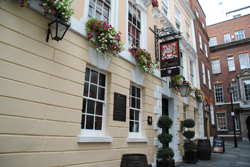
The pub The Devereux (pictured above), named for Robert Devereux, is among the buildings which now stand on the site (for more on the pub, see our earlier post here).

LondonLife – The Queen’s 90th birthday marked at Trooping the Colour…

Queen-in-The-Mall

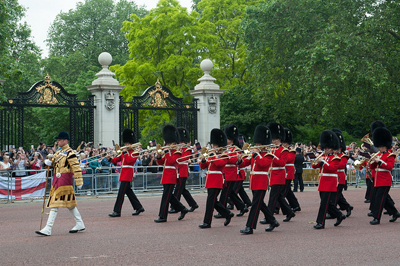
Photographer John Pannell was among the crowds who gathered in The Mall to witness Trooping the Colour on Saturday. Traditionally held to mark the Queen’s birthday, this year’s event – in honour of the fact that the Queen has turned 90 (her actual birthday being 21st April) – was followed on Sunday by a lunch for 10,000, known as the Patron’s Lunch, in The Mall. Trooping the Colour has marked the official birthday of the sovereign since the reign of King George II. Above are the Queen and Prince Philip while below are part of the Massed Bands of the Household Division, among those who marched, and, RAF planes fly-past Buckingham Palace while watched from the palace’s famed balcony by the Queen and the royal family.

Trooping-the-Colour
PlanesPICTURES: John Pannell/Flickr

LondonLife – A view down Constitutional Hill…

The-Mall

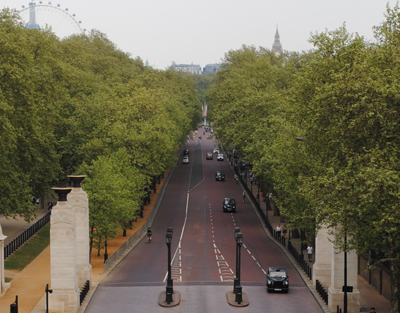
A view down Constitution Hill looking toward Whitehall, taken from the top of Wellington Arch at Hyde Park corner. To the left is Green Park and to the right, the grounds of Buckingham Palace. Constitutional Hill apparently has nothing to do with a document of any sort but takes its name from the fact that, considered to be a fine “constitutional” walk from St James’s Park to Hyde Park (King Charles II is rumoured to have been among those said to have taken their “constitutional” along this route while Queen Victoria survived a couple of assassination attempts on the road). The pillars at the near end are symbolic gates commemorating those who served Britain in World War I and II from the Indian subcontinent, Africa and the Caribbean (more on them in an upcoming post).

Daytripper – Lavenham, Suffolk…

GuildhallIt’s a Bank Holiday weekend and thoughts are turning to a day out, so we thought it a good time to take a look at the beautiful village of Lavenham in Suffolk, one of the finest “medieval villages” remaining in England.

While settlement of the village, which is about an hour and 45 minutes north-east of London by car, goes back to before Saxon times (indeed the village apparently takes its name from a Saxon thegn called Lafa) it was in the medieval period that it attained the charming character which is still so evident today.

Crooked-HouseThe village was awarded its market charter in 1257 and it was from this period until about 1530 that its ‘golden years’ occurred, based on its prominent role in the wool trade (in particular the production of sought-after blue broad cloth – ‘Lavenham Blue’) and its location between London and the key ports like Kings Lynn.

It was during this period that its several guildhall were constructed and it was recorded as one of the richest parts of England with some of its most prominent families becoming extremely wealthy, like the De Vere family headed by the Earl of Oxford, and the Spring and Branch families who used their wealth to raise themselves to the nobility.

Lavenham’s decline began in the later 1500s and followed a sharp downturn in the wool trade amid greater competition from Europe. Its fortunes reached a low in the late 18th century before industrialisation in the 19th century revitalised the village somewhat (although nowhere close to the prominence and affluence it once boasted).

Today Lavenham is something of a tourist mecca, boasting an amazing collection of timber-framed buildings – more than 320 of which are listed – mostly dating from between 1450 and 1500.

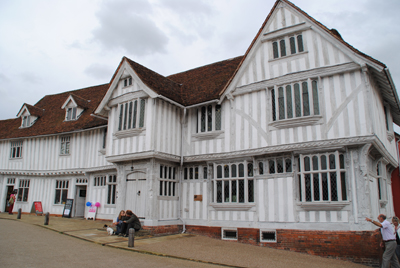
Central among them is the Guildhall (pictured top), located on the market place, which dates from about 1530, and as well as hosting religious guild activities (its formal name was the Guild of Corpus Christi), has also served as a prison, workhouse, almshouse, and wool store and now houses a National Trust-run museum.

One of the most famous photographed buildings in the town is the Crooked House on High Street (pictured above right), so-called because of the dramatic lean its upper story is on.

There’s also the Little Hall, which, dating from the 14th century, was the wool hall of clothier William Causation and is now home to the Suffolk Preservation Society (open to the public over the warmer months). And among other notable homes is De Vere House, a grade I-listed property (now available to stay in) which still had elements dating back to the Middle Ages (and was the last home in the village to be owned by the Earls of Oxford).

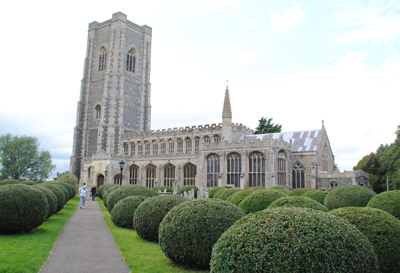
The Church of St Peter and St Paul (pictured below) is also notable – described as “one of the finest parish churches in England”. The current version (there has apparently been a church here since Saxon times) was apparently funded by the 13th Earl of Oxford and wealthy cloth merchants including Thomas Spring III (whose coat of arms appears 32 times on the parapet) to celebrate their safe return from Battle of Bosworth Field where King Henry VII was victorious in 1485.

A couple of interesting notes to finish on. Among the residents in the late 18th century was the London-born Jane Taylor who lived in Shilling Street with her family. Jane and her sister Ann published a collection of poetry which included the poem, The Star, from which the lyrics for Twinkle, Twinkle Little Star are taken.

There’s also a John Constable connection – the landscape painter was a student at the Grammar School which opened in Barn Street in 1647.

And, as you might expect in such a well-preserved location, Lavenham has also appeared on the big screen, notably De Vere House as the birthplace of Harry Potter and his mentor Albus Dumbledore.

A charming village to pass a few hours walking around (and, relax in, there’s plenty of pubs and cafes to refresh yourself at afterwards).

For more, check out www.discoverlavenham.co.uk and www.visit-lavenham.co.uk.

Lavenham-church

This Week in London – Exploring flight and space; ‘Horrible’ Tudors at Hampton Court; BioBlitz at Brompton Cemetery; and sleeping with the lions…

Spread-your-wings• A “ground-breaking” hands-on exhibition exploring the concept and future of flight and space travel opens at the National Maritime Museum in Greenwich this week. Above and Beyond, produced by Evergreen Exhibitions in association with Boeing (and created in collaboration with NASA), features more than 10 interactive displays, allowing visitors to learn to fly like a bird, take an elevator to space, enjoy a view of Earth from above or go on a marathon mission to Mars and see how your body would cope. Runs until 29th August. Admission charge applies. For more, see www.rmg.co.uk/see-do/exhibitions-events/above-and-beyond-exhibition.

Horrible Histories is bringing the world of the ‘Terrible Tudors’ to life at Hampton Court Palace this half-term break. The Birmingham Stage Company is offering the chance for visitors to dip into 100 years of Tudor history, spanning the reigns of the “horrible” Henries to that of the crowning of King James I in 1603. Get behind the dry facts and discover what the role of the Groom of the Stool was, which queen lost her wig as she was executed and decide whether to join in punishing the ‘whipping boy’ or the monarch and which side you’ll be on as the Spanish Armada set sail. The hour long performances will take place on the palace’s historic East Front Gardens (unreserved seating on the grass). Admission charge applies. Runs from today until 2nd June. For more see, www.hrp.org.uk/hampton-court-palace/.

The Royal Parks is hosting its first ever BioBlitz at Brompton Cemetery this Bank Holiday weekend. For 24 for hours from 5pm on Friday, people are invited to join in the hunt to track down as many species of plants, animals and fungi as possible with events including tree and nature walks, earthworm hunts, bee and wasp counts and lichen recording. There will also be a range of stalls for people to visit with representatives from a range of nature and wildlife organisations present. The BioBlitz is one of several projects linked to the £6.2 million National Lottery-funded facelift of the cemetery. For more, head to www.royalparks.org.uk/events/whats-on/bioblitz.

Sleep with the lions at ZSL London Zoo next to Regent’s Park from this week. The zoo new overnight experience at the Gir Lion Lodge, in which guests can stay in one of nine cabins at the heart of the new Land of the Lions exhibit, opened on Wednesday. Guests will also be taken on exclusive evening and morning tours in which they’ll find out more about how ZSL is working with local communities and rangers in India’s Gir Forest to protect these endangered cats. The private lodges will be available six nights a week until December with designated adults-only and family nights available. For more, see www.zsl.org/zsl-london-zoo/gir-lion-lodge. 

Send all items for inclusion to exploringlondon@gmail.com.

LondonLife – Richmond Weir and Lock…

Richmond-Weir

Crossing the River Thames just downstream of Richmond and Twickenham Bridge, the Richmond weir and lock complex (actually it’s a half-lock and it also incorporates a footbridge) was built in the early 1890s to maintain a navigable depth of water upstream from Richmond. The Grade II*-listed structure, which is maintained by the Port of London Authority, was formally opened by the Duke of York (later King George V) on 19th May, 1894.

Famous Londoners – Dr John Dee…

The subject of a current exhibition at the Royal College of Physicians, Dr John Dee – mathematician, courtier, astrologist and ‘magician’ are just some of the tags he is labelled with – is one of the most enigmatic figures of Tudor England.

John_Dee_memorial_plaque_at_S_Mary_the_Virgin_MortlakeBorn in London’s Tower ward in 1527, Dee was of Welsh descent and the son of Roland Dee, a mercer and courtier to King Henry VIII, and Johanna Wild. He attended school in Chelmsford and, at the age of 15 entered St John’s College, Cambridge, awarded a Bachelor of Arts in 1545 and a master’s degree in 1548. He was also a founding fellow of Trinity College when it was founded in 1546.

Dee travelled through Europe during the late 1540s and early 1550s, studying and lecturing at places including Louvain, Paris and Brussels. It was during this trip that he met mathematicians and cartographers like Gemma Frisius and Gerardus Mercator.

Back in England, Dee was appointed rector at Upton-upon-Severn (apparently on the recommendation of King Edward VI), and in 1555 was made a member of the Worshipful Company of Mercers. He had, meanwhile, turned down offers of professorships at both the Sorbonne in Paris and the University of Oxford, ostensibly because he had hopes of obtaining an official position at court.

It was perhaps in pursuit of this that he subsequently appeared at England’s Royal Court where he took on the role of teacher of the mathematical sciences while also serving as an astrologer to Queen Mary I and courtiers.

The latter role led to Dee’s arrest and imprisonment in 1555 on charges of being a ‘magus’ (magician) – he would go on to appear for questioning in the infamous Star Chamber – but he was eventually cleared of all charges.

In 1558, Dee became a scientific and medical advisor to Queen Elizabeth I and, by the mid-1560s, had established himself in the village of Mortlake (now in the south-west of Greater London) where he built a laboratory and gathered together what was the largest private library in the country at the time, said to have consisted of more than 4,000 books and manuscripts (and the subject of the current exhibition).

Dee was also associated with several English voyages of exploration for which he provided maps and navigational instruments, most famously  Sir Martin Frobisher’s expedition to Canada in 1576-78.

He is also known for his strong views on natural philosophy and astrology and the occult, which included the idea that mathematics had a special, supernatural power to reveal divine mysteries. Some of his occult-related ideas were explored in his 1564 text Monas hieroglyphics – one of numerous works he authored – but his most influential work is said to have been a preface he wrote to an English translation of Euclid’s Elements published in 1570 in which he argued for the central role of mathematics.

Dee is said to have married three times – the first in the mid-1560s and, following the deaths of his previous two wives, the last time in 1578 when he was wedded to Jane Fromond, who was less than half his age and who had been a lady-in-waiting to the Countess of Lincoln. She bore him some eight children (although there are questions over the paternity of at least one) and died in 1604 of the plaque.

By the 1580s, having failed to win the influence he hoped to have at court and wanting to further his explorations into the supernatural (in particular, communication with ‘angels’ through occult practice of crystal-gazing), he travelled to Europe with a convicted counterfeiter and medium Edward Kelley to Europe.

Returning to England, after much lobbying, Queen Elizabeth I appointed him warden of Manchester College in 1596, but despite this, he returned to London in 1605 where his final years were marked by poverty.

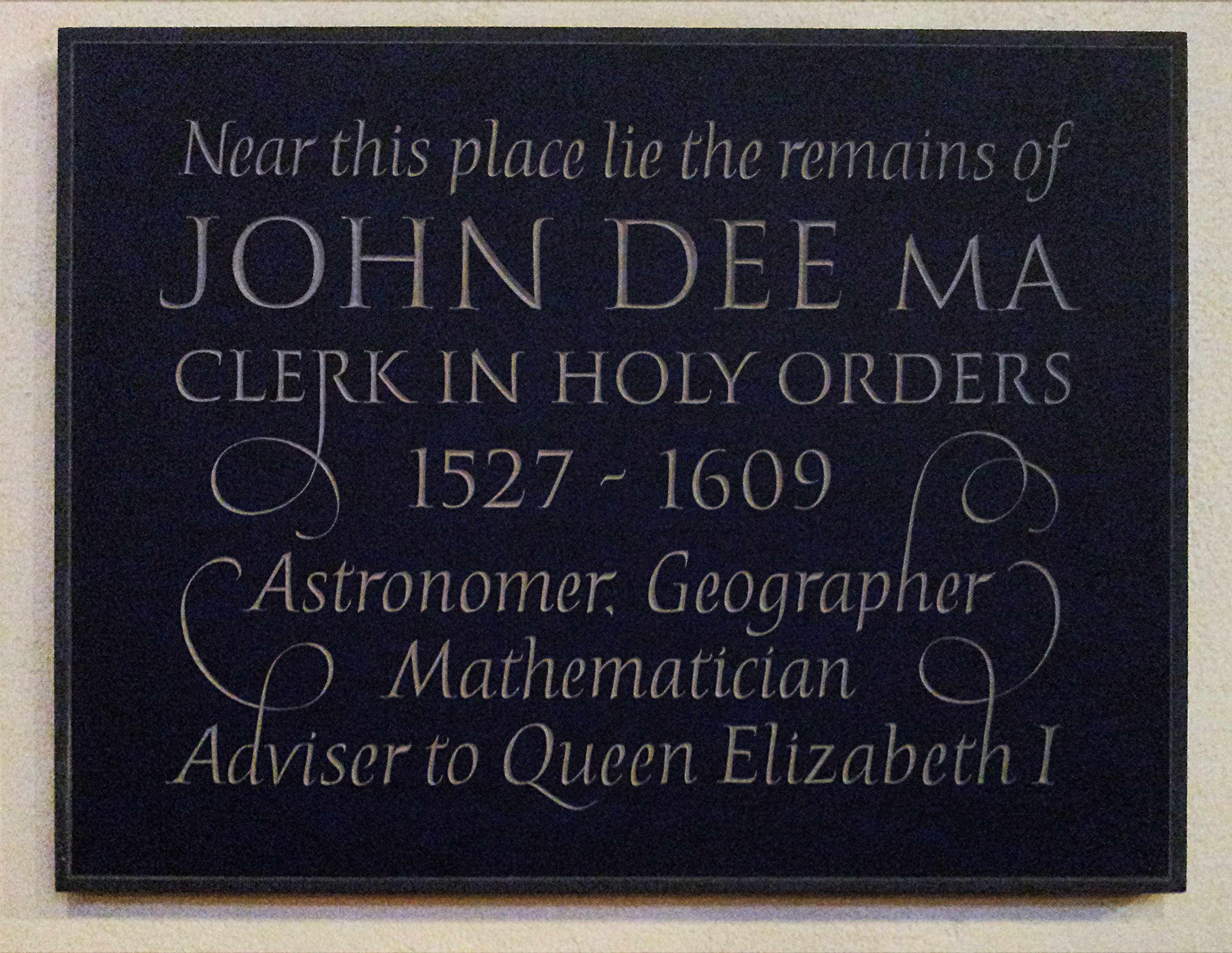
He is believed to have died in March, 1609, at the London home of a friend and was apparently buried in Mortlake (pictured, above, is a memorial plaque at St Mary the Virgin in Mortlake).

It’s believed that William Shakespeare modelled the figure of Prospero in the 1611 play The Tempest on Dee (it’s also claimed that he was the model for Marlowe’s Doctor Faustus).

Scholar, courtier, magician: the lost library of John Dee runs at the Royal College of Physicians at 11 St Andrews Place, Regent’s Park, until 29th July. Entry is free (check website for opening hours). For more, see www.rcplondon.ac.uk.

PICTURE: Robert Smith/CC BY-SA 3.0/Wikipedia

Lost London – The Nunnery of St Mary, Clerkenwell…

St-James-ClerkenwellThe Church of St James, which stands just to the north of Clerkenwell Green, is all that remains today of the medieval nunnery which once occupied a large swathe of land in the area. 

The Augustinian Nunnery of St Mary was founded in about 114o by Jorden de Briset, the lord of Clerkenwell Manor (he also founded the Hospitaller Priory of St John of Jerusalem which lay to the south – more on this here) on 14 acres of land to the east of the famous “Clerk’s Well” (more on the well, which was located close to, but within, the western border of the nunnery, in our earlier post here).

By 1160 a wall had been built around the precinct said to have been roughly bounded by Farringdon Lane, Clerkenwell Green (an open space between the two religious houses), St James’s Walk and a boundary to the south of, and parallel with, Bowling Green Lane to the north.

The church – where Briset and his wife were later buried and which doubled as a parish church – was built about the same time, along with an adjoining chapter-house – both of which were made of stone in contrast to the timber buildings which initially made up the rest of the complex.

A cloister and other stone buildings were erected to the north of the church later in the 12th and 13th centuries including a lodging for the prioress, a dormitory, refectory and kitchen for the nuns. Other buildings on the site included  a gatehouse, what was known as the “Nun’s Hall” – possibly a hall for guests – and an infirmary with its own chapel, the location of which is apparently something of a mystery.

Substantial renovation works were carried out in the late 15th and early 16th centuries and by the time of King Henry VIII’s dissolution, it had become one of the wealthiest monasteries in England (although it only ever housed about 20 canonesses).

One of the last nunneries to be suppressed, it was dissolved in 1539 with the nuns being pensioned off.

The site was initially granted to Thomas Howard, 3rd Duke of Norfolk, who held it only briefly being returning it to the king in a deal for another property and subsequently purchased by a succession of different owners.

Many of the buildings were converted for use as private mansions and outbuildings, among them Newcastle House and Challoner (later Cromwell due to the legend that Oliver Cromwell resided there) House which faced them across what had been the cloister courtyard.

The mansions were gradually redeveloped into smaller properties – it remained a popular residential area despite the building of a House of Detention to the immediate north – and in 1788-92, the parish church of St James was rebuilt to the designs of local architect James Carr, with the spire apparently modelled on St Martin-in-the-Fields (Carr also bought Newcastle House and pulled most of it down before redeveloping the area).

Church gardens, which are open to the public, now occupy some of the site of the former nunnery – in 1987, part of the medieval cloisters were excavated here.

For some insightful walks delving into the history of London, see Stephen Millar’s three books, London’s Hidden Walks: Volumes 1-3.

This Week in London – Commemorating the Battle of Jutland; ‘lost’ Egyptian cities; and, new Blue Plaques…

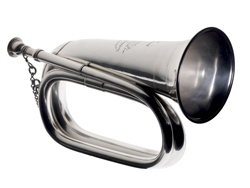
The largest naval conflict of World War I – the Battle of Jutland – is the subject of a new exhibition opening at the National Maritime Museum in Greenwich tomorrow. BugleMarking the centenary of the battle, Jutland 1916: WWI’s Greatest Sea Battle explores the battle itself (which claimed the lives of more than 8,500 as the British Grand Fleet met the German High Seas Fleet in what neither side could claim as a decisive victory) as well as its lead-up, aftermath and the experience of those serving on British and German warships through paintings and newspaper clippings, photographs, ship models and plans, sailor-made craft work and medals. Among the objects on display is a 14 foot long shipbuilder’s model of the HMS Queen Mary, which, one of the largest battle cruisers involved,was destroyed with only 18 survivors of the 1,266 crew. Among the personal stories told in the exhibition, meanwhile, is that of boy bugler William Robert Walker, of Kennington, who served on the HMS Calliope and, severely wounded during the battle, was later visited by King George V
and presented with a silver bugle by Admiral Sir John Jellicoe (the bugle, pictured, is on display). A series of events will accompany the exhibition which runs until November. Admission is free. For more, see www.rmg.co.uk/national-maritime-museum. PICTURE: © National Maritime Museum, London 

• Two ‘lost’ Egyptian cities and their watery fate are the subject of a new exhibition which opens at the British Museum today. Sunken cities: Egypt’s lost worlds is the museum’s first exhibition of underwater discoveries and focuses on the recent discoveries of Thonis-Heracleion and Canopus – submerged at the mouth of the Nile for more than 1,000 years. Among the 300 objects on display are more than than 200 artefacts excavated between 1996 and 2012. Highlights include a 5.4 metre statue of Hapy, a sculpture excavated from Canopus representing Arsine II (the eldest daughter of the Ptolemaic dynasty founder Ptolemy I) who became a goddess after her death, and a stela from Thonis-Heracleion which advertises a royal decree of Pharaoh Nectanebo I concerning taxes.  The exhibition runs until 27th November. Admission charge applies. For more, see www.britishmuseum.org.

New English Heritage Blue Plaques marking the homes of comedian Tommy Cooper and food writer Elizabeth David have been unveiled this month as part of the 150th anniversary of the scheme. Tommy Cooper lived at his former home at 51 Barrowgate Road in Chiswick between 1955 to 1984 and while there entertained fellow comedians such as Roy Hudd, Eric Sykes and Jimmy Tarbuck. Elizabeth David, meanwhile, is the first food writer to ever be commemorated with a Blue Plaque. She lived at the property at 24 Halsey Street in Chelsea for some 45 years until her death in 1992. For more, see www.english-heritage.org.uk/visit/blue-plaques/.

Send all items for inclusion to exploringlondon@gmail.com.

What’s in a name?…Fitzrovia…

BT_Tower-1This West End district, located between Bloomsbury, Marylebone and Soho, probably owes its name to the Fitzroy Tavern, a public house which in turn is believed to owe its name to the Dukes of Grafton, whose family name was Fitzroy.

The Fitzroys (the name derives from  a Norman-French phrase and was typically associated with base-born royal sons), owned land in the area until the end of the 1800s.

The family first become associated with the area after the Manor of Tottenham (more on that name in an upcoming post) came into the possession of Henry Fitzroy, an illegitimate son of King Charles II who became the Earl of Euston and later Duke of Grafton.

Incidentally, the grand Fitzroy Square, developed by the duke’s great-grandson, and Fitzroy Street are both also named after the family as are numerous other locations in the area including Grafton Street.

Fashionable as a residential area in the 1700s, the houses were gradually transformed into workshops – the area was noted for furniture-makers in particular – or cheap tenements and it’s during this period in the early 1800s that artists like John Constable were living in the area.

The name Fitzrovia apparently became popularised for the district which in the inter-war years, due to the community of artists and writers that met at the pub; it is said to have first appeared in print in the 1940s. Among those who were associated with the area during this period were the likes of writers Dylan Thomas and George Orwell and artists like Roger Fry and Augustus John.

More recently the area has become home to numerous media companies, particularly TV-related companies, and still hosts ample pubs, restaurants and cafes.

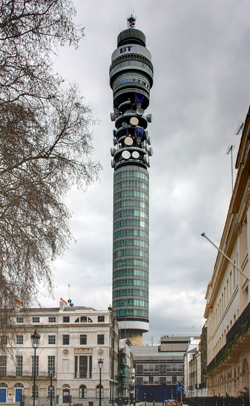
Notable buildings in the area include the BT Tower, a communications tower completed in 1964 which was until 1980, the tallest building not only in London but in the UK (and from where panoramic views could once be had – sadly it’s been long closed to the public).

Fitzrovia is also home to the quirky Pollock’s Toy Museum.

PICTURE: David Castor (caster)/Wikipedia

Correction: Fitzroy Square was developed by the great grandson of the 1st Duke of Grafton, not grandson as was originally stated.

10 iconic London film locations…10. A bridge, a park, and a round church…

OK, we’ve reached the last in our series of London film locations so this week we’re taking a quick look at three more…

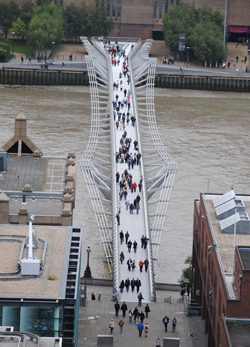
Millennium-FootbridgeThe Millennium Bridge. Initially nicknamed the “wobbly bridge” due to its propensity to move underfoot, this footbridge over the River Thames first opened in June, 2000, for only couple of days before it was closed for almost two years so its movement could be fixed and eventually reopened again in 2002. But despite its young age, the bridge has appeared not just in a Harry Potter film – 2009’s Harry Potter and the Half-Blood Prince – where it gets destroyed but also in the break-out 2014 Marvel film, Guardians of the Galaxy in which it plays the role of a bridge in the city of Xandar (embedded in the rest if the CGI-created city). Among other London locations featured in that film is the modern Lloyd’s Building in Lime Street (again, it makes part of Xandar).

The Regent’s Park. The 2010 film The King’s Speech features numerous London locations – among them is the Avenue Garden in the south-east corner of the park where speech therapist Lionel Logue (played by Geoffrey Rush) takes a stroll with Bertie, the future King George VI (played by Colin Firth), which turns a little uncomfortable. Other locations include 33 Portland Place (which plays the role of the Duke and Duchess’ Piccadilly home as well as that of the interior of Logue’s consulting rooms in the famous Harley Street), and the Draper’s Hall in the City, the interior of which plays the role of St James’s Palace.

The Temple Church. This famous – and beautiful – City of London church made its starring performance in the Tom Hanks movie of 2006, The Da Vinci Code. The church enters the movie when symbology professor Robert Langton (played by Hanks) and cryptologist Sophie Neveu (played by Audrey Tautou) come here in search for a knight’s tomb. Other London locations featured in the film (alongside those in France and Scotland), include Westminster Abbey (although the interiors were actually shot at Lincoln Cathedral). For more on the history of the church, see our earlier post here or on the tomb effigies, see our post here.

Our next special series kicks of next Wednesday.

This Week in London – Of Empress Catherine the Great and Capability Brown; a blue plaque double; and, the British graphic novel on show…

A once forgotten collection of watercolour paintings and drawings owned by Empress Catherine the Great of Russia has gone on show at Hampton Court Palace as part of commemorations marking the 300th anniversary of the birth of Lancelot ‘Capability’ Brown. The Empress and the Gardener exhibition features almost 60 intricately detailed views of the palace and its park and gardens during the time when Brown worked there as chief gardener to King George III between 1764 and 1783. The works came to be in the collection of the Empress – a renowned fan of English gardens – after Brown’s assistant, John Spyers, sold two albums of his drawings of the palace to the her for the considerable sum of 1,000 roubles. The albums disappeared into her collection at the Hermitage (now the State Hermitage Museum) and lay forgotten for more than 200 years before they were rediscovered by curator Mikhail Dedinkin in 2002. As well as the collection – on public show for the first time, the exhibition features portraits of Brown and the Empress, previously unseen drawings of her ‘English Palace’ in the grounds of the Peterhof near St Petersburg, and several pieces from the ‘Green Frog’ dinner service, created for the Empress by Wedgwood, which is decorated with some of the landscapes the prolific Brown created across England. Runs until 4th September. Admission charge applies. For more, see www.hrp.org.uk/hampton-court-palace/.

A house in Chelsea has become only one of 19 homes in London to bear two official blue plaques. Number 48 Paultons Square has the honour of having been home to two Nobel prize winners (albeit in different fields) – dramatist Samuel Beckett, who lived there for seven months in 1934 while writing his first novel, Murphy, and physicist Patrick Blackett, noted for his revolutionary work in U-boat detection during World War II, who lived there from 1953 to 1969. Other ‘doubles’ include 20 Maresfield Gardens in Hampstead (home to Sigmund Freud and Anna Freud) and 29 Fitzroy Street in Fitzrovia (home to George Bernard Shaw and Virginia Woolf). This year marks the 150th anniversary of the blue plaques scheme. For more, see www.english-heritage.org.uk/visit/blue-plaques/.

The rise of the British graphic novel is the subject of a new exhibition at the Cartoon Museum in Bloomsbury. The Great British Graphic Novel features works by 18th century artist William Hogarth as well as Kate Charlesworth, Dave Gibbons (one of the creators of the ground-breaking Watchmen), Martin Row, Posy Simmonds (creator of the Tamara Drewe comic strip) and Bryan and Mary Talbot. It runs until 24th July. Admission charge applies. For more, see www.cartoonmuseum.org.

Send all items for inclusion to exploringlondon@gmail.com.


Famous Londoners – Lancelot ‘Capability’ Brown…

This year marks 300 years since the birth of Lancelot “Capability” Brown, the most famed landscape designer of the Georgian age and a man who has been described as the “father of landscape architecture”.
Capability-BrownBrown is understood to have been born in 1716 in the village of Kirkharle in Northumberland, the fifth of six children of a land agent and a chambermaid (he was baptised in on 30th August so it is believed his birth happened sometime earlier that same year).

He attended the village school before he worked as apprentice or assistant to the head gardener in Sir William Loraine’s kitchen garden at Kirkharle Hall.

Having left home in 1741 he joined the gardening staff of Lord Cobham, as one of the gardeners at his property in Stowe, Buckinghamshire.

There he worked with William Kent, another famed landscape architect of the Georgian age and one of the founders of the new English style of gardens, until, at the age of 26, he was appointed head gardener.

He remained in Stowe until 1750 and while there, in 1744, married Bridget Wayet (with whom he went on to have nine children). During his time there, he also created the Grecian Valley and also took on freelance work from Lord Cobham’s noble friends, a fact which allowed him to produce a body of work that would start to make his reputation.

Having struck out on his own from Stowe, he settled with his family in Hammersmith, London, in the early 1750s, already widely known and considered by some the finest gardener in the kingdom.

The work continued to flow in and it’s believed that, over the span of his career, Brown was responsible for designing or contributing to the design of as many as 250 gardens at locations across the UK, – many of which can still be seen today. As well as Stowe, these included gardens at Blenheim Palace, Appuldurcombe House on the Isle of Wight, Warwick Castle, Harewood House and Petworth House in West Sussex.

Following on from the work of Kent, Brown was known for his naturalistic undulating landscapes, in particular their immense scale, flowing waterways and a feature known as a ‘ha-ha’, a ditch which blended seamlessly into the landscape but which was aimed at keeping animals away from the main house of the estate.

His style, which contrasted sharply with the more formalised, geometric gardens epitomised in the French style of gardening, did not, however, meet with universal praise. Criticisms levelled against him including that he had often erased the works of gardeners of previous generations to complete gardens which were, in the end, described by some as looking no different to “common fields”.

It’s worth noting that Brown also dabbled in architecture itself – his first country house project was the remodelling of Croome Court in Worcestershire and he went on to design and contribute to the design of several houses including Burghley House Northamptonshire as well as outbuildings including stable blocks.

The nickname ‘Capability’ apparently came from his habit of informing his client that their estates had great “capability” for improvement. It’s wasn’t apparently a name he used himself.

So established became his reputation that in 1764 Brown was appointed King George III’s Master Gardener at Hampton Court Palace (as well as Richmond and St James’ Palaces), taking up residence with his family at Wilderness House. He also worked on the gardens at Kew Palace.

Brown died on 6th February, 1783, in Hertford Street in London at the door of his daughter Bridget’s house (she had married architect Henry Holland with whom he Brown had, at times, collaborated). He was buried in the churchyard of St Peter and St Paul, the parish church of a small estate Brown owned at Fenstanton Manor in Cambridgeshire.

Brown impact on garden design in England is now undisputed although it wasn’t always the case – his contribution was largely dismissed in the 18th century and it was only in the later 20th century that he had become firmly established as a giant figure in the gardening world.

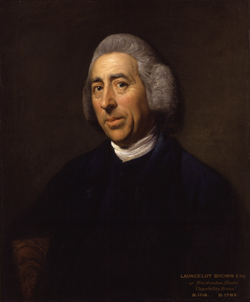
A celebrated portrait of Brown (pictured above) – painted by Nathaniel Dance in about 1773 – is in the collection of National Portrait Gallery.

For more on events surrounding the 300th anniversary of Brown’s birth, see www.capabilitybrown.org.

PICTURE: Capability Brown by Nathaniel Dance, circa 1773. © National Portrait Gallery, London
 

This Week in London – Seminal moments in Shakespearean performance; Maria Merian’s Butterflies; and, British conceptual art…

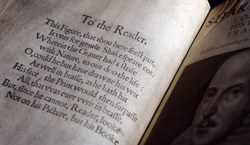
ShakespearesFirstFolio1623BritishLibraryPhotobyClareKendall It’s the 400th anniversary of Shakespeare’s death (in case you missed that), and among the many events marking the occasion comes a major exhibition at the British Library focusing on 10 key performances that it says have made the Bard the “cultural icon” he is today. Shakespeare in Ten Acts, which opens on Friday, focuses on performances which may not be the most famous but which represent key moments in shaping his legacy. They span the period the first performance of Hamlet at the Globe theatre in around 1600 to a radical interpretation of the same play from US theatre company The Wooster Group in 2013. Among the exhibition highlights are a human skull which was given to the actress Sarah Bernhardt by writer Victor Hugo (and which she used as Yorik’s skull when she played Hamlet in 1899), a dress worn by Vivien Leigh playing Lady Macbeth in the 1955 production of Macbeth at the Royal Shakespeare Company, the only surviving play script written in the Bard’s own hand and rare printed editions including Shakespeare’s First Folio and the earliest printed edition of Hamlet from 1603 (one of only two copies in the world). The exhibition, which runs until 6th September, is accompanied by a season of events. Admission charge applies. For more, see www.bl.uk. PICTURE: Shakespeare’s First Folio 1623 British Library Photo by Clare Kendall.

Still talking exhibitions commemorating Shakespeare’s death and a manuscript of William Boyce’s Ode to the Memory of Shakespeare will be on display at The Foundling Museum’s Handel Gallery from tomorrow. The work, which was composed in 1756, was performed annually at the Theatre Royal in Drury Lane. The manuscript, the first page of which was thought to be lost until it was acquired in 2006, formerly belonged to Samuel Arnold, who compiled the first complete edition of Handel’s works. Runs at the Bloomsbury-based museum until 30th May. Admission charge applies. For more, see www.foundlingmuseum.org.uk.

 Exquisite watercolours depicting the natural world go on show in The Queen’s Gallery at Buckingham Palace from tomorrow. Maria Merian’s Butterflies features 50 works produced by the eighteenth century German artist and entomologist Maria Sibylla Merian. The works – many of which record the flora and fauna of the then Dutch colony of Suriname in South America, were published in the 1706 work Metamorphosis Insectorum Surinamensium (The Metamorphosis of the Insects of Suriname) and partially printed, partially hand-painted versions of the plates were purchased by King George III for his library at Buckingham House (later Buckingham Palace). As well as insects, the works – which were based on a visit Merian made to the colony in 1699, depict lizards, crocodiles and snakes as well as tropical plants such as the pineapple. The exhibition runs until 9th October. Admission charge applies. For more, see www.royalcollection.org.uk/visit/the-queens-gallery-buckingham-palace.

The evolution of conceptual art in Britain is the subject of a new exhibition at Tate Britain in Milbank  Conceptual Art in Britain 1964-1979 features 70 works by 21 artists and positions conceptual art “not as a style but rather a game-changing shift in the way we think about art, how it is made and what it is for”. Highlights include Michael Craig-Martin’s An Oak Tree (1973) and Roelof Louw’s Soul City (Pyramid of Oranges) (1987) as well as Victor Burgin’s Possession (1976), Mary Kelly’s Post-Partum Document (1974-78) and Conrad Atkinson’s Northern Ireland 1968 – May Day 1975 (1975-76). Admission charge applies. Runs until 29th August. For more, see www.tate.org.uk.

Send all items for inclusion to exploringlondon@gmail.com.

This Week in London – Hampton Court’s Magic Garden; the Stones on show; and, Dutch Flowers at the National Gallery…

The-Magic-Garden
PICTURE: Historic Royal Palaces

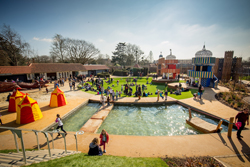
 Inspired by myths and legends of the Tudor Court, The Magic Garden has opened at Hampton Court Palace. The garden – located in King Henry VIII’s former tiltyard – has been designed by award-winning landscape architect Robert Myers and has been six years in the making. Features include the famous five lost tiltyard towers which have been recreated with each reflecting a different aspect of the Tudor era – from the King’s and Queen’s Towers which offer the best vantage point over the area, to the Discovery Tower which represents the Tudor fascination with exploration, the Battle Tower which symbolises King Henry VIII’s warlike spirit and the Lost Tower which brings to mind the eventual fate of the towers. There’s also a ‘wild wood’ – evoking the hunting grounds loved by the Tudors, a winding pathway of strange topiary and a ‘jungle’ of tree ferns and fatsias as well as a 25 foot long sleeping dragon who wakes as the clock strikes the hour. The garden, which is open until 30th October, is aimed at children of all ages, particularly those between two and 13 years-of-age. Admission charge applies. For more, see www.hrp.org.uk/hampton-court-palace/.

More than 500 artefacts related to the Rolling Stones have gone on display at the Saatchi Gallery in the first international exhibition on the group. EXHIBITIONISM: The Rolling Stones spans two floors and nine thematic galleries and charts the history of the Stones from the early 1960s to cultural icons as well as considering the band’s influence on popular culture. It features never-before-seen dressing room and backstage paraphernalia, instruments and costumes, original stage designs, audio tracks and video footage, personal diaries and album cover artwork. Works by an array of artists, designers, musicians and writers – everyone from Andy Warhol to Tom Stoppard and Martin Scorsese – are also included. Admission charge applies. Runs at the Kings Road gallery near Sloane Square until 4th September. For more, see www.saatchigallery.com.

The evolution of Dutch flower painting from the turn of the 17th century is the subject of a free exhibition which opened at the National Gallery off Trafalgar Square this week. Dutch Flowers features 22 works, about half of which come from the gallery’s collection while the other half come from private holdings. Artists whose works are featured include Jan Brueghel the Elder, Ambrosias Bosschaert and Roelandt Savoy – all among the first to produce paintings that exclusively depicted flowers. The exhibition – the first display of its kind for more than 20 years – is in Room 1 until 29th August. Admission is free. For more, see www.nationalgallery.org.uk.

Send all items for inclusion to exploringlondon@gmail.com.

A Moment in London’s History – Birth of a future queen…

17-Bruton-StreetQueen Elizabeth II, the oldest British monarch, celebrates her 90th birthday later this month and, although we’ve run a piece on the Queen’s birth before, we thought it only fitting to take a second look at what proved to be a momentous birth.

The then Princess Elizabeth (Elizabeth Alexandra Mary) was born at 17 Bruton Street in Mayfair – the London home of her maternal grandparents, the Earl and Countess of Strathmore (they also owned Glamis Castle in Scotland) – at 2.40am on 21st April, 1926.

She was apparently delivered by Caesarian section and the Home Secretary, Sir William Joynson-Hicks, was in attendance to ensure everything was above board (the custom, which has since been dropped, was apparently adopted after what was known as the ‘Warming Pan Scandal’ when, following the birth of Prince James Francis Edward, son of King James II and Queen Mary of Modena, in June, 1688, rumours spread that the baby had been stillborn and replaced by an imposter brought into the chamber inside a warming pan).

The first child of the Prince Albert, the Duke of York (Bertie) and Elizabeth Bowes-Lyon, the Duchess of York (later King George VI and Queen Elizabeth), she was third in line to the throne at her birth but thanks to the abdication of King Edward VIII, became her father’s heir.

The event apparently drew a crowd to the property (although none could yet suspect how important this princess was to become) and among the well-wishers who visited the newborn that afternoon were her paternal grandparents, King George V and Queen Mary, who had apparently been woken at 4am to be informed of the birth of their second grandchild.

The property was to be Princess Elizabeth’s home for the first few months of her life (named after her mother, paternal great-grandmother, Queen Alexandra, and paternal grandmother, Queen Mary, she was christened in the private chapel at Buckingham Palace five weeks after her birth).

The home of her birth and a neighbouring townhouse have both since been demolished and replaced by an office building. A plaque commemorating it as the Queen’s birthplace was installed in the Queen’s Silver Jubilee Year of 1977 and another to mark the Diamond Jubilee in 2012.

The Queen’s birthday will be officially commemorated in June.

PICTURE: Via London Remembers