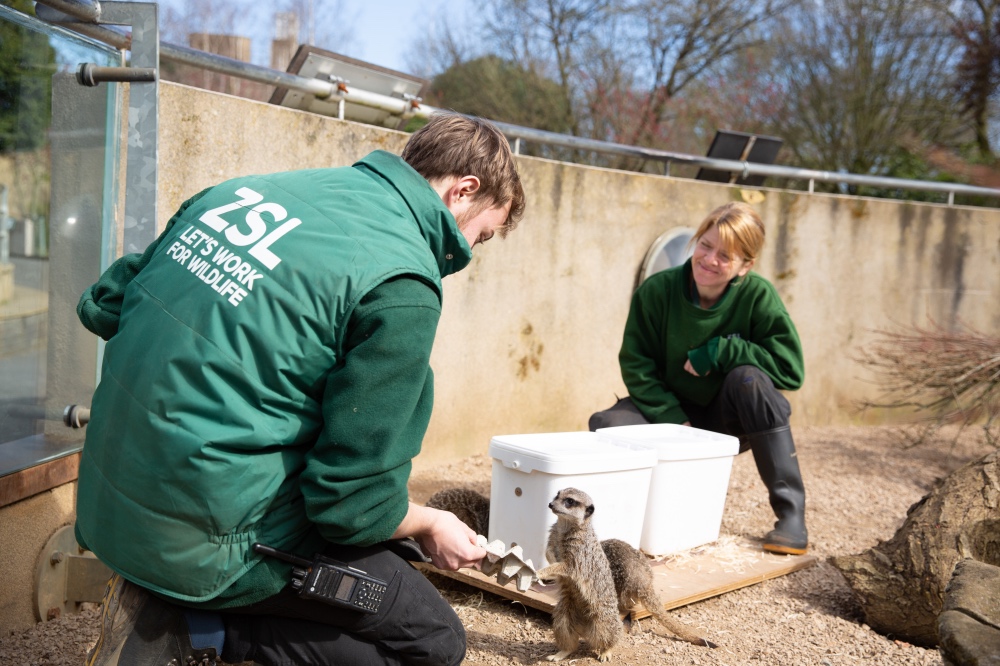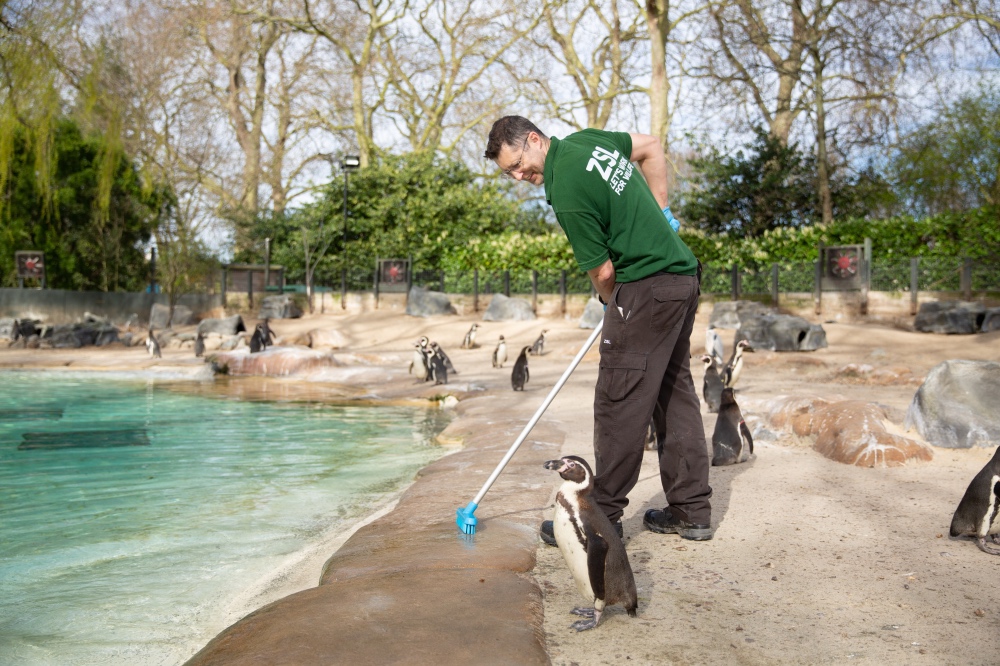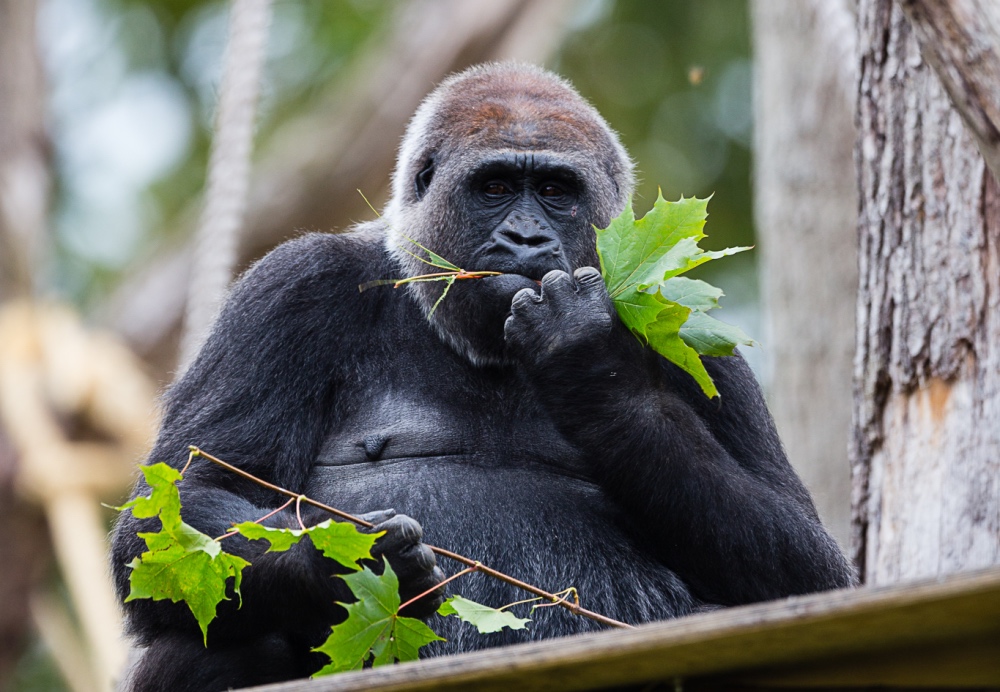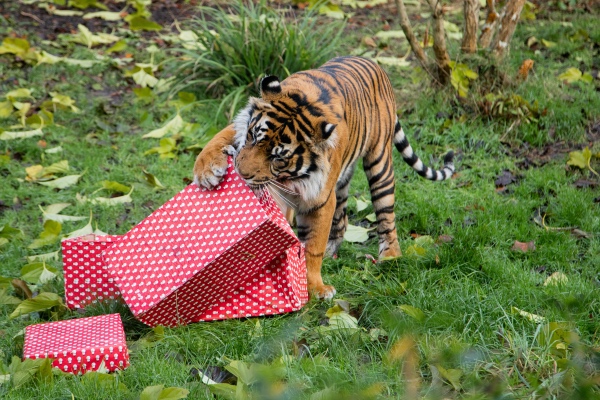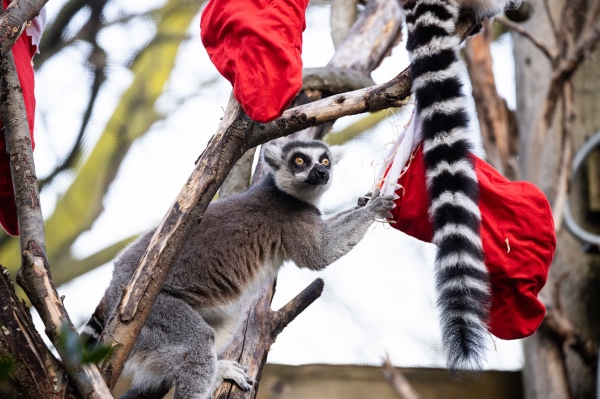
Christmas came early at ZSL London Zoo on Monday when animals woke to find their presents had been delivered. Among them was a new Christmas climbing frame decorated with edible gifts for the ever-popular Bolivian black-capped squirrel monkeys, turkey wings for Sumatran tiger Asim and hanging stockings stuffed with vegetable trimmings for the ring-tailed lemurs. “Just like children all over the country when they wake up on Christmas morning, Asim loved tearing into his brightly wrapped presents to get at the meaty snacks inside, while our squirrel monkeys and lemurs enjoyed finding the festive treats hidden in their stockings,” said Angela Ryan, the Zoo’s animal manager. The zoo is open every day with the exception of Christmas Day itself. For more, see www.zsl.org/London. ALL PICTURES: © ZSL London Zoo
LondonLife
LondonLife – Skeletons in the Tower…
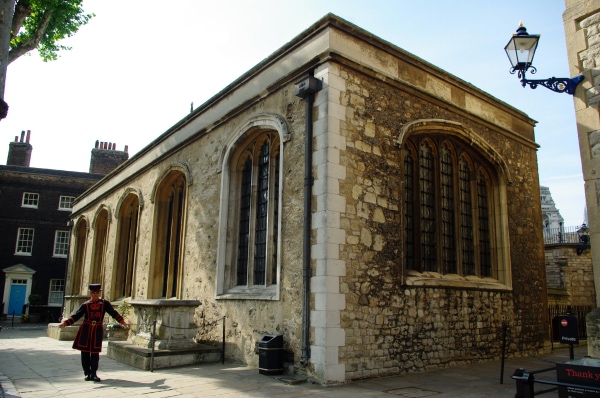
The remains of an adult female and a young child have been discovered beneath the floor of one of the entrances to the Chapel of St Peter ad Vincula in the Tower of London. Discovered as part of early investigations aimed at enabling better disabled access to the chapel, the two skeletons – the first complete skeletons found at the Tower since the 1970s – were found lying face up with their feet facing east, typical of a Christian burial. The adult, believed to be aged 35 to 45, is believed to have been buried within a coffin (coffin nails were present) while the child, believed to be aged about seven, was simply wrapped in a blanket – typical of later medieval and early Tudor burials – and due to that and further materials and artefacts uncovers, it is believed the two people were laid to rest between 1450 and 1550, a period between the Wars of the Roses and the reign of King Edward VI. The remains were reinterred in the chapel in a special ceremony conducted by the Tower of London’s chaplain, Rev Canon Roger Hall. The Chapel Royal was completed in 1520 and is perhaps most famed for being the burial place of two of King Henry VIII’s wives, Anne Boleyn and Catherine Howard. The discovery was explored in the the final episode of Inside the Tower of London which aired on Channel 5 in October.
LondonLife – The Boar’s Head Playhouse excavations…
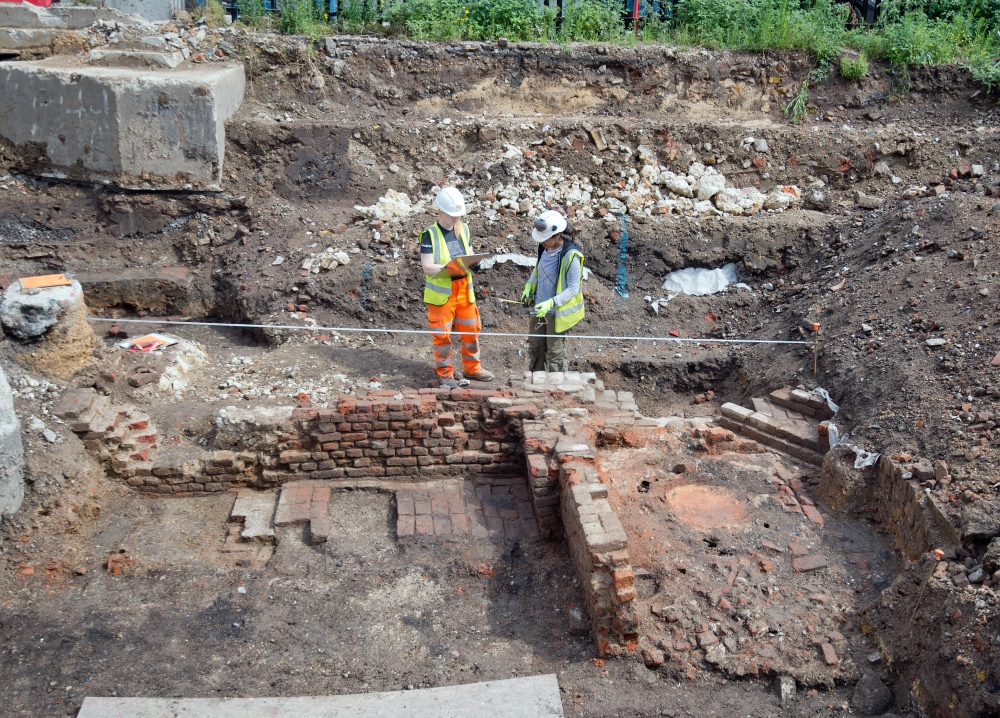
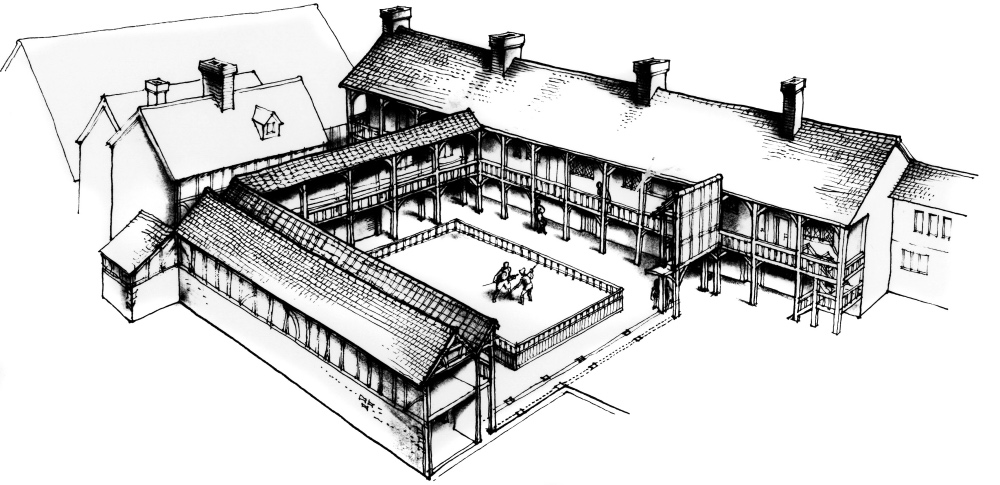
MOLA archaeologists have started excavating the site of The Boar’s Head Playhouse in Middlesex Street, Whitechapel, before construction of a new student housing complex. The playhouse, the location of which is known from historical accounts, was created in 1598 when inn owner Oliver Woodliffe converted his establishment by adding tiered galleries, a stage and central open air yard (extra galleries and a roof over the stage were added a year later). The playhouse hosted popular acting troupes including Lord Derby’s Men and the Lord Worcester’s Men, later the Queen’s Men, led by the famous actor and playwright Thomas Greene, and among the plays performed was the comedy No-body and Some-body as well as a chronicle of the life and reign of Elizabeth I, If You Know Not Me, You Know No Bodie. It is hoped the excavations will provide new insights into the theatre. The accommodation, being developed by Unite Students, will provide housing for 915 students and is expected to open in 2021. PICTURES: Top – Archaeologists record an 18th century clay tobacco pipe kiln built against 16th century walls associated with the Boar’s Head playhouse © MOLA; Below – Reconstruction of the Boar’s Head Playhouse from 1598, by C Walter Hodges.
LondonLife – A Greenwich streetscene…
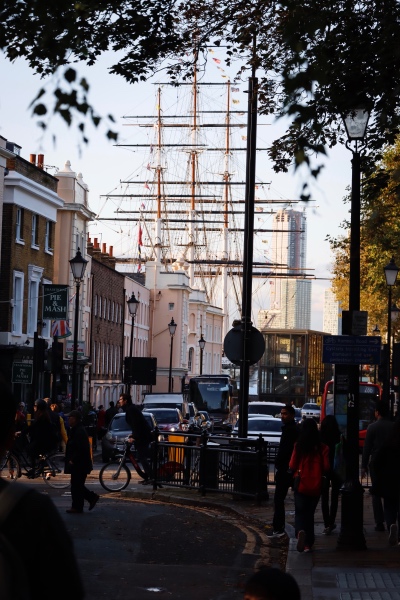
Greenwich with the masts of the Cutty Sark in the background. PICTURE: Robert Likovski/Unsplash
LondonLife – Gertrude Bell and Ronnie Scott commemorated…
Gertrude Bell – an adventurer, archaeologist, mountaineer and diplomat (who was at least partially responsible for the creation of the nation of Iraq) – has been honoured with an English Heritage Blue Plaque on the Chelsea home that served as her London based for some 40 years. The three storey Georgian residence at 95 Sloane Street (pictured) belonged to Lady Olliffe, the mother of Bell’s step-mother Florence. Bell, who spent much of her time in the Middle East, used the home as her London base between 1884, when she graduated from Queen’s College, through to her last visit to London in 1925, including during an extended period in 1915 when she managed the Red Cross’s Wounded and Missing Enquiry Department’s office in Arlington Street. Meanwhile, jazz musician Ronnie Scott has also been honoured with a Blue Plaque which marks the site of his first club in Soho. Scott and fellow saxophonist Pete King opened jazz club in the basement of 39 Gerrard Street in Chinatown on 30th October, 1959 – 60 years ago this year. The club remained there for six years before moving to 47 Frith Street in 1965. Musicians including Zoot Sims, Johnny Griffin, Roland Kirk, Dexter Gordon, Sonny Stitt, Stan Getz, Benny Golson, Ben Webster, and Al Cohn all performed at the club while patrons included Harold Pinter, the Beatles, Peter O’Toole, and Spike Milligan. For more on English Heritage Blue Plaques, visit www.english-heritage.org.uk/visit/blue-plaques/. PICTURE: Google Maps
LondonLife – St Bride’s among historic sites “rescued” in 2019…
St Bride’s Church in Fleet Street was among the hundreds of historic sites removed from Historic England’s Heritage at Risk Register this year. Published last month, the register is an annual inventory of historic sites “most at risk of being lost forever as a result of neglect, decay or inappropriate development”. It shows that while some 310 items have been removed from the list over the past year, some 247 were added, meaning there were 5,073 entries on the list this year, 87 less than the previous year. The Grade I-listed St Bride’s, which was designed by Sir Christopher Wren after the Great Fire of 1666, had needed repairs to both its famous steeple – said to have inspired the tiered wedding cake design – and the body of the church itself. Historic England spent almost £8.5 million on grants to help restore some of the country’s most historic sites over the past year. Among London sites still on the list are the Grade II*-listed Crystal Palace Park, the Grade I-listed St Pancras Church and sections of what remains of London’s Roman and medieval wall. For more, see www.historicengland.org.uk/advice/heritage-at-risk/.
LondonLife – Misty day at St Katharine Docks…
PICTURE: Robert Bye/Unsplash
LondonLife – Tranquil waters at Little Venice…
Little Venice, Paddington. PICTURE: Matthew Waring/Unsplash
LondonLife – View to St Paul’s…
PICTURE: Greg Jeanneau/Unsplash.
LondonLife – The beauty of space revealed…
A “creative and artistic” composition of the 35 phases of the total lunar eclipse that took place on 21st January has won the Royal Observatory Greenwich’s Insight Investment Astronomy Photographer of the Year for 2019. The win, which carried a £10,000 prize for Hungarian photographer László Francsics, also means the image is now at the heart of an exhibition featuring all the competition’s winners, runners-up and highly commended, as well as 68 short-listed pictures running at the National Maritime Museum until 26th April. Competition judge Ed Robinson described the Francsics’ work as “nothing short of masterful”. “The colours of our atmosphere projected onto the Moon’s disc during the eclipse are not only artistically pleasing but also offer an understanding of such events that can reveal aspects of our own, thin, yet essential part of our atmosphere,” he said. “In a year that celebrates 50 years since the first lunar landings it is fitting that this year’s overall winning image captures such a dynamic and captivating view of our Moon.” Other images on display include German photographer Nicolai Brügger’s image showcasing the Aurora Borealis over the Lofoten Islands in Norway (winner of the ‘Aurorae’ category), an image featuring UK photographer Ben Bush and his dog Floyd surrounded by Mars, Saturn and the galactic core of the Milky Way galaxy (‘People and Space’), and a sequence of images by Australian Andy Casely following the progress of the great global dust storm on Mars (‘Planets, Comets and Asteroids’). The display also includes an image of the Rosette Nebula by 11-year-old Davy van der Hoeven, of The Netherlands, who won Young Astronomy Photographer of the Year. The Insight Investment Astronomy Photographer of the Year, now in its 11th year, is run by the Royal Observatory Greenwich in association with Insight Investment and BBC Sky at Night Magazine. Admission charge applies. For more, see www.rmg.co.uk/whats-on/astronomy-photographer-year/galleries/2019/overall-winners. PICTURES: Top – ‘Into the Shadow’ © László Francsics (overall winner); Below (from top down) – ‘The Watcher’ © Nicolai Brügger (winner of the ‘Aurorae’ category); and, ‘Shells of Elliptical Galaxy NGC 3923 in Hydra’ © Rolf Wahl Olsen (winner of the ‘Galaxies’ category) .
LondonLife – Heading for daylight at Charing Cross…
LondonLife – Wandsworth Bridge at sunset…
Wandsworth Bridge over the River Thames in west London. It was opened in 1940, replacing an earlier bridge which was demolished a couple of years before. PICTURE: Frederick Tubiermont/Unsplash
LondonLife – Album hunt…
Taken in Lewis Cubitt Square, King’s Cross. PICTURE: Clem Onojeghuo/Unsplash
LondonLife – ‘Ship of Tolerance’ docks in the Thames…
Ilya and Emilia Kabakov’s Ship of Tolerance is moored at Royal Docks this month ahead of the annual celebration of London’s river, Totally Thames, in September. The 60 foot long, hand-crafted wooden ship is dedicated to educating and inspiring young people and features sails made by children from 40 London primary schools, Great Ormond Street Hospital and refugee centres in Birmingham, Leeds, Peterborough and Calais. The award-winning ship was first launched in Egypt in 2005 and has since appeared in numerous cities around the world including Venice, Havana, Moscow, New York and Rome. It can be seen at Royal Docks until 31st August and then outside the Tate Modern from 4th September to 6th October. For more on the ship and Totally Thames, see www.totallythames.org. PICTURE: Courtesy of Totally Thames.
LondonLife – Roman “pen” souvenir among thousands of finds on Bloomberg site…
An iron stylus bearing an inscription – described as the sort of cheap souvenir you might bring back for a friend after visiting a foreign city – is among thousands of Roman-era artefacts discovered during excavations for Bloomberg’s new European headquarters in Cannon Street. The stylus, which is about the length of a modern pen, dates from about AD70 and was used to write on wax-filled wooden writing tablets. It is inscribed in Latin text which, translated by classicist and epigrapher Dr Roger Tomlin, reads: “I have come from the city. I bring you a welcome gift with a sharp point that you may remember me. I ask, if fortune allowed, that I might be able [to give] as generously as the way is long [and] as my purse is empty”. It is believed the “city” referred to is Rome. The stylus is one of some 14,000 items Museum of London Archaeology archaeologists unearthed on the dig – including 200 styli (although only one bears an inscription) – which took place on what was the bank of the (now lost) Thames tributary, the Walbrook, between 2010 and 2014. It is among items on show in an exhibition now on at the Ashmolean Museum in Oxford called Last Supper in Pompeii. Head here for more details. Other finds from the excavations can be seen at the recently opened London Mithraeum Bloomberg SPACE. PICTURE: © MOLA
LondonLife – A new occupant heading for Number 10…
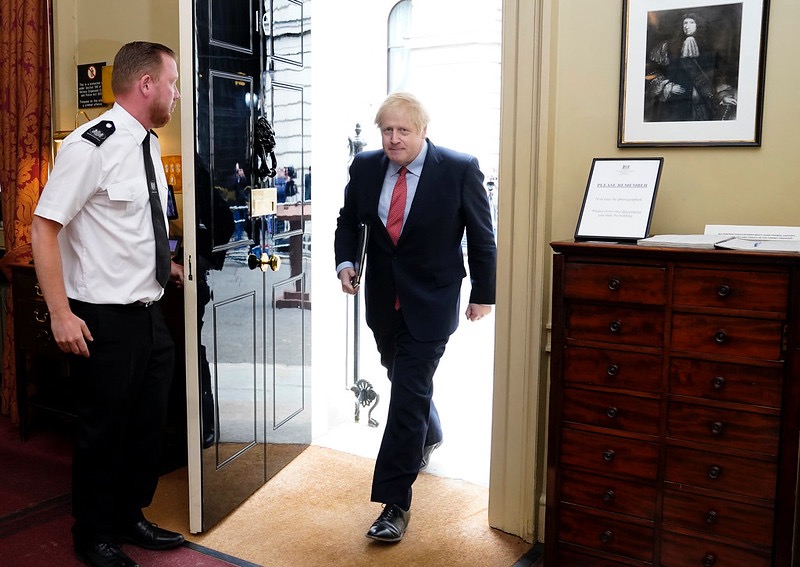
News today that Boris Johnson will be the next Prime Minister of the UK. Johnson, who will take over from Theresa May – only the second woman to hold the office – as PM tomorrow after winning the Conservative Party vote over Foreign Secretary Jeremy Hunt, will be the 14th Prime Minister to serve in the office during the reign of Queen Elizabeth II. PICTURE: US State Department
Lost London – The Bryant & May Testimonial Fountain…
Located outside Bow railway station in East London (and not far from the Bryant & May match factory), the Bryant & May Testimonial Fountain was built to celebrate the success of a campaign against the imposition of a tax on matches which had been proposed in 1871.
The proposed tax of half a pence per 100 matches, which had even attracted the attention of Queen Victoria who questioned its wisdom, sparked a march on Parliament by several thousand match-makers which led to clashes with police and allegations of brutality.
The Gothic fountain which featured a steeple topped by a cross and access to water on several side was erected by public subscription in 1872 and formally unveiled in October of that year.
The fountain was demolished in the early 1950s when the road was widened (the factory meanwhile closed down in 1979 when the work was moved to Liverpool). A plaque commemorating the former fountain is located close to the site near the former Poplar Town Hall.
PICTURE: A print of the Bryant & May Testimonial Fountain, printed by James Akerman (1872-1880) © The Trustees of the British Museum (licensed under CC BY-NC-SA 4.0/image cropped)
LondonLife – Living colour…
Close-up of the facade of Mizuho House, London branch of the Japanese investment bank Mizuho, in the Old Bailey London. PICTURE: Valdemars Magone/Unsplash
LondonLife – Angles on an iconic bridge…
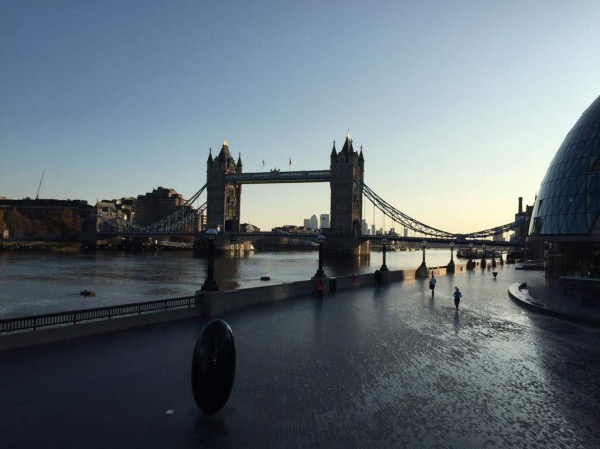
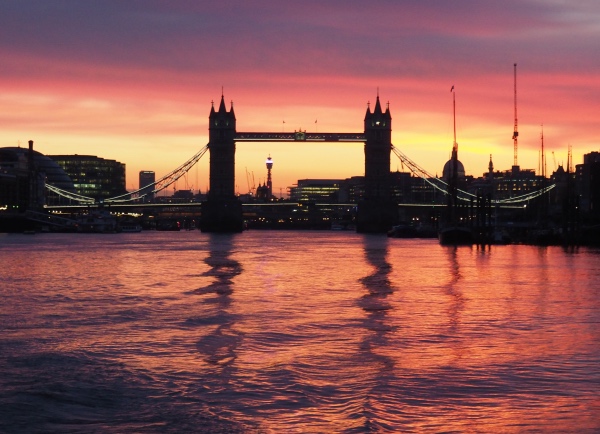
Tower Bridge marked its 125th birthday last weekend so to celebrate, here’s some different angles on London’s most photographed bridge. The Victorian Gothic bascule and suspension bridge, which spans the Thames just to the east of London Bridge (with which it’s not to be confused), took eight years to build and was officially opened on 30th June, 1894, by the then Prince and Princess of Wales (later King Edward VII and Queen Alexandra). For more on the celebrations taking place at the bridge over the coming weeks and months, see www.towerbridge.org.uk/125/.
LondonLife – Pete the plant prepares to take a selfie at ZSL London Zoo…
Pete, a maidenhair fern who lives at ZSL London Zoo, is preparing to take the world’s first plant selfie. Under the pioneering project taking place in the zoo’s Rainforest Life exhibit, microbial fuel cells – which harness the energy of naturally occurring bacteria in soil to generate electricity – will be used to power the plant to take its own picture. The fuel cells were designed by green energy specialists Plant E in the Netherlands and were created after ZSL’s Conservation Tech Unit, in partnership with Open Plant, Cambridge University and the Arribada Initiative, last year launched a competition to design a fuel cell that could be powered by plants. The new technology, which works around the clock, has the potential to allow researchers to monitor inhospitable and remote rainforest locations and record key data such as temperature, humidity, plant growth – all of which are crucial to the understanding of threats such as climate change and habitat loss. Zoo staff are asking people and come and cheer Pete on as he prepares to take his selfie with the actual event not expected for a few weeks. For more, see zsl.org. PICTURES: © ZSL London Zoo.