LondonLife – Christmas at Covent Garden…

Covent-Garden2

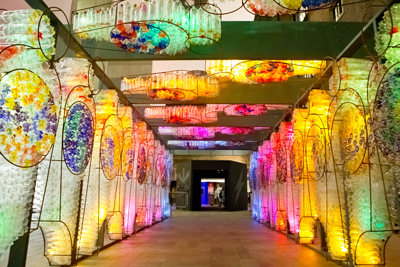
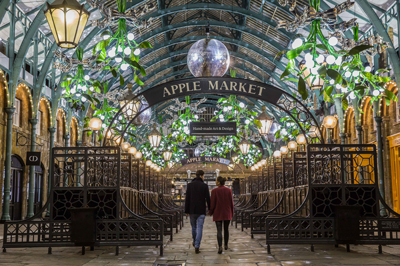
Covent-Garden4Take your chance to ‘meet under the mistletoe’ this year at Covent Garden, thanks to the designs of renowned  production designer Michael Howells. Howells, whose previous credits include fashion shows for the likes of Alexander McQueen as well as sets for films including Nanny McPhee and theatre productions such as Chariots of Fire, has come up with a design featuring more than 40 “mistletoe chandeliers” of up to 3.5 metres in size, each of which is adorned with almost 700 glistening berries.  The chandeliers are united by more than 320 metres of garlands while about 100,000 pealights are suspended inside the historic Market Building. Outside, London’s biggest hand-picked – and richly decorated – Christmas tree once again stands in the piazza.  For more on Covent Garden, see www.coventgarden.london.  PICTURES: Courtesy of Covent Garden.

Covent-Garden3

Covent-Garden1


LondonLife – An illuminated Christmas at Kew…

Kew-GardensIt was Queen Charlotte who first dressed the branches of a Christmas tree in Kew Palace in the 1790s and, drawing on that tradition, Kew Gardens is once again hosting a mile long winter light experience. Visitors can walk through ribbons of light, count the festooned Christmas trees and listen to a holly bush choir as well as see larger than life winter flora such as snowdrops and Christmas roses and pause at the scented Fire Garden for a moment of reflection. Santa and his elves are appearing on stage at the Princess of Wales Conservatory and a Victorian carousel and other rides are located at the White Peaks Cafe where visitors can sample goodies like mulled wine, spiced cider and roasted chestnuts.  The after-dark event runs from 5pm to 10pm on select dates until 2nd January. Admission charge applies. For more, see www.kew.org. PICTURE: The Palm House at Kew Gardens lit up for Christmas. Courtesy Kew Gardens.

LondonLife – Rediscovering Londinium’s residents…

Harper Road Woman (c) Museum of LondonA detailed picture of the inhabitants of Roman London, known as Londinium, has been created for the first time, the Museum of London announced this week. Detailed analysis of the DNA of four skeletons has revealed a culturally diverse population. The examined skeletons include that of a Roman woman (pictured left), likely to have been born in Britain with northern European ancestry, found buried with high status grave goods at Harper Road, Southwark, in 1979, and another of a man, whose DNA revealed connections to Eastern Europe and the Near East, who was found at London Wall in 1989 with injuries to his skull which suggest he may have been killed in the nearby amphitheatre before his head was dumped in a pit. The other two skeletons examined were found to be that of a blue-eyed teenaged girl found at Lant Street, Southwark, in 2003, believed to have been born in north Africa, whose ancestors lived in south-eastern Europe and west Eurasia, and that of an older man found at Mansell Street who was born in London and whose ancestry had links to Europe and north Africa. The examination – the first multi-disciplinary study of the inhabitants of a Roman city anywhere in the empire – also revealed that all four suffered from gum disease. Caroline McDonald, senior curator at the museum, said that while it has always been understood Roman London was a culturally diverse place, science was now “giving us certainty”. “People born in Londinium lived alongside people from across the Roman Empire exchanging ideas and cultures, much like the London we know today.” The four skeletons will form the basis of a new free display, Written in Bone, opening at the Museum of London on Friday. PICTURE: © Museum of London

WHERE: Museum of London, 150 London Wall (nearest Tube stations are Barbican and St Pauls); WHEN: 10am to 6pm daily; COST: Free; WEBSITE: www.museumoflondon.org.uk.

LondonLife Special – Expressing solidarity with Paris…

Pray for Paris

A week ago tonight the world was left reeling in the wake of the devastating series of coordinated terrorist attacks in Paris, France, which have left 132 people dead and hundreds more wounded. In the wake of the attacks, national landmarks across the world were lit up in the colours of the French flag, among them, the London Eye, overlooking the River Thames. PICTURE: Martin Sylvester/Digital Concepts.


LondonLife – City of spires…

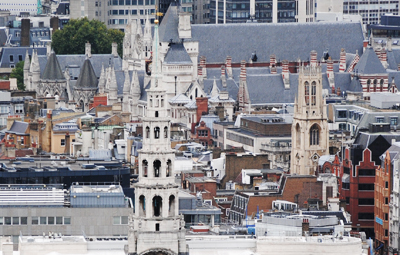
City-of-Spires

View looking west from St Paul’s Cathedral down Fleet Street.

LondonLife – A rare 17th century survivor in Pall Mall…

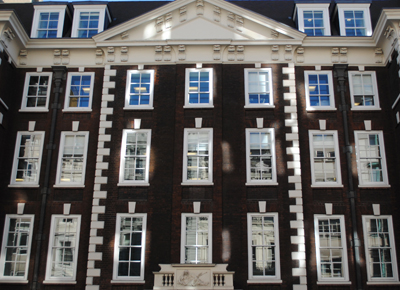
Pall-Mall

Facade of New Schomberg House at number 80-82 on the south side of Pall Mall. While the rest of the building dates from the 1950s, much of the facade from what is now known as Old Schomberg House (among numerous buildings in Pall Mall once occupied by the War Office) was retained and the eastern end restored. The house was originally built in the late 17th century for the Duke of Schomberg, a general in the service of King William III (hence the name), and replaced Portland House on the site. Later residents here included the painter Thomas Gainsborough, who lived here between 1774 until his death in 1788.

LondonLife – 600 years on, Westminster Abbey commemorates the Battle of Agincourt…

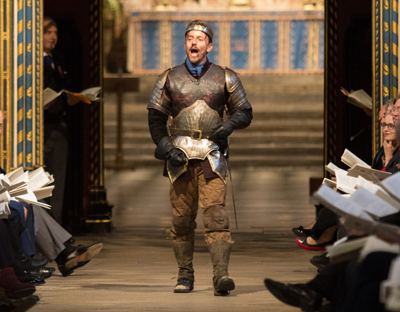
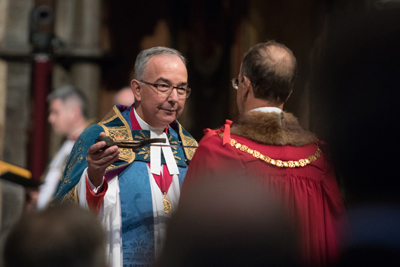
Sam-MarksHundreds gathered at Westminster Abbey last Thursday for a service to commemorate the 600th anniversary of the Battle of Agincourt – 600 years to the day when word of the battle’s victory arrived in London. During the service, the sword of King Henry V – who was buried in the abbey and whose chantry chapel is located above his tomb (see our earlier post here) – was carried through the abbey and presented to the Dean of Westminster, the Very Reverend Dr John Hall, at the High Altar (pictured below). “A hundred years ago, as our countrymen fought alongside the French, the old enmities had been put away,” Rev Dr Hall told those at the service who included the Duke of Kent and Princess Michael of Kent. “In the dark days before the Second World War, the story of Agincourt encouraged men and women alike to strive their utmost for freedom from tyranny. Today we give hearty thanks for our freedoms, and we pray for an end to tyranny wherever it is found, and for enduring peace and prosperity.” Royal Shakespeare Company actor Sam Marks read the St Crispin’s Day speech from the Bard’s Henry the Fifth (pictured above) while veteran of the stage and screen, Robert Hardy, read the prologue from Act IV of the same play. For more on abbey, visit www.westminster-abbey.org.  PICTURES: Ian Stratton/Westminster Abbey.

The-Dean-of-Westminster,-the-Very-Reverend-Dr-John-Hall-receives-the-sword-of-Henry-V

LondonLife – A rare glimpse inside King Henry V’s chantry chapel…

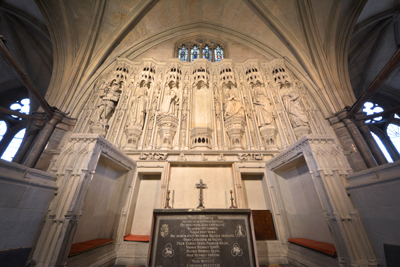
Henry-V-chantry-chapelA fortunate few last weekend had the chance to have a look inside King Henry V’s elaborately carved chantry chapel in Westminster Abbey as part of commemorations marking the 600th anniversary of the Battle of Agincourt. 

The chapel, which is located on a sort of mezzanine level above the king’s tomb at the east end of the Shrine of Edward the Confessor, is one of the smallest of the abbey’s chapels. It was constructed on the orders of the king – who died Vincennes in August, 1422, and was buried in the abbey on 7th November that year – so prayers could be said in perpetuity for his soul.

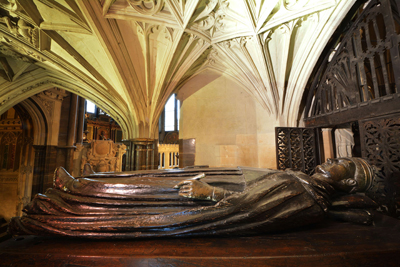
The tomb was completed in 1431 and the chantry chapel was built above between 1437 and 1450. The latter is entered via narrow stairways of worn steps hidden inside a pair of stone turrets which flank the tomb.

For centuries the Henry V’s funeral ‘achievements’ – the king’s saddle, helm and shield – were displayed on a wooden beam above the chantry chapel but these were restored and moved to the abbey museum in 1972.

Henry V’s wife, Catherine de Valois, who survived her husband by 15 years was eventually – in the Victorian age – buried under the chantry chapel altar (originally buried in the old Lady Chapel, King Henry VII had her removed and placed in an open coffin in the open air next to the tomb of King Henry V, when building his new chapel – among visitors to her mummified body was diarist Samuel Pepys who even kissed her. In 1778 she was buried in a vault before being relocated to her current position in 1878).

An inscription on the altar in the chantry chapel reads: “Under this slab (once the altar of this chapel) for long cast down and broken up by fire, rest at last, after various vicissitudes, finally deposited here by command of Queen Victoria, the bones of Catherine de Valois, daughter of Charles VI, King of France, wife of Henry V, mother of Henry VI, grandmother of Henry VII, born 1400, crowned 1421, died 1438”.

The chantry chapel is still occasionally used for services but, measuring just seven by three metres, is not usually open to the public because of size and access issues.

Westminster Abbey will hold a special service of commemoration on 29th October in partnership with charity Agincourt600. The day before, 28th October, it will host a one day conference for Henry V enthusiasts entitled ‘Beyond Agincourt: The Funerary Achievements of Henry V’. For more, see www.westminster-abbey.org/events/agincourt.

Above – King Henry V’s chantry chapel; Below – King Henry V’s tomb which sits below the chantry chapel. PICTURE: Jim Dyson/Dean & Chapter of Westminster
Henry-V-tomb

LondonLife – Giacometti’s works go on show at the National Portrait Gallery…

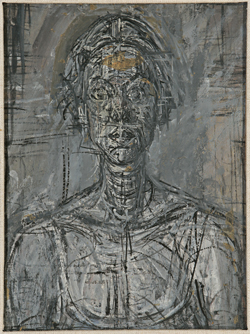
AnnetteBust of Annette is among more than 60 works by the 20th century Swiss artist Alberto Giacometti on display at the National Portrait Gallery in an exhibition which opened earlier this month. The first ever exhibition to consist solely of portraits by Giacometti (1901-66), Giacometti: Pure Presence features paintings, drawings and sculptures from across his entire career. While he is most famous for his tall, thin standing or walking figures – works which fueled his reputation as a leading surrealist sculptor, the exhibition focuses on his life-long preoccupation with portraiture. Apart from his wife Annette, subjects featured in his works include his brother Diego, friends such as the writers Louis Aragon and Jean Genet, retailer and philanthropist Lord Sainsbury, art writer James Lord, Isabel Nichol – who later become Francis Bacon’s muse, Isabel Rawsthorne, and a prostitute named Caroline with whom he worked for five years from 1960. Highlights of the exhibition include a portrait bust of his brother Diego created in 1914 when the artist was just 13, an Egyptian-inspired sculpture of Isabel’s head and his celebrated work, Women of Venice VIII, which stands at the centre of the exhibition. The exhibition, at the gallery just off Trafalgar Square, runs until 10th January. Admission charge applies. For more, see www.npg.org.uk. PICTURE: Bust of Annette by Alberto Giacometti, 1954 Private Collection/© The Estate of Alberto Giacometti (Fondation Giacometti, Paris and ADAGP, Paris) 2015.

LondonLife – Soiling the Tate Modern’s Turbine Hall…

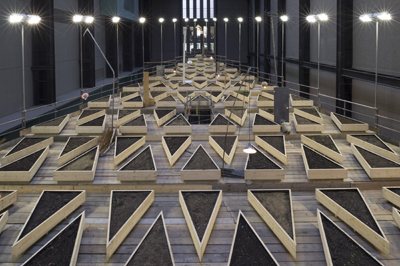
cruzvillegas0025

A grid containing 240 wooden planters filled with 23 tonnes of soil collected from gardens across London – from Peckham Rye to Regent’s Park – has been unveiled in the Tate Modern’s Turbine Hall. Entitled Empty Lot, the work by Mexican artist Abraham Cruzvillegas will be lit by lamp-posts made using materials found in skips and building sites around the Tate. The artist has planted nothing in the boxes but flowers, mushrooms or other greenery may grow depending on what seeds may have found their way into the soil. The new installation – the first in the Hyundai Commission series of annual site-specific works by international artists – can be seen in the Turbine Hall on Bankside from today until 3rd April. Admission is free. For more, see www.tate.org.uk. PICTURE: Andrew Dunkley © Tate 2015

LondonLife – The Australian coast comes to London…

Blue-PacificThe National Gallery has unveiled a coastal masterpiece by Australian painter Sir Arthur Streeton, Blue Pacific, lent to the gallery by a private collector for the next two years.

Painted in 1890, the painting – never seen before in the UK – depicts people strolling along the clifftops at Coogee in Sydney, looking eastward over the gleaming blue of the Pacific Ocean.

Christopher Riopelle, the gallery’s curator of post-1800 European paintings, says Streeton’s use of the vertical format was “brilliantly calculated to exploit the contrast between the azure sheet of water and the subtly observed depictions of rock face and sky”.

“Still young, but at the height of his powers, Streeton demonstrates here how impression was a capacious and flexible tool for confronting the awesome landscape unique to Australia.”

Streeton (1867-1943) was considered one of the most advanced landscape painters in Australia in the 1880s and 1890s and was one of the first to adopt an impressionist style. His masterpiece, Golden Summer (1889), was exhibited at the Royal Academy of Arts in 1891.

Blue Pacific is now on show in Room 43 at the gallery off Trafalgar Square alongside Monet’s Water-Lilies and Manet’s The Execution of Maximilian.  Entry is free. For more on the gallery, see www.nationalgallery.org.uk.

PICTURE: Blue Pacific, 1890, Sir Arthur Streeton (1867 – 1943), oil on canvas, © on loan from a private collection/via National Gallery.

LondonLife – Supermoon over Docklands…

Supermoon

London photographer Ian Wylie captures the “supermoon” rising over Canary Wharf in London’s east on Sunday, ahead of the lunar eclipse in the early hours of Monday. As seen from London Bridge at 6:54pm – 20 minutes after moonrise and six minutes after sunset. A supermoon occurs when the moon reaches the closest part of its orbit to Earth and hence appears larger than normal. This week’s supermoon coincided with a lunar eclipse – in which the moon passes behind the Earth through its shadow (also known as an umbra) – which later made the moon appear red (a lunar eclipse is also known as a “blood moon”). Last seen in 1982, the phenomena will apparently not be visible again until 2033. PICTURE: © Ian Wylie/Flickr

LondonLife – The Quadriga at Hyde Park Corner…

The-QuadrigaKnown as ‘The Quadriga’, this bronze monument atop Wellington Arch at Hyde Park Corner depicts Nike, goddess of victory, in a four horse chariot. The work of English sculptor Adrian Jones, the quadriga was part of Decimus Burton’s original early 19th century design but it wasn’t until 1911-1912 that this colossal piece – once the largest bronze monument in Europe – was installed, replacing an equestrian statue of the Duke of Wellington which was moved to Aldershot (a smaller equestrian statue of the Duke now stands nearby). For more on the arch, see www.english-heritage.org.uk/visit/places/wellington-arch/.

LondonLife – Remembering Agatha Christie…

Agatha_ChristieToday marks 125 years since the birth of the world’s best-selling novelist, Agatha Christie, subject of this memorial which was unveiled in Covent Garden in 2012.

Standing at St Martin’s Cross – the intersection of Cranbourn and Great Newport Streets, the memorial – which also marks 60 years and 25,000 performances of her record breaking long-running London play The Mousetrap – is the work of sculptor Ben Twiston-Davies.

It takes the form of a 2.4 metre high book with a bust of Christie in profile and features a series of motifs from Christie’s works as well as a ‘bookshelf’ of her best sellers in English and other languages, the titles of which were selected in a competition involving fans.

Christie, who was born on 15th September, 1890, in Torquay, Devon, and died on 12th January, 1976, is famous for the scores of detective novels she wrote – featuring the likes of detectives Miss Marple and London’s own Hercule Poirot – which have gone on to sell more than two billion copies around the world.

The memorial was unveiled on 18th November, 2012, by Christie’s grandson, Matthew Pritchard, along with Sir Stephen Waley-Cohen, chairman of Mousetrap Productions, and the Lord Mayor of Westminster, Cr Angela Harvey.

For more on the memorial, see www.agathachristiememorial.co.uk. For more on events surrounding the anniversary, see www.agathachristie.com.

PICTURE: Diagram Lajard

LondonLife – Kenwood’s architect James Adam rediscovered…

Antonio-Zucchi-'Portrait-of-James-Adam'-Credit---Adam-Williams-Fine-Art-LtdA painting of James Adam, unseen for almost 150 years, has gone on show at Kenwood House in London’s north.

Antonio Zucchi’s Portrait of James Adam, dating from 1763, depicts Adam who, along with his brother Robert, created the splendid villa which now sits on the northern edge of Hampstead Heath between 1767 and about 1779.

The Adams’ first encountered Zucchi while on a “grand tour” in Italy and engaged him as their draughtsman, recording what they were seeing.

They subsequently had him decorate ceilings and walls at Kenwood and his signature was also recently discovered on the painting of Adam – the only known portrait the artist completed – after it was cleaned.

The painting depicts Adam as both architect and “man of fashion” and shows his interest in classical statues and ornamentation, showing the famous Medici vase in the background.

The painting hadn’t been seen by the public since 1867. The painting, loaned to English Heritage – managers of Kenwood House – by Adam Williams Fine Art Ltd in New York, can be seen until 4th January.

WHERE: Kenwood House, off Hampstead Lane, Hampstead Heath (nearest Tube stations are Golders Green and Archway/nearest rail is Gospel Oak and Hampstead Heath); WHEN: daily, 10am to 5pm; COST: Free; WEBSITE: www.english-heritage.org.uk/kenwood

PICTURE: Adam Williams Fine Art Ltd.

LondonLife – See the Thames…in Blackfriars station…

Photo-exhibition-at-Blackfriars-station

This is one of a series of works by renowned photographer Henry Reichhold which features in the exhibition Thames – Heart of London, currently on show at Blackfriars Thameslink railway station. Thameslink and JCDecaux have provided 49 platform advertising sites for the display, part of the Totally Thames celebrations taking place throughout September. The photographs, which measure 2.5 metres long, are an attempt to capture the character of the Thames as it winds its way through the city and were taken from a series of notable vantage points including the Shard, City Hall, OXO Tower, One Canada Square, Southbank Tower and the Houses of Parliament. As well as the river itself, they also capture some of the many events which have taken place upon it – from the Diamond Jubilee Pageant to New Year’s Day celebrations. Each image has taken between one and three weeks to create from up to 100 separate photographs – selected out of more than 800 taken on a single day – which have then been put together in a stunning panorama. New York-born Reichhold says the process of “extracting” the final image is “never the same”. “The camera is very stubborn about creating a ‘mechanical’ view and it is the reinterpretation of these files to in some way reflect what the human eye sees that I find so troublesome and fascinating.” The exhibition is at Blackfriars Station, 179 Queen Victoria Street, London, and runs until 30th September.  Entry is free to passengers with a valid GTR train ticket and to holders of a 10p platform ticket.

LondonLife – New River Wildlife…

New-River

Taken along New River Walk which follows the course of the “New River” in Islington. The New River, completed in 1613, was a man-made canal which brought water from Hertfordshire to New River Head in Clerkenwell (it now takes water to reservoirs in Stoke Newington). PICTURE: David Adams.

LondonLife – Crossrail unearthed mass burial believed to be of Great Plague victims…

Plague-Pit---Crossrail

Thirty skeletons found in a mass burial – the latest archaeological find at Crossrail’s Liverpool Street site – are believed to have been victims of the Great Plague of 1665. Made during the excavation of the former Bedlam burial ground in order to make way for a new eastern entrance to the station, the discovery comes during the 350th anniversary year of the Great Plague. Jay Carver, the lead archaeologist for Crossrail, said the mass burial – with the bodies placed in now long gone wooden coffins – was unlike other individual burials found in the cemetery and thus “is likely a reaction to a catastrophic event”. “Only closer analysis will tell if this is a plague pit from the Great Plague of 1665 but we hope this gruesome but exciting find will tell us more about one of London’s notorious killers.” Clues which suggest that may be the case include a headstone found nearby marked “1665” and the fact that the 30 people all seem to have been buried on the same day. Museum of London Archaeology osteologists will now analyse the skeletons to find out the cause of death. Archaeologists have excavated more than 3,500 skeletons from the site since excavation of the burial ground – used between 1569 to at least 1738 – began earlier this year. It suggested 30,000 Londoners were buried there during that period. For more on the the Great Plague, see our earlier post herePICTURE: © Crossrail Ltd.

LondonLife – Enjoying the greenery…

Green-ParkA stroll through the green oasis of the aptly named Green Park in central London. For a look at the history of Green Park, see our earlier post here.


LondonLife – London’s celebration of sculpture…

(i)-Damien-Hirst,-Charity.-Sculpture-in-the-City-2015Damien Hirst’s seven foot tall statue Charity (2002-2003) stands in the shadow of the Gherkin as a highlight of this year’s Sculpture in the City event. Kicking off last month, the exhibition – the fifth of its kind – features 14 works by a series of internationally renowned artists. Other sculptures (pictured below) include Adam Chodzko’s 2010 work Ghost (on show at Leadenhall Market), Laura Ford’s 2012 work Day of Judgement – Cats 1 & 2 (150 Leadenhall Street), Sigalit Laudau’s 2011 work ‘O my friends, there are no friends’ (St Helen’s Square), and Kris Martin’s 2012 work Bells II (on the corner of Bishopsgate and Wormwood Street). The works can be seen until May next year. For more (including a map of locations), see www.cityoflondon.gov.uk/sculptureinthecity. PICTURES: Nick Turpin.

Adam-Chodzko's-'Ghost',-Leadenhall-Market.-Sculpture-in-the-City-2015,-Photograph-by-Nick-Turpin

(i)-Laura-Ford's-'Days-of-Judgement---Cats-1-&-2'.-Sculpture-in-the-City-2015,-Photograph-by-Nick-Turpin

(iii)-Sigalit-Landau.-O-my-friends,-there-are-no-friends.-Sculpture-in-the-City-2015.

Kris-Martin--Bells-II_landscape