LondonLife – Shakespeare in bronze at The Globe…

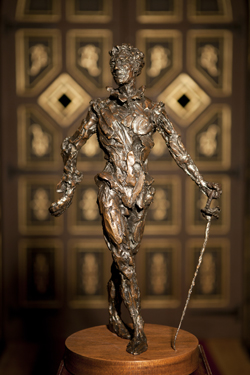
Shakespeare's-Globe2A series of bronze sculptures inspired by the characters of William Shakespeare’s plays is appearing at the Shakespeare’s Globe Theatre on Bankside this summer. The work of Susan Bacon, the sculptures are being displayed alongside some of the clay maquettes – or “sculptural calligraphy” – Bacon created before working in bronze. She explains: “The characters start with a small sketch in clay. These maquettes are to me the beginning of an idea, the seeds that make up Shakespeare’s characters. As in the study of the spontaneous fluency in Zen Calligraphy with ink, so it can be in clay; a natural attempt to transfer these ideas and their energy into uninterrupted form. Working on images and speeches I combine in my mind many ideas and thoughts that are drawn out by the words. Only then do I execute a quick sculptural response.” The sculptures can be seen in the foyer of the Globe until 18th October (open daily, 9am to 11pm, free admission). For more, see www.shakespearesglobe.com.

PICTURE: Pete Le May

LondonLife – Exposing London’s criminal past…

Daniel-GoodThe death mask of Daniel Good, executed outside Newgate prison on 23rd May, 1842, for the murder of his wife Jane Jones. It was thanks to delays in apprehending Good caused by communication problems that a dedicated detective was formed within the Metropolitan Police. Good’s death mask is just one of the many items from the Metropolitan Police’s Crime Museum which will be on display at the Museum of London’s forthcoming exhibition, The Crime Museum Uncovered. Opening in October, the display will feature never-before-seen objects from the police museum which are usually only accessible to police professionals and their invited guests. Along with the death mask, other objects to be seen in the display will include a memoir by Donald Swanson, senior investigating officer on the investigation into the Jack the Ripper killings in the late 1880s, a pin cushion embroidered with human hair by Annie Parker, who died in 1879 after having been arrested more than 400 times for alcohol-related offences, and ‘microdots’ containing secret messages along with a microdot reader founder in Mrs Helen Kroger’s handbag when she was arrested for involvement in the Portland Soviet Spy Ring in 1961. The exhibition will run from 9th October to 10th April, 2016. Admission charges apply. For more, see www.museumoflondon.org.uk.

LondonLife – Battersea in rebirth…

BatterseaWork continues on repurposing the former Battersea Power Station as part of the £15 billion Nine Elms project that will create a whole new precinct located on the south bank of the Thames. Photographer Ian Wylie recently captured the work in progress. He writes: “I’ve been keeping an eye on the huge redevelopment of the entire Nine Elms area, including the new American Embassy quarter and the Battersea Power Station development. Also noticing the work going on to remove, rebuild and replace the four iconic power station chimneys as seen from other London viewpoints, including this one: flic.kr/p/rpGocV. So (these) photos were simply a result of another walk around the area where so much is changing so fast and yet reminders of London’s past still remain, such as this very old street sign: flic.kr/p/tQVY9W. It’s not an area that attracts a large number of visitors but it was interesting to see a few people walking around, just as I was, obviously also intrigued by the past, present and future of this site.” For more on the project, see www.batterseapowerstation.co.uk and www.nineelmslondon.com.

LondonLife – Blooming beauty at Chelsea…

Chelsea4

The RHS Chelsea Flower Show opened in London’s west this week so we thought we’d take a look at some of the treasures on show. The show, which is in its 102nd year, has been held in the grounds of the Royal Hospital Chelsea since 1913 (except during the two World Wars) and while its claim to be Britain’s largest flower show has been lost to the RHS Hampton Court Palace Flower Show, it remains the nation’s most prestigious. The five day show runs until Saturday. From the top – Chelsea pensioners look at ‘Peter Beales Roses’ in the Great Pavilion; the Inter-flora display in the Great Pavilion; a model poses in front of the Thailand, Land of Buddhism display; and, award-winning garden sculptor David Harber hosts the Mad Hatter’s tea party. For more on the show, visit www.rhs.org.uk/shows-events/rhs-chelsea-flower-show PICTURES: RHS/Hannah McKay and RHS.


Chelsea3

Chelsea2

Chelsea1

LondonLife – Londoner’s bones under the microscope in a quest to see industrialisation’s effects…

Museum-of-London-1

The effects of industrialisation on Londoners and the diseases that affected them is the subject of a new ground-breaking research project being conducted by the Museum of London. Led by Jelena Bekvalac, based at the Museum of London’s Centre for Human Bioarcheology (pictured above, right), the researchers will examine the skeletal remains of more than 1,000 adult men and women from industrial-era London, 500 skeletons from the medieval metropolis and a further 500 medieval and post-medieval skeletal human remains from areas outside of London with the latter to be used for comparison purposes. In the project, made possible through a City of London Archaeological Trust grant from a bequest made by the late Rosemary Green, the museum will employ the latest clinical techniques – including direct digital radiography, CT scanning and 3D modelling – to examine the bones. “The most tangible evidence we have for the long-term consequences of the industrialisation process upon us is, quite simply, written in our bones,” says Dr Bekvalac. The project will result in the creation of an extensive new interactive digital resource that will be able to be explored online. For more, see www.museumoflondon.org.ukPICTURE: Courtesy of Museum of London.

LondonLife – Royal gun salute in Hyde Park marks birth of Princess Charlotte Elizabeth Diana…

Gun-salute

Guns fired a royal salute in Hyde Park on Monday to mark the birth of the Duke and Duchess of Cambridge’s new daughter (and Prince George’s new sister), named Princess Charlotte Elizabeth Diana (or more formally, Her Royal Highness Princess Charlotte of Cambridge). Seventy-one horses pulling six World War I-era 13-pounder field guns from the King’s Troop Royal Horse Artillery rode out in procession with the Royal Artillery Band from Wellington Barracks, past Buckingham Palace, up Constitution Hill to Wellington Arch, and into Hyde Park to fire the salute. The 41 gun salute was fired at the same time as a 62 gun salute at the Tower of London. By custom, gun salutes are fired for the birth of every prince or princess, regardless of where they sit in the order of succession. A basic salute is 21 rounds with an additional 20 rounds fired because Hyde Park is a Royal Park while at the Tower of London an extra 20 rounds are fired because it is a royal palace along with a further 21 because of its City of London location. The princess, fourth in line to the throne, was born at 8:34am on Saturday at St Mary’s Hospital in Paddington, and weighed 8lbs, 3oz (3.7kg). PICTURE: © Courtesy of Ian Wylie Photo.

LondonLife – The Queen’s House set to be given a makeover ahead of 400th anniversary…

The-Queen's-HouseGreenwich icon, the Queen’s House, is set to close on 27th July this year to allow for refurbishment and upgrade ahead of the 400th anniversary of its commissioning and design in 2016. The landmark will be closed until 4th July, 2016, after which those visiting the house will be able to see Orazio Gentileschi’s Biblically-themed painting, Joseph and Potiphar’s Wife, displayed in the building for the first time since 1650. Part of the Royal Collection, the painting was one of a series commissioned for the building by King Charles I and his wife Queen Henrietta Maria. The Queen’s House was designed by Inigo Jones in 1616 for King James I’s wife, Anne of Denmark, and, acknowledged as a masterpiece of 17th century architecture, was the first classically-designed building in country. The makeover will see galleries refurbished, the introduction of new displays and the restoration of components including the ceiling in the King’s Presence Chamber (the Queen’s Presence Chamber was restored in 2013). For more, see www.rmg.co.uk.

LondonLife – Georgian princesses show their skills…

Fringe-LoomThe fringe loom of Queen Charlotte – wife of King George III – is among the objects on display at Kew Palace this year. Historic Royal Palaces is exploring some of the untold stories of the king’s daughters who once called the palace, which was originally built in 1631 for a Flemish merchant before it was acquired by King George II, home. Under examination are the pastimes of the royal women – from drawing and painting to weaving, paper cutting and even the decoration of a ‘Baby House’ created by the princesses as a showcase of their talents. Along with Kew Palace – located inside Kew Gardens in London’s west, also opened is the nearby rustic retreat built in 1770 known as Queen Charlotte’s cottage. Inside is the “Print Room”, hung with more than 150 satirical engravings, and the “Picnic Room”, decorated paintings of trailing nasturtiums and convolvulus – the work of Princess Elizabeth, an acclaimed artist. For more, see www.hrp.org.uk/KewPalace/.
PICTURE: Historic Royal Palaces

LondonLife – Daffodils at Chelsea…

Daffodils

Daffodils blooming outside the Royal Hospital Chelsea.

The final in our series on Winston Churchill will be published a day late this week on Thursday and This Week in London will be published on Friday.

LondonLife – New galleries link Museum of London with current events…

Looking-for-Londoners-6The Museum of London has opened two new display spaces which feature new archaeological discoveries, reveal the relevance of the museum’s collection to current events in London and showcase objects not usually on display. Opened last week, Looking for Londoners currently features objects uncovered during recent excavations to improve the Baitul Aziz Mosque at Dickens Square in Southwark, including the skull of an 18th century longhorn cow, pots used in burying Roman remains, and as child’s cup dating from the mid-19th century believed to have belonged to Richard Greenfield, born in 1847 as the fourth child of grocer Samuel Greenfield and his wife Mary Ann (pictured). Show Space’s current display, meanwhile, is themed on the idea of ‘spring’ and Londoners attempts to bring nature into the capital with objects including a ‘spring’ fancy dress outfit worn in the late 1890s to a ball in the Portsmans Rooms in Baker Street, cupcake coloured porcelain figurines featuring various embodiments of spring and a ‘mystery gnome’. Access to the new permanent galleries is free. For more, see www.museumoflondon.org.uk. PICTURE: © Museum of London

LondonLife – Mooning over Westminster…

Moon-over-St-James

The moon rises over Westminster. The steeple belongs to the Church of St Stephen with St John, located in Rochester Row.

LondonLife – #MuseumWeek…

Dr-Johnsons-HouseIt’s #MuseumWeek on Twitter and museums all over London are among the more than 2,000 institutions worldwide already tweeting away. Among those, large and small, taking part in London are the @hornimanmuseum, @ExploreWellcome, @JewishMuseumLDN, @BFHouse@HRP_Palaces, @NMMGreenwichand @drjohnsonshouse (pictured). Each day of the week they’ll be tweeting on a different theme until Sunday (today’s is #souvenirsMW). For the full stream, head to @MuseumWeek.

LondonLife – An ancient guardian sits watch…

Guardian

Marking the boundary of the City of London on Victoria Embankment is this large statue of a dragon holding a shield bearing the City’s coat-of-arms. One of a pair, these two statues were originally mounted above the entrance to the Coal Exchange in Lower Thames Street and were moved here in 1963 following the building’s demolition. They’re just two of numerous dragons which guard the City’s outer edges.

LondonLife – Astrologer, former Lord Mayor and Leveller among those buried in Bedlam, new research finds…

Bedlam2

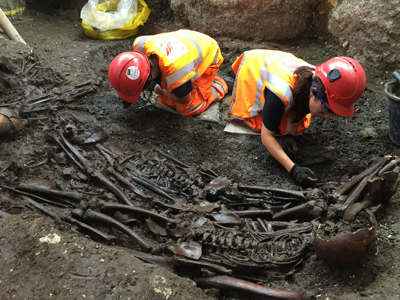
The remains of an astrologer believed to have been stoned to death by an angry mob, a former Lord Mayor of London and a member of Civil War era dissenting group, the Levellers, who was executed by firing squad may be among those exhumed from the former Bedlam burial ground in Liverpool Street in the City of London in a new archaeological excavation.

A research project carried out ahead of the planned excavation of the new eastern entrance of the Liverpool Street Crossrail Station has unearthed the names and backgrounds of more than 5,000 of the 20,000 Londoners who were buried on the site in the 16th and 17th centuries.

They include Dr John Lamb, an astrologer and advisor to the Duke of Buckingham, who a mob apparently stoned to death outside a theatre in 1628 after allegations against him of rape and black magic, Sir Ambrose Nicholas, Lord Mayor of London in 1575, as well as victims of riots by ‘Fanatiques’ (as noted in the diaries of Samuel Pepys in January, 1661) and, according to a report in The Independent, Robert Lockyer, a member of the Leveller movement who was executed by firing squad in 1649 during the English Civil War.

Some 3,000 skeletons will be disinterred in the excavation along with, it is expected, Roman and medieval artefacts. The dig will start next month and will be carried out by MOLA (Museum of London Archaeology). The skeletons will be analysed before they are reburied in consecrated ground.

The research into the backgrounds of more than 5,000 of those buried on the site – which was established in 1569 to help alleviate overcrowding caused by outbreaks of plague and other epidemics – has been carried out by 16 volunteers with the results compiled into a new online database – the Bedlam Burial Ground Register. Plague was the most common form of death followed by infant mortality and consumption.

“This research is a window into one of the most turbulent periods of London’s past,” said lead archaeologist Jay Carver. “These people lived through civil wars, the Restoration, Shakespeare’s plays, the birth of modern industry, plague and the Great Fire.”

Crossrail workers recently discovered the gravestone of Mary Godfree who died in September, 1665, as a result of the ‘Great Plague’ which reached its peak that year.

PICTURES: Courtesy of Crossrail.

We’re running a bit behind this week, so the next instalment in our Churchill series won’t appear until later this week.

LondonLife – Riverside gaze…

Somerset-House2

Detail of the stonework on the facade of Somerset House, on the north bank of the Thames. For more on Somerset House, see our earlier post here.


LondonLife – Mary and infant Jesus back on display in St Paul’s…

The-Madonna-and-ChildThis Victorian-era marble statue of the Virgin and Child has gone back on show in St Paul’s Cathedral more than 70 years after it taken down following bombing during World War II. Part of an ornate high altar and reredos installed at the cathedral’s east end in 1888, the statue – the work of Thomas Garner – was put into storage after that part of the cathedral took a direct hit during the Blitz of 1940 and what remained of the altar was dismantled (the statue and a crucifix were the only parts retained by the cathedral). It can now be seen in the Chapel of St Erkenwald and St Ethelburga (also known as the Middlesex Chapel) in the north transept. For more, see www.stpauls.co.uk. PICTURE: The Chapter of St Paul’s Cathedral.


LondonLife – The Duke of York has a facelift…

Duke-of-YorkA monument commemorating Prince Frederick, the Duke of York and Albany and commander-in-chief of the British Army during the French Revolutionary wars – the Duke of York Column in St James’s Park – has had a makeover. The monument, which was erected in 1834, is the tallest in the Royal Parks. It features a 124 foot tall column of pink and grey Aberdeen granite designed by Benjamin Wyatt and is topped by a 14 foot tall bronze statue of the duke (thought to be the ‘Grand Old Duke of York’ referred to in the nursery rhyme), designed by Sir Richard Westmacott. The column has been cleaned while the statue, which had developed a green pigment thanks to the oxidation process which also gives the Statue of Liberty its green patina, has been repatinated, rewaxed and buffed. The monument, which cost £100,000 to refurbish, originally cost £15,760 and was funded with a day’s pay from every serving soldier. For more on St James’s Park, check out www.royalparks.org.uk/parks/st-jamess-park. PICTURE: Courtesy of Royal Parks.

LondonLife – Prince Albert keeps his lonely vigil…

Albert-Memorial2


The Albert Memorial, South Kensington. For its history, see our earlier post here.

LondonLife – Sir David Wilkie’s ‘A Young Woman Kneeling at a Prayer Desk’ rediscovered…

A-Young-WomanThought to be lost for more than 140 years, a painting by Scottish artist Sir David Wilkie went on display at the National Gallery off Trafalgar Square last month. A Young Woman Kneeling at a Prayer Desk was discovered in the US having previously been last heard of in 1872 when it was sold by a relative of the 1st Earl of Mulgrave, Henry Phipps, whose daughter, Lady Augusta Phipps, was thought to be the subject of the painting which dates from 1813 (she died that year at the age of just 12). While the work was known to exist thanks to it having featured in an oil sketch the artist had sent to his brother – an army officer in India, it was only recently rediscovered when spotted by London-based art dealer Ben Elwes in a catalogue advertising its sale in New York. The National Gallery says it was only able to purchase the painting thanks to late Birmingham art teacher Marcia Lay, who left a bequest to the gallery. The painting is displayed alongside masterpieces by the likes of Turner, Constable, Gainsborough and Reynolds in Room 34. For more, see www.nationalgallery.org.uk. PICTURE: David Wilkie, A Young Woman Kneeling at a Prayer Desk, 1813, © National Gallery, London.

LondonLife – Oliver Cromwell’s coffin plate goes to auction…

Coffin-Plate-(i)The copper gilt plate found on former Lord Protector Oliver Cromwell’s breast when his body was exhumed will be put up to auction in London later today. Sotheby’s says that according to contemporary reports, the plate was found in a leaden canister lying on Cromwell’s chest when the coffin – interred in Coffin-Plate-(ii)the Henry VII Chapel in Westminster Abbey – was opened by James Norfolke, Serjeant of the House of Commons, on the orders of parliament on 26th January, 1661 – just two years from Cromwell was buried. Norfolke apparently took the plate which was subsequently handed down through his family. It was not the only relic associated with Cromwell to survive – while Cromwell’s body, along with that of regicides Henry Ireton and John Bradshaw, was hanged at Tyburn and then apparently buried in an unmarked grave pit, his head was placed on a spike above Westminster Hall and remained there for more than 20 years until it blew down in a gale and was taken by a guard. It apparently subsequently passed through numerous private hands before, in 1960, it was interred in a secret location in the chapel of Sidney Sussex College in Cambridge. Meanwhile, the plate – which bears the arms of the Protectorate on one side and an inscription in Latin with the dates of Cromwell’s birth, inauguration as Lord Protector and death on the other – is listed with an estimated price of between £8,000 and £12,000. For more on the item, see www.sothebys.com/en/auctions/ecatalogue/2014/english-literature-history-childrens-books-illustrations-l14408/lot.3.html.