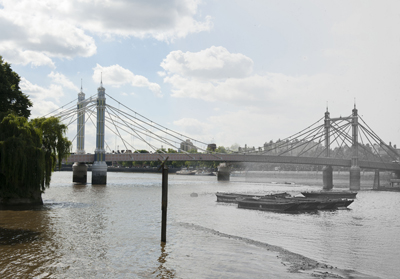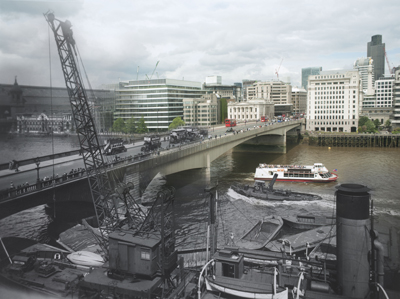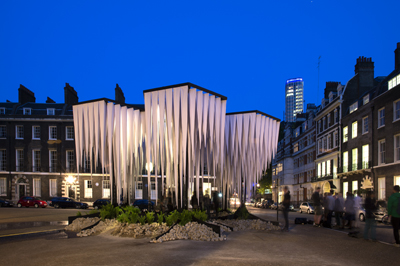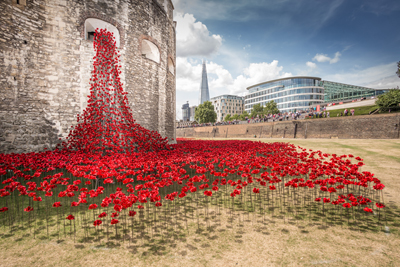
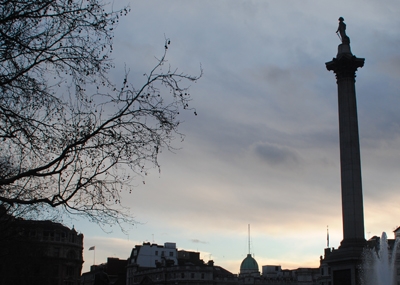
Nelson stands atop his column in Trafalgar Square, watching as a city falls into slumber…
PICTURE: David Adams
Crowds lined the banks of The Thames last weekend as Her Majesty’s Watermen rowed from Hampton Court Palace to the Tower of London in the annual “Tudor Pull”. The palace-to-palace rowing event on Sunday kicked off around 10am with a ceremony at Hampton Court during which the ‘Stela’ – an ancient piece of medieval water pipe made from a hollowed-out tree trunk which symbolises the power of The Thames – is passed to the watermen who then took it up river to the Tower in the royal barge Gloriana. The barge, which was accompanied by a fleet of other traditional rowing craft, stopped at several locations along the journey, before it arrived at the Tower in Sunday afternoon where the ‘Stela’ was presented to the Governor. The event is also said to commemorate the sinking in 1256 of Queen Eleanor’s royal barge under old London Bridge. For more on the Historic Royal Palaces in London, head to www.hrp.org.uk.
PICTURE: Courtesy of Historic Royal Palaces.
Our new special series will kick off next week!
Time is running out for your entry into Cakespeare – the V&A’s competition to find the best Shakespeare-themed cake as part of the institution’s celebration of the 450th anniversary of William Shakespeare’s birth. The competition, which closes on 4th May, was launched earlier this month with an almost 15 kilogram cake created by Jane Asher Party Cakes (actress Jane Asher and the cake are pictured). A fruitcake, it features the playwright at work with a writing table and feature quill made from icing while a scroll lists the 36 plays in Shakespeare’s First Folio (which is on show in the V&A’s Theatre and Performance Galleries). To enter the competition, design, bake and decorate your cake celebrating Shakespeare and then upload an image of it to social media, tagged #Cakespeare. Oh, and the winner – selected by Asher and Geoff Marsh, director or the V&A’s department of theatre and performance – will receive a weekend for two in Stratford-upon-Avon complete with tickets to see the Royal Shakespeare Company. The V&A’s Shakespeare Festival runs until 4th May. For more, see www.vam.ac.uk. So enjoy your Shakespeare – and your cake…might be a way to take your mind off London’s transport woes! PICTURE: Victoria and Albert Museum, London.
In contrast to the colourless smog which has lain over London, Scottish artist David Batchelor’s sculpture, Chromolocomotion, brings a splash of colour to the Grand Terrace at St Pancras International. Unveiled this week, the 20 by 10 metre work consists of 44 L-shaped pieces of coloured perspex suspended from the Grade I-listed roof of the Barlow Shed. It replaces Lucy and Jorge Orta’s Cloud: Meteoros and is the second installation commissioned by St Pancras International’s owners HS1 Ltd as part of the Terrace Wires initiative. The work will remain in place until late September. For more on the initiative, see www.terracewires.co.uk. PICTURE: HS1 Ltd.
This year marks the 300th anniversary of the Hanoverian accession and to celebrate, Historic Royal Palaces are running a range of events at Hampton Court, Kensington and Kew Palaces. The ‘Glorious Georges’ season opens on Easter weekend – we’ll be bringing more details closer to the time.In the meantime, see which of the Georges and associated figures you can identify in this image. For more, check out www.hrp.org.uk.
A website launched last year – Britain from Above – boasts some unique perspectives on London among its more than 61,000 images including this one above of the South Bank site of the Festival of Britain – a national exhibition held at various venues across Britain as a post-war “tonic” for the nation – under construction, taken on 14th August, 1950. The website features images taken as part of a collection of aerial photographs taken between 1919 and 1953 by pioneering air survey company Aerofilms Ltd. It has been created by English Heritage, the Royal Commission on the Ancient and Historical Monuments of Scotland and the Royal Commission on the Ancient and Historical Monuments of Wales following their joint purchase of the company’s collection of more than 1.26 million negatives and 2000 photo albums and forms part of a four year project which aims to conserve and digitise some 95,000 of the oldest and most valuable photographs in the collection. Under the project, the general public is invited to share and record their knowledge and memories of the photographs featured. To get involved, head to www.britainfromabove.org.uk. Below can be seen an image of the FA Cup Final being played between Sheffield Wednesday and West Bromwich Albion (Sheffield were 4-2 victors) at Wembley Stadium on 27th April, 1935. PICTURES: © English Heritage. Aerofilms Collection EAW031792/© English Heritage. Aerofilms Collection EPW046905.
Once making chocolate for kings including William III, George I and George II, a special royal chocolate-making kitchen has opened at Hampton Court Palace – the only surviving example of its kind in the country. The opening – which is part of Historic Royal Palaces’ celebration of the 300th anniversary of the Hanoverian accession – comes after research identified the exact location of the kitchen which, having been used as a storeroom, was found in a “remarkably well preserved” state with original fittings such as the stove and furniture intact. Among those known to have worked in the kitchen is Thomas Tosier (pictured above), personal chocolatier to King George I, and it was in here he prepared special chocolate drinks. (Interestingly, Tosier’s wife Grace apparently traded on her husband’s royal association to promote her own chocolate house in Greenwich). A new display in the kitchen explores how the chocolate was made for the king and features copper cooking equipment and bespoke chocolate serving silverware, glassware and linens from the 18th century. The Royal Chocolate Kitchen will also play host to live Georgian chocolate making sessions. PICTURE: © Historic Royal Palaces/Richard Lea Hair.
WHERE: Hampton Court Palace, East Molesey, Surrey (nearest station is Hampton Court from Waterloo); WHEN: 10am to 4.30pm until 29th March after which it’s open to 6pm); COST: Adult £18.20, Concession £15.40, Child under 16 £9.10 (under fives free), family tickets, garden only tickets and online booking discounts available; WEBSITE:www.hrp.org.uk/HamptonCourtPalace/.
The Brompton Road tube station, which closed in 1934 after being made redundant following the opening of other stations, sold for a reported £53 million over the weekend. The former Piccadilly Line station, located between South Kensington and Knightsbridge stations, opened in 1906 and was designed by architect Leslie Green for the Great Northern, Piccadilly and Brompton Railway. It was used as a command centre for anti-aircraft guns during World War II and the story goes was where Nazi Rudolf Hess was interrogated after being captured in 1941. Owned up until the sale by the Ministry of Defence, it was most recently used as a training centre for air cadets and naval reservists. It will reportedly be converted into residential flats.
Colourful terraced homes located in Bywater Street, a pretty cul-de-sac just off King’s Road, in Chelsea. Incidentally, number 9, was the fictional home of spy George Smiley in John le Carré’s Tinker Tailor Soldier Spy. Number 10 as used as the home in the BBC TV series of the same name dating from 1979.
Following on from its LEGO advent calendar and Christmas tree, Covent Garden is home to a giant LEGO snow globe this Christmas. Made of 120,000 bricks, it features 14 of London’s most iconic landmarks – from Nelson’s Column, Buckingham Palace (see below) and the London Eye to The Shard, Shakespeare’s Globe and, of course, Covent Garden. The models took Duncan Titmarsh, the UK’s only certified LEGO professional, around 75 days to build. Hidden among the models are a number of LEGO Santas – count them to win prizes and press a button to make snow fall inside the globe. For more, see www.coventgardenlondonuk.com.
A bust of the anti-apartheid activist and global icon Nelson Mandela at the South Bank Centre has become one of several places in London where people are paying their respects to the former South African president and Noble Peace Prize winner who died last Thursday at the age of 95. The bust – below which are a quoted Mandela’s words, “The struggle is my life” – was erected in 1985 by the Greater London Council. A full-length, larger-than-life statue of Mandela, by Ian Walters, stands in Parliament Square in Whitehall – it was unveiled in 2007 by then Prime Minister Gordon Brown with Mandela himself in attendance.
In a reminder of the summer’s past, here’s an image of Londoners enjoying the sun in the shadow of London’s Eye. The EDF Energy London Eye this year officially welcomed its 50 millionth visitor, some 13 years after the 135 metre high wheel first commenced operation. It was originally anticipated the Eye would only exist for five years but such has been its success that it’s been granted lifelong permission to remain at its South Bank site. For more on the Eye, check out www.londoneye.com.
The Royal Tank Regiment Memorial in Whitehall is among the many war memorials in London – poignant reminders of what the nation stopped to remember on Remembrance Sunday. The work of Vivien Mallock, this particular memorial was unveiled on the corner of Whitehall Court and Whitehall Place by Queen Elizabeth II in June, 2000. The memorial shows the crew of a World War II Comet tank including a commander, loader, gunner, hull machine gunner and driver. For more on the regiment, see www.royaltankregiment.com.
Joey, the puppet horse used in the West End play War Horse, has taken up a new home at the V&A in South Kensington. Created by the Handspring Puppet Company for the National Theatre’s adaption of Michael Morpurgo’s novel, Joey appeared in more than 1,640 shows since his debut at the New London Theatre on 28th March, 2009. He will now be housed in the V&A’s Theatre and Performance Gallery in a specially created display which shows how the puppet was operated on stage and features three mannequin puppeteers to illustrate the process. Joey was donated by Adrian Kohler and Basil Jones of South Africa’s Handspring Puppet Company who designed and created the puppets used in War Horse. War Horse, which continues its run at the New London Theatre, has been seen by more than four million people. For more, see www.vam.ac.uk. PICTURE: Joey at the V&A operated by Nicholas Hart (Head), Stuart Angell (Heart), Thomas Goodridge (Hind). © Victoria and Albert Museum, London.
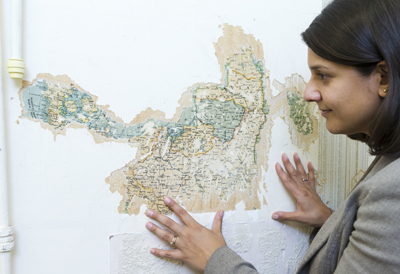
A map of the Romney plantation is among a selection of unseen documents from a West Indian sugar plantation on show as part of a new display, A Material Connection, which opened at the Museum of London Docklands in August. The documents are just some of the 1,000 letters, invoices and deeds dating from between the 1740s and 1860s which make up the Romney family plantation archive. It is the first time the public have a chance to see documents from the archive which was purchased by the museum in 2011 using an £85,000 grant from the Heritage Lottery Fund. The display explores the role London played as a nexus between Britain and its slave colonies and in particular the relationship between a specific slave plantation and its owner. Opened on the International Day for the Remembrance of the Slave Trade and of its Abolition (23rd August), the display forms part of the London, Sugar & Slavery exhibition at the museum. For more, check out the Museum of London Docklands.
PICTURE: Museum of London Docklands.
View of the top of the Monument from the top of St Paul’s Cathedral. For more on the history of The Monument, see our earlier post here.
Designed by Pritzker Prize winning architect Zada Hadid, the new Serpentine Sackler Gallery opened to the public in Kensington Gardens on Saturday. Located just a few minutes walk from the Serpentine Gallery on the north side of the Serpentine Bridge, the 900 square metre premises is partly located in a renovated Grade II*-listed building, The Magazine (built in 1805 as a gunpowder store and used by the military until 1963), as well as in a curvaceous modern extension to the north and west. The new gallery, which also features a ‘social space’ and restaurant, is named after Dr Mortimer and Dame Theresa Sackler, whose foundation provided the largest donation for the project – the largest single gift donated to the Serpentine Gallery in its 43-year history. The opening exhibition, Today We Reboot The Planet, features the large scale sculptural work of Argentinian artist Adrián Villar Rojas. The exhibition runs until 10th November. For more, see www.serpentinegallery.org. PICTURES: Serpentine Sackler Gallery, © 2013 Luke Hayes