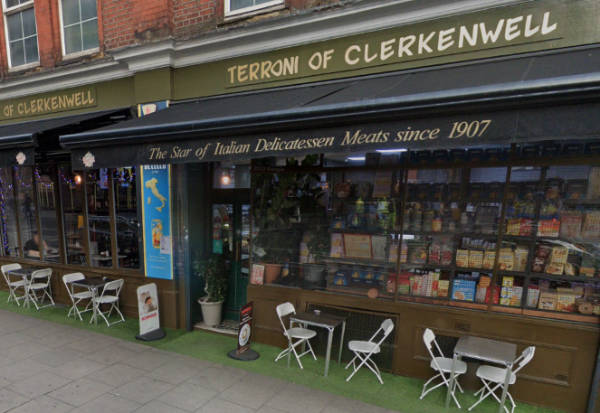
Terroni of Clerkenwell seen in December, 2021. PICTURE: Google Maps
Terroni of Clerkenwell, which opened in 1878, is said to be London’s oldest Italian deli.
Located in the district known as Little Italy next to St Peter’s Italian Church, Terroni was opened by Luigi Terroni to supply Italians living in London with a taste of home.
The business at 138-140 Clerkenwell Road in Clerkenwell was sold to the Anessa family in 1983. It underwent renovation in the early Noughties which saw the deli double in size. A coffee bar was added in 2012.
The shop, located at 155 Brick Lane, is sometimes known as the ‘yellow shop’, thanks to its bright yellow sign, to distinguish it from the ‘white one’, another bagel bakery a few doors down, Beigel Bake.
Two brothers named David Barel and Aron Zelman took over the business, then known as the Evering Bakery, in 1987, and were, according to the shop’s website, joined by their sister Mazal White soon after.
The shop, which changed the spelling of bagel to beigel in its name in 2002 in reflection of its Yiddish roots, introduced a bagel-shaping machine in 1994 but many products are still hand-made. According to the website, the bakery these days makes more than 7,000 bagels a day.
The shop, which is famously open 24 hours a day, did briefly close for several months last year, explaining on social media when it reopened in June that the closure had been for a range of reasons including a long-standing family dispute over the building’s ownership and rents and the health struggles of Aron.
They announced that the next generation – including Aron’s 22-year-old quadruplets and Mazal’s three children – would be taking over the business and launched a funding raising effort to help with some of financial burdens the shop was facing.
Craven Cottage, home of Fulham FC on the bank of the River Thames in west London, is the city’s oldest football stadium.
Craven Cottage (with the Grade II-listed Johnny Haynes Stand on the left in 2021. PICTURE: Nick/Flickr (licensed under CC BY-NC-SA 2.0)/Image cropped
The site has been home to the club since 1896, having previously been based at a range of grounds. It took two years to prepare the ground for play including constructing a changing room building.
The first match was played at the ground on 10th October, 1896 (Fulham beat Minerva 4-0 in the Middlesex Senior Cup).
Initially the ground was surrounded with terracing only – this changed in 1903 when the first stand was built on the north side of the ground. Providing seating for 1,200 spectators, it was affectionately known as the ‘Rabbit Hutch’.
The stand didn’t last long. Just 18 months later, it was condemned as dangerous by municipal officials and had to be pulled down.
In January, 1905, it was reported that the club had gained a 99-year lease on the ground. Work on a new stand, 5,000-seat, started just four months later to be designed by Archibald Leitch with steelwork provided by Clyde Structural Iron Company. Known as the Stevenage Road Stand (with a brick facade on the road), it opened on 2nd September that year.
The Cottage Pavilion in 2018. PICTURE: Nick/Flickr (licensed under CC BY-NC-ND 2.0)/Image cropped
Leitch also designed the Cottage Pavillion, located at the south-east corner of the ground, which was used for change rooms and by the club’s administration.
In 1907, the club hosted the first full international match when, in March, 1907, England and Wales drew 1-1.
While the club regularly saw crowds of up to 40,000 in the lead-up to World War II, a record was set in 1938 at a game between Fulham and Millwall when the crowd numbered just shy of 50,000.
These days there are four stands: the Grade II-listed Johnny Haynes Stand on the east side of the ground (it was renamed in 2005 in honour of the club legend who also has a statue at the ground); the Riverside Stand on the west side (redeveloped in recent years); the Hammersmith End stand (located to the north of the ground, traditionally its home end); and, the Putney End stand (located at the south end).
The Cottage Pavilion, the balcony of which is from where player’s families have traditionally watched games, remains in the south-east corner.
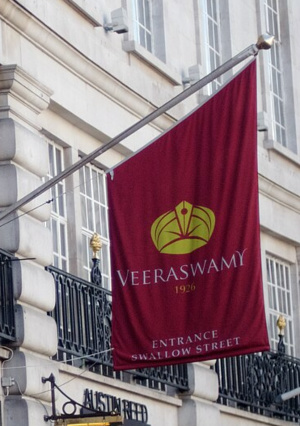
The restaurant was opened by Edward Palmer, the great-grandson of General William Palmer, who was secretary to Warren Hastings, the first Governor General of India and the Moghul Princess Faisan Nissa Begum.
It’s name is said to have come from his mother’s family and Palmer is said to have been greatly influenced by the princess in the creation of the menu.
The restaurant – located in Victory House and entered from Swallow Street – was taken over by the MP William Steward in 1934. He sold it in 1967 and the restaurant later passed through several hands.
The current owners – Namita Panjabi & Ranjit Mathrani of MW Eat – bought it in 1996. They have since modernised the menu and interiors.
Over the years, the restaurant has attracted a star-studded clientele which included royalty including Edward, Prince of Wales (later King Edward VIII), King Abdullah of Jordan, and the Maharajah of Cooch-Behar as well as Winston Churchill, actor Marlon Brando and Princess Anne.
In 2016, the restaurant was awarded a Michelin star.
The restaurant, which is located on the Crown Estate, is currently collecting signatures for a petition asking King Charles III to intercede with the Crown Commissioners, asking them to renew its lease after the commissioner served a notice to vacate. The matter is currently before the courts.
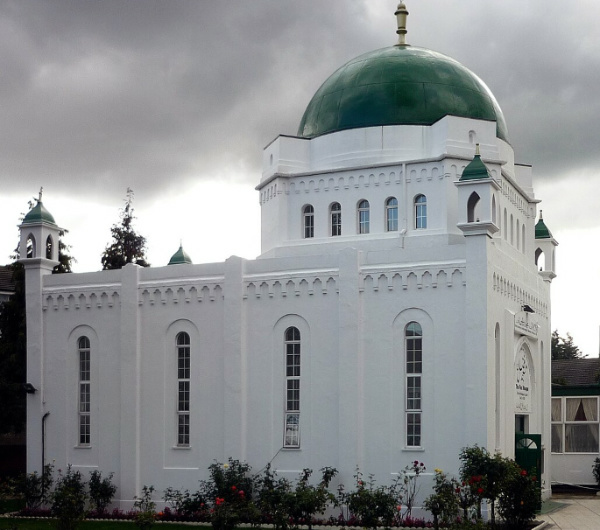
Known as the Fazl Mosque (Grace Mosque in English), the mosque – which is also known as the London Mosque and is the second oldest in Britain – is said to have cost some £6,223 and is understood to have been designed by TH Mawson and Sons.
Said to have been financed by the donations of Ahmadiyya community in India (the land had been purchased in 1920), the foundation stone was laid in 1924 by Mirza Bashir-ud-Din Mahmud Ahmad, the second Caliph of the Ahmadiyya and leader of the worldwide Ahmadiyya Muslim Community.
The Grade II-listed building was formally opened by Khan Bahadur Sheikh Abdul Qadir, an ex-minister of Punjab Legislative Council, on 4th October, 1926, with about 600 guests.
The mosque can accommodate about 150 people and the first Imam was Maulana Abdul Rahim Dard.
Visitors to the mosque have included King Saud of Saudi Arabia and the Crown Prince Faisal Bin Abdul-Aziz, who visited in 1935. In more recent times, Prince Edward, the Earl of Wessex, and Justin Welby, the Archbishop of Canterbury, have both visited the property.
The fourth caliph, Mirza Tahir Ahmad, lived in an apartment in a separate building on the premises, originally built for the mosque’s imam, after migrating from Pakistan where prohibitions were placed on the Ahmadis, banning them from any public expression of the Islamic faith.
It remained so until his death in 2003 after which the current caliph, Mirza Masroor Ahmad, lived there until relocating to the estate known as Islamabad in Tilford in 2019.
During this period between 1984 and 2019, the mosque at 16 Gressenhall Road served as the de facto headquarters of the Ahmadiyya Muslim Community worldwide.
It’s that time of year and while it seems less people are these days sending Christmas cards, there are many who still do.
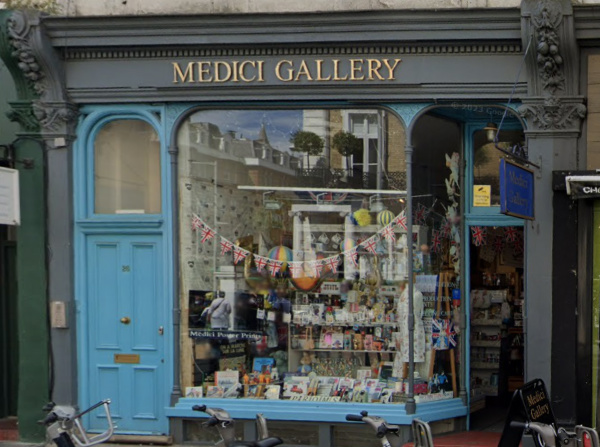
While we’ve previously written about the origins of greeting cards at Christmas (and who first sent them), today we’re taking a look at the oldest shop in which they’re still sold in London – often said to be the Medici Gallery in South Kensington.
The Medici Gallery in South Kensington: PICTURE: Google Maps
The gallery was opened by the Medici Society in 1908. This organisation had been founded by Philip Lee Warner and Eustace Gurney with the intention of promoting the work of artists to a wider audience. It initially operated on a subscription basis under which subscribers pay a set rate and then obtain copies of prints but later became a limited company.
The name Medici was said to have been chosen as a homage to the Medici family known for, among other things, the promotion of the arts in Florence during the Renaissance.
The gallery first started selling greeting cards in the 1930s and continues to do so today.
London is filled with bollards designed to prevent vehicles, old and new, from travelling where they shouldn’t. And, of course, there’s much debate over which is the oldest.
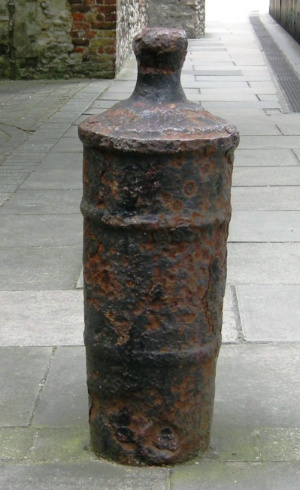
The oldest may well be a rather rusty looking one in the courtyard outside the Church of St Helen’s Bishopsgate.
In what was a practice replicated elsewhere in the City around the time, it’s apparently made out of the French naval cannon dating from the 18th century.
The cannon’s muzzle end has been embedded into the pavement with the non-loading end sticking up.
Legend says that another cannon bollard, located just outside the Globe Theatre on South Bank, comes from French ships captured at the Battle of Trafalgar. While it is indeed said to be a cannon, many have cast doubt on its origins as coming from Trafalgar.
Correction: We’ve correct the story to say it was the non-loading end stickingup.
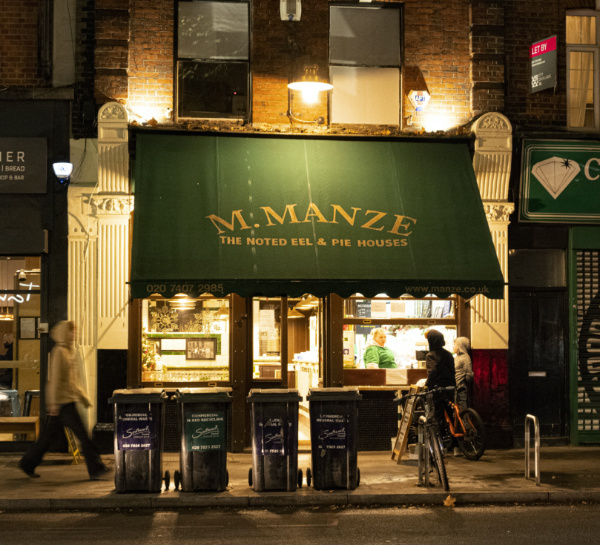
The shop was opened in 1902 by Michele Manze, who was born in Ravello, southern Italy, and has been serving their pies and mash with green liquor (a parsley sauce) and eels ever since.
Manze had arrived in London with his family when just three-years-old and settling in Bermondsey, south of the Thames, has started what was originally an ice supply business which soon started selling ice-cream. But Michele branched out into the pie and mash business.
The first shop under his name was at 87 Tower Bridge Road. It was established by Robert Cooke (of a famed family of pie and mash purveyors) in 1891 and Manze took over soon after his marriage to Cooke’s widowed daughter, Ada Poole.
Manze opened a second in Southwark Park Road in 1908. Three further shops followed – two in Poplar which were destroyed in World War II – one at Peckham High Street in 1927.
Several of his brothers including Luigi, meanwhile, opened their own pie and mash shops and so it’s said there were 14 pie, mash and eel shops bearing the Manze name by 1930.
That number has since been whittled down for various reasons and there are today there are three M Manze pie and mash shops – the Tower Bridge Road and Peckham establishments and a third which was opened in Sutton in 1998.
The Tower Bridge Road shop was damaged during World War II when the front of it was blown out.
Famous clientele have apparently included Roy Orbison, Rio Ferdinand and David Beckham and it even appeared in a music video of Elton John’s.
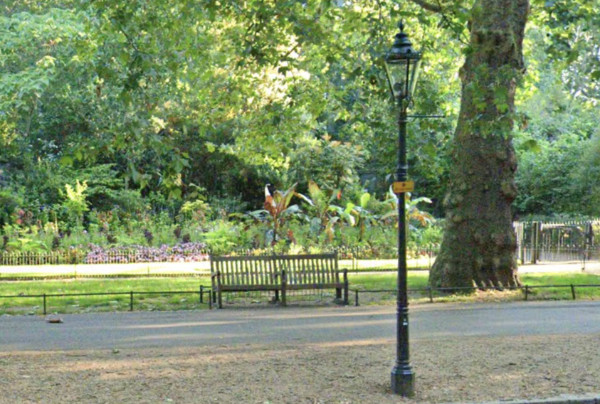
One of the George IV lamps in Birdcage Walk. PICTURE: Via Google Maps
There remain some 1,300 publicly maintained gas lamps still in use in London’s streets but the oldest surviving gas lamps can be found in Birdcage Walk (along the south side of St James’s Park).
These cast iron lamps bear the insignia of King George IV who ruled from 1820 to 1830. While lamps had been installed in London since the reign of King George III (the earliest permanent placement was on Westminster Bridge in 1813), these lamps were installed during his successor’s reign.
They are among numerous Grade II-listed lamp stands on Birdcage Walk (some others are marked with thee insignia of King William IV).
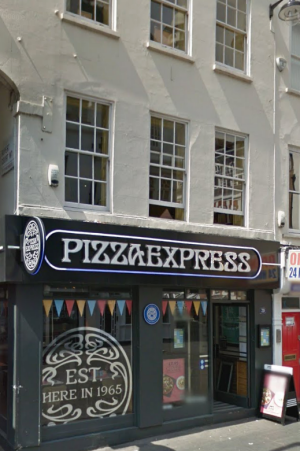
London’s first Pizza Express in Soho, taken prior to its closure in July, 2014. PICTURE: Google Maps.
While pizza had been available in London restaurants some time before, the first dedicated pizzeria is said to have been the first Pizza Express located in Wardour Street in Soho.
The premises on the corner of Rupert Court and Wardour Street was established by Peter Boizot, who has reportedly first discovered pizza while in Italy in the 1940s, and, having witnessed the appearance of pizzerias elsewhere in Europe, decided to bring the concept to London.
Opening its doors on 27th March, 1965, the establishment was modelled on Italian pizzerias. Boizot had partnered with Italian designer, Enzo Apicella, to create an authentic Italian experience which included an open kitchen, simple furnishings and a wine menu (he also brought in a pizza chef from Sicily).
While the concept apparently wasn’t an instant success, it soon did catch on and Pizza Express opened further branches across the city – the first in Coptic Street next to the British Museum in 1967.
Sadly the Wardour Street premises was among dozens that the chain closed during the coronavirus pandemic in 2020.
London’s oldest roundabout is said to be located in Southwark at the intersection of Borough, Westminster Bridge, Waterloo, London and Blackfriars Roads.
St George’s Circus was built in 1771 (during the reign of King George III) and designed by Robert Mylne as a grand southern entrance to London with radiating roads leading to three bridges over the Thames: London Bridge, Westminster Bridge and Blackfriars Bridge.
Mylne also designed the obelisk which still stands in the centre of the circus. As well as showing the date on which it was erected, the obelisk also records distances to Palace Yard in Westminster, Fleet Street, and London Bridge. Gas lamps were placed at each corner to illuminate the intersection.
The now Grade II*-listed obelisk has a rather interesting history in itself. Having stood at the roundabout for more than a century, in about 1897 it was relocated to Geraldine Mary Harmsworth Park outside the Imperial War Museum on Lambeth Road to make way for a clocktower designed to mark Queen Victoria’s Diamond Jubilee.
The clocktower itself, however, was removed in the 1930s to help with traffic flow. It wasn’t until 1998 that the obelisk was moved back to its original site (now minus the oil lamps).
Interestingly, an Act of Parliament passed in 1812 specifies that all buildings on the intersection must be located 240 feet from the obelisk (the reason, apparently, for curved facades on some of the surrounding buildings).
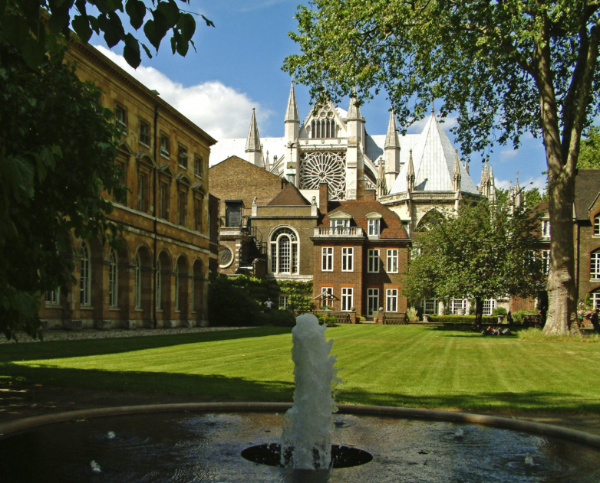
The College Garden. PICTURE: Anguskirk/Flickr (licensed under CC BY-NC-ND 2.0)
Not to be confused with London’s oldest botanic garden (The Chelsea Physic Garden), the College Garden at Westminster Abbey is believed to be the oldest garden in England under continuous cultivation.
In monastic times, the garden, as well as providing eye-pleasing flower displays, was used to grow vegetables and medicinal herbs for the abbey’s resident monks and it also included an orchard, as well as fishponds and beehives. The first herbarium dates from at least 1306 although the infirmary garden was originally established in the 11th century..
The garden was under the overall supervision of the abbey’s Infirmer – responsible for caring for the sick or infirm – and was tended to by a head gardener and two under-gardeners (all of whom were monks).
The oldest surviving feature of the garden today is a high stone wall which dates from 1376. Today the garden features London plane trees planted in the 1850s and a broad expanse of lawn.
There is also a small rose garden which marks Queen Elizabeth II’s accession to the throne and a herb garden planted to commemorate the lives of the monks and the founding of the Westminster School.
A 1993 bronze sculpture depicting the Crucifixion of Jesus Christ, by Enzo Plazzotta, sits out the south end of the garden. A single jet fountain was added in 2002.
The west side of the garden is bordered by the 18th century dormitory for the Westminster School. Two late Victorian houses, originally used for clergy, stand at the north end.
The garden is accessed from the south-east corner of the abbey cloister.
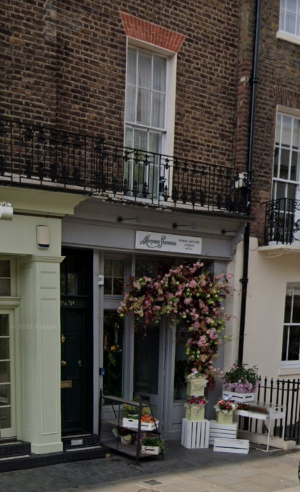
Moyses Stevens premises at 53 Elizabeth Street in Belgravia. PICTURE: Google Maps
While flowers have been sold in London for centuries, the oldest surviving family florist is said to be Moyses Stevens.
The original shop was opened by Miss Moyses (who became Mrs Stevens) in Victoria Street, Belgravia. It was extended in the 1930s and a branch in Berkeley Square, Mayfair, followed in 1936.
The firm, a regular at the Chelsea Flower Show, held the royal warrant for Queen Elizabeth The Queen Mother and that for then-Prince Charles (we’re not clear on what this means now he’s King).
Known for their wedding arrangements, Moyses Stevens now operates out of locations across the city including one in the Selfridges Food Hall and, since 2019, a flower school in the former Battersea Power Station.
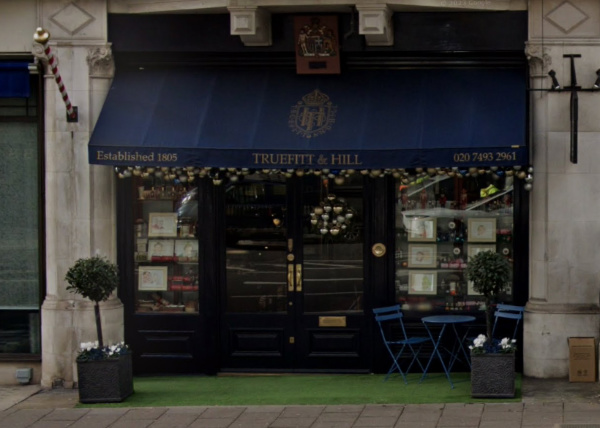
William Francis Truefitt, who styled himself as hairdresser to the British Royal Court, established his first barbershop at 2 Cross-Lane, Long Acre, on 21st October, 1805 – famously on the same day as the Battle of Trafalgar.
In 1811, he moved the business to 40 Old Bond Street. In 1935, Truefitt acquired Old Bond Street firm Edwin S Hill & Co – which had been established in 1911 – and the firm moved to its address at 23 Old Bond Street.
The company, which now has outlets around the world – received its first Royal Warrant – wigmaker – from King George III and also held a warrant from the late Prince Philip.
Royalty aside, customers at the shop have included everyone from Lawrence Olivier to Mahatma Gandhi, Frank Sinatra, John Wayne, David Niven, Oscar Wilde and Winston Churchill. The firm was also referenced by such literary luminaries as Charles Dickens and William Thackeray.
The firm moved to its current location at 71 St James’s Street in 1994.
Recently listed at Grade II by the Department of Culture, Media and Sport, a Barclays Bank in the northern London suburb of Enfield was the first in the world to be fitted with an automatic teller machine or ATM as we know them.
The prototype machine was devised by John Shepherd-Barron, managing director at banknote manufacturer De La Rue and required the customer to insert a special paper voucher punched with dots corresponding to their four digit PIN (the PIN featured four digits because Shepherd-Barron, who had initially proposed using six, heeded the words of wife after she told him she couldn’t recall more than four).
The bank, located at 20 The Town, was selected for a range of reasons, including that it has good pavement access, high windows and was close to Barclays head office.
The ATM was officially opened on 27th June, 1967, by Barclays deputy chairman Sir Thomas Bland while actor and comedian Reg Varney made the first £10 withdrawal.
The red brick bank where the machine was located was built in 1897 and designed by William Gilbee Scott in a style architectural historian Nikolaus Pevsner described as “exuberant Flemish Renaissance”.
Barclays celebrated the 50th anniversary of the installation in 2017 with the installation of a plaque and by turning one of the existing cash machines at the Enfield branch gold.
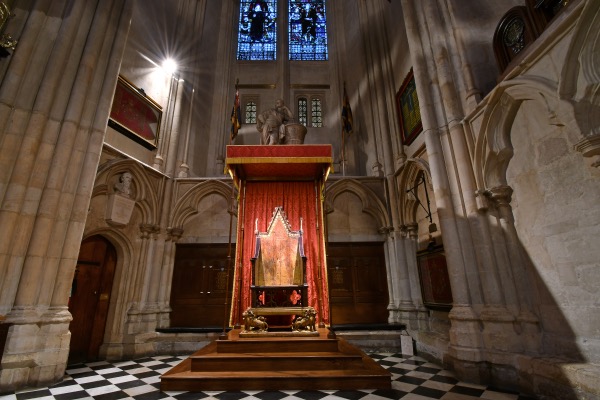
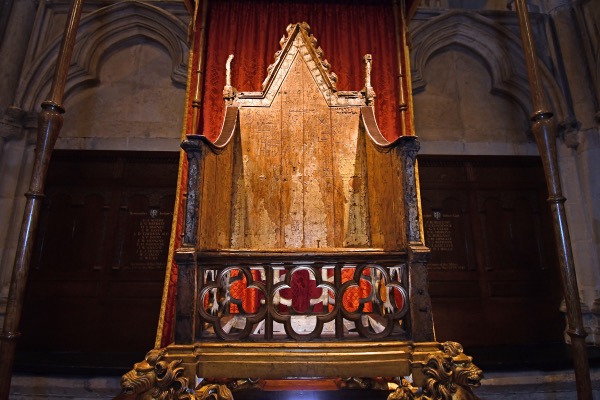
The Coronation Chair in Westminster Abbey PICTURE: Jim Dyson/Getty Images/Dean and Chapter of Westminster
The coronation of King Charles III is taking place in Westminster Abbey on 6th June and in preparation for that, the Coronation Chair is getting a makeover.
The six foot tall chair, which was made around 1300, is commonly referred to as the oldest piece of furniture in the UK which is still used for its original purpose and which is by a known maker.
The chair was constructed on the orders of King Edward I in 1300-1301 specifically to hold the Scone of Stone which he had brought south from Scotland several years before and which he had given into the care of the Abbot of Westminster.
Made of oak and painted by one Master Walter, the chair was decorated with patterns of birds, foliage and animals on a gilt background. On the seat back was painted the figure of a king, possibly King Edward I, with his feet resting on a lion. The chair, which would have had the appearance of being made of gold, would have also been decorated with coloured glass.
The space for the stone below the seat was originally fully enclosed and it’s believed the chair originally contained no seat with the King sitting on a cushion placed directly on the Stone of Scone.
The chair now rests on four gilt lions which were added in the 16th century (although those currently there are replacements made in 1727).
The Coronation Chair in Westminster Abbey PICTURE: Jim Dyson/Getty Images/Dean and Chapter of Westminster
While there is some debate over whether King Edward II was sitting in the chair when he was crowned in 1308, that has certainly been the case from the 1399 when King Henry IV was crowned while sitting on it. Twenty-six subsequent monarchs including everyone from King Henry VIII to Queen Elizabeth II followed suit (Oliver Cromwell, meanwhile, had the chair removed to Westminster Hall when installed there as Lord Protector).
The chair has been graffitied in earlier centuries thanks mostly to Westminster schoolboys and visitors. Among the most legible graffiti scrawled upon it is “P Abbott slept in this chair 5-6 July 1800”. It also suffered minor damage in a bomb attack in 1914 thought to have been carried out by Suffragettes (it didn’t suffer any damage in World War II thanks to its being removed to Gloucester Cathedral).
The Stone of Scone, which had been taken briefly back to Scotland by Scottish Nationalists in 1950, was formally returned to Scotland in 1996 where it can now be seen at Edinburgh Castle. It is being returned to London for the coronation.
The chair, which for centuries had been kept in the Chapel of St Edward the Confessor, was moved to the abbey’s ambulatory in 1998 and then again moved again in 2010, this time to a specially-built enclosure in St George’s Chapel, located at the west end of the nave, so it could undergo conservation work. The two year conservation program was completed in 2013.
The chair is currently undergoing cleaning and work to stabilise what’s left of the gilding ahead of the coronation.
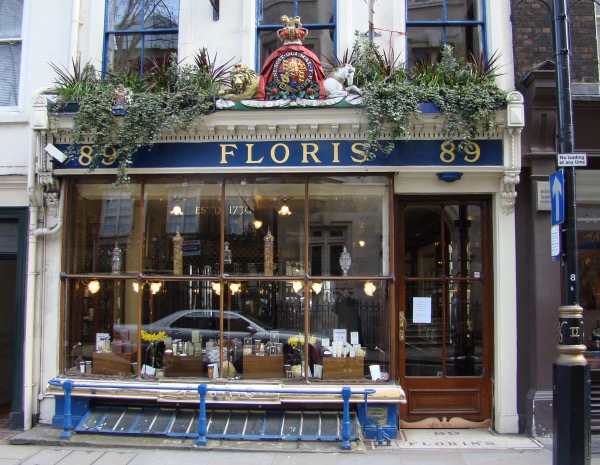
Not just said to be the oldest perfumer in London but in the UK, Floris London started life as a barber-shop and comb-maker in Jermyn Street, St James’s, by immigrant Juan Famenias Floris.
PICTURE: Sergey Moskalev (licensed under CC BY-SA 3.0)
Floris arrived in London in 1730, having travelled from the island of Menorca in the Balearic Islands which had become a British possession after it was captured in 1708 in the War of the Spanish Succession.
The story goes that Floris was missing the sweet scent of the flowers of his youth on the island and so he and his wife Elizabeth began creating and selling perfumes (and living in a premises above the shop).
Floris was granted his first Royal Warrant in 1820 soon after the accession of King George IV as ‘Smooth Pointed Comb Maker’ to His Majesty. It was to be the first of many.
Customers have included everyone from Admiral Lord Nelson (who kept a room Lady Emma Hamilton on the building’s third floor) and Florence Nightingale to Mary Shelley, Beau Brummell, Oscar Wilde, Winston Churchill, Marilyn Monroe and members of the Royal Family including the Duke and Duchess of Sussex, creating a bespoke fragrance for their wedding in 2016.
Writer Ian Fleming was also a customer – the No 89 Eau de Toilette was to become a favourite of James Bond. The company’s other pop culture references include a mention in the Al Pacino film, Scent of a Woman.
Still a privately owned family business, Floris is still run by Juan’s’ descendants today and the London store at 89 Jermyn Street, which was renovated in 2017, remains in the same building Floris first established his business. The current shop front was added in the early 19th century and over it sits the original coat-of-arms granted by King George IV.
Inside, the Spanish mahogany cabinets were purchased from the Great Exhibition held in Hyde Park in 1851. The four storey property, which these days features a small museum at the rear, is now Grade II-listed.
Floris opened a second store at 147 Ebury Street, Belgravia in 2012.
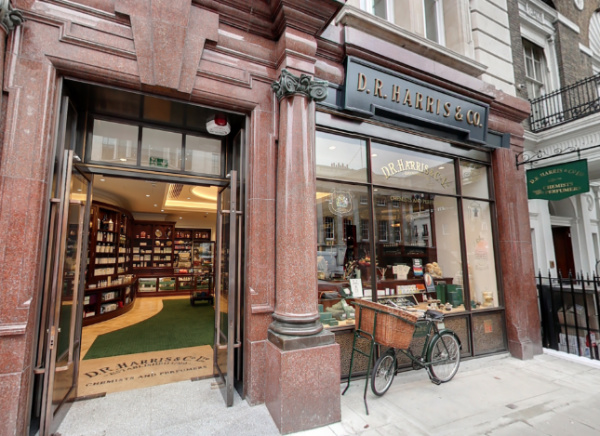
Founded as far back as 1790 and still serving customers today, DR Harris & Co Ltd is London’s oldest pharmacy.
The company, which specialises in “traditional gentleman’s grooming products” and these days also sells unisex haircare products, skincare products and soaps, first opened its doors when Henry Harris, a surgeon, set up shop at number 11 St James’s Street under the name of Harris’s Apothecary.
DR Harris and Co pictured in 2015. PICTURE: Courtesy of Google Maps.
The DR became part of the name when Harris’s cousin, Daniel Rotely, an early pharmaceutical chemist, joined the company and together they developed a range of luxury perfumes and remedies, becoming particularly known for their lavender water, colognes and English flower perfumes.
Located at the heart of what was known as “Clubland” thanks to the many gentlemen’s clubs once found in the surrounding streets, its clients quickly grew to include the gentry and the court of St James’s.
In 1938, the company was awarded the warrant as chemists to Queen Elizabeth, later the Queen Mother, an honour which it held until her death in 2002. In 2002, it was awarded the warrant as chemist for the Prince of Wales, and in 2012 was awarded the warrant as pharmacist and pharmacy suppliers to Queen Elizabeth II.
The company’s premises at what is now 29 St James’s Street was refurbished several years ago. For more, see www.drharris.co.uk.
There’s a couple of contenders for this title – the ferry service at Woolwich and that at Hampton.
Ferry services linking the north bank of the Thames at Woolwich North to the south bank at Woolwich have operated on the Thames since at least the 14th century.
The Woolwich Ferry’s northern terminal. PICTURE: Matt Buck (licensed under CC BY-SA 2.0)
While they were previously commercial operations, in 1889 a free passenger and vehicle ferry service started operation. By the early 1960s increasing demand saw the paddle steamers retired and the ferry service upgraded to a roll-on/roll-off model. The Woolwich Ferry service, which has been run by numerous authorities over the past century, is currently run by Transport for London.
Another contender for the title of London’s oldest (still operational) ferry service is the Hampton Ferry, a pedestrian service, which operates on the Thames about a mile west of Hampton Court Bridge between Hampton on the north bank and Hurst Park, Molesey, the south bank.
The ferry service, which was first used by fishermen and agricultural workers, dates back to 1514 and was incorporated by statute, making it one of the oldest British companies. The ferry, which costs £2 for a single crossing, operates seasonally from April to October.