Around London – The Lord Mayor’s Show goes on; London 2012 Festival launched; dowry tradition lives on; and, Leonardo da Vinci at the National Gallery…

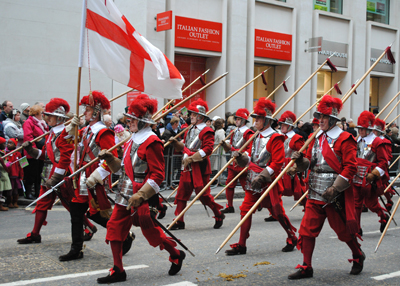
On Saturday the annual Lord Mayor’s Show will crawl its way across London’s Square Mile in a three mile long procession that will involve 123 floats and 6,200 people. The show (a scene from last year’s procession is pictured) is held each year as the first public outing of the newly elected Lord Mayor – this year it’s David Wootton, the City of London’s 684th Lord Mayor, who officially takes up his new office tomorrow (11th November). Organisers have said the procession will follow its usual route despite the protestors currently encamped outside St Paul’s. Leaving Mansion House, the official residence of the Lord Mayor, at 11am, it will make its way down Cheapside to St Paul’s Cathedral, where the new Lord Mayor will be blessed, before heading onto the Royal Courts of Justice, where the Lord Mayor swears an oath of allegiance to Queen Elizabeth II, and then returning to Mansion House. The the procession, the origins of which date back to 1215, will feature representatives of livery companies, educational and youth organisations, military units and other London-associated organisations and charities like St Bart’s Hospital. There will be a fireworks display at 5pm on the Thames between Blackfriars and Waterloo. For more information, see www.lordmayorshow.org.

• Organisers have unveiled plans for the London 2012 Festival, a 12 week nationwide cultural celebration of music, theatre, dance, art, literature, film and fashion held around next year’s Games. We’ll be providing more details in upcoming weeks and months but among the highlights in London will be a British Museum exhibition on the importance of Shakespeare as well as “pop-up” performances by actor Mark Rylance – both held as part of the World Shakespeare Festival, a musical tribute to the history of jazz at the Barbican by the London Symphony Orchestra and Jazz at the Lincoln Center Orchestra, an exhibition of the work of artist Damien Hirst at the Tate Modern and another on Yoko Ono at the Serpentine Gallery, and ‘Poetry Parnassus’ at the Southbank Centre – the largest poetry festival ever staged in the UK. The festival is the finale of the “Cultural Olympiad” – launched in 2008, it has featured a program of events inspired by the 2012 Olympics – and will see more than 10 million free events being held across the country. For more details, see www.london2012.com.

In a tradition which dates back to the late 1800s, three “poor, honest (and) young” women have been awarded a dowry by the City of London Corporation. Susan Renner-Eggleston, Elizabeth Skilton, and Jenny Furber have each received around £100 under the terms of a bequest Italian-born Pasquale Favale made to the City in 1882. Inspired by the happiness he found is his marriage to his London-born wife Eliza, Favale bequeathed 18,000 Lira to the City in 1882 and stipulated that each year a portion of the money was to be given to “three poor, honest, young women, natives of the City of London, aged 16 to 25 who had recently been or were about to be married”. To be eligible the women must have been born in the City of London or currently reside there.

• On Now: Leonardo da Vinci: Painter at the Court of Milan. Billed as the year’s blockbuster art event in London, this exhibition at the National Gallery focuses on Da Vinci’s time as a court painter in Milan in the 1480s-90s and features 60 paintings and drawings. Thanks to a collaboration between the National Gallery and the Louvre, they include two versions of the Virgin of the Rocks (it is the first time the two versions are being shown together). Other paintings include Portrait of a Musician, Saint Jerome, The Lady with an Ermine (an image of Cecilia Gallerani, mistress of Milan’s ruler at the time – Ludovico Maria Sforza, ‘Il Moro’) and Belle Ferronniere as well as a copy of Da Vinci’s painting, The Last Supper, by his pupil Giamopietrino. Runs until 5th February and an admission charge applies. For more, see www.nationalgallery.org.uk.

Around London: Taking to the skies over the Thames; a new plumber in Cannon Street; and, new images of war at IWM…

The proposed cable car crossing of the Thames will be sponsored by airline Emirates in a 10-year, £36 million deal announced last Friday. To be known as the ‘Emirates Air Line’, the cable car will link the DLR station Royal Victoria with the Jubilee Line station North Greenwich and will involve the creation of two new cable car stations bearing the sponsor’s name – Emirates Greenwich Peninsula on the south bank and Emirates Royal Docks on the north. It is the first time a corporate brand will appear on the Tube map. Transport for London has said the new service could be operational by summer 2012 (although whether it will be ready for the Olympics remains uncertain). It will feature 34 cable car gondolas and ferry as many as 2,500 passengers across the river every hour with an expected two million passengers to use the service each year. The journey is expected to take five minutes and will see the gondolas travelling at a height of 160 feet above the river. The sponsorship deal was announced by the Mayor of London, Boris Johnson, along with Tim Clark, president of Emirates Airline, and Mike Brown, managing director of London Underground and Rail.

• The Duke of Gloucester unveiled a new statue, called Plumber’s Apprentice, at Cannon Street Station last week to mark the 400th anniversary of the granting of a Royal Charter to London’s Worshipful Company of Plumbers. Sculpted by Martin Jennings (he also created the statue of British poet Sir John Betjeman that now stands in St Pancras Station), the seven foot tall bronze statue is said to underline the livery company’s ongoing commitment to train young plumbers. The company, which was formed in 1365, received its charter from King James I in 1611. From 1690, following the destruction of the company’s previous hall in the Great Fire of London, it was based in a building on the site of the railway station. In 1863, it was forced to again move when the hall was compulsorily purchased to make way for the railway. Also present at the unveiling were the Lord Mayor of London, Michael Bear, and the Lady Mayoress, herself a sculptress and liverymen of the Worshipful Company of Plumbers. For more, see www.plumberscompany.org.uk.

• On now: Shaped by War: Photographs by Don McCullin. The Imperial War Museum is hosting the largest ever exhibition of the life and works of acclaimed photographer Don McCullin. The display features some 250 photographs including rarely seen before portraits of anonymous victims of war, contact sheets, objects, magazine and personal memorabilia. Conflicts covered include those of the Cold War, in places like Vietnam and Cambodia, Bangladesh and the Middle East – the latter include images from the Gulf War and the 20o3 invasion of Iraq. There is also a newly commissioned video in which McCullin talks about the exhibition. Runs until 15th April, 2012. An admission charge applies. For more, see www.iwm.org.uk.

LondonLife – New Sheriffs in the City…

The two new sheriffs of the City of London – Alderman Alan Yarrow and Wendy Mead CC (pictured here second and fourth from left with Lord Mayor Michael Bear between them) – were admitted into office in a ceremony at Guildhall last week following their election in June by the City livery companies. The office of sheriff dates back to the Middle Ages and, until the institution of the mayoralty in 1189, sheriffs or ‘shire reeves’ were charged with governing the city as the king’s representatives, collecting royal revenues and enforcing royal justice. The role now includes ensuring the smooth running of the Central Criminal Court (housed at the Old Bailey), attending the Lord Mayor as he carries out his official duties and presenting petitions from the City to Parliament at the Bar at the House of Commons. Meanwhile, the City of London announced on Monday that Alderman David Wootton, himself a former sheriff (as all Lord Mayors must be) as well as a past master of of the Worshipful Company of Fletchers and of the Worshipful Company of Solicitors, has been elected the 684th Lord Mayor of the City of London. He takes office on Friday, 11th November (the Lord Mayor’s Show takes place the following day). For more, see www.cityoflondon.gov.uk.

PICTURE: Courtesy of City of London Corporation.

10 small (and fascinating) museums in London…8. The Geffrye Museum

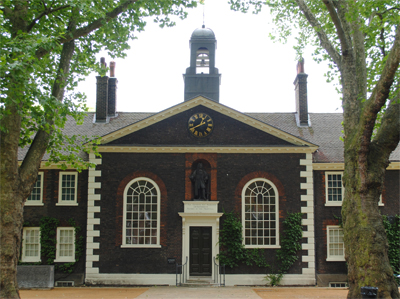
We have mentioned this museum before, but it’s well worth doing so again (particularly for those who may have missed the first entry). Located in former almhouses in Shoreditch, the Geffrye Museum is a survey of house interiors from the 17th century through to modern times.

Featuring 11 reconstructed period interiors created using authentic furnishings, it tells the story of the city through its residents’ homes (albeit largely wealthy ones) and includes a look at a hall in 1630, a parlour in 1790, a drawing room in 1870 and a loft conversion dating from 1998. There’s an audio guide which provides details on each room and information panels as you go along (and if you can’t get there but want to have a look, the website gives a detailed look at each room with notes on select furnishings).

The almshouses in which the museum resides (it runs along the rear wing of a U-shaped courtyard and takes in the chapel) were built in the early 1700s by the Company of Ironmongers after it received a bequest from Sir Robert Geffrye, a former twice-master of the company and a former Lord Mayor of London (his statue adorns the front of the chapel and faces out into the courtyard, itself a quiet oasis in busy Shoreditch).

These were used until early in the 20th century when the company decided to relocate the remaining pensioners. But the buildings have been preserved and it is possible to visit a former almshouse which has been restored and opened as a museum with displays on what life was like for the pensioners. Meanwhile, at the rear of the museum is a walled herb garden filled with herbs and a series of ‘period garden rooms’ ranging from the 17th to 20th centuries.

There’s also a restaurant and shop onsite (housed in a new extension opened in 1998).

WHERE: 136 Kingsland Road, Shoreditch. Nearest tube is Liverpool Street or Old Street (a fair walk) or Hoxton Overground Station (next door); WHEN: Tuesdays to Saturdays, 10am-5pm or Sundays and Bank Holidays, 12-5pm (gardens open until 31st October); COST: Free (admission to almhouses £2.50 at set times on select days); WEBSITE: www.geffrye-museum.org.uk


Famous Londoners – Sir William Walworth

Twice Lord Mayor of London, Sir William Walworth is best remembered as the man who killed the leader of the Peasant’s Revolt, Wat Tyler.

Believed to have been born in the first half of the 14th century to a couple in Durham, Walworth at some point moved to London where he was apprenticed to the leading fishmonger John Lovekyn (he was also one of London’s biggest exporters of wool).

In 1368, following Lovekyn’s death, Walworth replaced Lovekyn as the alderman of Bridge Ward. Two years later, in 1370, he was elected sheriff and the following year he became an MP (by this stage, he was also already a major lender of money to the crown). Walworth was first elected as mayor in 1374, elected again as an MP in 1377, and again as mayor in 1380.

It was on 13th June, 1381, Walworth, still London’s mayor, led the defence of London Bridge against Wat Tyler and the rebels. He was later with the king, Richard II, when he subsequently met with Tyler and others at Smithfield. During that encounter Walworth stabbed Tyler and later had him beheaded. The reason for Walworth’s stabbing of Tyler remains unclear.

Walworth was knighted on the field for his efforts in defending the king during the rebellion and was later involved in restoring the peace in London and in the counties of Kent and Middlesex.

Sir William did marry but he and his wife Margaret, who died in 1394, had no children. Following his death in 1386 at his house in Thames Street (later the Fishmonger’s Hall), he was buried at the church of St Michael, Crooked Lane, to which he had already made some substantial donations.

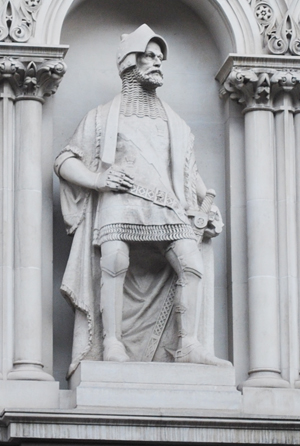
He subsequently became a hero in popular story-telling and in 1592 was included in Richard Johnson’s book Nine Worthies of London. A wooden statue of him was placed at the Fishmonger’s Hall in 1685. There is a much later statue of Sir William on the Holborn Viaduct (pictured).

This article has been updated.

Treasures of London – Admiral Lord Nelson’s coat

It was roughly two hours into the Battle of Trafalgar on 21st October, 1805, about 1.15pm, that Great Britain’s most famous seaman, Admiral Horatio Lord Nelson, was fatally struck by a musket ball.

Fired by a marksmen in the rigging of the French ship Redoubtable, the musket ball struck him in the left shoulder as he stood on the deck of his flagship, HMS Victory.

Having fallen to his knees, he was spotted by the Victory‘s captain, Thomas Hardy, before he collapsed. Carried below the decks to the ship’s cockpit, it was there that he died (the Victory can still be visited at Portsmouth).

His damaged coat, meanwhile, was placed under the head of Midshipman George Augustus Westphal, who was being treated for his injuries nearby. Blood from the midshipman (late himself an admiral) stuck his hair to one of the epaulettes, part of which was was cut away and retained by his family as a memento.

The “undress jacket” was later returned to Nelson’s mistress, Emma Lady Hamilton, in accordance with his wishes. She later gave it to Joshua Jonathan Smith, Lord Mayor of London in 1810-1811, to as payment of a debt just prior to retiring to France in 1814. It was Prince Albert, the consort of Queen Victoria, who later purchased the coat for £150 from Smith’s widow and presented it to Greenwich Hospital in 1845.

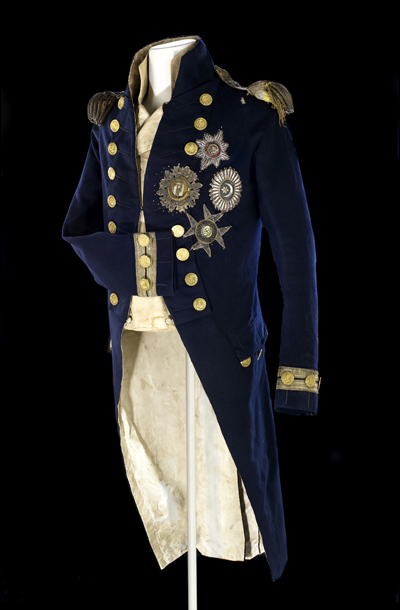
The jacket can now be found in the National Maritime Museum in Greenwich (housed in a section of the former Naval College). Along with the fatal musket ball hole on the left shoulder, the tails and left sleeve of the jacket are stained with the blood of John Scott, Nelson’s secretary, who had died in the early moments of the battle on the spot where Nelson was later shot. It’s also possible to see where the epaulette was damaged during the treatment of Midshipman Westphal.

The front of the coat also features embroidered versions of the four orders of chivalry awarded to Nelson – these are the star of the Order of the Bath, the Order of the Crescent awarded by the Sultan of Turkey, the Order of St Ferdinand and of Merit awarded by Ferdinand IV of Naples, and the German Order of St Joachim. According to the National Maritime Museum, “Nelson habitually wore them on all his uniform coats”.

The coat’s right sleeve is positioned as Nelson would have worn it – in 1797 he had lost his right arm at the Battle of Santa Cruz de Tenerife.

PICTURE: Vice-admiral’s undress coat worn by Nelson (1758-1805) at the Battle of Trafalgar. There is a bullet hole on the left shoulder, close to the epaulette. (c) National Maritime Museum, Greenwich, London, Greenwich Hospital Collection.

WHERE: National Maritime Museum, Romney Road, Greenwich, (nearest DLR station is Cutty Sark or Greenwich mainline station); WHEN: Open 10am to 5pm daily; COST: Free; WEBSITE: www.nmm.ac.uk.

Famous Londoners – Henry Fitz-Ailwyn

In the first of a series in Famous Londoners looking at past mayors of London, we profile the first person recorded as having that title, Henry Fitz-Ailwyn (also known as Henry Fitz-Ailwin). While his name might not be familiar to us today, it’s clear than in the 12th century, he was a personage to be reckoned with.

Believed to have been born in the 1130s or 40s, Fitz-Ailwyn is said to have been the son of a wealthy Londoner. Apparently involved in the cloth trade, possibly as a draper, he owned property in several counties and in what was Candlewick Street in London (now named Cannon Street).

Records show he was a London alderman in 1168 and later served as mayor, thanks apparently to the support of King Richard I (the dates are uncertain – some claim he took up the post in 1194 but the City of London Corporation records his tenure as 1189 to 1211).

Among his claims to fame are that he issued London’s first building regulations (concerning the need to build in stone) after a fire in 1212 destroyed parts of the city (although he apparently had no powers to enforce them).

Fitz-Ailwyn died the same year and is noted by the Museum of London as “the only mayor ever to serve in office for a full life term”.

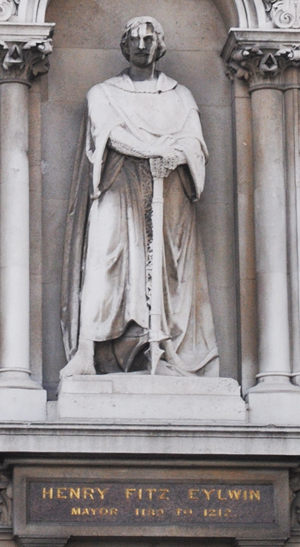
His name is commemorated in a window at the Guildhall and by a statue which stands on the exterior of one of the step buildings at Holborn Viaduct (pictured).

Famous Londoners – Sir Thomas Gresham

Remembered primarily for having founded the Royal Exchange as a centre for commerce in London and Gresham College, Sir Thomas Gresham was one of London’s leading merchants and financiers and an important advisor to successive monarchs during the sixteenth century.

Gresham was born in Milk Lane, London, to merchant Sir Richard Gresham (himself Lord Mayor of London in 1537-38) around 1518-19. He studied at Cambridge before being apprenticed to learn the family trade with his uncle, Sir John Gresham.

In 1543, he was admitted to the Mercers’ Company and subsequently spent time in the Low Countries, residing principally in Antwerp and acting as an agent for King Henry VIII. In 1544 he married Anne Fernley, widow of another London merchant. He also had a house in Lombard Street at this time.

Sir Thomas became an important advisor  to King Edward VI, helping him alleviate financial concerns, a role he continued to play during the successive reigns of Queen Mary I and Queen Elizabeth I (although he spent some time out of favor during Mary’s reign).

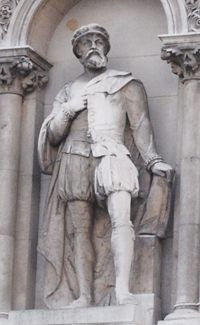
Knighted for his services to the crown in 1559, he proposed to built his ‘exchange’ in 1565, offering to pay for it himself if the City of London and Mercers’ Company provided the land. Modelled on the bourse in Antwerp with a trading floor and shops and offices set around a large central courtyard, it was officially awarded the title ‘royal’ by Queen Elizabeth I in 1571.

Sir Thomas died suddenly in 1579, apparently of a heart attack, and left the majority of his wealth to his widow but included clauses in his will stating that after her death rents from the Royal Exchange be used to create a college which would see seven professors offer free lecturers on subjects ranging from astronomy and geometry to rhetoric and divinity.

Known as Gresham College, it became the first institution of higher education in London when it was founded in 1597 and was initially based at Sir Thomas’ mansion in Bishopsgate (it’s now based in Barnard’s Inn Hall and, as it has for the past 400 years, still offers free public lectures).

In 1666, Sir Thomas’ Royal Exchange burnt down along with much of London but it was rebuilt immediately afterward (King Charles II laid the foundation stone of the new building) and rebuilt again following another fire in 1838 (at the time the building was largely occupied by two insurance companies, one of which was Lloyds of London).

It’s this third building, designed by Sir Thomas Tite to resemble the original plan, which stands on the site today. While trading has long since ceased there – it’s now a luxury-end shopping centre – Sir Thomas’s symbol, the gold ‘Gresham Grasshopper’, can still be seen on the weathervane. For more information on the Royal Exchange, see www.theroyalexchange.co.uk.


Famous Londoners: Richard ‘Dick’ Whittington

In the first in an occasional series on famous Londoners, we take a look at who Dick Whittington really was.

While he’s remembered by many today as a poor boy who made a fortune by cleverly trading his mice-catching cat, Richard Whittington was in fact born into a noble Gloucestershire family around 1350 and, after coming to London, rose in power and influence to become a four time Mayor of London who, after his death, set a new standard in philanthropy.

Sir Richard was born in the 1350s as the youngest son of Sir William Whittington, Lord of the Manor of Pauntley. As the second son, he was not able to inherit and so left home when his father died to seek work in London. There he served as an apprentice, before becoming a mercer (a dealer in costly fabrics) and subsequently became a supplier of valuable materials like silks and cloth of gold to King Richard II and later King Henry IV as well as other members of court.

Growing in wealth and influence (as well as dealing in cloth, he lent considerable sums to both kings and as a result was granted part of the wool tax collected at various ports), Whittington became a city alderman in 1393 and was chosen by the king as mayor in 1397 when the incumbent, Adam Bamme, died. He was subsequently re-elected in 1398, again in 1406, and in 1419.

Whittington died in 1423 and, as he and his wife Alice (who had died before him) had no children, he left his substantial fortune – estimated at some £5,000 – to charity. The money was used to establish almshouses (entrusted to the care of the Mercer’s Company, of which Sir Richard was master three times), as well as libraries and other public works including rebuilding Newgate Gaol and building a public lavatory known as ‘Whittington’s longhouse’. The Charity of Sir Richard Whittington is still operational. It’s undoubtedly his charity which touched so many Londoners which led to his fame.

While many versions of Whittington’s life have been told since the first recorded retellings in the late 16th and early 17th century, the story as we generally know it today (and one which has become a panto favorite) is that he was a poor boy from Gloucestershire who walked to London to seek his fortune and indeed found work there in the home of a rich merchant, Fitzwarren. He slept in the attic and kept a cat to keep down the numbers of mice.

Fitzwarren is said to have invited his servants to invest in a sailing voyage and as Dick had no money, he offered his cat, usually named ‘Tommy’, instead. Some time later he decided to leave London for his home and set out on foot but when on Highgate Hill on his way out, he heard the bells of London summoning him back, saying ‘Turn again, Whittington, three times Lord Mayor of London’. (Although Whittington actually served as mayor four times, the first two times were back-to-back, meaning some may have considered it as three).

So he did and returning to the merchant’s house, he found the ship had returned and that his cat had played a starring role in saving the court of the King of the Barbary Coast from being overrun with mice. The king apparently paid a large sum to buy the cat and Whittington became a wealthy man, marrying Fitzwarren’s daughter Alice and, as the bells prophesised, becoming ‘Lord Mayor of London’ (actually mayors at the time of the real Dick Whittington weren’t given the title Lord).

These days a statue of Whittington’s cat – the Whittington Stone (picture above) – still sits on Highgate Hill, marking the site where he apparently ‘turned again’ (among other references to Dick Whittington in London is the Dick Whittington ‘ale trail’ – a free downloadable pub guide).

As to whether he actually had a cat? While there’s apparently no evidence he did, it’s nice to think there was a real cat behind the myth (even if he didn’t rid the Kingdom of Barbary of its mice)!